
Photosynthesis Overview of Photosynthesis Process by which plants
Photosynthesis
Overview of Photosynthesis § Process by which plants and other autotrophs store the energy of sunlight into sugars. § Requires sunlight, water, and carbon dioxide. § Overall equation: 6 CO 2 + 6 H 20 C 6 H 12 O 6 + 6 O 2 § Occurs in the leaves of plants in organelles called chloroplasts.
Overall Equation § 6 CO 2 + 6 H 2 O C 6 H 12 O 6 + 6 O 2 § Carbon dioxide + water (in the presence of light) yields glucose + oxygen § Plants use the sugars to produce complex carbohydrates (starches) § CO 2 comes from the air or water in which they grow
Light and Pigments § Photosynthesis requires light and chlorophyll (a molecules in chloroplasts) § Energy from the sun travels to Earth in the form of light § Sunlight is perceived as “white” light but is actually a mixture of different wavelengths of light § These different wavelengths are known as the visible spectrum: ROY G BIV
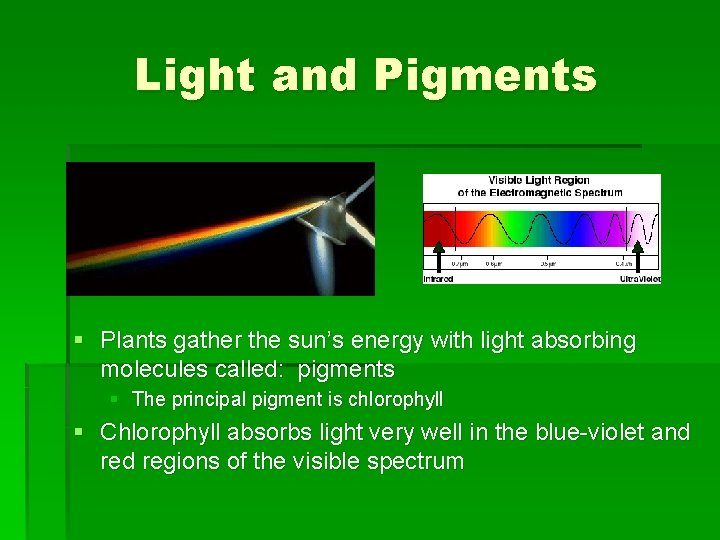
Light and Pigments § Plants gather the sun’s energy with light absorbing molecules called: pigments § The principal pigment is chlorophyll § Chlorophyll absorbs light very well in the blue-violet and regions of the visible spectrum
Light and Pigments § Green is reflected by leaves § Also contain red and orange pigments such as carotene that absorb light in other regions of the spectrum § Light is a form of energy § Since chlorophyll absorbs light it absorbs energy § Energy is transferred directly to electrons in the chlorophyll molecule which raises the energy levels of the electrons § The high energy electrons make photosynthesis work
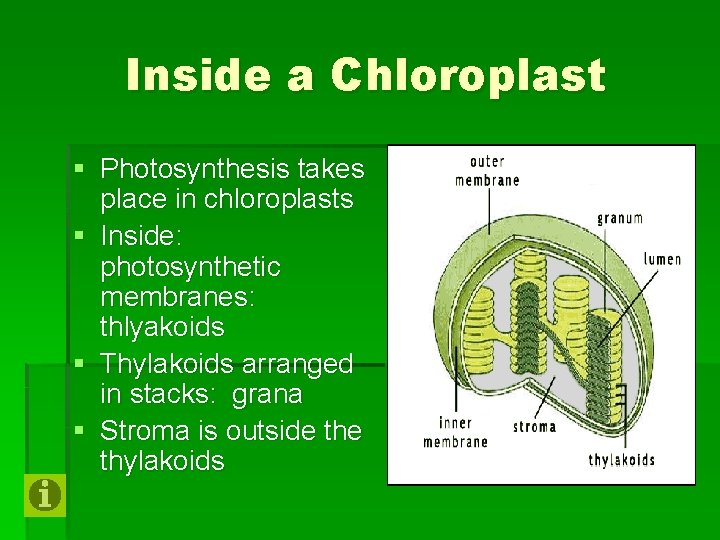
Inside a Chloroplast § Photosynthesis takes place in chloroplasts § Inside: photosynthetic membranes: thlyakoids § Thylakoids arranged in stacks: grana § Stroma is outside thylakoids
Factors Affecting Photosynthesis § Availability of water § Water is one of the raw materials § Shortage of water can slow or even stop photosynthesis § Plants that live in dry conditions (desert plants and conifers) have a waxy coating on their leaves that reduces water loss
Factors Affecting Photosynthesis § Temperature § Photosynthesis depends on enzymes that function best between 0º to 35º C § Temperatures above or below may damage the enzymes, slowing photosynthesis § Very low temperatures and photosynthesis may stop entirely
Factors Affecting Photosynthesis § Intensity of light § Increase light intensity and increase photosynthesis § After light intensity reaches a certain level, plant reaches a maximum rate of photosynthesis § Varies from plant to plant
Photosynthesis: The Chemical Process § Occurs in two main phases. § Light reactions § Dark reactions (aka – the Calvin Cycle) § Light reactions are the “photo” part of photosynthesis. Light is absorbed by pigments. § Dark reactions are the “synthesis” part of photosynthesis. Trapped energy from the sun is converted to the chemical energy of sugars.
Light Reactions § Light-dependent reactions occur on the thylakoid membranes. § Light and water are required for this process. § Energy storage molecules are formed. (ATP and NADPH) § Oxygen gas is made as a waste product.
Dark Reactions § Dark reactions (light-independent) occur in the stroma. § Carbon dioxide is “fixed” into the sugar glucose. § ATP and NADPH molecules created during the light reactions power the production of this glucose.
- Slides: 13