
Photosynthesis Life from Light and Air AP Biology
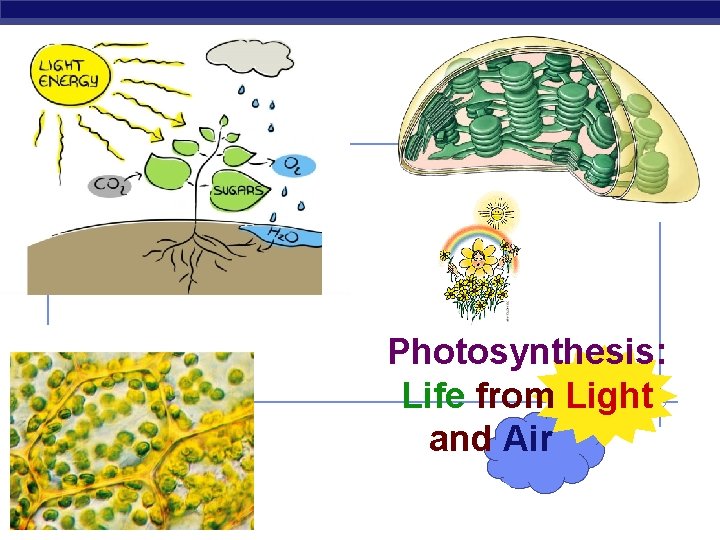
Photosynthesis: Life from Light and Air AP Biology
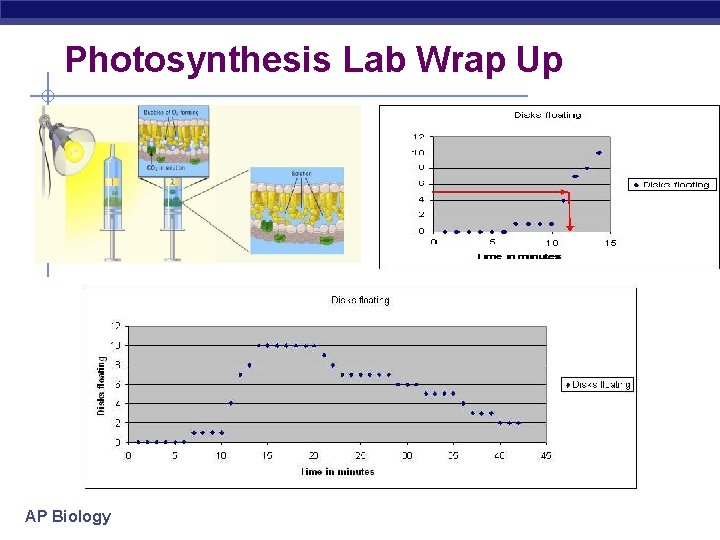
Photosynthesis Lab Wrap Up AP Biology
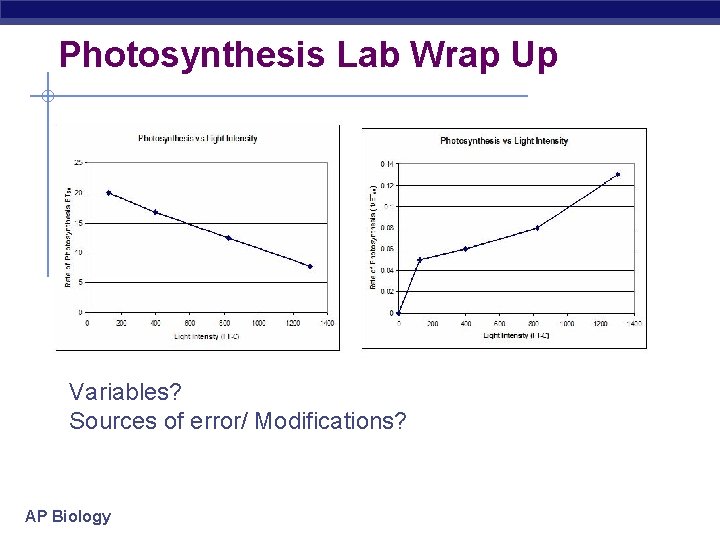
Photosynthesis Lab Wrap Up Variables? Sources of error/ Modifications? AP Biology
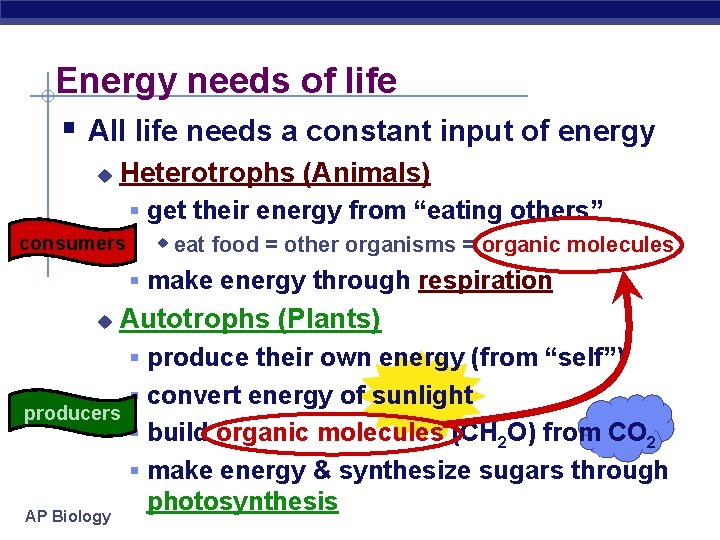
Energy needs of life § All life needs a constant input of energy u Heterotrophs (Animals) § get their energy from “eating others” consumers w eat food = other organisms = organic molecules § make energy through respiration u Autotrophs (Plants) § produce their own energy (from “self”) § convert energy of sunlight producers § build organic molecules (CH 2 O) from CO 2 § make energy & synthesize sugars through photosynthesis AP Biology
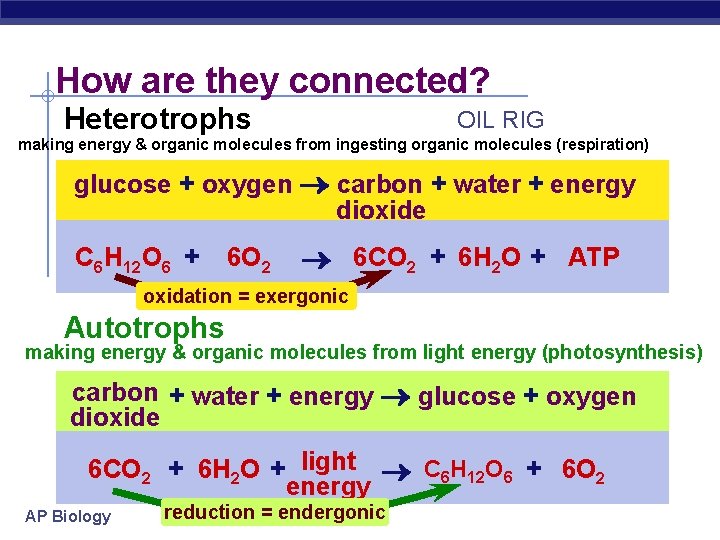
How are they connected? Heterotrophs OIL RIG making energy & organic molecules from ingesting organic molecules (respiration) glucose + oxygen carbon + water + energy dioxide C 6 H 12 O 6 + 6 O 2 6 CO 2 + 6 H 2 O + ATP oxidation = exergonic Autotrophs making energy & organic molecules from light energy (photosynthesis) carbon + water + energy glucose + oxygen dioxide 6 CO 2 + 6 H 2 O + light C 6 H 12 O 6 + 6 O 2 energy AP Biology reduction = endergonic
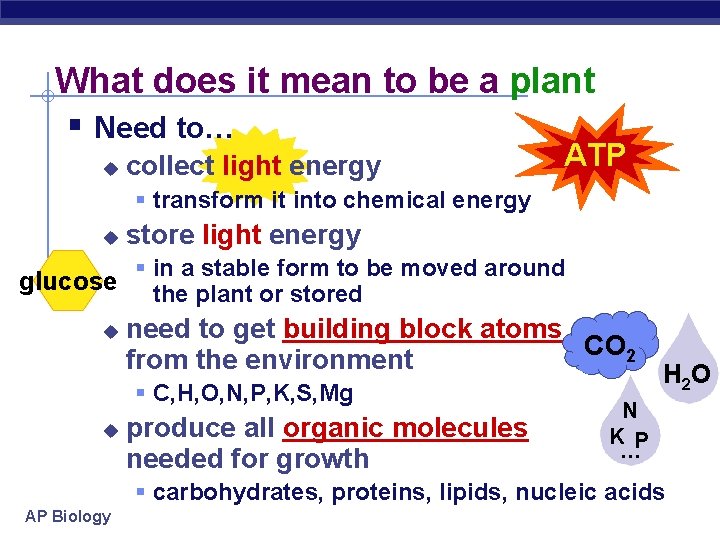
What does it mean to be a plant § Need to… u collect light energy ATP § transform it into chemical energy u glucose u store light energy § in a stable form to be moved around the plant or stored need to get building block atoms CO 2 from the environment § C, H, O, N, P, K, S, Mg u produce all organic molecules needed for growth H 2 O N K P … § carbohydrates, proteins, lipids, nucleic acids AP Biology
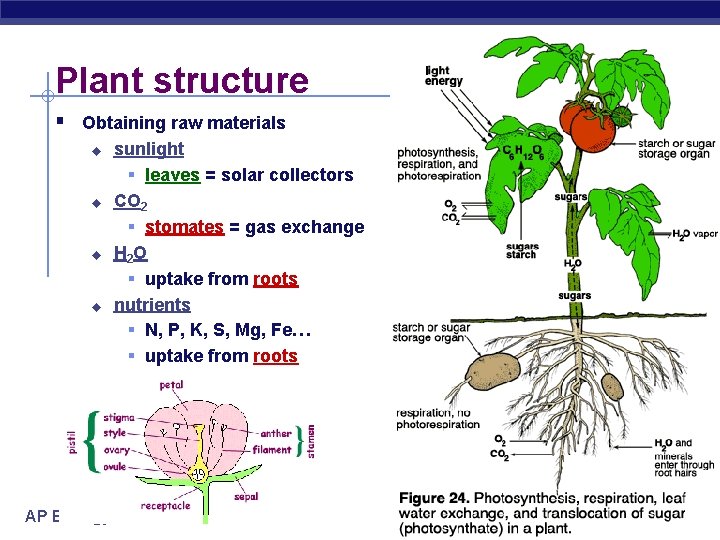
Plant structure § Obtaining raw materials u u AP Biology sunlight § leaves = solar collectors CO 2 § stomates = gas exchange H 2 O § uptake from roots nutrients § N, P, K, S, Mg, Fe… § uptake from roots
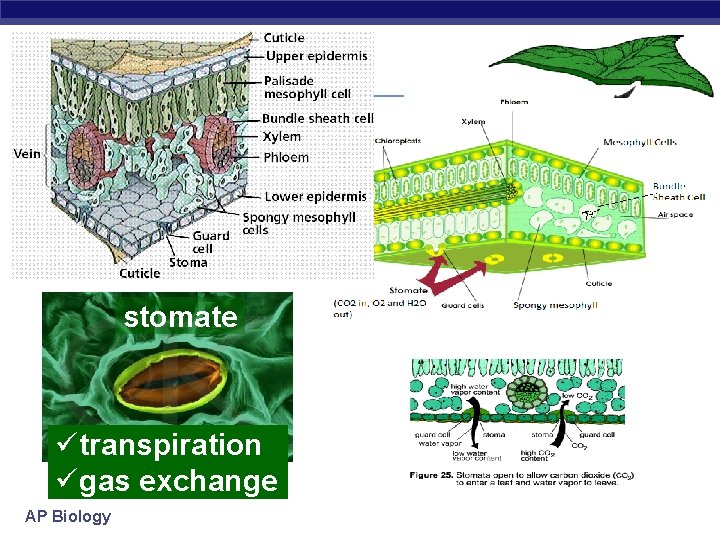
stomate ütranspiration ügas exchange AP Biology
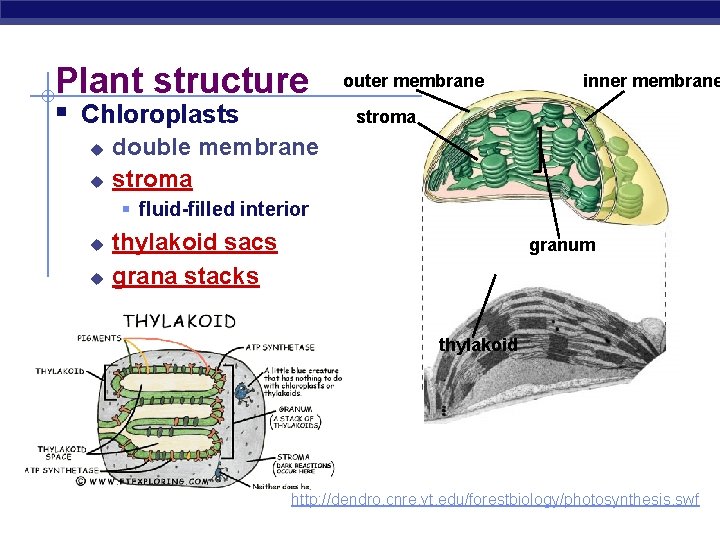
Plant structure § Chloroplasts u u outer membrane inner membrane stroma double membrane stroma § fluid-filled interior u u thylakoid sacs grana stacks granum thylakoid AP Biology http: //dendro. cnre. vt. edu/forestbiology/photosynthesis. swf
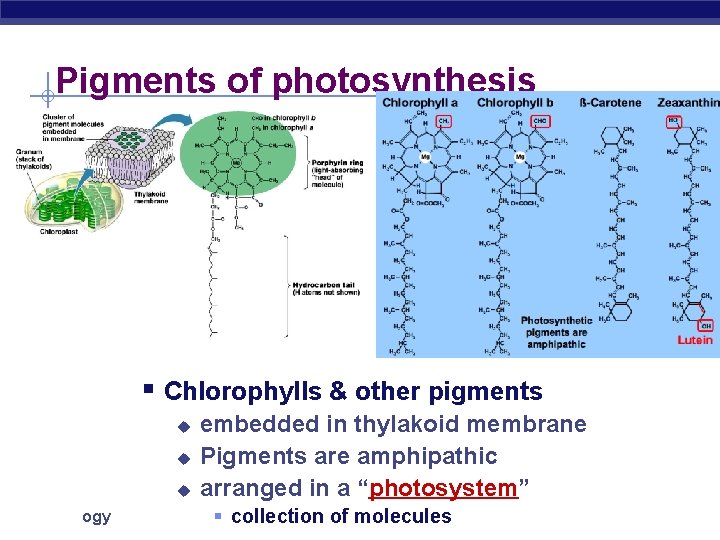
Pigments of photosynthesis § Chlorophylls & other pigments u u u AP Biology embedded in thylakoid membrane Pigments are amphipathic arranged in a “photosystem” § collection of molecules
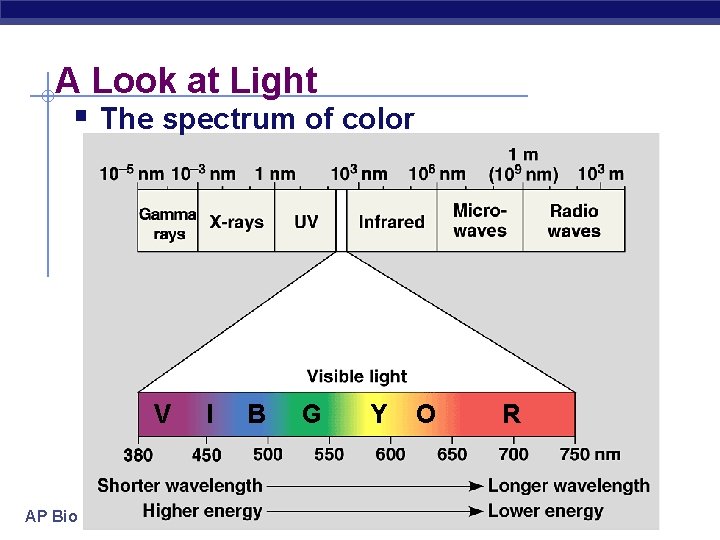
A Look at Light § The spectrum of color V AP Biology I B G Y O R

Light: absorption spectra § Photosynthesis gets energy by absorbing wavelengths of light u u chlorophyll a § absorbs best in red & blue wavelengths & least in green accessory pigments with different structures absorb light of different wavelengths § chlorophyll b, carotenoids Why are plants green? AP Biology
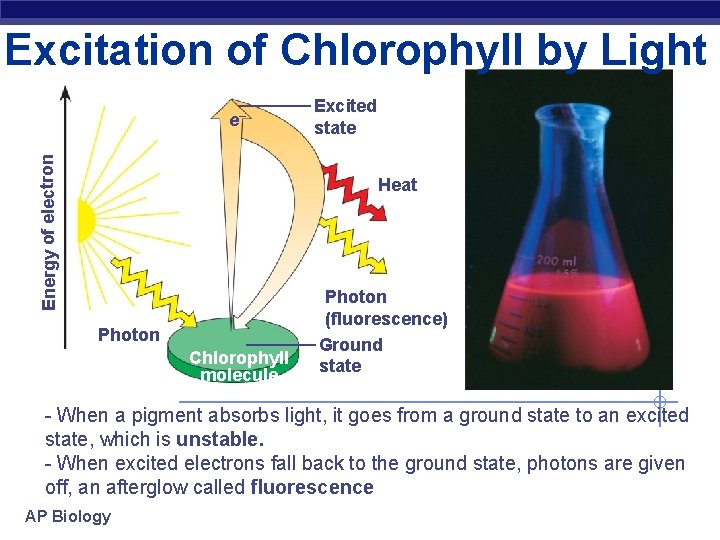
Excitation of Chlorophyll by Light Energy of electron e– Excited state Heat Photon Chlorophyll molecule Photon (fluorescence) Ground state - When a pigment absorbs light, it goes from a ground state to an excited state, which is unstable. - When excited electrons fall back to the ground state, photons are given off, an afterglow called fluorescence AP Biology
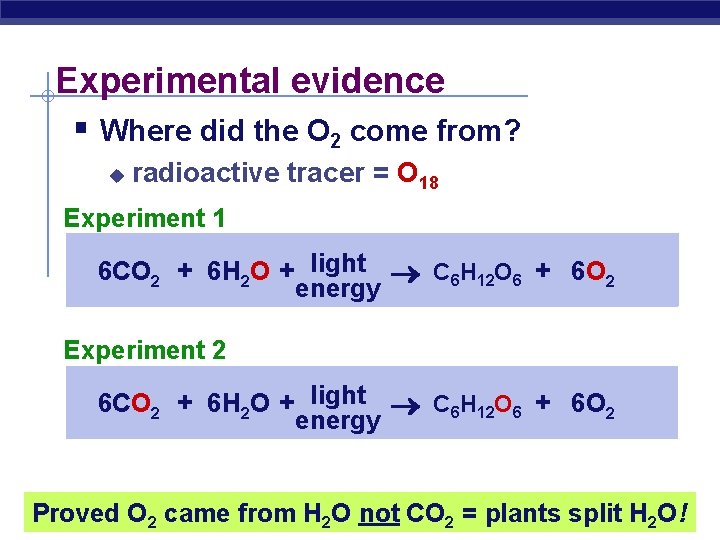
Experimental evidence § Where did the O 2 come from? u radioactive tracer = O 18 Experiment 1 6 CO 2 + 6 H 2 O + light C 6 H 12 O 6 + 6 O 2 energy Experiment 2 6 CO 2 + 6 H 2 O + light C 6 H 12 O 6 + 6 O 2 energy Proved O 2 came from H 2 O not CO 2 = plants split H 2 O! AP Biology
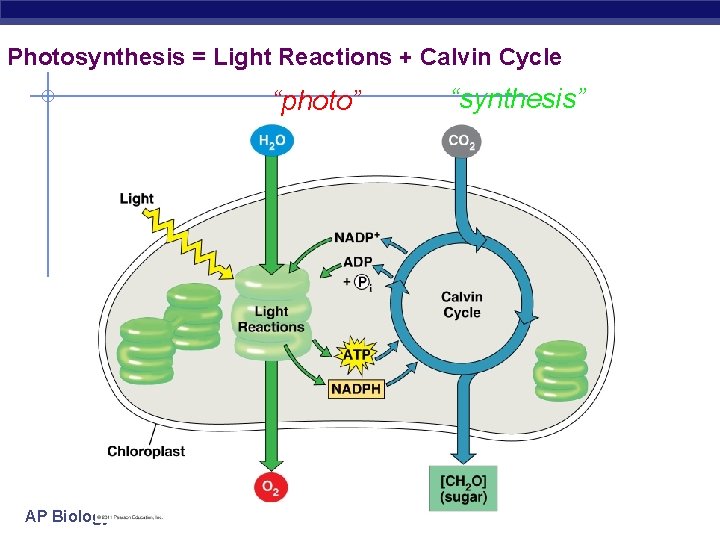
Photosynthesis = Light Reactions + Calvin Cycle “photo” AP Biology “synthesis”
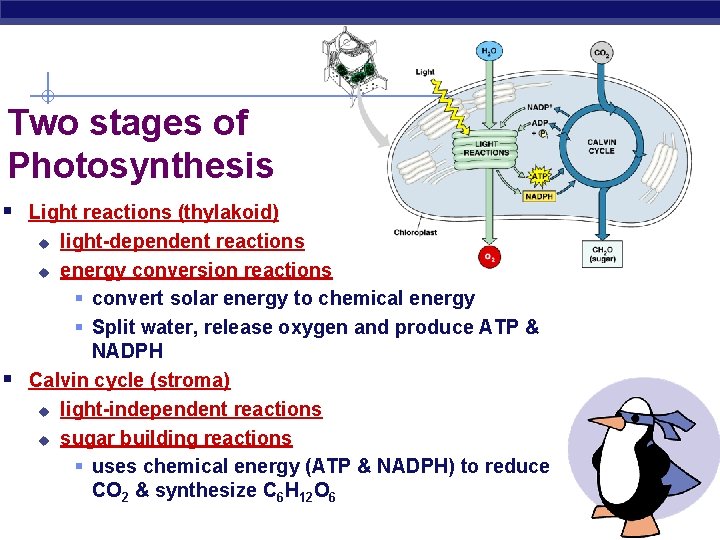
Two stages of Photosynthesis § Light reactions (thylakoid) light-dependent reactions u energy conversion reactions § convert solar energy to chemical energy § Split water, release oxygen and produce ATP & NADPH Calvin cycle (stroma) u light-independent reactions u sugar building reactions § uses chemical energy (ATP & NADPH) to reduce CO 2 & synthesize C 6 H 12 O 6 u § AP Biology
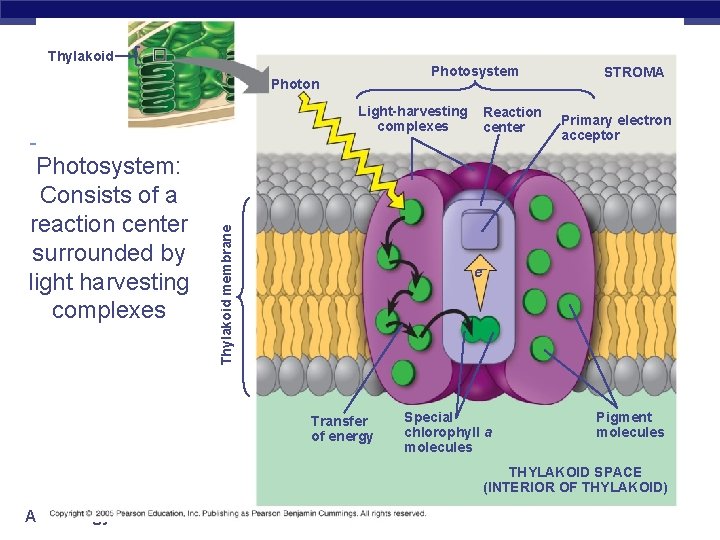
Thylakoid Photosystem Photon Photosystem: Consists of a reaction center surrounded by light harvesting complexes Thylakoid membrane Light-harvesting complexes Reaction center STROMA Primary electron acceptor e– Transfer of energy Special chlorophyll a molecules Pigment molecules THYLAKOID SPACE (INTERIOR OF THYLAKOID) AP Biology
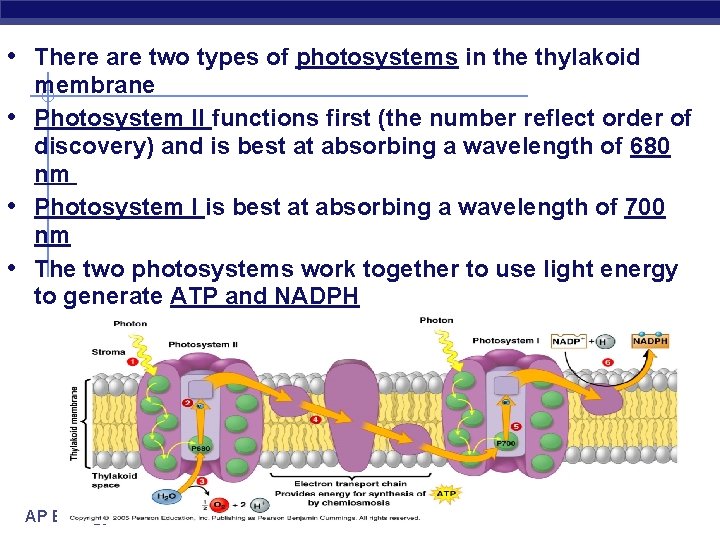
• There are two types of photosystems in the thylakoid • • • membrane Photosystem II functions first (the number reflect order of discovery) and is best at absorbing a wavelength of 680 nm Photosystem I is best at absorbing a wavelength of 700 nm The two photosystems work together to use light energy to generate ATP and NADPH AP Biology
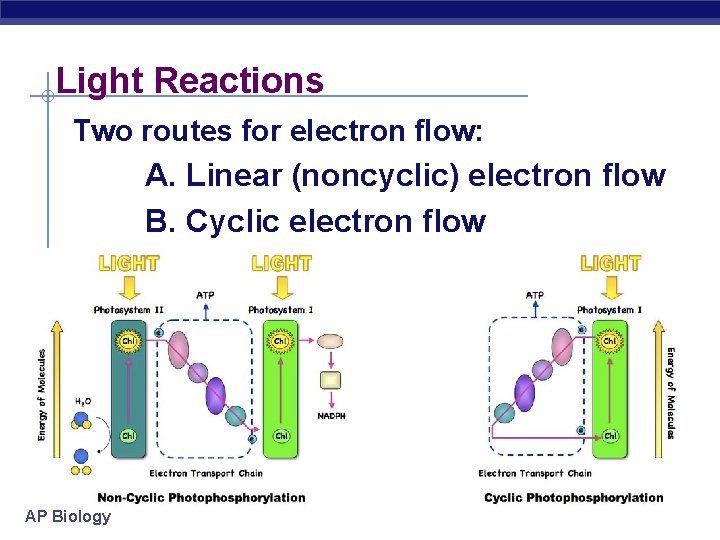
Light Reactions Two routes for electron flow: A. Linear (noncyclic) electron flow B. Cyclic electron flow AP Biology
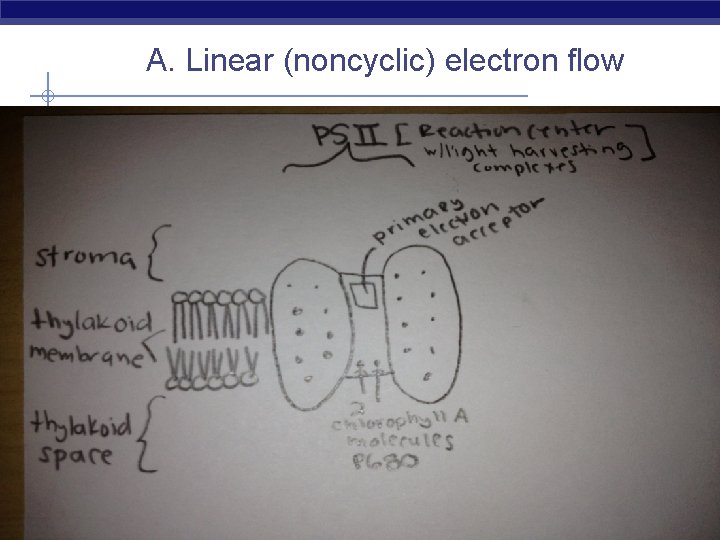
A. Linear (noncyclic) electron flow AP Biology
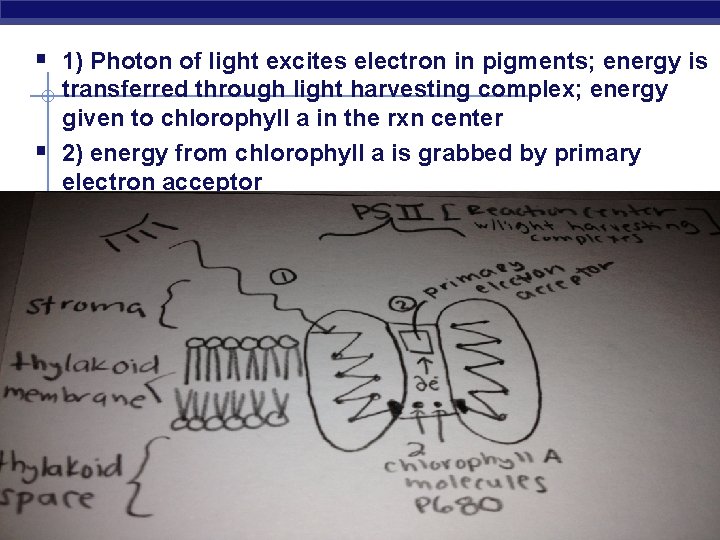
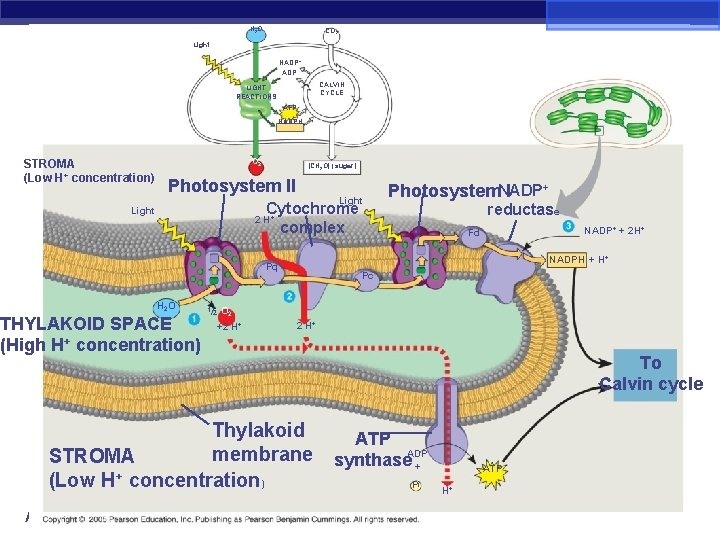
§ 1) Photon of light excites electron in pigments; energy is § transferred through light harvesting complex; energy given to chlorophyll a in the rxn center 2) energy from chlorophyll a is grabbed by primary electron acceptor AP Biology
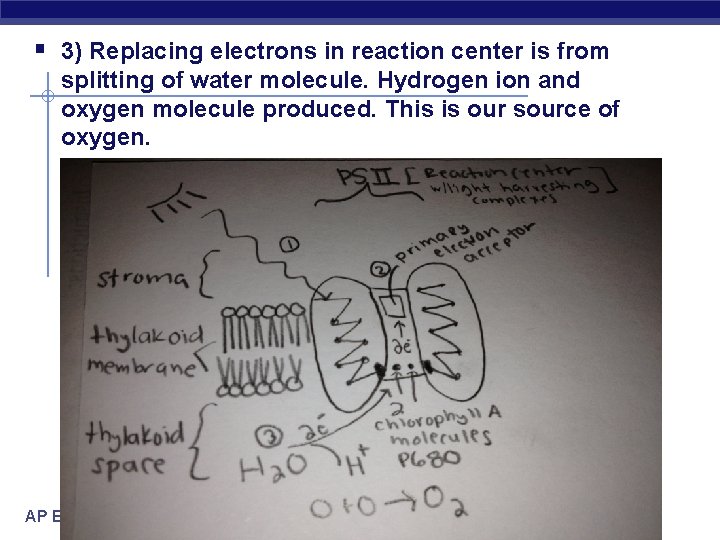
§ 3) Replacing electrons in reaction center is from splitting of water molecule. Hydrogen ion and oxygen molecule produced. This is our source of oxygen. AP Biology
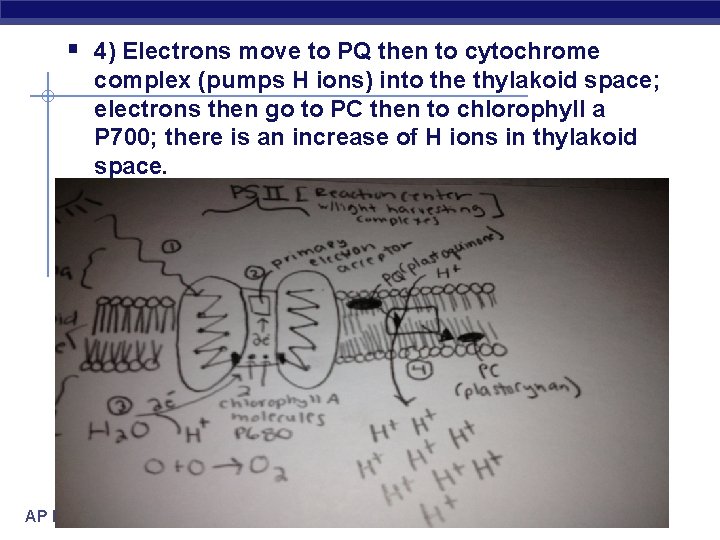
§ 4) Electrons move to PQ then to cytochrome complex (pumps H ions) into the thylakoid space; electrons then go to PC then to chlorophyll a P 700; there is an increase of H ions in thylakoid space. AP Biology
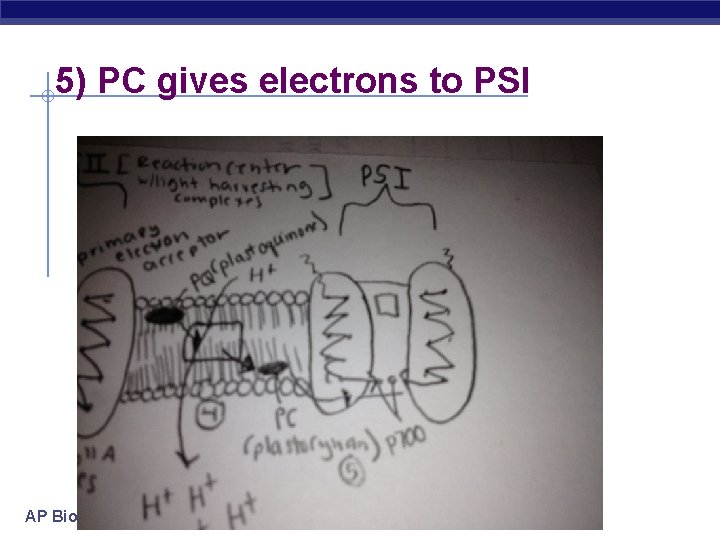
5) PC gives electrons to PSI AP Biology
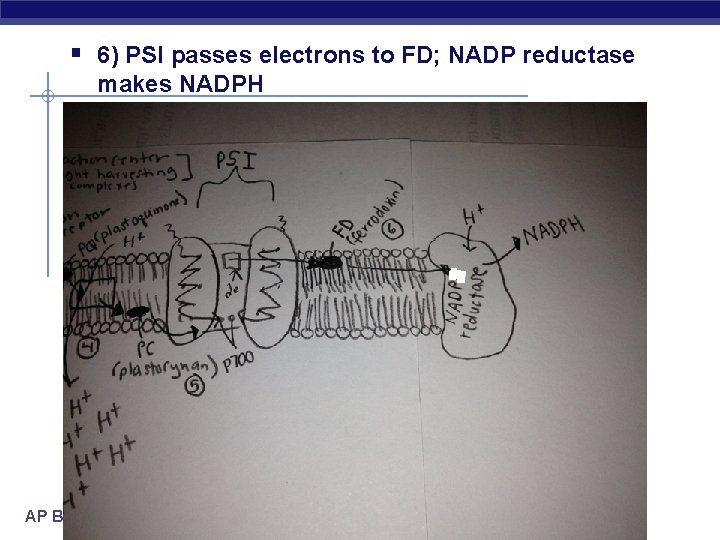
§ 6) PSI passes electrons to FD; NADP reductase makes NADPH AP Biology
![§ 7) H ions in thylakoid space move from [high] to [low] through ATP](http://slidetodoc.com/presentation_image_h2/51578fe4496798f78b16d6040b260086/image-26.jpg "§ 7) H ions in thylakoid space move from [high] to [low] through ATP")
§ 7) H ions in thylakoid space move from [high] to [low] through ATP synthase (ADP + Pi, makes ATP) AP Biology
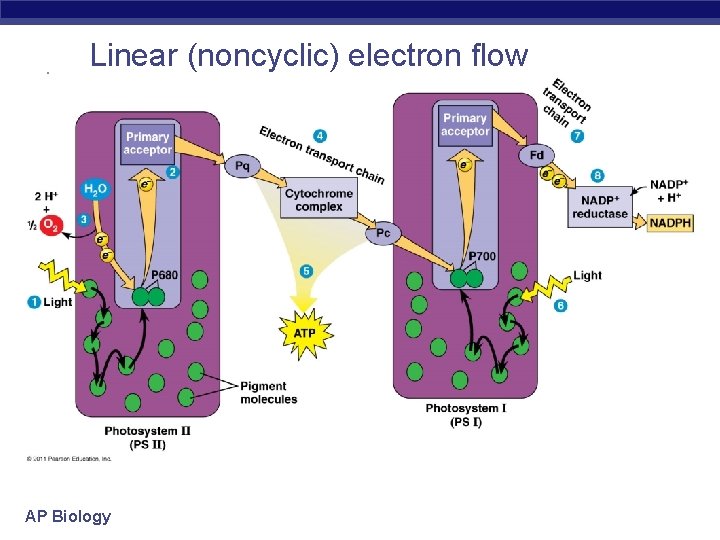
Linear (noncyclic) electron flow AP Biology
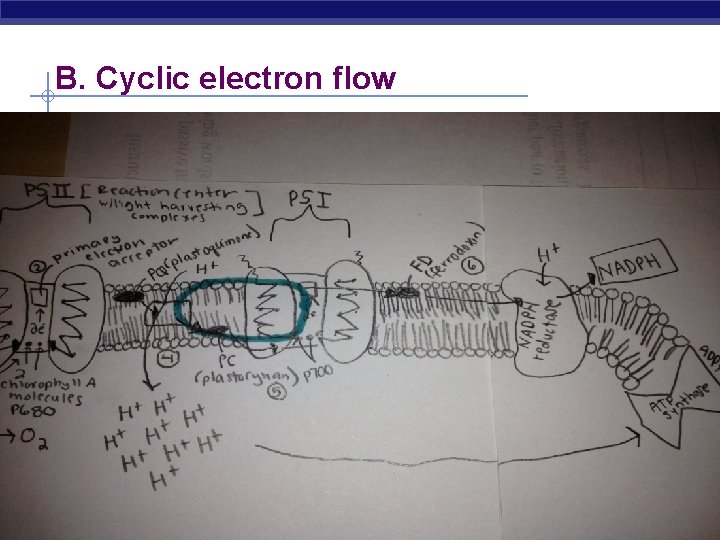
B. Cyclic electron flow AP Biology
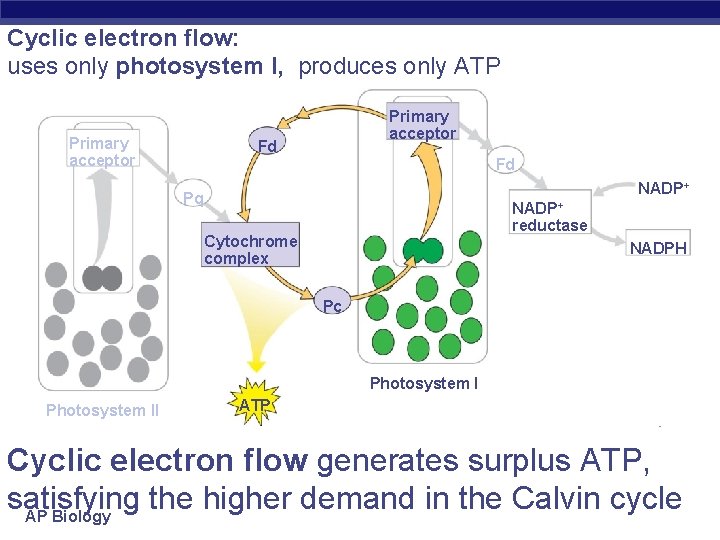
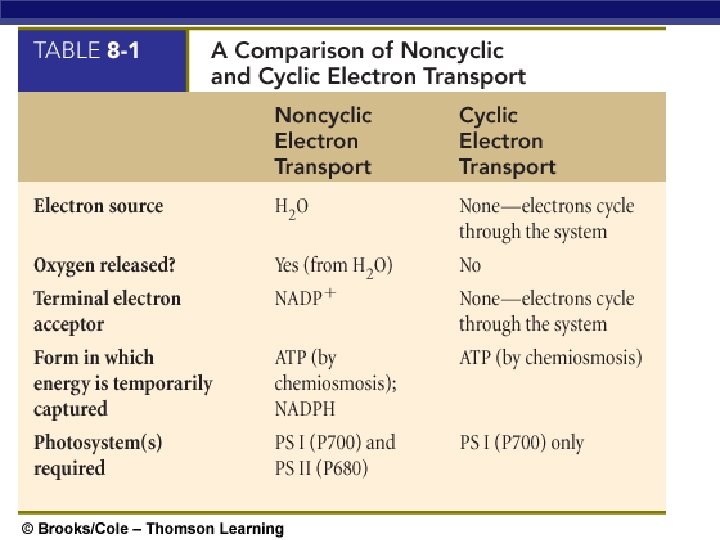
Cyclic electron flow: uses only photosystem I, produces only ATP Primary acceptor Fd Fd NADP+ Pq NADP+ reductase Cytochrome complex NADPH Pc Photosystem II ATP Cyclic electron flow generates surplus ATP, satisfying the higher demand in the Calvin cycle AP Biology
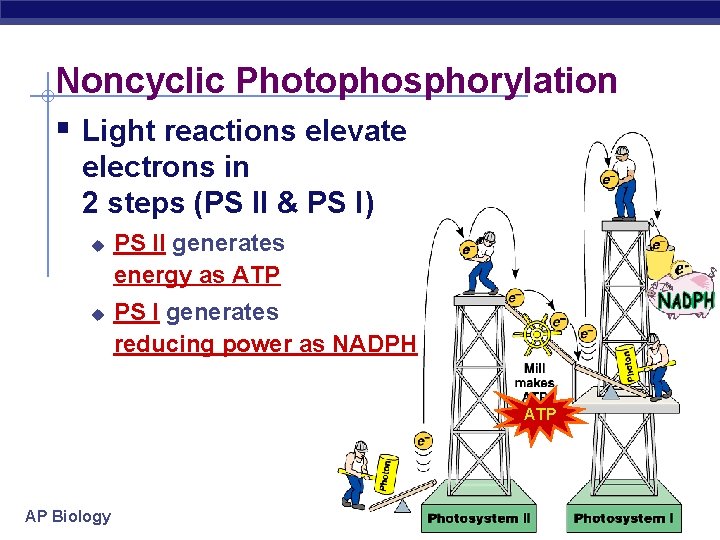
Noncyclic Photophosphorylation § Light reactions elevate electrons in 2 steps (PS II & PS I) u u PS II generates energy as ATP PS I generates reducing power as NADPH ATP AP Biology
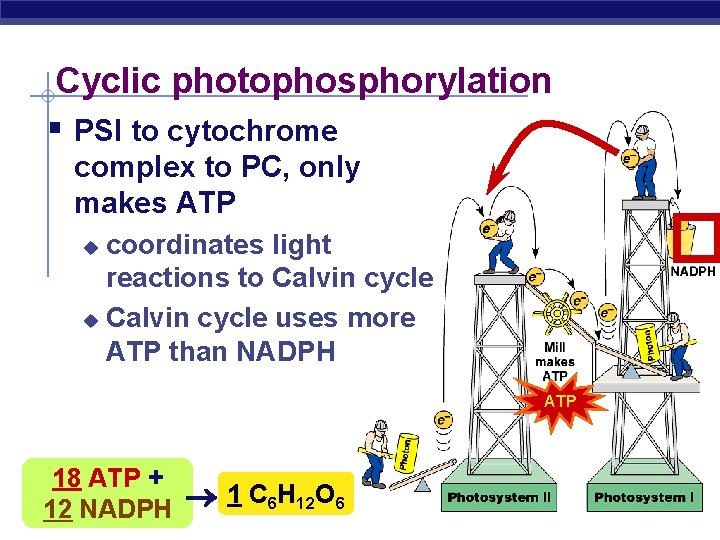
Cyclic photophosphorylation § PSI to cytochrome complex to PC, only makes ATP � coordinates light reactions to Calvin cycle uses more ATP than NADPH u ATP 18 ATP + NADPH AP 12 Biology 1 C 6 H 12 O 6
AP Biology
H 2 O CO 2 Light NADP+ ADP CALVIN CYCLE LIGHT REACTIONS ATP NADPH STROMA (Low H+ concentration) O 2 [CH 2 O] (sugar) Photosystem II Light Cytochrome 2 H+ complex Light THYLAKOID SPACE (High H+ concentration) 1/2 NADP+ + 2 H+ Fd Pc O 2 +2 H+ Thylakoid membrane STROMA (Low H+ concentration) AP Biology reductase NADPH + H+ Pq H 2 O + Photosystem. NADP I To Calvin cycle ATP ADP synthase + Pi ATP H+
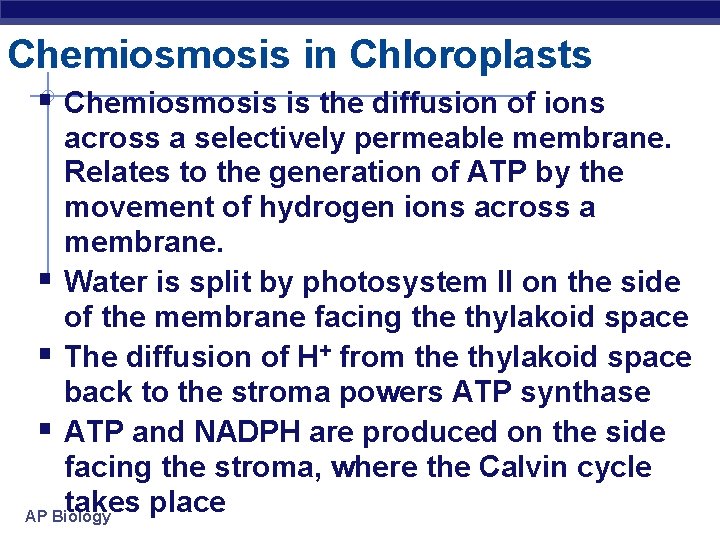
Chemiosmosis in Chloroplasts § Chemiosmosis is the diffusion of ions across a selectively permeable membrane. Relates to the generation of ATP by the movement of hydrogen ions across a membrane. § Water is split by photosystem II on the side of the membrane facing the thylakoid space § The diffusion of H+ from the thylakoid space back to the stroma powers ATP synthase § ATP and NADPH are produced on the side facing the stroma, where the Calvin cycle takes place AP Biology
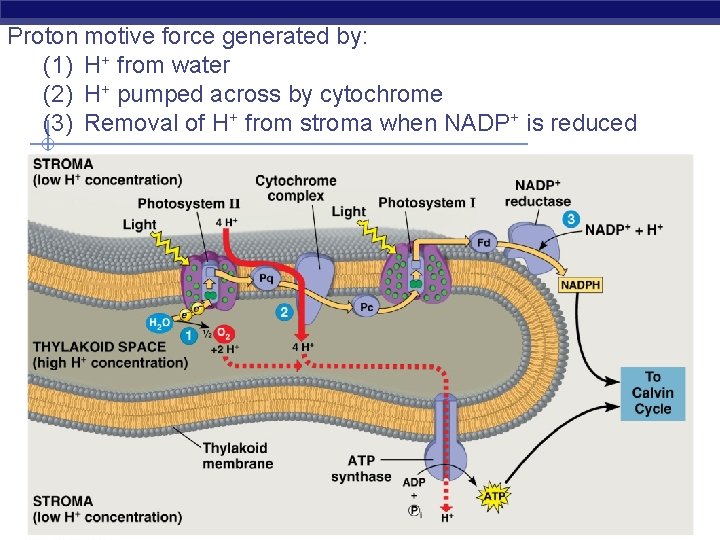
Proton motive force generated by: (1) H+ from water (2) H+ pumped across by cytochrome (3) Removal of H+ from stroma when NADP+ is reduced AP Biology
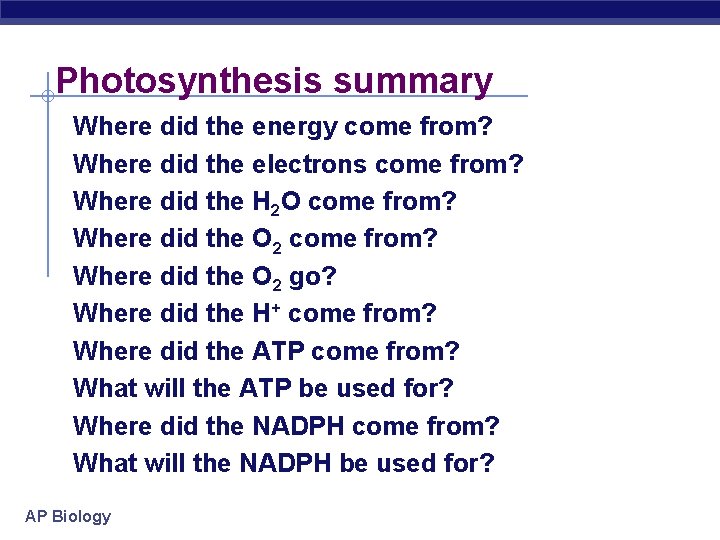
Photosynthesis summary Where did the energy come from? Where did the electrons come from? Where did the H 2 O come from? Where did the O 2 go? Where did the H+ come from? Where did the ATP come from? What will the ATP be used for? Where did the NADPH come from? What will the NADPH be used for? AP Biology
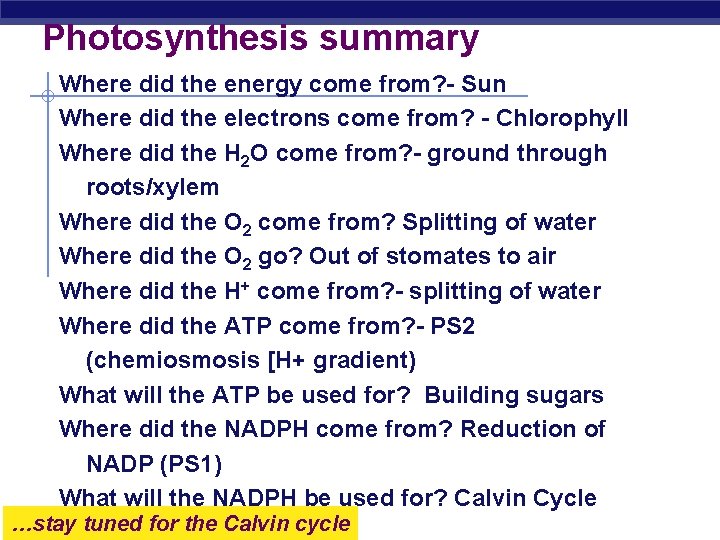
Photosynthesis summary Where did the energy come from? - Sun Where did the electrons come from? - Chlorophyll Where did the H 2 O come from? - ground through roots/xylem Where did the O 2 come from? Splitting of water Where did the O 2 go? Out of stomates to air Where did the H+ come from? - splitting of water Where did the ATP come from? - PS 2 (chemiosmosis [H+ gradient) What will the ATP be used for? Building sugars Where did the NADPH come from? Reduction of NADP (PS 1) What will the NADPH be used for? Calvin Cycle AP Biology …stay tuned for the Calvin cycle
- Slides: 37