
Photosynthesis Life from Light and Air AP Biology
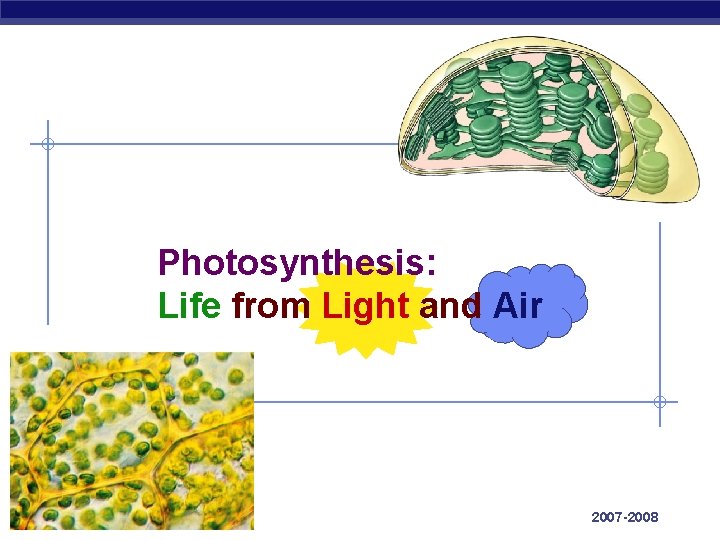
Photosynthesis: Life from Light and Air AP Biology 2007 -2008
Energy needs of life § All life needs a constant input of energy u Heterotrophs (Animals) § get their energy from “eating others” consumers w eat food = other organisms = organic molecules § make energy through respiration u Autotrophs (Plants) § produce their own energy (from “self”) § convert energy of sunlight producers § build organic molecules (CHO) from CO 2 § make energy & synthesize sugars through photosynthesis AP Biology
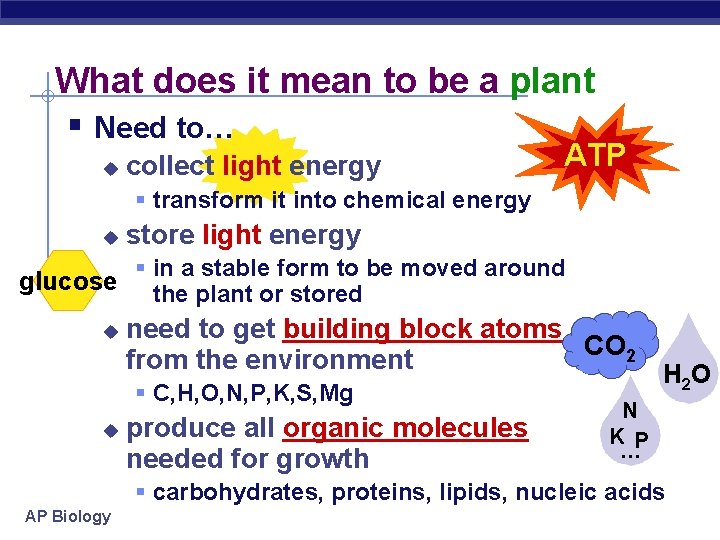
What does it mean to be a plant § Need to… u collect light energy ATP § transform it into chemical energy u glucose u store light energy § in a stable form to be moved around the plant or stored need to get building block atoms CO 2 from the environment § C, H, O, N, P, K, S, Mg u produce all organic molecules needed for growth H 2 O N K P … § carbohydrates, proteins, lipids, nucleic acids AP Biology
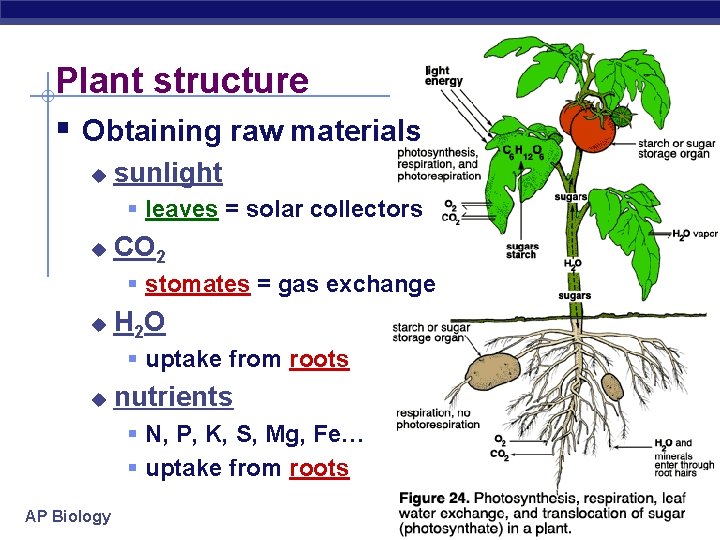
Plant structure § Obtaining raw materials u sunlight § leaves = solar collectors u CO 2 § stomates = gas exchange u H 2 O § uptake from roots u nutrients § N, P, K, S, Mg, Fe… § uptake from roots AP Biology
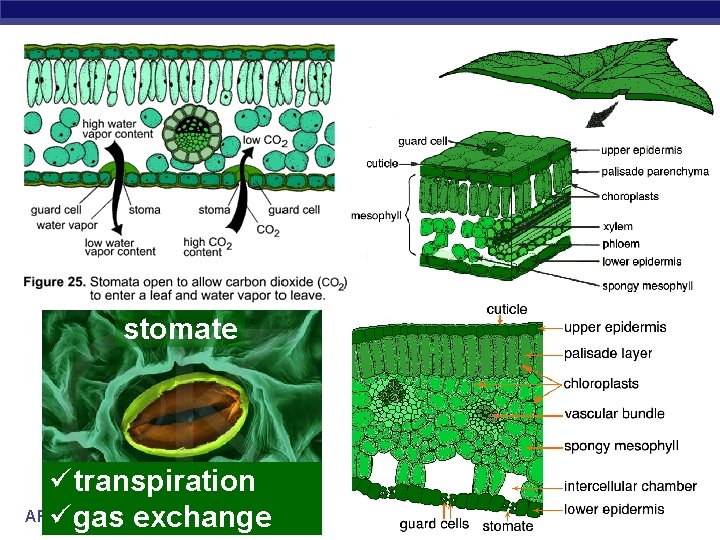
stomate ütranspiration AP ü Biology gas exchange
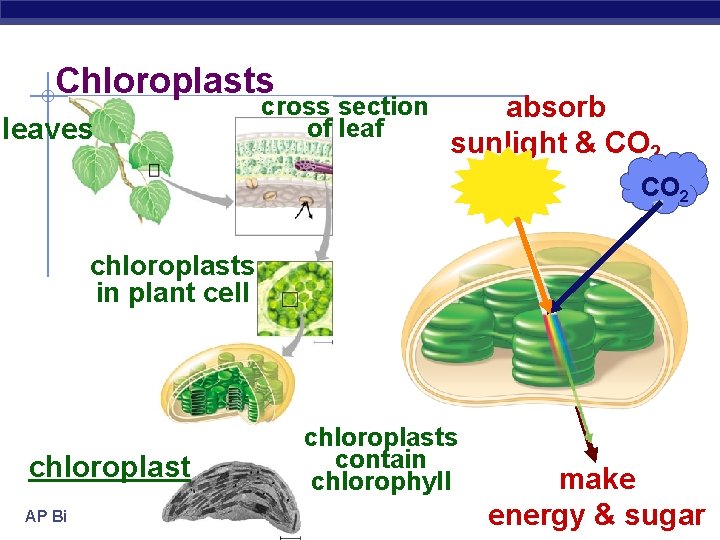
Chloroplasts leaves cross section of leaf absorb sunlight & CO 2 chloroplasts in plant cell chloroplast AP Biology chloroplasts contain chlorophyll make energy & sugar
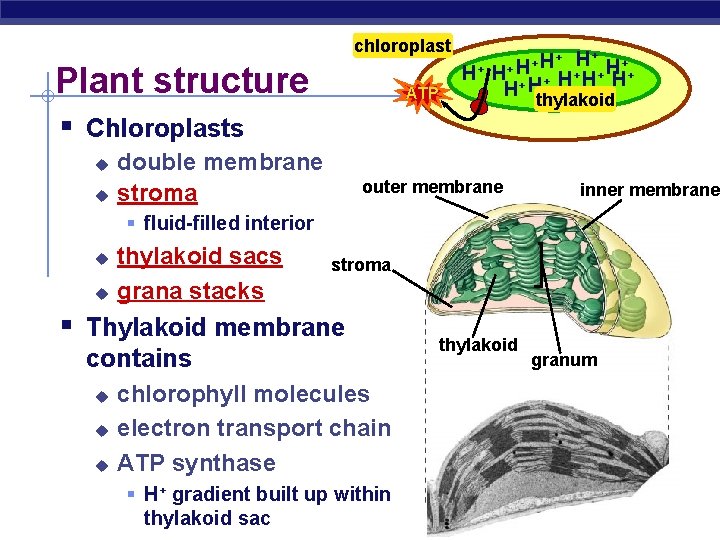
chloroplast Plant structure H+ ATP + + H+ H H+ + H H + H+ H+ H+ + H H thylakoid § Chloroplasts u u double membrane stroma outer membrane inner membrane § fluid-filled interior u u thylakoid sacs grana stacks stroma § Thylakoid membrane contains u u u chlorophyll molecules electron transport chain ATP synthase § H+ gradient built up within AP Biology thylakoid sac thylakoid granum
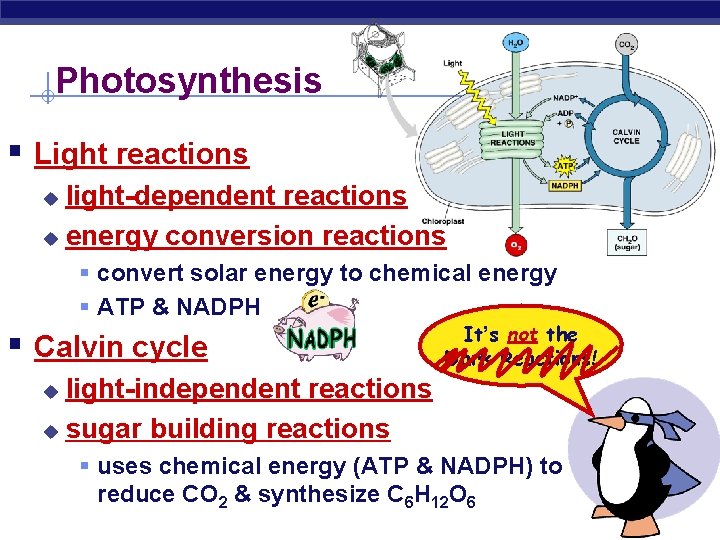
Photosynthesis § Light reactions light-dependent reactions u energy conversion reactions u § convert solar energy to chemical energy § ATP & NADPH § Calvin cycle It’s not the Dark Reactions! light-independent reactions u sugar building reactions u § uses chemical energy (ATP & NADPH) to reduce CO 2 & synthesize C 6 H 12 O 6 AP Biology
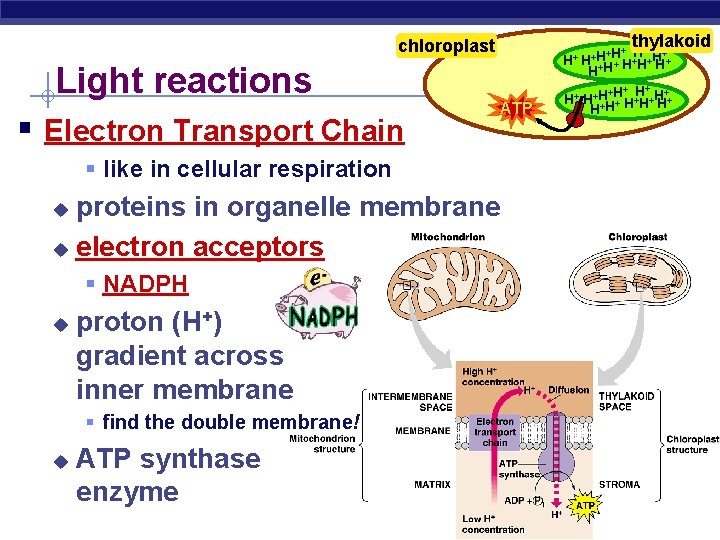
thylakoid chloroplast Light reactions § Electron Transport Chain § like in cellular respiration proteins in organelle membrane u electron acceptors u § NADPH u proton (H+) gradient across inner membrane § find the double membrane! u ATP synthase enzyme AP Biology + +H+ H H+ + H+ H+H +H+ H H ATP + +H+ H H+ + H+ H+H H H H
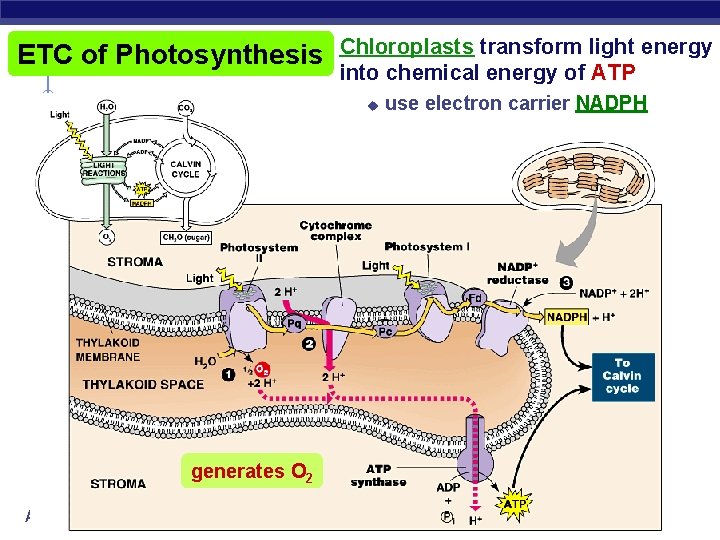
ETC of Photosynthesis Chloroplasts transform light energy into chemical energy of ATP u generates O 2 AP Biology use electron carrier NADPH
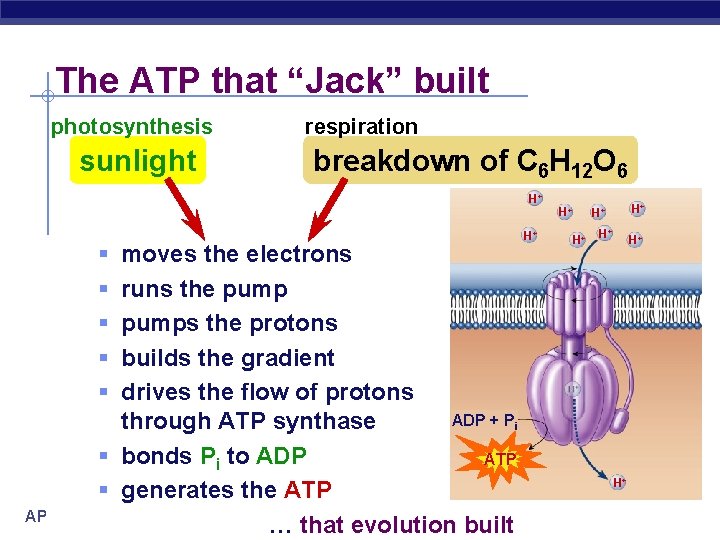
The ATP that “Jack” built photosynthesis sunlight respiration breakdown of C 6 H 12 O 6 H+ H+ moves the electrons runs the pumps the protons builds the gradient drives the flow of protons ADP + Pi through ATP synthase § bonds Pi to ADP ATP § generates the ATP AP Biology … that evolution built § § § H+ H+
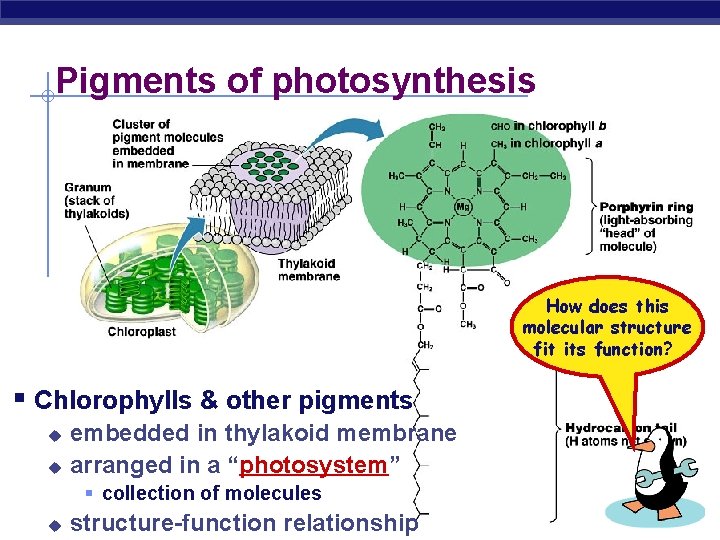
Pigments of photosynthesis How does this molecular structure fit its function? § Chlorophylls & other pigments u u embedded in thylakoid membrane arranged in a “photosystem” § collection of molecules AP Biology u structure-function relationship
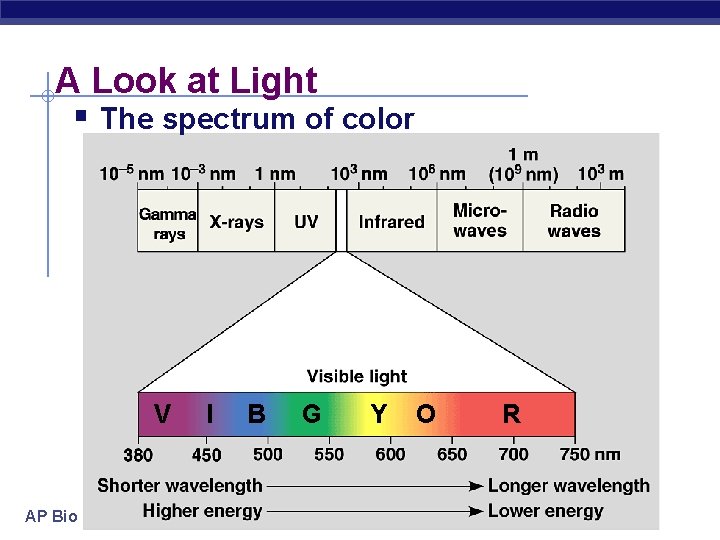
A Look at Light § The spectrum of color V AP Biology I B G Y O R
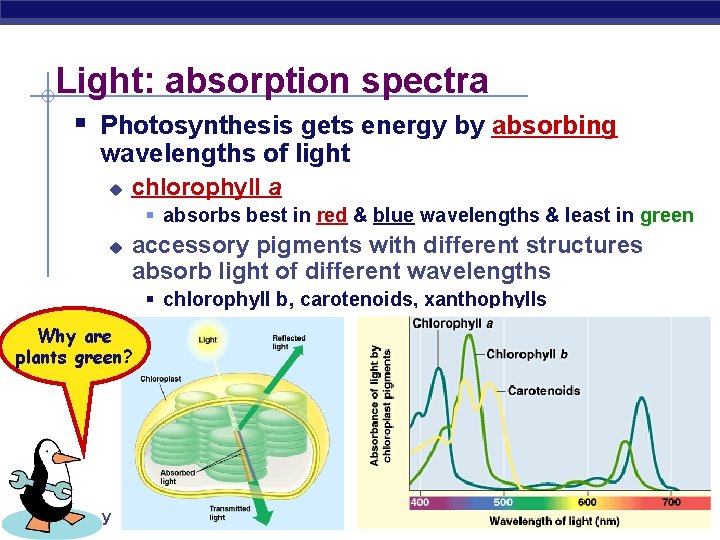
Light: absorption spectra § Photosynthesis gets energy by absorbing wavelengths of light u chlorophyll a § absorbs best in red & blue wavelengths & least in green u accessory pigments with different structures absorb light of different wavelengths § chlorophyll b, carotenoids, xanthophylls Why are plants green? AP Biology
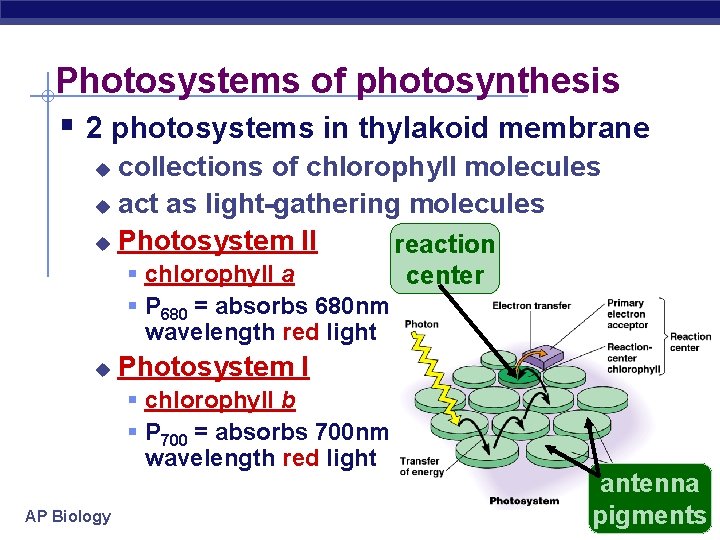
Photosystems of photosynthesis § 2 photosystems in thylakoid membrane collections of chlorophyll molecules u act as light-gathering molecules u Photosystem II reaction u § chlorophyll a center § P 680 = absorbs 680 nm wavelength red light u Photosystem I § chlorophyll b § P 700 = absorbs 700 nm wavelength red light AP Biology antenna pigments

ETC of Photosynthesis e e sun O split H 2 O H+ + H+ H + H+ +H H+ H+ H to Calvin Cycle ATP AP Biology
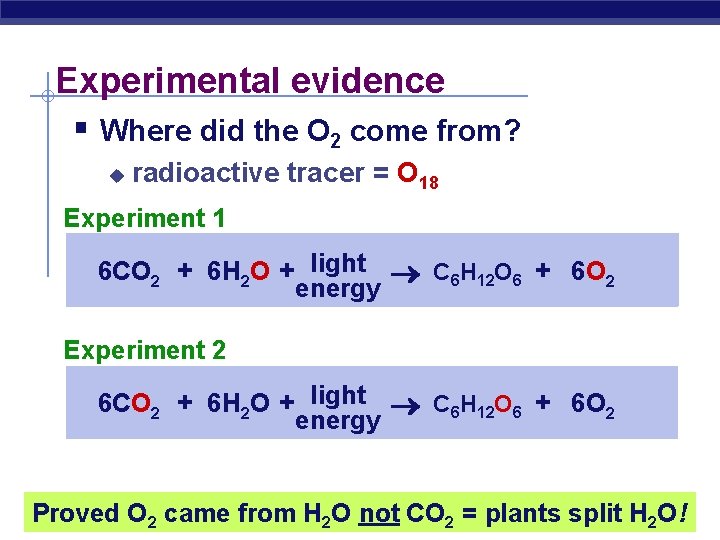
Experimental evidence § Where did the O 2 come from? u radioactive tracer = O 18 Experiment 1 6 CO 2 + 6 H 2 O + light C 6 H 12 O 6 + 6 O 2 energy Experiment 2 6 CO 2 + 6 H 2 O + light C 6 H 12 O 6 + 6 O 2 energy Proved O 2 came from H 2 O not CO 2 = plants split H 2 O! AP Biology
Photosynthesis summary Where did the energy come from? Where did the electrons come from? Where did the H 2 O come from? Where did the O 2 go? Where did the H+ come from? Where did the ATP come from? What will the ATP be used for? Where did the NADPH come from? What will the NADPH be used for? AP Biology …stay tuned for the Calvin cycle
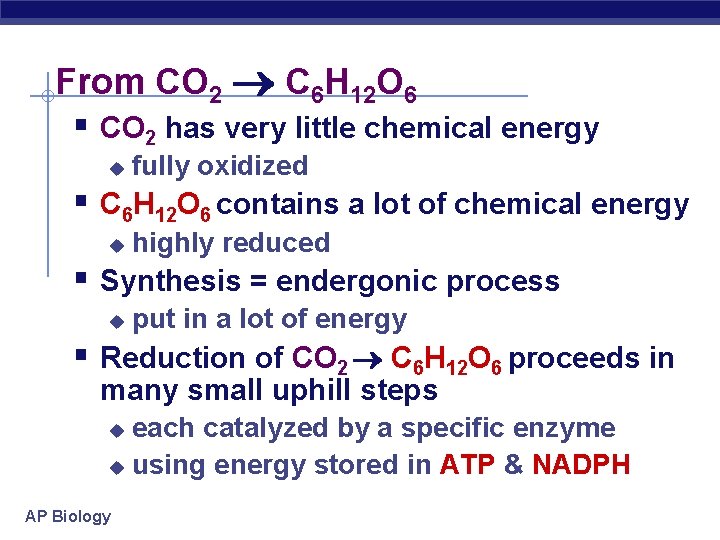
From CO 2 C 6 H 12 O 6 § CO 2 has very little chemical energy u fully oxidized § C 6 H 12 O 6 contains a lot of chemical energy u highly reduced § Synthesis = endergonic process u put in a lot of energy § Reduction of CO 2 C 6 H 12 O 6 proceeds in many small uphill steps each catalyzed by a specific enzyme u using energy stored in ATP & NADPH u AP Biology
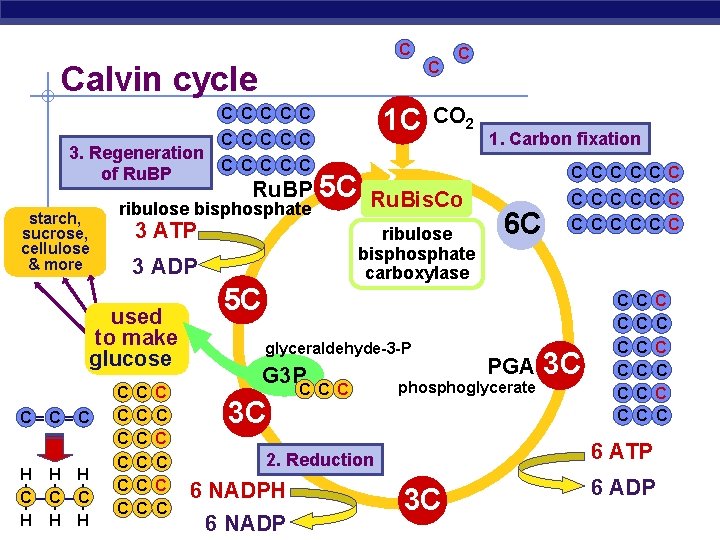
C Calvin cycle 1 C C C 3. Regeneration C C C of Ru. BP starch, sucrose, cellulose & more ribulose bisphosphate 3 ATP H H H | | | C–C–C AP Biology C C C C CO 2 5 C Ru. Bis. Co glyceraldehyde-3 -P G 3 P 3 C C 6 NADP 6 C PGA phosphoglycerate C C C 3 C C C C C 6 ATP 2. Reduction 6 NADPH 1. Carbon fixation C C C ribulose bisphosphate carboxylase 3 ADP used to make glucose C=C=C 5 C C C 3 C 6 ADP H | H |
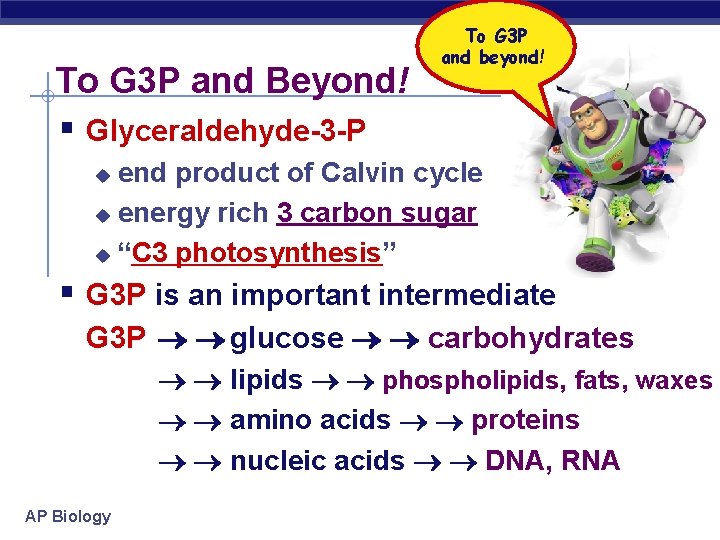
To G 3 P and Beyond! § Glyceraldehyde-3 -P To G 3 P and beyond! end product of Calvin cycle u energy rich 3 carbon sugar u “C 3 photosynthesis” u § G 3 P is an important intermediate § G 3 P glucose carbohydrates lipids phospholipids, fats, waxes amino acids proteins nucleic acids DNA, RNA AP Biology
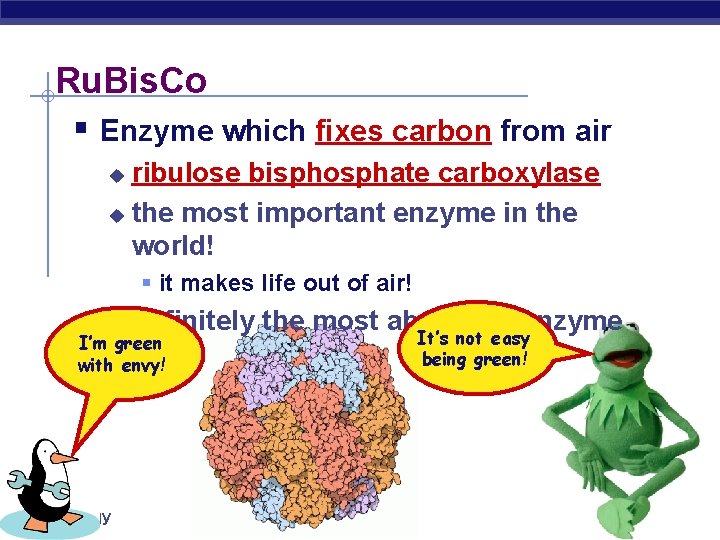
Ru. Bis. Co § Enzyme which fixes carbon from air ribulose bisphosphate carboxylase u the most important enzyme in the world! u § it makes life out of air! definitely the most abundant enzyme It’s not easy u I’m green with envy! AP Biology being green!
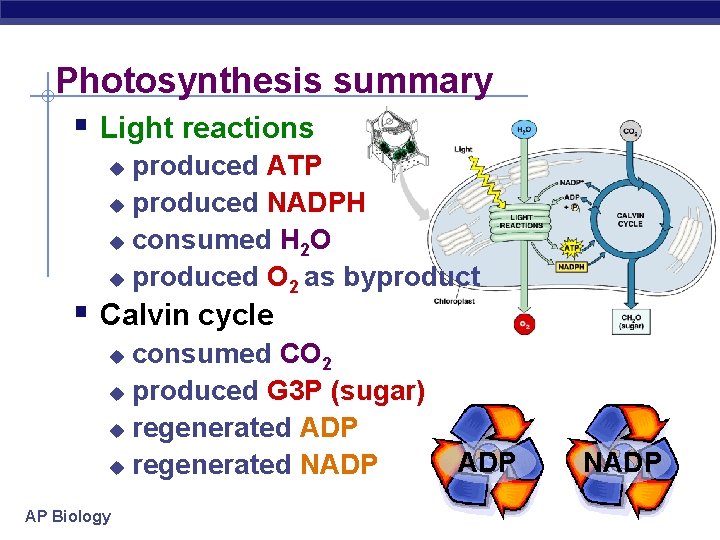
Photosynthesis summary § Light reactions produced ATP u produced NADPH u consumed H 2 O u produced O 2 as byproduct u § Calvin cycle consumed CO 2 u produced G 3 P (sugar) u regenerated ADP u regenerated NADP u AP Biology ADP NADP
Supporting a biosphere § On global scale, photosynthesis is the most important process for the continuation of life on Earth u each year photosynthesis… § captures 121 billion tons of CO 2 § synthesizes 160 billion tons of carbohydrate u AP Biology heterotrophs are dependent on plants as food source for fuel & raw materials
The poetic perspective… § All the solid material of every plant § was built by sunlight out of thin air All the solid material of every animal was built from plant material air AP Biology sun Then all the plants, cats, dogs, elephants & people … are really particles of air woven together by strands of sunlight!
Processing AP Biology
Light Reactions + sunlight Energy Building Reactions AP Biology + + § produces § releases __as a waste product
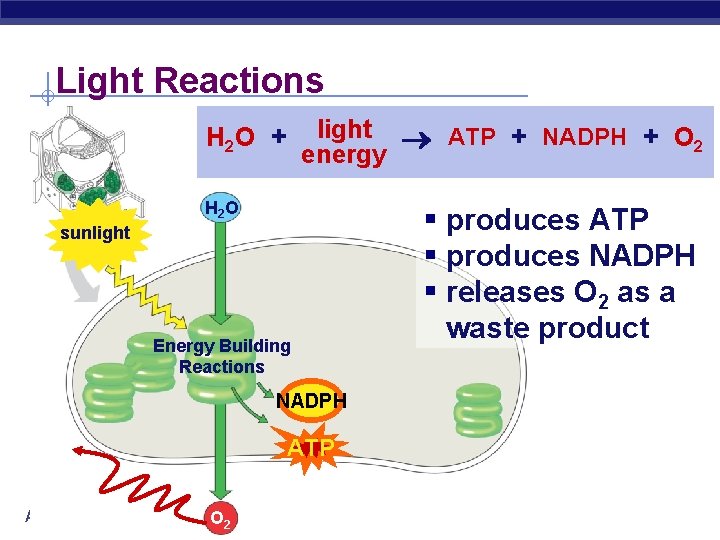
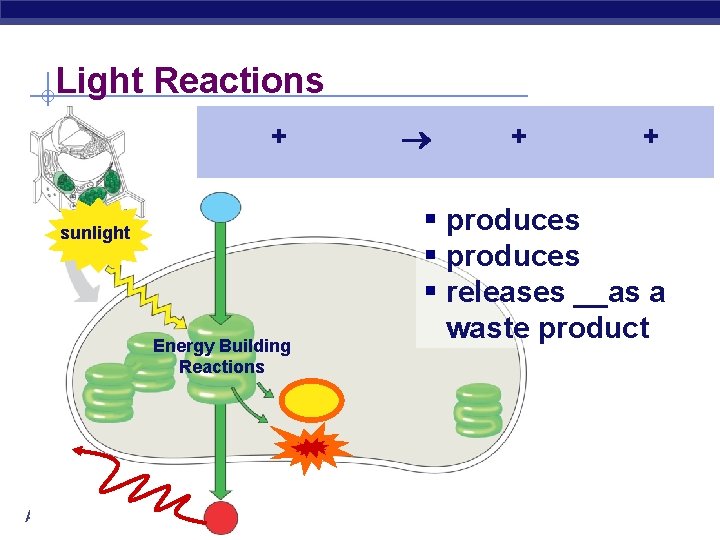
Light Reactions light ATP + NADPH + O 2 energy H 2 O + H 2 O sunlight Energy Building Reactions NADPH ATP AP Biology O 2 § produces ATP § produces NADPH § releases O 2 as a waste product
Calvin Cycle + + Sugar Building Reactions AP Biology sugars + + § builds § Uses___&___ § recycles ___ & ____ § back to make more ATP & NADPH
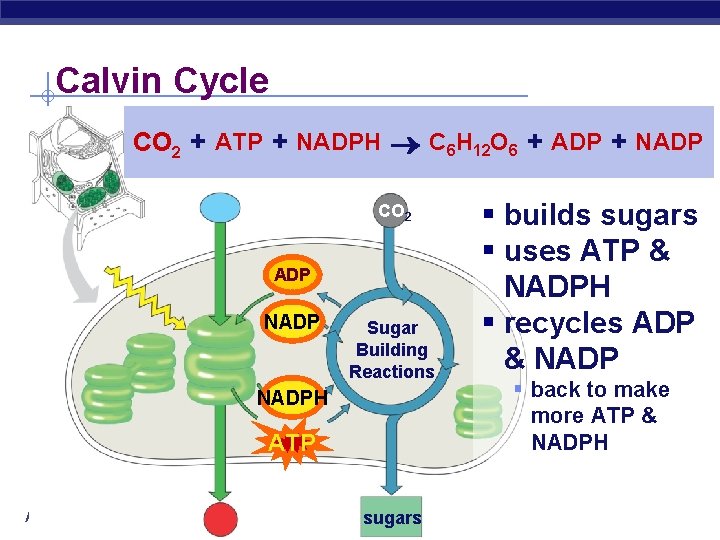
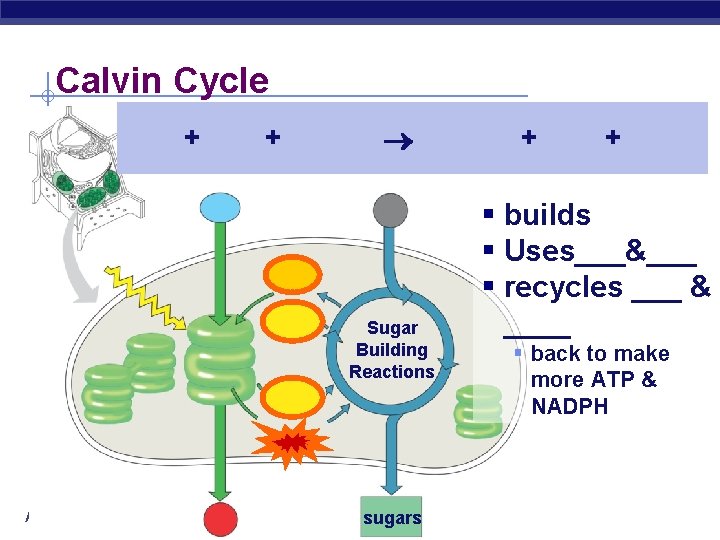
Calvin Cycle CO 2 + ATP + NADPH C 6 H 12 O 6 + ADP + NADP CO 2 ADP NADP Sugar Building Reactions NADPH ATP AP Biology sugars § builds sugars § uses ATP & NADPH § recycles ADP & NADP § back to make more ATP & NADPH
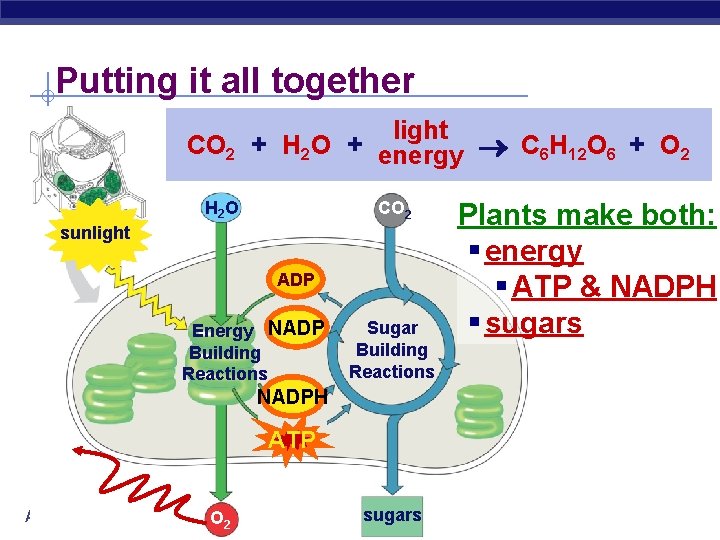
Putting it all together light CO 2 + H 2 O + energy C 6 H 12 O 6 + O 2 H 2 O CO 2 sunlight ADP Energy NADP Building Reactions Sugar Building Reactions NADPH ATP AP Biology O 2 sugars Plants make both: § energy § ATP & NADPH § sugars
- Slides: 31