
Photosynthesis Leaf Food supply factory Adapted to maximize
- Slides: 13
Photosynthesis
Leaf § Food supply factory § Adapted to maximize light absorption and CO 2 diffusion.
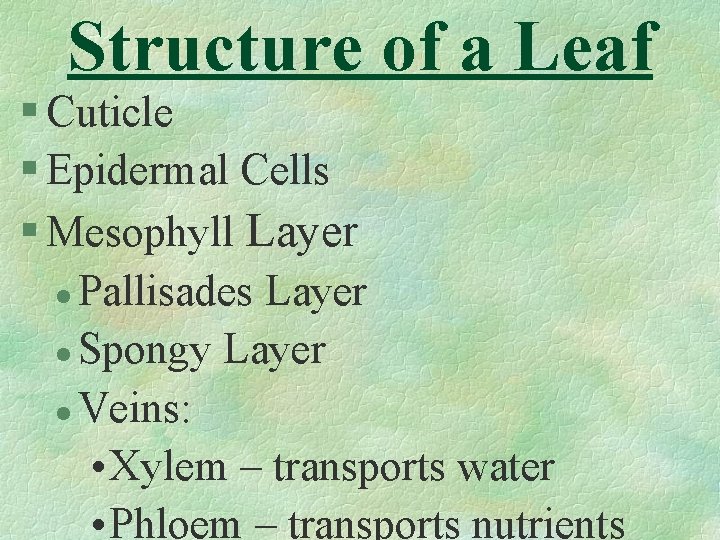
Structure of a Leaf § Cuticle § Epidermal Cells § Mesophyll Layer l Pallisades Layer l Spongy Layer l Veins: • Xylem – transports water • Phloem – transports nutrients
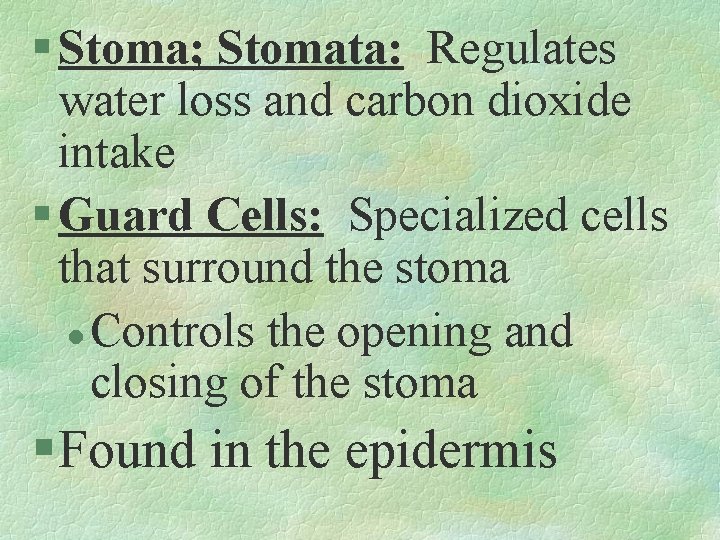
§ Stoma; Stomata: Regulates water loss and carbon dioxide intake § Guard Cells: Specialized cells that surround the stoma l Controls the opening and closing of the stoma § Found in the epidermis
Mesophyll § Photosynthesis tissue § Loaded with Chloroplasts § Air sacs act as reservoirs for CO 2 and H 2 O.
Photosynthesis § Green plants and algae use the solar energy and molecules of CO 2 into sugar and starch. § Supplies 02. § CO 2 + H 20
Photosynthesis § Light Reactions § Dark Reactions: Calvin Cycle
Light Reactions § 1 Plant leaf traps sunlight through the chlorophyll § 2 Electrons within the chlorophyll absorb the light energy
Light Reactions § 3 Electrons get excited and leave the chlorophyll § 4 They are picked up by an electron acceptor molecule and go through a series of reactions (Electron Transport)
Light Reactions § 5. As the e- gets passed along, energy is released. § 6 The final acceptor is NADP + § 7. A water molecule splits E- goes back to chlrophyll l O 2 gets released into air l H attaches to NADP l
Light Reactions § Uses § Water § Light § Produces § ATP § NADPH § O 2
Dark Reactions § Called the Calvin Cycle § 1. CO 2 enters chloroplast § 2. Synthesis part of photosynthesis § Makes glucose
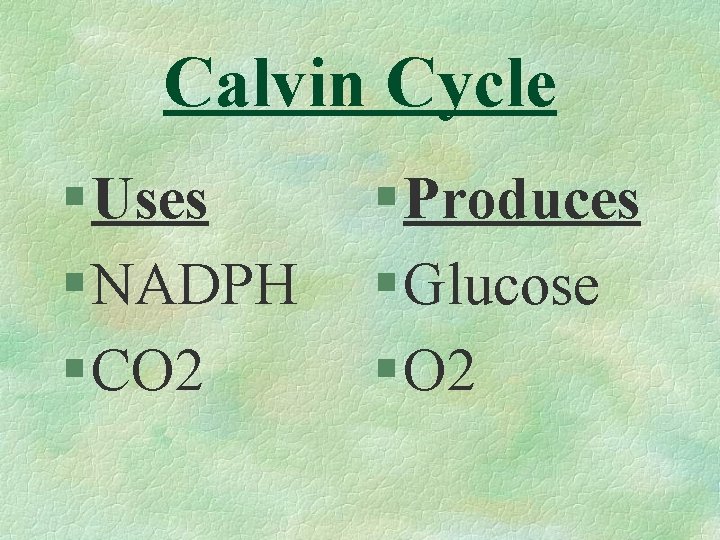
Calvin Cycle § Uses § NADPH § CO 2 § Produces § Glucose § O 2