
Photosynthesis Is defined as A process by which
Photosynthesis § Is defined as… § A process by which light energy is converted into chemical energy § Where does this take place? § In the chloroplasts of plant cells
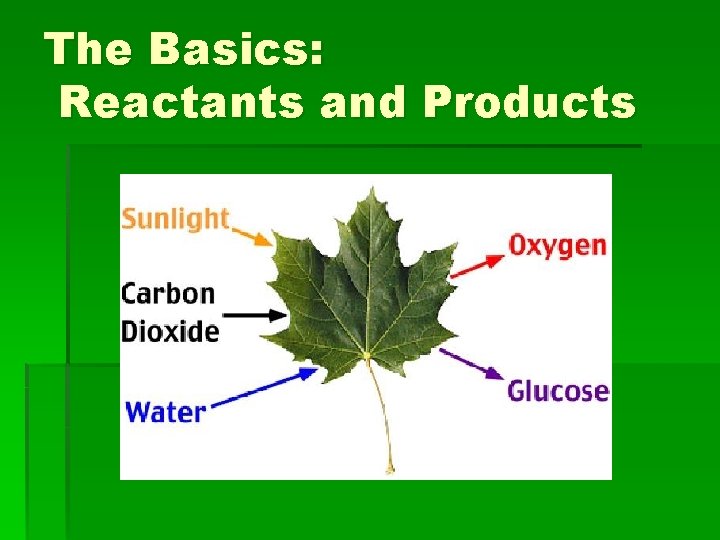
The Basics: Reactants and Products
The main source of energy for all life is…. § The SUN § Photosynthesis is the process of converting sunlight into ATP then into organic molecules that store energy.
ATP § How is ATP like money? § It is: Energy currency -- the only form of energy living things can use (spend). § How does ATP release energy? § By breaking the bond between the 2 nd and 3 rd phosphate and becoming ADP.
Autotrophs are… Plants or other organisms that make their own energy from the sun or inorganic compounds (they are producers) § Heterotrophs are consumers that… § Get energy from food by eating plants and animals that eat plants
Where are the stroma and thylakoid space relative to the thylakoid membrane? § The chloroplast contains thylakoids in a fluid-filled space called the stroma. § The thylakoid space is inside thylakoid and the membrane surrounds it.
Where is chlorophyll located? § On the thylakoid membrane § What is chlorophyll? § A pigment that absorbs and reflects light
What are three products of photolysis? § 1 Oxygen to the atmosphere § 2 H+ ions inside thylakoid membrane § 3 Electrons to chlorophyll to replace those lost to the ETC
What frequencies of light are absorbed and reflected by chlorophyll? § Red and blue are absorbed § Green is reflected
What happens to chlorophyll when it absorbs light energy? § It loses excited electrons to the electron transport chain. § How are these electrons replaced? § Photolysis= light splitting water with an enzyme.
Describe the ETC: electron transport chain. § A series of protein molecules embedded on the membrane where each one has a higher attraction for electrons than the previous one.
What happens as the energy is released in each redox reaction? § This energy is used to actively transport H+ ions into the thylakoid space against the gradient. § This builds up a higher concentration of H+ in the thylakoid space.
Are H+ freely permeable to the thylakoid membrane? (can they cross easily? ) § No-- they are charged! § How do H+ ions diffuse out of the thylakoid space into the stroma? § Through a transport protein called… § ATP Synthetase
Is the flow of H+ ions through ATP Synthase “energy requiring” or “energy releasing”? § Energy releasing § This energy is used to form ATP
Is the formation of ATP energy requiring or energy releasing? § Energy requiring § Energy is needed to create the bond between the 2 nd and 3 rd phosphate making ATP from ADP + P
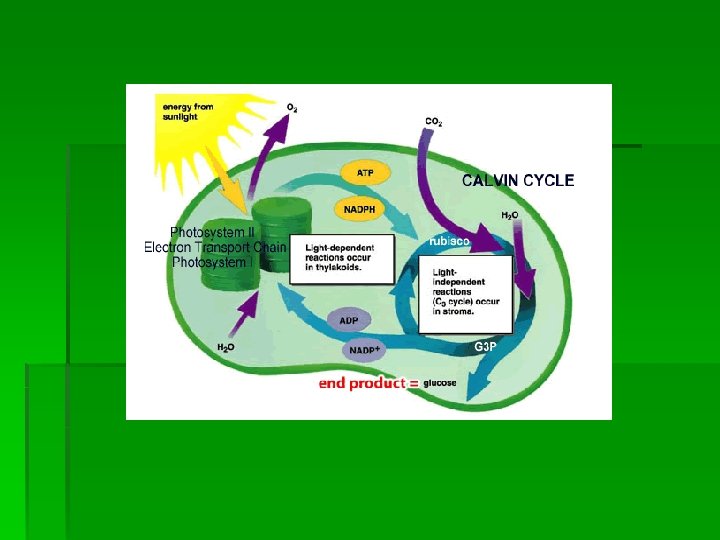
What serves as the final electron acceptor at the end of the electron transport chain? § NADP+ § What happens to create NADPH? § NADP+ combines with the final e- and H+ from the stroma to make NADPH. § NADPH is used in the next phase.
What three things are needed for the light reactions? What three things are produced in the light reactions? § Needed--Light, water, chlorophyll § Produced--oxygen (to atmosphere), ATP, and NADPH (to dark reactions)
The dark reactions, AKA -- the light independent reactions, are also known as… § The Calvin Cycle § What is carbon fixation and where does the carbon come from? § CO 2 from the air is added to a 5 Carbon sugar = this is “carbon fixation” § Glucose is produced
What is NADPH used for? § It carries electrons and H+ ions to the Calvin Cycle. § These are used to build glucose molecules. § What enzyme is key to this process? § Rubisco
Explain the results of the Photosynthesis Lab § What light treatments had the highest and the lowest rate of reaction? § What role did DPIP (blue stuff) play in the photosynthesis reaction?
Now that you know all about photosynthesis. . § Don’t forget to hug a tree! § Without photosynthesis, we would not have air to breath or food to eat. § THE END ?
- Slides: 22