
Photosynthesis Introduction to Biology How does a tree
Photosynthesis Introduction to Biology
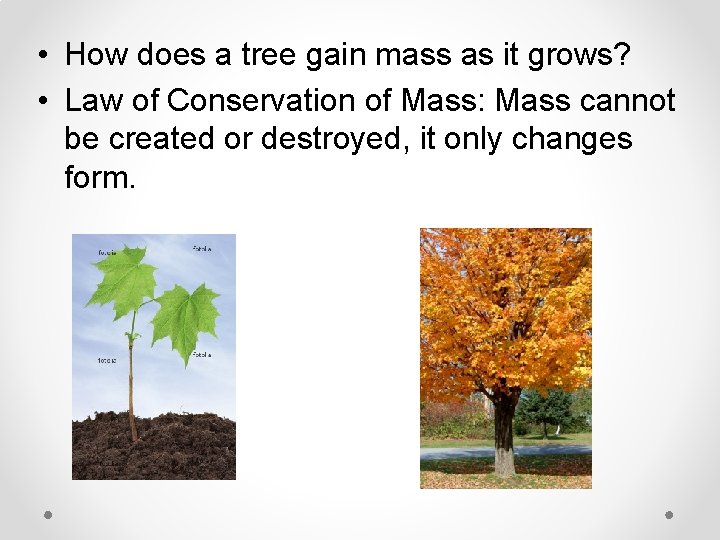
• How does a tree gain mass as it grows? • Law of Conservation of Mass: Mass cannot be created or destroyed, it only changes form.

Van Helmont’s Experiment • Jan Baptista van Helmont, a scientist from Belgium, conducted an experiment to determine the source of a tree’s mass. o He grew a Willow tree in a pot for 5 years and re -measured the mass. o The Willow tree grew by 74 kg, but the mass of the soil changed very little. o Van Helmont concluded that the source of the plant’s mass is water.
Woodward’s Experiment • John Woodward, a professor at Cambridge university in the 1600 s, decided to test this conclusion. o He measured the mass of water he added to the plants. o He also measured the mass of the plants as they grew. o After 77 days of plant growth, the plant increased in mass by 1 gram. Over 76, 000 grams of water had been added.

Priestley’s Experiment • Joseph Priestley believed that plants changed the air somehow. • He placed a small mint plant in a jar with a lit candle. o He closed the jar, the candle used up the oxygen, and the flame extinguished. o After about a month, he was able to re-light the candle, proving that the plant had changed the air by producing oxygen.

Priestley’s Second Experiment • In his second experiment, Joseph Priestley kept a mouse in a closed jar of air until it collapsed. • He then repeated the experiment, but included a large plant in the jar with the mouse. o The mouse survived!
The Answer • What are plants made of? o Primarily carbohydrates such as cellulose, sucrose, fructose, etc. o Carbohydrates are made of carbon, oxygen, and hydrogen. • What would be the source of each of these elements for plants? o Hydrogen: Water o Oxygen: Water o Carbon: . . ?

Photosynthesis • Photo = “light”, Synthesis “to make” • Photosynthesis is using light energy to make organic compounds such as sugars.
• Autotrophs are able to produce the molecules they need for life without eating anything. o Photoautotrophs use sunlight as their energy source. o Chemoautotrophs use non-living chemicals (like Hydrogen sulfide gas) as their energy source • Almost all plants are photoautotrophs. o Also includes algae, some protozoa, and some bacteria.
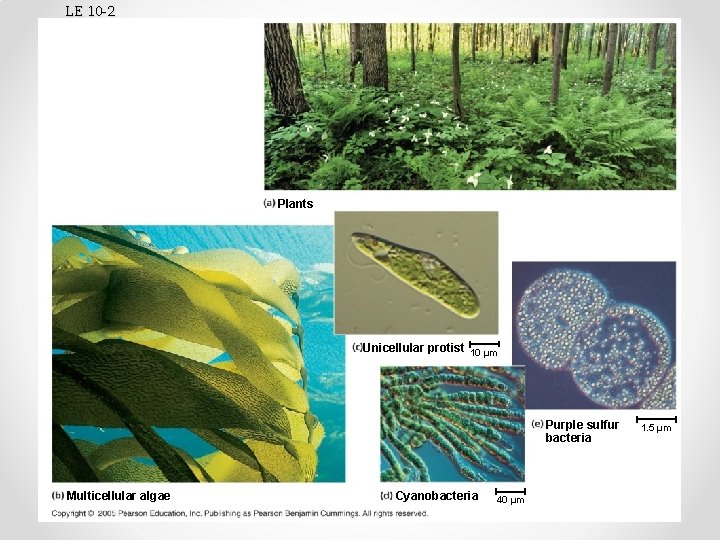
LE 10 -2 Plants Unicellular protist 10 µm Purple sulfur bacteria Multicellular algae Cyanobacteria 40 µm 1. 5 µm
• Heterotrophs obtain their organic material by eating other organisms • Almost all heterotrophs, including humans, depend on photoautotrophs like plants for food and oxygen
Energy in Sunlight • Energy from the sun travels to Earth in the form of light. • Sunlight is a mixture of many different types of energy: o Ultraviolet: Invisible to us, causes sunburns o Visible Light: Wavelengths of light we can see, o Infrared: Energy in the form of heat

Energy • Our eyes see the different wavelengths of the visible spectrum as different colors: red, orange, yellow, green, blue, indigo, and violet.
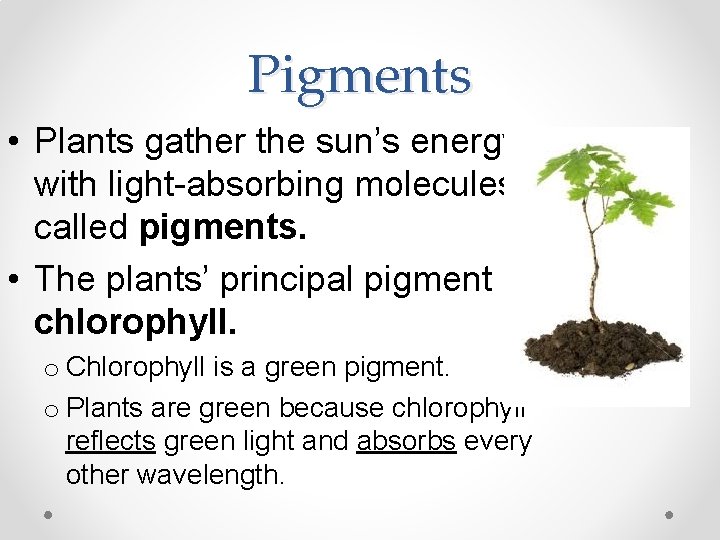
Pigments • Plants gather the sun’s energy with light-absorbing molecules called pigments. • The plants’ principal pigment is chlorophyll. o Chlorophyll is a green pigment. o Plants are green because chlorophyll reflects green light and absorbs every other wavelength.

Pigments • There are two types of chlorophyll found in plants, chlorophyll a and chlorophyll b. • Chlorophyll absorbs blue-violet and red light very well, but not green. o Remember, green light is reflected, and not absorbed.
Measuring Light Absorption • A spectrophotometer measures a pigment’s ability to absorb various wavelengths • This machine sends light through pigments and measures the fraction of light transmitted at each wavelength

LE 10 -8 a White light Refracting prism Chlorophyll solution Photoelectric tube Galvanometer 0 Slit moves to pass light of selected wavelength Green light 100 The high transmittance (low absorption) reading indicates that chlorophyll absorbs very little green light.
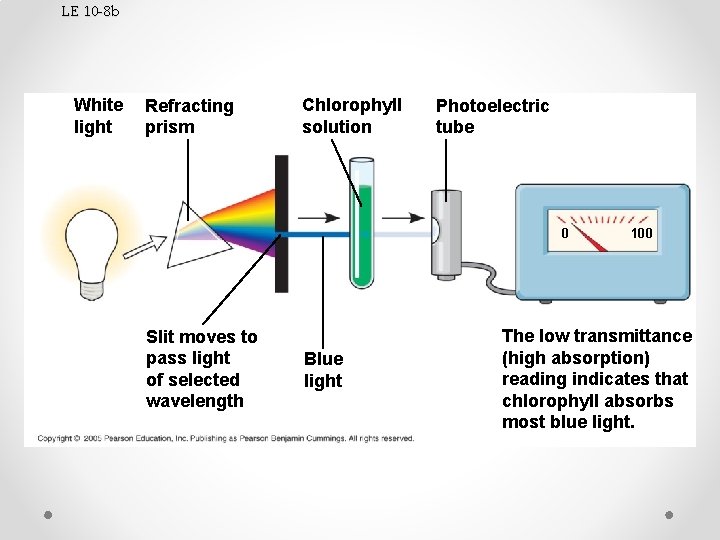
LE 10 -8 b White light Refracting prism Chlorophyll solution Photoelectric tube 0 Slit moves to pass light of selected wavelength Blue light 100 The low transmittance (high absorption) reading indicates that chlorophyll absorbs most blue light.
• An absorption spectrum is a graph plotting a pigment’s light absorption versus wavelength • The absorption spectrum of chlorophyll a suggests that violet-blue and red light work best for photosynthesis
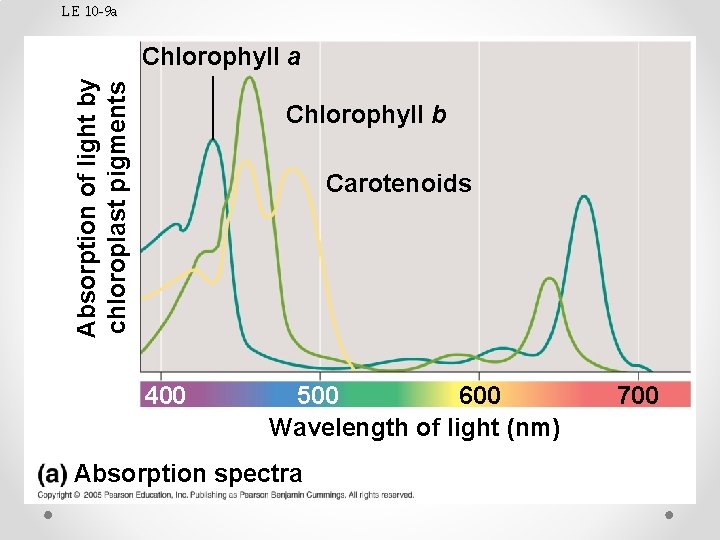
LE 10 -9 a Absorption of light by chloroplast pigments Chlorophyll a Chlorophyll b Carotenoids 400 500 600 Wavelength of light (nm) Absorption spectra 700
Pigments • Plant cells contain other pigments besides chlorophyll that increase the wavelengths absorbed. o These are called carotenoids. • During the summer, so much chlorophyll is produced that the green color overwhelms the other pigments. • When temperatures drop, the plants stop producing chlorophyll, and the other pigments may be seen.
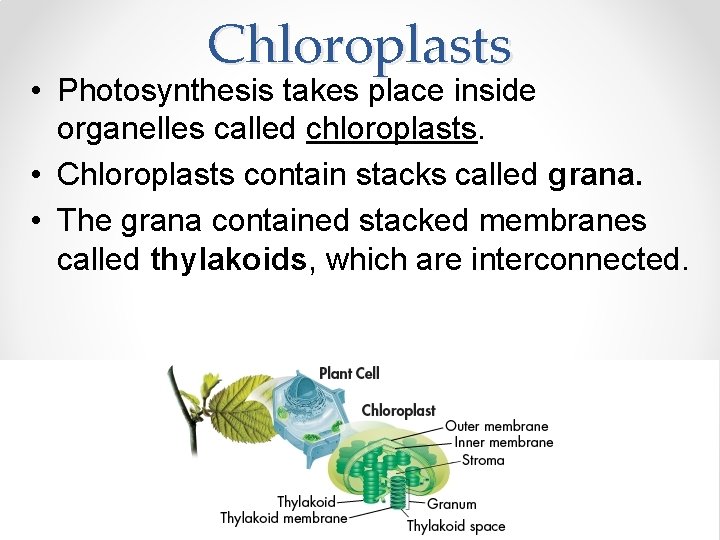
Chloroplasts • Photosynthesis takes place inside organelles called chloroplasts. • Chloroplasts contain stacks called grana. • The grana contained stacked membranes called thylakoids, which are interconnected.
Chloroplasts • Leaves are the major locations of photosynthesis • Their green color is from chlorophyll, the green pigment within chloroplasts • Light energy absorbed by chlorophyll drives the reactions needed to produce sugars from carbon dioxide. • The plant “breathes” through microscopic pores called stomata. o CO 2 enters the leaf and O 2 exits
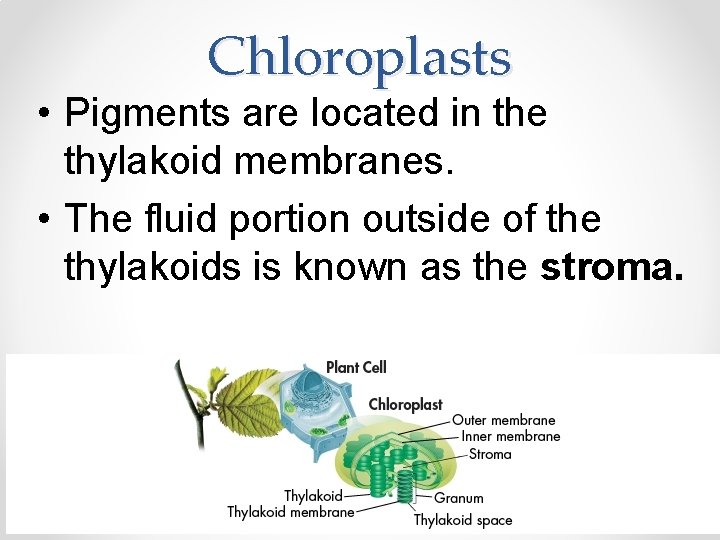
Chloroplasts • Pigments are located in the thylakoid membranes. • The fluid portion outside of the thylakoids is known as the stroma.
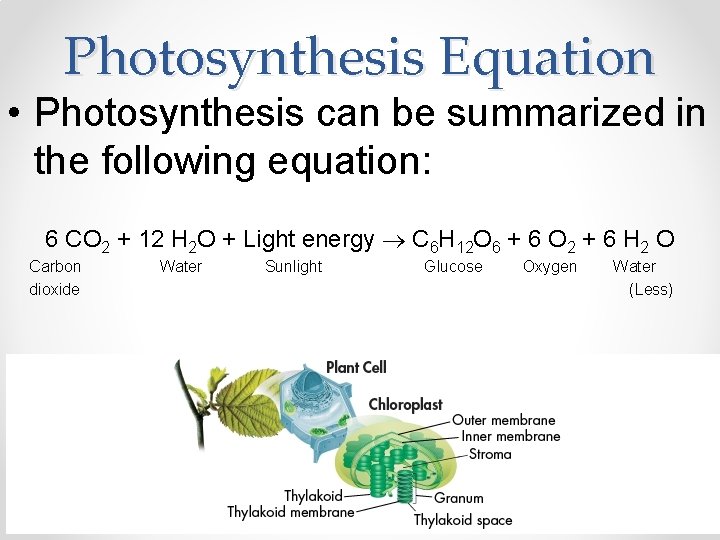
Photosynthesis Equation • Photosynthesis can be summarized in the following equation: 6 CO 2 + 12 H 2 O + Light energy C 6 H 12 O 6 + 6 O 2 + 6 H 2 O Carbon dioxide Water Sunlight Glucose Oxygen Water (Less)
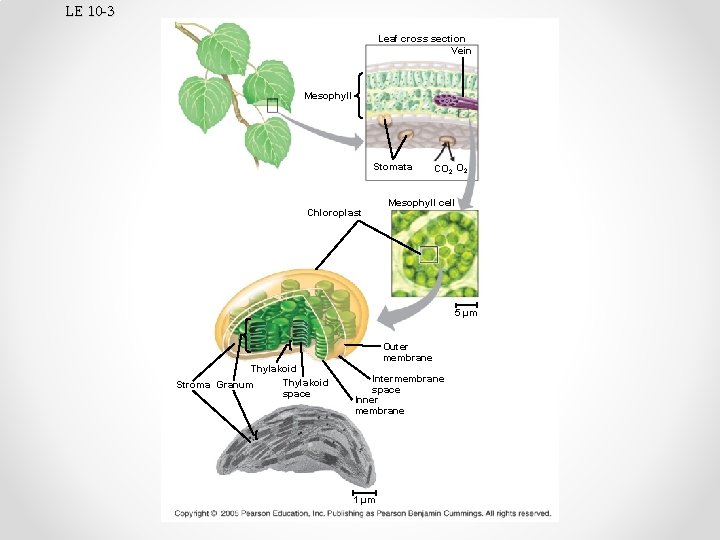
LE 10 -3 Leaf cross section Vein Mesophyll Stomata Chloroplast CO 2 Mesophyll cell 5 µm Outer membrane Thylakoid Stroma Granum space Intermembrane space Inner membrane 1 µm
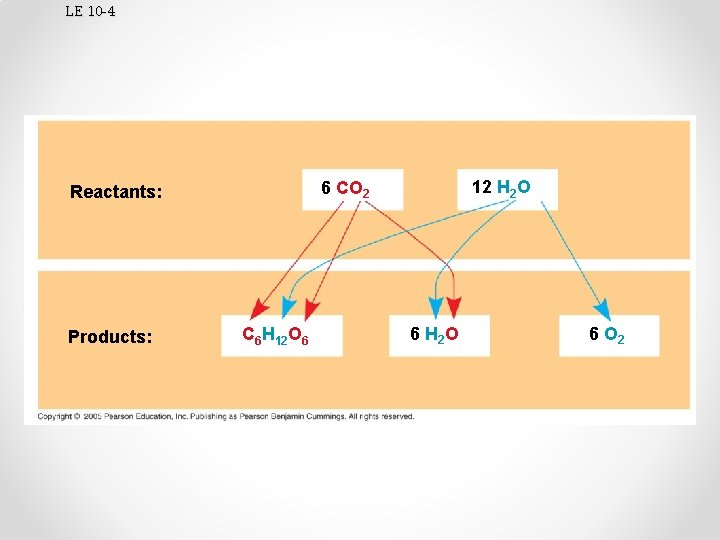
LE 10 -4 Products: 12 H 2 O 6 CO 2 Reactants: C 6 H 12 O 6 6 H 2 O 6 O 2
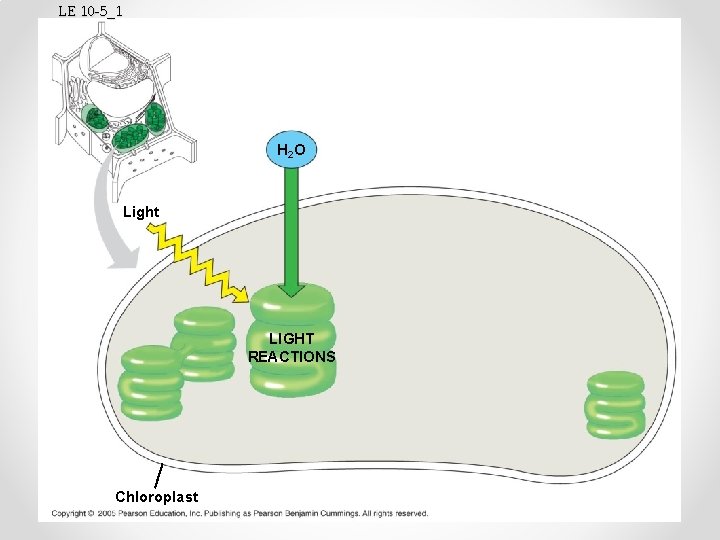
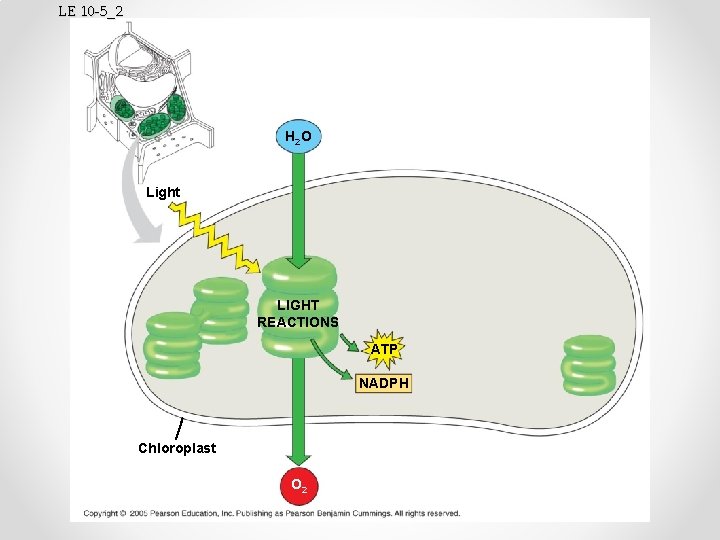
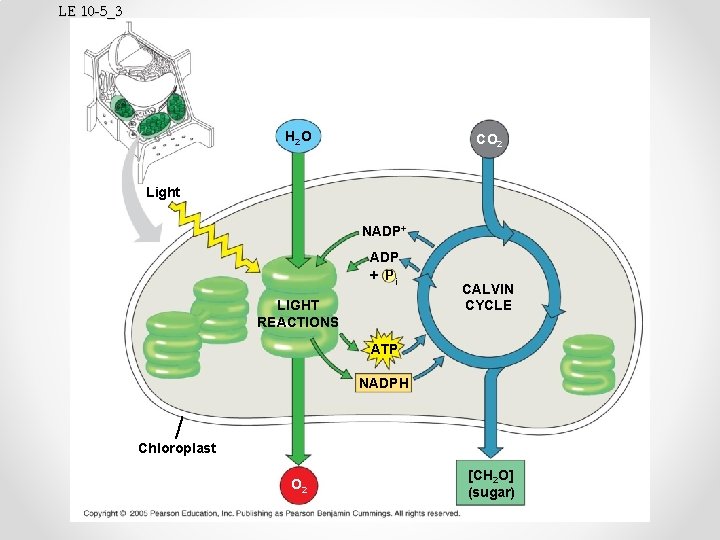
Stages of Photosynthesis • Photosynthesis consists of the light reactions (the photo part) and Calvin cycle (the synthesis part) • The light reactions occur in the thylakoids of the chloroplast. o Splits water, releases O 2, produces ATP and NADPH • The Calvin cycle occurs in the stroma of the chloroplast. o Forms sugar from CO 2 using ATP and NADPH
LE 10 -5_1 H 2 O Light LIGHT REACTIONS Chloroplast
LE 10 -5_2 H 2 O Light LIGHT REACTIONS ATP NADPH Chloroplast O 2
LE 10 -5_3 H 2 O CO 2 Light NADP+ ADP + Pi LIGHT REACTIONS CALVIN CYCLE ATP NADPH Chloroplast O 2 [CH 2 O] (sugar)
ATP and NADPH • Chloroplasts are solar-powered chemical factories • Their thylakoids transform light energy into the chemical energy of ATP and NADPH. o These are small energy-containing molecules that can be used to make glucose later.
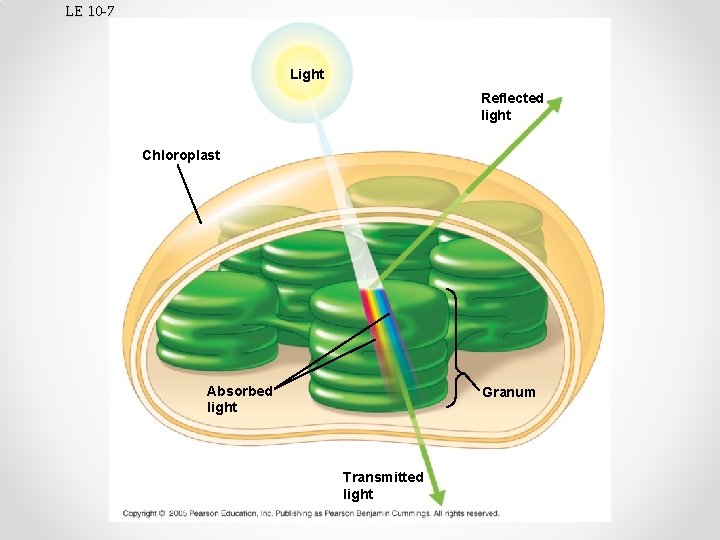
LE 10 -7 Light Reflected light Chloroplast Absorbed light Granum Transmitted light
Absorption of Sunlight • When chlorophyll absorbs light, it goes from a low-energy ground state to an high-energy excited state, which is unstable. • When excited electrons fall back to the ground state, photons are given off causing fluorescence.
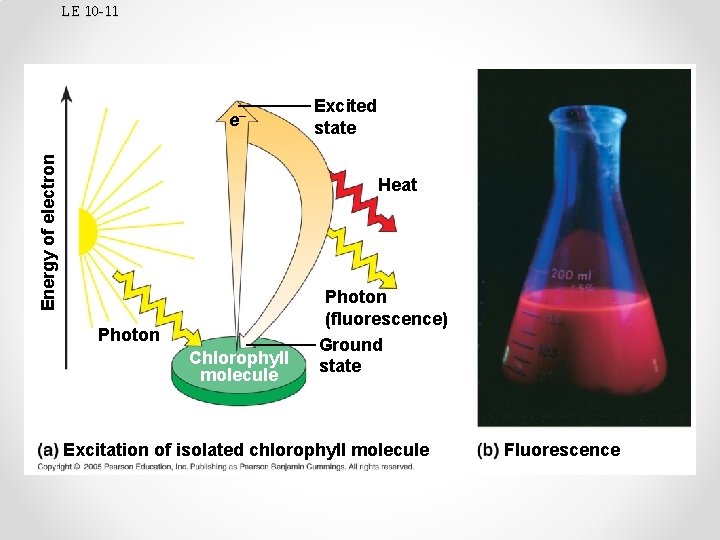
LE 10 -11 Energy of electron e– Excited state Heat Photon Chlorophyll molecule Photon (fluorescence) Ground state Excitation of isolated chlorophyll molecule Fluorescence
The Photosystem • The basic unit of photosynthesis in the thylakoid is called a photosystem. • A photosystem contains a reaction center surrounded by light-harvesting complexes • The light-harvesting complexes (pigment molecules) funnel the energy from photons of sunlight to the reaction center.
• The reaction center contains chlorophyll, which absorbs the energy from the photon. • This splits a water molecule into O 2 , 2 H+ ions, and 2 electrons. • These electrons are energized and passed onto another molecule called the primary electron acceptor.
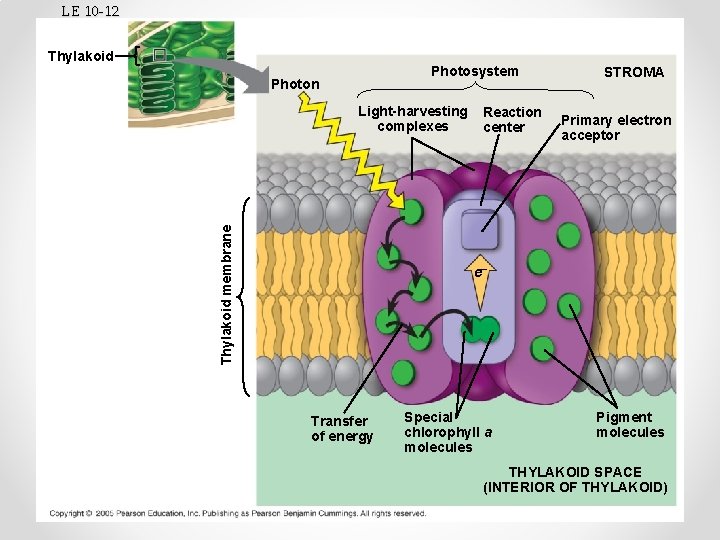
LE 10 -12 Thylakoid Photosystem Photon Thylakoid membrane Light-harvesting complexes Reaction center STROMA Primary electron acceptor e– Transfer of energy Special chlorophyll a molecules Pigment molecules THYLAKOID SPACE (INTERIOR OF THYLAKOID)
• There are two types of photosystems in the thylakoid membrane: • Photosystem II absorbs wavelengths of sunlight 680 nm long. • Photosystem I then absorbs wavelengths of sunlight 700 nm long. • The two photosystems work together to use light energy to generate ATP and NADPH
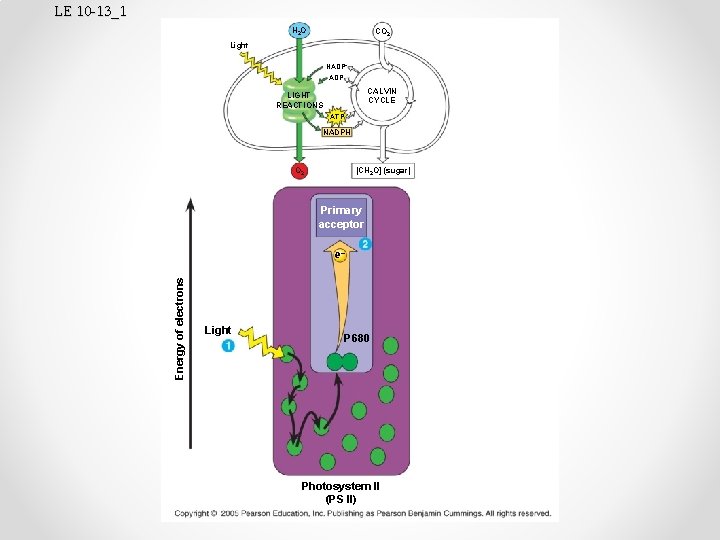
LE 10 -13_1 H 2 O CO 2 Light NADP+ ADP CALVIN CYCLE LIGHT REACTIONS ATP NADPH O 2 [CH 2 O] (sugar) Primary acceptor Energy of electrons e– Light P 680 Photosystem II (PS II)
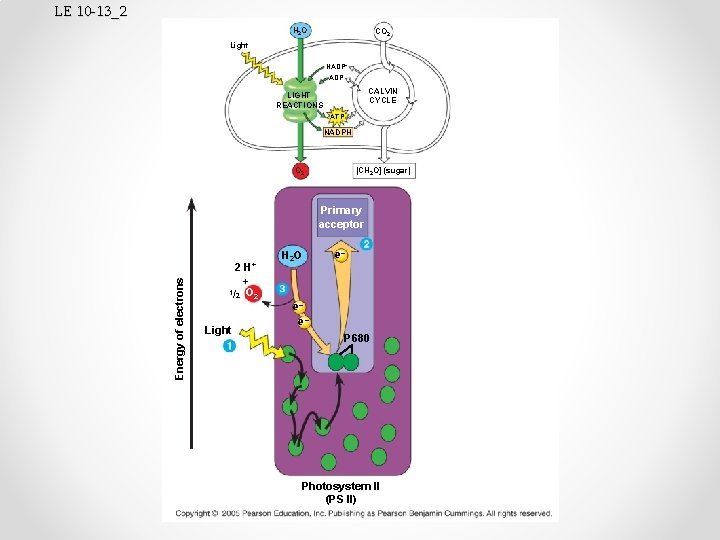
LE 10 -13_2 H 2 O CO 2 Light NADP+ ADP CALVIN CYCLE LIGHT REACTIONS ATP NADPH O 2 [CH 2 O] (sugar) Energy of electrons Primary acceptor 2 H+ 1/2 + O 2 Light H 2 O e– e– e– P 680 Photosystem II (PS II)
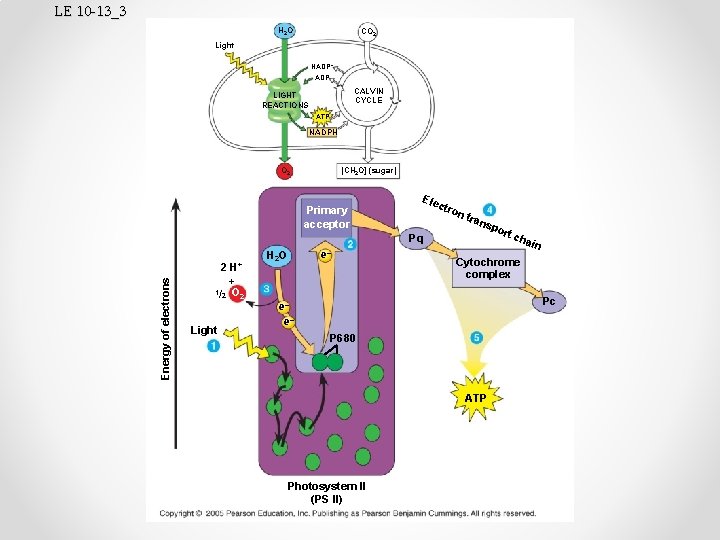
LE 10 -13_3 H 2 O CO 2 Light NADP+ ADP CALVIN CYCLE LIGHT REACTIONS ATP NADPH O 2 [CH 2 O] (sugar) Primary acceptor Ele ctro n tr ans por Energy of electrons Pq 2 H+ + 1/2 O 2 Light H 2 O e– t ch ain Cytochrome complex Pc e– e– P 680 ATP Photosystem II (PS II)
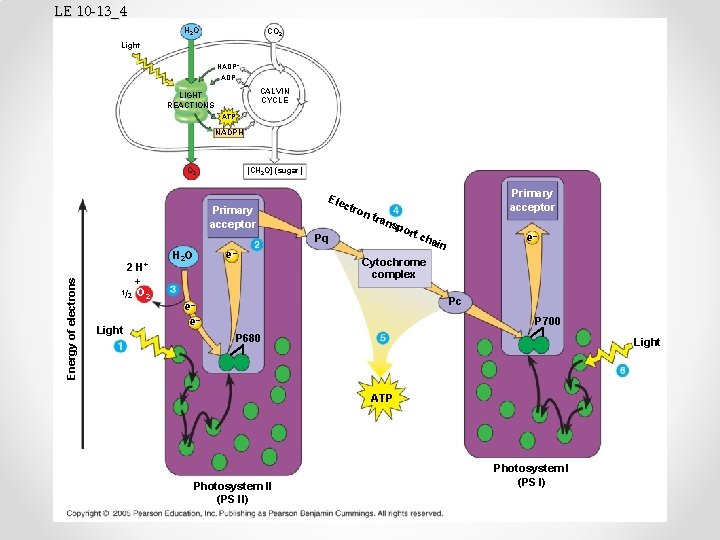
LE 10 -13_4 H 2 O CO 2 Light NADP+ ADP CALVIN CYCLE LIGHT REACTIONS ATP NADPH O 2 [CH 2 O] (sugar) Primary acceptor Ele n tr ans por Energy of electrons Pq 2 H+ 1/2 + O 2 Light H 2 O e– Primary acceptor ctro t ch e– ain Cytochrome complex Pc e– e– P 700 P 680 Light ATP Photosystem II (PS II) Photosystem I (PS I)
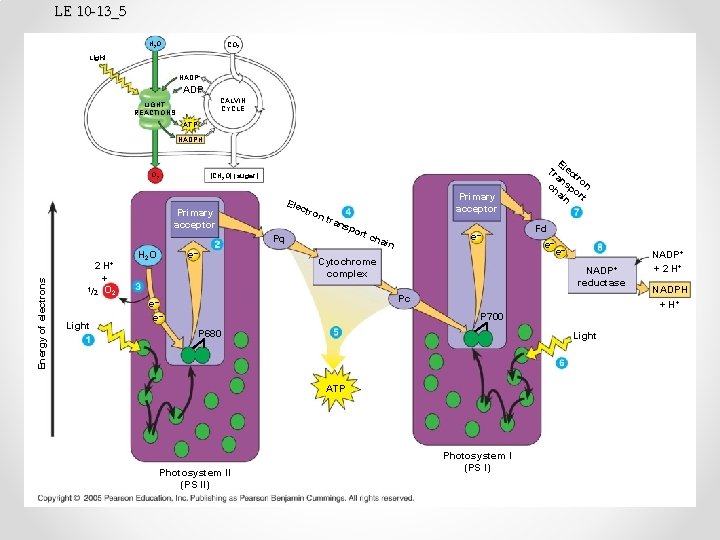
LE 10 -13_5 H 2 O CO 2 Light NADP+ ADP CALVIN CYCLE LIGHT REACTIONS ATP NADPH O 2 Ele ctro Primary acceptor n tr ans Pq Energy of electrons 2 H+ e– H 2 O por t ch e– ain Cytochrome complex + 1/2 O 2 Light E Tr lec an tro ch sp n ai ort n [CH 2 O] (sugar) Fd e– e– NADP+ reductase Pc e– e– P 700 P 680 Light ATP Photosystem II (PS II) Photosystem I (PS I) NADP+ + 2 H+ NADPH + H+
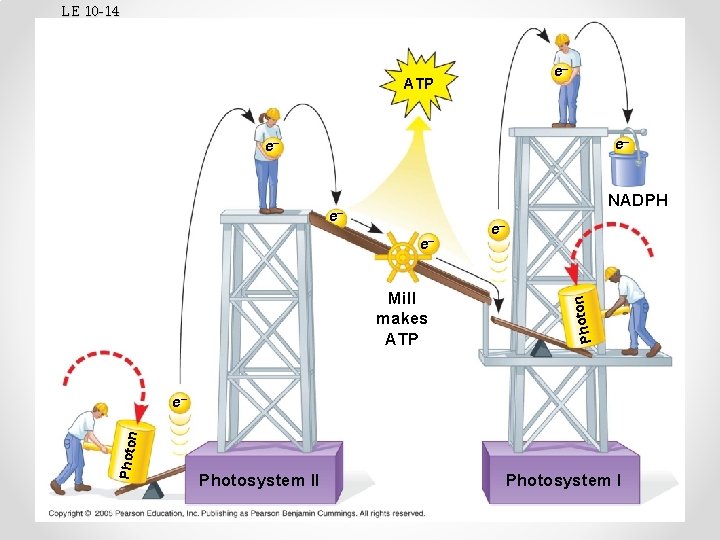
LE 10 -14 e– ATP e– e– NADPH Mill makes ATP n e– e– Photon e– Photosystem II Photosystem I
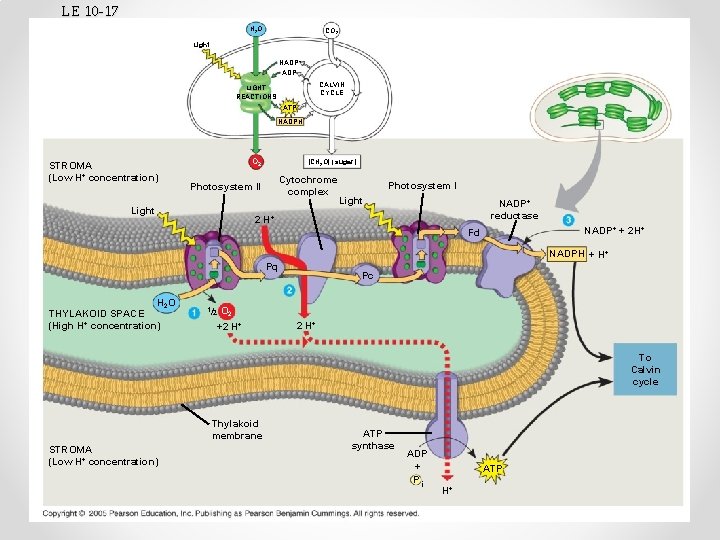
LE 10 -17 H 2 O CO 2 Light NADP+ ADP CALVIN CYCLE LIGHT REACTIONS ATP NADPH STROMA (Low H+ concentration) O 2 [CH 2 O] (sugar) Cytochrome complex Photosystem II Light 2 Photosystem I Light NADP+ reductase H+ NADP+ + 2 H+ Fd NADPH + H+ Pq H 2 O THYLAKOID SPACE (High H+ concentration) 1/2 Pc O 2 +2 H+ To Calvin cycle Thylakoid membrane STROMA (Low H+ concentration) ATP synthase ADP + Pi ATP H+
Building Glucose • The Calvin cycle builds sugar from smaller molecules by using ATP and NADPH • Carbon enters the cycle as CO 2 and leaves as a sugar named glyceraldehyde-3 -phospate (G 3 P) o To make one G 3 P, the cycle must take place three times, using up three molecules of CO 2
• The Calvin cycle has three phases: o Three atoms of carbon from carbon dioxide are added to the cycle using an enzyme called rubisco. • This creates a 6 -carbon molecule o ATP and NADPH is used to create two molecules of G 3 P • One leaves the cycle, one stays behind o The original molecules in the cycle are then regenerated using more ATP
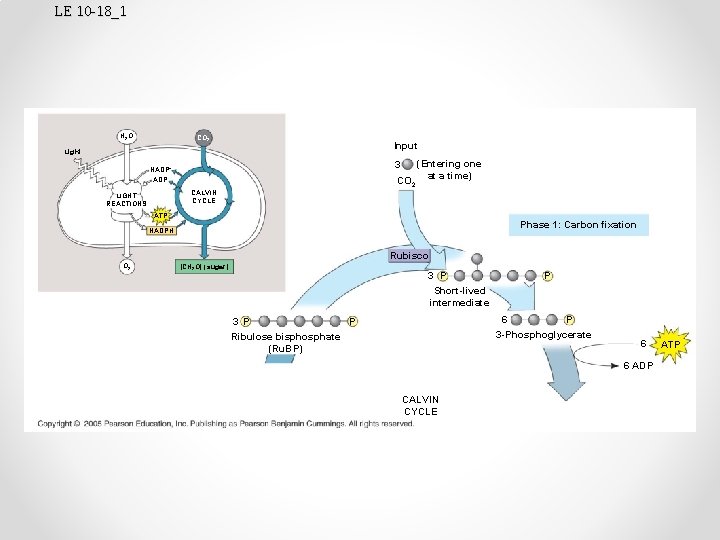
LE 10 -18_1 H 2 O CO 2 Input Light (Entering one CO 2 at a time) 3 NADP+ ADP CALVIN CYCLE LIGHT REACTIONS ATP Phase 1: Carbon fixation NADPH Rubisco O 2 [CH 2 O] (sugar) 3 P Short-lived intermediate P P 6 3 -Phosphoglycerate 3 P P Ribulose bisphosphate (Ru. BP) 6 6 ADP CALVIN CYCLE ATP
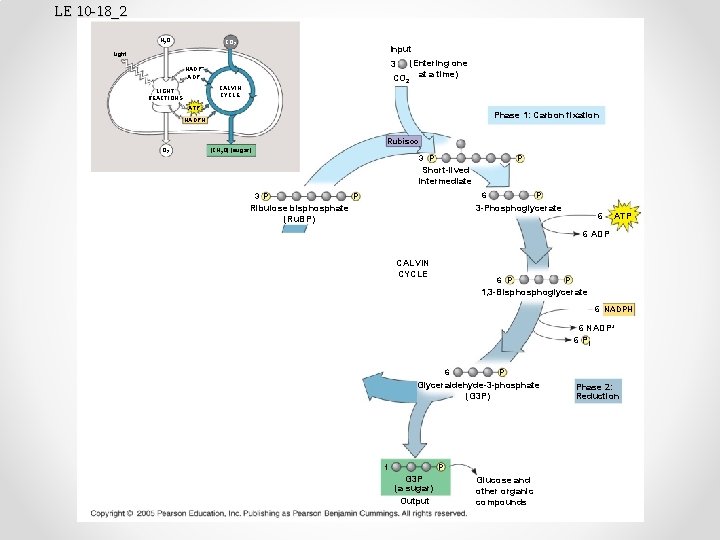
LE 10 -18_2 H 2 O CO 2 Input Light (Entering one CO 2 at a time) 3 NADP+ ADP CALVIN CYCLE LIGHT REACTIONS ATP Phase 1: Carbon fixation NADPH Rubisco O 2 [CH 2 O] (sugar) 3 P P Short-lived intermediate 3 P P 6 P 3 -Phosphoglycerate Ribulose bisphosphate (Ru. BP) 6 ATP 6 ADP CALVIN CYCLE 6 P P 1, 3 -Bisphoglycerate 6 NADPH 6 NADP+ 6 Pi 6 P Glyceraldehyde-3 -phosphate (G 3 P) 1 P G 3 P (a sugar) Output Glucose and other organic compounds Phase 2: Reduction
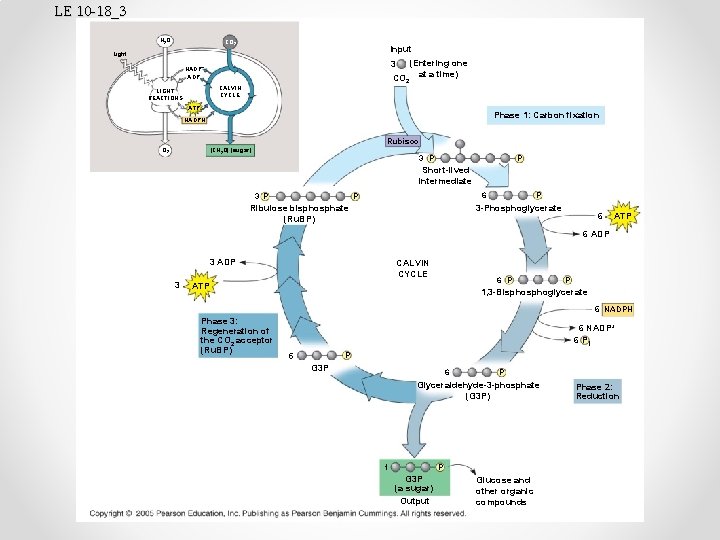
LE 10 -18_3 H 2 O CO 2 Input Light (Entering one CO 2 at a time) 3 NADP+ ADP CALVIN CYCLE LIGHT REACTIONS ATP Phase 1: Carbon fixation NADPH Rubisco O 2 [CH 2 O] (sugar) 3 P P Short-lived intermediate 3 P P 6 P 3 -Phosphoglycerate Ribulose bisphosphate (Ru. BP) 6 ATP 6 ADP 3 CALVIN CYCLE 6 P ATP P 1, 3 -Bisphoglycerate 6 NADPH Phase 3: Regeneration of the CO 2 acceptor (Ru. BP) 6 NADP+ 6 Pi P 5 G 3 P 6 P Glyceraldehyde-3 -phosphate (G 3 P) 1 P G 3 P (a sugar) Output Glucose and other organic compounds Phase 2: Reduction
Adaptations in Arid Environments • Dehydration is a problem for plants, especially in hot, arid ecosystems. • On hot, dry days, plants close their stomata, which conserves water but also limits photosynthesis. o Plants are unable to take in CO 2 and remove O 2. • These conditions favor a seemingly wasteful process called photorespiration.
Photorespiration: An Evolutionary Relic? • In photorespiration, O 2 is added to the Calvin cycle instead of CO 2 • This produces a molecule that must be sent to the mitochondria before it can be sent back and the Calvin cycle finished. o This uses more energy to produce G 3 P, and is much less efficient for the plant.
• Photorespiration may be an evolutionary relic because rubisco first evolved at a time when the atmosphere had far less O 2 and more CO 2 • In many plants, photorespiration is a problem because on a hot, dry day it can drain much of the plant’s ATP and NADPH.
C 4 Plants • Some plants have an adaptation to manage life in arid climates. These are called C 4 plants. o Example: Sugar cane, corn • These plants minimize the cost of photorespiration by incorporating CO 2 into four-carbon compounds and storing them in areas of the leaf less exposed to the dry air. • These four-carbon compounds can be used to release carbon dioxide when the stomata are closed, allowing the Calvin cycle to continue like normal.
CAM Plants • CAM plants open their stomata at night, incorporating CO 2 into organic acids • Stomata close during the day, and CO 2 is released from organic acids and used in the Calvin cycle
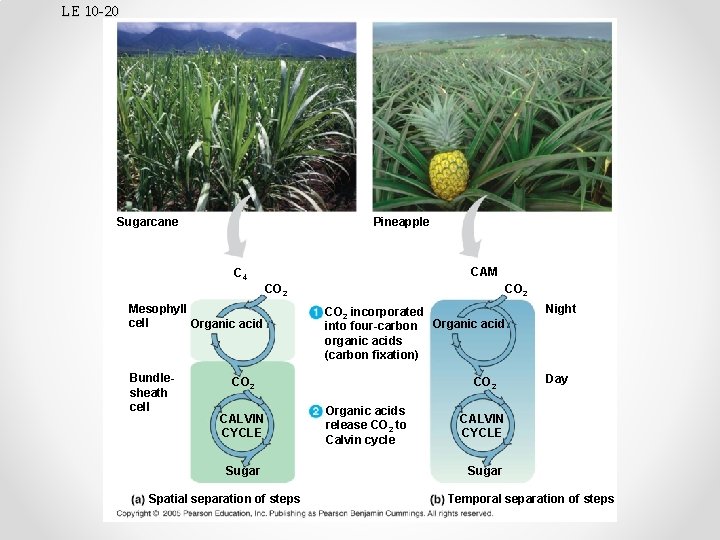
LE 10 -20 Sugarcane Pineapple CAM C 4 CO 2 Mesophyll cell Organic acid Bundlesheath cell CO 2 incorporated into four-carbon Organic acid organic acids (carbon fixation) CO 2 CALVIN CYCLE Sugar Spatial separation of steps CO 2 Organic acids release CO 2 to Calvin cycle Night Day CALVIN CYCLE Sugar Temporal separation of steps
- Slides: 57