
Photosynthesis Early Questions about Plants How does a
Photosynthesis
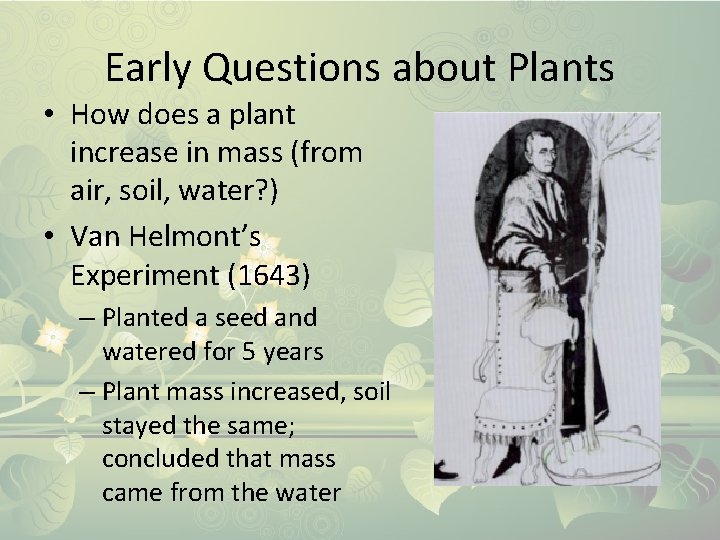
Early Questions about Plants • How does a plant increase in mass (from air, soil, water? ) • Van Helmont’s Experiment (1643) – Planted a seed and watered for 5 years – Plant mass increased, soil stayed the same; concluded that mass came from the water
Priestly (1771) • Burned candle in bell jar until it went out • Placed sprig of mint in bell jar for a few days, then the candle could be relit • Concluded that plants released a substance (O 2) necessary for burning

Ingenhousz (1779) • Repeated Priestley’s experiment with and without sunlight • Showed that Priestley’s results only occurred in the presence of sunlight • Light was necessary for plants to produce oxygen
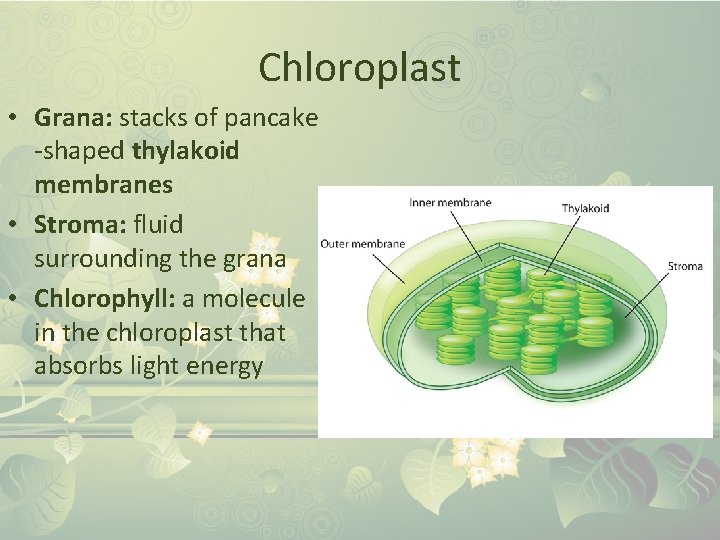
Chloroplast • Grana: stacks of pancake -shaped thylakoid membranes • Stroma: fluid surrounding the grana • Chlorophyll: a molecule in the chloroplast that absorbs light energy
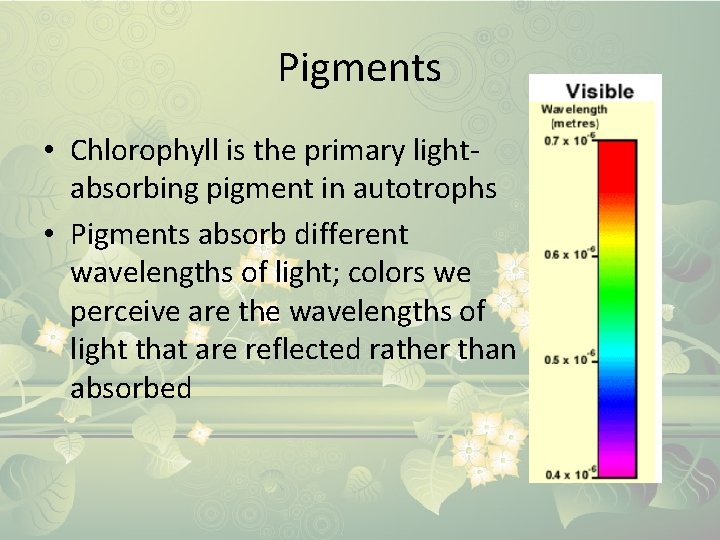
Pigments • Chlorophyll is the primary lightabsorbing pigment in autotrophs • Pigments absorb different wavelengths of light; colors we perceive are the wavelengths of light that are reflected rather than absorbed
Chlorophyll a and b • Chlorophyll a – Found in all plants, algae, cyanobacteria – Reflects green – Necessary for photosynthesis (light reactions) • Chlorophyll b – Accessory pigment (also reflects green) – Can transfer energy to chlorophyll a – Other accessory pigments: carotenes (orange), xanthophylls (yellow, brown), phycobilins (red)
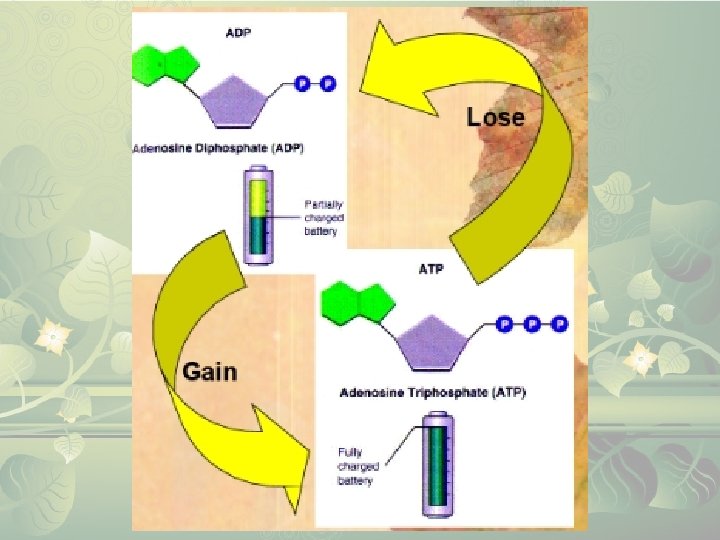
Energy Storing Compounds • Energy is required to form bonds to build glucose (photosynthesis) and is released when glucose is split apart (respiration) 1. NADP+ (electron carrier) NADPH (energy) Nicotinamide adenine dinucleotide phosphate 2. ADP (energy carrier) ATP (most important energy storing compound that is used by all living cells)
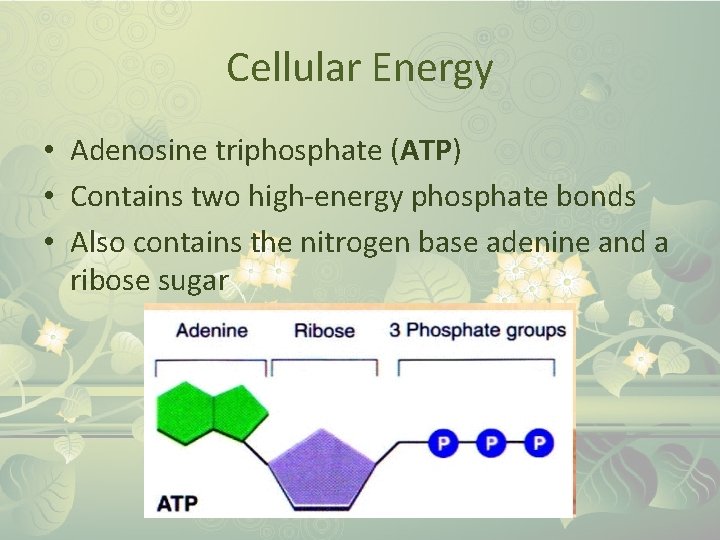
Cellular Energy • Adenosine triphosphate (ATP) • Contains two high-energy phosphate bonds • Also contains the nitrogen base adenine and a ribose sugar
Releasing Energy from ATP • Breaking the last phosphate bond from ATP will: – Release energy for cells to use – Form ADP • Dephosphorylation – When free phosphate group is added back to an ADP molecule to produce ATP phosphorylation
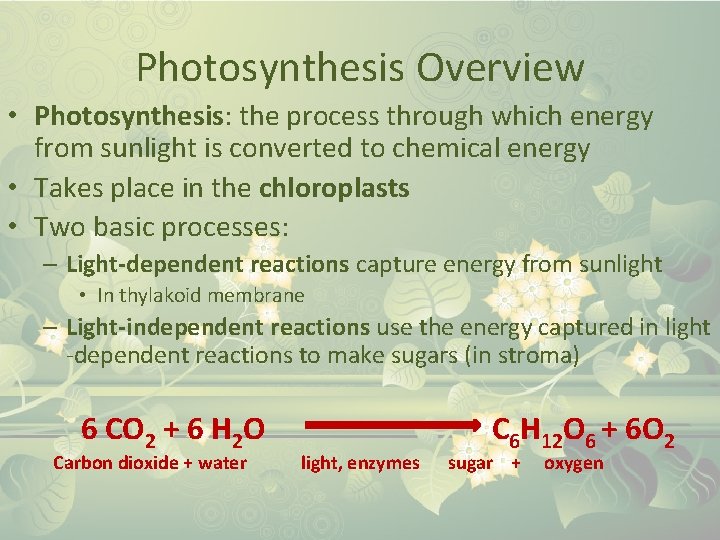
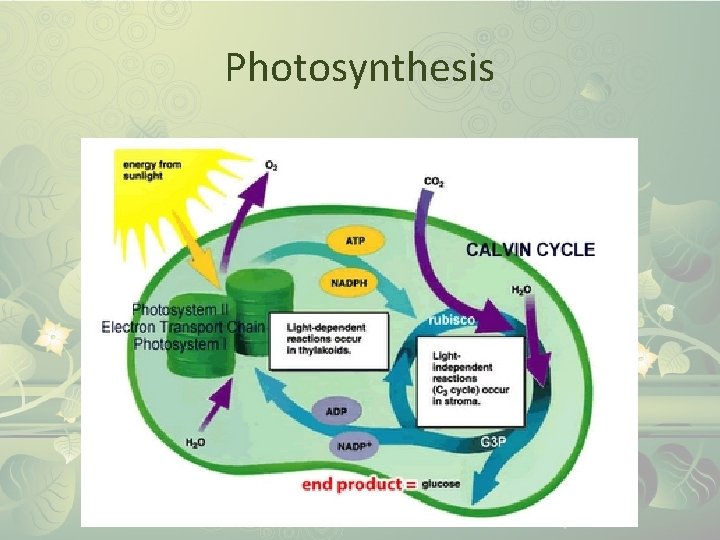
Photosynthesis Overview • Photosynthesis: the process through which energy from sunlight is converted to chemical energy • Takes place in the chloroplasts • Two basic processes: – Light-dependent reactions capture energy from sunlight • In thylakoid membrane – Light-independent reactions use the energy captured in light -dependent reactions to make sugars (in stroma) 6 CO 2 + 6 H 2 O Carbon dioxide + water light, enzymes C 6 H 12 O 6 + 6 O 2 sugar + oxygen
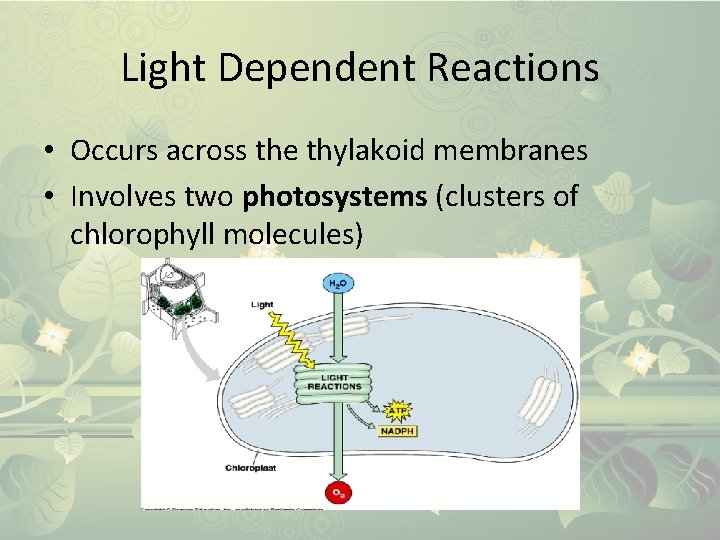
Light Dependent Reactions • Occurs across the thylakoid membranes • Involves two photosystems (clusters of chlorophyll molecules)
Photosystem II 1. Energy absorbed from sunlight 2. Water molecules split – Oxygen is released as waste 3. H+ ions transported – H+ ions build up inside thylakoid membrane – Electrons move on to photosystem I
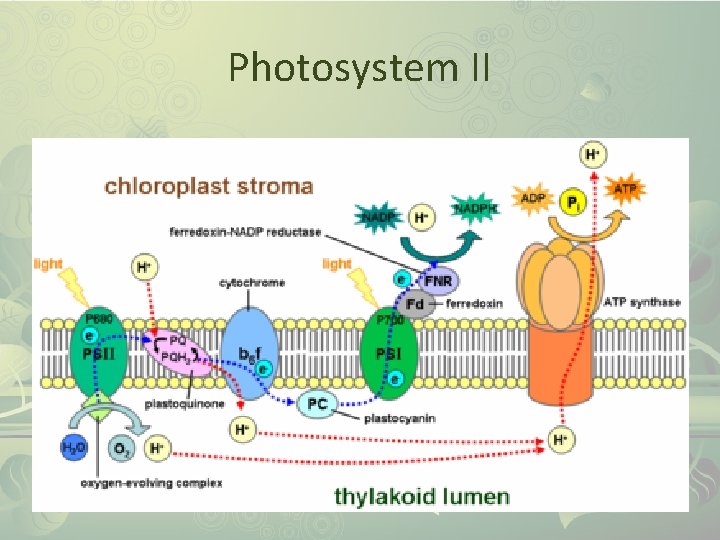
Photosystem II
Photosystem I and Energy-Carrying Molecules Electron Transport Chain 1. Energy is absorbed again from sunlight 2. NADPH (an energy molecule) is produced by electrons being added to NADP+ molecules 3. H+ ions move through a protein channel called ATP synthase in the thylakoid membrane, forming ATP (energy)
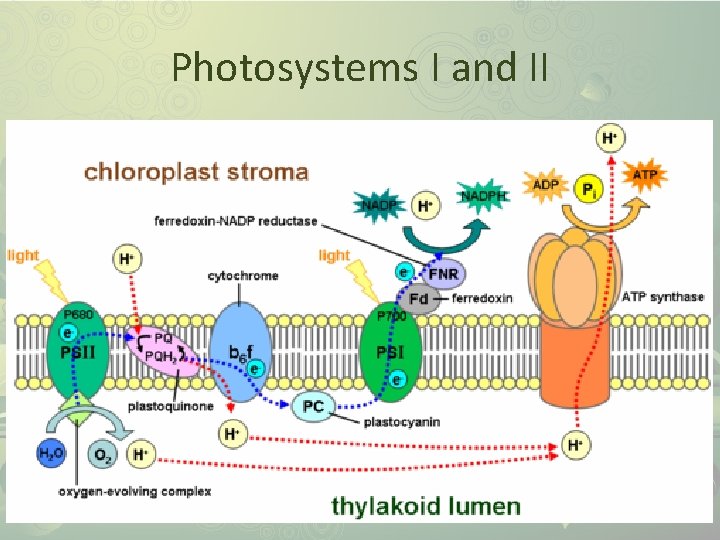
Photosystems I and II
Summary of Light-Dependent Reactions • Energy is captured and transferred to electrons that enter the electron transport chain • Water molecules are broken down into oxygen, H+ ions, and electrons • Electrons provide energy for H+ ion transport and are added to NADP+ to form NADPH • H+ ions flowing through ATP synthase make ATP
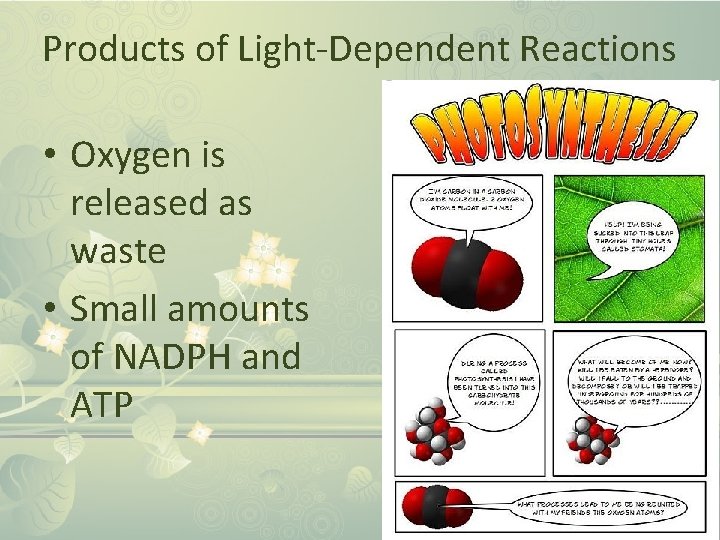
Products of Light-Dependent Reactions • Oxygen is released as waste • Small amounts of NADPH and ATP
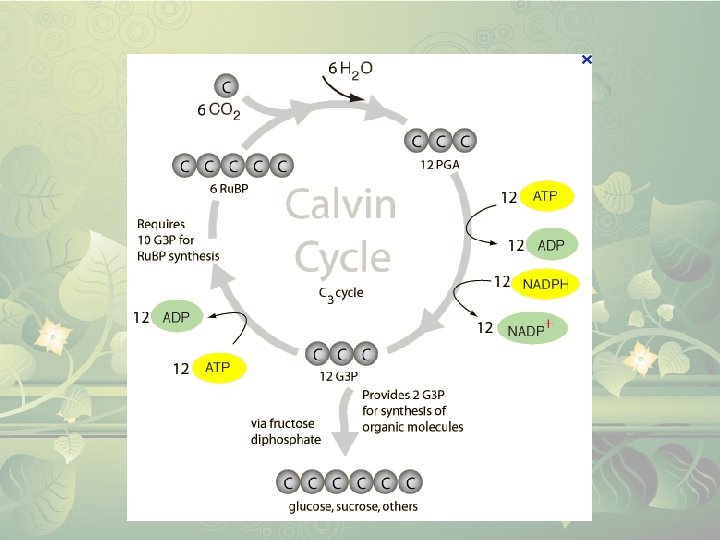
Light-Independent Reactions • Do not need sunlight • Uses energy from light-dependent reactions • Take place inside the stroma (fluid surrounding thylakoid membranes) • Also called the Calvin Cycle or dark reactions • Use carbon dioxide and ATP and NADPH molecules to build simple sugars (carbon fixation)
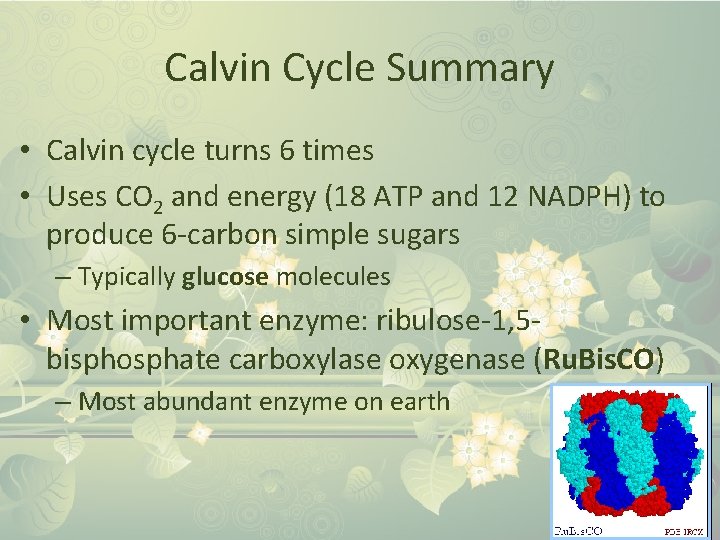
Calvin Cycle Summary • Calvin cycle turns 6 times • Uses CO 2 and energy (18 ATP and 12 NADPH) to produce 6 -carbon simple sugars – Typically glucose molecules • Most important enzyme: ribulose-1, 5 bisphosphate carboxylase oxygenase (Ru. Bis. CO) – Most abundant enzyme on earth
Calvin Cycle • Ru. Bis. CO helps put together CO 2 + Ribulose biphosphate (Ru. BP… a 5 -carbon compound) • As the cycle proceeds, CO 2 first forms intermediate compounds called PGAL (phosphoglyceraldehyde) • Ultimately forms 6 -carbon glucose – C 6 H 12 O 6 – Stores 90 x more chemical energy than ATP
Photosynthesis
Photosynthesis Summary • Light-dependent reactions (sun chemical energy) – Energy captured and transferred to electrons – Water molecules split, releasing oxygen – A little bit of energy (ATP and NADPH) produced • Light-independent reactions (chemical energy sugars) – Calvin cycle – CO 2 is broken down and ATP and NADPH is used to build 6 -carbon sugar – Uses the enzyme Ru. Bis. CO
- Slides: 26