
Photosynthesis Details The Light Reactions and the Calvin




- Slides: 22
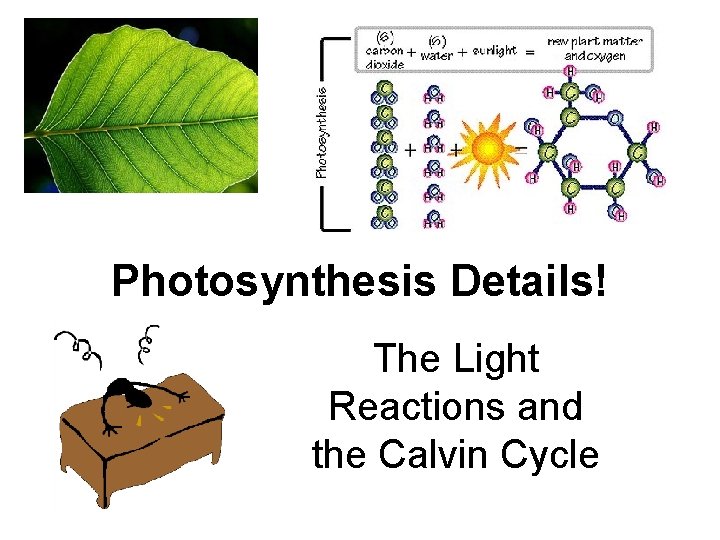
Photosynthesis Details! The Light Reactions and the Calvin Cycle
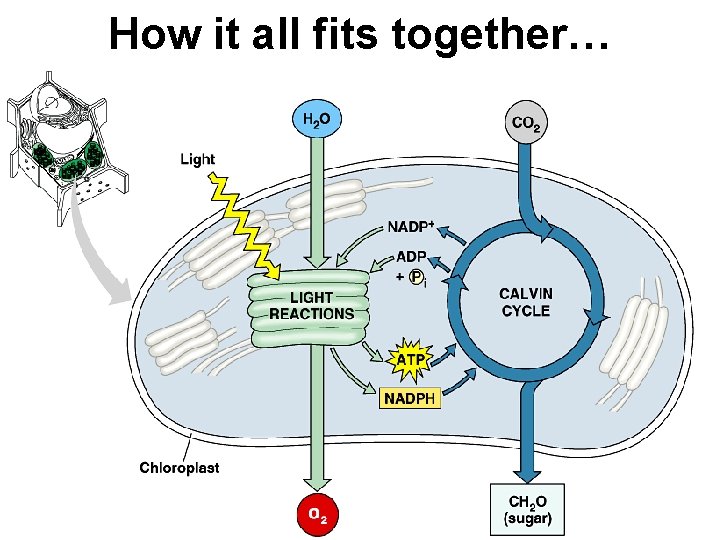
How it all fits together…
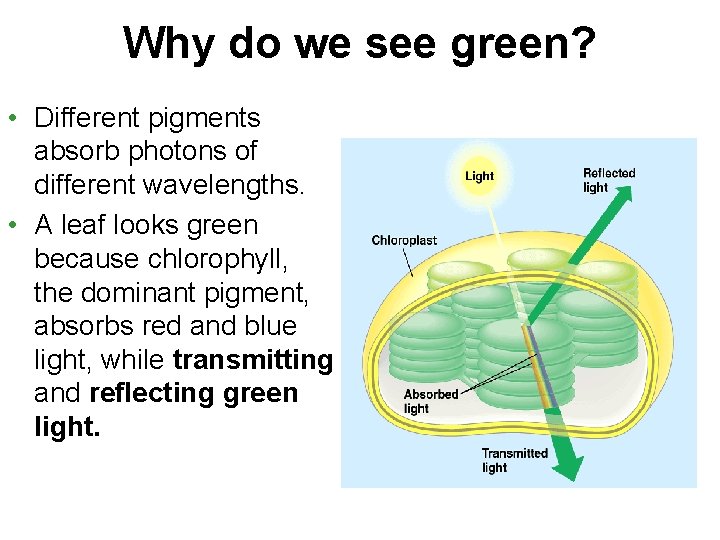
Why do we see green? • Different pigments absorb photons of different wavelengths. • A leaf looks green because chlorophyll, the dominant pigment, absorbs red and blue light, while transmitting and reflecting green light.
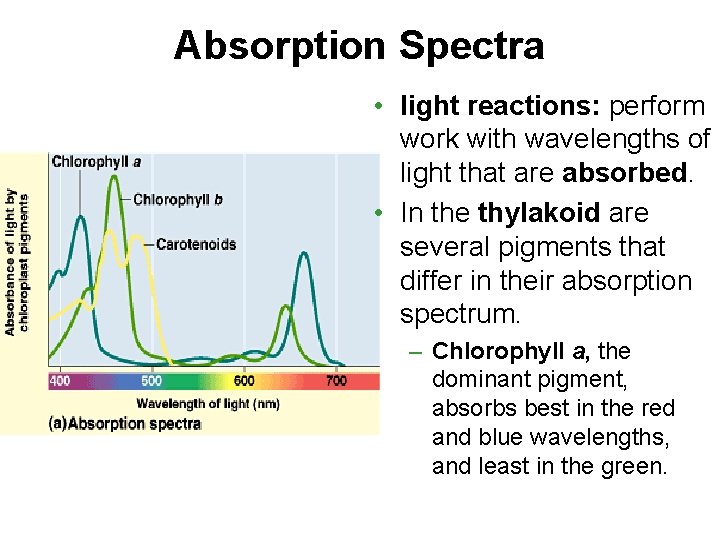
Absorption Spectra • light reactions: perform work with wavelengths of light that are absorbed. • In the thylakoid are several pigments that differ in their absorption spectrum. – Chlorophyll a, the dominant pigment, absorbs best in the red and blue wavelengths, and least in the green.
Photon Absorption • When a molecule absorbs a photon, one of that molecule’s electrons is elevated to an orbital with more potential energy. • Photons are absorbed by clusters of pigment molecules in the thylakoid membranes.
Excited Electrons! • Excited electrons are unstable… they drop to their ground state in a billionth of a second, releasing heat energy. – Car in the sun gets hot! – Some photons release light too…
Photosystems • Photosystems: the “lightharvesting units”, made of chlorophyll, proteins and other organic molecules – consists of a few hundred chlorophyll a, chlorophyll b, and carotenoid molecules • Energy is transmitted from pigment molecule to pigment molecule until it reaches a particular chlorophyll a: the reaction center – Like a satellite dish! • Primary electron acceptor: captures the excited electron
Two Types of Photosystems • Photosystem I: has a reaction center chlorophyll, the P 700 center, that has an absorption peak at 700 nm • Photosystem II: has a reaction center with a peak at 680 nm – differences due to the proteins associated with each reaction center • These two photosystems work together to use light energy to generate ATP and NADPH.
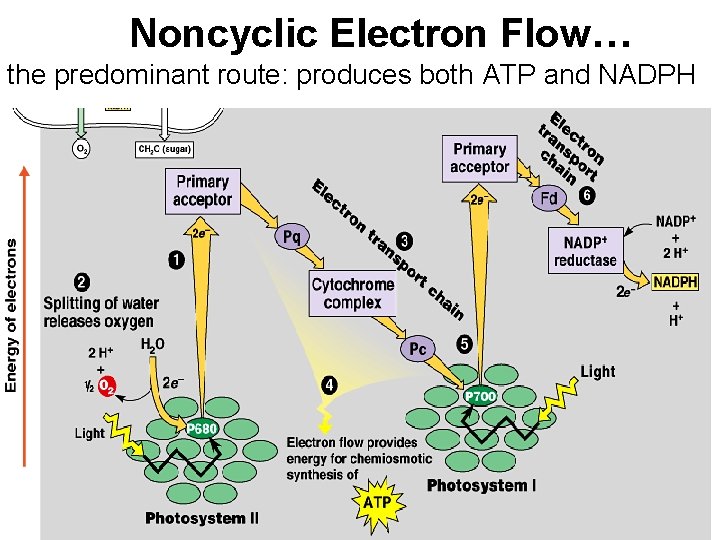
Noncyclic Electron Flow… the predominant route: produces both ATP and NADPH
The steps… 1. Photosystem II absorbs light, 2 excited electrons are passed to P 680 (chlorophyll a). Then the electrons are captured by the primary electron acceptor. 2. Water is split to replace the lost electrons • splits into 2 H+ and an oxygen atom which combines with another to form O 2 3. Excited electrons “fall” down the electron transport chain to Photosystem I
4. Energy of “falling” electrons is used to make ATP using chemiosmosis across the thylakoid membrane: noncyclic photophosphorylation – ATP is used by the Calvin Cycle 5. The falling electrons fill a “hole” in P 700 (chlorophyll a) in Photosystem I. This hole is created when photons excite electrons on the photosystem I complex. The light energy sends 2 electrons to another primary electron acceptor 6. Electrons “fall” down a second electron transport chain. Electrons are picked up by NADP+ to form NADPH – NADPH will go to the Calvin Cycle
Summary • The light reactions use the solar power of photons absorbed by both photosystem I and photosystem II to provide chemical energy in the form of ATP and reducing power in the form of the electrons carried by NADPH
Calvin says, “I need more ATP!” • Problem: Noncyclic electron flow produces about the same amount of ATP and NADPH, but the Calvin Cycle uses MORE ATP – Cyclic Electron Flow makes up the difference. • Cyclic Electron Flow: uses only photosystem I, but electrons are sent down the first electron transport chain to make ATP – generate ATP by cyclic photophosphorylation
Cyclic Electron Flow
Chemiosmosis (again? !) • Yup! …electron transport chain pumps protons across a membrane as electrons are passed along a series of more electronegative carriers. • This builds the H+ gradient across the membrane. • ATP synthase molecules generate ATP as H+ diffuses back across the membrane.
The Calvin Cycle • Carbon enters the cycle in the form of CO 2 and leaves as sugar • The actual sugar product of the Calvin cycle is not glucose, but a three-carbon sugar, glyceraldehyde -3 -phosphate (G 3 P) – G 3 P is the starting material for making other organic compounds, including glucose and other carbohydrates. • spends the energy of ATP and the reducing power of electrons carried by NADPH to make the sugar – 1 G 3 P = 9 ATP and 6 NAPDH – The cycle must take place 3 times, fixing 3 molecules of carbon dioxide • 3 Phases…
Phase 1: Carbon fixation • each CO 2 molecule is attached to a five-carbon sugar, ribulose bisphosphate (Ru. BP). • This enzyme rubisco catalyzes the first step • The 6 -carbon intermediate splits in half to form two molecules of 3 -phosphoglycerate per CO 2.
Phase 2: Reduction • each 3 -phosphoglycerate receives another phosphate group from ATP • NADPH donates a pair of electrons • Six molecules of G 3 P are produced, but only 1 exits the cycle (others are reused) • G 3 P can be used to make glucose and other organic compounds
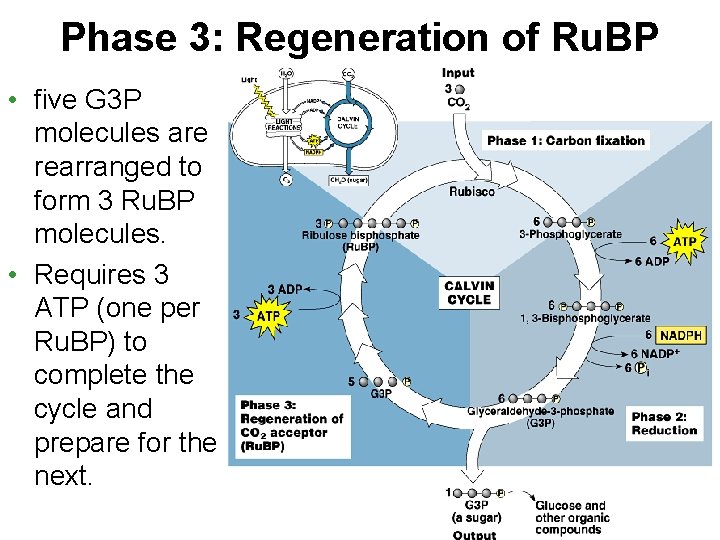
Phase 3: Regeneration of Ru. BP • five G 3 P molecules are rearranged to form 3 Ru. BP molecules. • Requires 3 ATP (one per Ru. BP) to complete the cycle and prepare for the next.
Now I need a nap!