
Photosynthesis Copyright 2005 Pearson Education Inc publishing as
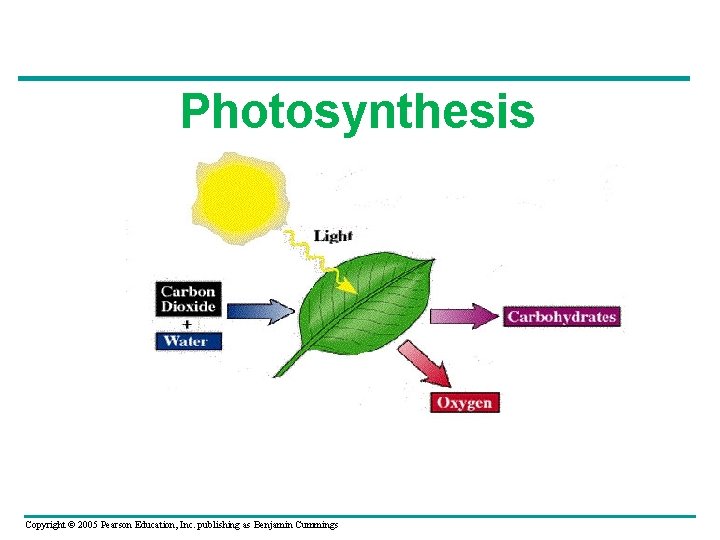
Photosynthesis Copyright © 2005 Pearson Education, Inc. publishing as Benjamin Cummings
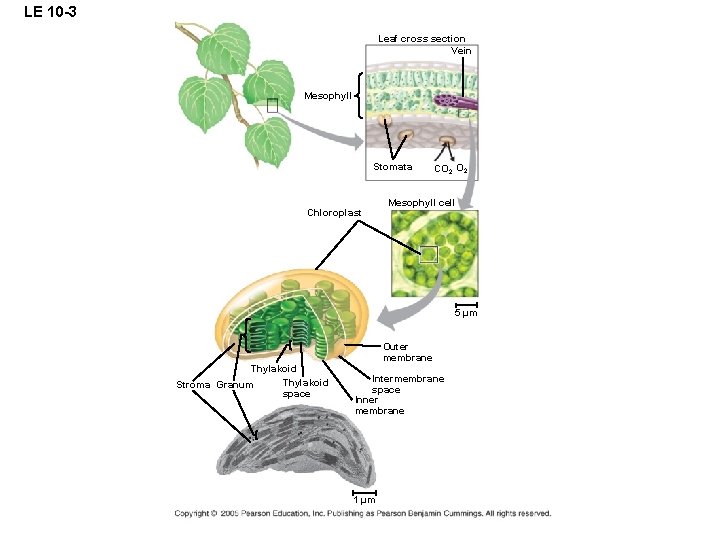
LE 10 -3 Leaf cross section Vein Mesophyll Stomata Chloroplast CO 2 Mesophyll cell 5 µm Outer membrane Thylakoid Stroma Granum space Intermembrane space Inner membrane 1 µm
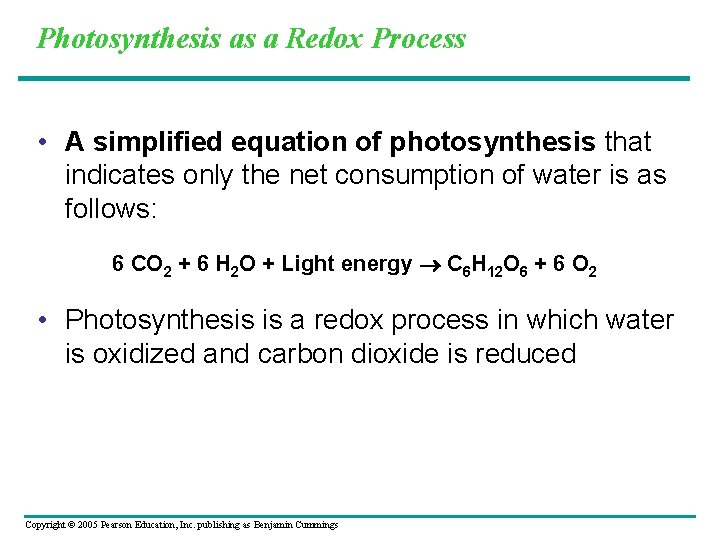
Photosynthesis as a Redox Process • A simplified equation of photosynthesis that indicates only the net consumption of water is as follows: 6 CO 2 + 6 H 2 O + Light energy C 6 H 12 O 6 + 6 O 2 • Photosynthesis is a redox process in which water is oxidized and carbon dioxide is reduced Copyright © 2005 Pearson Education, Inc. publishing as Benjamin Cummings
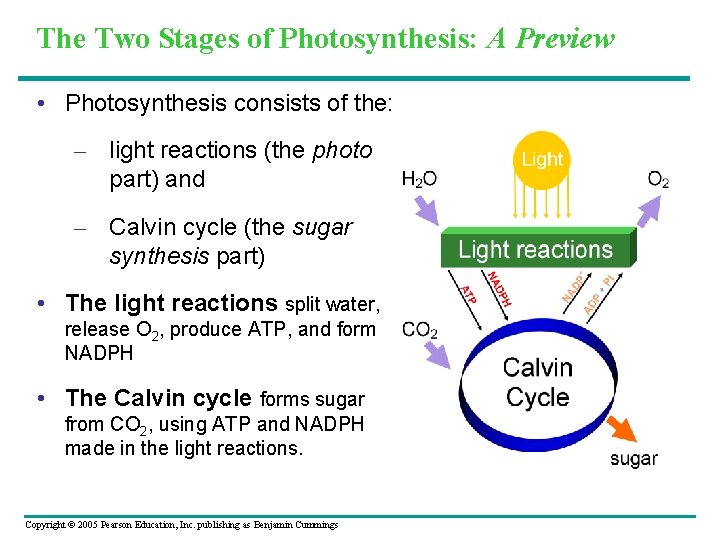
The Two Stages of Photosynthesis: A Preview • Photosynthesis consists of the: – light reactions (the photo part) and – Calvin cycle (the sugar synthesis part) • The light reactions split water, release O 2, produce ATP, and form NADPH • The Calvin cycle forms sugar from CO 2, using ATP and NADPH made in the light reactions. Copyright © 2005 Pearson Education, Inc. publishing as Benjamin Cummings
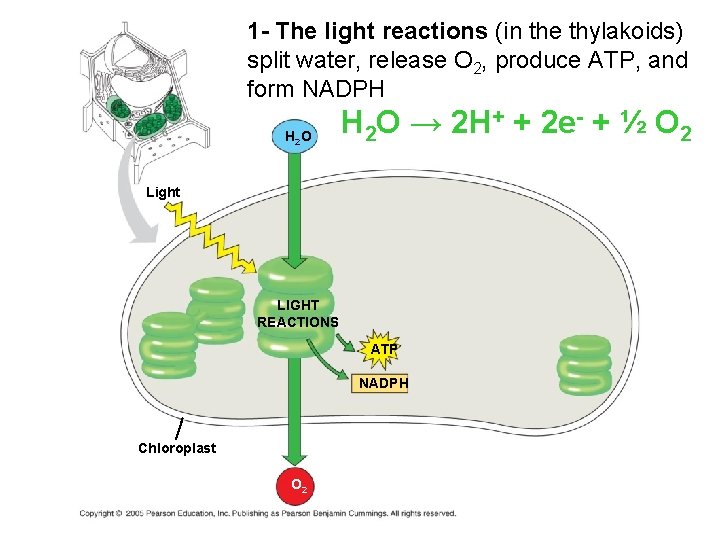
1 - The light reactions (in the thylakoids) split water, release O 2, produce ATP, and form NADPH H 2 O → 2 H+ + 2 e- + ½ O 2 Light LIGHT REACTIONS ATP NADPH Chloroplast O 2
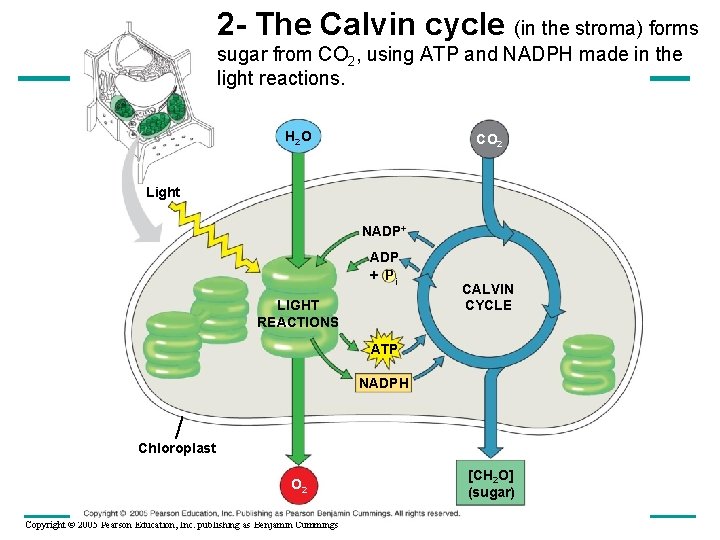
2 - The Calvin cycle (in the stroma) forms sugar from CO 2, using ATP and NADPH made in the light reactions. H 2 O CO 2 Light NADP+ ADP + Pi LIGHT REACTIONS CALVIN CYCLE ATP NADPH Chloroplast O 2 Copyright © 2005 Pearson Education, Inc. publishing as Benjamin Cummings [CH 2 O] (sugar)
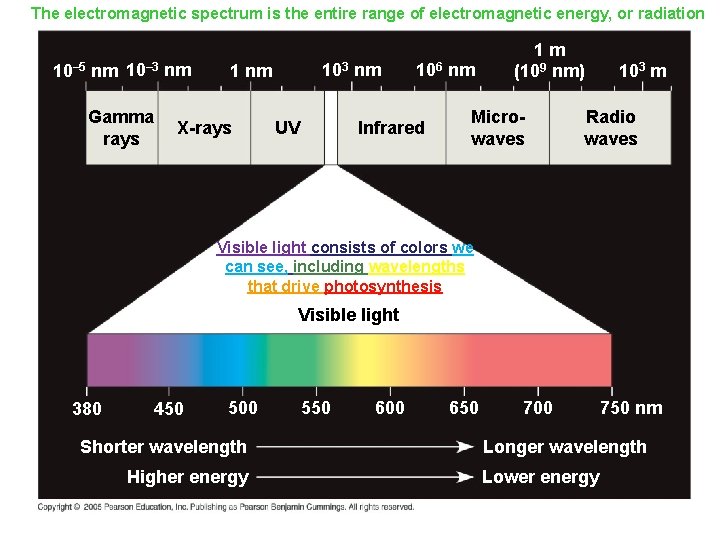
The electromagnetic spectrum is the entire range of electromagnetic energy, or radiation 10– 5 nm 10– 3 nm Gamma rays 103 nm 1 nm X-rays 106 nm Infrared UV 1 m (109 nm) Microwaves 103 m Radio waves Visible light consists of colors we can see, including wavelengths that drive photosynthesis Visible light 380 450 500 Shorter wavelength Higher energy 550 600 650 700 750 nm Longer wavelength Lower energy
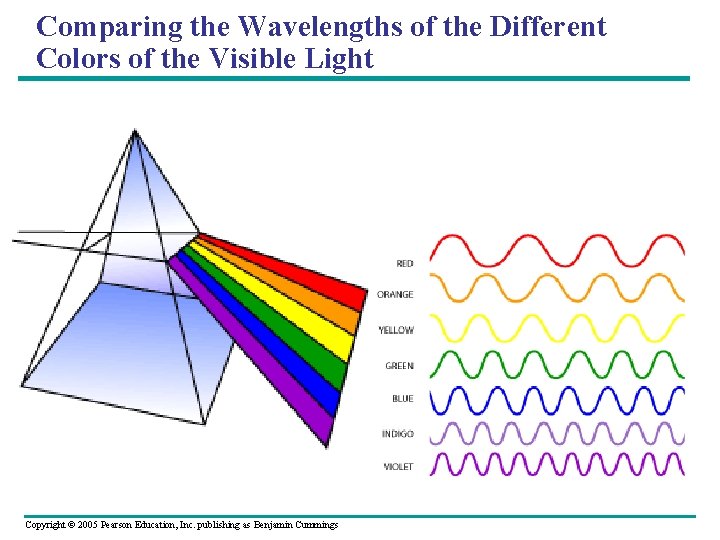
Comparing the Wavelengths of the Different Colors of the Visible Light Copyright © 2005 Pearson Education, Inc. publishing as Benjamin Cummings
Photosynthetic Pigments: The Light Receptors • Pigments are substances that absorb visible light • Different pigments absorb different wavelengths • Wavelengths that are not absorbed are reflected or transmitted • Leaves appear green because chlorophyll reflects and transmits green light Copyright © 2005 Pearson Education, Inc. publishing as Benjamin Cummings
Photosynthetic Pigments • The main photosynthetic pigment is called – Chlorophyll a. • The accessory pigments are: – chlorophyll b – carotenoids absorb excessive light that would damage chlorophyll. Types of carotenoids: – Carotenes (are pure hydrocarbons, made solely from C & H. For example: -carotene in carrots) – Xanthophylls (are oxygenated hydrocarbons, made of C, H & O. For example lycopene, the red pigment in tomatoes) Copyright © 2005 Pearson Education, Inc. publishing as Benjamin Cummings
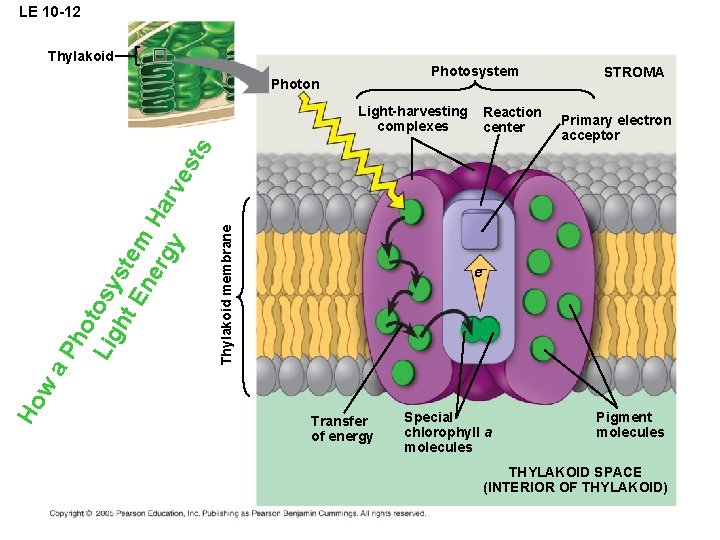
LE 10 -12 Thylakoid Photosystem Photon Reaction center Primary electron acceptor Thylakoid membrane e– Ho w a. P ho Lig tosy ht ste En m er Ha gy rv es ts Light-harvesting complexes STROMA Transfer of energy Special chlorophyll a molecules Pigment molecules THYLAKOID SPACE (INTERIOR OF THYLAKOID)
The Light Reactions • During the light reactions, there are two possible routes for electron flow: 1 - the linear (noncyclic) electron flow. 2 - the cyclic electron flow. Copyright © 2005 Pearson Education, Inc. publishing as Benjamin Cummings
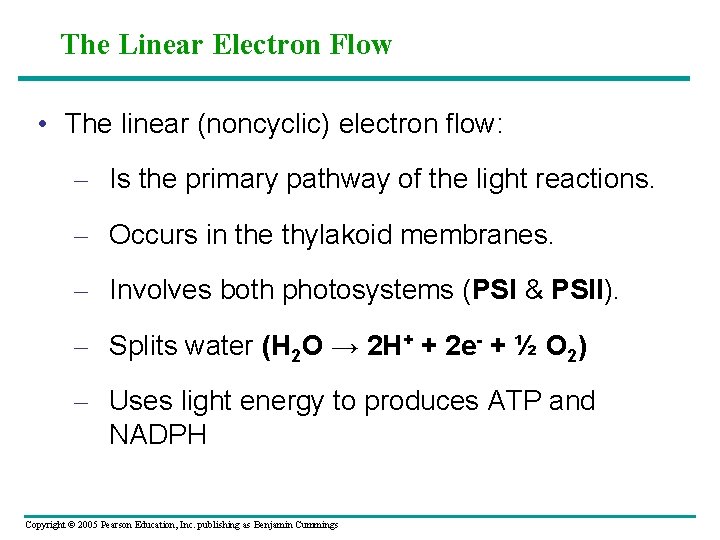
The Linear Electron Flow • The linear (noncyclic) electron flow: – Is the primary pathway of the light reactions. – Occurs in the thylakoid membranes. – Involves both photosystems (PSI & PSII). – Splits water (H 2 O → 2 H+ + 2 e- + ½ O 2) – Uses light energy to produces ATP and NADPH Copyright © 2005 Pearson Education, Inc. publishing as Benjamin Cummings
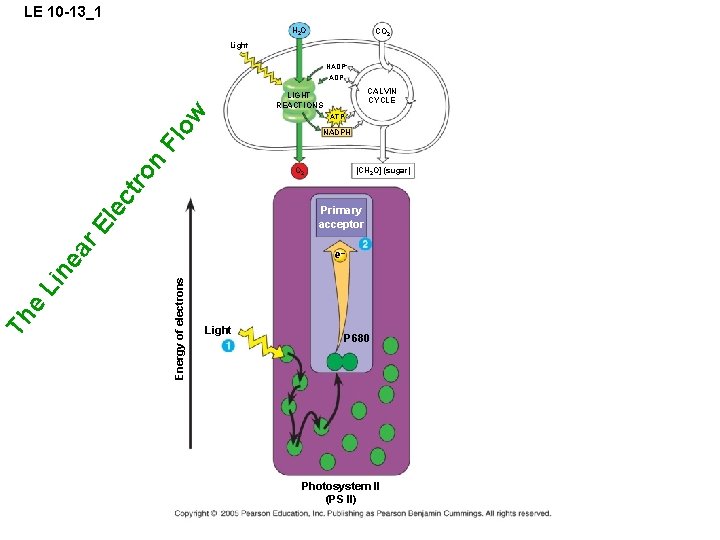
LE 10 -13_1 H 2 O CO 2 Light NADP+ ADP CALVIN CYCLE ow LIGHT REACTIONS ATP ro n Fl NADPH ct O 2 le Primary acceptor r. E e– Energy of electrons Li ne a Th e [CH 2 O] (sugar) Light P 680 Photosystem II (PS II)
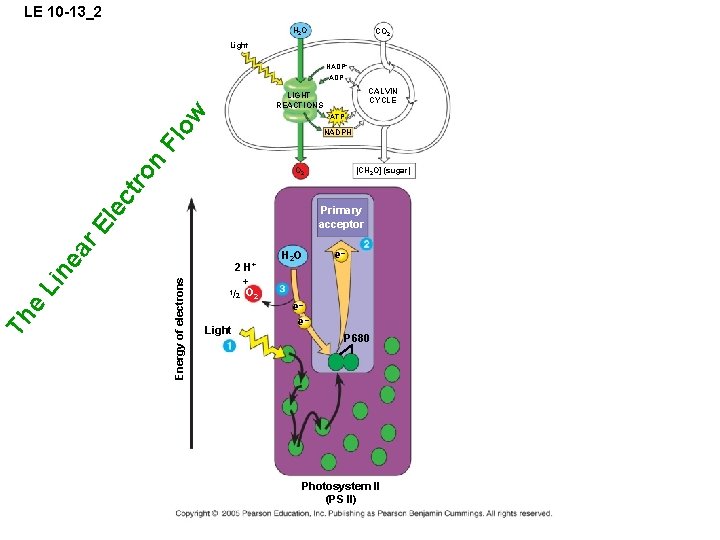
LE 10 -13_2 H 2 O CO 2 Light NADP+ ADP CALVIN CYCLE ow LIGHT REACTIONS ATP ro n Fl NADPH ct O 2 le Primary acceptor Energy of electrons r. E Li ne a Th e [CH 2 O] (sugar) 2 H+ 1/2 + O 2 Light H 2 O e– e– e– P 680 Photosystem II (PS II)
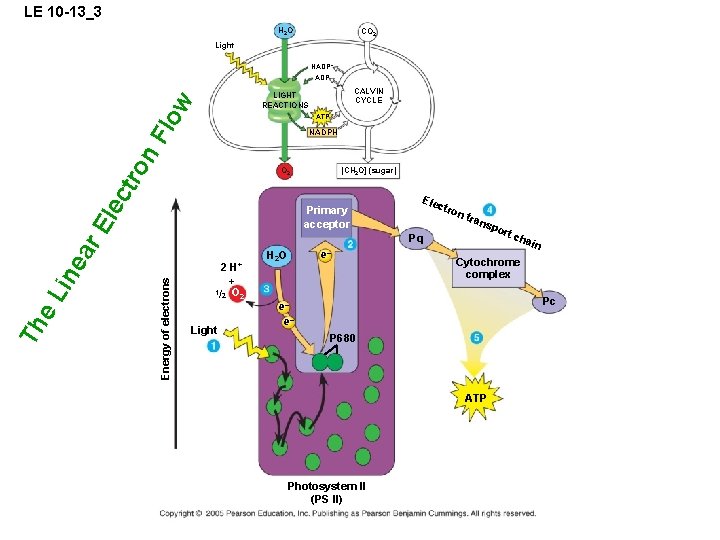
LE 10 -13_3 H 2 O CO 2 Light NADP+ ADP low ATP tro n. F NADPH lec O 2 [CH 2 O] (sugar) Primary acceptor ar E Ele ctro n Pq Energy of electrons e. L ine Th CALVIN CYCLE LIGHT REACTIONS 2 H+ + 1/2 O 2 Light H 2 O e– tran spo rt c hai n Cytochrome complex Pc e– e– P 680 ATP Photosystem II (PS II)
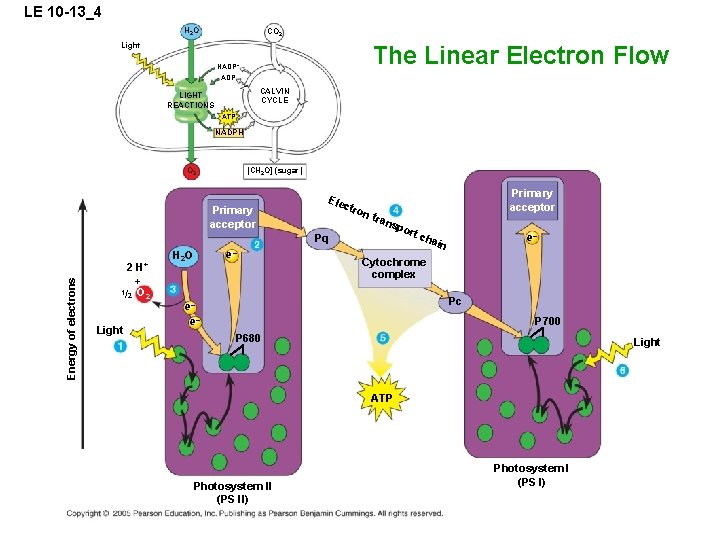
LE 10 -13_4 H 2 O CO 2 Light The Linear Electron Flow NADP+ ADP CALVIN CYCLE LIGHT REACTIONS ATP NADPH O 2 [CH 2 O] (sugar) Primary acceptor Ele ctro n Energy of electrons Pq 2 H+ 1/2 + O 2 Light H 2 O e– Primary acceptor tran spo rt c hai e– n Cytochrome complex Pc e– e– P 700 P 680 Light ATP Photosystem II (PS II) Photosystem I (PS I)
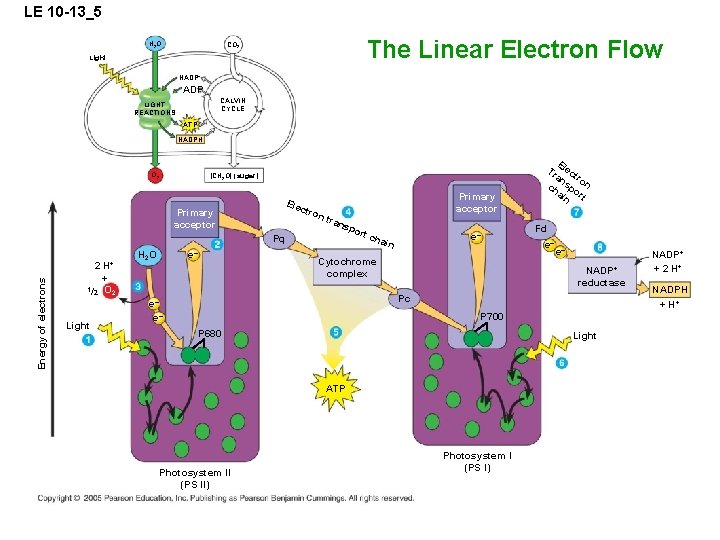
LE 10 -13_5 H 2 O The Linear Electron Flow CO 2 Light NADP+ ADP CALVIN CYCLE LIGHT REACTIONS ATP NADPH O 2 Ele c tron Primary acceptor Pq Energy of electrons 2 H+ e– H 2 O Primary acceptor tran spo rt c e– hai n Cytochrome complex + 1/2 O 2 Light E Tr lec an tro ch spo n ai rt n [CH 2 O] (sugar) Fd e– e– NADP+ reductase Pc e– e– P 700 P 680 Light ATP Photosystem II (PS II) Photosystem I (PS I) NADP+ + 2 H+ NADPH + H+
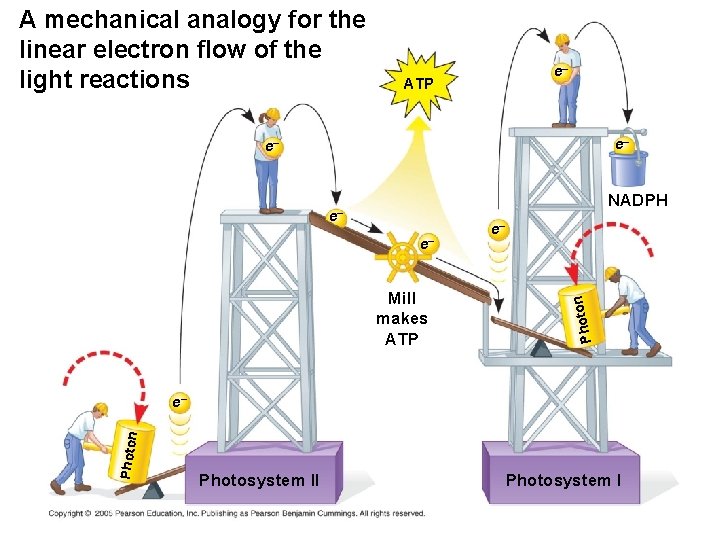
A mechanical analogy for the linear electron flow of the light reactions e– ATP e– e– NADPH Mill makes ATP n e– e– Photon e– Photosystem II Photosystem I
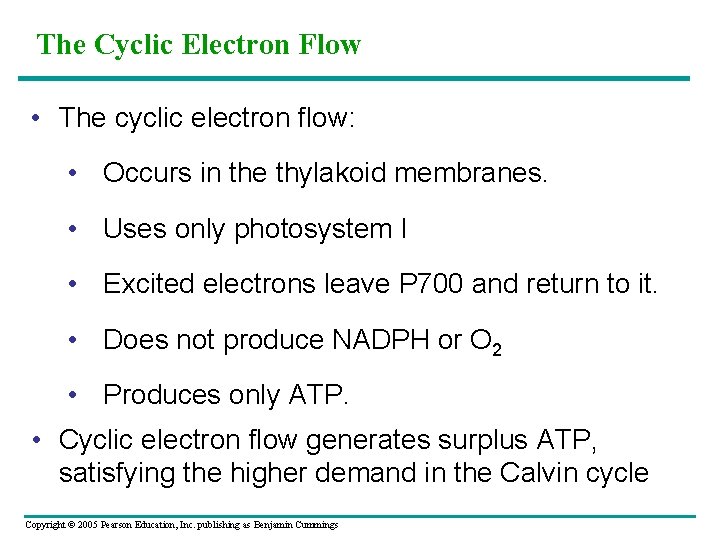
The Cyclic Electron Flow • The cyclic electron flow: • Occurs in the thylakoid membranes. • Uses only photosystem I • Excited electrons leave P 700 and return to it. • Does not produce NADPH or O 2 • Produces only ATP. • Cyclic electron flow generates surplus ATP, satisfying the higher demand in the Calvin cycle Copyright © 2005 Pearson Education, Inc. publishing as Benjamin Cummings
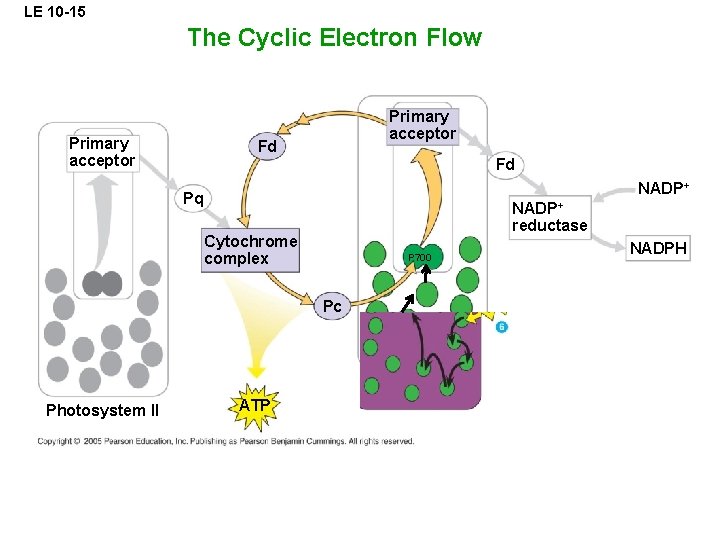
LE 10 -15 The Cyclic Electron Flow Primary acceptor Fd Fd NADP+ Pq NADP+ reductase Cytochrome complex P 700 Pc Photosystem II ATP NADPH
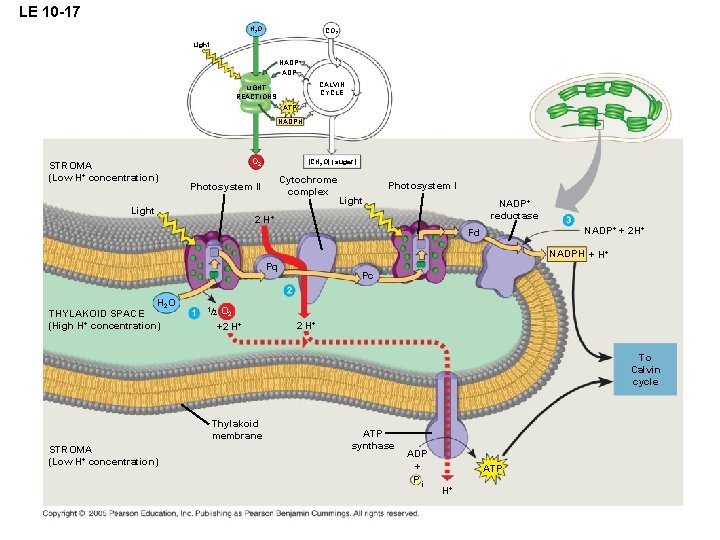
LE 10 -17 H 2 O CO 2 Light NADP+ ADP CALVIN CYCLE LIGHT REACTIONS ATP NADPH STROMA (Low H+ concentration) O 2 [CH 2 O] (sugar) Cytochrome complex Photosystem II Light 2 Photosystem I Light NADP+ reductase H+ NADP+ + 2 H+ Fd NADPH + H+ Pq H 2 O THYLAKOID SPACE (High H+ concentration) 1/2 Pc O 2 +2 H+ To Calvin cycle Thylakoid membrane STROMA (Low H+ concentration) ATP synthase ADP + Pi ATP H+
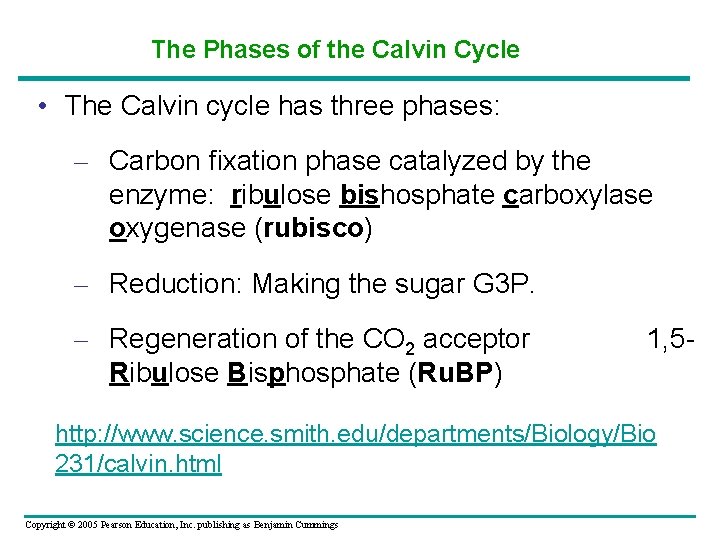
The Phases of the Calvin Cycle • The Calvin cycle has three phases: – Carbon fixation phase catalyzed by the enzyme: ribulose bishosphate carboxylase oxygenase (rubisco) – Reduction: Making the sugar G 3 P. – Regeneration of the CO 2 acceptor Ribulose Bisphosphate (Ru. BP) 1, 5 - http: //www. science. smith. edu/departments/Biology/Bio 231/calvin. html Copyright © 2005 Pearson Education, Inc. publishing as Benjamin Cummings
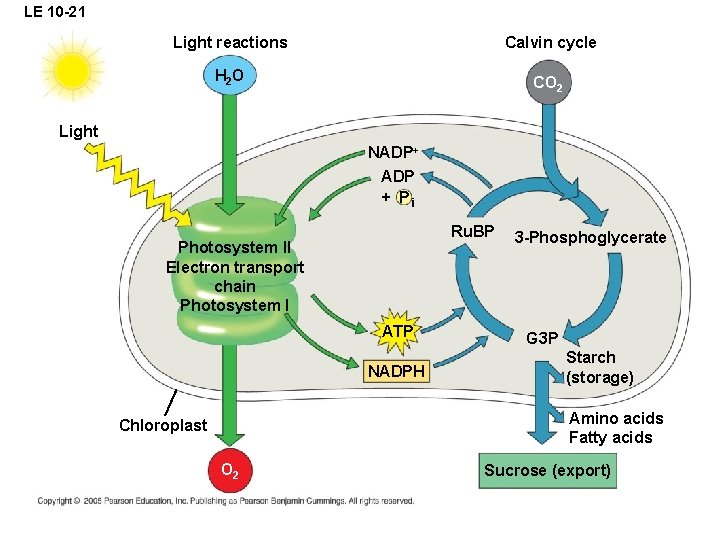
LE 10 -21 Light reactions Calvin cycle H 2 O CO 2 Light NADP+ ADP + Pi Ru. BP Photosystem II Electron transport chain Photosystem I ATP NADPH 3 -Phosphoglycerate G 3 P Starch (storage) Amino acids Fatty acids Chloroplast O 2 Sucrose (export)
- Slides: 24