
Photosynthesis Chapter 8 Photosynthesis Overview Energy for all
- Slides: 26
Photosynthesis Chapter 8
Photosynthesis Overview Energy for all life on Earth ultimately comes from photosynthesis. 6 CO 2 + 12 H 2 O C 6 H 12 O 6 + 6 H 2 O + 6 O 2 Photosynthesis is divided into: light-dependent reactions -capture energy from sunlight -make ATP and reduce NADP+ to NADPH carbon fixation reactions -use ATP and NADPH to synthesize organic molecules from CO 2 2
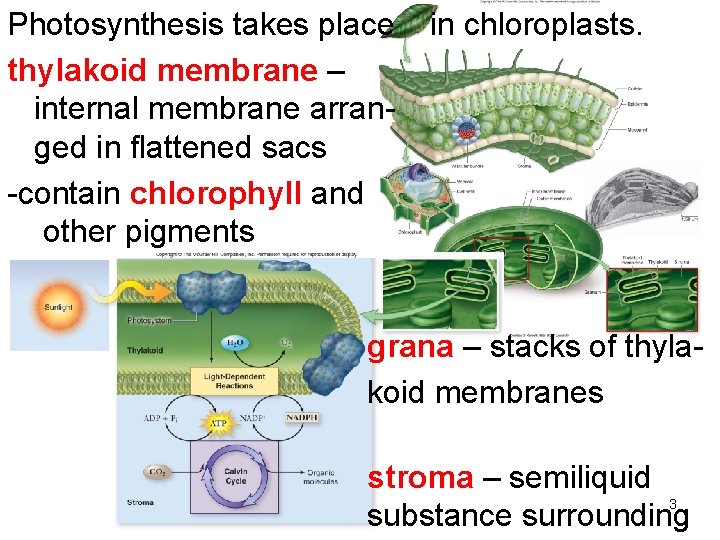
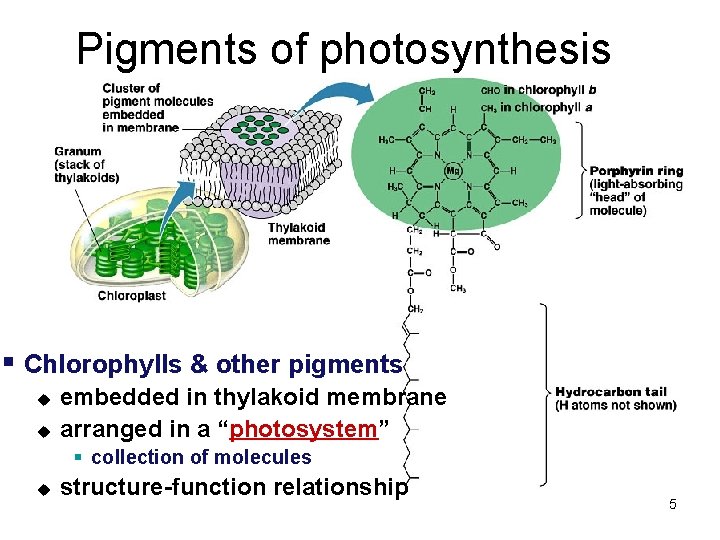
Photosynthesis takes place thylakoid membrane – internal membrane arranged in flattened sacs -contain chlorophyll and other pigments in chloroplasts. grana – stacks of thylakoid membranes stroma – semiliquid 3 substance surrounding
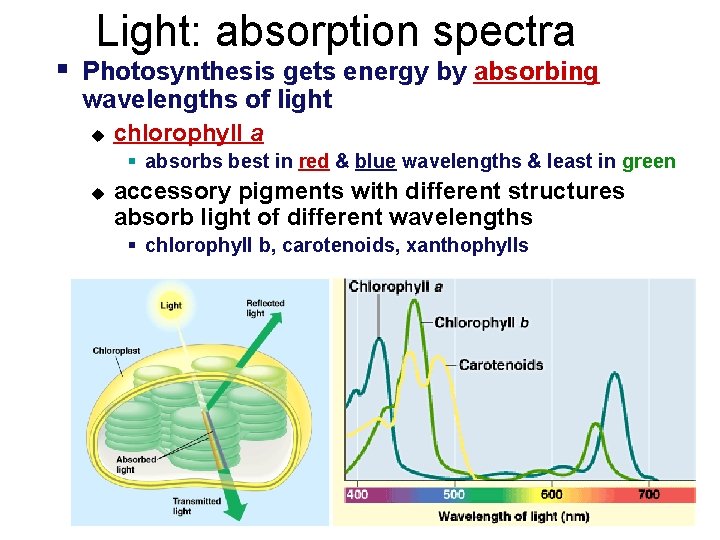
Light: absorption spectra § Photosynthesis gets energy by absorbing wavelengths of light u chlorophyll a § absorbs best in red & blue wavelengths & least in green u accessory pigments with different structures absorb light of different wavelengths § chlorophyll b, carotenoids, xanthophylls
Pigments of photosynthesis § Chlorophylls & other pigments u u embedded in thylakoid membrane arranged in a “photosystem” § collection of molecules u structure-function relationship 5
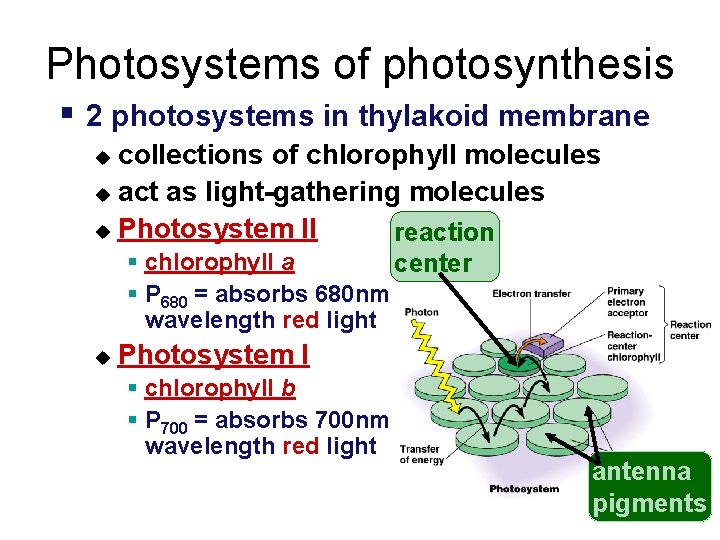
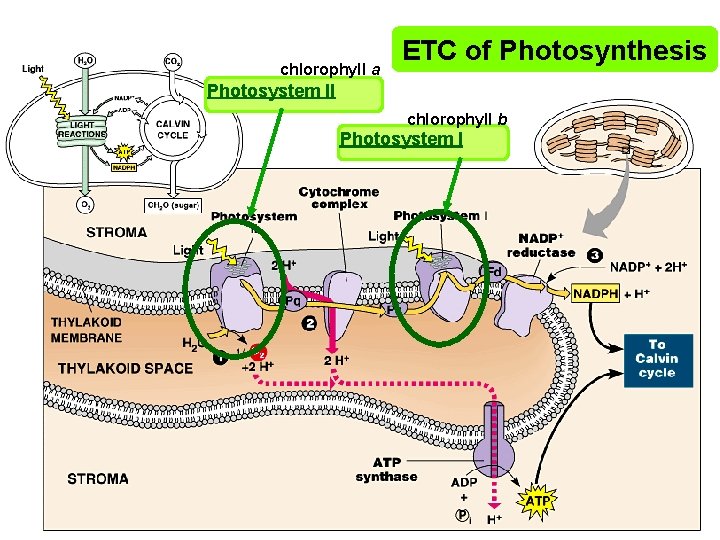
Photosystems of photosynthesis § 2 photosystems in thylakoid membrane collections of chlorophyll molecules u act as light-gathering molecules u Photosystem II reaction u § chlorophyll a center § P 680 = absorbs 680 nm wavelength red light u Photosystem I § chlorophyll b § P 700 = absorbs 700 nm wavelength red light antenna pigments
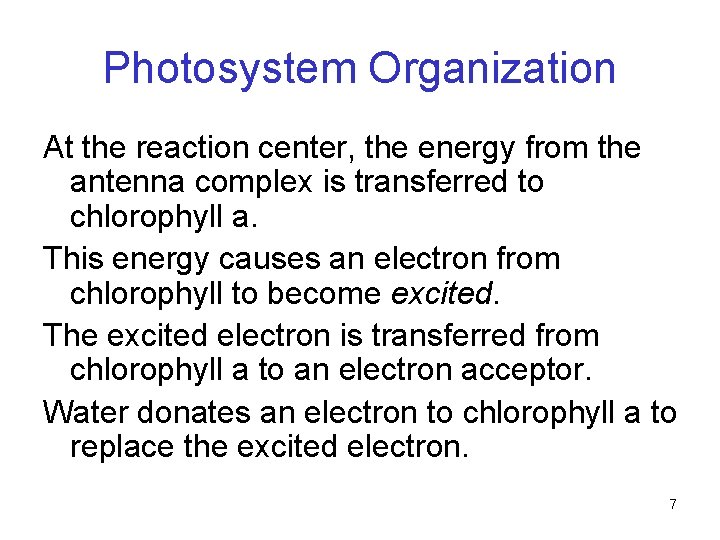
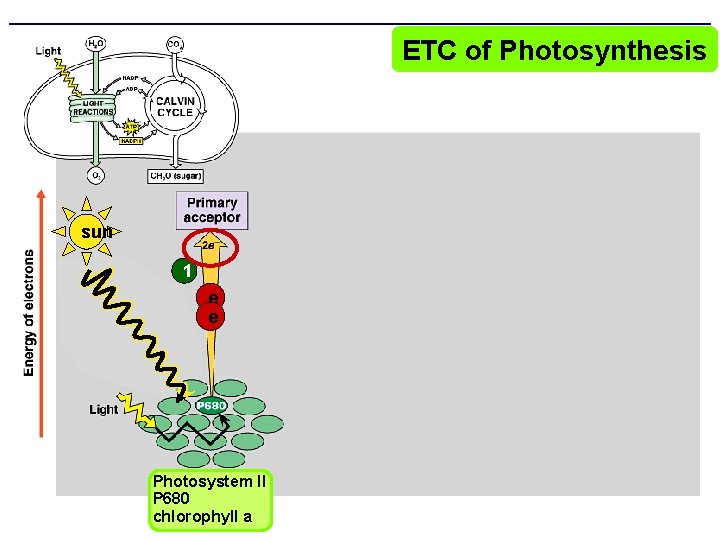
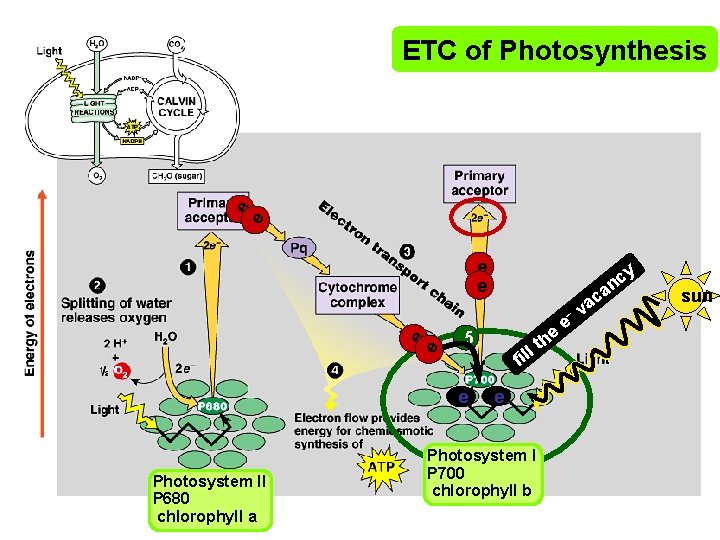
Photosystem Organization At the reaction center, the energy from the antenna complex is transferred to chlorophyll a. This energy causes an electron from chlorophyll to become excited. The excited electron is transferred from chlorophyll a to an electron acceptor. Water donates an electron to chlorophyll a to replace the excited electron. 7
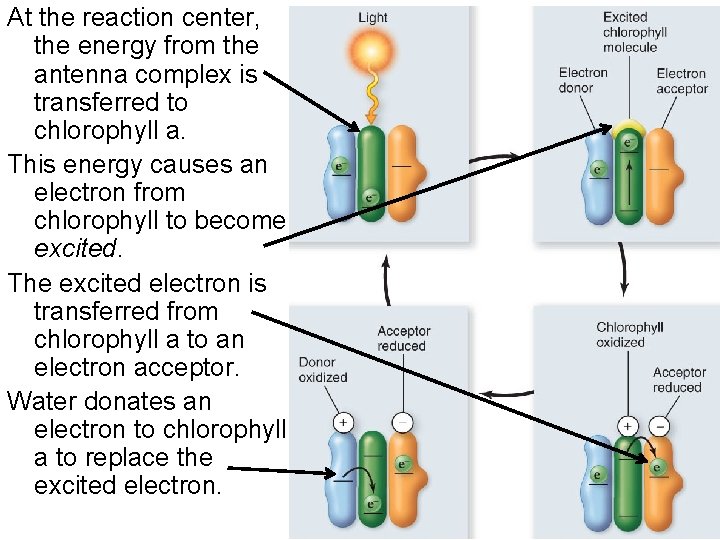
At the reaction center, the energy from the antenna complex is transferred to chlorophyll a. This energy causes an electron from chlorophyll to become excited. The excited electron is transferred from chlorophyll a to an electron acceptor. Water donates an electron to chlorophyll a to replace the excited electron. 8
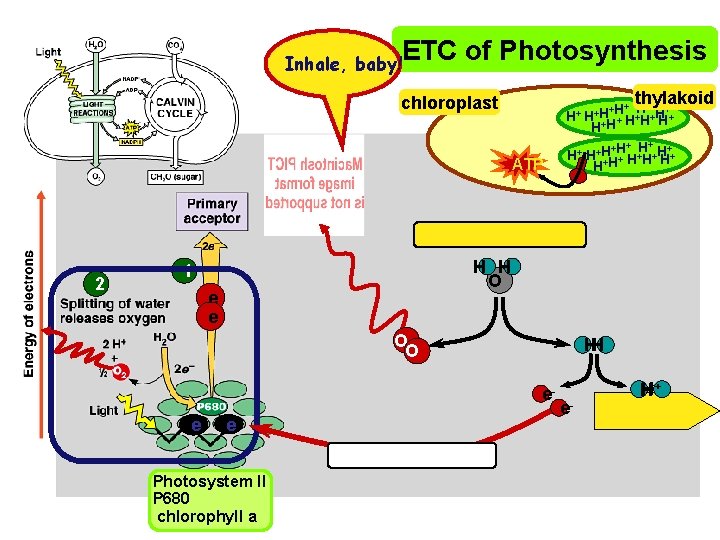
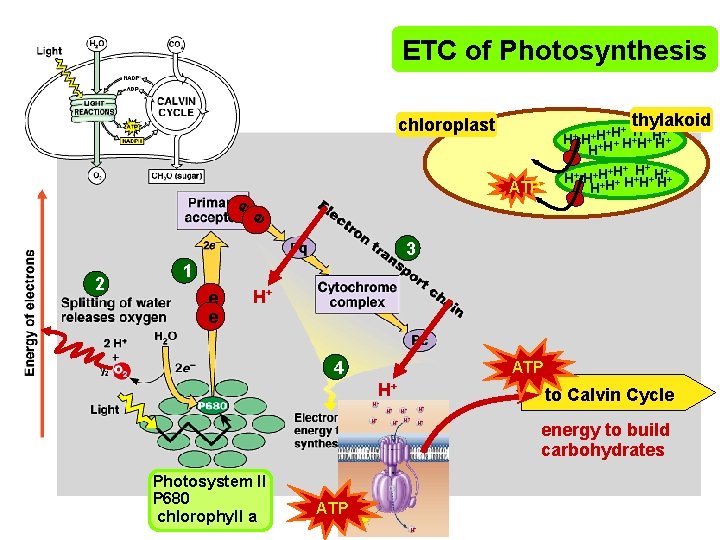
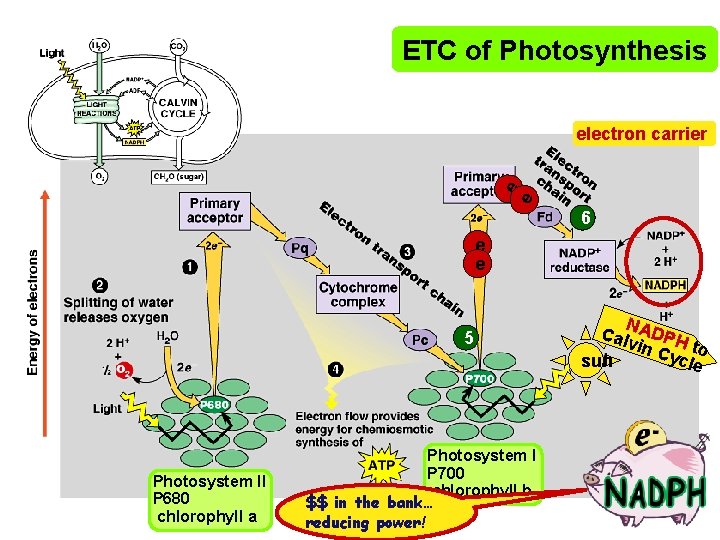
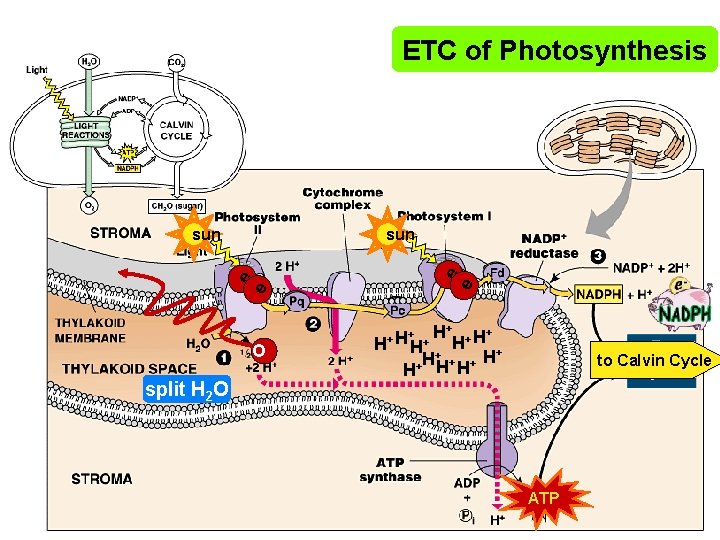
Light-Dependent Reactions Light-dependent reactions occur in 4 stages: 1. a photon of light is captured by a pigment molecule 2. energy is transferred to the reaction center; an excited electron is transferred to an acceptor molecule 3. electron transport – electrons move through carriers to reduce NADP+ 4. chemiosmosis – produces ATP 9
Light-Dependent Reactions ATP is produced via chemiosmosis. - ATP synthase is embedded in the thylakoid membrane -protons have accumulated in the thylakoid space -protons move into the stroma only through ATP synthase -ATP is produced from ADP + Pi 10
chlorophyll a ETC of Photosynthesis Photosystem II chlorophyll b Photosystem I
ETC of Photosynthesis sun 1 e e Photosystem II P 680 chlorophyll a
Inhale, baby! ETC of Photosynthesis thylakoid chloroplast + +H+ H H+ + H+ H+H +H+ H H ATP H+ + +H+ H H+ + H H+ H+ HH Plants SPLIT water! O H H e e O O H e- e e fill the e– vacancy Photosystem II P 680 chlorophyll a e- +H 1 H 2 H+
ETC of Photosynthesis thylakoid chloroplast H+ + +H+ H H+ + H+ H+H H H H e e ATP + +H+ H H+ + H H+ H+ HH 3 2 1 e e H+ 4 ATP H+ H+ H+ Photosystem II P 680 chlorophyll a H+ to Calvin Cycle H+ H+ H ADP + Pi ATP H+ H+ energy to build carbohydrates
e e ETC of Photosynthesis e e y c an e e – e Photosystem II P 680 chlorophyll a e 5 h lt fil e Photosystem I P 700 chlorophyll b e c va sun
ETC of Photosynthesis e e electron carrier 6 e e 5 Photosystem II P 680 chlorophyll a Photosystem I P 700 chlorophyll b $$ in the bank… reducing power! N Cal ADPH vin Cyc to sun le
ETC of Photosynthesis sun e e sun O split H 2 O H+ + H+ H + H+ +H H+ H+ H to Calvin Cycle ATP
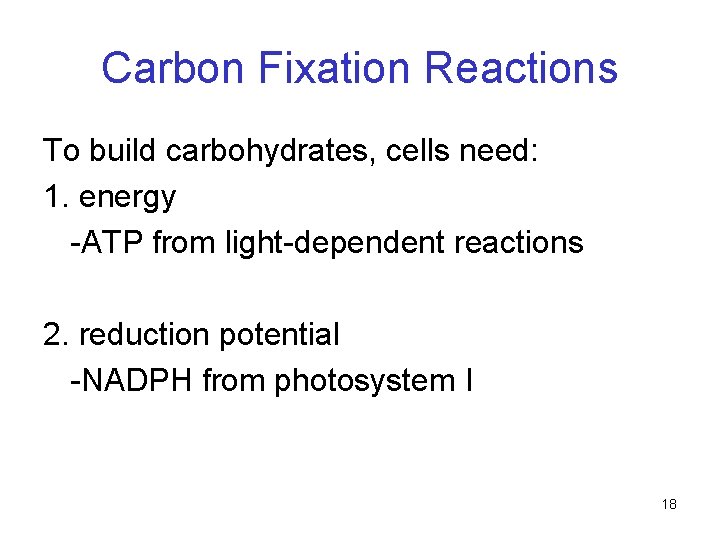
Carbon Fixation Reactions To build carbohydrates, cells need: 1. energy -ATP from light-dependent reactions 2. reduction potential -NADPH from photosystem I 18
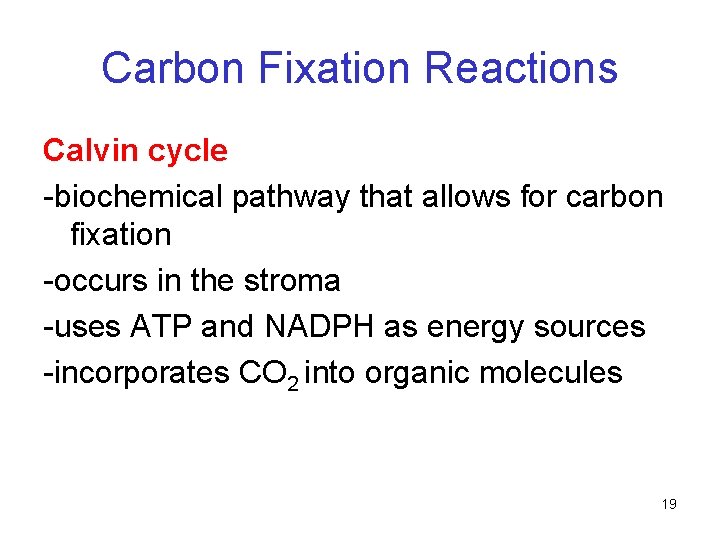
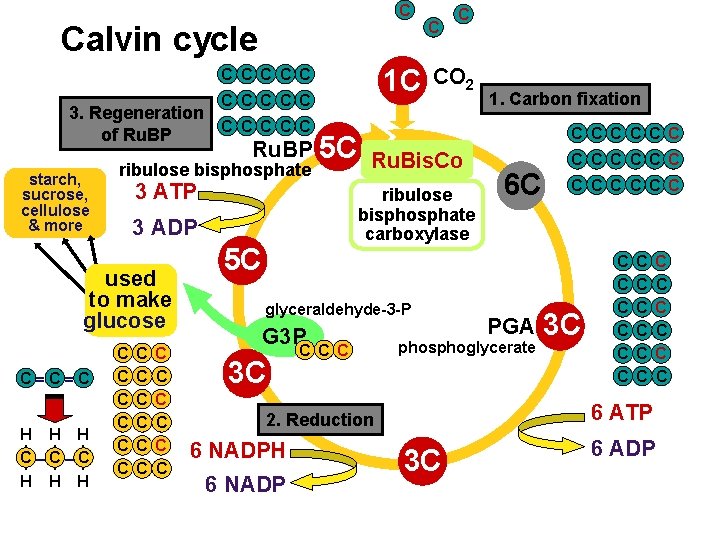
Carbon Fixation Reactions Calvin cycle -biochemical pathway that allows for carbon fixation -occurs in the stroma -uses ATP and NADPH as energy sources -incorporates CO 2 into organic molecules 19
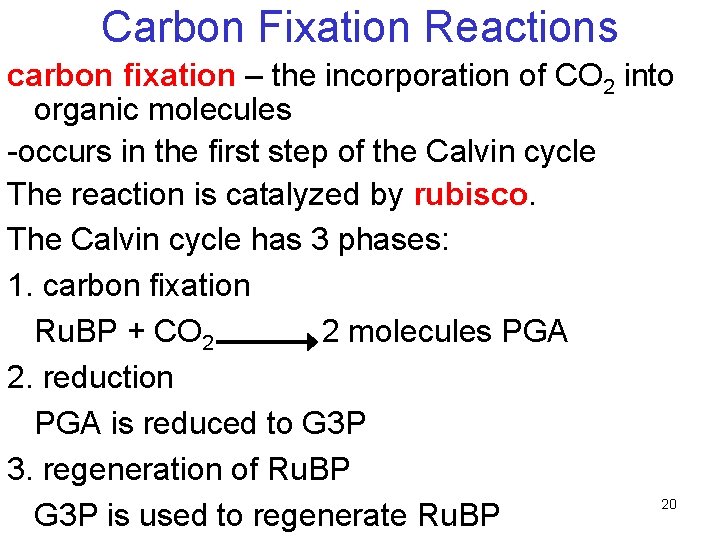
Carbon Fixation Reactions carbon fixation – the incorporation of CO 2 into organic molecules -occurs in the first step of the Calvin cycle The reaction is catalyzed by rubisco. The Calvin cycle has 3 phases: 1. carbon fixation Ru. BP + CO 2 2 molecules PGA 2. reduction PGA is reduced to G 3 P 3. regeneration of Ru. BP 20 G 3 P is used to regenerate Ru. BP
C Calvin cycle 1 C C C 3. Regeneration C C C of Ru. BP starch, sucrose, cellulose & more ribulose bisphosphate 3 ATP H H H | | | C–C–C C C C C CO 2 5 C Ru. Bis. Co glyceraldehyde-3 -P G 3 P 3 C C 6 NADP 6 C PGA phosphoglycerate C C C 3 C C C C C 6 ATP 2. Reduction 6 NADPH 1. Carbon fixation C C C ribulose bisphosphate carboxylase 3 ADP used to make glucose C=C=C 5 C C 3 C 6 ADP H | H |
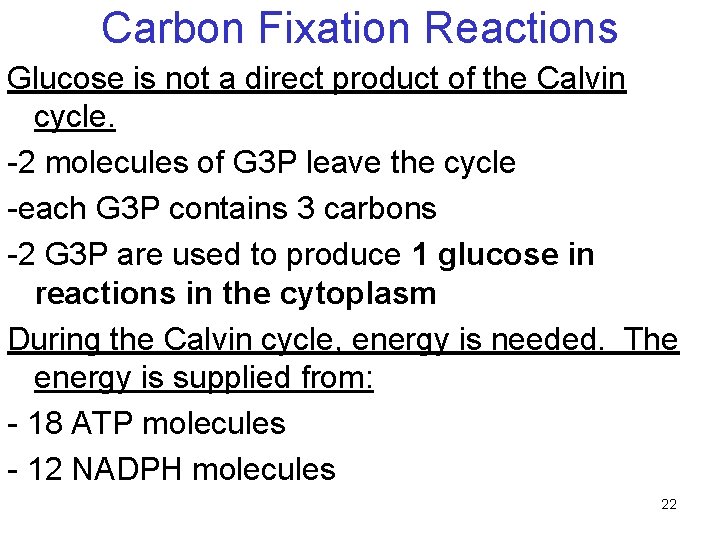
Carbon Fixation Reactions Glucose is not a direct product of the Calvin cycle. -2 molecules of G 3 P leave the cycle -each G 3 P contains 3 carbons -2 G 3 P are used to produce 1 glucose in reactions in the cytoplasm During the Calvin cycle, energy is needed. The energy is supplied from: - 18 ATP molecules - 12 NADPH molecules 22
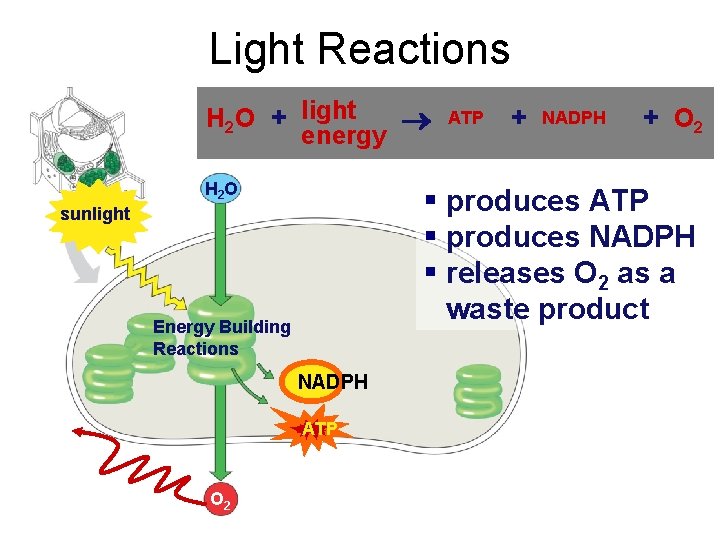
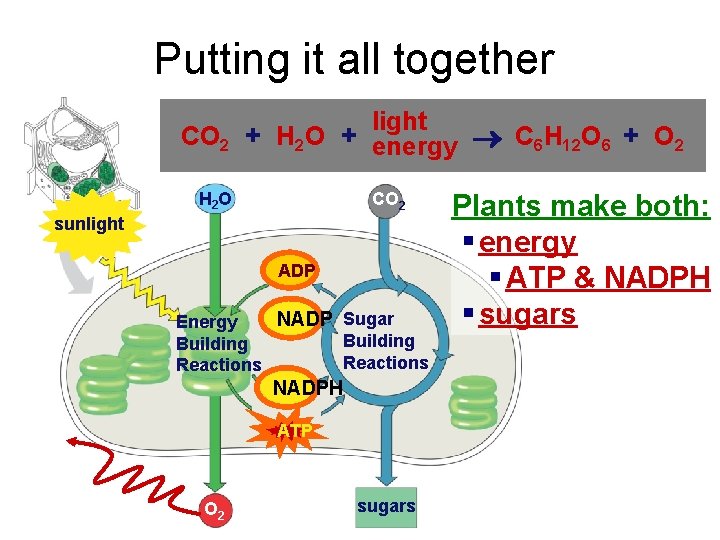
Light Reactions H 2 O + light energy H 2 O + NADPH + O 2 § produces ATP § produces NADPH § releases O 2 as a waste product sunlight Energy Building Reactions NADPH ATP O 2 ATP
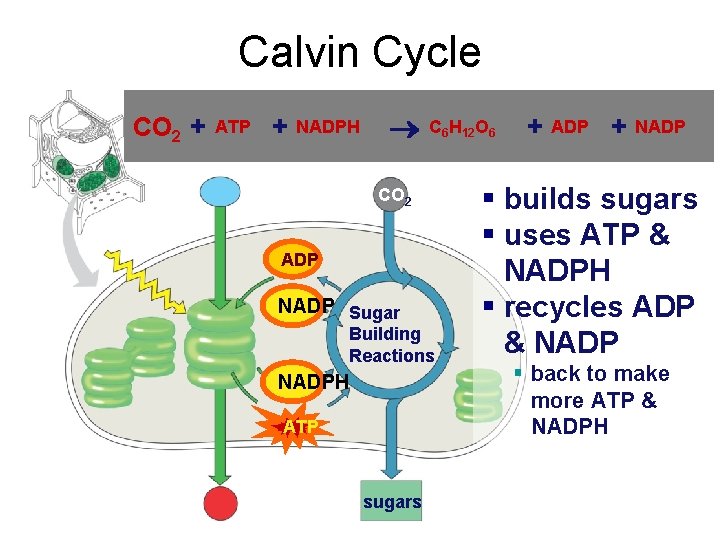
Calvin Cycle CO 2 + ATP + NADPH C 6 H 12 O 6 CO 2 ADP NADP Sugar Building Reactions NADPH ATP sugars + ADP + NADP § builds sugars § uses ATP & NADPH § recycles ADP & NADP § back to make more ATP & NADPH
Putting it all together light CO 2 + H 2 O + energy C 6 H 12 O 6 + O 2 H 2 O CO 2 sunlight ADP NADP Sugar Energy Building Reactions NADPH ATP O 2 sugars Plants make both: § energy § ATP & NADPH § sugars
Carbon Fixation Reactions The energy cycle: -photosynthesis uses the products of respiration as starting substrates -respiration uses the products of photosynthesis as starting substrates 26