
Photosynthesis Chapter 4 Energy and Metabolism 1 SB
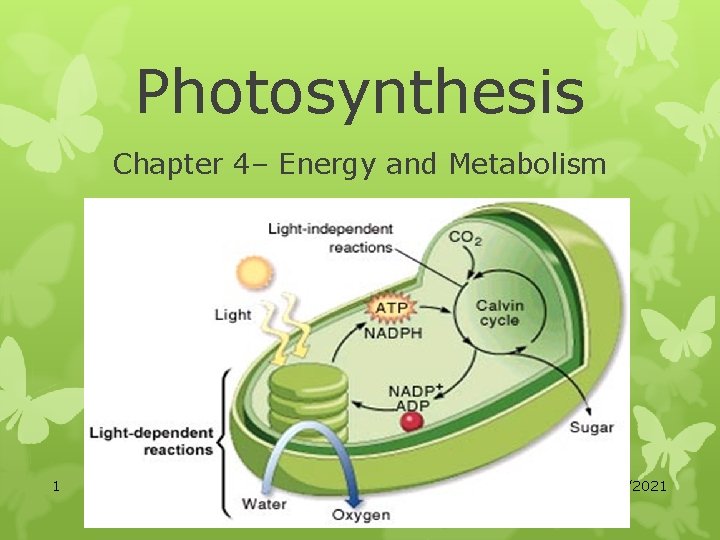
Photosynthesis Chapter 4– Energy and Metabolism 1 SB 3 a 10/30/2021
SB 3 Students will derive the relationship between single-celled and multi-celled organisms and the increasing complexity of systems. a. Explain the cycling of energy through the process of photosynthesis and respiration. 2 SB 3 a 10/30/2021
Questions To Think About What molecule serves as the primary energy source for metabolism? What process forms the basis of almost all food chains on Earth? The energy of movement is referred to as ________ energy. 3 SB 3 a 10/30/2021
Today’s Objectives Given information and/or diagrams on the process of photosynthesis, write and/or identify the equation, raw materials, sites, products, factors affecting the process, and the role of chlorophyll in the light and dark reactions. 4 SB 3 a 10/30/2021
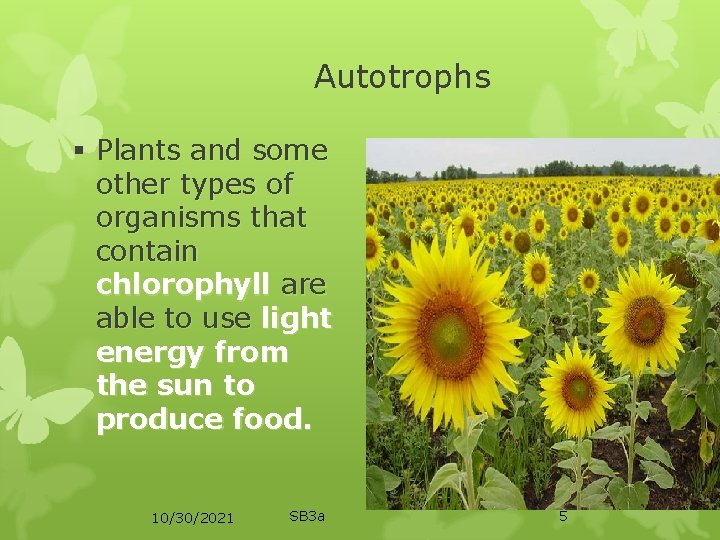
Autotrophs § Plants and some other types of organisms that contain chlorophyll are able to use light energy from the sun to produce food. 10/30/2021 SB 3 a 5
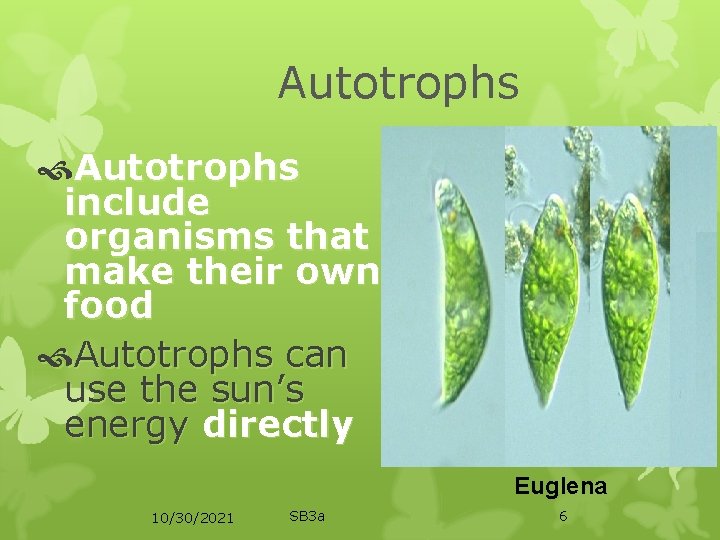
Autotrophs include organisms that make their own food Autotrophs can use the sun’s energy directly Euglena 10/30/2021 SB 3 a 6
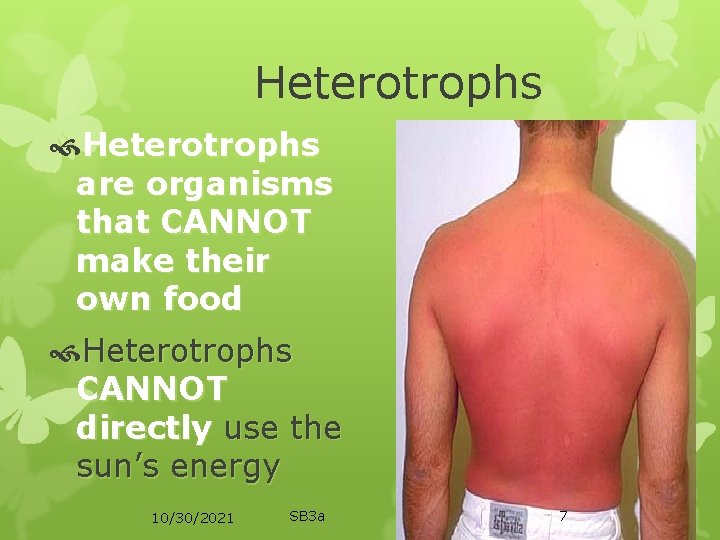
Heterotrophs are organisms that CANNOT make their own food Heterotrophs CANNOT directly use the sun’s energy 10/30/2021 SB 3 a 7
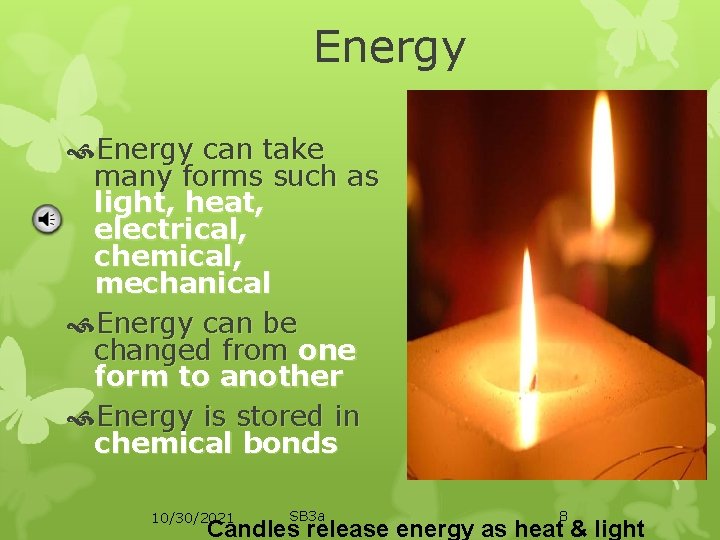
Energy can take many forms such as light, heat, electrical, chemical, mechanical Energy can be changed from one form to another Energy is stored in chemical bonds 10/30/2021 SB 3 a 8 Candles release energy as heat & light
ATP: The Cell’s Currency Adenosine Triphosphate Energy from food is converted into high energy bonds in ATP ADP + energy ATP Contains 3 high-energy phosphate bonds, adenine, and ribose 9 SB 3 a 10/30/2021
Importance of ATP Principal compound used to store energy in living organisms Provides all the energy for the cells activities The process of releasing ATP’s energy & reforming the molecule is called phosphorylation 10 SB 3 a 10/30/2021
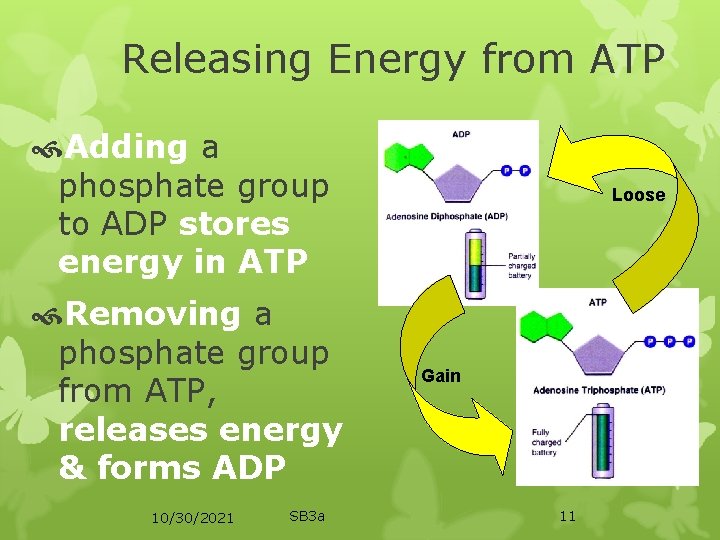
Releasing Energy from ATP Adding a phosphate group to ADP stores energy in ATP Removing a phosphate group from ATP, releases energy & forms ADP 10/30/2021 SB 3 a Loose Gain 11

Uses of ATP Cells use ATP for: Active transport Movement Photosynthesis Cellular Respiration All other cellular reactions 10/30/2021 SB 3 a 12
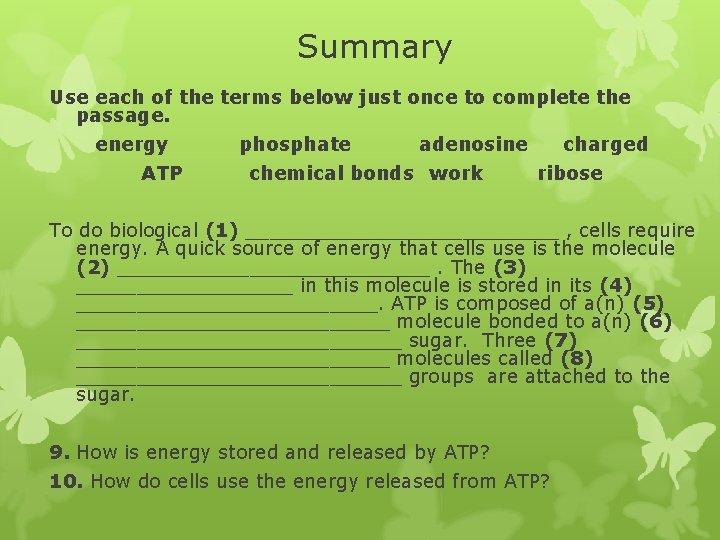
Summary Use each of the terms below just once to complete the passage. energy ATP phosphate adenosine chemical bonds work charged ribose To do biological (1) _____________ , cells require energy. A quick source of energy that cells use is the molecule (2) _____________. The (3) _________ in this molecule is stored in its (4) _____________. ATP is composed of a(n) (5) _____________ molecule bonded to a(n) (6) ______________ sugar. Three (7) _____________ molecules called (8) ______________ groups are attached to the sugar. 9. How is energy stored and released by ATP? 10. How do cells use the energy released from ATP?
Glucose is a monosaccharide C 6 H 12 O 6 One molecule of glucose stores 90 times more chemical energy than one molecule of ATP 14 SB 3 a 10/30/2021
History of Photosynthesis 15 SB 3 a 10/30/2021
Early Questions on Plants Several centuries ago, the question was: Does the increase in mass of a plant come from the air? The soil? The water? 16 SB 3 a 10/30/2021
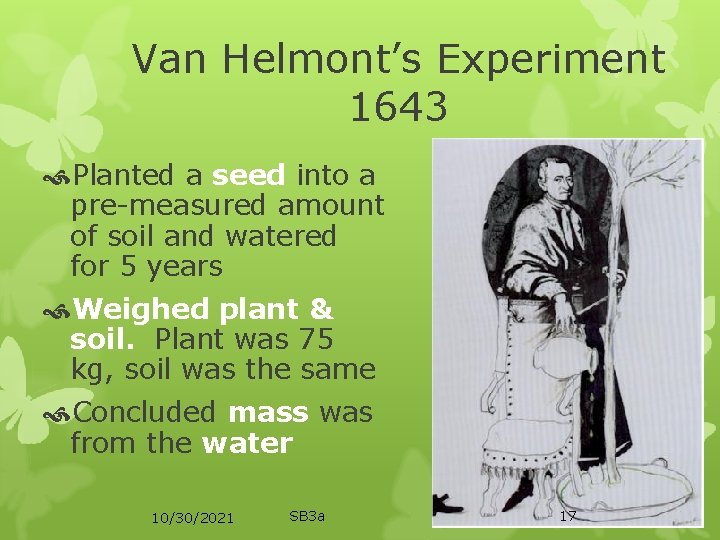
Van Helmont’s Experiment 1643 Planted a seed into a pre-measured amount of soil and watered for 5 years Weighed plant & soil. Plant was 75 kg, soil was the same Concluded mass was from the water 10/30/2021 SB 3 a 17
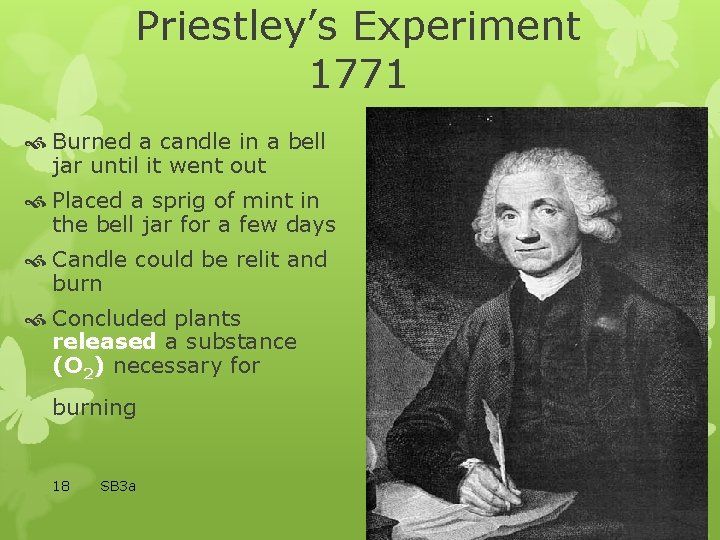
Priestley’s Experiment 1771 Burned a candle in a bell jar until it went out Placed a sprig of mint in the bell jar for a few days Candle could be relit and burn Concluded plants released a substance (O 2) necessary for burning 18 SB 3 a 10/30/2021
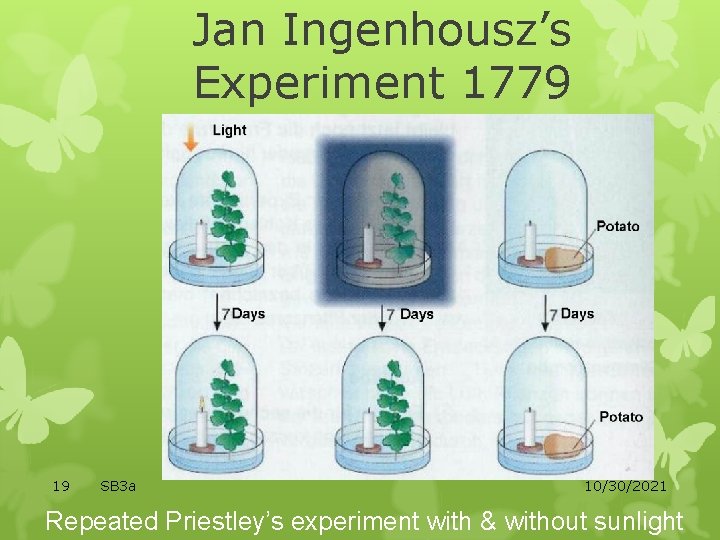
Jan Ingenhousz’s Experiment 1779 19 SB 3 a 10/30/2021 Repeated Priestley’s experiment with & without sunlight
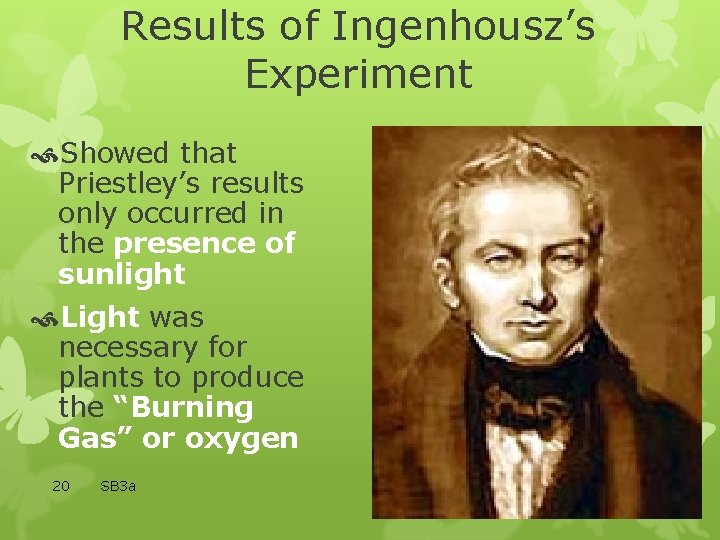
Results of Ingenhousz’s Experiment Showed that Priestley’s results only occurred in the presence of sunlight Light was necessary for plants to produce the “Burning Gas” or oxygen 20 SB 3 a 10/30/2021
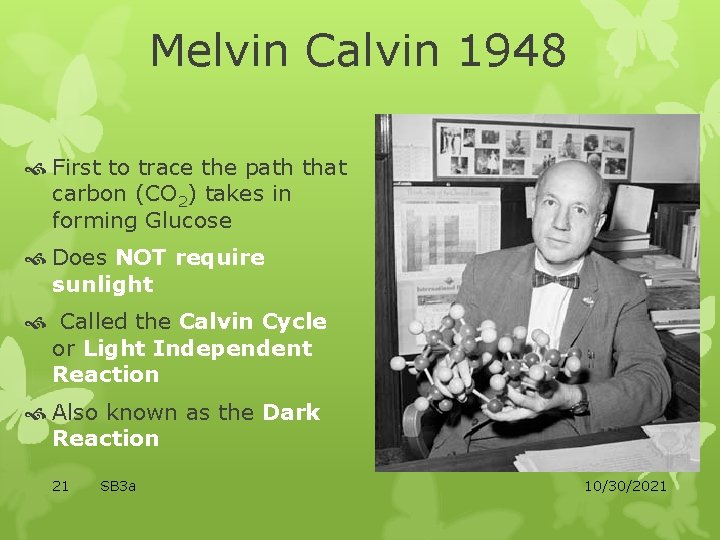
Melvin Calvin 1948 First to trace the path that carbon (CO 2) takes in forming Glucose Does NOT require sunlight Called the Calvin Cycle or Light Independent Reaction Also known as the Dark Reaction 21 SB 3 a 10/30/2021
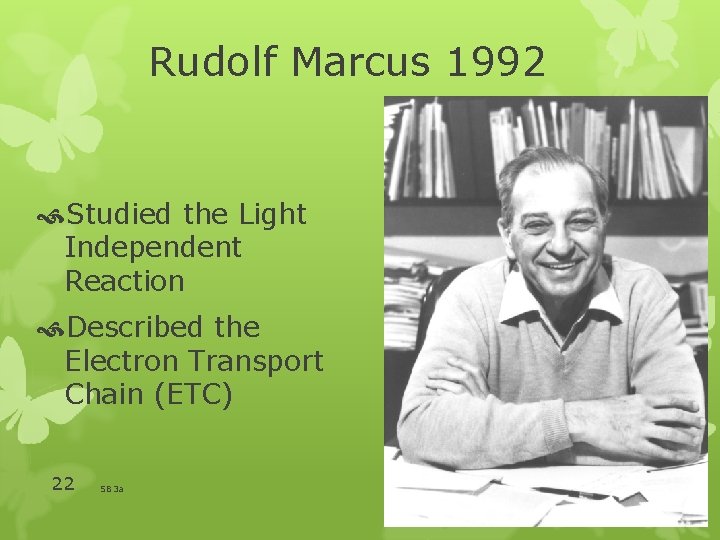
Rudolf Marcus 1992 Studied the Light Independent Reaction Described the Electron Transport Chain (ETC) 22 SB 3 a 10/30/2021
Photosynthesis 6 CO 2 + 6 H 2 O + E C 6 H 12 O 6 + 6 O 2 Basis of most of the earth’s food chains Produces and maintains all of the earth’s atmospheric oxygen Most oxygen produced in the oceans 23 SB 3 a 10/30/2021
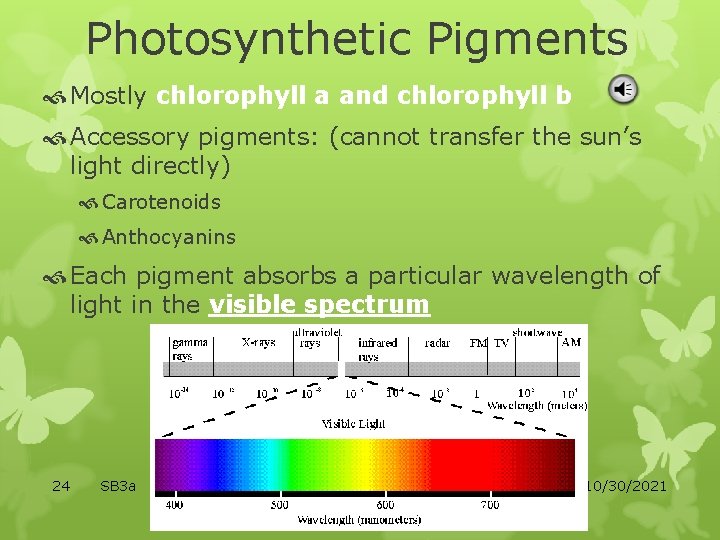
Photosynthetic Pigments Mostly chlorophyll a and chlorophyll b Accessory pigments: (cannot transfer the sun’s light directly) Carotenoids Anthocyanins Each pigment absorbs a particular wavelength of light in the visible spectrum 24 SB 3 a 10/30/2021
Chlorophyll a Found in all plants, algae, & cyanobacteria. Makes photosynthesis possible Participates directly in the Light Reactions Can accept energy from chlorophyll b 25 SB 3 a 10/30/2021
Chlorophyll b is an accessory pigment Acts indirectly in photosynthesis by transferring the light it absorbs to chlorophyll a Like chlorophyll a, it absorbs red & blue light and REFLECTS GREEN 26 SB 3 a 10/30/2021
Think Critically Some plant leaves contain yellow and red pigments as well as chlorophyll. In the fall, those leaves may become red or yellow. Suggest an explanation for those color changes. 27 SB 3 a 10/30/2021
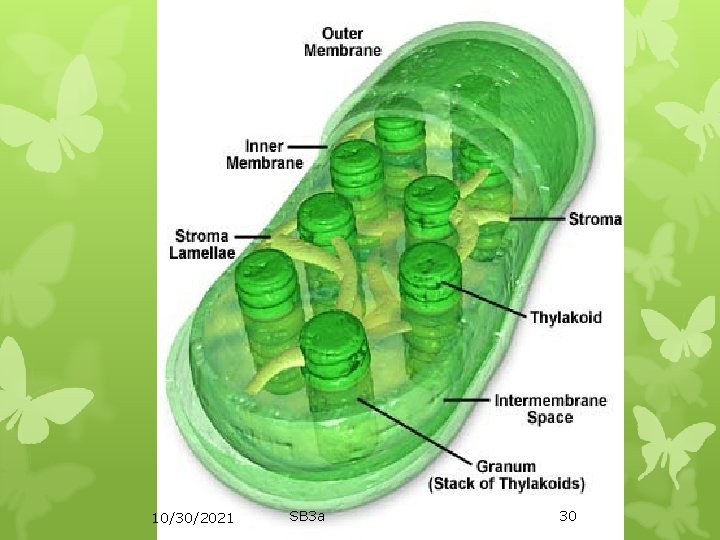
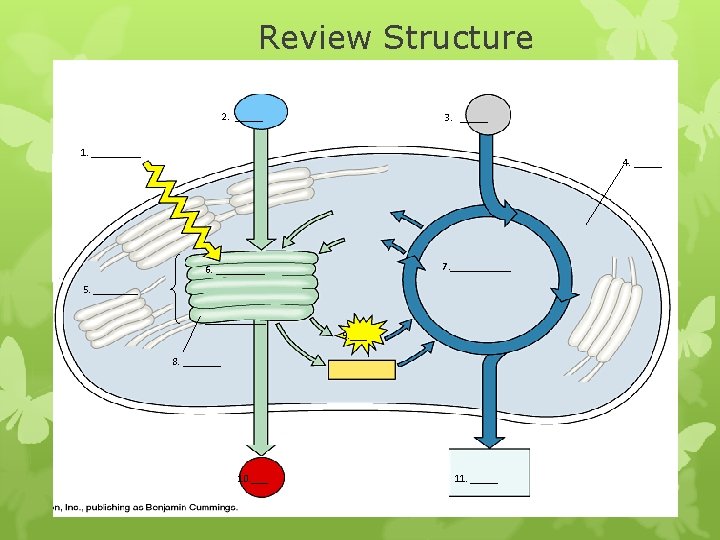
Structure of a Chloroplast Double membrane organelle Outer membrane smooth Inner membrane forms stacks of connected sacs called thylakoids Thylakoid stack is called the granum (grana-plural) Gel-like material around grana called stroma 28 SB 3 a 10/30/2021
Function of Stroma Light Independent reactions occur here ATP used to make carbohydrates like glucose Location of the Calvin Cycle 29 SB 3 a 10/30/2021
10/30/2021 SB 3 a 30
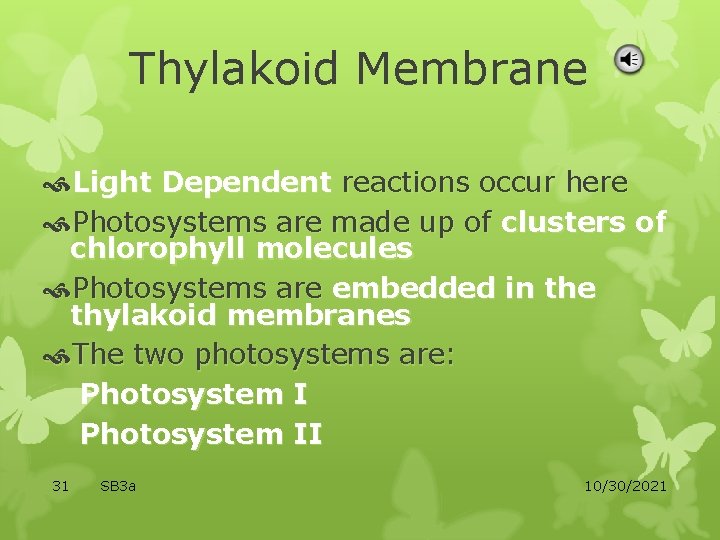
Thylakoid Membrane Light Dependent reactions occur here Photosystems are made up of clusters of chlorophyll molecules Photosystems are embedded in the thylakoid membranes The two photosystems are: Photosystem II 31 SB 3 a 10/30/2021
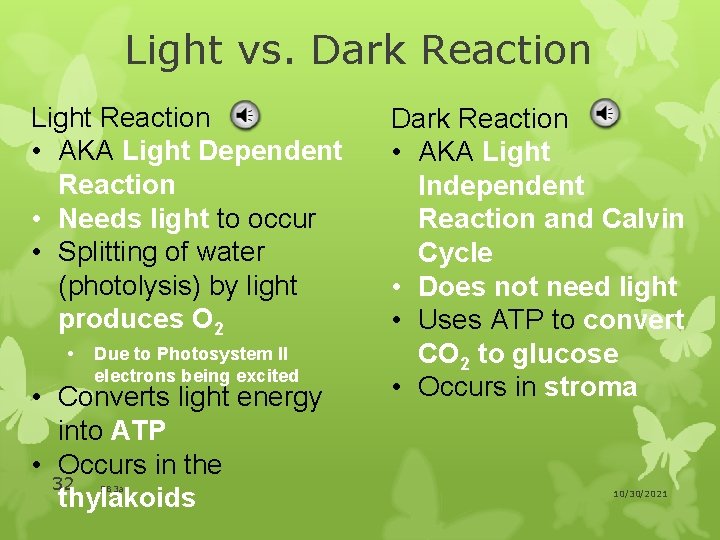
Light vs. Dark Reaction Light Reaction • AKA Light Dependent Reaction • Needs light to occur • Splitting of water (photolysis) by light produces O 2 • Due to Photosystem II electrons being excited • Converts light energy into ATP • Occurs in the 32 thylakoids SB 3 a Dark Reaction • AKA Light Independent Reaction and Calvin Cycle • Does not need light • Uses ATP to convert CO 2 to glucose • Occurs in stroma 10/30/2021
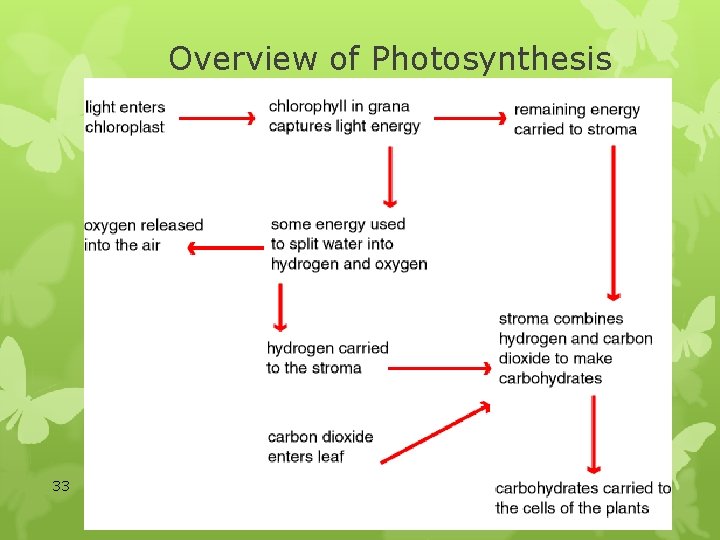
Overview of Photosynthesis 33 SB 3 a 10/30/2021
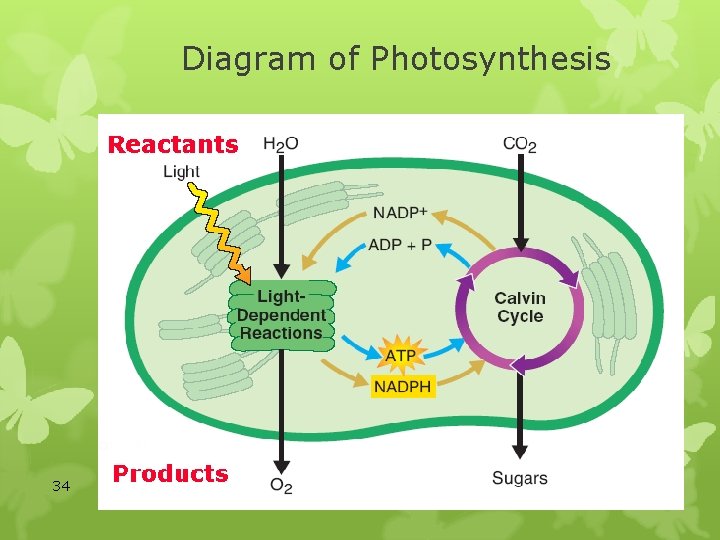
Diagram of Photosynthesis 34 SB 3 a 10/30/2021
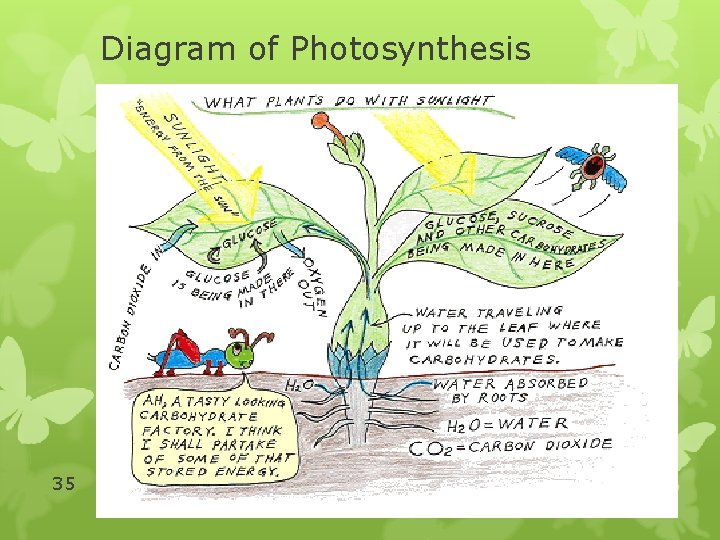
Diagram of Photosynthesis 35 SB 3 a 10/30/2021
Factors Affecting the Rate of Photosynthesis Amount of available water Shortage of water can slow or stop photosynthesis Temperature Enzymes needed work best at 0°C and 30°C Amount of available light energy 36 Increasing light, increases SB 3 a photosynthesis 10/30/2021
Think Critically 1. During which step is oxygen produced? 2. During which step is sugar produced? 3. Would sugar still be produced at night? 4. Would sugar be produced if the Light Dependent reactions had not occurred? 5. Would the rate of photosynthesis change under drought conditions or in arid climates? 37 SB 3 a 10/30/2021
Think Critically Many of the sun’s rays may be blocked by dust or clouds formed by volcanic eruptions or pollution. What are some possible short-term and longterm effects of this on photosynthesis? 39 SB 3 a 10/30/2021
- Slides: 39