
Photosynthesis Chapter 10 Photosynthesis d Cyanobacteria 10 m
Photosynthesis Chapter 10
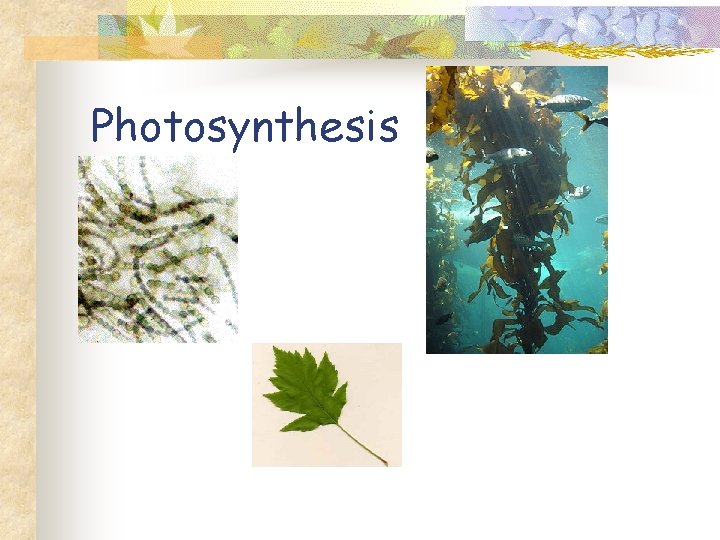
Photosynthesis
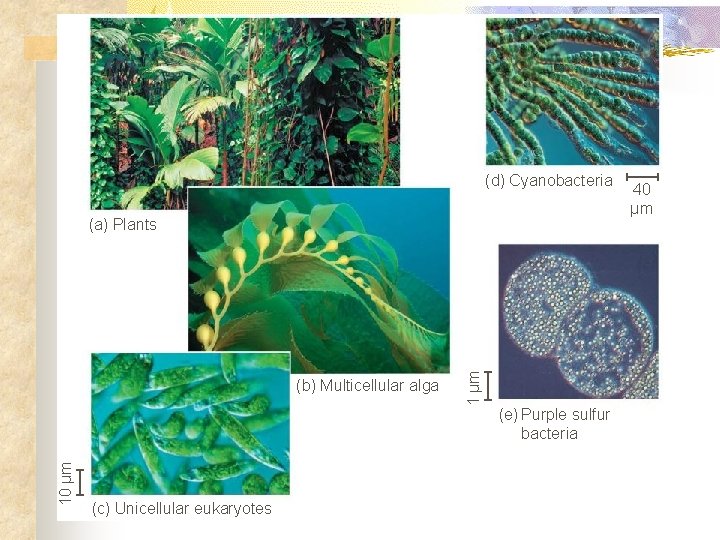
(d) Cyanobacteria 10 μm (b) Multicellular alga (c) Unicellular eukaryotes 1 μm (a) Plants (e) Purple sulfur bacteria 40 μm
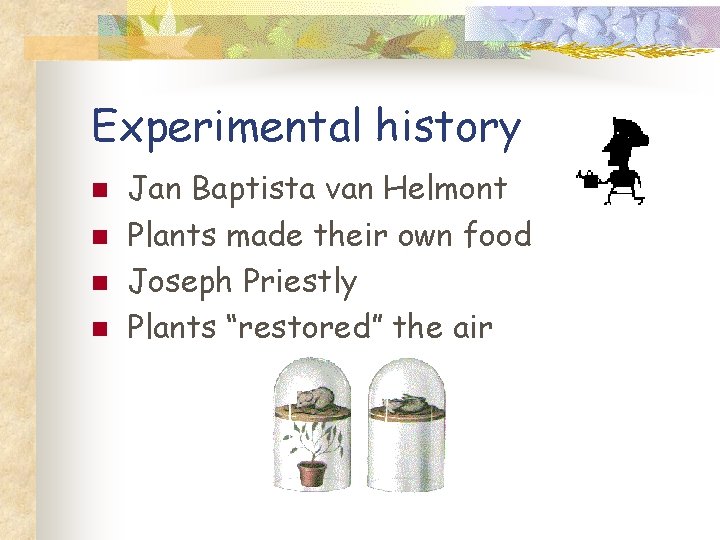
Experimental history n n Jan Baptista van Helmont Plants made their own food Joseph Priestly Plants “restored” the air
Experimental history n n n Jan Ingenhousz Sun’s energy split CO 2 Carbon & Oxygen was released into air Carbon combined with water Make carbohydrates
Experimental history n n n Fredrick Forest Blackman 1. Initial “light” reactions are independent of temperature 2. Second set of “dark” reactions are independent of light Dependent on CO 2 concentrations & temperature Enzymes involved in light-independent reactions
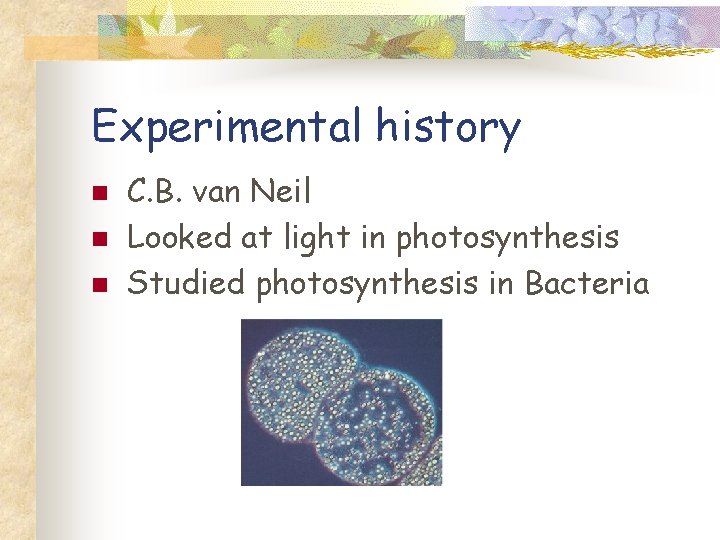
Experimental history n n n C. B. van Neil Looked at light in photosynthesis Studied photosynthesis in Bacteria
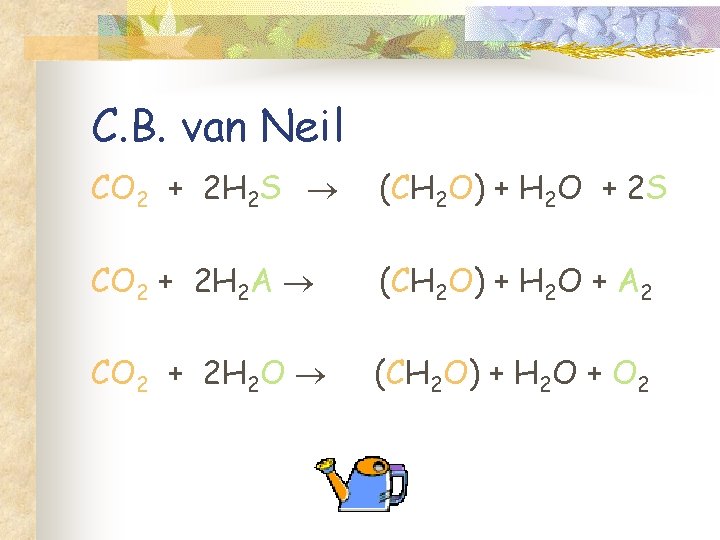
C. B. van Neil CO 2 + 2 H 2 S (CH 2 O) + H 2 O + 2 S CO 2 + 2 H 2 A (CH 2 O) + H 2 O + A 2 CO 2 + 2 H 2 O (CH 2 O) + H 2 O + O 2
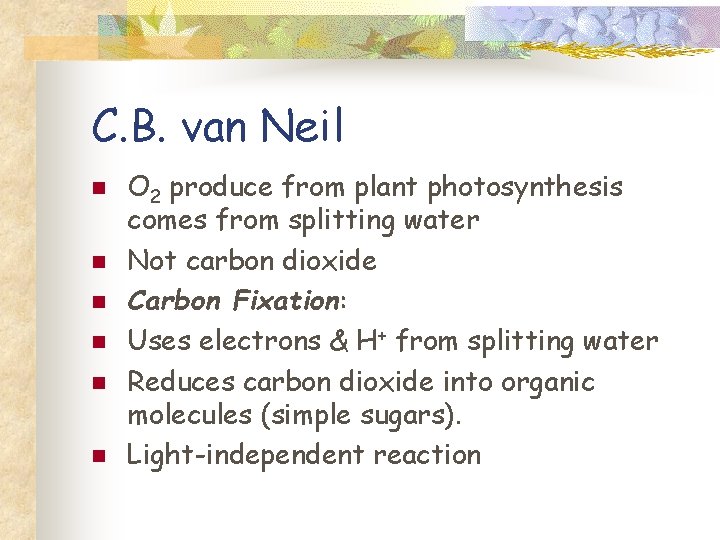
C. B. van Neil n n n O 2 produce from plant photosynthesis comes from splitting water Not carbon dioxide Carbon Fixation: Uses electrons & H+ from splitting water Reduces carbon dioxide into organic molecules (simple sugars). Light-independent reaction
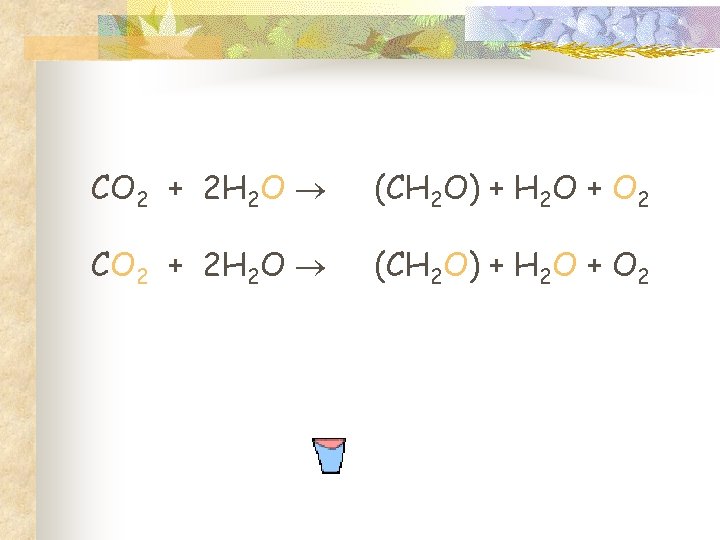
CO 2 + 2 H 2 O (CH 2 O) + H 2 O + O 2
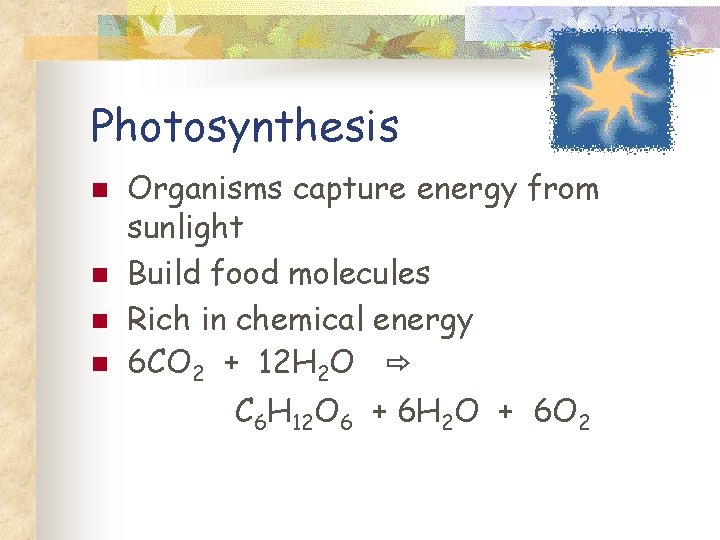
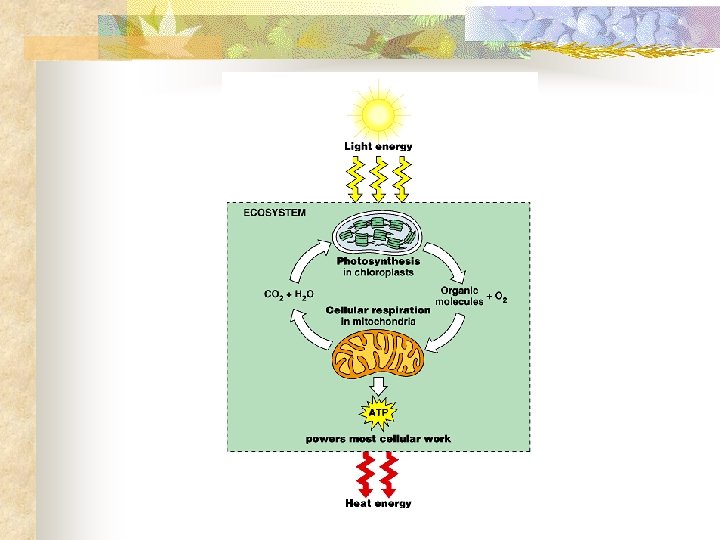
Photosynthesis n n Organisms capture energy from sunlight Build food molecules Rich in chemical energy 6 CO 2 + 12 H 2 O ⇨ C 6 H 12 O 6 + 6 H 2 O + 6 O 2
Photosynthesis n n n Captures only 1% of sun’s energy Provides energy for life Source of energy when life began
Photosynthesis n n Photon: Packets of energy UV light photons have greater energy than visible light UV light has shorter wavelengths
Photosynthesis n n n Visible light Purple shorter wavelengths More energetic photons Red longer wavelengths Less energetic photons
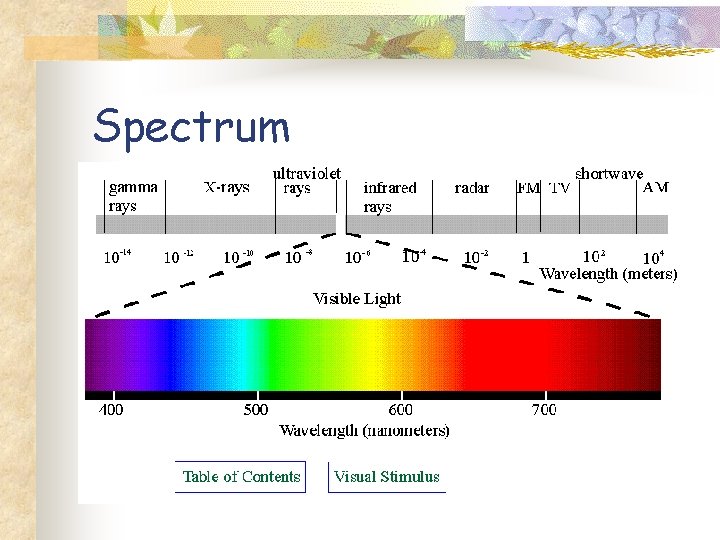
Spectrum
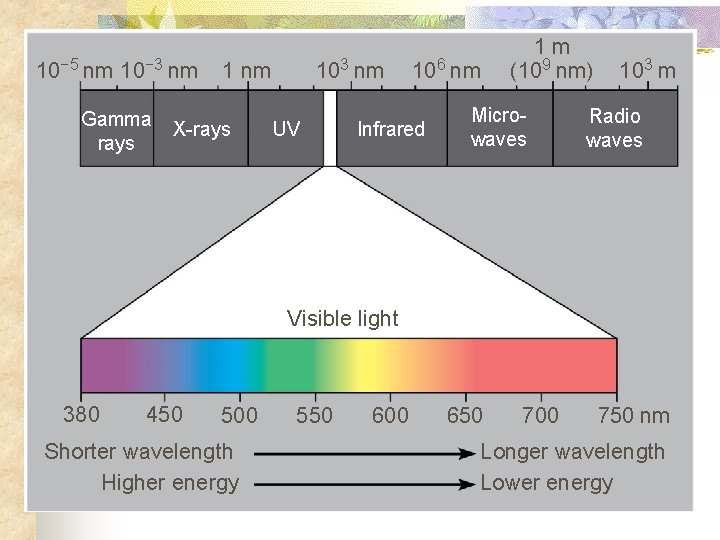
10− 5 nm 10− 3 nm Gamma rays 103 nm 1 nm X-rays UV 106 nm Infrared 1 m (109 nm) Microwaves 103 m Radio waves Visible light 380 450 500 Shorter wavelength Higher energy 550 600 650 700 750 nm Longer wavelength Lower energy
Absorption Spectrums n n n Photon of energy strikes a molecule Absorbed by the molecule or lost as heat Depends on energy in photon (wavelength) Depends on atom’s available energy levels Specific for each molecule
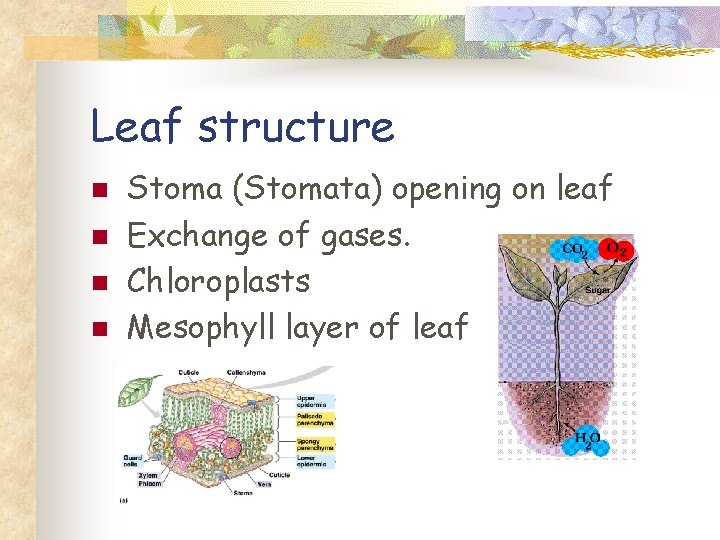
Leaf structure n n Stoma (Stomata) opening on leaf Exchange of gases. Chloroplasts Mesophyll layer of leaf
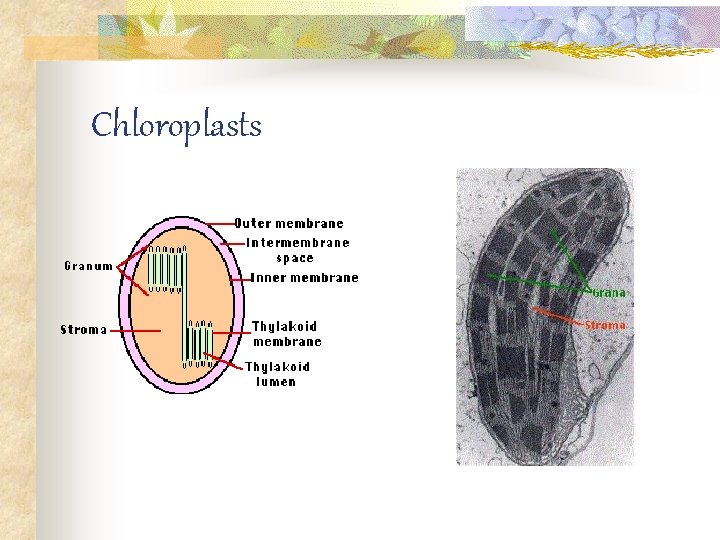
Chloroplasts n n n n Thylakoids: Internal membranes of chloroplasts Grana: Stacks of thylakoids Chlorophyll: Green pigment Captures light for photosynthesis Membranes of thylakoids
Chloroplasts n n n Stroma: Semi-liquid substance Surrounds thylakoids Contain enzymes Make organic molecules from carbon dioxide
Chloroplasts
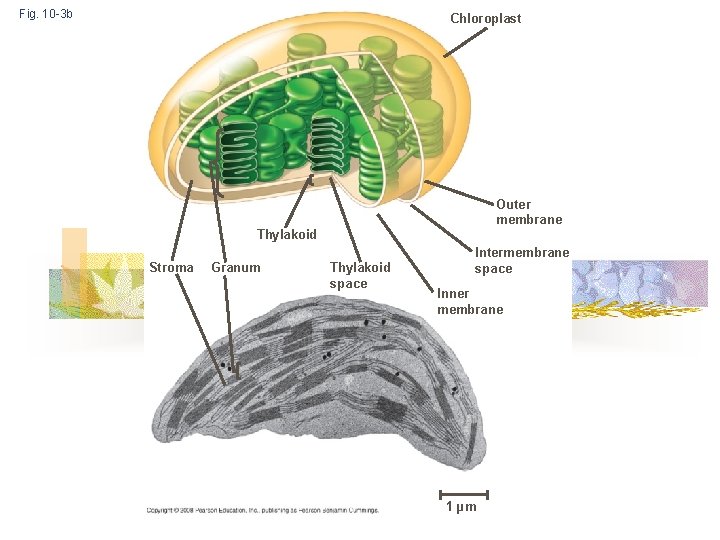
Fig. 10 -3 b Chloroplast Outer membrane Thylakoid Stroma Granum Thylakoid space Intermembrane space Inner membrane 1 µm
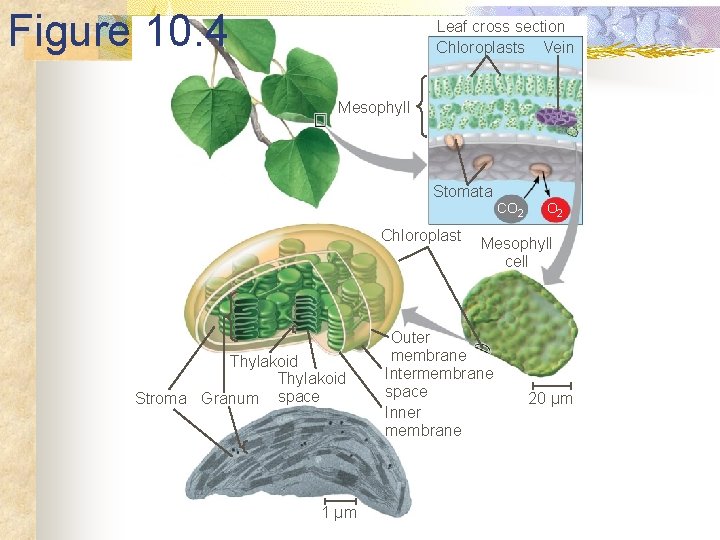
Figure 10. 4 Leaf cross section Chloroplasts Vein Mesophyll Stomata CO 2 Chloroplast Thylakoid Stroma Granum space 1 μm O 2 Mesophyll cell Outer membrane Intermembrane space Inner membrane 20 μm
Pigments n n n Molecules Absorb energy in visible range Chlorophylls & Carotenoids Chlorophyll a & b Absorb photons in the blue-violet & red light
Pigments n n Chlorophyll a main pigment of photosynthesis Converts light energy to chemical energy Chlorophyll b & carotenoids are accessory pigments Capture light energy at different wavelengths
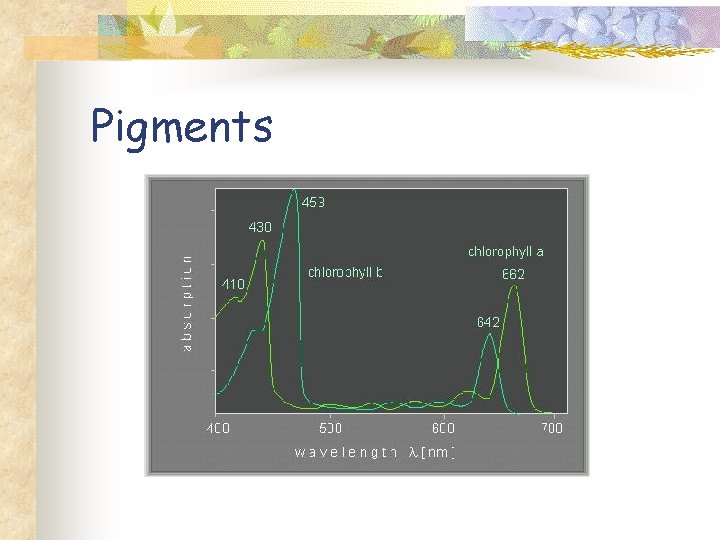
Pigments
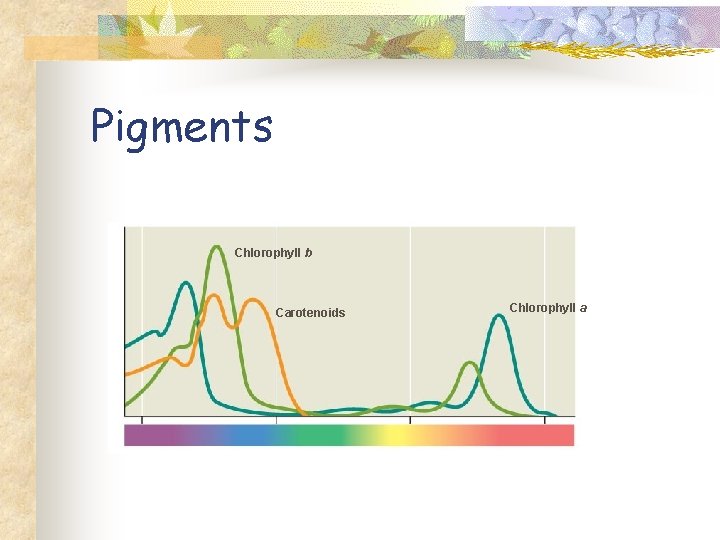
Pigments Chlorophyll b Carotenoids Chlorophyll a
Chlorophyll structure n n n Located in thylakoid membranes A porphyrin ring with a Mg in center Hydrocarbon tail Photons are absorbed by the ring Absorbs photons very effectively Excites electrons in the ring
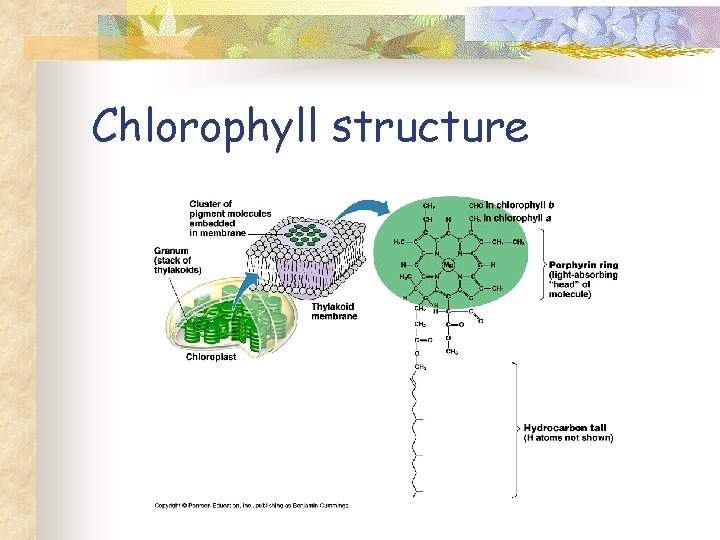
Chlorophyll structure
n D: Chapter_10A_Power. Point_Lectures10 _Lecture_Presentation10_07 Light. And. Pig ments_A. html
Carotenoids n n Two carbon rings attached by a carbon chain Not as efficient as the Chlorophylls Beta carotene (helps eyes) Found in carrots and yellow veggies
Photosystem n n n Cluster of photosynthetic pigments Membrane of thylakoids (surface) Each pigment captures light energy Photosystem then gathers energy Energy makes ATP & NADPH
Photosystems n n n Chlorophyll a molecules Accessory pigments (chlorophyll b & carotenoids) Associated proteins
Photosystems n n n Consists of 2 components 1. Antenna (light gathering) complex 2. Reaction center
Photosystem n n n 1. Antenna complex Gathers photons from sun Web of Chlorophyll a molecules Held by proteins in membrane Accessory pigments carotenoids Energy is passed along the pigments to reaction center
Photosystems n n n 2. Reaction centers 2 special chlorophyll a molecules Accept the energy Chlorophyll a than passes the energized electron to an acceptor Acceptor is reduced (quinone)
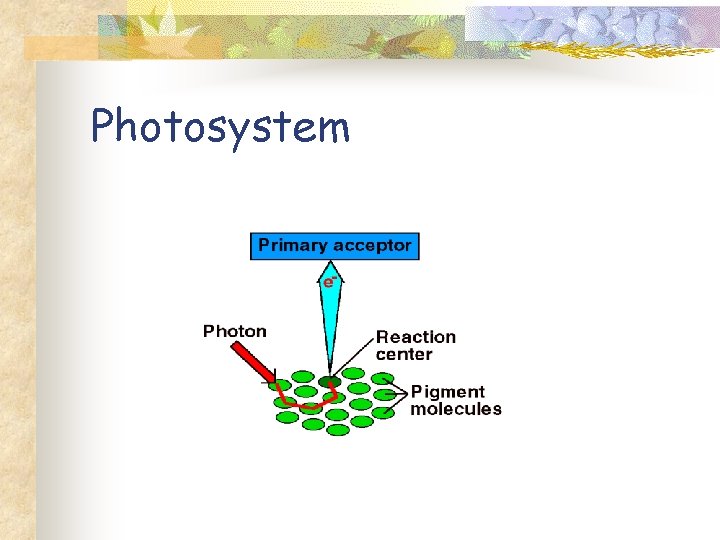
Photosystem
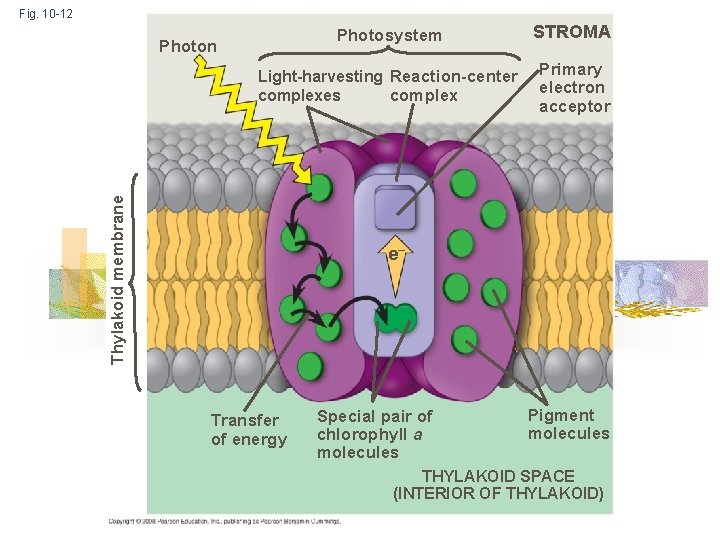
Fig. 10 -12 Photosystem STROMA Light-harvesting Reaction-center complexes Primary electron acceptor Thylakoid membrane Photon e– Transfer of energy Special pair of chlorophyll a molecules Pigment molecules THYLAKOID SPACE (INTERIOR OF THYLAKOID)
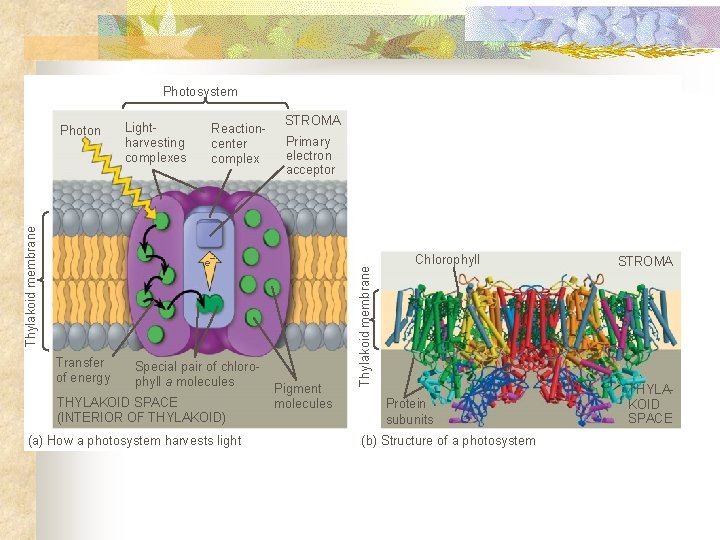
Photosystem Lightharvesting complexes Reactioncenter complex STROMA Primary electron acceptor e− Transfer of energy Special pair of chlorophyll a molecules THYLAKOID SPACE (INTERIOR OF THYLAKOID) (a) How a photosystem harvests light Pigment molecules Thylakoid membrane Photon Chlorophyll Protein subunits (b) Structure of a photosystem STROMA THYLAKOID SPACE
2 photosystems n n n n Photosystem I (older) Absorbs energy at 700 nm wavelength Generates NADPH Photosystem II (newer) Absorbs energy at 680 nm wavelength Splits water (releases oxygen) Generates ATP 2 systems work together to absorb more energy
NADP+ Nicotinamide Adenine Dinucleotide Phosphate Coenzyme Electron carrier Reduced during light-dependent reactions Used later to reduce carbon Carbon dioxide forms organic molecules Photosynthesis is a redox reaction n n n
Photophosphorylation n n Addition of phosphate group to ADP Light energy
Photosynthesis n n n Occurs in 3 stages 1. Capturing energy from sun 2. Energy makes ATP Reducing power in NADPH 3. ATP & NADPH Power synthesis of organic molecules

Photosynthesis n n n n Light dependent reactions First 2 steps of photosynthesis Presence of light Light-independent reactions Formation of organic molecules Calvin cycle Can occur +/- light
Photosynthesis n n n 1. Chloroplasts 2. Light-dependent reactions Sun’s energy makes NADPH & ATP 3. Light-independent reactions ATP & NADPH CO 2 into organic molecules
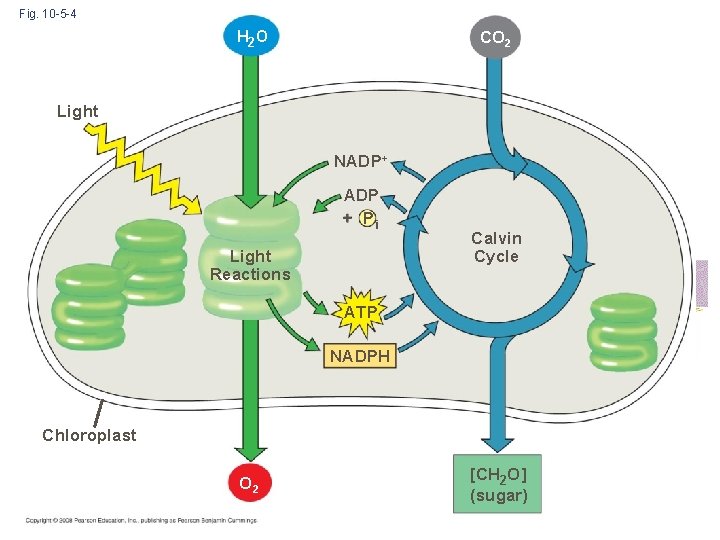
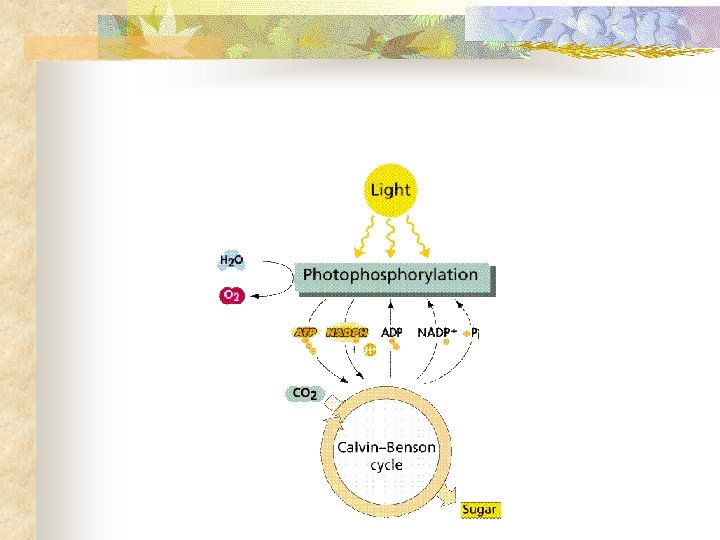
Fig. 10 -5 -4 CO 2 H 2 O Light NADP+ ADP + Pi Light Reactions Calvin Cycle ATP NADPH Chloroplast O 2 [CH 2 O] (sugar)
Photosynthesis (Process) n n Light dependent reactions Linear electron flow Energy transfer Thylakoid membranes
Light dependent reactions n n n Photosystem II (680 nm) Light is captured by pigments Excites an electron (unstable) Energy is transferred to reaction center (special chlorophyll) Passes excited electron to an acceptor molecule
Light dependent reactions n n n PS II is oxidized Water splits (enzyme) Water donates an electron to chlorophyll Reduces PS II Oxygen (O 2) is released with 2 protons (H+)
Light dependent reactions n n n Electron is transported to PS I (700 nm) Electron is passed along proteins in the membrane (ETC) Protons are transported across the membrane Protons flow back across the membrane & through ATP synthase Generate ATP
Light dependent reactions n n n At the same time PS I received light energy Excites an electron Primary acceptor accepts the electron PS I is excited Electron from PS II is passed to PS I Reduces the PS I
Light dependent reactions n n PS I excited electron is passed to a second ETC Ferredoxin protein NADP+ reductase catalyzes the transfer of the electron to NADP+ Makes NADPH
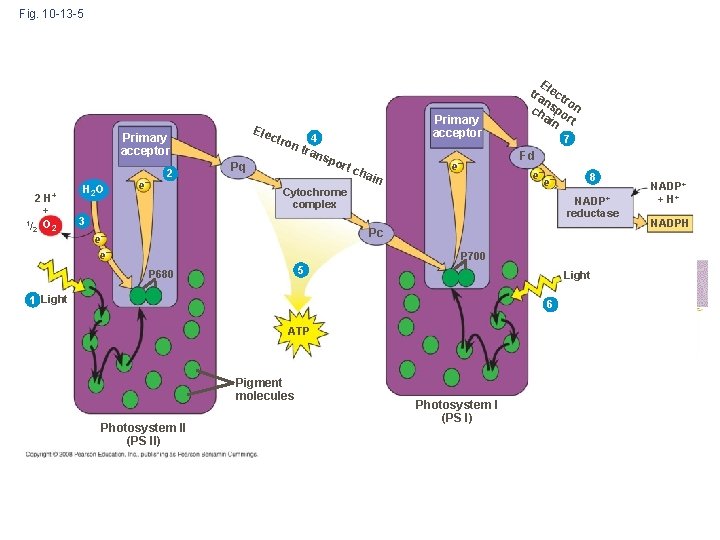
Fig. 10 -13 -5 Ele c Primary acceptor 2 H+ + 1/ O 2 2 H 2 O e– 2 tron Pq Primary acceptor 4 tran spo rt c hai e– n Cytochrome complex 3 E tra lect n ro ch spo n ain rt 7 Fd e– e– 8 NADP+ reductase Pc e– e– P 700 5 P 680 Light 1 Light 6 ATP Pigment molecules Photosystem II (PS II) Photosystem I (PS I) NADP+ + H+ NADPH
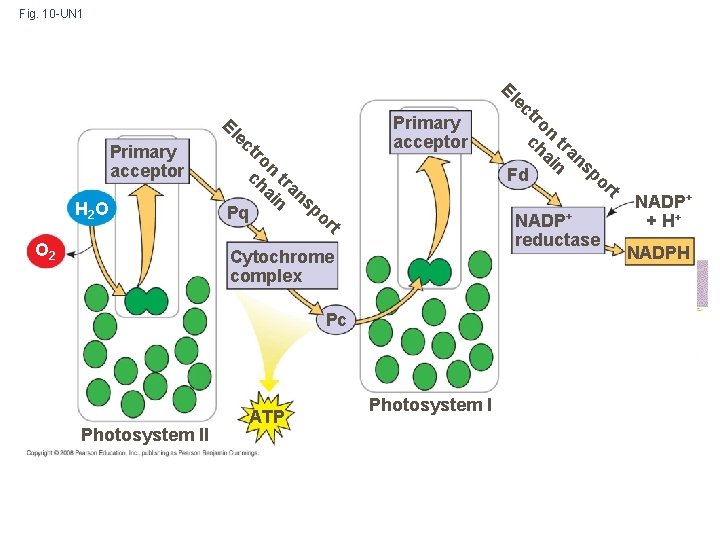
Fig. 10 -UN 1 H 2 O CO 2 El e El Primary acceptor H 2 O O 2 Primary acceptor ec tr on ch tr ai an n sp or Pq NADP+ reductase Cytochrome complex Pc Photosystem II O 2 ro n ch tr ai an n sp Fd o rt t ATP ct Photosystem I NADP+ + H+ NADPH
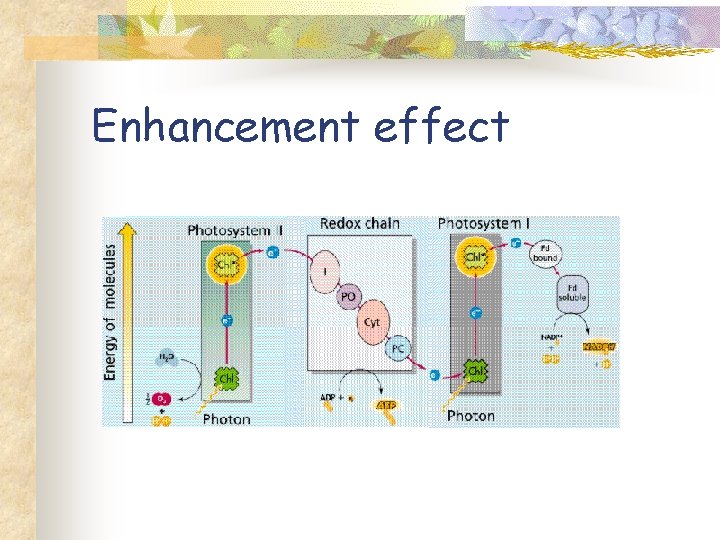
Enhancement effect
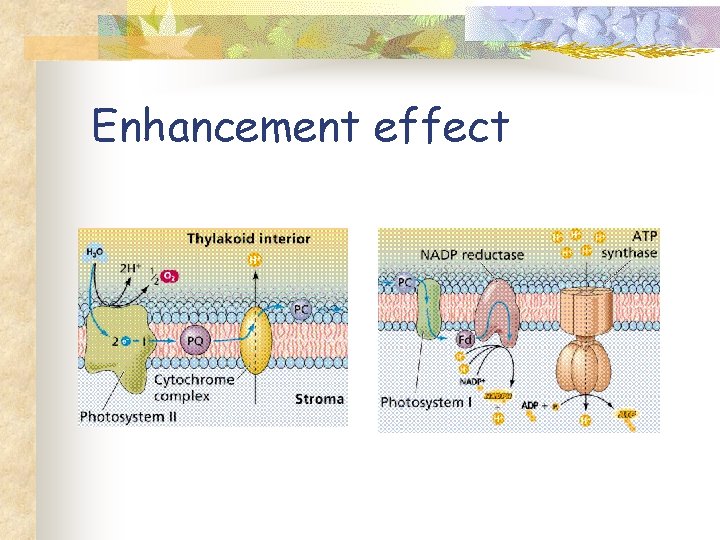
Enhancement effect
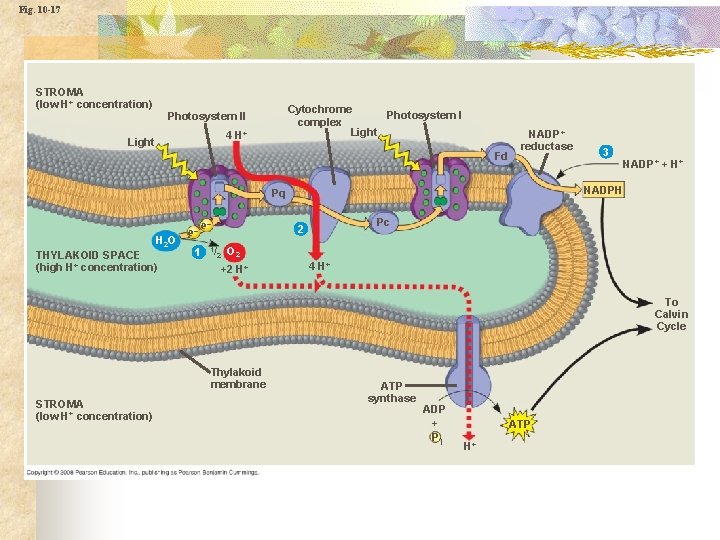
Fig. 10 -17 STROMA (low H+ concentration) Cytochrome Photosystem I complex Light Photosystem II 4 H+ Light Fd NADP+ reductase H 2 O THYLAKOID SPACE (high H+ concentration) 1 e– Pc 2 1/ 2 NADP+ + H+ NADPH Pq e– 3 O 2 +2 H+ 4 H+ To Calvin Cycle Thylakoid membrane STROMA (low H+ concentration) ATP synthase ADP + Pi ATP H+
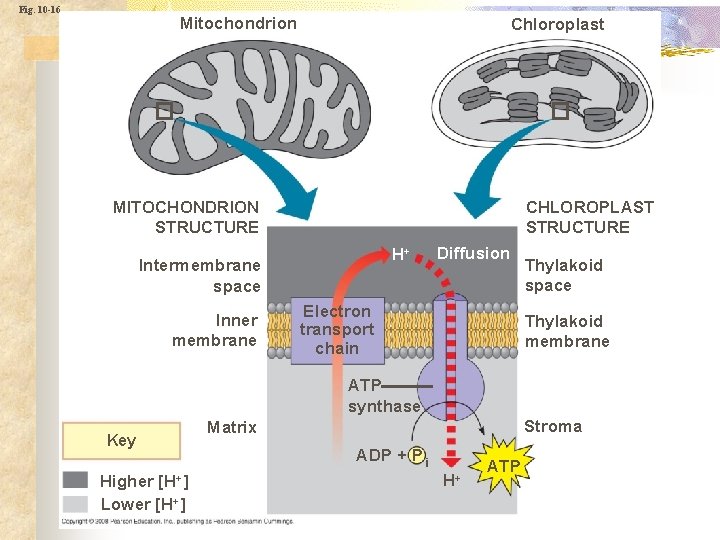
Fig. 10 -16 Mitochondrion Chloroplast MITOCHONDRION STRUCTURE CHLOROPLAST STRUCTURE H+ Intermembrane space Inner membrane Diffusion Electron transport chain Thylakoid space Thylakoid membrane ATP synthase Stroma Matrix Key ADP + P i [H+] Higher Lower [H+] H+ ATP
Photosystems n n n Noncyclic photophosphorylation 2 systems work in series Produce NADPH & ATP Replaces electrons from splitting water System II (splits water)works first then I (NADPH)
Photosystems n n n When more ATP is needed Plant changes direction Electron used to make NADPH in PS I is directed to make ATP
Calvin Cycle n n Named for Melvin Calvin Cyclic because it regenerates it’s starting material C 3 photosynthesis First organic compound has 3 carbons
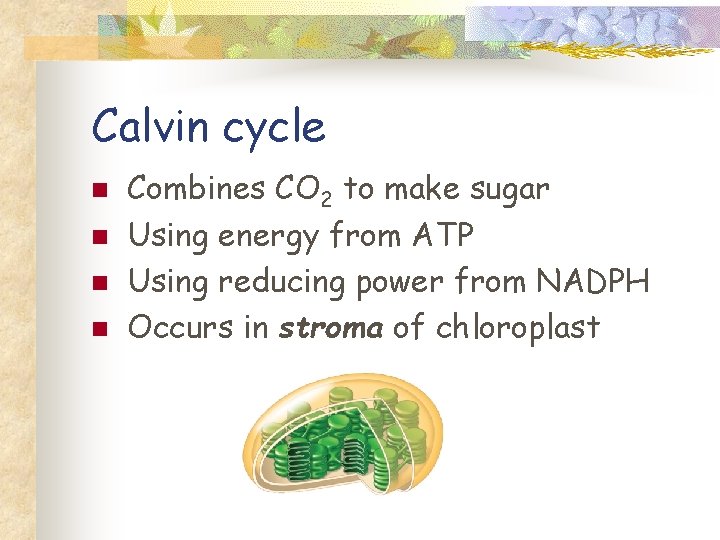
Calvin cycle n n Combines CO 2 to make sugar Using energy from ATP Using reducing power from NADPH Occurs in stroma of chloroplast
Calvin Cycle n n Consists of three parts 1. Fixation of carbon dioxide 2. Reduction-forms G 3 P (glyceraldehyde 3 -phosphate) 3. Regeneration of Ru. BP (ribulose 1, 5 bisphosphate)
Calvin Cycle n n n 3 cycles 3 CO 2 molecules 1 molecule of G 3 P 6 NADPH 9 ATP
Fixation of carbon n n n CO 2 combines with Ribulose 1, 5 bisphosphate (Ru. BP) Temporary 6 carbon intermediate Splits-forms 2 - three carbon molecules 3 -phosphoglycerate (PGA) Large enzyme that catalyses reaction (Rubisco) Ribulose bisphosphate carboxylase/oxygenase
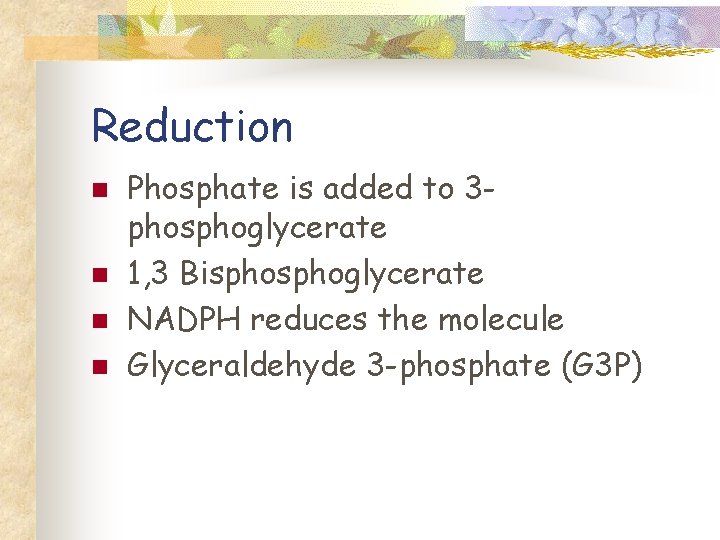
Reduction n n Phosphate is added to 3 phosphoglycerate 1, 3 Bisphoglycerate NADPH reduces the molecule Glyceraldehyde 3 -phosphate (G 3 P)
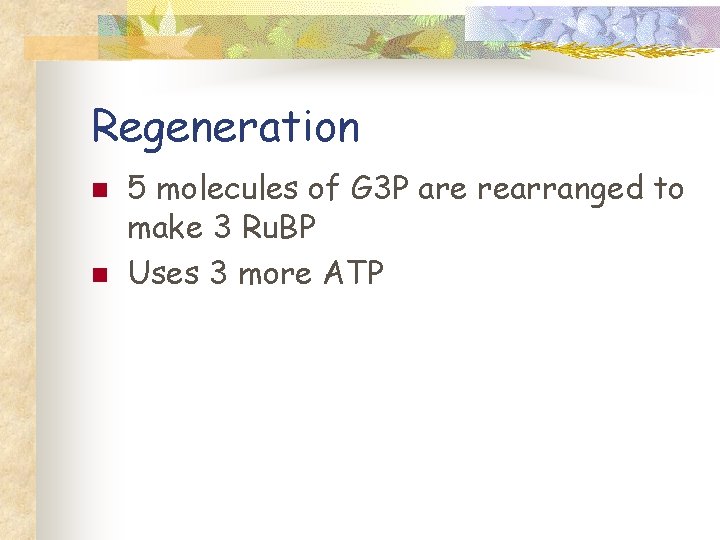
Regeneration n n 5 molecules of G 3 P are rearranged to make 3 Ru. BP Uses 3 more ATP
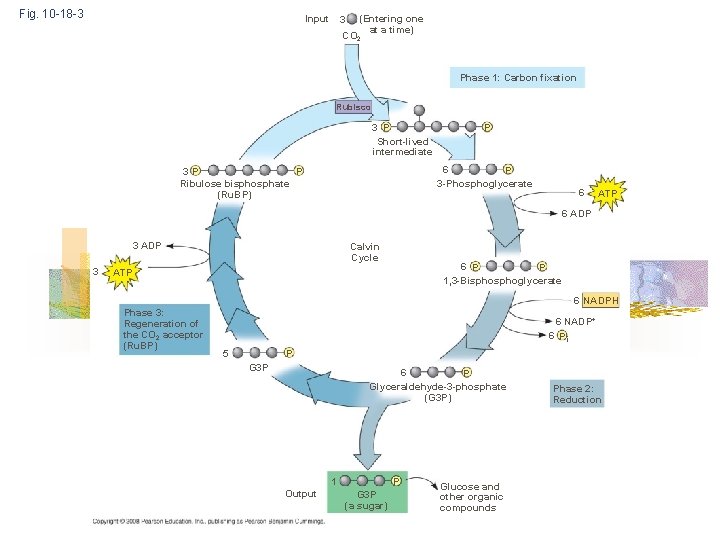
Fig. 10 -18 -3 Input 3 (Entering one at a time) CO 2 Phase 1: Carbon fixation Rubisco 3 P Short-lived intermediate P 6 P 3 -Phosphoglycerate 3 P P Ribulose bisphosphate (Ru. BP) 6 ATP 6 ADP 3 Calvin Cycle 6 P P 1, 3 -Bisphoglycerate ATP 6 NADPH Phase 3: Regeneration of the CO 2 acceptor (Ru. BP) 6 NADP+ 6 Pi P 5 G 3 P 6 P Glyceraldehyde-3 -phosphate (G 3 P) 1 Output P G 3 P (a sugar) Glucose and other organic compounds Phase 2: Reduction
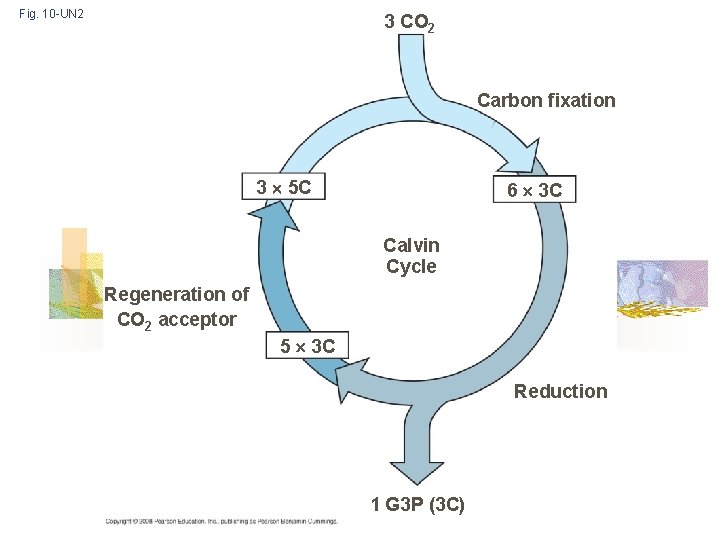
Fig. 10 -UN 2 3 CO 2 Carbon fixation 3 5 C 6 3 C Calvin Cycle Regeneration of CO 2 acceptor 5 3 C Reduction 1 G 3 P (3 C)
Calvin Cycle n n n 3 CO 2 enter cycle & combine with Ru. BP Generates 3 molecules more of Ru. BP & one G 3 P (glyceraldehyde 3 phosphate) G 3 P can be made into glucose & other sugars
Calvin Cycle Enzyme mediated n 5 of these enzymes need light to be more efficient n Net reaction 3 CO 2 + 9 ATP + 6 NADPH ⇨ n G 3 P + 8 Pi + 9 ADP + 6 NADP+
G 3 P n n n G 3 P Converted to fructose 6 -phosphate (reverse of glycolysis) Made into sucrose Happens in cytoplasm Intense photosynthesis G 3 P levels rise so much some is converted to starch
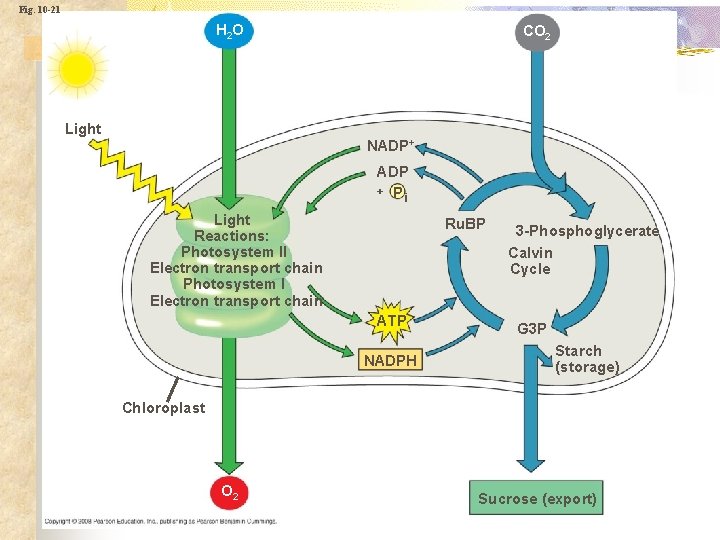
Fig. 10 -21 H 2 O CO 2 Light NADP+ ADP + P i Light Reactions: Photosystem II Electron transport chain Photosystem I Electron transport chain Ru. BP ATP NADPH 3 -Phosphoglycerate Calvin Cycle G 3 P Starch (storage) Chloroplast O 2 Sucrose (export)
Summary n n n Light reactions Thylakoids Use Sun’s energy Make ATP & NADPH Split water make oxygen
Summary n n n Dark reactions Stroma Use ATP & NADPH Make G 3 P Regenerate ADP, Inorganic P, and NADP
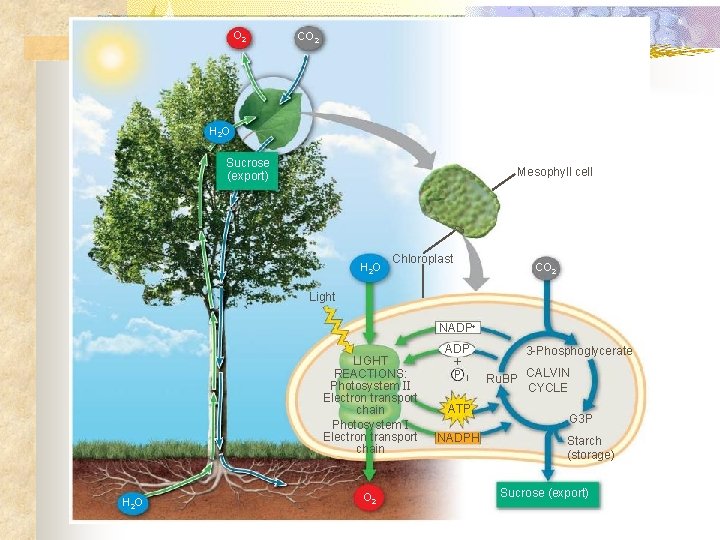
O 2 CO 2 H 2 O Sucrose (export) Mesophyll cell H 2 O Chloroplast CO 2 Light NADP+ LIGHT REACTIONS: Photosystem II Electron transport chain Photosystem I Electron transport chain H 2 O O 2 ADP + Pi ATP NADPH 3 -Phosphoglycerate Ru. BP CALVIN CYCLE G 3 P Starch (storage) Sucrose (export)
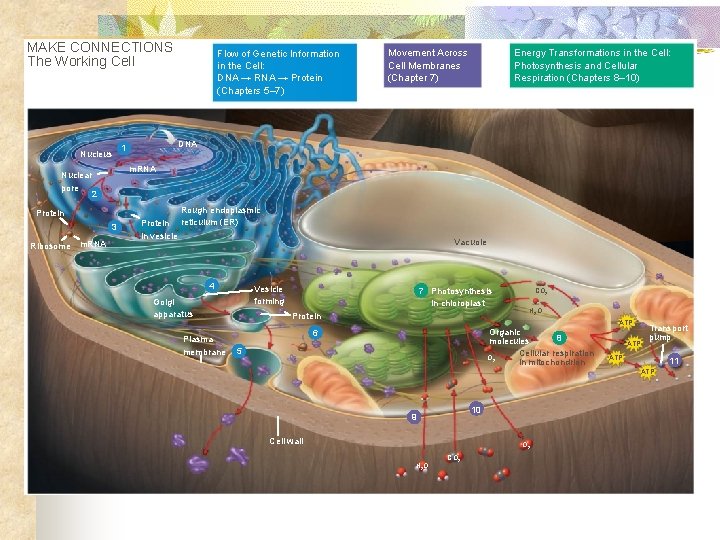
MAKE CONNECTIONS The Working Cell Nucleus Protein 3 m. RNA Movement Across Cell Membranes (Chapter 7) Energy Transformations in the Cell: Photosynthesis and Cellular Respiration (Chapters 8– 10) DNA 1 m. RNA Nuclear pore 2 Ribosome Flow of Genetic Information in the Cell: DNA → RNA → Protein (Chapters 5– 7) Rough endoplasmic Protein reticulum (ER) in vesicle 4 Vesicle forming Golgi apparatus Plasma membrane Vacuole 7 Photosynthesis in chloroplast Protein CO 2 H 2 O ATP Organic 8 molecules Cellular respiration O 2 in mitochondrion 6 5 ATP Transport pump ATP 11 ATP 10 9 Cell wall O 2 H 2 O CO 2
Photorespiration n n Rubisco oxidizes Ru. BP (starting molecules of Calvin cycle) Oxygen is incorporated into Ru. BP Undergoes reactions that release CO 2 & O 2 compete for same sight on the enzyme Under conditions greater than the optimal 250 C this process occurs more readily
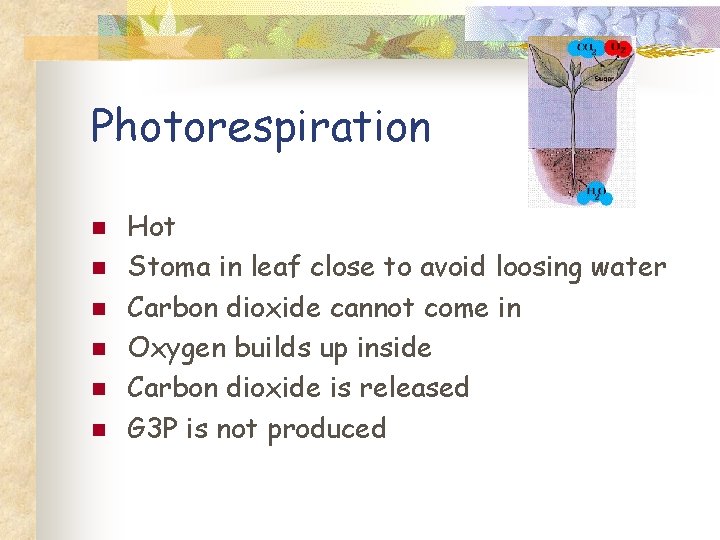
Photorespiration n n n Hot Stoma in leaf close to avoid loosing water Carbon dioxide cannot come in Oxygen builds up inside Carbon dioxide is released G 3 P is not produced
C 4 Photosynthesis n n n Process to avoid loosing carbon dioxide Plant fixes carbon dioxide into a 4 carbon molecule (oxaloacetate) PEP carboxylase (enzyme) Oxaloacetate is converted to malate Then taken to stroma for Calvin cycle Sugarcane and corn
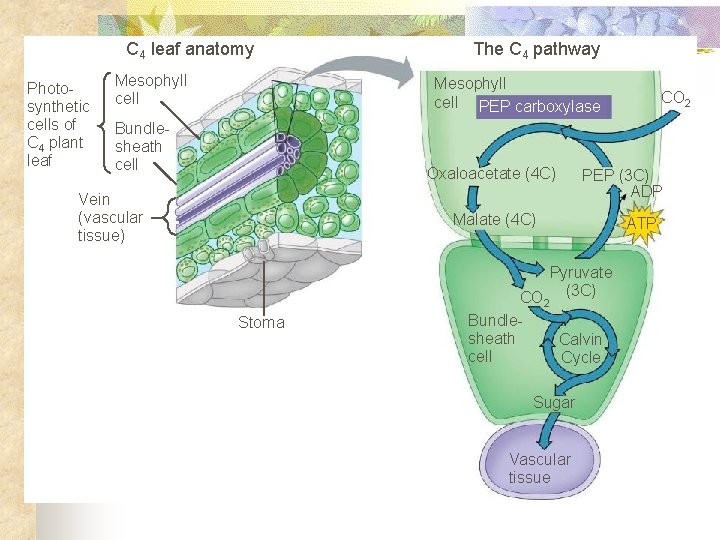
C 4 leaf anatomy Photosynthetic cells of C 4 plant leaf Mesophyll cell The C 4 pathway Mesophyll cell PEP carboxylase Bundlesheath cell Oxaloacetate (4 C) Vein (vascular tissue) PEP (3 C) ADP Malate (4 C) Stoma Pyruvate CO 2 (3 C) Bundlesheath Calvin cell Cycle Sugar Vascular tissue CO 2 ATP
CAM n n n Process to prevent loss of CO 2 Plants in dry hot regions (cacti) Reverse what most plants do Open stoma at night Allows CO 2 to come in & water to leave Close them during the day.
CAM n n Carbon fix CO 2 at night into 4 carbon chains (organic acids) Use the Calvin cycle during the day.
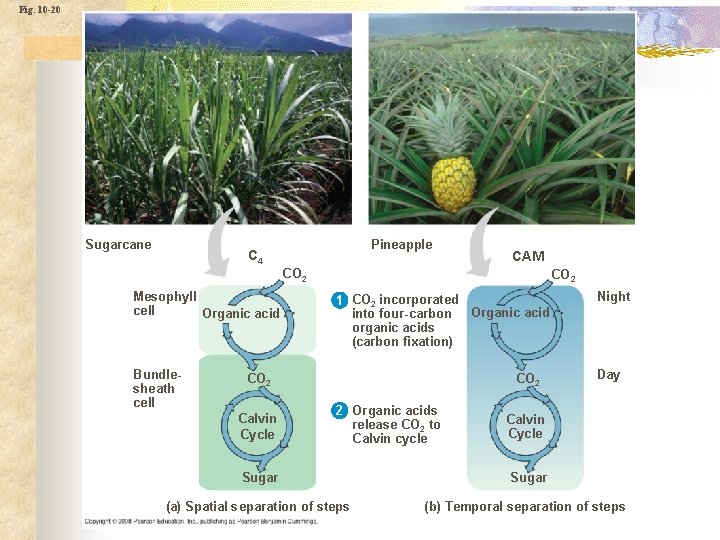
Fig. 10 -20 Sugarcane Pineapple C 4 CAM CO 2 Mesophyll cell Organic acid Bundlesheath cell CO 2 1 CO 2 incorporated into four-carbon Organic acid organic acids (carbon fixation) CO 2 Calvin Cycle CO 2 2 Organic acids release CO 2 to Calvin cycle Night Day Calvin Cycle Sugar (a) Spatial separation of steps (b) Temporal separation of steps
- Slides: 89