
Photosynthesis Ch 10 AP Biology Lesson 1 Intro
Photosynthesis Ch. 10 AP Biology
Lesson 1: Intro to Photosynthesis You. Tube Video: Ø Photosynthesis
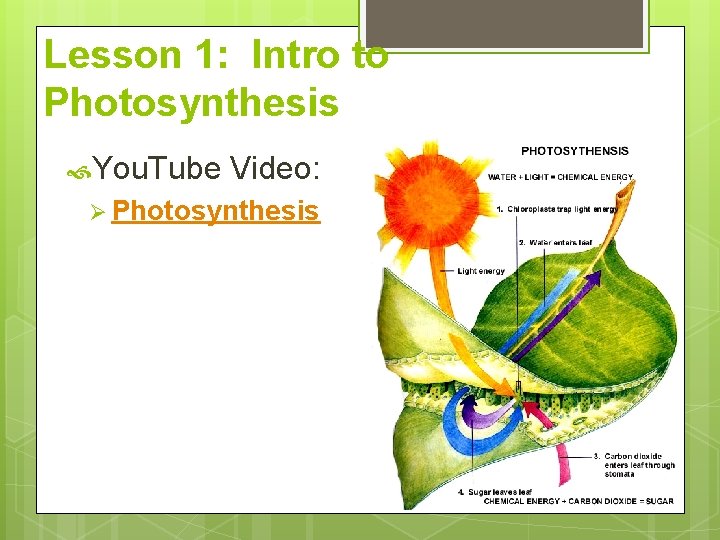
Overview: The Process That Feeds the Biosphere Photosynthesis is the process of converting solar energy into chemical energy to nourish most of the biosphere, whether directly or indirectly. Photosynthesis occurs in most autotrophs (plants, algae, other protists & some prokaryotes) that use it to produce organic molecules from CO 2, H 2 O and solar energy.

Figure 10. 2 Autotrophs (b) Multicellular alga (a) Plants (d) Cyanobacteria (c) Unicellular protists 10 m (e) Purple sulfur 1 m bacteria 40 m
Heterotrophs are the consumers of the biosphere that obtain their organic material (food) and O 2 primarily from other photosynthetic organisms. Fossil fuels represent solar energy stores, harnessed by autotrophs that lived & died millions of years ago, that still supply life today with energy needs.
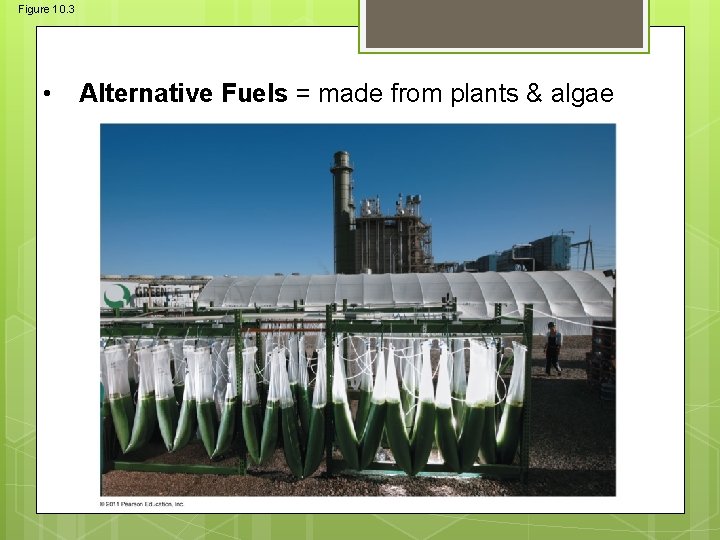
Figure 10. 3 • Alternative Fuels = made from plants & algae
Concept 10. 1: Photosynthesis converts light energy to the chemical energy of food Chloroplasts = the sites of photosynthesis in plants Chloroplasts are similar in structure to bacteria & are believed by some to have likely evolved from photosynthetic bacteria. The structural organization of these cells allows for the chemical reactions of photosynthesis
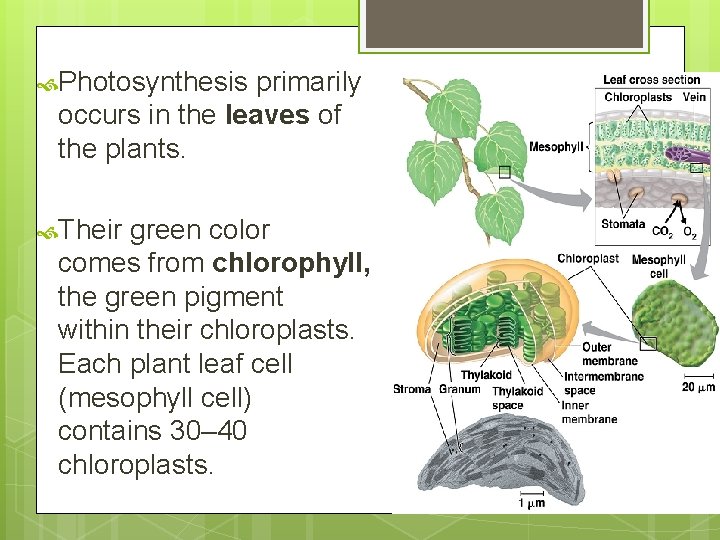
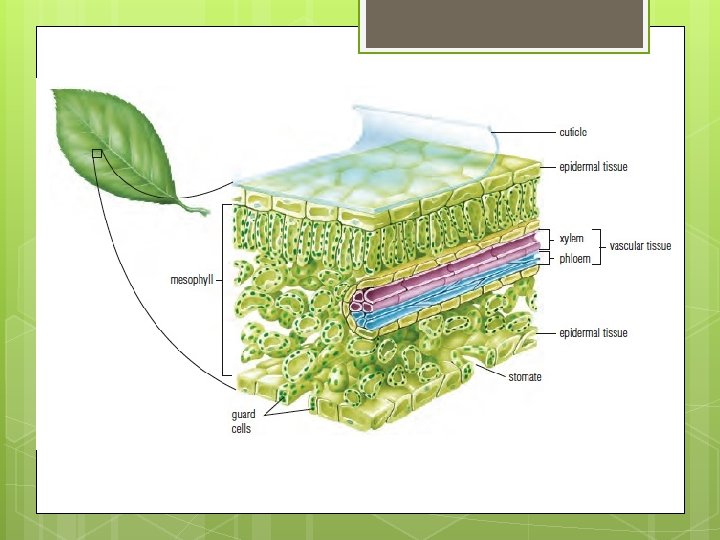
Photosynthesis primarily occurs in the leaves of the plants. Their green color comes from chlorophyll, the green pigment within their chloroplasts. Each plant leaf cell (mesophyll cell) contains 30– 40 chloroplasts.
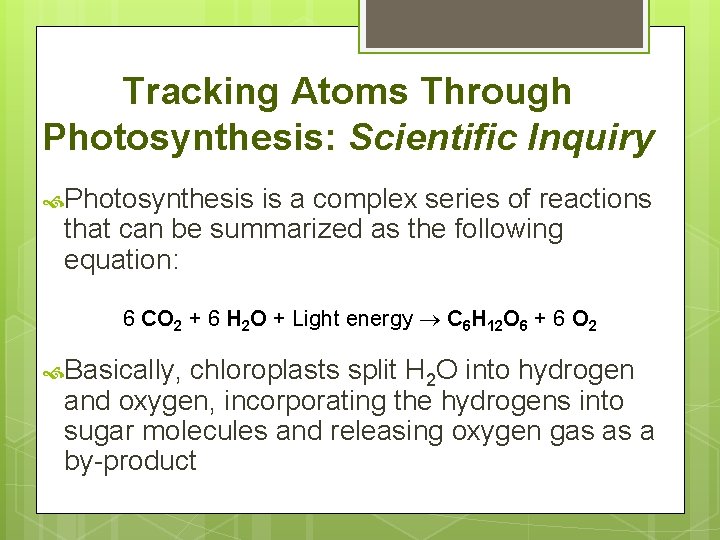
Tracking Atoms Through Photosynthesis: Scientific Inquiry Photosynthesis is a complex series of reactions that can be summarized as the following equation: 6 CO 2 + 6 H 2 O + Light energy C 6 H 12 O 6 + 6 O 2 Basically, chloroplasts split H 2 O into hydrogen and oxygen, incorporating the hydrogens into sugar molecules and releasing oxygen gas as a by-product
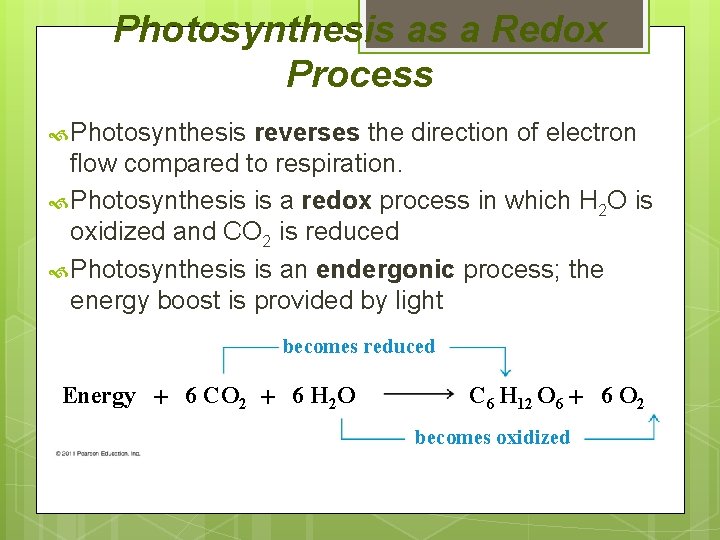
Photosynthesis as a Redox Process Photosynthesis reverses the direction of electron flow compared to respiration. Photosynthesis is a redox process in which H 2 O is oxidized and CO 2 is reduced Photosynthesis is an endergonic process; the energy boost is provided by light becomes reduced Energy 6 CO 2 6 H 2 O C 6 H 12 O 6 6 O 2 becomes oxidized
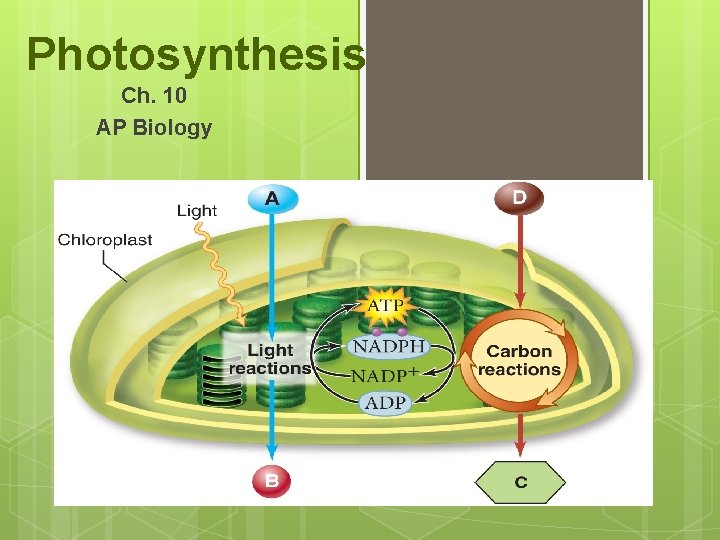
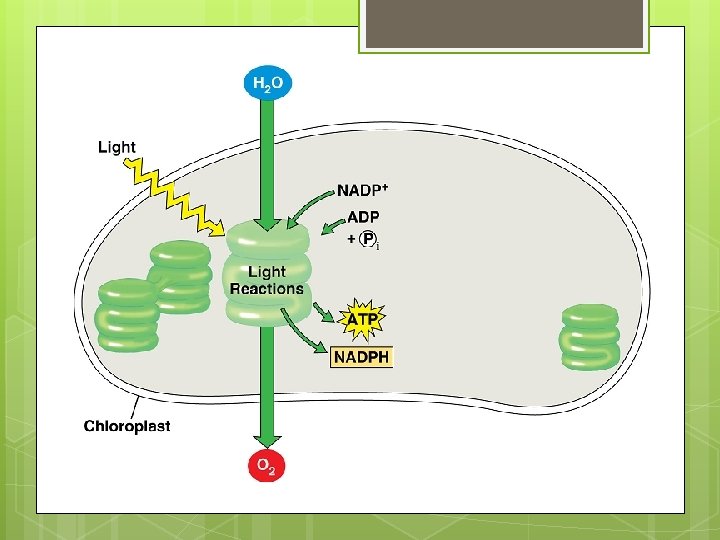
The Two Stages of Photosynthesis: A Preview Photosynthesis consists of the light reactions (photo) and Calvin cycle (synthesis). Light Reactions In the Thylakoid Membranes Split H 2 O Release O 2 Reduce NADP+ to NADPH Generate ATP from ADP & Pi by photophosphorylation.
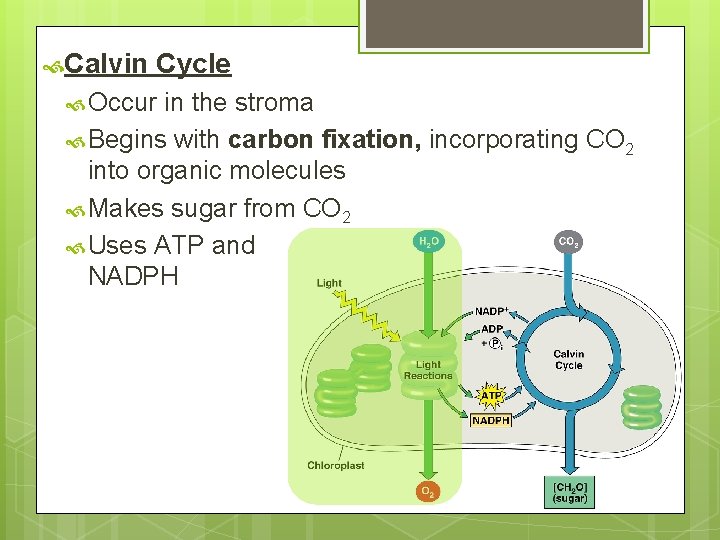
Calvin Cycle Occur in the stroma Begins with carbon fixation, incorporating CO 2 into organic molecules Makes sugar from CO 2 Uses ATP and NADPH
Lesson 2: Light Reactions You. Tube Ø Video: Photosynthesis (Light Reactions) by ndsuvirtualcell
Concept 10. 2 The light reactions convert solar energy to the chemical energy of ATP and NADPH Chloroplasts’ thylakoid membranes transform light energy into the chemical energy of ATP and NADPH Light is electromagnetic energy, radiation, whose wavelengths can be seen. Light also behaves as though it consists of discrete particles, called photons.
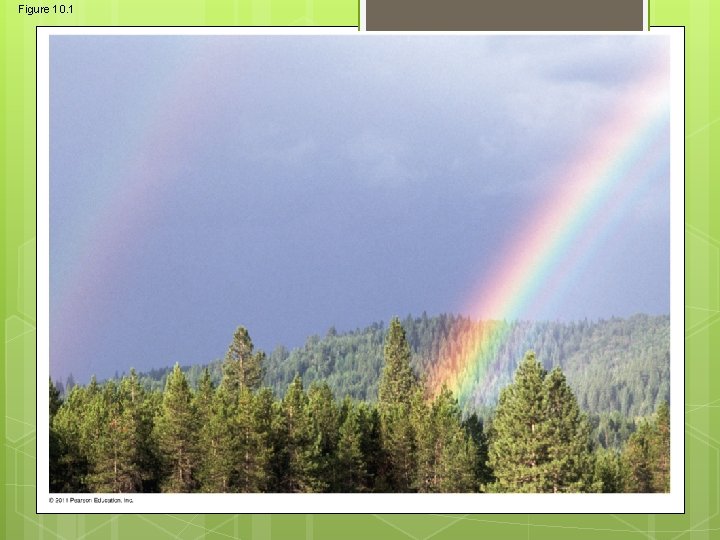
Figure 10. 1
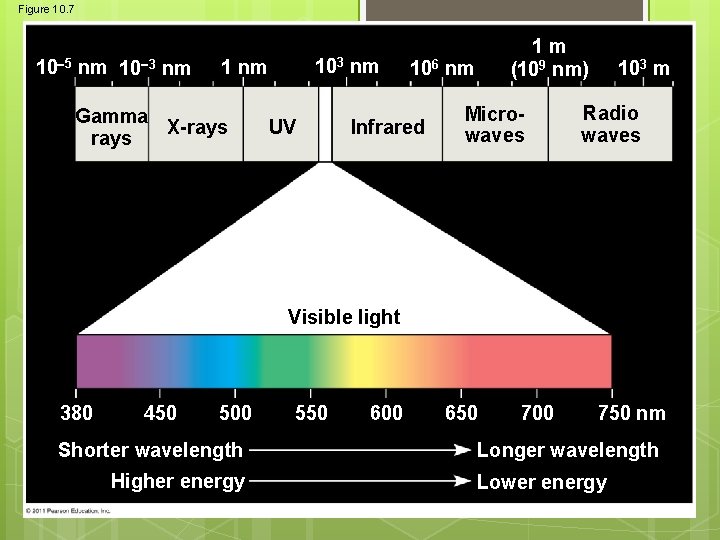
Figure 10. 7 10 5 nm 10 3 nm 103 1 nm Gamma X-rays UV nm 1 m (109 nm) 106 nm Infrared Microwaves 103 m Radio waves Visible light 380 450 500 Shorter wavelength Higher energy 550 600 650 700 750 nm Longer wavelength Lower energy
Photosynthetic Pigments: The Light Receptors Pigments absorb some wavelengths of visible light and reflect (or transmit) others. Leaves appear green because chlorophyll reflects and transmits green light Animation: Light and Pigments
A spectrophotometer measures a pigment’s ability to absorb various wavelengths. An absorption spectrum is a graph plotting a pigment’s light absorption versus wavelength. The absorption spectrum of chlorophyll a suggests that violet-blue and red light work best for photosynthesis. An action spectrum profiles the relative effectiveness of different wavelengths of radiation in driving a process.
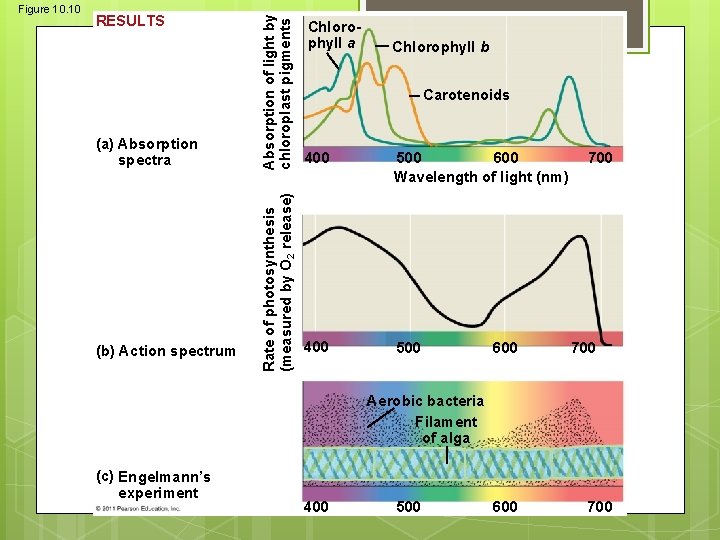
(a) Absorption spectra (b) Action spectrum Absorption of light by chloroplast pigments RESULTS Rate of photosynthesis (measured by O 2 release) Figure 10. 10 Chlorophyll a Chlorophyll b Carotenoids 400 500 600 Wavelength of light (nm) 400 500 600 700 Aerobic bacteria Filament of alga (c) Engelmann’s experiment 400 500 600 700
Chlorophyll a is the main photosynthetic pigment Accessory pigments, such as chlorophyll b, broaden the spectrum used for photosynthesis Accessory pigments called carotenoids absorb excessive light that would damage chlorophyll
Excitation of Chlorophyll by Light When a pigment absorbs light, it goes from a ground state to an excited state, which is unstable. When excited electrons fall back to the ground state, photons are given off, an afterglow called fluorescence. If illuminated, an isolated solution of chlorophyll will fluoresce, giving off light and heat.
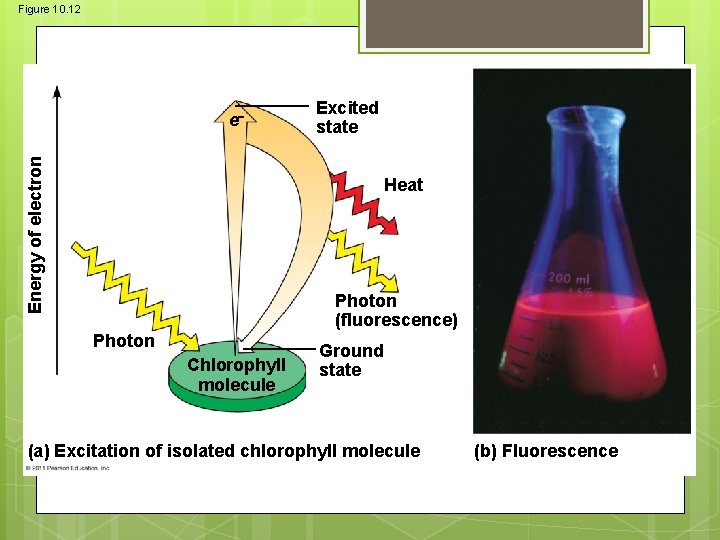
Figure 10. 12 Energy of electron e Excited state Heat Photon (fluorescence) Photon Chlorophyll molecule Ground state (a) Excitation of isolated chlorophyll molecule (b) Fluorescence
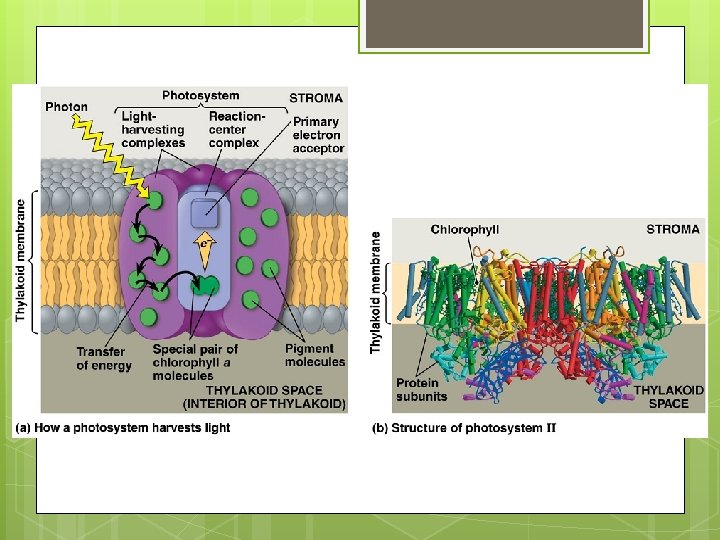
Photosystems Photosynthetic pigments in the thylakoid membranes are clustered together, forming photosystems. Photosystem II & Photosystem I II occurs first to replace electrons lost at Photosystem I. Because Photosystem I was discovered first, it is labeled as Photosystem I instead of II.
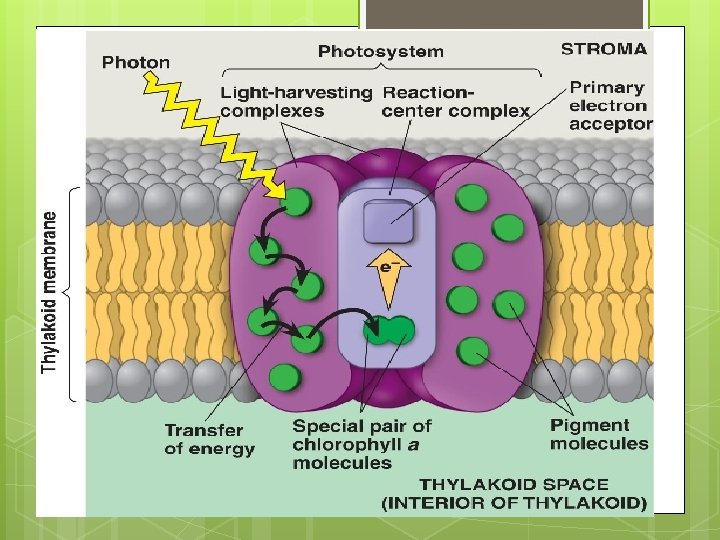
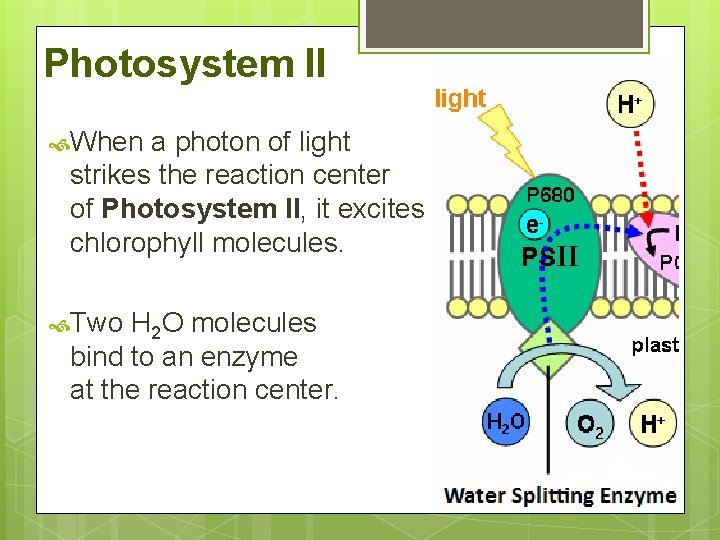
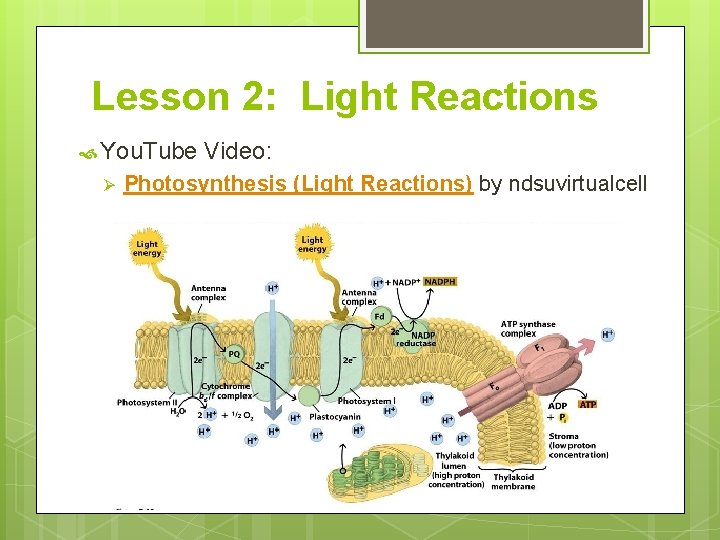
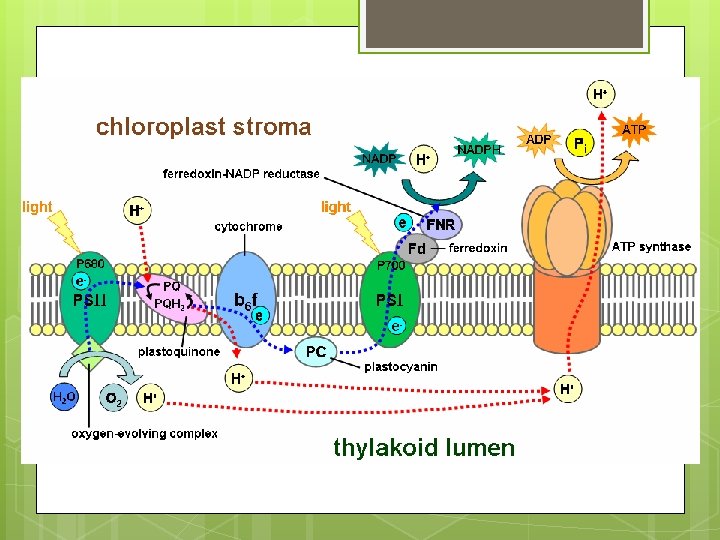
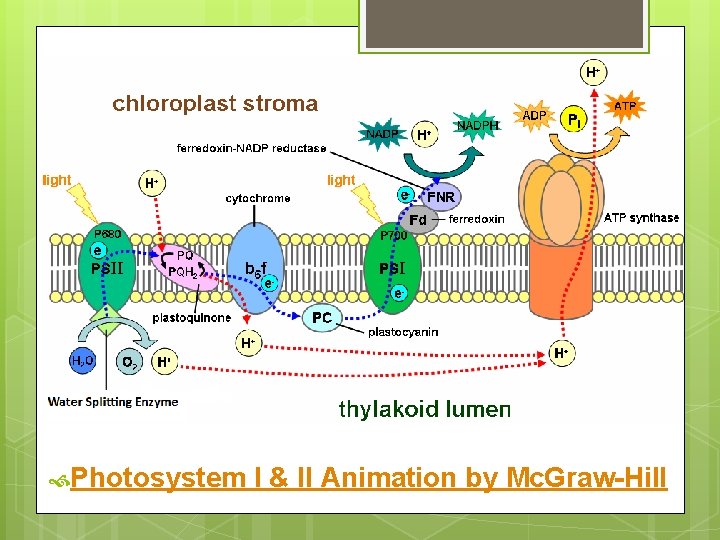
Photosystem II When a photon of light strikes the reaction center of Photosystem II, it excites an electron in chlorophyll molecules. Two H 2 O molecules bind to an enzyme at the reaction center.
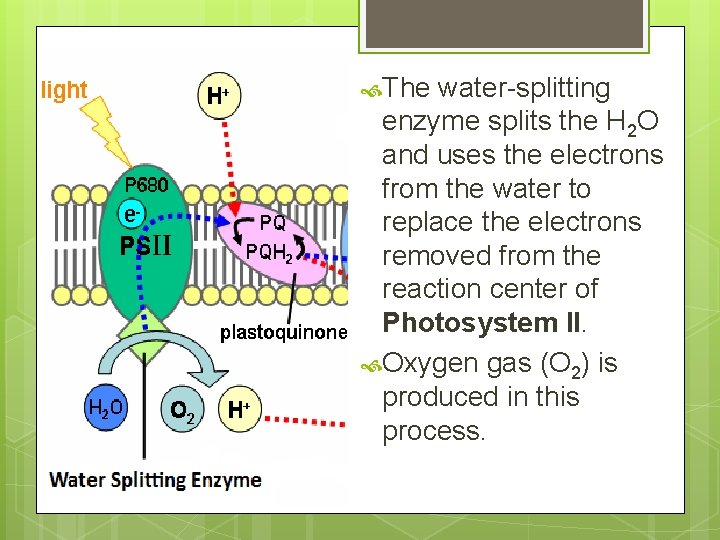
The water-splitting enzyme splits the H 2 O and uses the electrons from the water to replace the electrons removed from the reaction center of Photosystem II. Oxygen gas (O 2) is produced in this process.
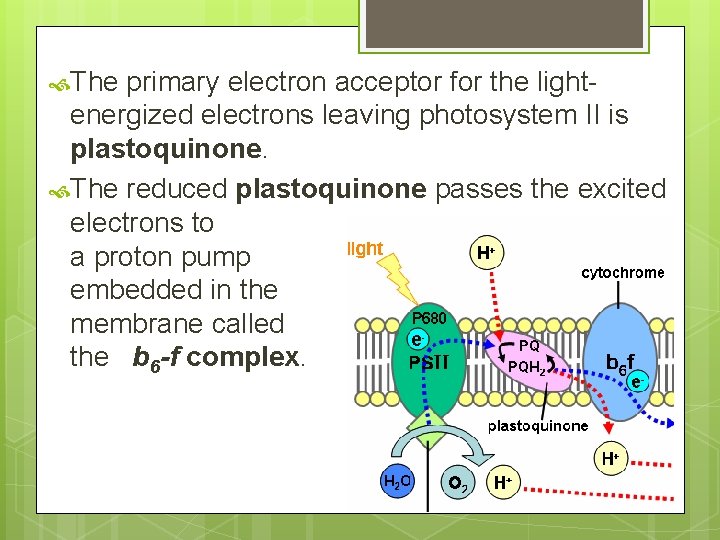
The primary electron acceptor for the lightenergized electrons leaving photosystem II is plastoquinone. The reduced plastoquinone passes the excited electrons to a proton pump embedded in the membrane called the b 6 -f complex.
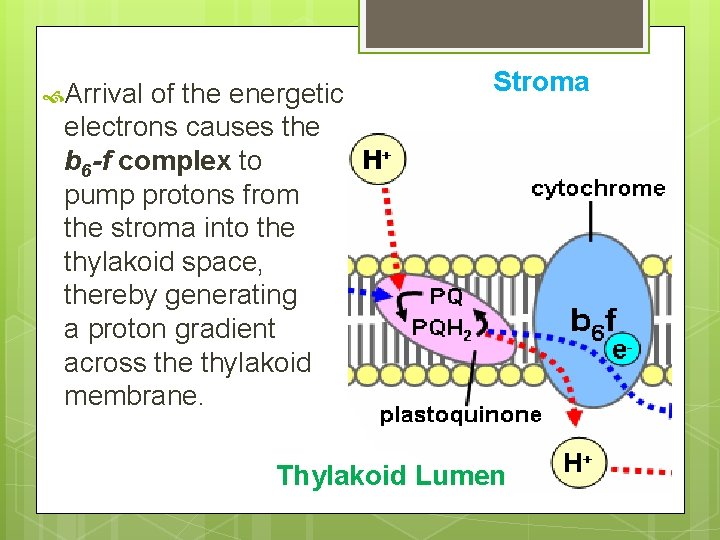
Arrival of the energetic electrons causes the b 6 -f complex to pump protons from the stroma into the thylakoid space, thereby generating a proton gradient across the thylakoid membrane. Stroma Thylakoid Lumen
Because thylakoid membrane is impermeable to protons, the protons in the stroma must pass through the channels provided by ATP synthase. As protons pass through, ADP is phosphorylated to ATP and released into the stroma. This process for making ATP is referred to as photophosphorylation.
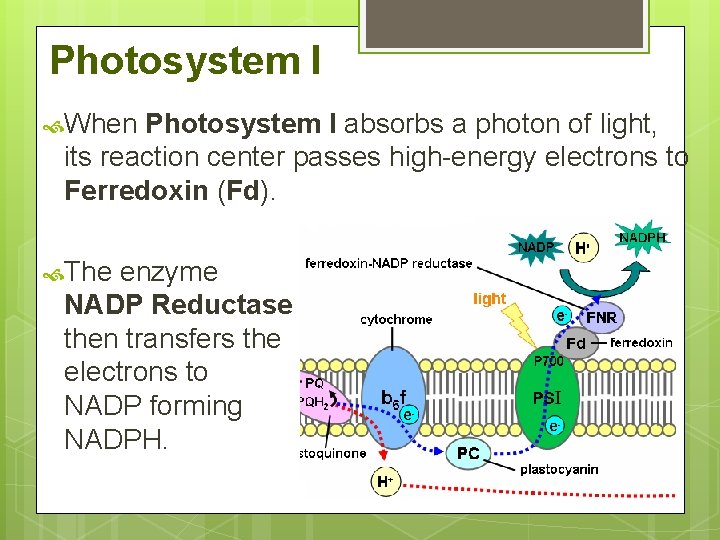
Photosystem I When Photosystem I absorbs a photon of light, its reaction center passes high-energy electrons to Ferredoxin (Fd). The enzyme NADP Reductase then transfers the electrons to NADP forming NADPH.
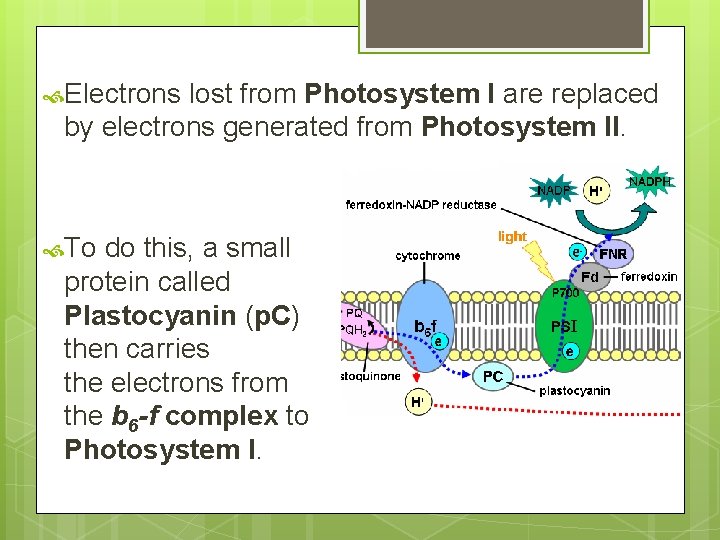
Electrons lost from Photosystem I are replaced by electrons generated from Photosystem II. To do this, a small protein called Plastocyanin (p. C) then carries the electrons from the b 6 -f complex to Photosystem I.
Photosystem I & II Animation by Mc. Graw-Hill
ATP Synthase Just as in the ETC of cellular respiration, a concentration gradient forms for Hydrogen ions (protons). This proton concentration build-up occurs inside thylakoid lumen (area between the thylakoid membranes). The protons move down their gradient through ATP Synthase into the chloroplast’s stroma. This movement of protons attaches Pi to ADP, forming ATP which will be used along with the electrons of NADPH to run the Calvin Cycle in the stroma.
Lesson 3: Calvin Cycle You. Tube Video: Photosynthesis
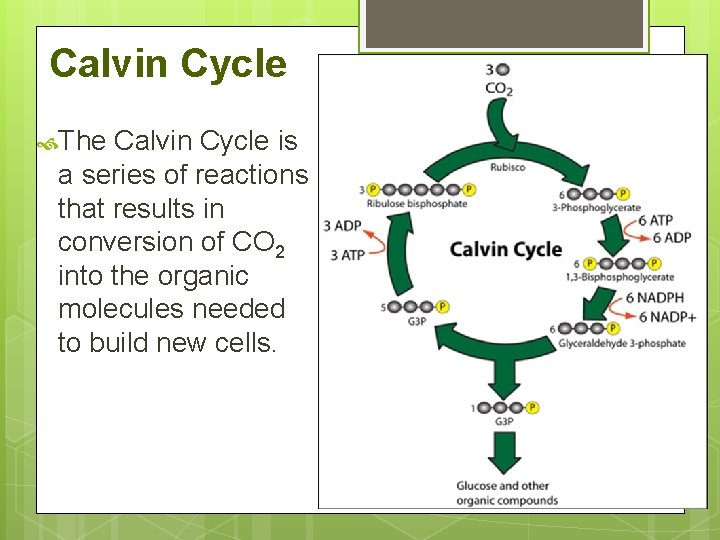
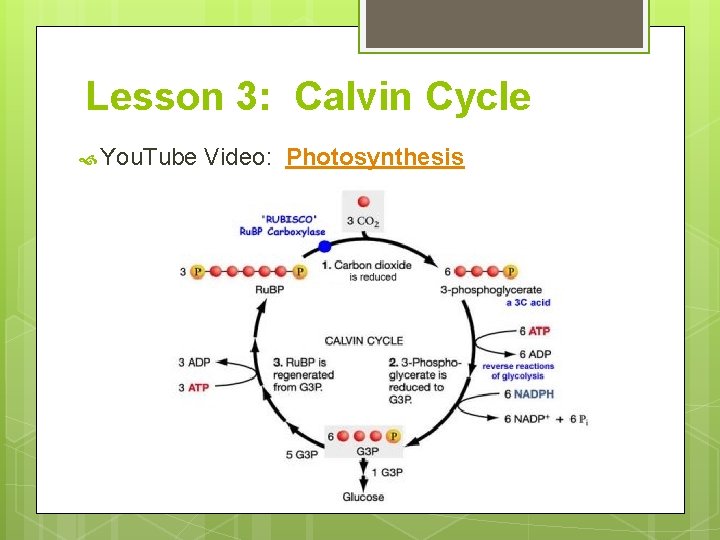
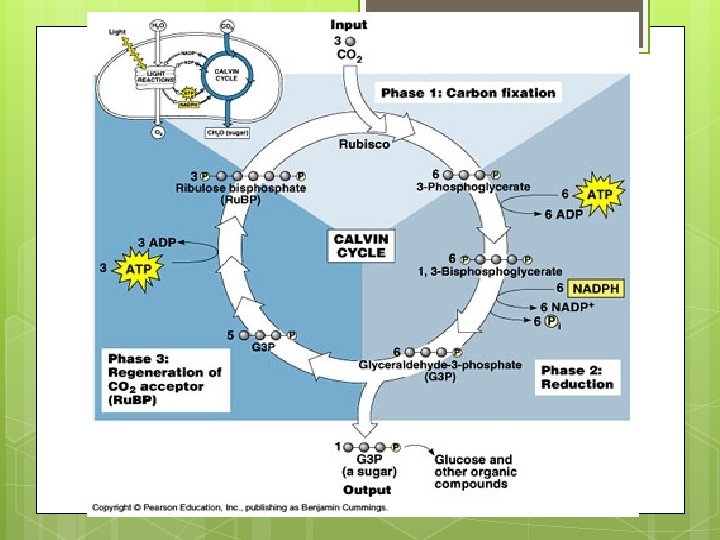
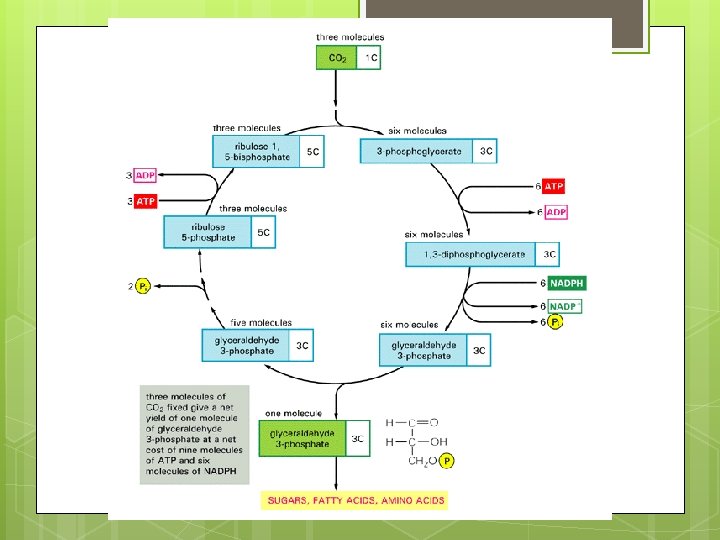
Calvin Cycle The Calvin Cycle is a series of reactions that results in conversion of CO 2 into the organic molecules needed to build new cells.
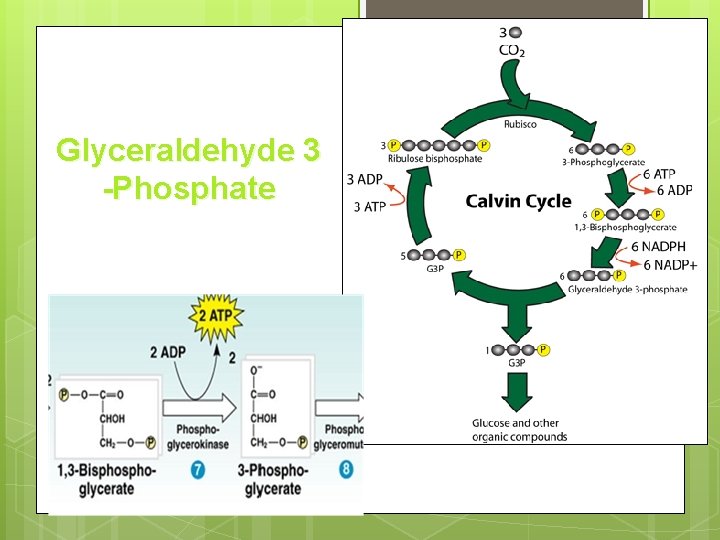
Glyceraldehyde 3 -Phosphate
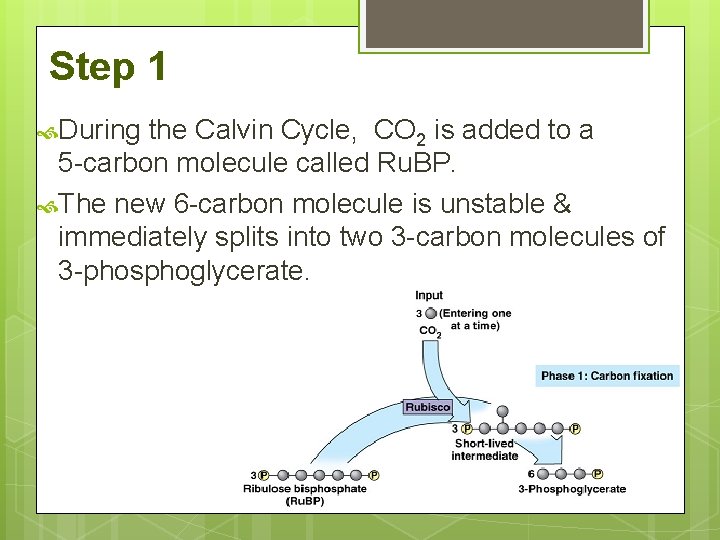
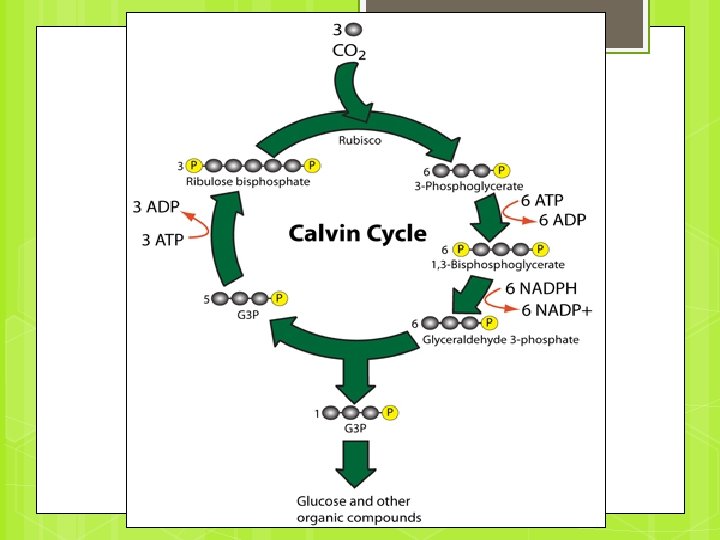
Step 1 During the Calvin Cycle, CO 2 is added to a 5 -carbon molecule called Ru. BP. The new 6 -carbon molecule is unstable & immediately splits into two 3 -carbon molecules of 3 -phosphoglycerate.
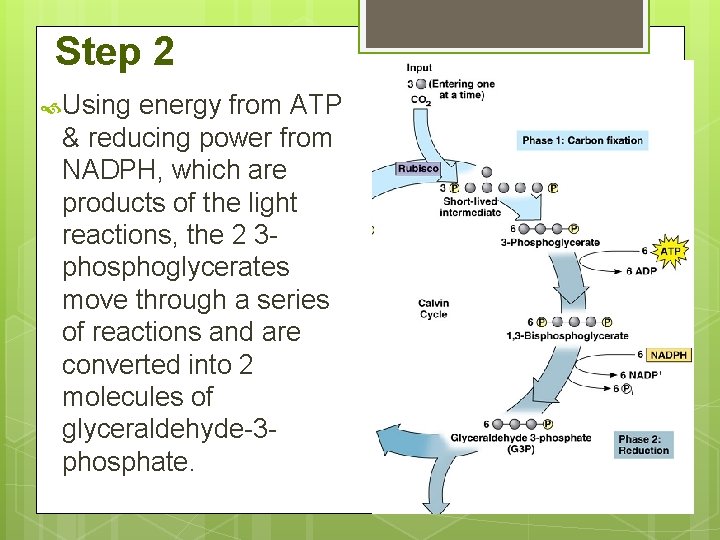
Step 2 Using energy from ATP & reducing power from NADPH, which are products of the light reactions, the 2 3 phosphoglycerates move through a series of reactions and are converted into 2 molecules of glyceraldehyde-3 phosphate.
Step 3 When several of these glyceraldehyde-3 phosphate molecules have been produced, some combine to make glucose while others are reused in the Calvin Cycle. To generate an entire new glucose molecule, the cycle has to turn several times because each turn of the cycle adds only one carbon atom from each molecule of CO 2.
Animations Photosynthetic Electron Transport by Mc. Graw- Hill Calvin Cycle Animation by Mc. Graw-Hill
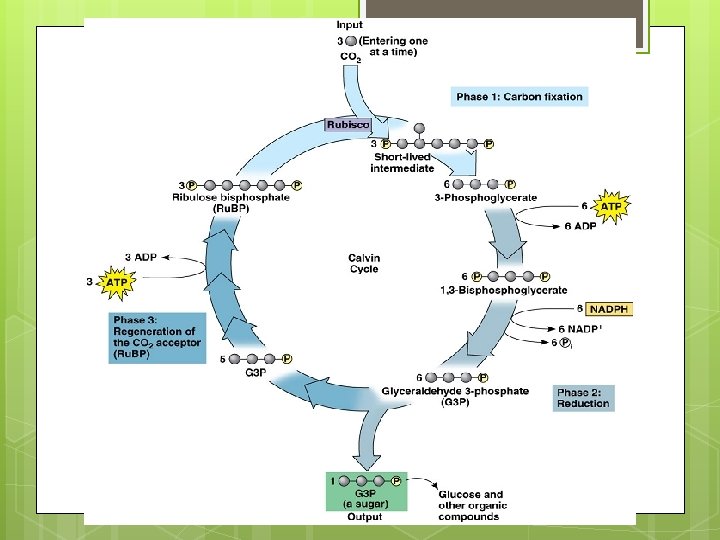
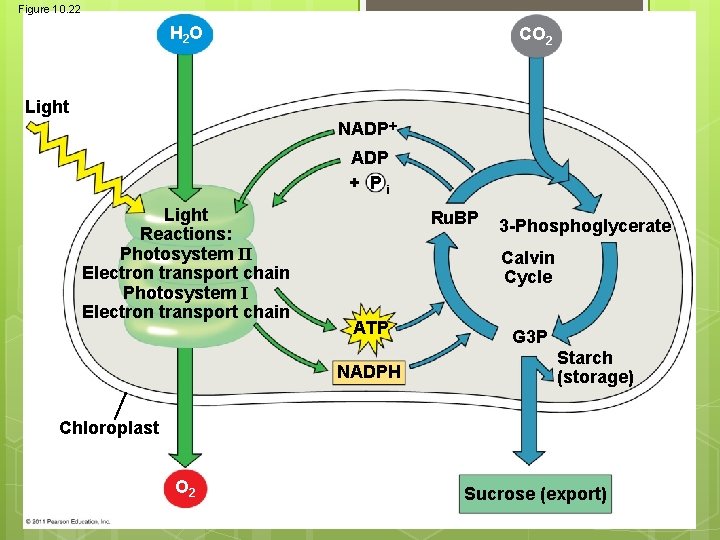
Figure 10. 22 H 2 O CO 2 Light NADP + Pi Light Reactions: Photosystem II Electron transport chain Photosystem I Electron transport chain Ru. BP 3 -Phosphoglycerate Calvin Cycle ATP NADPH G 3 P Starch (storage) Chloroplast O 2 Sucrose (export)
Photosynthesis Music For Country/Pop Music Enthusiasts: Photosynthesis For Rap Music Enthusiasts: Photosynthesis
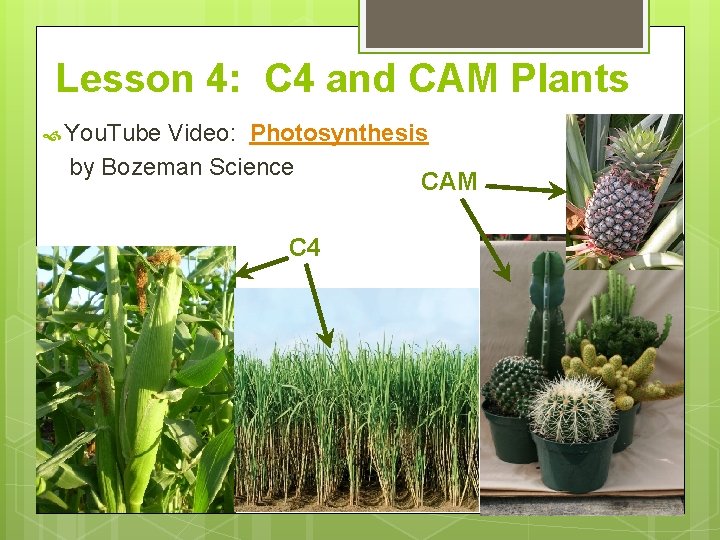
Lesson 4: C 4 and CAM Plants You. Tube Video: Photosynthesis by Bozeman Science CAM C 4
Concept 10. 4 Alternative mechanisms of carbon fixation have evolved in hot, arid climates Dehydration is a problem for plants, sometimes requiring trade-offs with other metabolic processes, especially photosynthesis. On hot, dry days, plants close their stomata, which conserves H 2 O but also limits photosynthesis. The closing of stomata reduces access to CO 2 and causes O 2 to build up. These conditions favor an apparently wasteful process called photorespiration.
Photorespiration: An Evolutionary Relic? In most plants (C 3 plants), initial fixation of CO 2, via the enzyme Ru. Bis. Co, forms a three-carbon compound (3 -phosphoglycerate). In photorespiration, Ru. Bis. Co adds O 2 instead of CO 2 in the Calvin cycle, producing a two-carbon compound. Photorespiration consumes O 2 and organic fuel and releases CO 2 without producing ATP or sugar.
Photorespiration may be an evolutionary relic because some scientists believe that Ru. Bis. Co first evolved at a time when the atmosphere had far less O 2 and more CO 2. Photorespiration limits the damaging products of light reactions that build up in the absence of the Calvin cycle. In many plants, photorespiration is a problem because on a hot, dry day it can drain as much as 50% of the carbon fixed by the Calvin cycle.
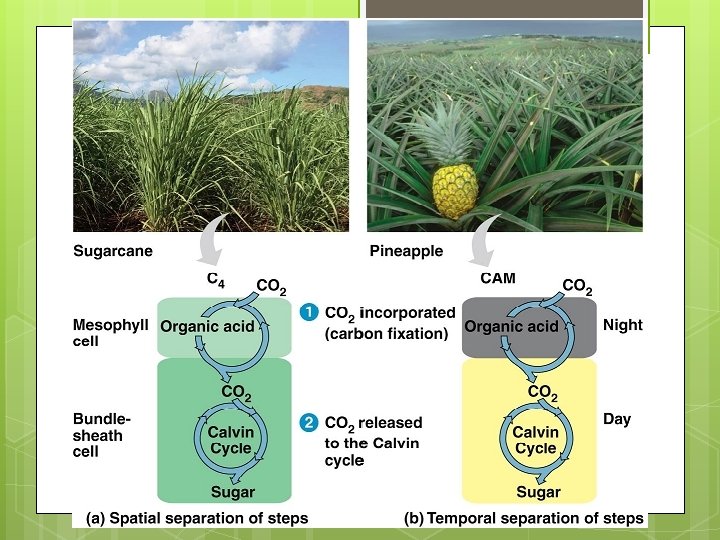
C 4 Plants C 4 plants minimize the cost of photorespiration by incorporating CO 2 into four-carbon compounds in mesophyll cells. This step requires the enzyme PEP carboxylase has a higher affinity for CO 2 than Ru. Bis. Co does; it can fix CO 2 even when CO 2 concentrations are low. These four-carbon compounds are exported to bundle-sheath cells, where they release CO 2 that is then used in the Calvin cycle.
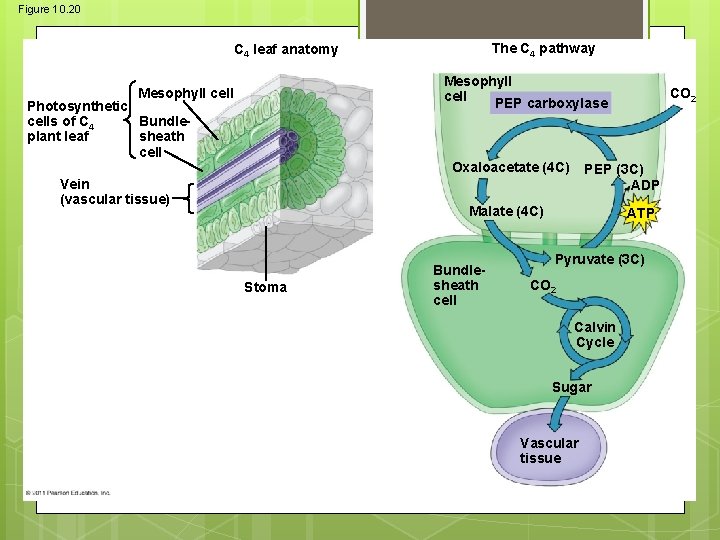
Figure 10. 20 The C 4 pathway C 4 leaf anatomy Mesophyll cell PEP carboxylase Mesophyll cell Photosynthetic cells of C 4 Bundleplant leaf sheath cell Oxaloacetate (4 C) Vein (vascular tissue) PEP (3 C) ADP Malate (4 C) Stoma Bundlesheath cell CO 2 ATP Pyruvate (3 C) CO 2 Calvin Cycle Sugar Vascular tissue
CAM Plants Some plants, including succulents, use Crassulacean Acid Metabolism (CAM) to fix carbon. CAM plants open their stomata at night, incorporating CO 2 into organic acids. Stomata close during the day, and CO 2 is released from organic acids and used in the Calvin cycle.
The Importance of Photosynthesis: A Review The energy entering chloroplasts as sunlight gets stored as chemical energy in organic compounds. Sugar made in the chloroplasts supplies chemical energy and carbon skeletons to synthesize the organic molecules of cells. Plants store excess sugar as starch in structures such as roots, tubers, seeds, and fruits. In addition to food production, photosynthesis produces the O 2 in our atmosphere.
- Slides: 59