
Photosynthesis Cellular Respiration Review Unit 3 Photosynthesis Cellular
- Slides: 26
Photosynthesis & Cellular Respiration – Review Unit 3
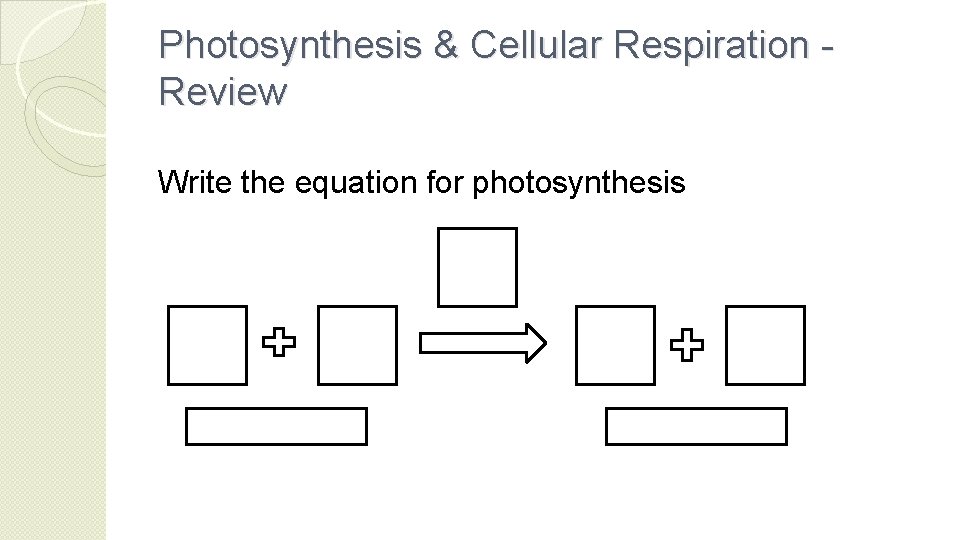
Photosynthesis & Cellular Respiration Review Write the equation for photosynthesis
Photosynthesis & Cellular Respiration Review �List 1. 2. 3. 4. four factors that limit the rate of photosynthesis.
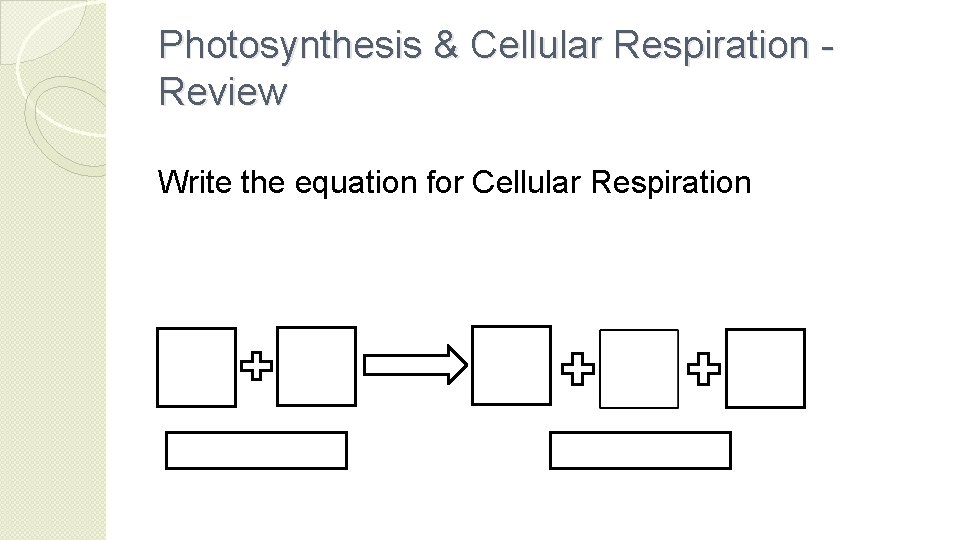
Photosynthesis & Cellular Respiration Review Write the equation for Cellular Respiration
Photosynthesis & Cellular Respiration Review �List two factors that limit the rate of cellular respiration 1. 2.
Photosynthesis & Cellular Respiration 1. Which of these would lead to a lower rate of photosynthesis in a plant? A. An increase in the amount of oxygen in the air B. A decrease in the amount of oxygen in the air C. An increase in the amount of carbon dioxide in the air D. A decrease in the amount of carbon dioxide in the air
Photosynthesis & Cellular Respiration 2. How would a drop in temperature most likely affect the processes of cellular respiration and photosynthesis? A. The rates of both cellular respiration and photosynthesis would decrease B. The rates of both cellular respiration an photosynthesis would remain constant C. The rate of photosynthesis would increase, and the rate of cellular respiration would decrease D. The rate of photosynthesis would decrease, and the rate of cellular respiration would increase
Photosynthesis & Cellular Respiration 3. Which statement describes a way in which cellular respiration differs from photosynthesis? A. Cellular respiration consists of two phases. B. Cellular respiration releases carbon dioxide. C. Cellular respiration provides energy for the cell. D. Cellular respiration is carried out in one specific organelle.
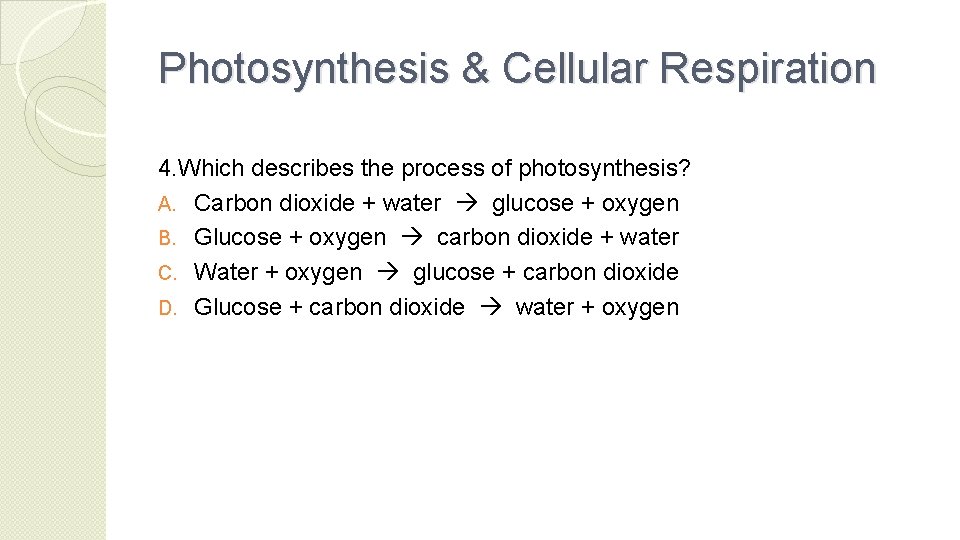
Photosynthesis & Cellular Respiration 4. Which describes the process of photosynthesis? A. Carbon dioxide + water glucose + oxygen B. Glucose + oxygen carbon dioxide + water C. Water + oxygen glucose + carbon dioxide D. Glucose + carbon dioxide water + oxygen
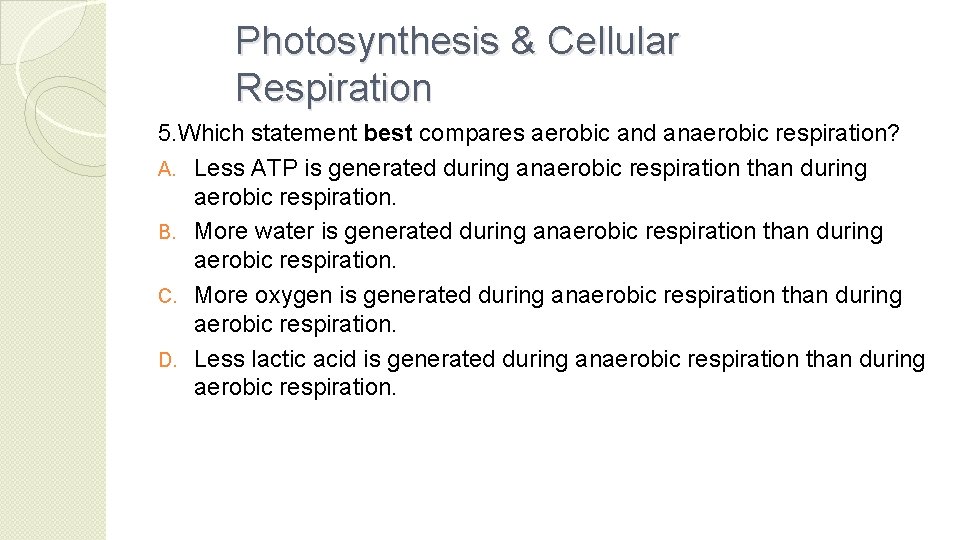
Photosynthesis & Cellular Respiration 5. Which statement best compares aerobic and anaerobic respiration? A. Less ATP is generated during anaerobic respiration than during aerobic respiration. B. More water is generated during anaerobic respiration than during aerobic respiration. C. More oxygen is generated during anaerobic respiration than during aerobic respiration. D. Less lactic acid is generated during anaerobic respiration than during aerobic respiration.
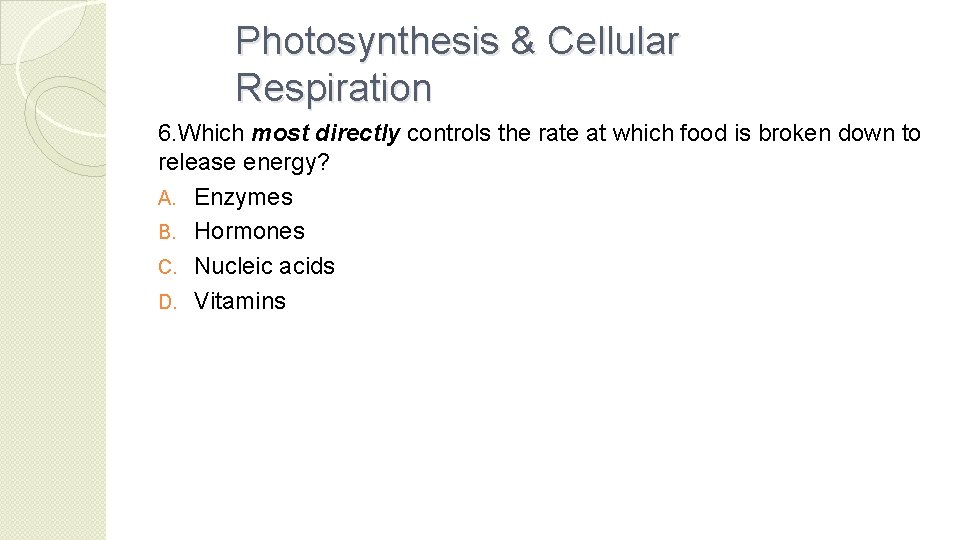
Photosynthesis & Cellular Respiration 6. Which most directly controls the rate at which food is broken down to release energy? A. Enzymes B. Hormones C. Nucleic acids D. Vitamins
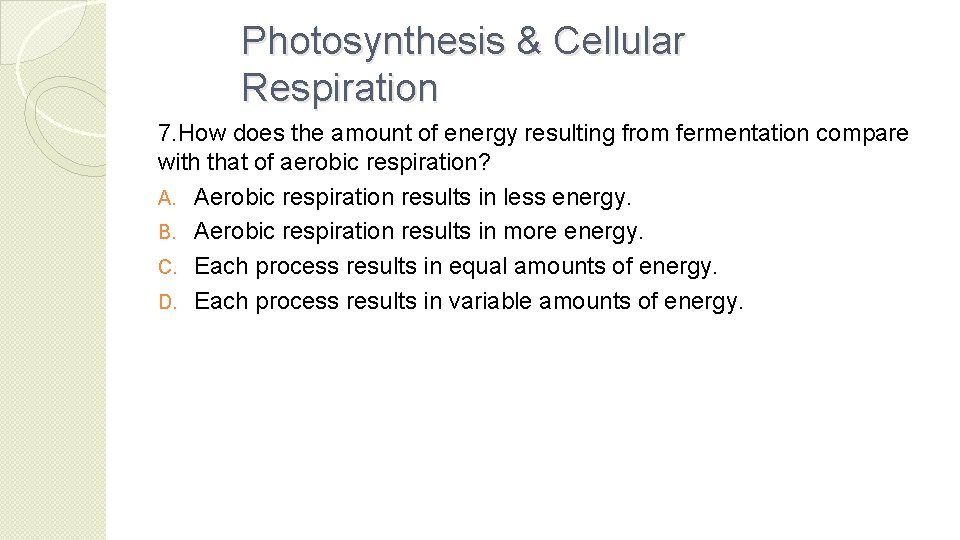
Photosynthesis & Cellular Respiration 7. How does the amount of energy resulting from fermentation compare with that of aerobic respiration? A. Aerobic respiration results in less energy. B. Aerobic respiration results in more energy. C. Each process results in equal amounts of energy. D. Each process results in variable amounts of energy.
Photosynthesis & Cellular Respiration 8. What will most likely be the result if all of the mitochondria are removed from a plant cell? A. It will be unable to carry out respiration. B. It will lose water through osmosis. C. It will break down the ribosomes in the cell. D. It will be unable to photosynthesize.
Photosynthesis & Cellular Respiration 9. What happens during photosynthesis? A. Heterotrophs consume ATP B. Heterotrophs produce ATP C. Autotrophs consume carbohydrates D. Autotrophs produce carbohydrates
Photosynthesis & Cellular Respiration 10. A student is collecting the gas given off from a plant in bright sunlight at a temperature of 27ºC. The gas being collected is probably A. Oxygen B. Carbon dioxide C. ATP D. Glucose
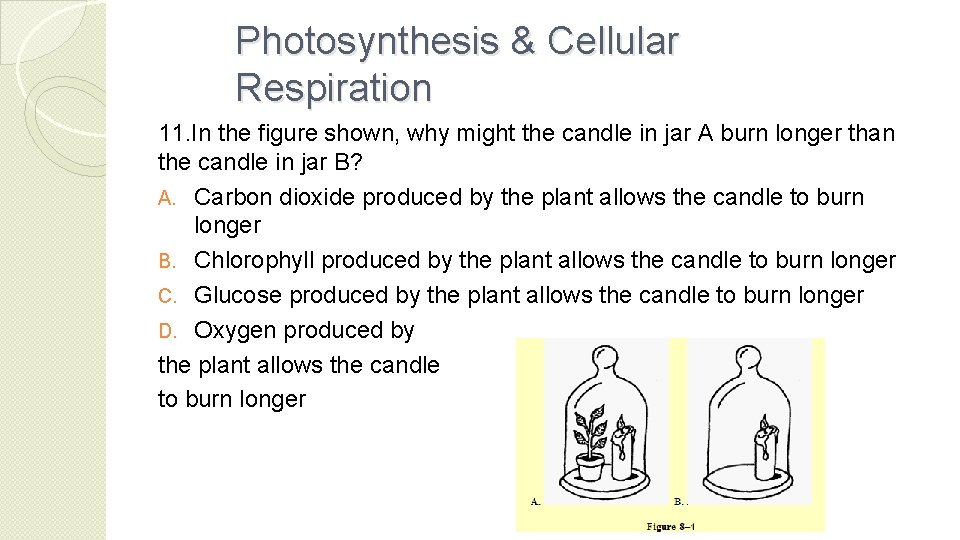
Photosynthesis & Cellular Respiration 11. In the figure shown, why might the candle in jar A burn longer than the candle in jar B? A. Carbon dioxide produced by the plant allows the candle to burn longer B. Chlorophyll produced by the plant allows the candle to burn longer C. Glucose produced by the plant allows the candle to burn longer D. Oxygen produced by the plant allows the candle to burn longer
Photosynthesis & Cellular Respiration 12. If you continue to increase the intensity of light that a plant receives, what happens? A. The rate of photosynthesis increases indefinitely with light intensity B. The rate of photosynthesis decreases indefinitely with light intensity C. The rate of photosynthesis increases and then levels off D. The rate photosynthesis does not change
Photosynthesis & Cellular Respiration 13. How do organisms get the energy they need? A. By burning food molecules and releasing their energy as heat B. By breathing oxygen into the lungs and combining it with carbon dioxide C. By breaking down molecules gradually and capturing their chemical energy D. By using the sun’s energy to break down food molecules and form chemicals
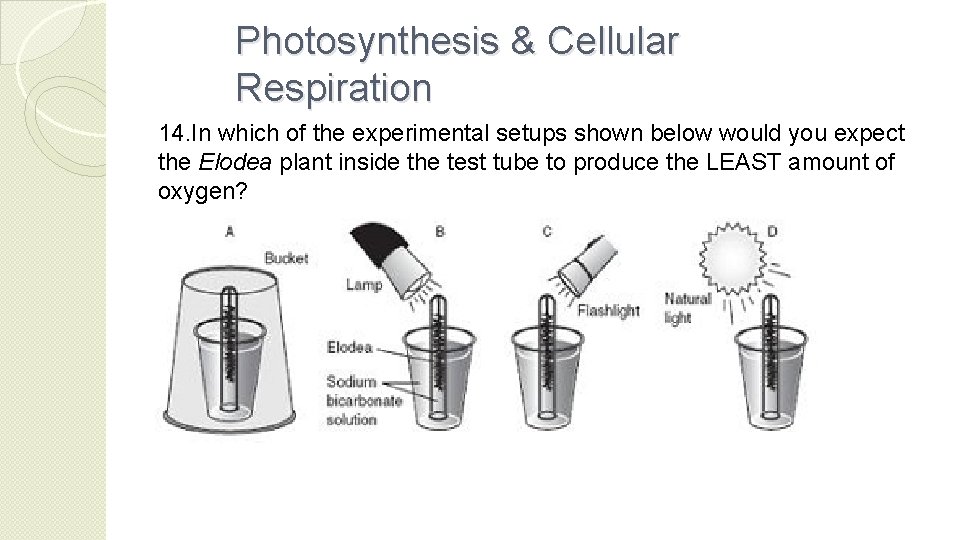
Photosynthesis & Cellular Respiration 14. In which of the experimental setups shown below would you expect the Elodea plant inside the test tube to produce the LEAST amount of oxygen?
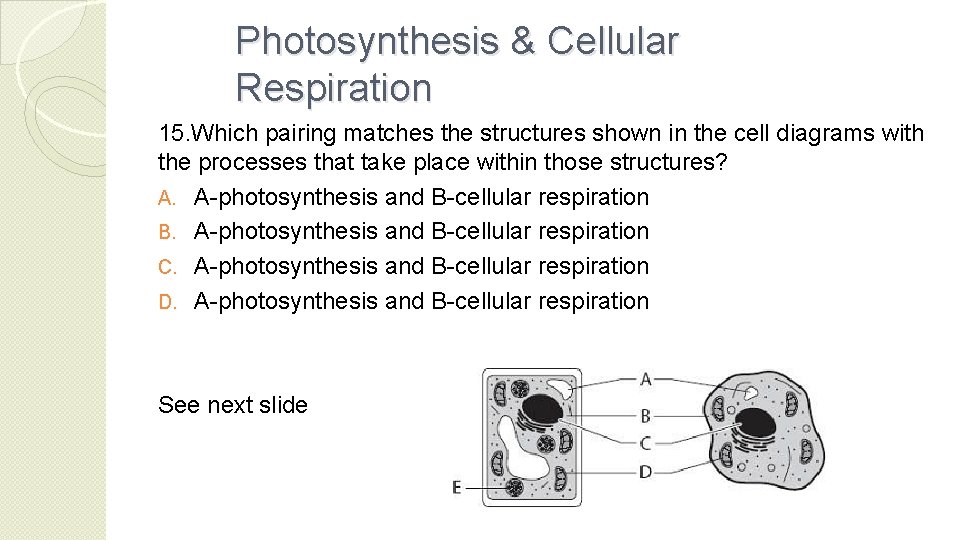
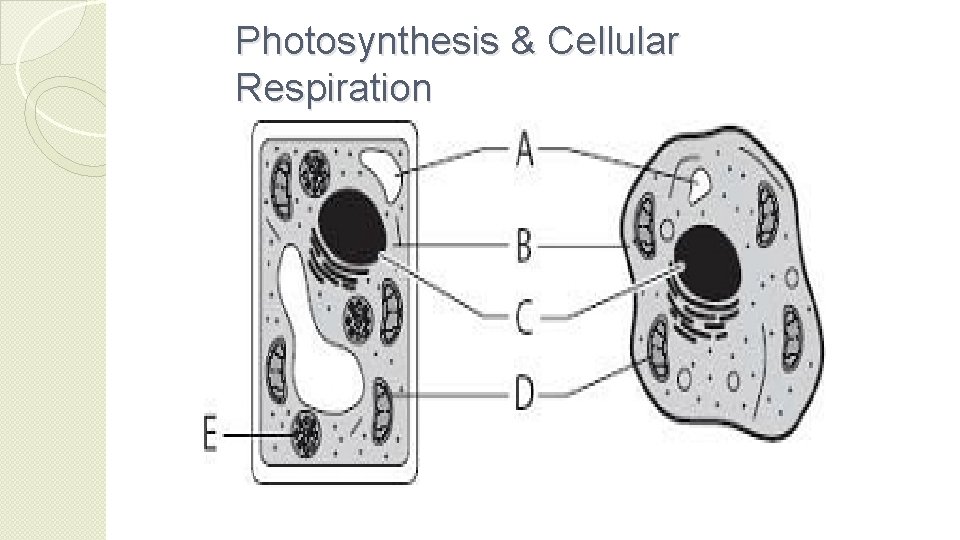
Photosynthesis & Cellular Respiration 15. Which pairing matches the structures shown in the cell diagrams with the processes that take place within those structures? A. A-photosynthesis and B-cellular respiration B. A-photosynthesis and B-cellular respiration C. A-photosynthesis and B-cellular respiration D. A-photosynthesis and B-cellular respiration See next slide
Photosynthesis & Cellular Respiration
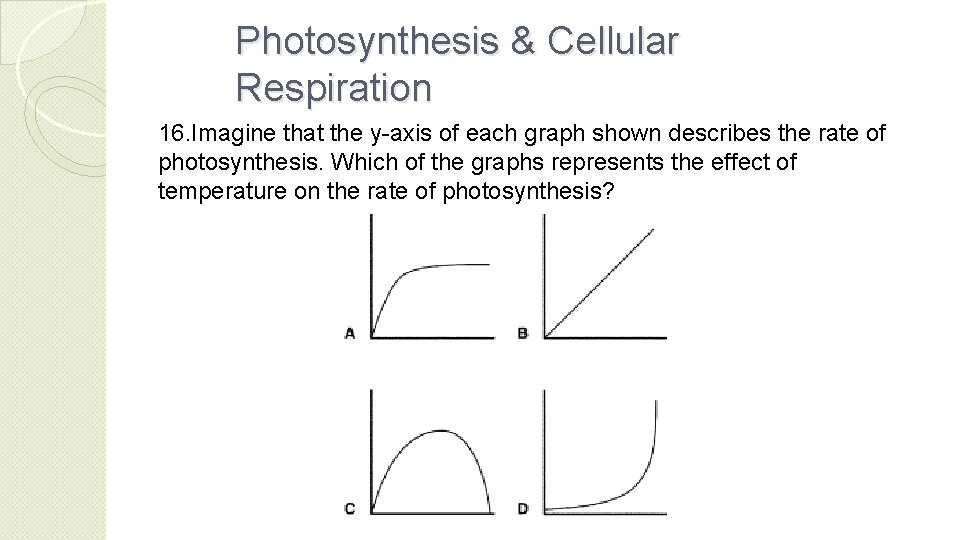
Photosynthesis & Cellular Respiration 16. Imagine that the y-axis of each graph shown describes the rate of photosynthesis. Which of the graphs represents the effect of temperature on the rate of photosynthesis?
Photosynthesis & Cellular Respiration 17. Which of the following is one of the ways that cellular respiration and photosynthesis are opposite processes? A. Photosynthesis releases energy and cellular respiration stores energy B. Photosynthesis removes carbon dioxide from the atmosphere, cellular respiration puts it back C. Photosynthesis removes oxygen from the atmosphere, cellular respiration puts it back D. Photosynthesis consumes glucose, cellular respiration produces glucose
Photosynthesis & Cellular Respiration 18. Photosynthesis is to chloroplasts as cellular respiration is to A. Chloroplasts B. Cytoplasm C. Mitochondria D. Nuclei
Photosynthesis & Cellular Respiration 19. Unlike photosynthesis, cellular respiration occurs in A. Animal cells only B. Plant cells only C. Prokaryotic cells only D. All eukaryotic cells
Photosynthesis & Cellular Respiration 20. The products of photosynthesis are the A. Products of cellular respiration B. Reactants of cellular respiration C. Products of glycolysis D. Reactants of fermentation