
PHOTOSYNTHESIS CELLULAR RESPIRATION REMEMBERCHARACTERISTICS OF LIVING THINGS made
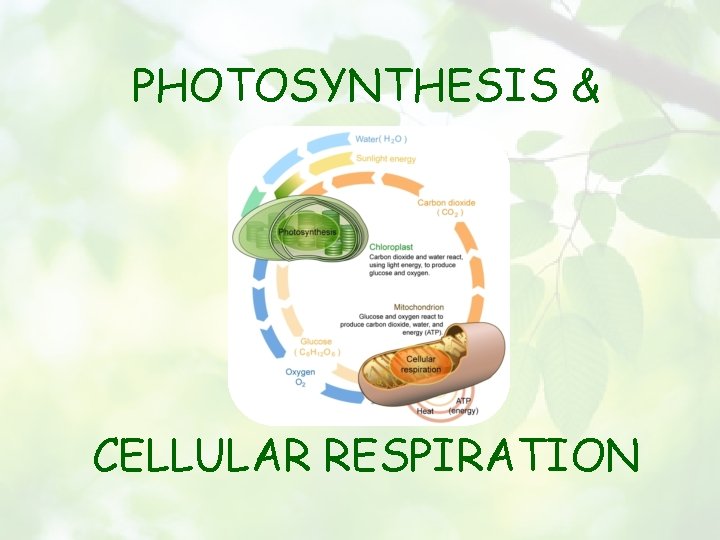
PHOTOSYNTHESIS & CELLULAR RESPIRATION
REMEMBER…CHARACTERISTICS OF LIVING THINGS made up of units called cells reproduce based on a universal genetic code (DNA) grow and develop obtain and use materials and energy (metabolism) respond to their environment (adapt) maintain a stable internal environment (homeostasis) taken as a group, organisms evolve
ENERGY AND LIFE
ENERGY Energy: the ability to do work Living things must be able to obtain and use energy in order to exist. ATP (adenosine triphosphate) – chemical compound that living things use to store energy
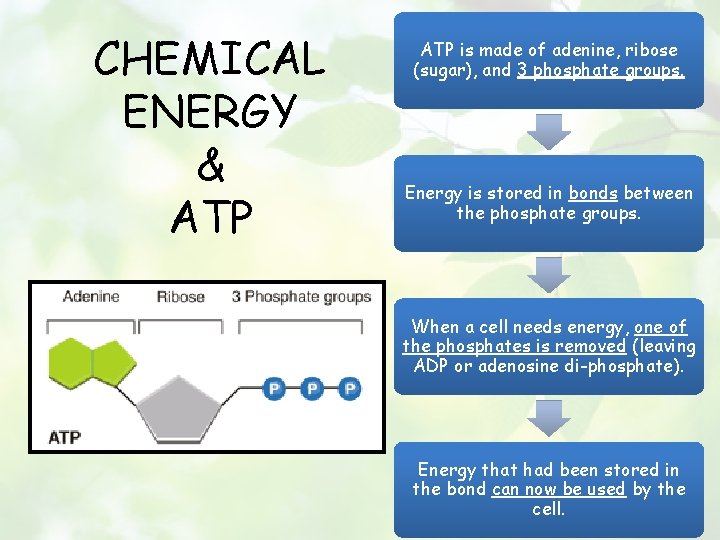
CHEMICAL ENERGY & ATP is made of adenine, ribose (sugar), and 3 phosphate groups. Energy is stored in bonds between the phosphate groups. When a cell needs energy, one of the phosphates is removed (leaving ADP or adenosine di-phosphate). Energy that had been stored in the bond can now be used by the cell.

ATP can be compared to a rechargeable battery. ATP • Charged battery ADP • Partially charged battery (needs charging)
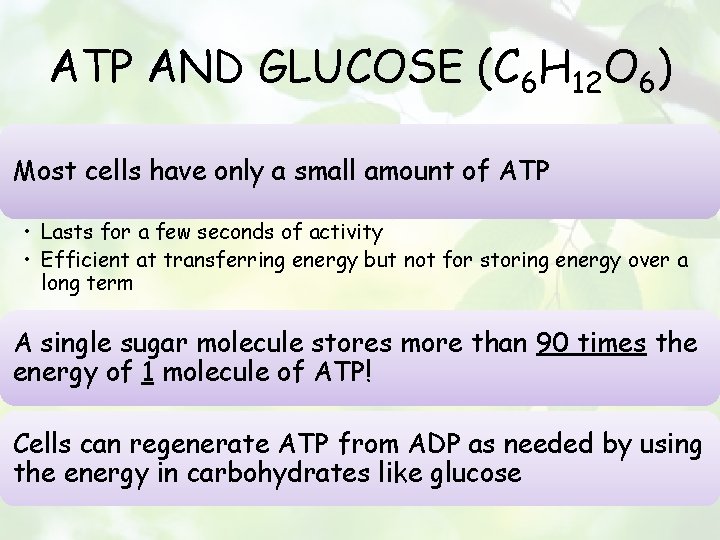
ATP AND GLUCOSE (C 6 H 12 O 6) Most cells have only a small amount of ATP • Lasts for a few seconds of activity • Efficient at transferring energy but not for storing energy over a long term A single sugar molecule stores more than 90 times the energy of 1 molecule of ATP! Cells can regenerate ATP from ADP as needed by using the energy in carbohydrates like glucose
SO…WHERE DO LIVING THINGS GET ENERGY? FOOD • To live, all organisms need food and must release energy from that food.
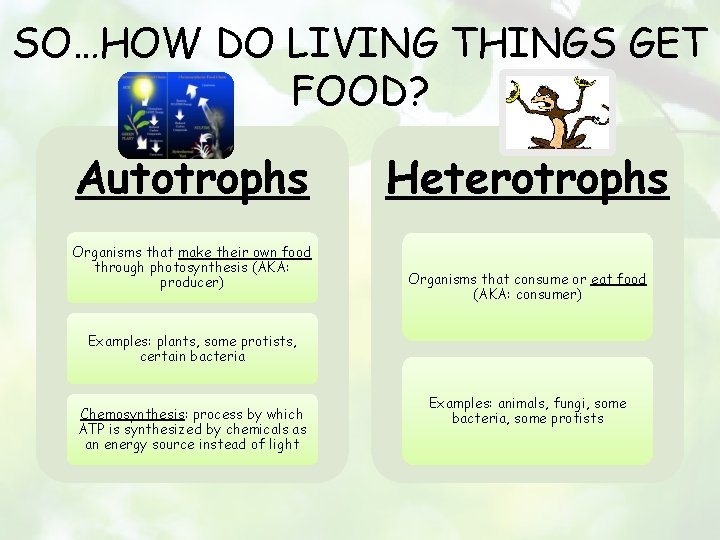
SO…HOW DO LIVING THINGS GET FOOD? Autotrophs Organisms that make their own food through photosynthesis (AKA: producer) Heterotrophs Organisms that consume or eat food (AKA: consumer) Examples: plants, some protists, certain bacteria Chemosynthesis: process by which ATP is synthesized by chemicals as an energy source instead of light Examples: animals, fungi, some bacteria, some protists
PHOTOSYNTHESIS: AN OVERVIEW
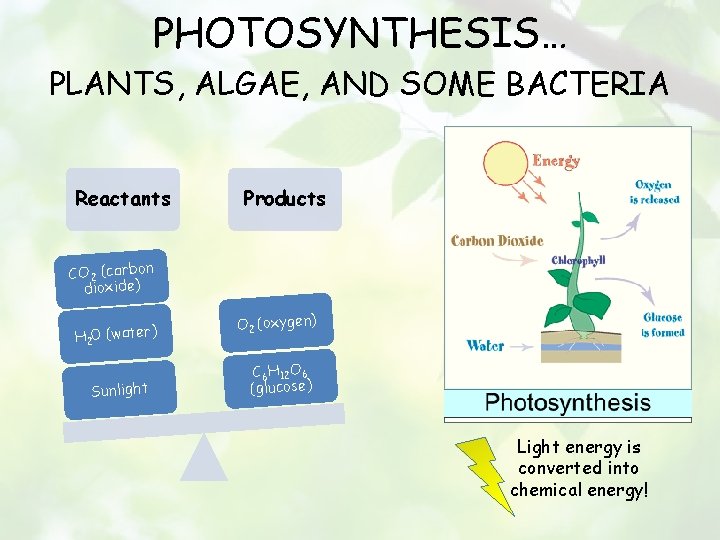
PHOTOSYNTHESIS… PLANTS, ALGAE, AND SOME BACTERIA Reactants Products CO 2 (carbon dioxide) H 20 (water) Sunlight O 2 (oxygen) C 6 H 12 O 6 (glucose) Light energy is converted into chemical energy!
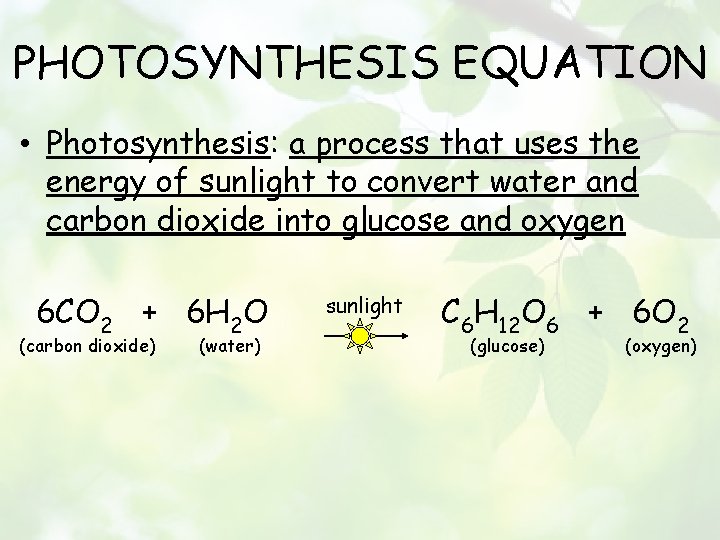
PHOTOSYNTHESIS EQUATION • Photosynthesis: a process that uses the energy of sunlight to convert water and carbon dioxide into glucose and oxygen 6 CO 2 + 6 H 2 O (carbon dioxide) (water) sunlight C 6 H 12 O 6 + 6 O 2 (glucose) (oxygen)
THE REACTIONS OF PHOTOSYNTHESIS
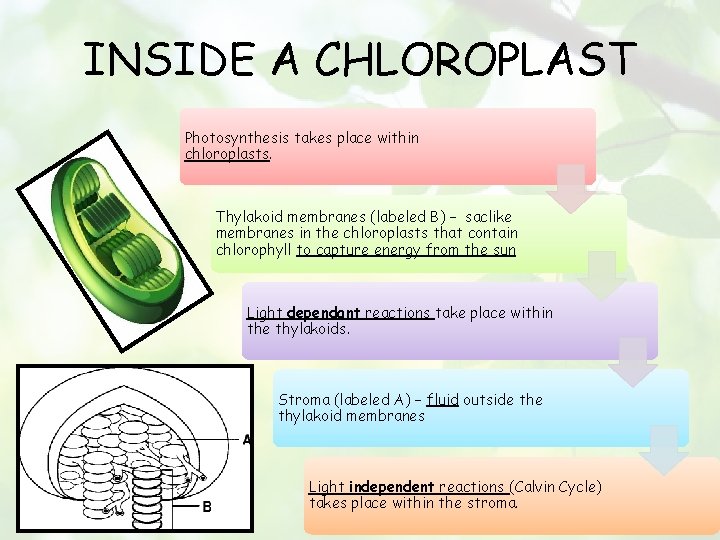
INSIDE A CHLOROPLAST Photosynthesis takes place within chloroplasts. Thylakoid membranes (labeled B) – saclike membranes in the chloroplasts that contain chlorophyll to capture energy from the sun Light dependant reactions take place within the thylakoids. Stroma (labeled A) – fluid outside thylakoid membranes Light independent reactions (Calvin Cycle) takes place within the stroma.
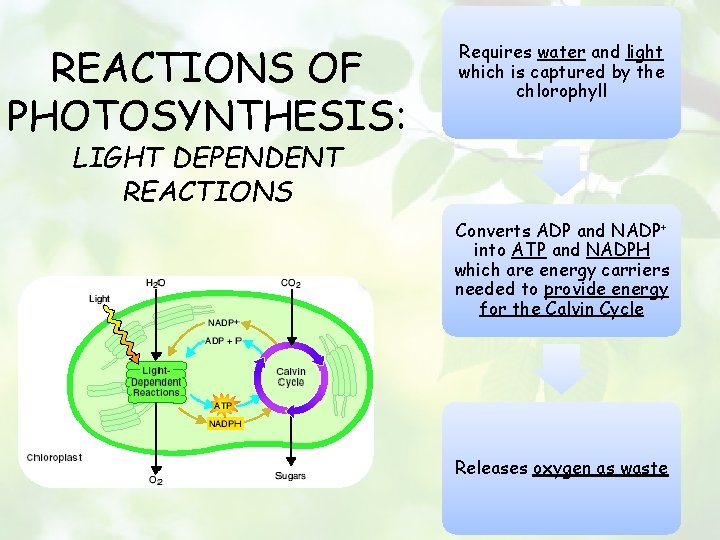
REACTIONS OF PHOTOSYNTHESIS: Requires water and light which is captured by the chlorophyll LIGHT DEPENDENT REACTIONS Converts ADP and NADP+ into ATP and NADPH which are energy carriers needed to provide energy for the Calvin Cycle Releases oxygen as waste
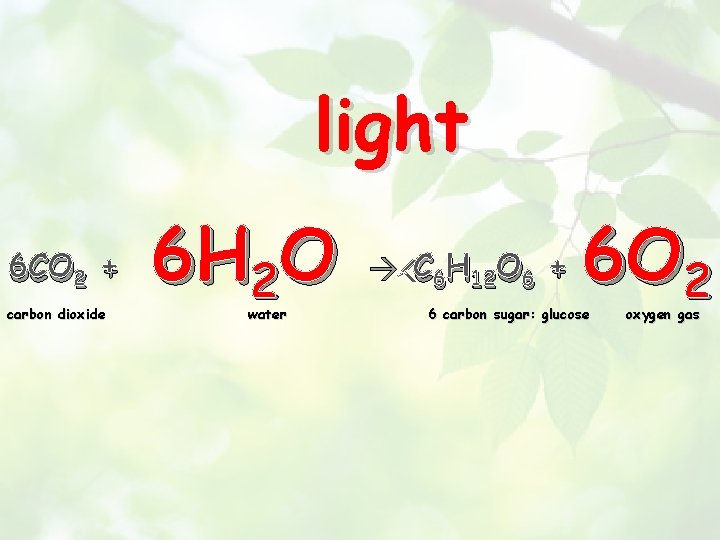
light 6 CO 2 + carbon dioxide 6 H 2 O water C 6 H 12 O 6 + 6 O 2 6 carbon sugar: glucose oxygen gas
THE SECOND STAGE OF PHOTOSYNTHESIS USES ENERGY FROM THE FIRST STAGE TO MAKE SUGARS
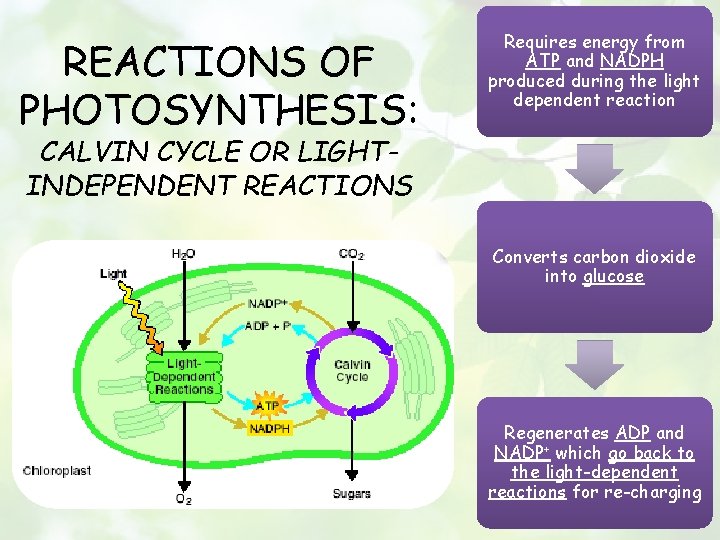
REACTIONS OF PHOTOSYNTHESIS: Requires energy from ATP and NADPH produced during the light dependent reaction CALVIN CYCLE OR LIGHTINDEPENDENT REACTIONS Converts carbon dioxide into glucose Regenerates ADP and NADP+ which go back to the light-dependent reactions for re-charging
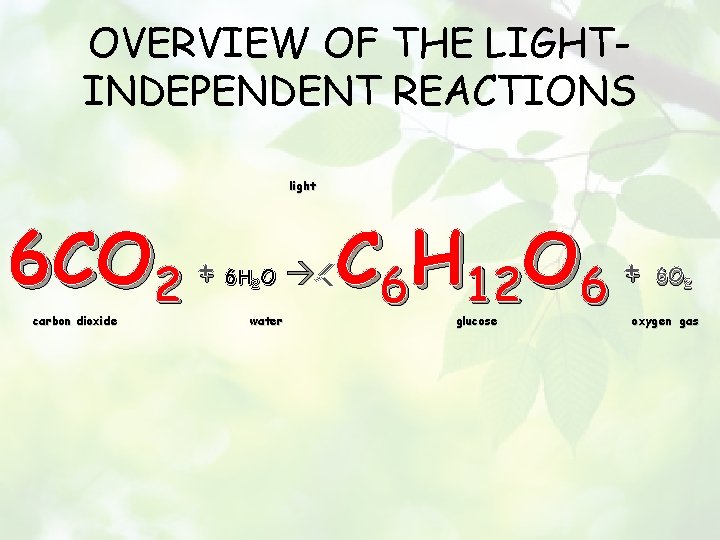
OVERVIEW OF THE LIGHTINDEPENDENT REACTIONS light 6 CO 2 + carbon dioxide 6 H 2 O water C 6 H 12 O 6 + glucose 6 O 2 oxygen gas
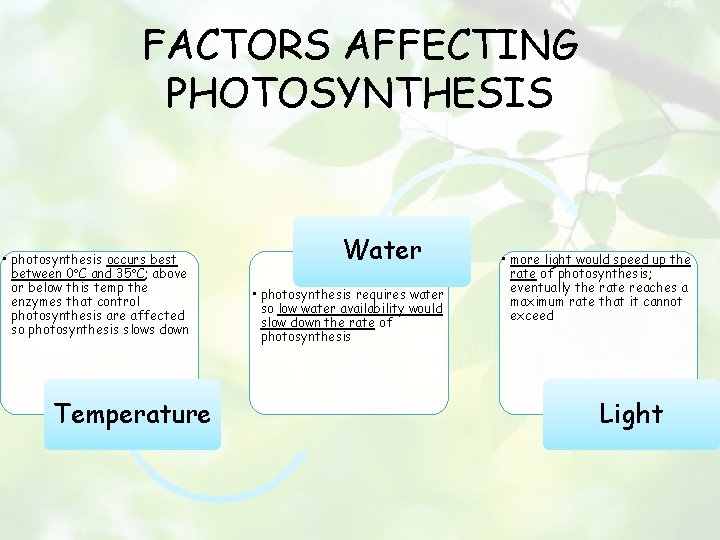
FACTORS AFFECTING PHOTOSYNTHESIS • photosynthesis occurs best between 0 C and 35 C; above or below this temp the enzymes that control photosynthesis are affected so photosynthesis slows down Temperature Water • photosynthesis requires water so low water availability would slow down the rate of photosynthesis • more light would speed up the rate of photosynthesis; eventually the rate reaches a maximum rate that it cannot exceed Light
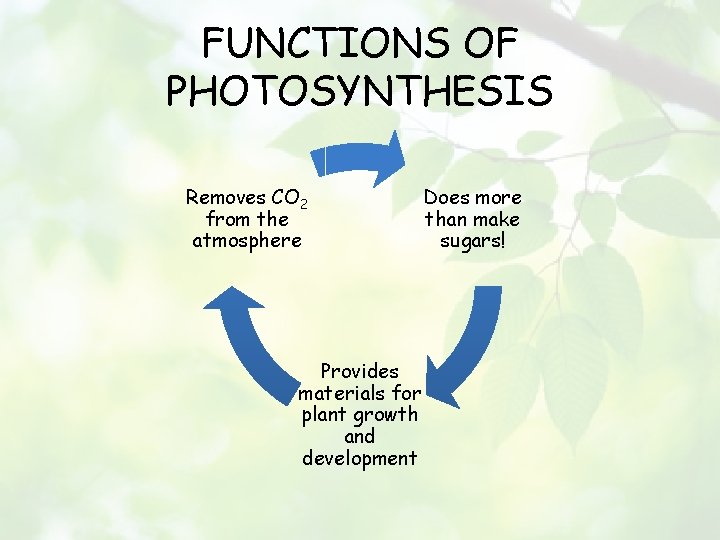
FUNCTIONS OF PHOTOSYNTHESIS Removes CO 2 from the atmosphere Provides materials for plant growth and development Does more than make sugars!
HOW WE CAME TO UNDERSTAND PHOTOSYNTHESIS
THE QUESTION: HOW DOES A TREE INCREASE ITS MASS? FROM THE SOIL? FROM THE WATER? FROM THE AIR?
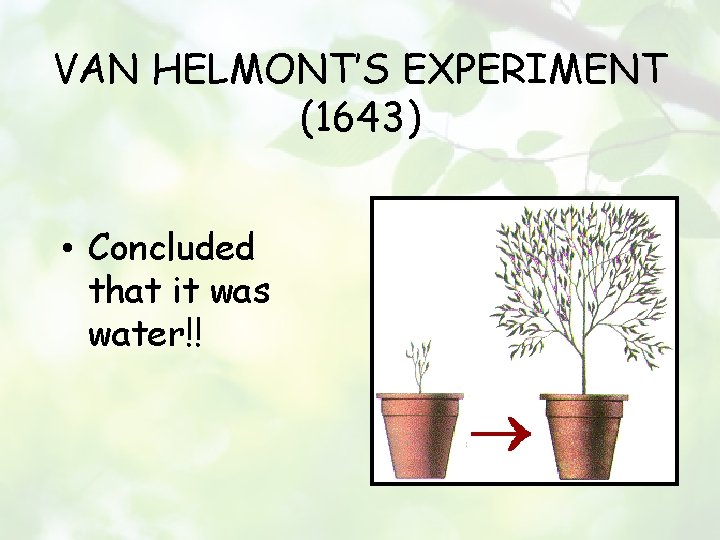
VAN HELMONT’S EXPERIMENT (1643) • Concluded that it was water!!

PRIESTLEY’S EXPERIMENT (1771) • Candle burned in the presence of oxygen • A candle could be relit near a plant and it would burn longer because the plant released oxygen
INGENHOUSZ’S EXPERIMENT (1779) • Showed Priestley’s experiment only worked when the plant was exposed to light • Light is necessary for plants to produce oxygen
PHOTOSYNTHESIS COMPLETED!
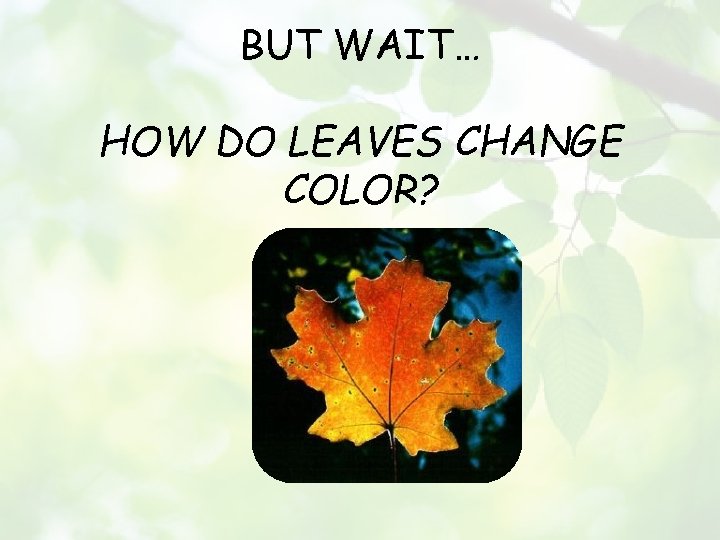
BUT WAIT… HOW DO LEAVES CHANGE COLOR?
ABSORPTION OF LIGHT ENERGY • Light energy is a form of radiation • Energy in the form of waves that travel through space • Different types of radiation (i. e. light, heat) have different wavelengths
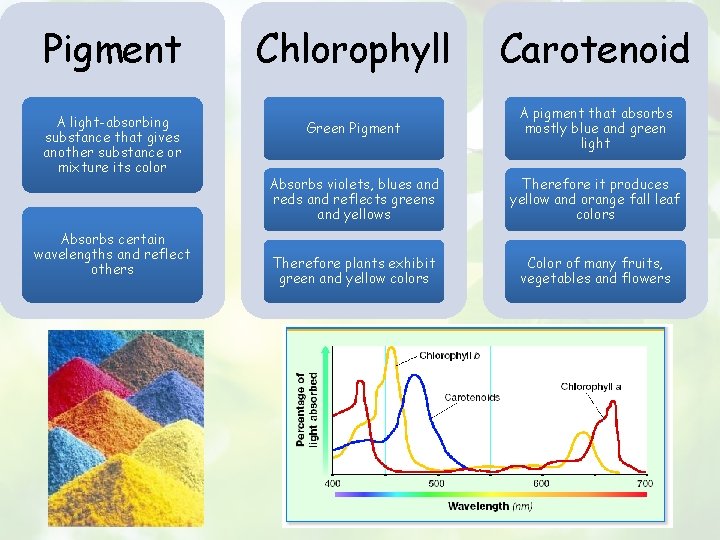
Pigment A light-absorbing substance that gives another substance or mixture its color Absorbs certain wavelengths and reflect others Chlorophyll Carotenoid Green Pigment A pigment that absorbs mostly blue and green light Absorbs violets, blues and reds and reflects greens and yellows Therefore it produces yellow and orange fall leaf colors Therefore plants exhibit green and yellow colors Color of many fruits, vegetables and flowers
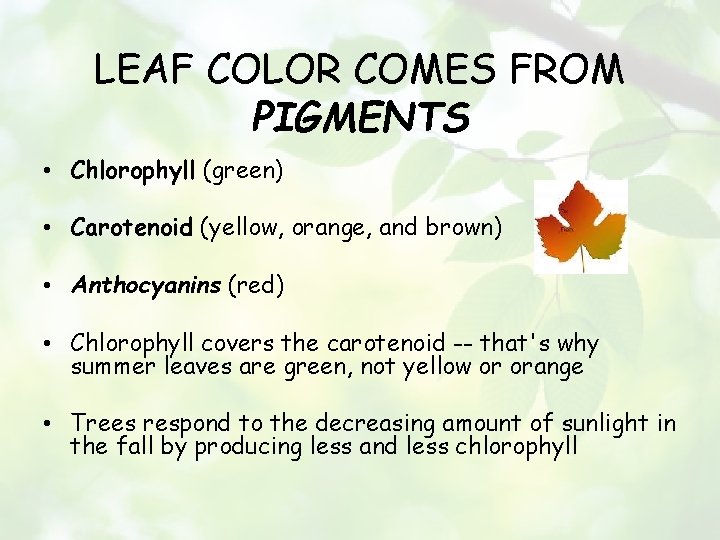
LEAF COLOR COMES FROM PIGMENTS • Chlorophyll (green) • Carotenoid (yellow, orange, and brown) • Anthocyanins (red) • Chlorophyll covers the carotenoid -- that's why summer leaves are green, not yellow or orange • Trees respond to the decreasing amount of sunlight in the fall by producing less and less chlorophyll
LEAF COLOR COMES FROM PIGMENTS • Eventually, a tree stops producing chlorophyll • When that happens, the carotenoid already in the leaves can finally show through • The leaves become a bright rainbow of glowing yellows, sparkling oranges and warm browns
PART II
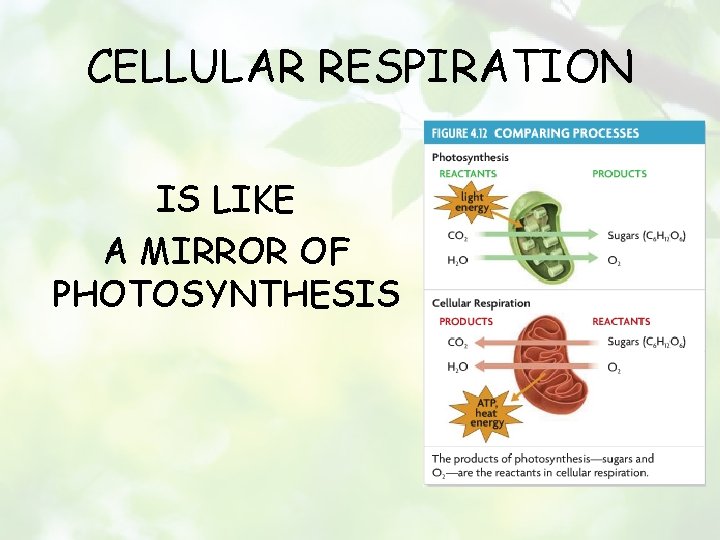
CELLULAR RESPIRATION IS LIKE A MIRROR OF PHOTOSYNTHESIS
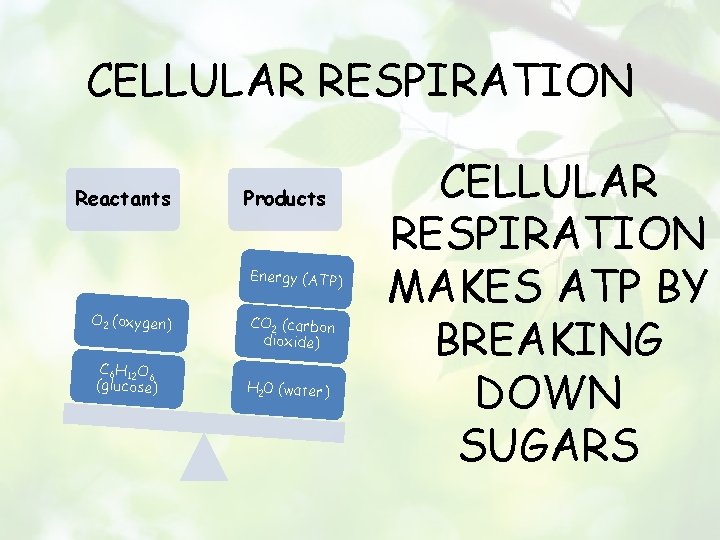
CELLULAR RESPIRATION Reactants Products Energy (ATP) O 2 (oxygen) C 6 H 12 O 6 (glucose) CO 2 (carbon dioxide) H 20 (water) CELLULAR RESPIRATION MAKES ATP BY BREAKING DOWN SUGARS
CHEMICAL ENERGY AND FOOD Food provides cells with energy and serves as raw materials for building new molecules. How do organisms get the energy from their food? Cells release energy from glucose and other food compounds by the processes of cellular respiration, fermentation, or both.

CELLULAR RESPIRATION enzymes C 6 H 12 O 6 + 6 O 2 6 CO 2 + 6 H 2 O + energy Glucose oxygen gas carbon dioxide water ATP
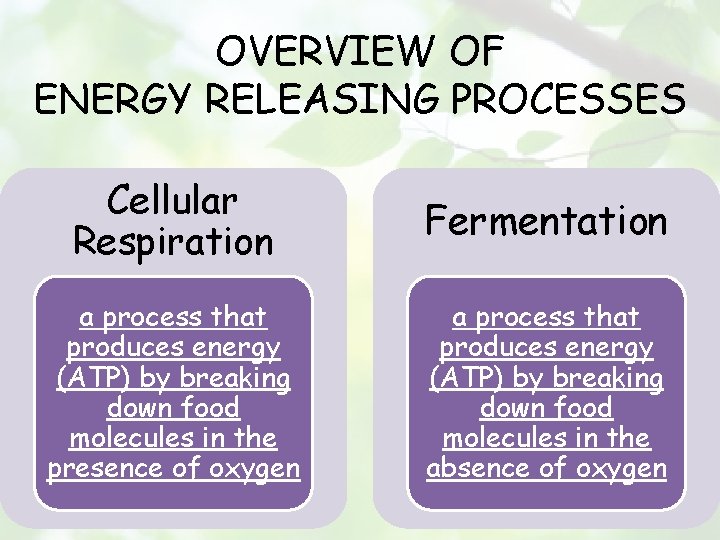
OVERVIEW OF ENERGY RELEASING PROCESSES Cellular Respiration Fermentation a process that produces energy (ATP) by breaking down food molecules in the presence of oxygen a process that produces energy (ATP) by breaking down food molecules in the absence of oxygen
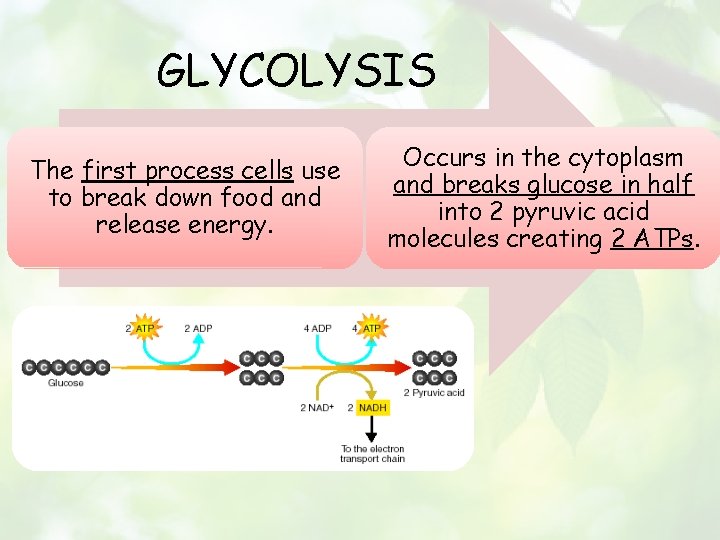
GLYCOLYSIS The first process cells use to break down food and release energy. Occurs in the cytoplasm and breaks glucose in half into 2 pyruvic acid molecules creating 2 ATPs.
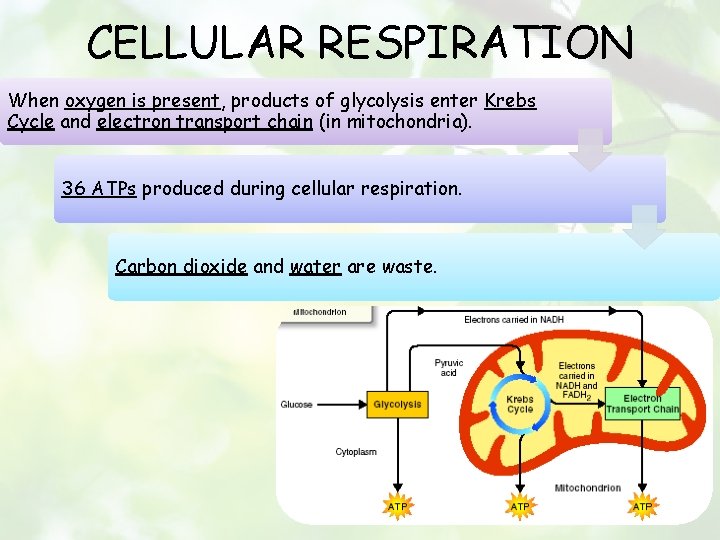
CELLULAR RESPIRATION When oxygen is present, products of glycolysis enter Krebs Cycle and electron transport chain (in mitochondria). 36 ATPs produced during cellular respiration. Carbon dioxide and water are waste.
FERMENTATION When oxygen is NOT present, products of glycolysis go through fermentation instead. Fermentation regenerates starting materials of glycolysis so glycolysis can continue making ATP (only 2 ATPs). Alcoholic fermentation Lactic acid fermentation
ALCOHOLIC VS. LACTIC ACID FERMENTATION Alcoholic Fermentation Lactic Acid Fermentation performed by yeast and other microorganisms occurs in muscle cells during strenuous exercise when cells aren’t getting enough oxygen used in bread and alcohol industries because alcohol and carbon dioxide are waste products lactic acid produced as a waste product causes muscles to burn during a strenuous workout
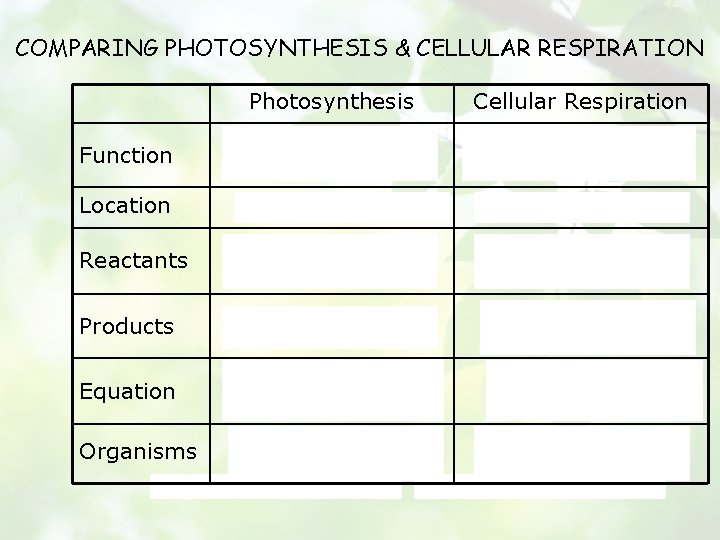
COMPARING PHOTOSYNTHESIS & CELLULAR RESPIRATION Photosynthesis Cellular Respiration Function to store energy by making food to release energy by breaking down food Location Chloroplasts Mitochondria Carbon Dioxide + Water + Sunlight Glucose + Oxygen Products Glucose + Oxygen Carbon Dioxide + Water + Energy Equation 6 H 2 O + 6 CO 2 C 6 H 12 O 6 + 6 O 2 6 H 2 O + 6 CO 2 autotrophs and heterotrophs Reactants Organisms
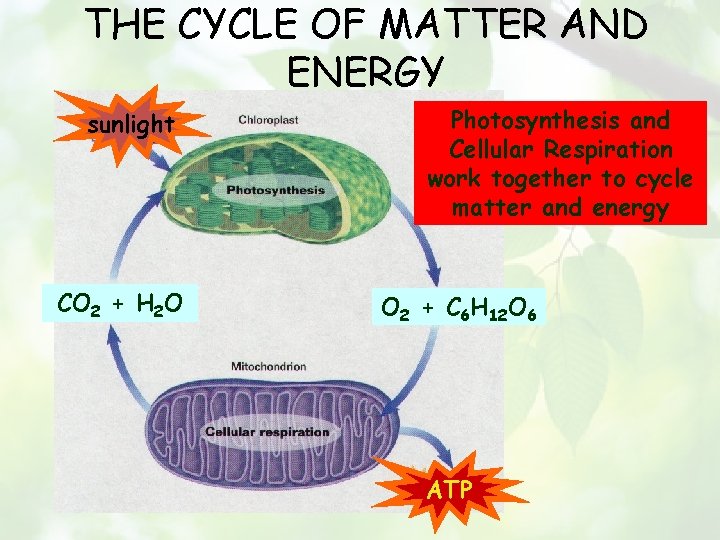
THE CYCLE OF MATTER AND ENERGY sunlight CO 2 + H 2 O Photosynthesis and Cellular Respiration work together to cycle matter and energy O 2 + C 6 H 12 O 6 ATP
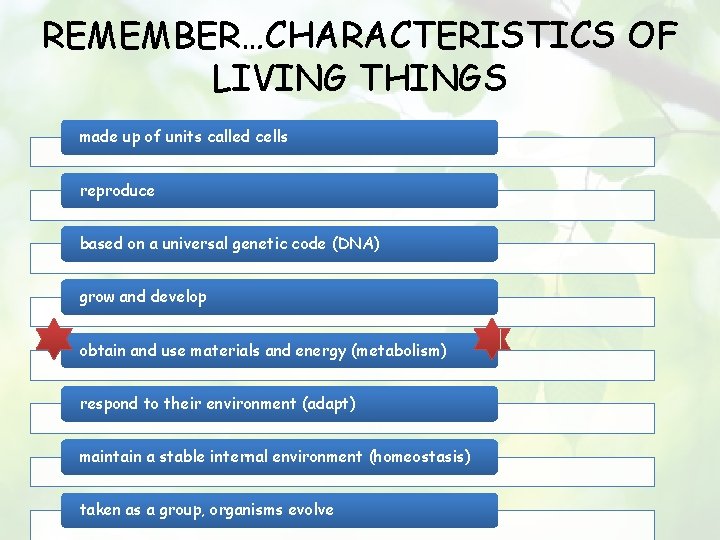
REMEMBER…CHARACTERISTICS OF LIVING THINGS made up of units called cells reproduce based on a universal genetic code (DNA) grow and develop obtain and use materials and energy (metabolism) respond to their environment (adapt) maintain a stable internal environment (homeostasis) taken as a group, organisms evolve
- Slides: 45