
Photosynthesis Cellular Respiration Chapter 9 Summary The stuff
- Slides: 21
Photosynthesis & Cellular Respiration Chapter 9 Summary— **The stuff you REALLY need to know**
What is photosynthesis? § The process by which autotrophs trap energy from sunlight with chlorophyll and use this energy to convert carbon dioxide and water into simple sugars.
Which organisms carry out photosynthesis? § § § Plants Algae Photosynthetic bacteria
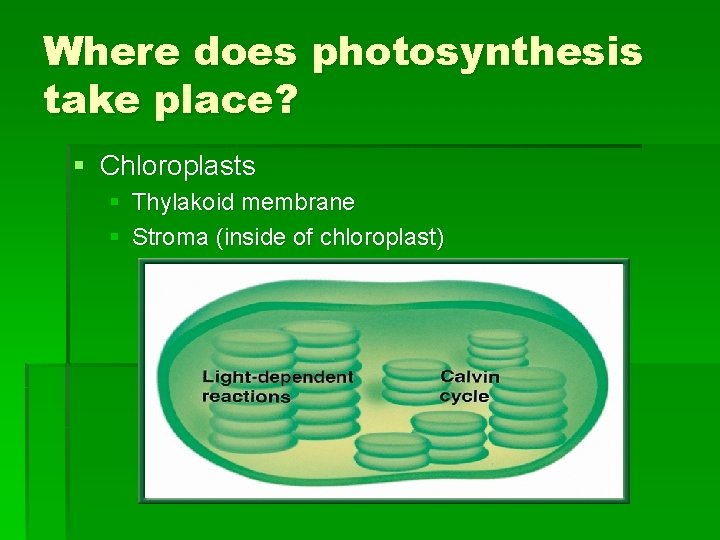
Where does photosynthesis take place? § Chloroplasts § Thylakoid membrane § Stroma (inside of chloroplast)
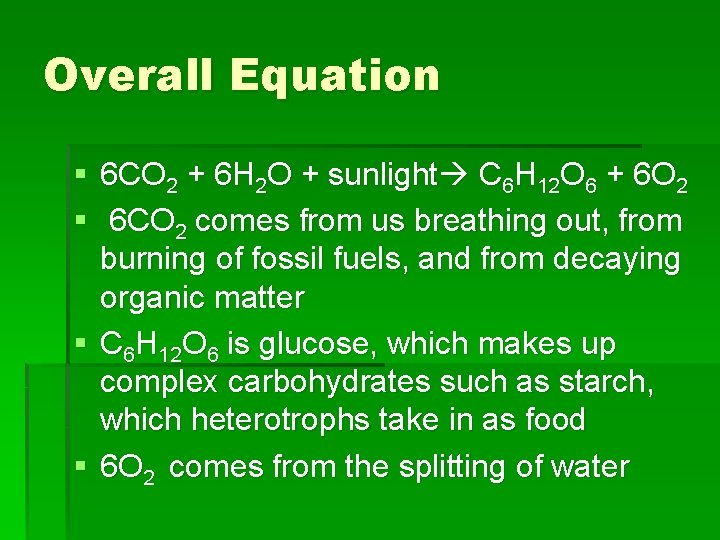
Overall Equation § 6 CO 2 + 6 H 2 O + sunlight C 6 H 12 O 6 + 6 O 2 § 6 CO 2 comes from us breathing out, from burning of fossil fuels, and from decaying organic matter § C 6 H 12 O 6 is glucose, which makes up complex carbohydrates such as starch, which heterotrophs take in as food § 6 O 2 comes from the splitting of water
What is the glucose used for?
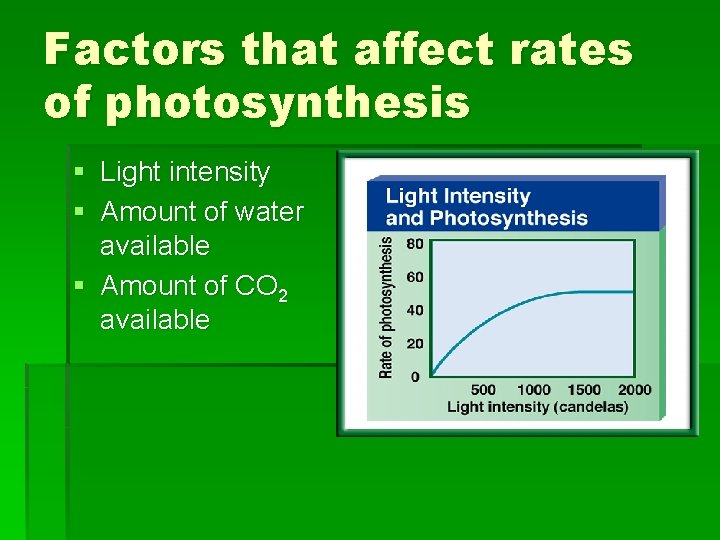
Factors that affect rates of photosynthesis § Light intensity § Amount of water available § Amount of CO 2 available
Section 8 -3 CELLULAR RESPIRATION
What is cellular respiration? § The process by which food molecules are broken down to produce ATP § Purpose: To obtain energy for life processes
What affects the rate of cellular respiration? § § § Number of mitochondria in a cell Amount of carbohydrates available Amount of oxygen available
Which organisms carry out cellular respiration? § § Plants Animals Fungi Etc. (every living cell)
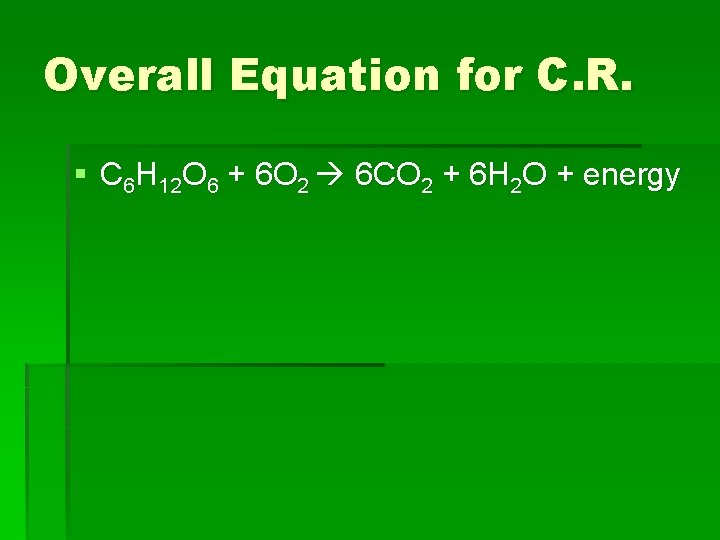
Overall Equation for C. R. § C 6 H 12 O 6 + 6 O 2 6 CO 2 + 6 H 2 O + energy
Steps of Cellular Respiration § Glycolysis § Where? Cytoplasm of cell § What? Breakdown of glucose § What does it require? 2 ATPs to get started § What forms? 4 ATPs, 2 NADHs, 2 pyruvates (most of glucose’s energy is still stored in pyruvate)
What happens next? § If oxygen is present, pyruvate is transported to the mitochondrial matrix where it is converted to CO 2 through the Krebs cycle § The Krebs cycle produces 6 CO 2, 2 ATP, 8 NADH, 2 FADH 2
What happens next? § The NADH & FADH 2 from the Krebs cycle release electrons to the Electron Transport Chain (ETC) in the mitochondrial membrane & protons to the mitochondrial matrix, creating a concentration gradient. They diffuse through ATP synthase, creating 32 ATPs.
Electron Transport Chain § Oxygen is the final electron acceptor in the ETC. § Protons & electrons are transferred to the O 2 to form water § The Krebs cycle and ETC are part of aerobic cellular respiration (oxygen present)
What if there’s no oxygen available? § Without oxygen, the proteins in the ETC can’t pass electrons so oxygen can’t accept the electrons and therefore ATP production stops.
Anaerobic environment § If oxygen is not present after glycolysis, fermentation occurs to produce small amounts of ATP to keep the cell from dying.
Fermentation § Alcohol (a. k. a. Alcoholic) § Produces CO 2, ethyl alcohol, 2 ATP § Yeast cells do this (CO 2 released makes bread rise) & some bacteria § Lactic Acid § Produces lactic acid & 2 ATP § Muscle cells do this during strenuous exercise, muscles get sore
Types of Cellular Respiration Summary § Aerobic § Requires oxygen § Produces 36 ATP—very efficient § Lots of energy!!! § Anaerobic § § Does not require oxygen Supplies energy when oxygen is scarce Called fermentation Produces 2 ATP—inefficient
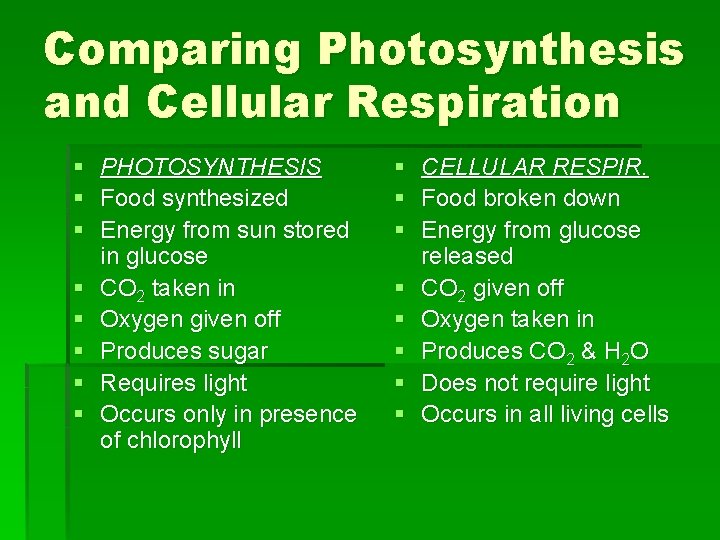
Comparing Photosynthesis and Cellular Respiration § PHOTOSYNTHESIS § Food synthesized § Energy from sun stored in glucose § CO 2 taken in § Oxygen given off § Produces sugar § Requires light § Occurs only in presence of chlorophyll § CELLULAR RESPIR. § Food broken down § Energy from glucose released § CO 2 given off § Oxygen taken in § Produces CO 2 & H 2 O § Does not require light § Occurs in all living cells