
Photosynthesis By Chloe Christina Photosynthesis is the process
Photosynthesis By: Chloe & Christina
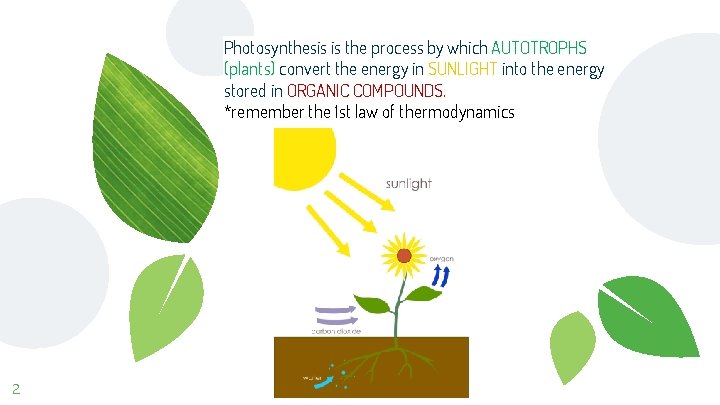
Photosynthesis is the process by which AUTOTROPHS (plants) convert the energy in SUNLIGHT into the energy stored in ORGANIC COMPOUNDS. *remember the 1 st law of thermodynamics “ 2
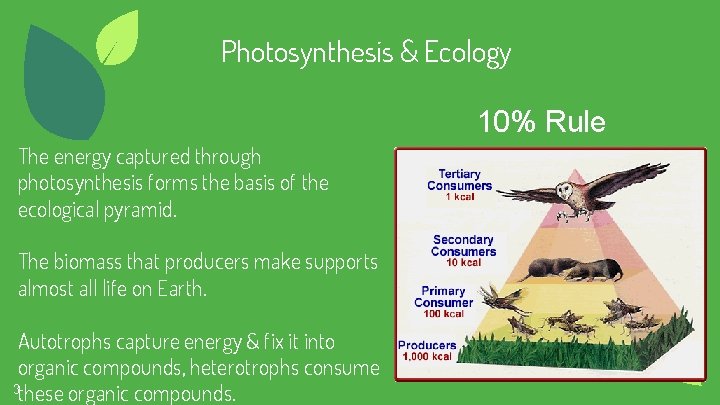
Photosynthesis & Ecology 10% Rule The energy captured through photosynthesis forms the basis of the ecological pyramid. The biomass that producers make supports almost all life on Earth. Autotrophs capture energy & fix it into organic compounds, heterotrophs consume 3 these organic compounds.
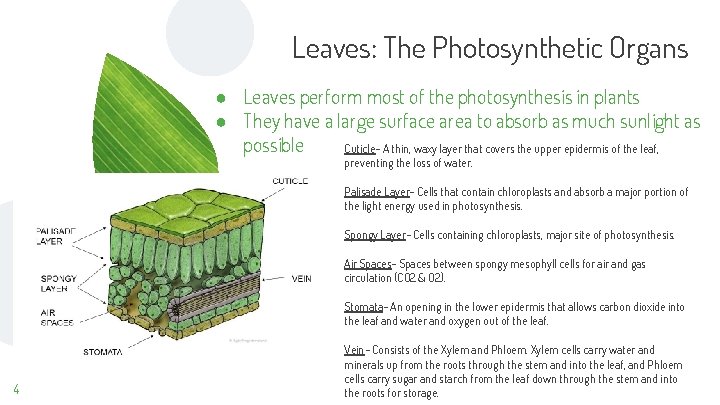
Leaves: The Photosynthetic Organs ● Leaves perform most of the photosynthesis in plants ● They have a large surface area to absorb as much sunlight as possible Cuticle- A thin, waxy layer that covers the upper epidermis of the leaf, preventing the loss of water. Palisade Layer- Cells that contain chloroplasts and absorb a major portion of the light energy used in photosynthesis. Spongy Layer- Cells containing chloroplasts, major site of photosynthesis. Air Spaces- Spaces between spongy mesophyll cells for air and gas circulation (CO 2 & O 2). Stomata- An opening in the lower epidermis that allows carbon dioxide into the leaf and water and oxygen out of the leaf. 4 Vein- Consists of the Xylem and Phloem. Xylem cells carry water and minerals up from the roots through the stem and into the leaf, and Phloem cells carry sugar and starch from the leaf down through the stem and into the roots for storage.
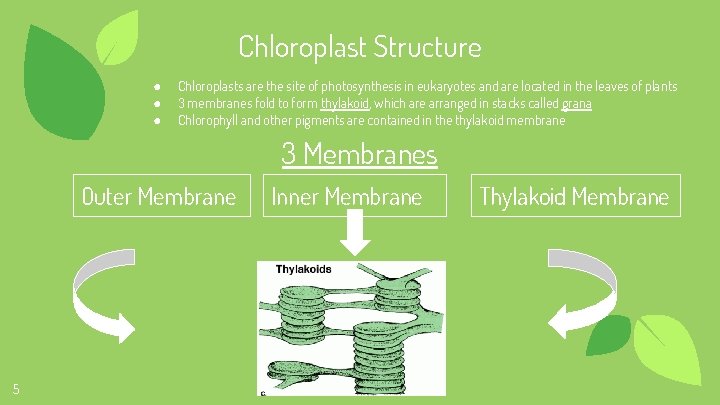
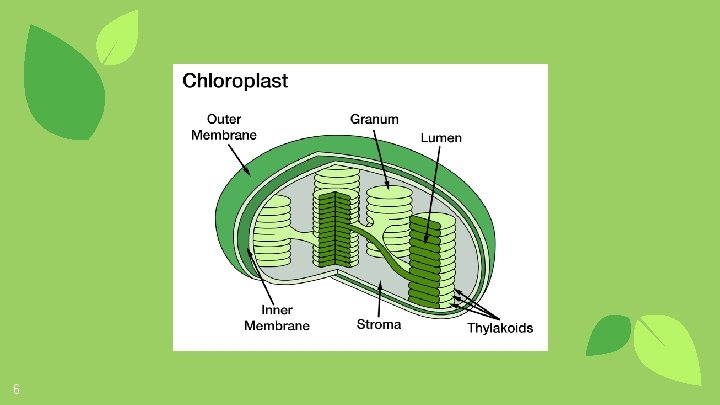
Chloroplast Structure ● ● ● Chloroplasts are the site of photosynthesis in eukaryotes and are located in the leaves of plants 3 membranes fold to form thylakoid, which are arranged in stacks called grana Chlorophyll and other pigments are contained in the thylakoid membrane 3 Membranes Outer Membrane 5 Inner Membrane Thylakoid Membrane
6
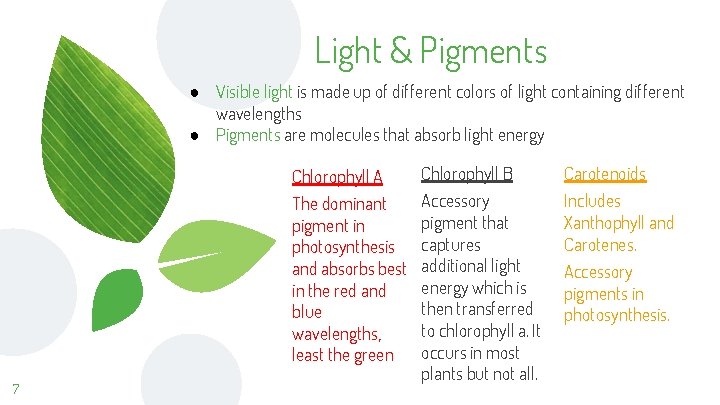
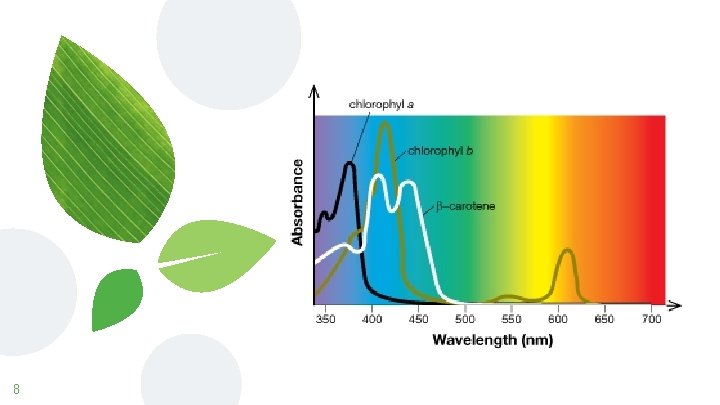
Light & Pigments ● Visible light is made up of different colors of light containing different wavelengths ● Pigments are molecules that absorb light energy 7 Chlorophyll A Chlorophyll B Carotenoids The dominant pigment in photosynthesis and absorbs best in the red and blue wavelengths, least the green Accessory pigment that captures additional light energy which is then transferred to chlorophyll a. It occurs in most plants but not all. Includes Xanthophyll and Carotenes. Accessory pigments in photosynthesis.
8
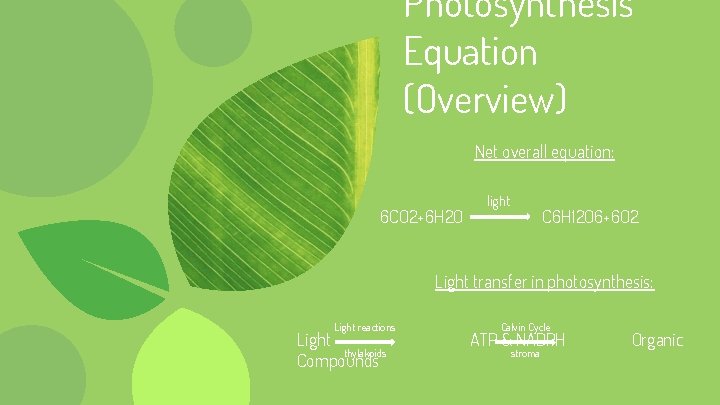
Photosynthesis Equation (Overview) Net overall equation: 6 CO 2+6 H 2 O light C 6 H 12 O 6+6 O 2 Light transfer in photosynthesis: Light reactions Light thylakoids Compounds Calvin Cycle ATP & NADPH stroma Organic
Phase 1: Light Dependent Reactions
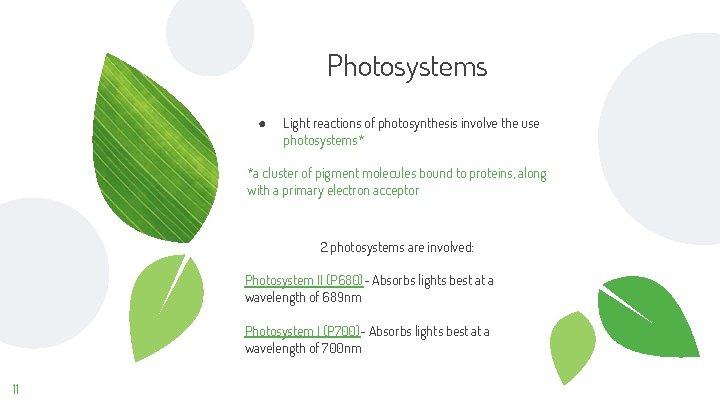
Photosystems “ ● Light reactions of photosynthesis involve the use photosystems* *a cluster of pigment molecules bound to proteins, along with a primary electron acceptor 2 photosystems are involved: Photosystem II (P 680)- Absorbs lights best at a wavelength of 689 nm Photosystem I (P 700)- Absorbs lights best at a wavelength of 700 nm 11
Non-Cyclic Electron Flow 12
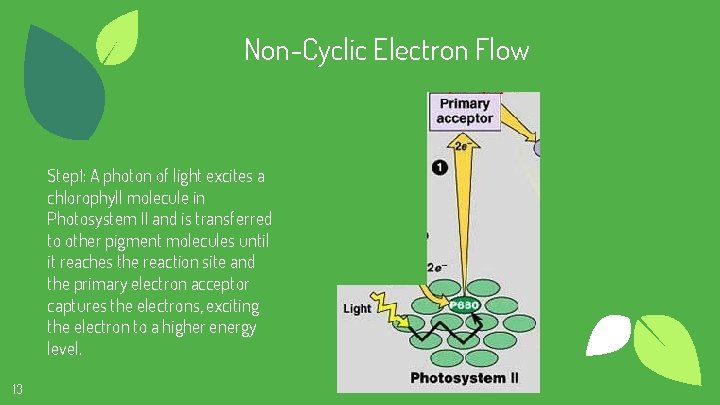
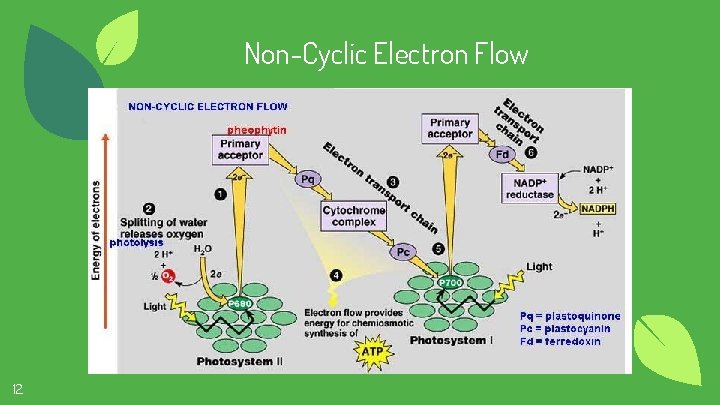
Non-Cyclic Electron Flow Step 1: A photon of light excites a chlorophyll molecule in Photosystem II and is transferred to other pigment molecules until it reaches the reaction site and the primary electron acceptor captures the electrons, exciting the electron to a higher energy level. 13
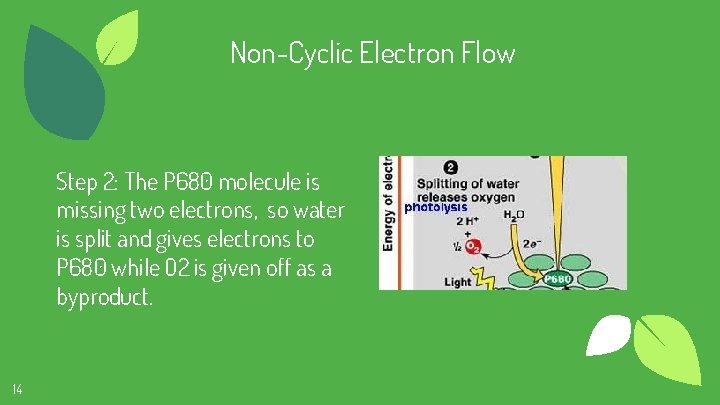
Non-Cyclic Electron Flow Step 2: The P 680 molecule is missing two electrons, so water is split and gives electrons to P 680 while O 2 is given off as a byproduct. 14
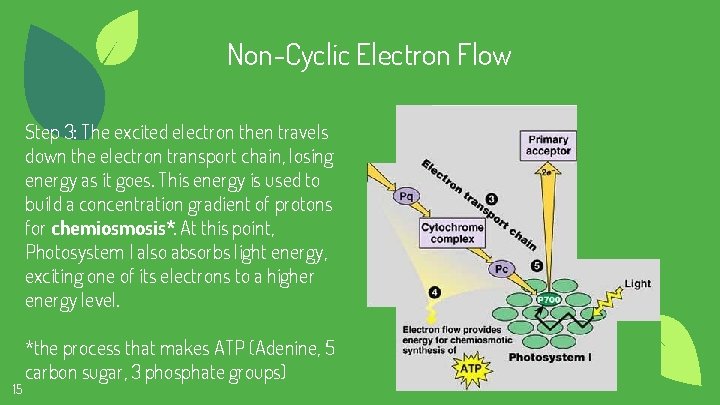
Non-Cyclic Electron Flow Step 3: The excited electron then travels down the electron transport chain, losing energy as it goes. This energy is used to build a concentration gradient of protons for chemiosmosis*. At this point, Photosystem I also absorbs light energy, exciting one of its electrons to a higher energy level. 15 *the process that makes ATP (Adenine, 5 carbon sugar, 3 phosphate groups)
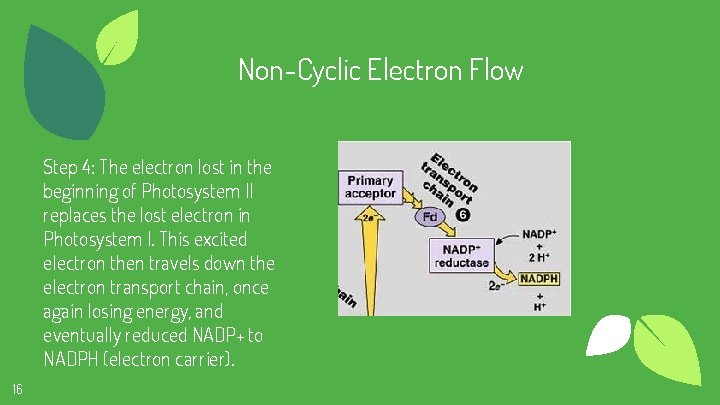
Non-Cyclic Electron Flow Step 4: The electron lost in the beginning of Photosystem II replaces the lost electron in Photosystem I. This excited electron then travels down the electron transport chain, once again losing energy, and eventually reduced NADP+ to NADPH (electron carrier). 16
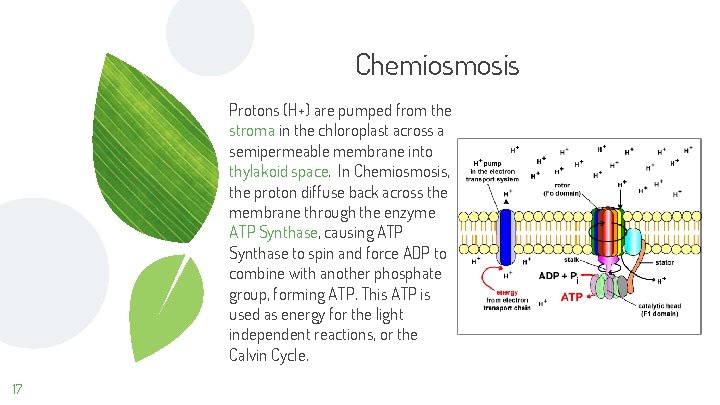
Chemiosmosis Protons (H+) are pumped from the stroma in the chloroplast across a semipermeable membrane into thylakoid space. In Chemiosmosis, the proton diffuse back across the membrane through the enzyme ATP Synthase, causing ATP Synthase to spin and force ADP to combine with another phosphate group, forming ATP. This ATP is used as energy for the light independent reactions, or the Calvin Cycle. 17
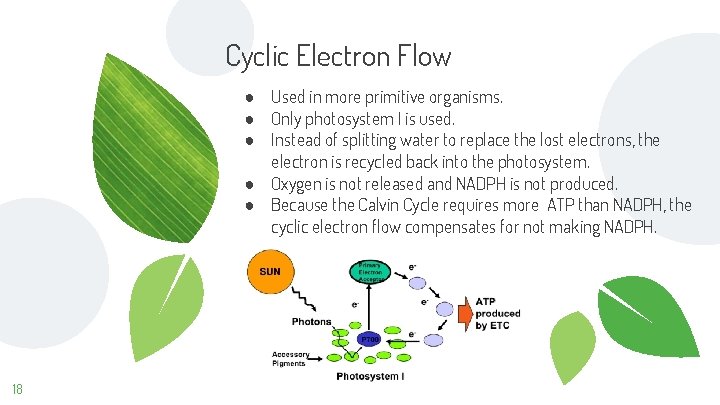
Cyclic Electron Flow ● Used in more primitive organisms. ● Only photosystem I is used. ● Instead of splitting water to replace the lost electrons, the electron is recycled back into the photosystem. ● Oxygen is not released and NADPH is not produced. ● Because the Calvin Cycle requires more ATP than NADPH, the cyclic electron flow compensates for not making NADPH. “ 18
Light Independent Reactions
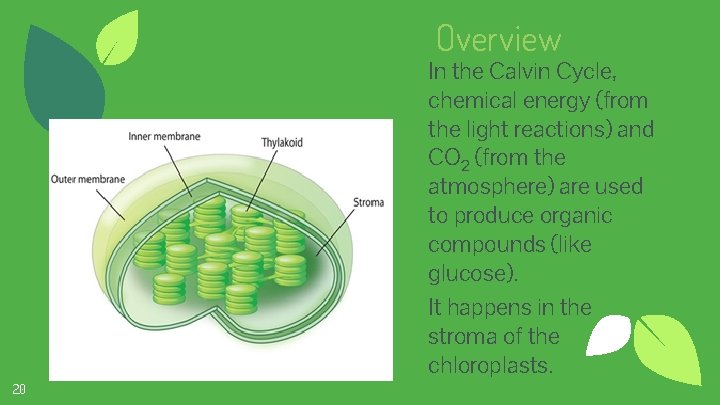
Overview In the Calvin Cycle, chemical energy (from the light reactions) and CO 2 (from the atmosphere) are used to produce organic compounds (like glucose). It happens in the stroma of the chloroplasts. 20
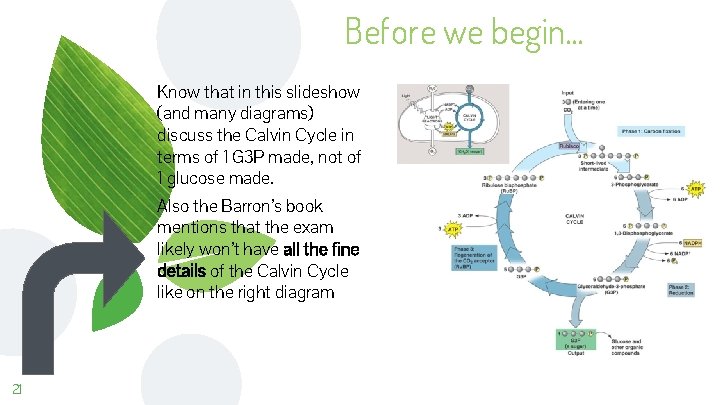
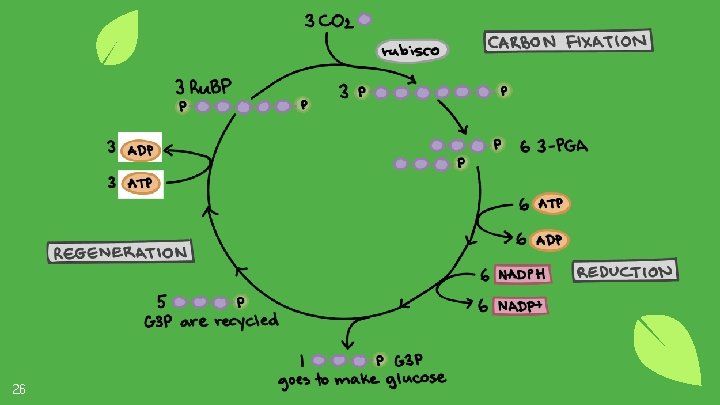
Before we begin. . . Know that in this slideshow (and many diagrams) discuss the Calvin Cycle in terms of 1 G 3 P made, not of 1 glucose made. Also the Barron’s book mentions that the exam likely won’t have all the fine details of the Calvin Cycle like on the right diagram 21
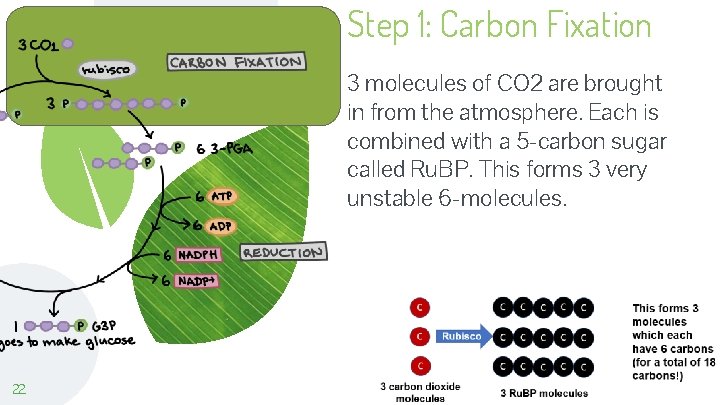
Step 1: Carbon Fixation 3 molecules of CO 2 are brought in from the atmosphere. Each is combined with a 5 -carbon sugar called Ru. BP. This forms 3 very unstable 6 -molecules. 22
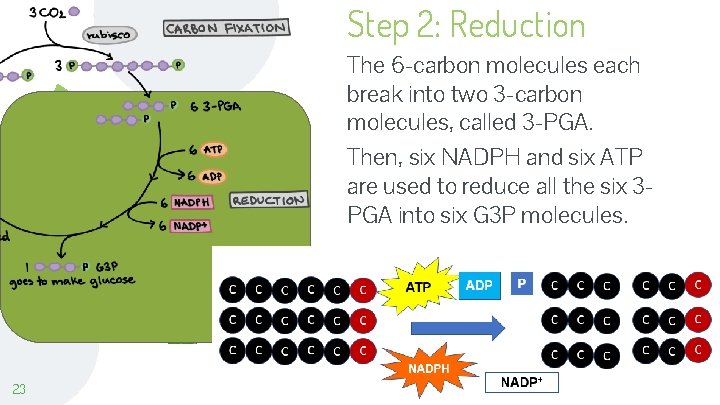
Step 2: Reduction The 6 -carbon molecules each break into two 3 -carbon molecules, called 3 -PGA. Then, six NADPH and six ATP are used to reduce all the six 3 PGA into six G 3 P molecules. 23
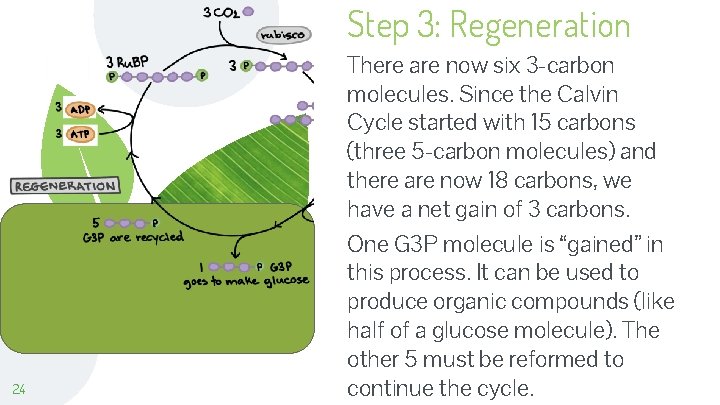
Step 3: Regeneration 24 There are now six 3 -carbon molecules. Since the Calvin Cycle started with 15 carbons (three 5 -carbon molecules) and there are now 18 carbons, we have a net gain of 3 carbons. One G 3 P molecule is “gained” in this process. It can be used to produce organic compounds (like half of a glucose molecule). The other 5 must be reformed to continue the cycle.
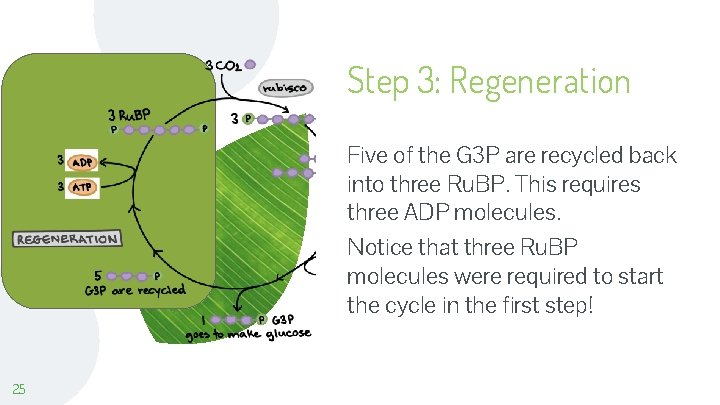
Step 3: Regeneration Five of the G 3 P are recycled back into three Ru. BP. This requires three ADP molecules. Notice that three Ru. BP molecules were required to start the cycle in the first step! 25
26
Photorespiration
What if there’s no CO 2? If there is no CO 2 for rubisco to bind with, it will instead bind to O 2. This is called photorespiration. Makes compounds that must be broken apart 28 Doesn’t make any sugar Uses up ATP
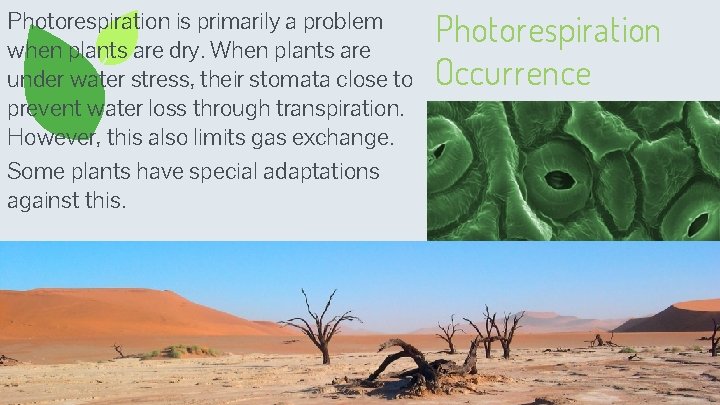
Photorespiration is primarily a problem when plants are dry. When plants are under water stress, their stomata close to prevent water loss through transpiration. However, this also limits gas exchange. Some plants have special adaptations against this. 29 Photorespiration Occurrence
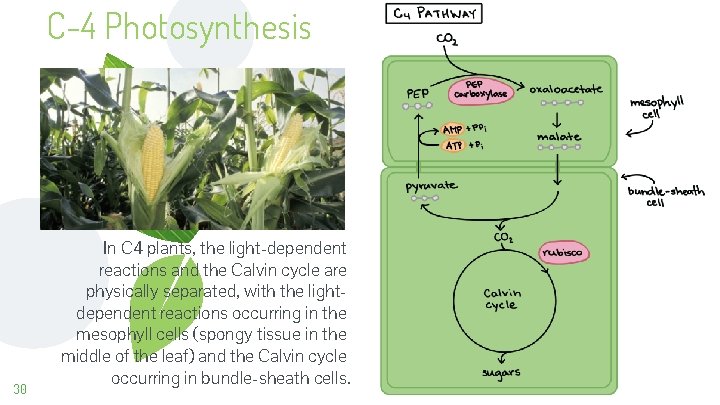
C-4 Photosynthesis 30 In C 4 plants, the light-dependent reactions and the Calvin cycle are physically separated, with the lightdependent reactions occurring in the mesophyll cells (spongy tissue in the middle of the leaf) and the Calvin cycle occurring in bundle-sheath cells.
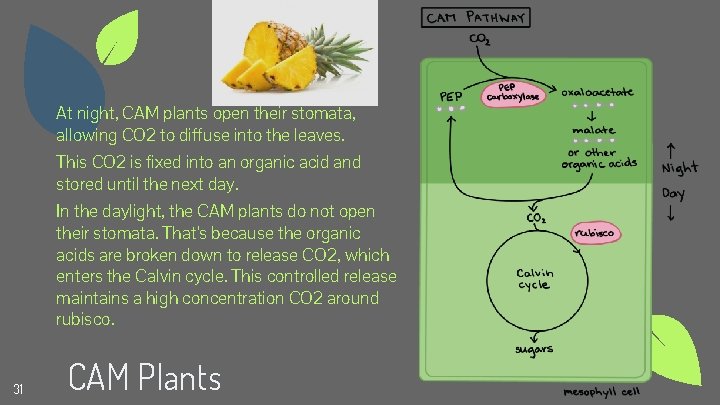
At night, CAM plants open their stomata, allowing CO 2 to diffuse into the leaves. This CO 2 is fixed into an organic acid and stored until the next day. In the daylight, the CAM plants do not open their stomata. That's because the organic acids are broken down to release CO 2, which enters the Calvin cycle. This controlled release maintains a high concentration CO 2 around rubisco. 31 CAM Plants
“ Z Z I https: //quizizz. com/admin/ quiz/5 ae 9 fda 2 b 9 c 1 e 8001 b 812 d 99 32 Z I U Q
- Slides: 32