
Photosynthesis Bell Ringer Where does most energy come
Photosynthesis
Bell Ringer • Where does most energy come from? How do you get energy? • What processes are involved with you obtaining energy. (list as many as possible)
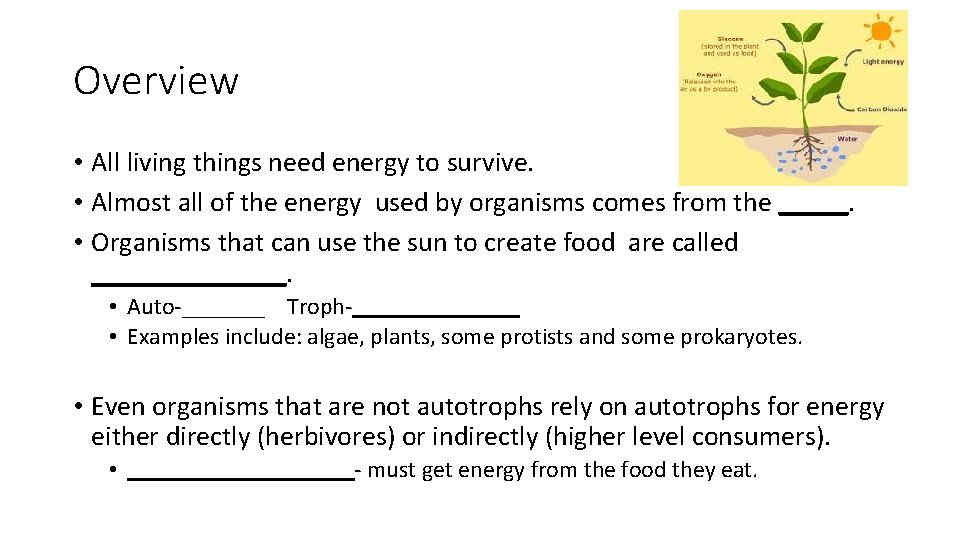
Overview • All living things need energy to survive. • Almost all of the energy used by organisms comes from the _____. • Organisms that can use the sun to create food are called _______. • Auto-_______ Troph-_______ • Examples include: algae, plants, some protists and some prokaryotes. • Even organisms that are not autotrophs rely on autotrophs for energy either directly (herbivores) or indirectly (higher level consumers). • __________- must get energy from the food they eat.
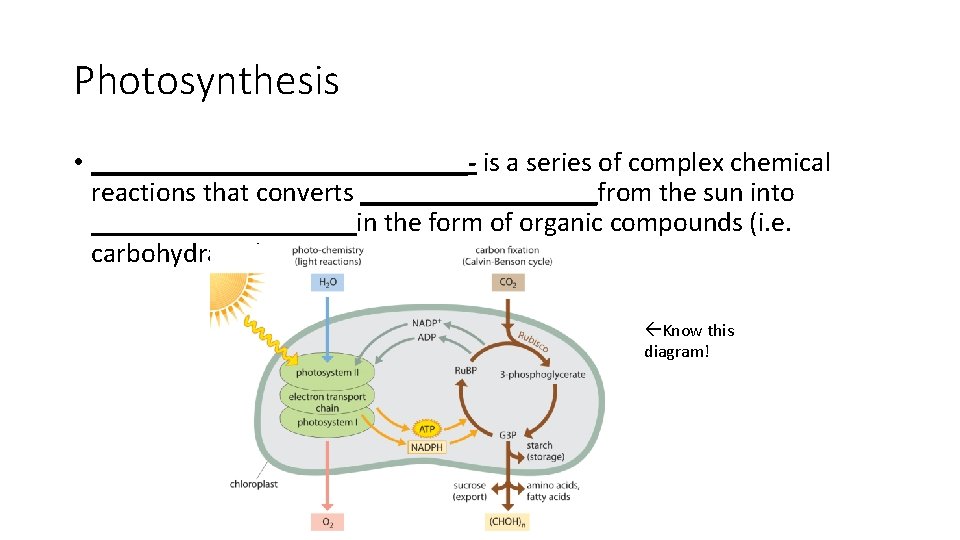
Photosynthesis • ______________- is a series of complex chemical reactions that converts _________from the sun into __________in the form of organic compounds (i. e. carbohydrates). Know this diagram!

Photosynthesis • The molecules used (_______) during photosynthesis include: • Carbon Dioxide (CO 2) , Water (H 2 O) • The molecules ______ (products) include: • Glucose (C 6 H 12 O 6), Oxygen O 2
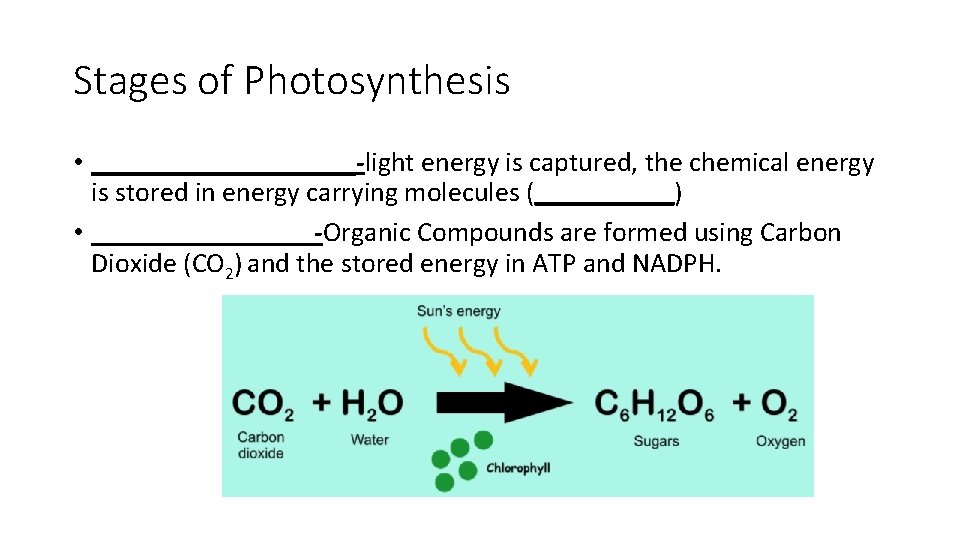
Stages of Photosynthesis • __________-light energy is captured, the chemical energy is stored in energy carrying molecules (_____) • ________-Organic Compounds are formed using Carbon Dioxide (CO 2) and the stored energy in ATP and NADPH.
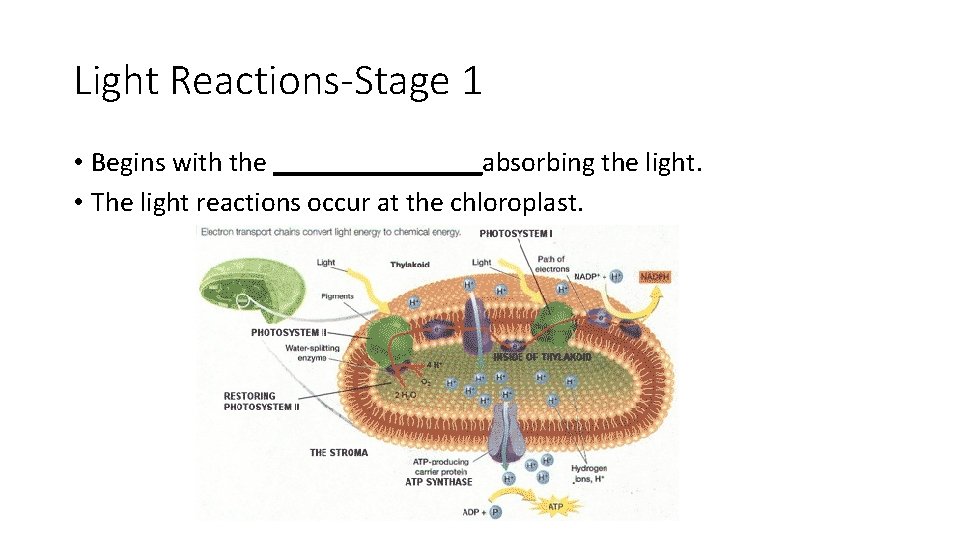
Light Reactions-Stage 1 • Begins with the ________absorbing the light. • The light reactions occur at the chloroplast.
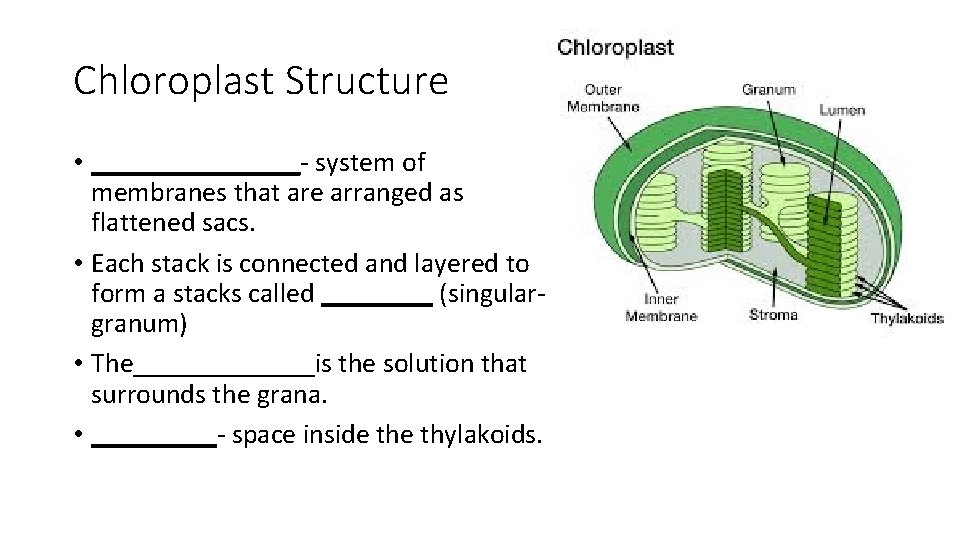
Chloroplast Structure • ________- system of membranes that are arranged as flattened sacs. • Each stack is connected and layered to form a stacks called ____ (singulargranum) • The_______is the solution that surrounds the grana. • _____- space inside thylakoids.
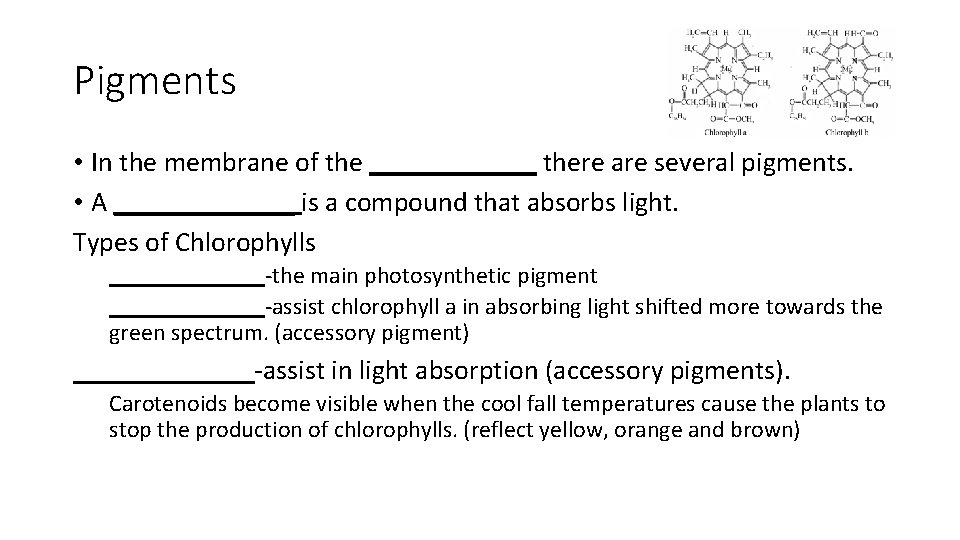
Pigments • In the membrane of the ______ there are several pigments. • A _______ is a compound that absorbs light. Types of Chlorophylls _______-the main photosynthetic pigment _______-assist chlorophyll a in absorbing light shifted more towards the green spectrum. (accessory pigment) _______-assist in light absorption (accessory pigments). Carotenoids become visible when the cool fall temperatures cause the plants to stop the production of chlorophylls. (reflect yellow, orange and brown)
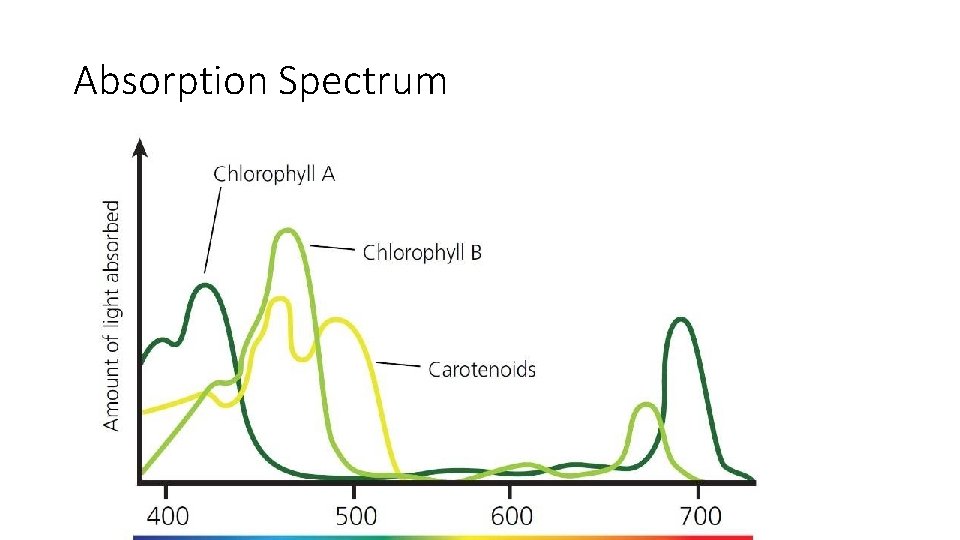
Absorption Spectrum
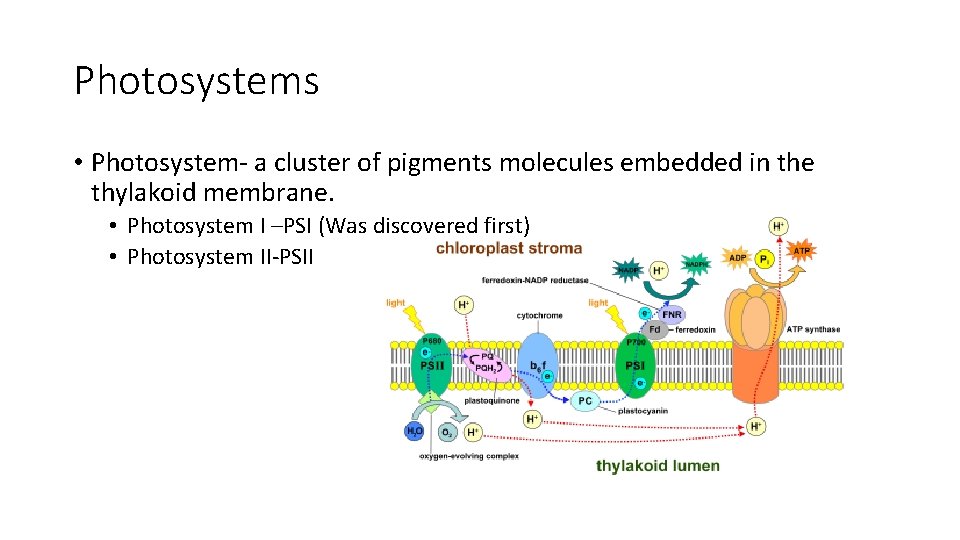
Photosystems • Photosystem- a cluster of pigments molecules embedded in the thylakoid membrane. • Photosystem I –PSI (Was discovered first) • Photosystem II-PSII
Bell Ringer • Why do plants appear green? • What wavelengths of light does chlorophyll a reflect? • What wavelengths of light does chlorophyll b reflect? • What wavelengths of light does carotenoids reflect?
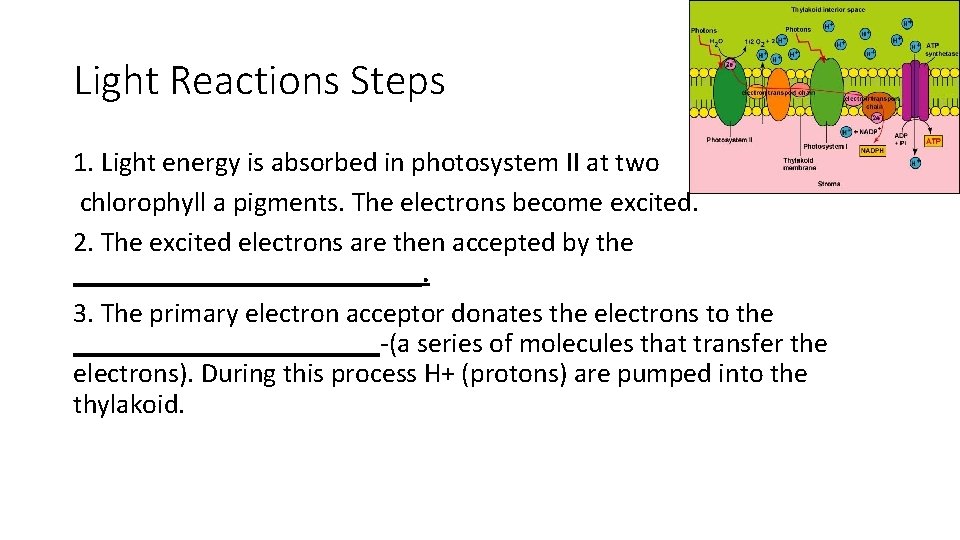
Light Reactions Steps 1. Light energy is absorbed in photosystem II at two chlorophyll a pigments. The electrons become excited. 2. The excited electrons are then accepted by the _____________. 3. The primary electron acceptor donates the electrons to the ___________-(a series of molecules that transfer the electrons). During this process H+ (protons) are pumped into the thylakoid.
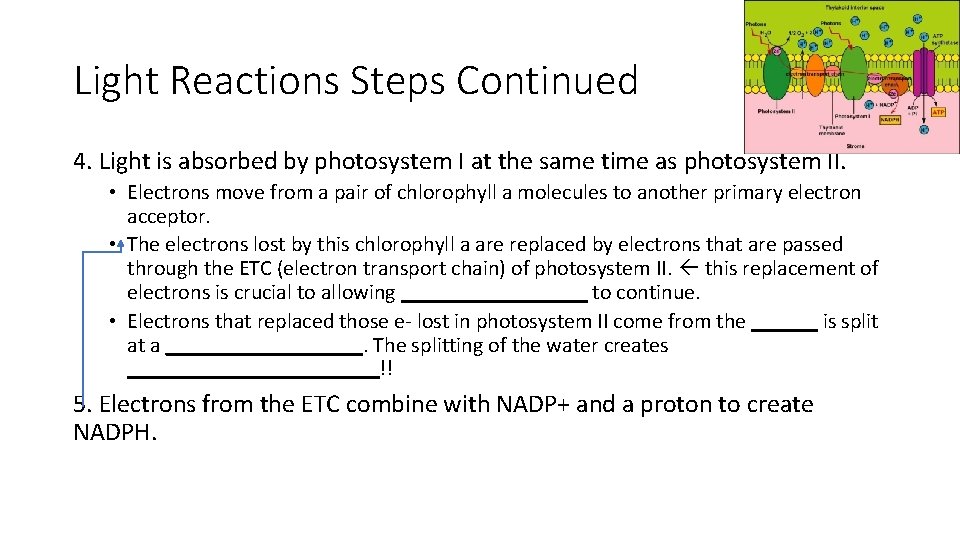
Light Reactions Steps Continued 4. Light is absorbed by photosystem I at the same time as photosystem II. • Electrons move from a pair of chlorophyll a molecules to another primary electron acceptor. • The electrons lost by this chlorophyll a are replaced by electrons that are passed through the ETC (electron transport chain) of photosystem II. this replacement of electrons is crucial to allowing _________ to continue. • Electrons that replaced those e- lost in photosystem II come from the ______ is split at a _________. The splitting of the water creates ____________!! 5. Electrons from the ETC combine with NADP+ and a proton to create NADPH.
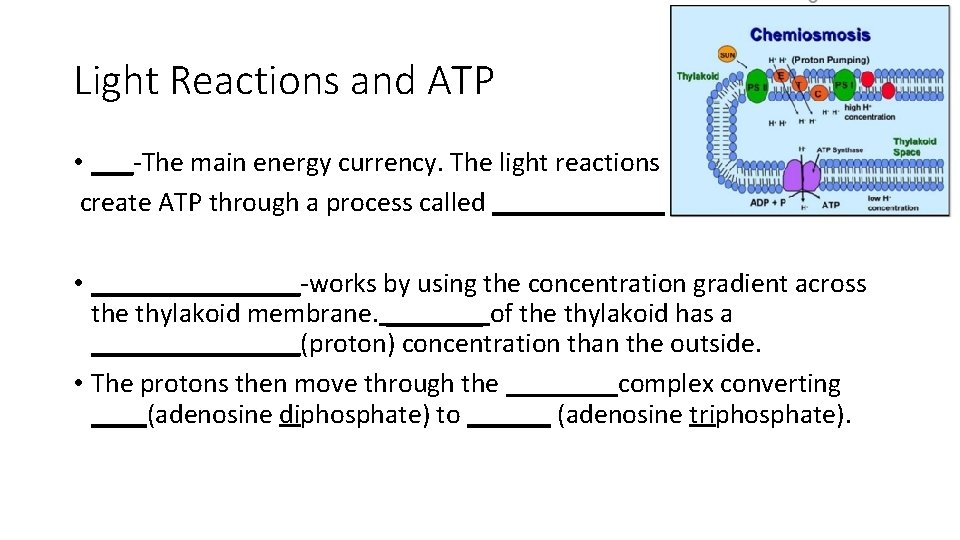
Light Reactions and ATP • ___-The main energy currency. The light reactions create ATP through a process called _______. • ________-works by using the concentration gradient across the thylakoid membrane. _______ of the thylakoid has a ________(proton) concentration than the outside. • The protons then move through the ____complex converting ____(adenosine diphosphate) to ______ (adenosine triphosphate).
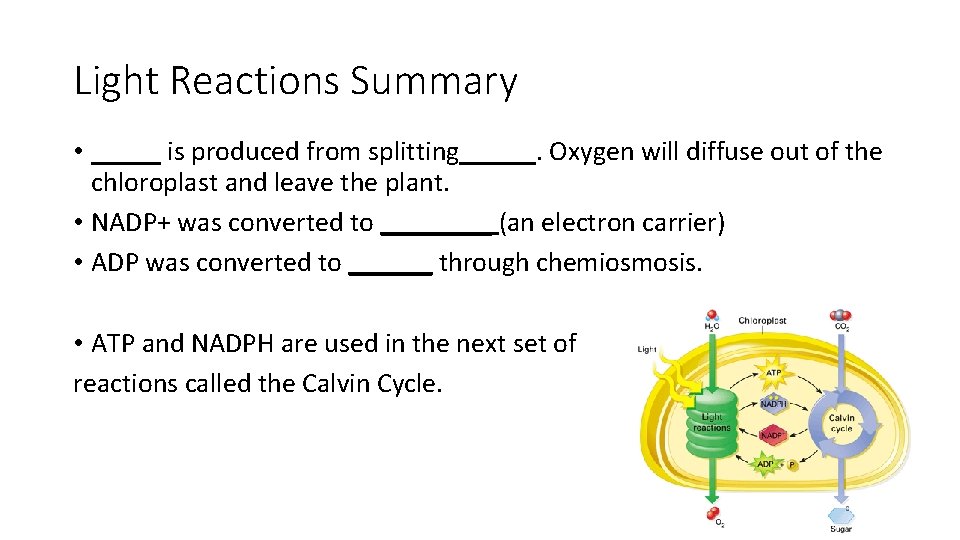
Light Reactions Summary • _____ is produced from splitting _____. Oxygen will diffuse out of the chloroplast and leave the plant. • NADP+ was converted to ____ (an electron carrier) • ADP was converted to ______ through chemiosmosis. • ATP and NADPH are used in the next set of reactions called the Calvin Cycle.
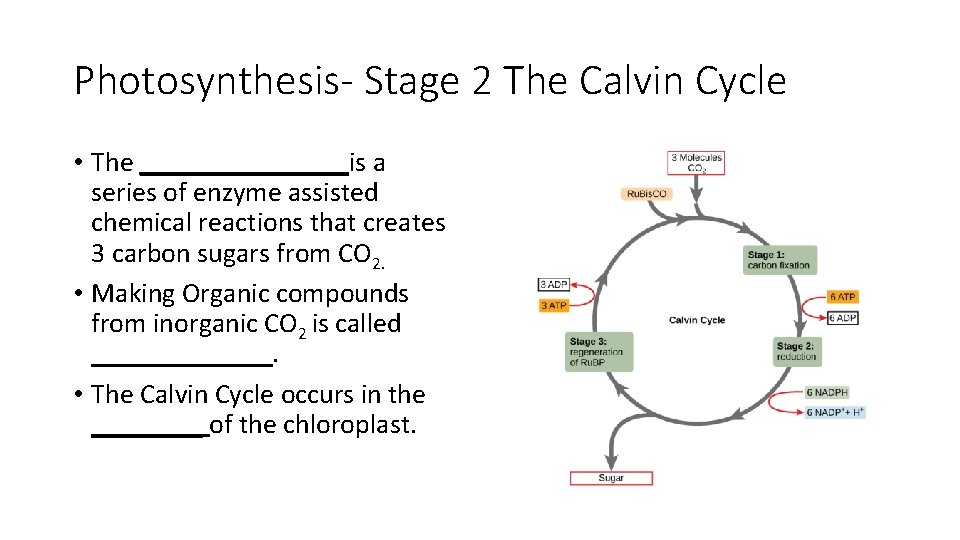
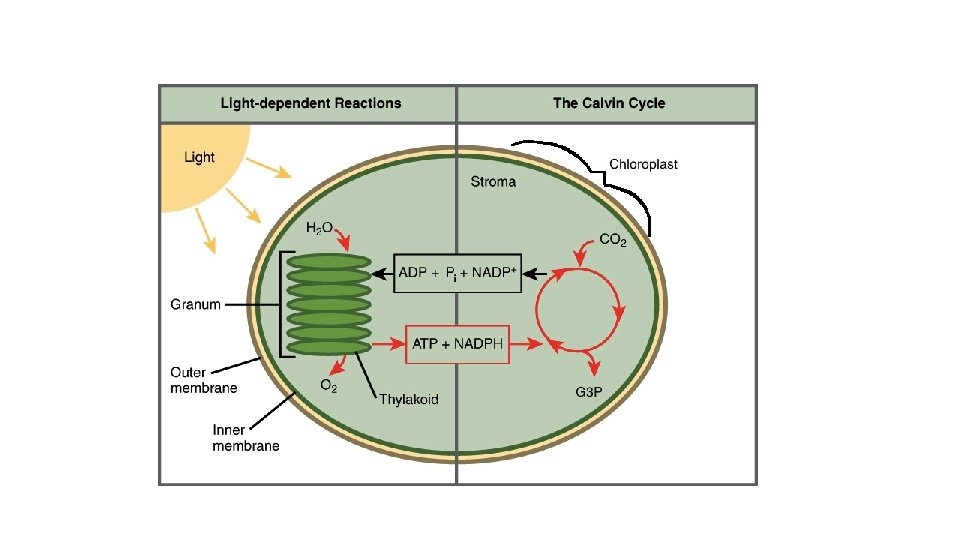
Photosynthesis- Stage 2 The Calvin Cycle • The ________is a series of enzyme assisted chemical reactions that creates 3 carbon sugars from CO 2. • Making Organic compounds from inorganic CO 2 is called _______. • The Calvin Cycle occurs in the ____ of the chloroplast.
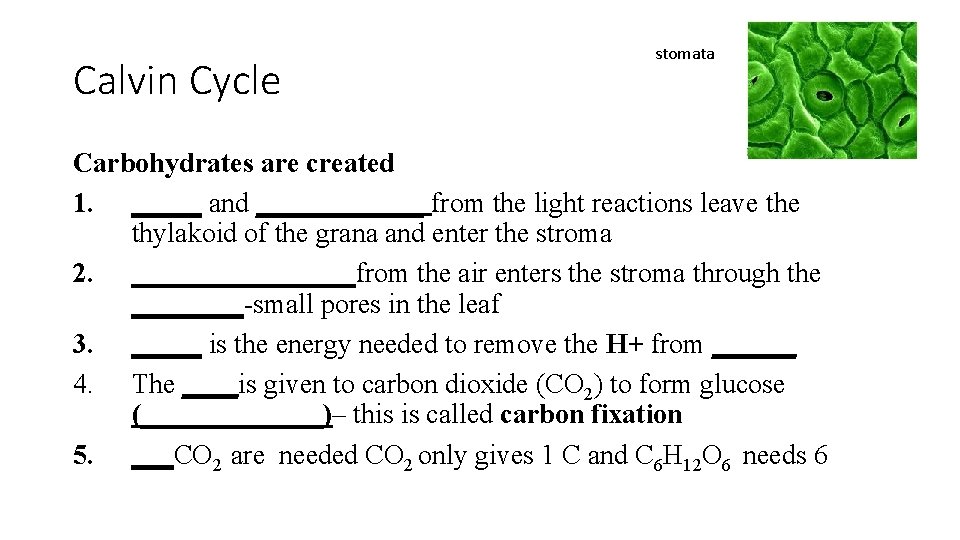
Calvin Cycle stomata Carbohydrates are created 1. _____ and ______ from the light reactions leave thylakoid of the grana and enter the stroma 2. ________from the air enters the stroma through the ____-small pores in the leaf 3. _____ is the energy needed to remove the H+ from ______ 4. The ____is given to carbon dioxide (CO 2) to form glucose (_______)– this is called carbon fixation 5. ___CO 2 are needed CO 2 only gives 1 C and C 6 H 12 O 6 needs 6
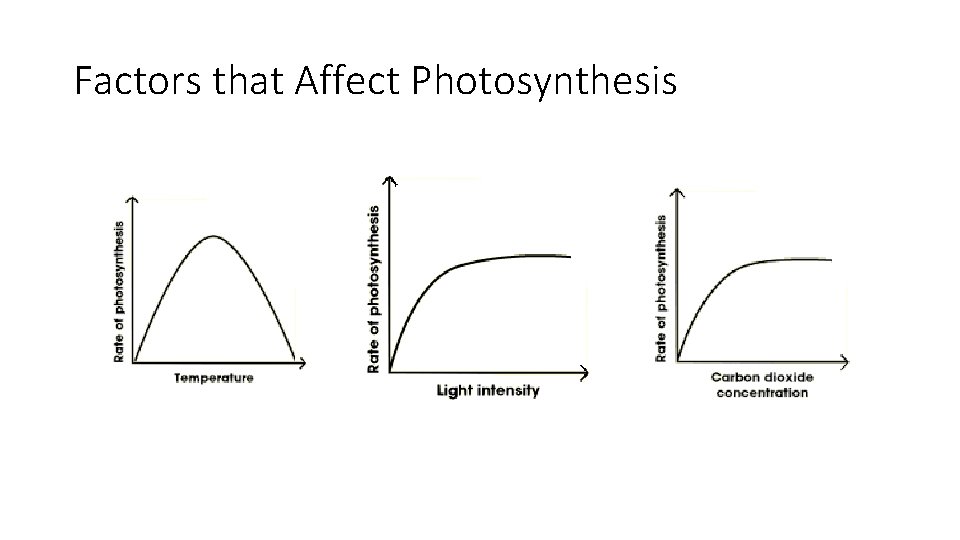
Factors that Affect Photosynthesis • _________As light intensity is increased the rate of photosynthesis increased until the maximum rate of photosynthesis is achieved. _________- Increased temperature increases the rate of photosynthesis until the enzymes become ineffective due to high temperatures. • __________Increasing the CO 2 levels increases the rate of photosynthesis until the rate of photosynthesis levels off.
Factors that Affect Photosynthesis
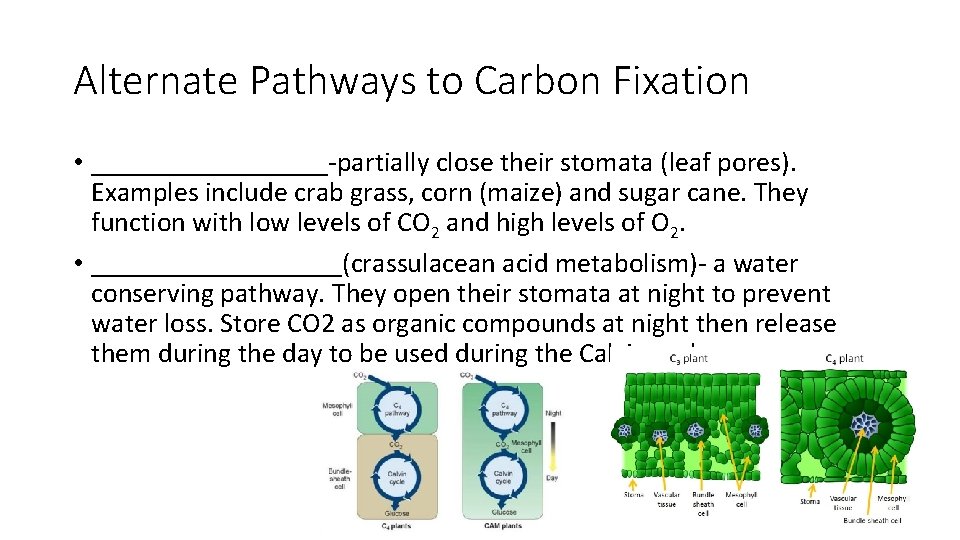
Alternate Pathways to Carbon Fixation • _________-partially close their stomata (leaf pores). Examples include crab grass, corn (maize) and sugar cane. They function with low levels of CO 2 and high levels of O 2. • _________(crassulacean acid metabolism)- a water conserving pathway. They open their stomata at night to prevent water loss. Store CO 2 as organic compounds at night then release them during the day to be used during the Calvin cycle.
Bell Ringer • Explain how increased global temperature could affect plants.
- Slides: 23