
Photosynthesis and Cellular Respiration Moving Material In Plants
- Slides: 9
Photosynthesis and Cellular Respiration
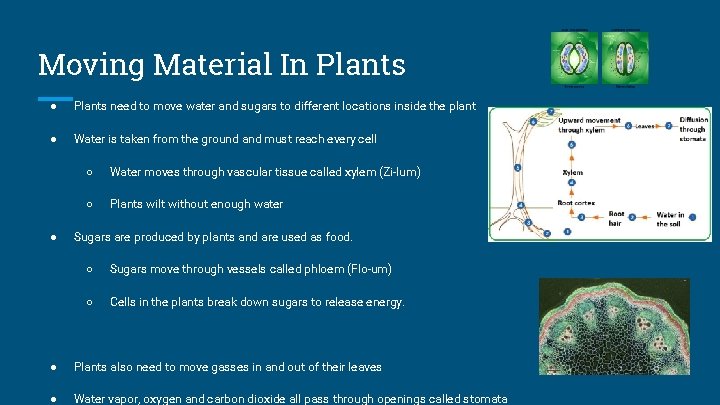
Moving Material In Plants ● Plants need to move water and sugars to different locations inside the plant ● Water is taken from the ground and must reach every cell ● ○ Water moves through vascular tissue called xylem (Zi-lum) ○ Plants wilt without enough water Sugars are produced by plants and are used as food. ○ Sugars move through vessels called phloem (Flo-um) ○ Cells in the plants break down sugars to release energy. ● Plants also need to move gasses in and out of their leaves ● Water vapor, oxygen and carbon dioxide all pass through openings called stomata
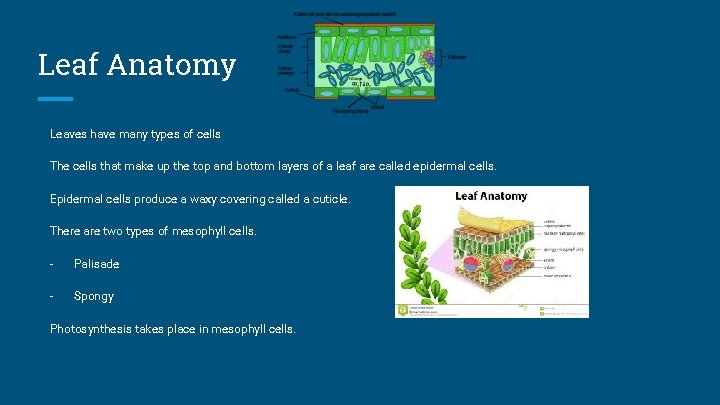
Leaf Anatomy Leaves have many types of cells The cells that make up the top and bottom layers of a leaf are called epidermal cells. Epidermal cells produce a waxy covering called a cuticle. There are two types of mesophyll cells. - Palisade - Spongy Photosynthesis takes place in mesophyll cells.
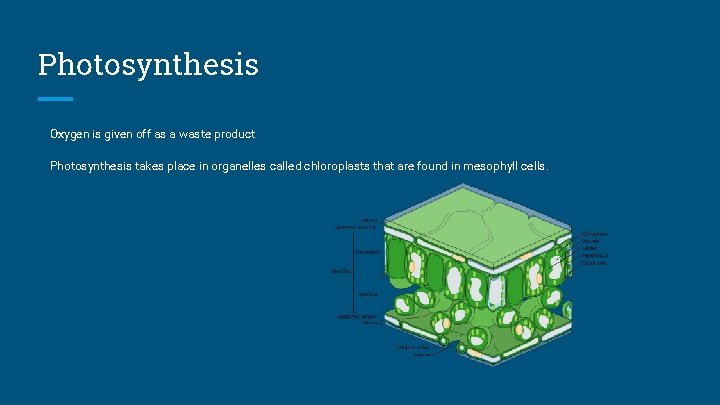
Photosynthesis Oxygen is given off as a waste product Photosynthesis takes place in organelles called chloroplasts that are found in mesophyll cells.
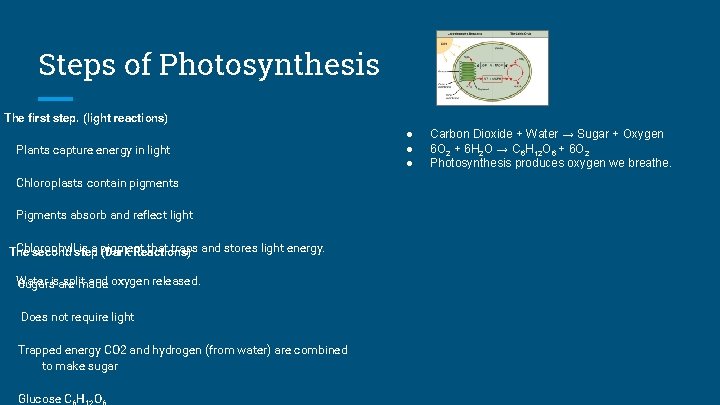
Steps of Photosynthesis The first step. (light reactions) Plants capture energy in light Chloroplasts contain pigments Pigments absorb and reflect light Chlorophyll is a pigment that traps and stores light energy. The second step (Dark Reactions) Water split and oxygen released. Sugarsisare made Does not require light Trapped energy CO 2 and hydrogen (from water) are combined to make sugar Glucose C H O ● ● ● Carbon Dioxide + Water → Sugar + Oxygen 6 O 2 + 6 H 2 O → C 6 H 12 O 6 + 6 O 2 Photosynthesis produces oxygen we breathe.
Cellular Respiration ● Energy is stored in bonds in food molecules Animals get energy from food. Plants produce sugar, but without cellular respiration, plants could not grow, reproduce, or repair tissues. All organisms require energy
Steps of Cellular Respiration ● Cellular Respiration is a series of chemical reactions that convert food molecules into a usable form of energy called ATP ● Adenosine triphosphate ( ATP) ● ○ Two step process ○ Glycolysis Oxidation of Pyruvic acid ○ Krebs cycle ○ Electron transport chain
Glycolysis ● Takes place in the cytoplasm ● Does NOT require oxygen (anaerobic) ● Glucose is broken down into two pyruvates ● Produces a few ATP molecules (2 ATP)
Oxidation of Pyruvic Acid ● Takes place in Mitochondria ● Does require oxygen (aerobic) ● Pyruvates are broken down ● Krebs Cycle (2 ATP) ● Electron Transport Chain (34 ATP) ● Generates large amounts of ATP ● Waste products: CO 2 and H 20