
Photosynthesis and Cellular Respiration Energy for Life Complementary
- Slides: 18
Photosynthesis and Cellular Respiration Energy for Life
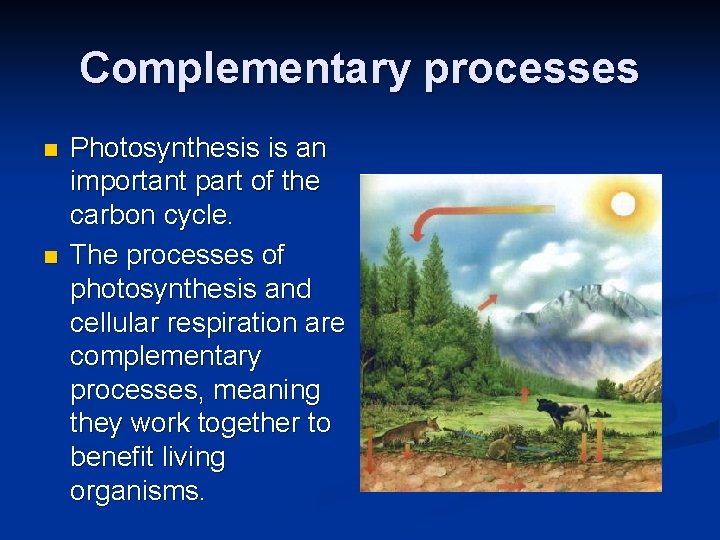
Complementary processes n n Photosynthesis is an important part of the carbon cycle. The processes of photosynthesis and cellular respiration are complementary processes, meaning they work together to benefit living organisms.
Plants and animals contribute… Autotrophs, such as plants, produce glucose using the carbon in carbon dioxide. n Both autotrophs and heterotrophs, such as grasshoppers that eat plants, use those carbohydrates in cellular respiration. n Respiration, in turn, produces carbon dioxide. n
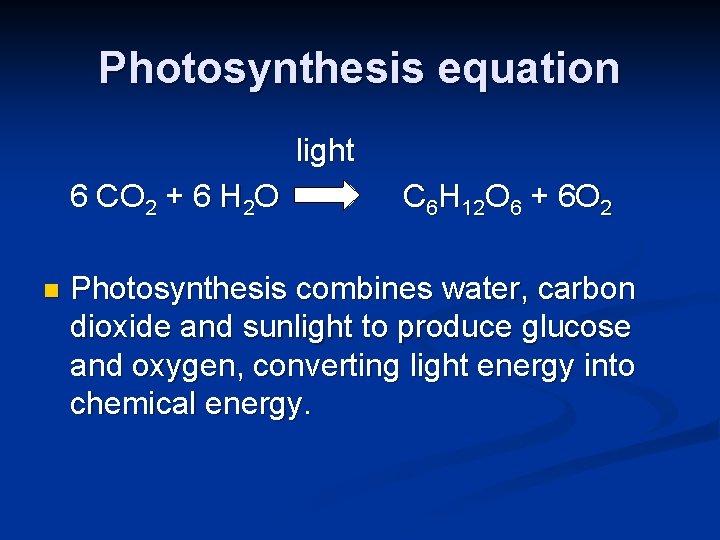
Photosynthesis equation light 6 CO 2 + 6 H 2 O n C 6 H 12 O 6 + 6 O 2 Photosynthesis combines water, carbon dioxide and sunlight to produce glucose and oxygen, converting light energy into chemical energy.
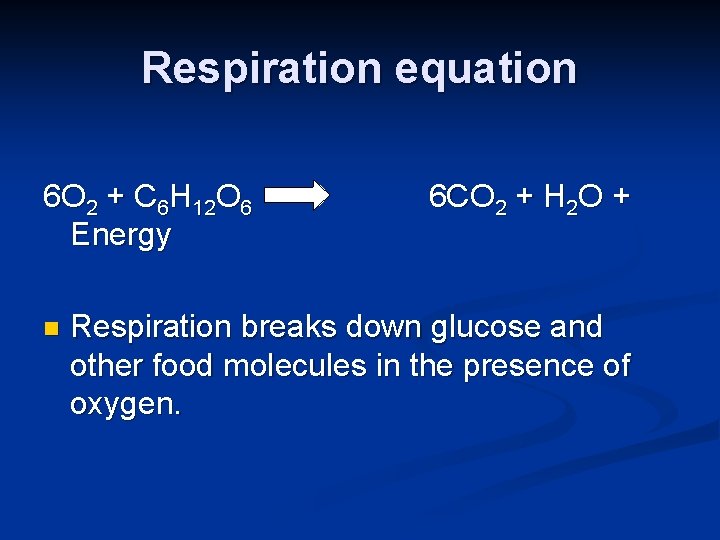
Respiration equation 6 O 2 + C 6 H 12 O 6 Energy n 6 CO 2 + H 2 O + Respiration breaks down glucose and other food molecules in the presence of oxygen.
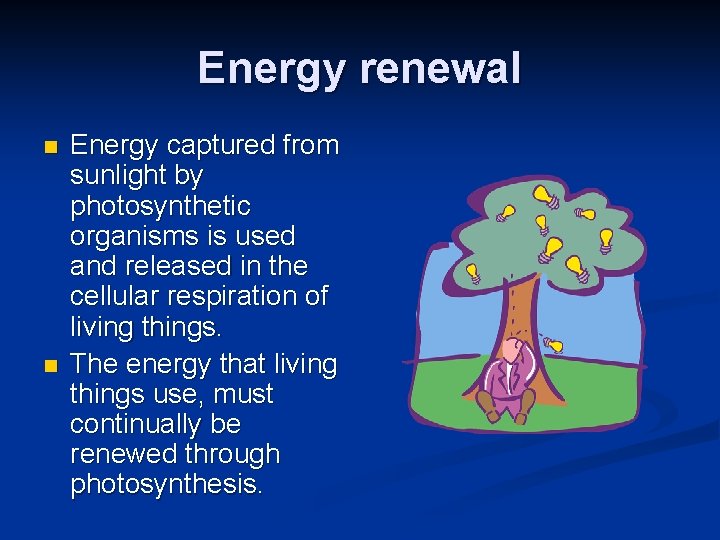
Energy renewal n n Energy captured from sunlight by photosynthetic organisms is used and released in the cellular respiration of living things. The energy that living things use, must continually be renewed through photosynthesis.
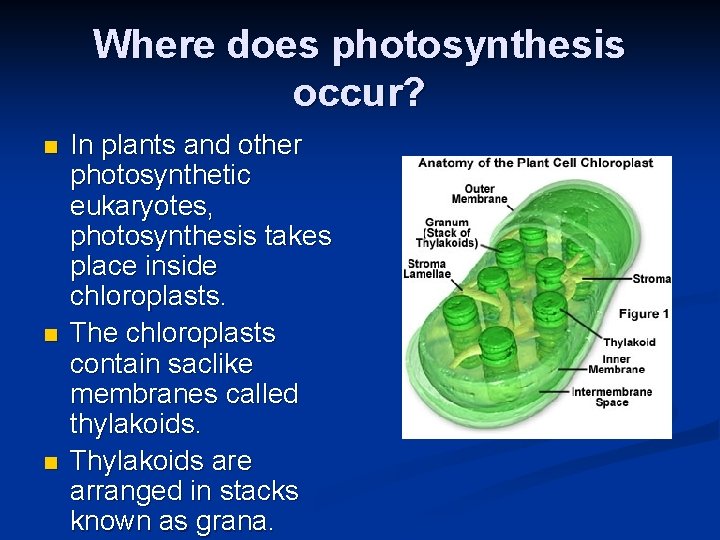
Where does photosynthesis occur? n n n In plants and other photosynthetic eukaryotes, photosynthesis takes place inside chloroplasts. The chloroplasts contain saclike membranes called thylakoids. Thylakoids are arranged in stacks known as grana.
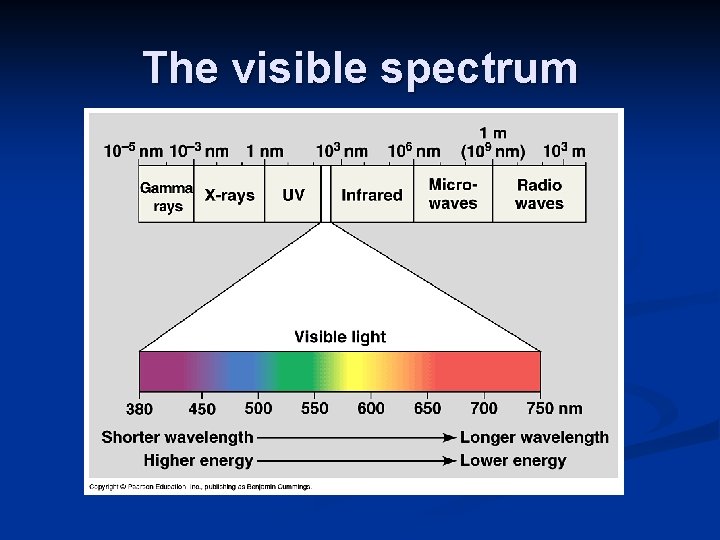
What is the visible spectrum of light and why is it important? The visible spectrum of light is the set of varying wavelengths of light that are visible to our eyes as different colors. n Sunlight is a mixture of different wavelengths of light, even though it appears as “white light” to your eyes. n
The visible spectrum
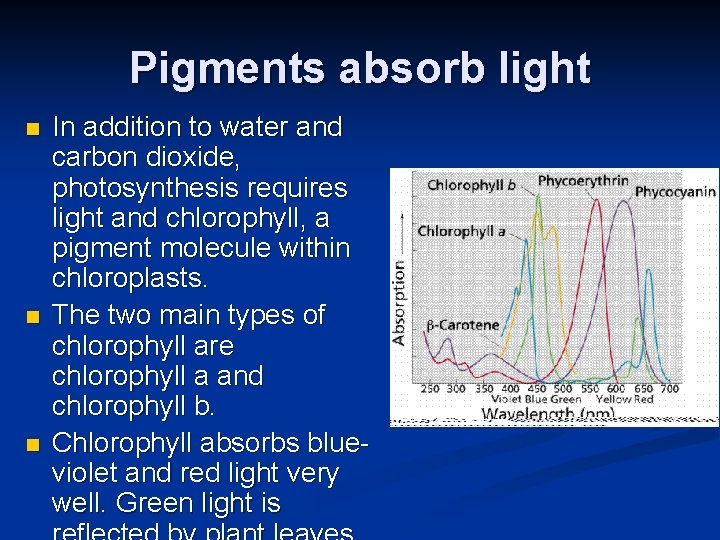
Pigments absorb light n n n In addition to water and carbon dioxide, photosynthesis requires light and chlorophyll, a pigment molecule within chloroplasts. The two main types of chlorophyll are chlorophyll a and chlorophyll b. Chlorophyll absorbs blueviolet and red light very well. Green light is
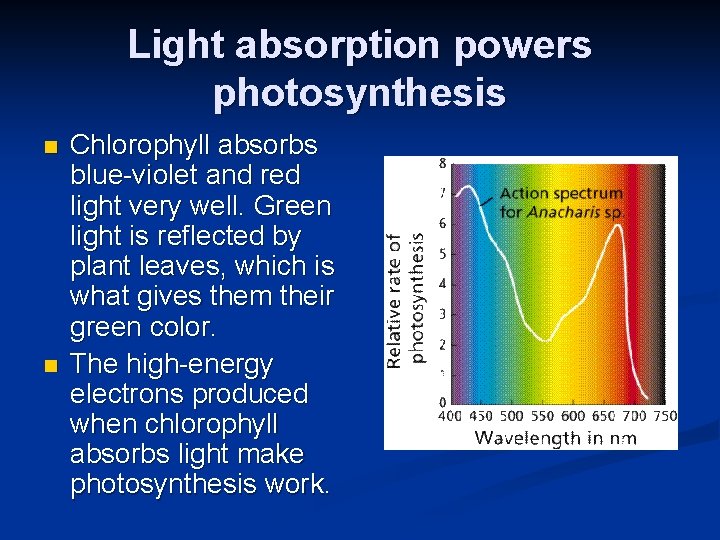
Light absorption powers photosynthesis n n Chlorophyll absorbs blue-violet and red light very well. Green light is reflected by plant leaves, which is what gives them their green color. The high-energy electrons produced when chlorophyll absorbs light make photosynthesis work.
Cellular Respiration
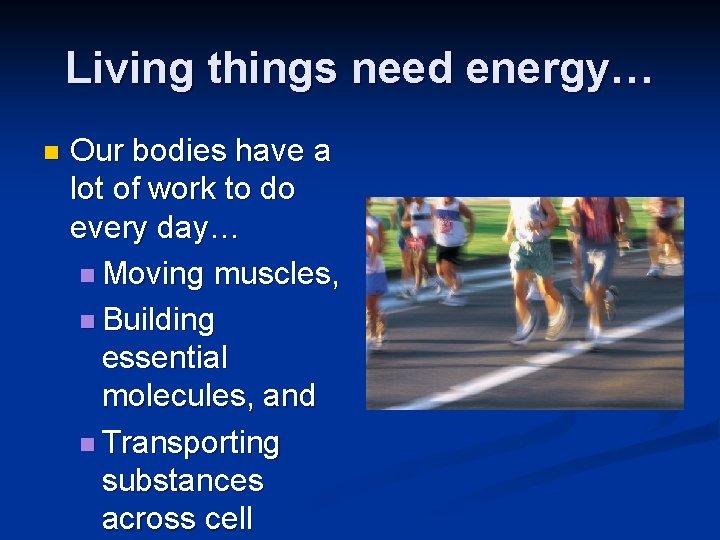
Living things need energy… n Our bodies have a lot of work to do every day… n Moving muscles, n Building essential molecules, and n Transporting substances across cell
Where do we get energy? n Food provides the energy living things need to grow and reproduce. n Food is the source of the material our cells use to build new
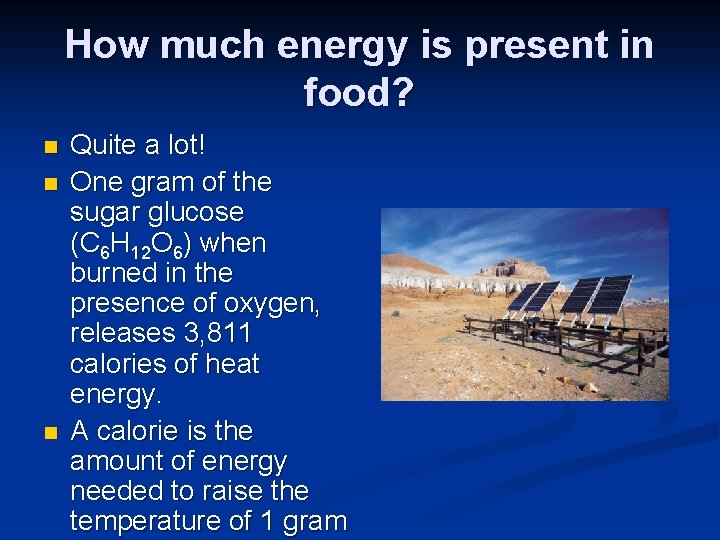
How much energy is present in food? n n n Quite a lot! One gram of the sugar glucose (C 6 H 12 O 6) when burned in the presence of oxygen, releases 3, 811 calories of heat energy. A calorie is the amount of energy needed to raise the temperature of 1 gram
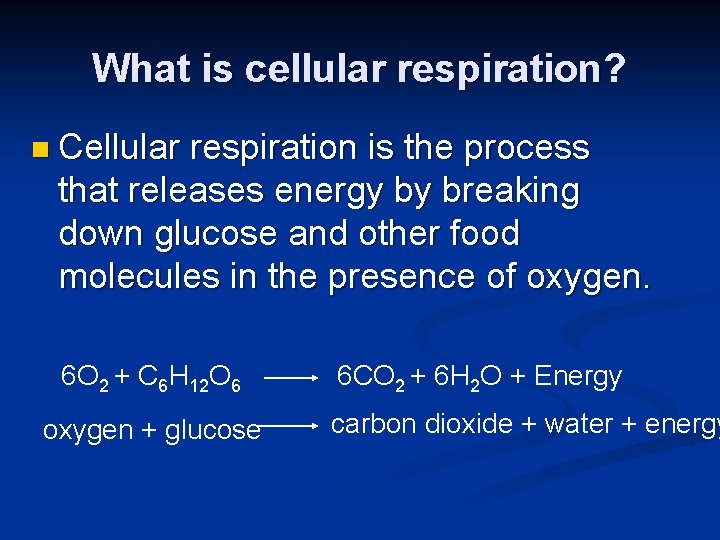
What is cellular respiration? n Cellular respiration is the process that releases energy by breaking down glucose and other food molecules in the presence of oxygen. 6 O 2 + C 6 H 12 O 6 oxygen + glucose 6 CO 2 + 6 H 2 O + Energy carbon dioxide + water + energy
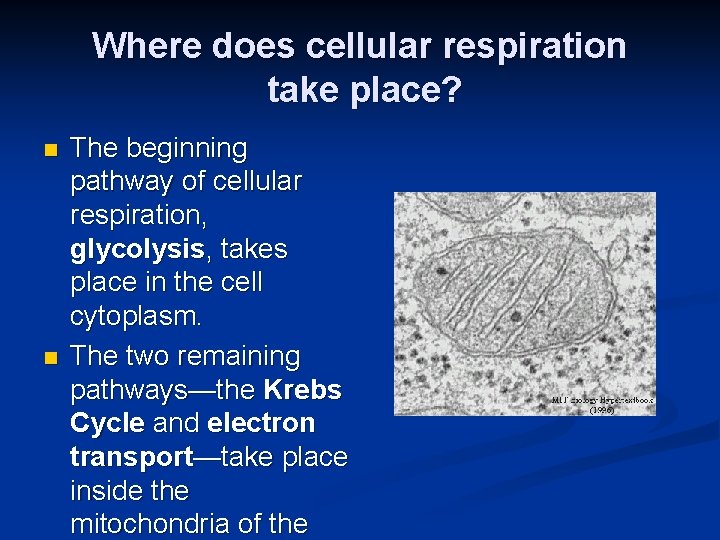
Where does cellular respiration take place? n n The beginning pathway of cellular respiration, glycolysis, takes place in the cell cytoplasm. The two remaining pathways—the Krebs Cycle and electron transport—take place inside the mitochondria of the
What happens if oxygen is not available? n n n Glycolysis is then followed by a different pathway. The combined process of this pathway and glycolysis is called fermentation. Fermentation releases energy from food molecules by producing ATP in the absence of oxygen.