
PHOTOSYNTHESIS An anabolic process in which carbohydrates are
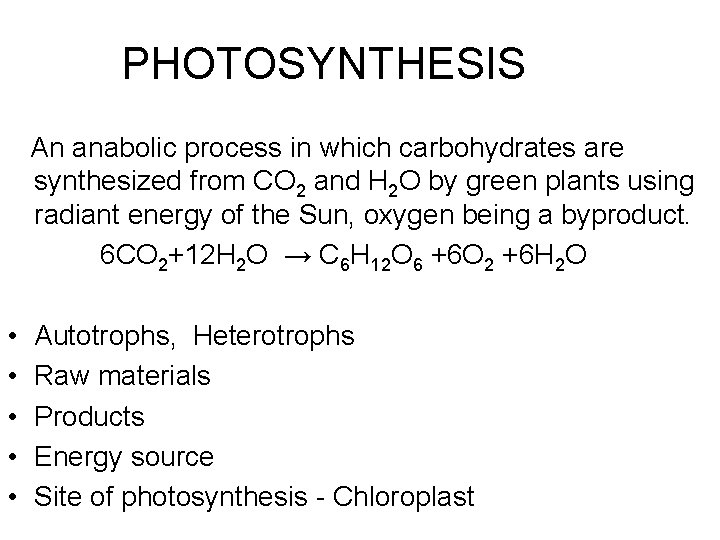
PHOTOSYNTHESIS An anabolic process in which carbohydrates are synthesized from CO 2 and H 2 O by green plants using radiant energy of the Sun, oxygen being a byproduct. 6 CO 2+12 H 2 O → C 6 H 12 O 6 +6 O 2 +6 H 2 O • • • Autotrophs, Heterotrophs Raw materials Products Energy source Site of photosynthesis - Chloroplast

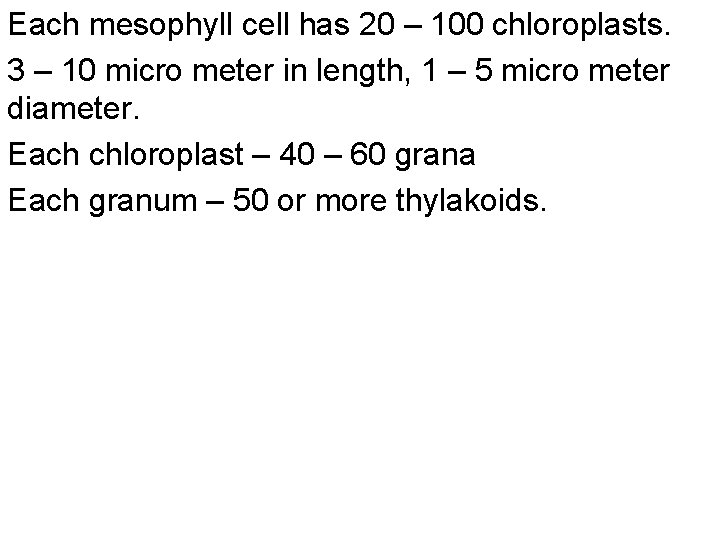
Each mesophyll cell has 20 – 100 chloroplasts. 3 – 10 micro meter in length, 1 – 5 micro meter diameter. Each chloroplast – 40 – 60 grana Each granum – 50 or more thylakoids.
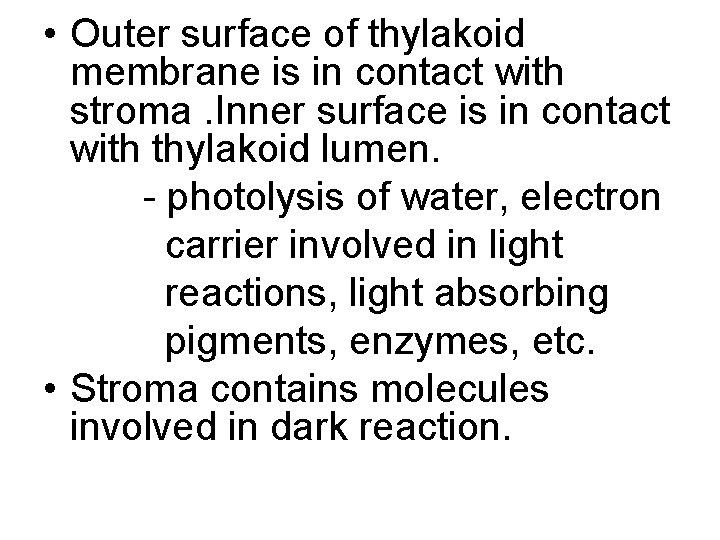
• Outer surface of thylakoid membrane is in contact with stroma. Inner surface is in contact with thylakoid lumen. - photolysis of water, electron carrier involved in light reactions, light absorbing pigments, enzymes, etc. • Stroma contains molecules involved in dark reaction.
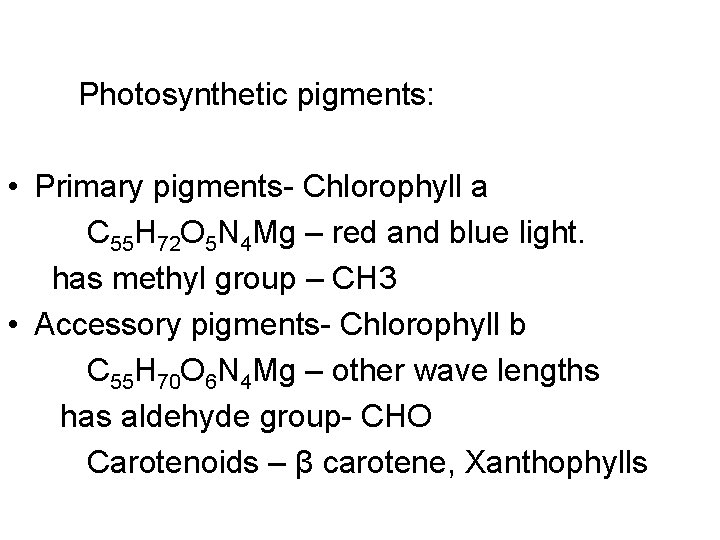
Photosynthetic pigments: • Primary pigments- Chlorophyll a C 55 H 72 O 5 N 4 Mg – red and blue light. has methyl group – CH 3 • Accessory pigments- Chlorophyll b C 55 H 70 O 6 N 4 Mg – other wave lengths has aldehyde group- CHO Carotenoids – β carotene, Xanthophylls

Photosystems - R Emerson in 1957 • Consists of around 200 mol. of chlorophylls and about 50 mol. of Carotenoids. • Consists of photochemical reaction center having chlorophyll a with specific protein. • Other pigment molecules are light harvesting mol. or antenna mol. • A single thylakoid possess hundreds of photosystems.
![• Photosystem I [P 700 ] made of chlorophyll a, b - absorbs](http://slidetodoc.com/presentation_image_h2/674947bfd6618d7ff24fa32d3cac3830/image-7.jpg "• Photosystem I [P 700 ] made of chlorophyll a, b - absorbs")
• Photosystem I [P 700 ] made of chlorophyll a, b - absorbs red light of 700 nm • Photosystem II [P 680 ] responds better to slightly shorter wavelength. • Only reaction centers give up energized electrons. • Water is the source of H to reduce carbon and molecular O 2 is released during photosynthesis.
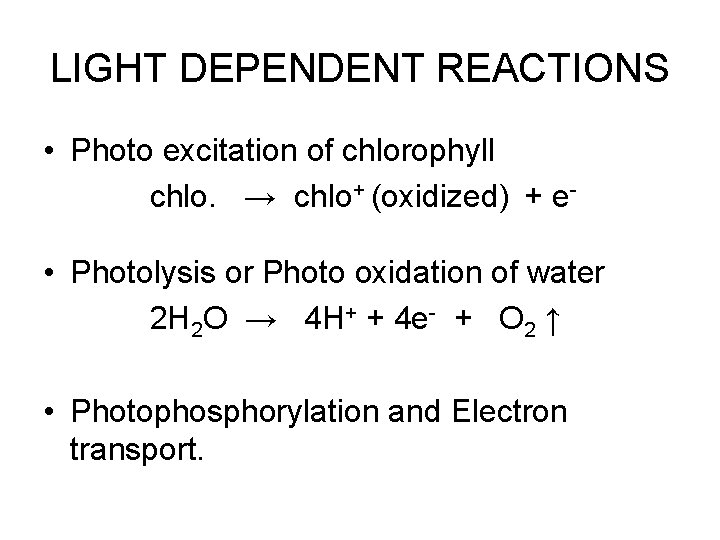
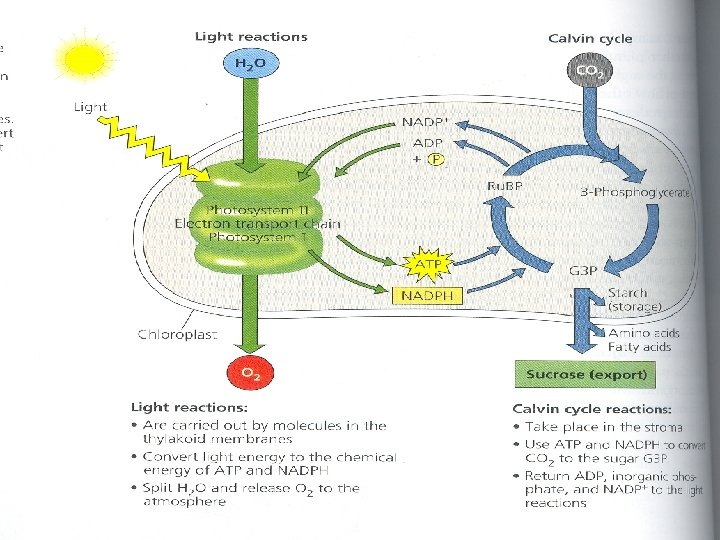
LIGHT DEPENDENT REACTIONS • Photo excitation of chlorophyll chlo. → chlo+ (oxidized) + e • Photolysis or Photo oxidation of water 2 H 2 O → 4 H+ + 4 e- + O 2 ↑ • Photophosphorylation and Electron transport.


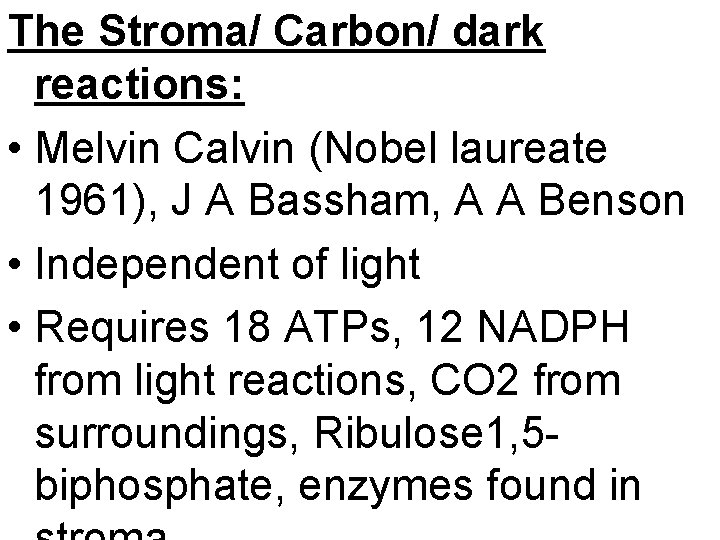
The Stroma/ Carbon/ dark reactions: • Melvin Calvin (Nobel laureate 1961), J A Bassham, A A Benson • Independent of light • Requires 18 ATPs, 12 NADPH from light reactions, CO 2 from surroundings, Ribulose 1, 5 biphosphate, enzymes found in
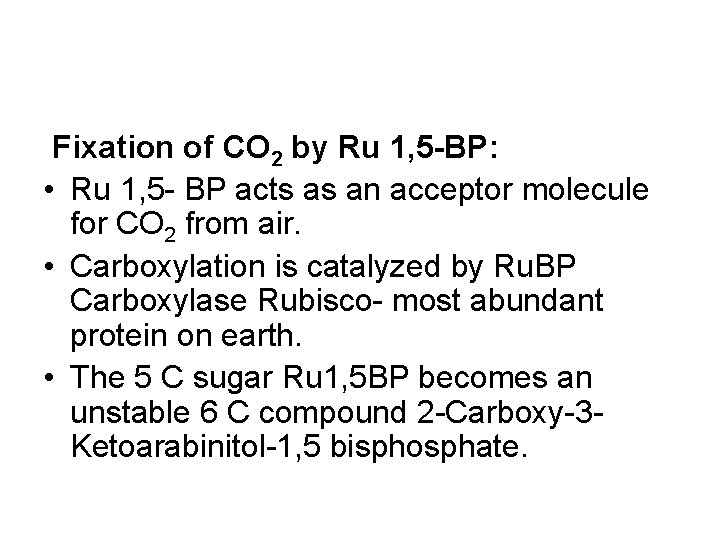
Fixation of CO 2 by Ru 1, 5 -BP: • Ru 1, 5 - BP acts as an acceptor molecule for CO 2 from air. • Carboxylation is catalyzed by Ru. BP Carboxylase Rubisco- most abundant protein on earth. • The 5 C sugar Ru 1, 5 BP becomes an unstable 6 C compound 2 -Carboxy-3 Ketoarabinitol-1, 5 bisphosphate.
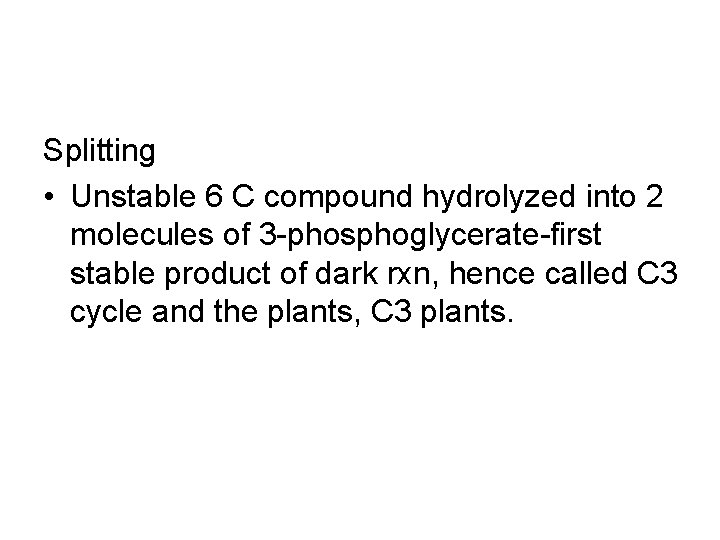
Splitting • Unstable 6 C compound hydrolyzed into 2 molecules of 3 -phosphoglycerate-first stable product of dark rxn, hence called C 3 cycle and the plants, C 3 plants.
Second Phosphorylation : • 3 PGA receives a phosphate group from ATP and becomes 1, 3 - Bisphoglycerate. Reduction : • 1, 3 - Bisphoglycerate accepts Hydrogen from NADPH and gets reduced into energy rich 3 C sugar Glyceraldehyde-3 - Phosphate or Phosphoglyceraldehyde (PGAL). * Reduction of 6 CO 2 forms 12 PGAL in the stroma.
Regeneration of Ru 1, 5 BP : • Out of 12 PGAL , 10 molecules are used in regenerating Ru 1, 5 BP. Uses 6 ATPs and formation of intermediate compounds in the form of 3, 4, 5, 6 and 7 C sugars. * 6 revolutions of the cycle are required to produce the 6 C carbohydrate.
Carbohydrate Synthesis • It occurs in the cytosol • Two molecules of PGAL is transported from stroma to the cytosol by a phosphate translocator – an antiport protein. • It exchanges two PGAL for two molecules of Pi across the chloroplast membrane. • Most Glucose is converted into transport sugar sucrose or storage sugar starch.
C 4 Photosynthesis ( Hatch – Slack Pathway) • MD Hatch and CR Slack – 1966, Mainly in monocots with the first product 4 C molecule oxaloacetate. • C 4 plants exhibit a unique leaf anatomy called Kranz (= ahalo), where there are two rings of cells around a vascular bundle, the inner bundle sheath cells and outer mesophyll cells. • The bundle sheath cells have rudimentary chloroplasts and mesophyll cells well developed chloroplasts – dimorphic.
• C 4 pathway starts in the mesophyll cells where carbon dioxide condenses with 3 C compound phosphoenol pyruvate (PEP). To produce 4 C oxaloacetate, which is reduced to malate. • Malate enters the bundle sheath cells and is decarboxylated into pyruvate and CO 2. • The pyruvate returns to mesophyll cells to form PEP again and repeat the process.
Advantages • C 4 plants have higher affinity for CO 2 and hence the plants can carry out photosynthesis even at low CO 2 concentrations. • Carry out rapid photosynthesis at higher temperatures. • Avoid photorespiration in which CO 2 is released without ATP synthesis.
Crassulacean Acid Metabolism (CAM) • Adaptation seen in succulents • First discovered in the family Crassulaceae. • In these plants the stomata is scotactive – closed during day and open at night. • Water loss is prevented and photorespiration cannot occur. • In the night when stomata opens at cooler temperatures CO 2 is fixed by C 4 pathway.
- Slides: 23