
Photosynthesis 6 2 Reactions of Photosynthesis Photosynthesis Purpose
- Slides: 14
Photosynthesis 6. 2 Reactions of Photosynthesis
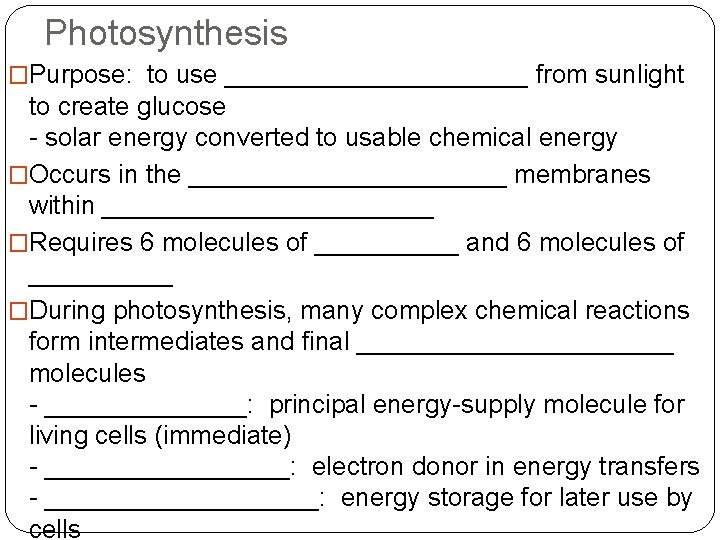
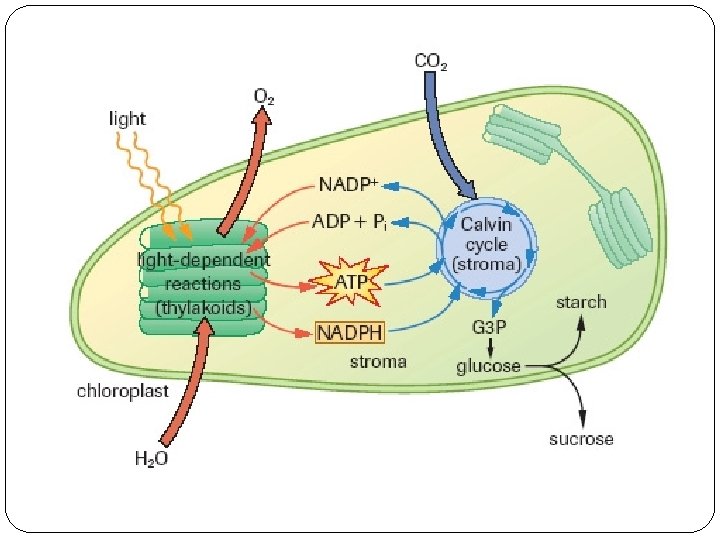
Photosynthesis �Purpose: to use ___________ from sunlight to create glucose - solar energy converted to usable chemical energy �Occurs in the ___________ membranes within ____________ �Requires 6 molecules of _____ and 6 molecules of _____ �During photosynthesis, many complex chemical reactions form intermediates and final ___________ molecules - _______: principal energy-supply molecule for living cells (immediate) - _________: electron donor in energy transfers - __________: energy storage for later use by cells
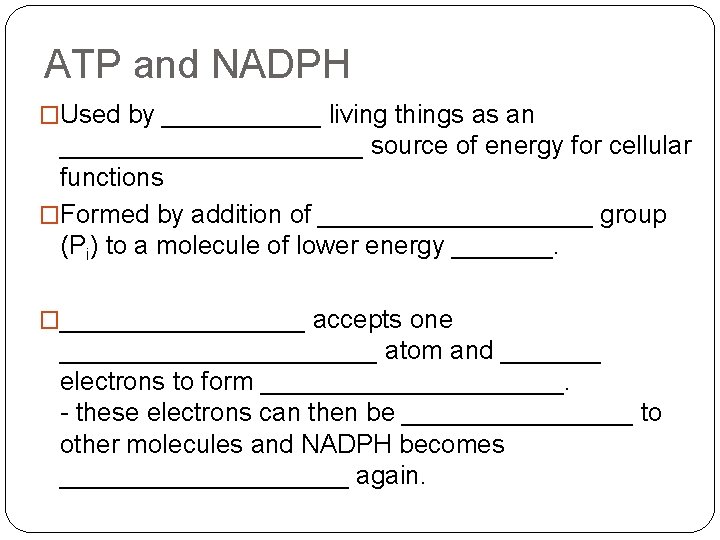
ATP and NADPH �Used by ______ living things as an ___________ source of energy for cellular functions �Formed by addition of __________ group (Pi) to a molecule of lower energy _______. �_________ accepts one ___________ atom and _______ electrons to form ___________. - these electrons can then be ________ to other molecules and NADPH becomes __________ again.
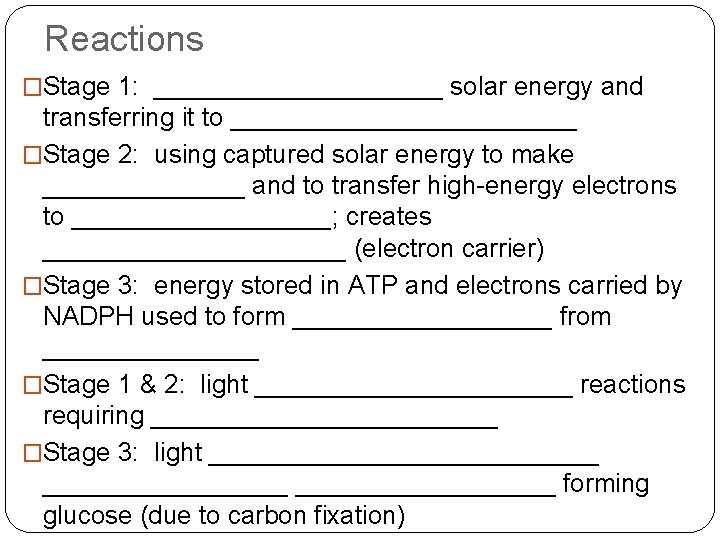
Reactions �Stage 1: __________ solar energy and transferring it to ____________ �Stage 2: using captured solar energy to make _______ and to transfer high-energy electrons to _________; creates ___________ (electron carrier) �Stage 3: energy stored in ATP and electrons carried by NADPH used to form _________ from ________ �Stage 1 & 2: light ___________ reactions requiring ____________ �Stage 3: light __________________ forming glucose (due to carbon fixation)
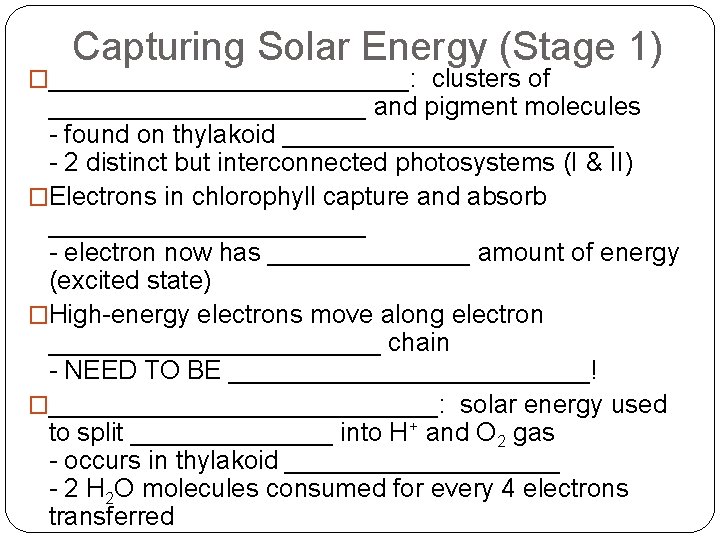
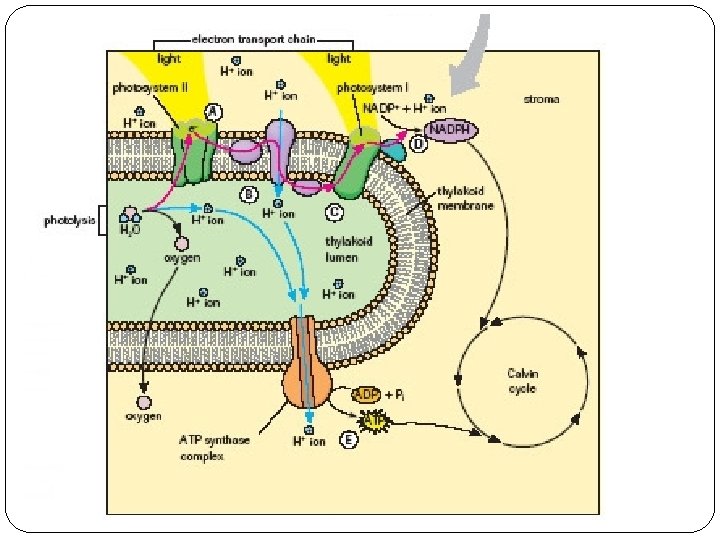
Capturing Solar Energy (Stage 1) �_____________: clusters of ___________ and pigment molecules - found on thylakoid ____________ - 2 distinct but interconnected photosystems (I & II) �Electrons in chlorophyll capture and absorb ___________ - electron now has _______ amount of energy (excited state) �High-energy electrons move along electron ____________ chain - NEED TO BE _____________! �______________: solar energy used to split _______ into H+ and O 2 gas - occurs in thylakoid __________ - 2 H 2 O molecules consumed for every 4 electrons transferred
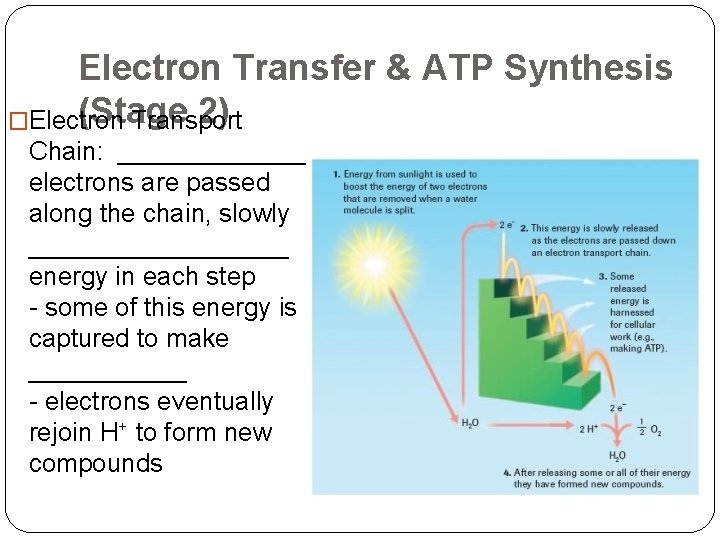
Electron Transfer & ATP Synthesis (Stage 2) �Electron Transport Chain: _______ electrons are passed along the chain, slowly _________ energy in each step - some of this energy is captured to make ______ - electrons eventually rejoin H+ to form new compounds
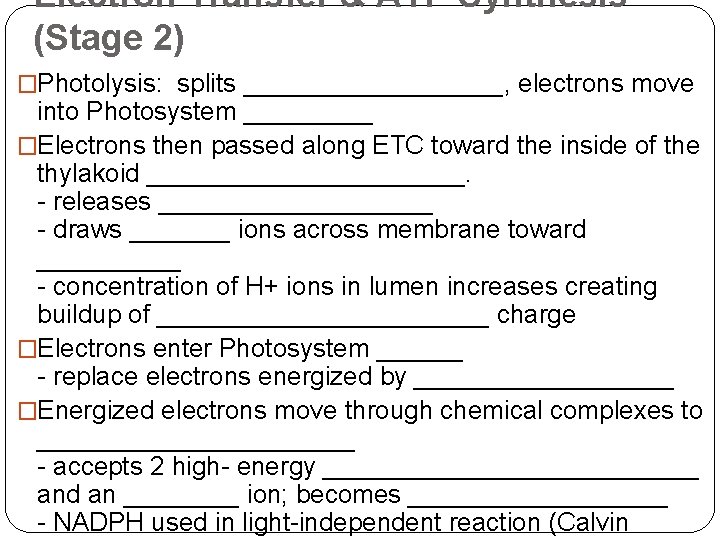
Electron Transfer & ATP Synthesis (Stage 2) �Photolysis: splits _________, electrons move into Photosystem _____ �Electrons then passed along ETC toward the inside of the thylakoid ___________. - releases __________ - draws _______ ions across membrane toward _____ - concentration of H+ ions in lumen increases creating buildup of ____________ charge �Electrons enter Photosystem ______ - replace electrons energized by _________ �Energized electrons move through chemical complexes to ___________ - accepts 2 high- energy _____________ and an ____ ion; becomes _________ - NADPH used in light-independent reaction (Calvin
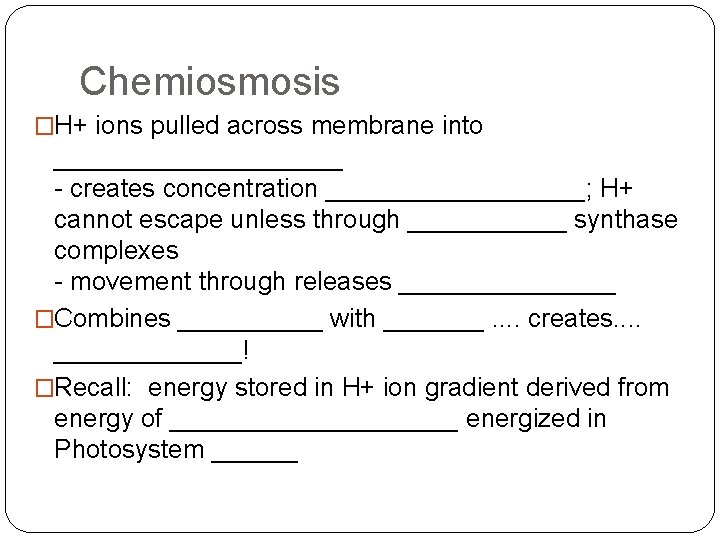
Chemiosmosis �H+ ions pulled across membrane into __________ - creates concentration _________; H+ cannot escape unless through ______ synthase complexes - movement through releases ________ �Combines _____ with _______. . creates. . _______! �Recall: energy stored in H+ ion gradient derived from energy of __________ energized in Photosystem ______
Review Stage 2 Light-dependent reactions: � � �
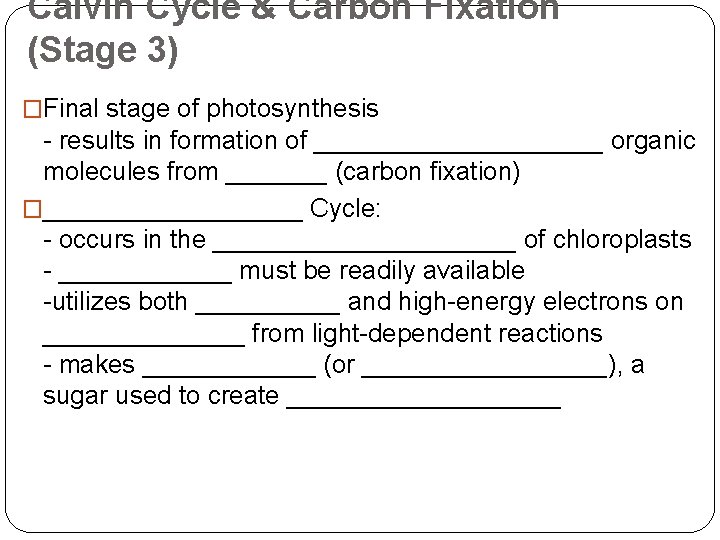
Calvin Cycle & Carbon Fixation (Stage 3) �Final stage of photosynthesis - results in formation of __________ organic molecules from _______ (carbon fixation) �_________ Cycle: - occurs in the ___________ of chloroplasts - ______ must be readily available -utilizes both _____ and high-energy electrons on _______ from light-dependent reactions - makes ______ (or _________), a sugar used to create __________
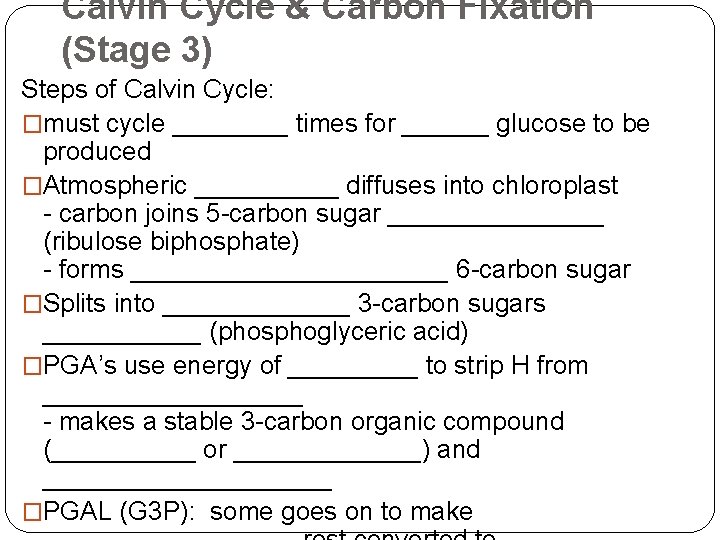
Calvin Cycle & Carbon Fixation (Stage 3) Steps of Calvin Cycle: �must cycle ____ times for ______ glucose to be produced �Atmospheric _____ diffuses into chloroplast - carbon joins 5 -carbon sugar ________ (ribulose biphosphate) - forms ___________ 6 -carbon sugar �Splits into _______ 3 -carbon sugars ______ (phosphoglyceric acid) �PGA’s use energy of _____ to strip H from _________ - makes a stable 3 -carbon organic compound (_____ or _______) and __________ �PGAL (G 3 P): some goes on to make
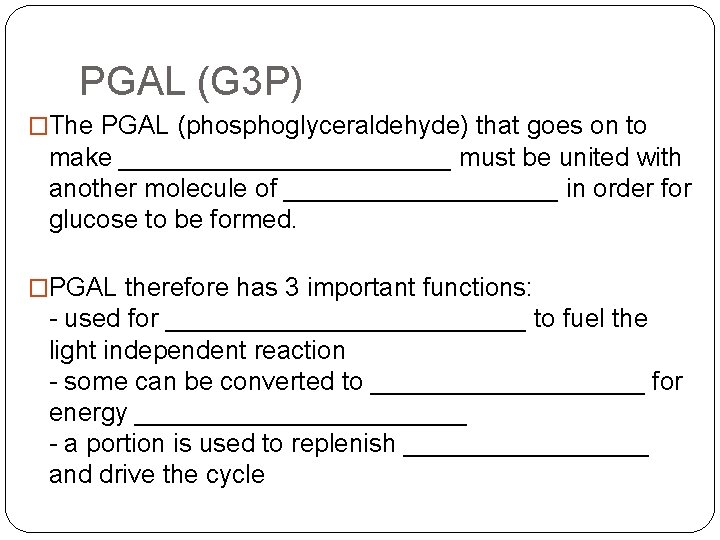
PGAL (G 3 P) �The PGAL (phosphoglyceraldehyde) that goes on to make ____________ must be united with another molecule of __________ in order for glucose to be formed. �PGAL therefore has 3 important functions: - used for _____________ to fuel the light independent reaction - some can be converted to __________ for energy ____________ - a portion is used to replenish _________ and drive the cycle