
PHOTOSTORY CONTEST on Sustainable Development Orientation Workshop Phearanich
PHOTO-STORY CONTEST on Sustainable Development Orientation Workshop Phearanich Hing, Climate Change Policy Analyst 13 July 2012

Outlines Background Sustainable Development (SD) definition Key events Cambodia and Sustainable development Rio+20 Conference on SD and Cambodia National Report on Rio+20 • Key themes for Photo-Story Contest • • •
Background • 1972: SD in a book on UN Stockholm Conference on the Human Environment • 1980: Report on World Conservation Strategy —Living Resources Conservation for SD by IUCN, WWF & UNEP • 1987: the Brundlandt’s report “OUR COMMON FUTURE”

Definition Humanity has the ability to make development sustainable – to ensure that it meets the needs of the present without compromising the ability of future generation to meet their own needs

Key events • 1992 United Nations Conference on Environment and Development (UNCED) in Rio de Janeiro • 2002 World Summit on Sustainable Development (WSSD) in Johannesburg • 2012 Rio+20 Conference on Sustainable Development
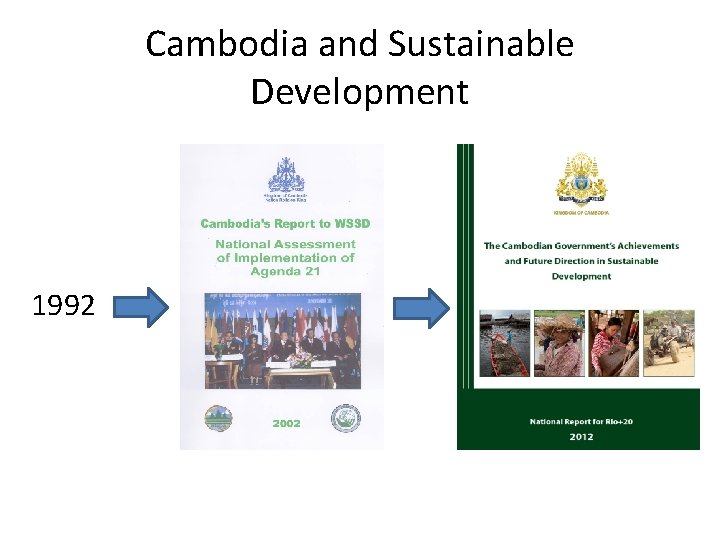
Cambodia and Sustainable Development 1992
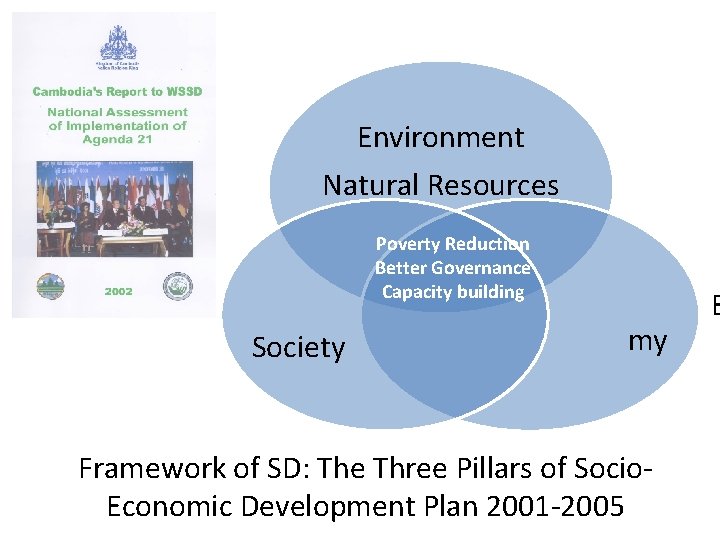
Environment Natural Resources Poverty Reduction Better Governance Capacity building Society my Framework of SD: The Three Pillars of Socio. Economic Development Plan 2001 -2005 E
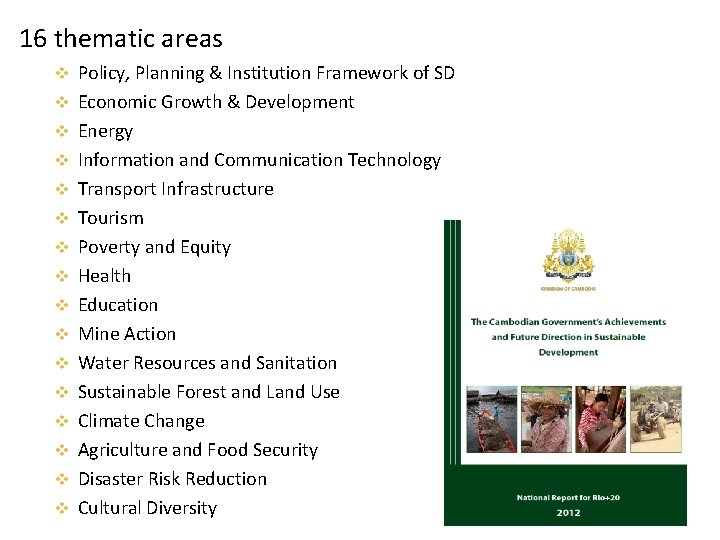
16 thematic areas v v v v Policy, Planning & Institution Framework of SD Economic Growth & Development Energy Information and Communication Technology Transport Infrastructure Tourism Poverty and Equity Health Education Mine Action Water Resources and Sanitation Sustainable Forest and Land Use Climate Change Agriculture and Food Security Disaster Risk Reduction Cultural Diversity
Key themes for Photo-Story Contest • • • Agriculture Climate Change Water Resource and Sanitation Tourism Sustainable Forest and Land Use Economic Grow and Development
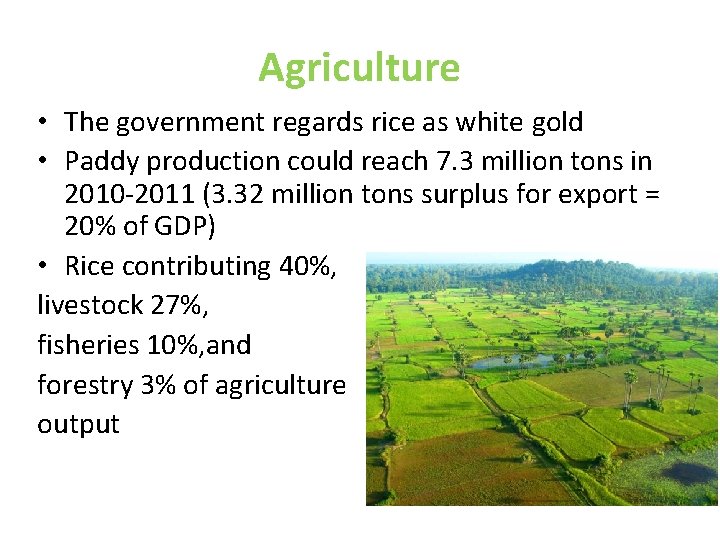
Agriculture • The government regards rice as white gold • Paddy production could reach 7. 3 million tons in 2010 -2011 (3. 32 million tons surplus for export = 20% of GDP) • Rice contributing 40%, livestock 27%, fisheries 10%, and forestry 3% of agriculture output
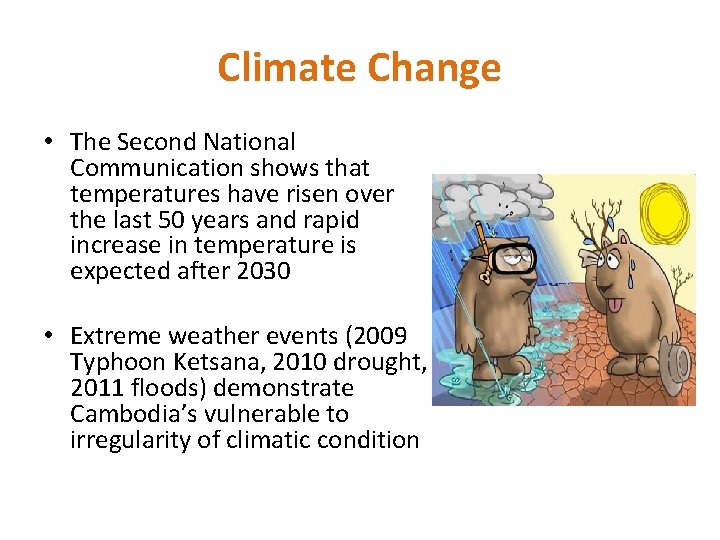
Climate Change • The Second National Communication shows that temperatures have risen over the last 50 years and rapid increase in temperature is expected after 2030 • Extreme weather events (2009 Typhoon Ketsana, 2010 drought, 2011 floods) demonstrate Cambodia’s vulnerable to irregularity of climatic condition
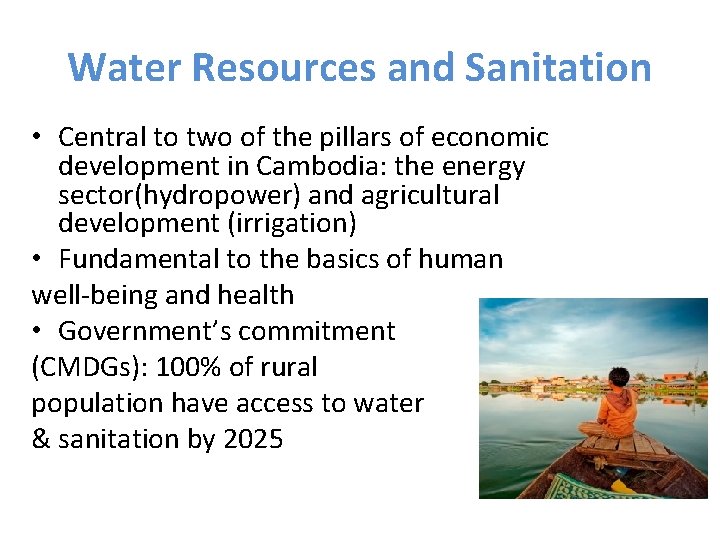
Water Resources and Sanitation • Central to two of the pillars of economic development in Cambodia: the energy sector(hydropower) and agricultural development (irrigation) • Fundamental to the basics of human well-being and health • Government’s commitment (CMDGs): 100% of rural population have access to water & sanitation by 2025
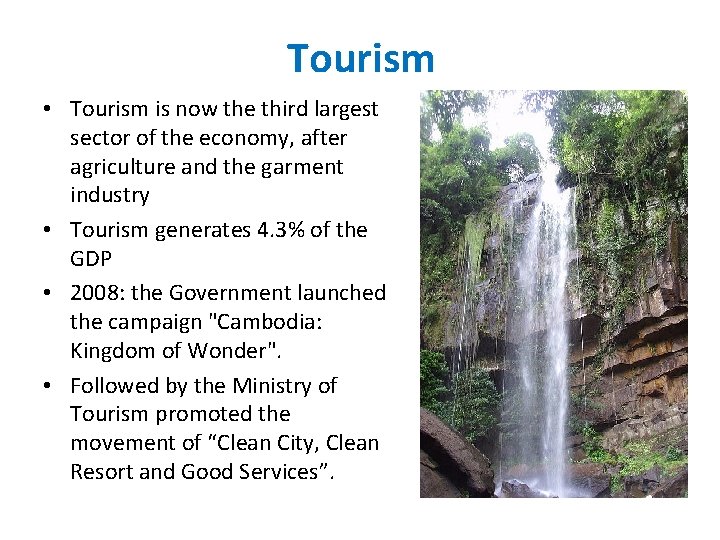
Tourism • Tourism is now the third largest sector of the economy, after agriculture and the garment industry • Tourism generates 4. 3% of the GDP • 2008: the Government launched the campaign "Cambodia: Kingdom of Wonder". • Followed by the Ministry of Tourism promoted the movement of “Clean City, Clean Resort and Good Services”.
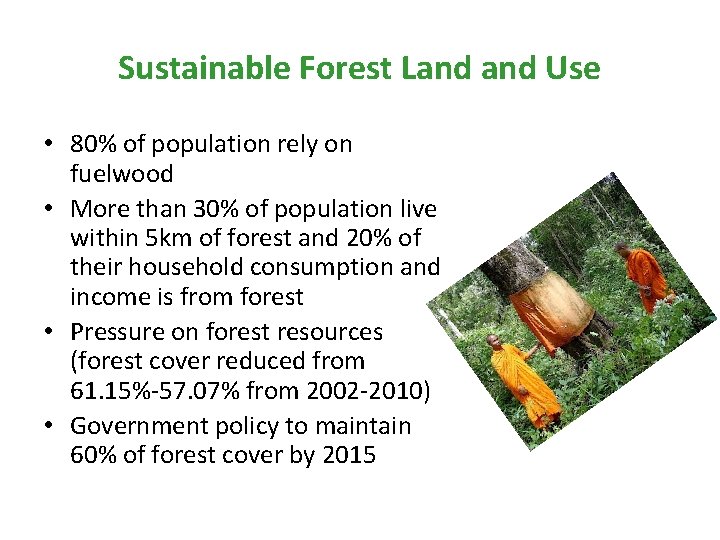
Sustainable Forest Land Use • 80% of population rely on fuelwood • More than 30% of population live within 5 km of forest and 20% of their household consumption and income is from forest • Pressure on forest resources (forest cover reduced from 61. 15%-57. 07% from 2002 -2010) • Government policy to maintain 60% of forest cover by 2015
Economic Growth and Development • From 1994 -2011 experienced average growth rate 7. 7% • The Cambodian economy is based upon four main pillars of growth: agriculture, industry (garments), tourism and construction • Niche sectors: garments and tourism • Abundant land agricultural resources
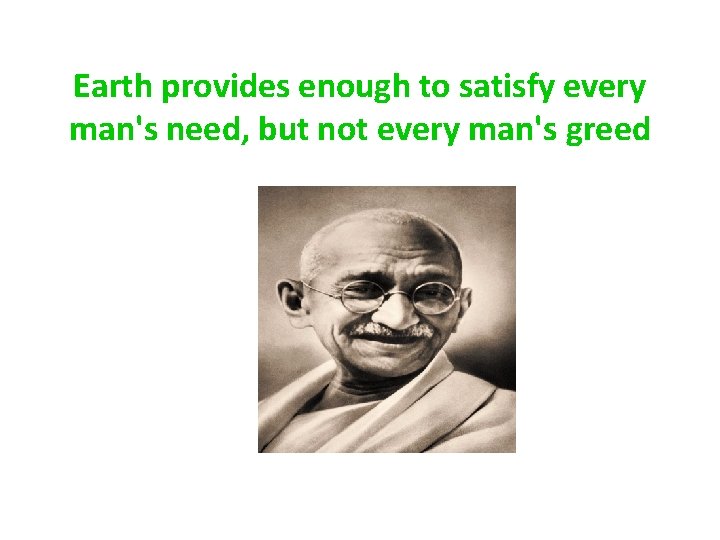
Earth provides enough to satisfy every man's need, but not every man's greed
- Slides: 16