
Photos placed in horizontal position with even amount


- Slides: 94
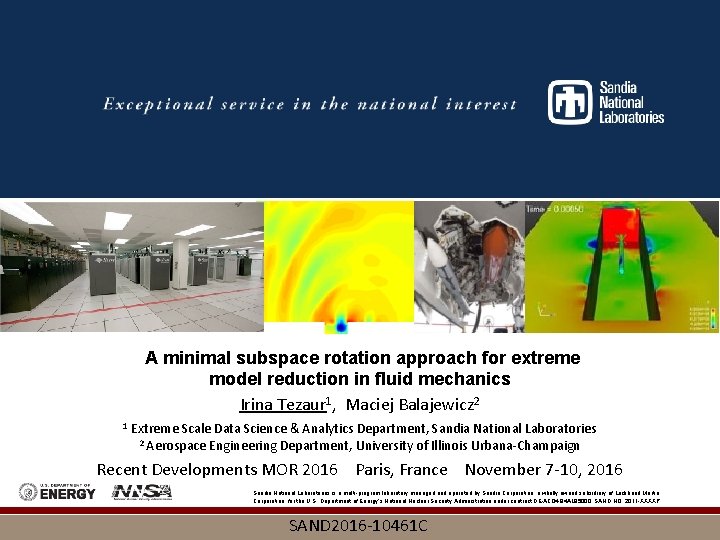
Photos placed in horizontal position with even amount of white space between photos and header A minimal subspace rotation approach for extreme model reduction in fluid mechanics Irina Tezaur 1, Maciej Balajewicz 2 1 Extreme Scale Data Science & Analytics Department, Sandia National Laboratories 2 Aerospace Engineering Department, University of Illinois Urbana-Champaign Recent Developments MOR 2016 Paris, France November 7 -10, 2016 Sandia National Laboratories is a multi-program laboratory managed and operated by Sandia Corporation, a wholly owned subsidiary of Lockheed Martin Corporation, for the U. S. Department of Energy’s National Nuclear Security Administration under contract DE-AC 04 -94 AL 85000. SAND NO. 2011 -XXXXP SAND 2016 -10461 C
Outline 1. Introduction • Targeted application • POD/Galerkin approach to MOR • Extreme model reduction • Mode truncation instability in MOR 2. Accounting for modal truncation • Traditional linear eddy-viscosity approach • New proposed approach via subspace rotation 3. Applications • Low Reynolds (Re) number channel driven cavity • Moderate Reynolds (Re) number channel driven cavity 4. Extension to Least-Squares Petrov-Galerkin (LSPG) ROMs 5. Summary & future work
Outline 1. Introduction • Targeted application • POD/Galerkin approach to MOR • Extreme model reduction • Mode truncation instability in MOR 2. Accounting for modal truncation • Traditional linear eddy-viscosity approach • New proposed approach via subspace rotation 3. Applications • Low Reynolds (Re) number channel driven cavity • Moderate Reynolds (Re) number channel driven cavity 4. Extension to Least-Squares Petrov-Galerkin (LSPG) ROMs 5. Summary & future work
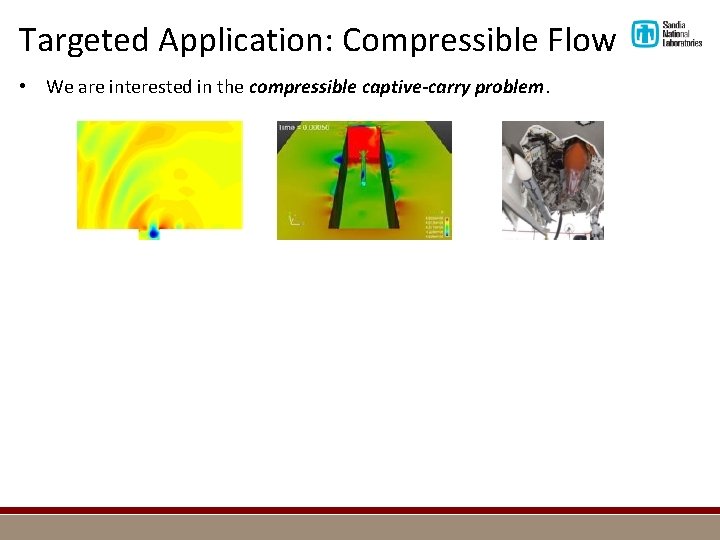
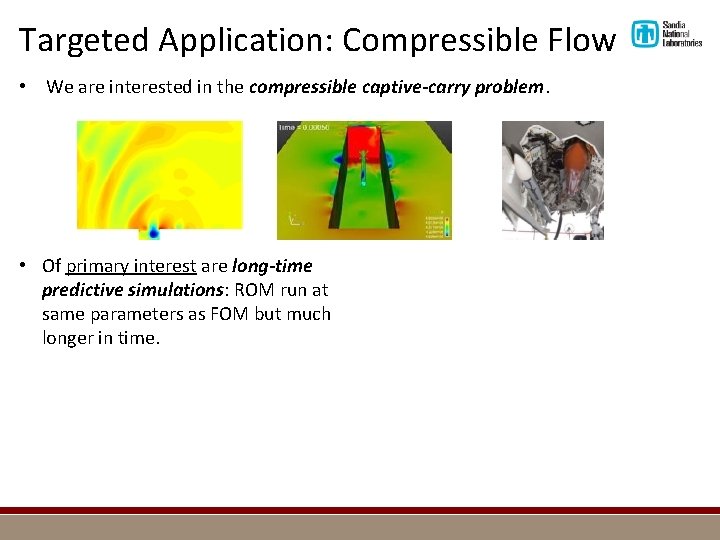
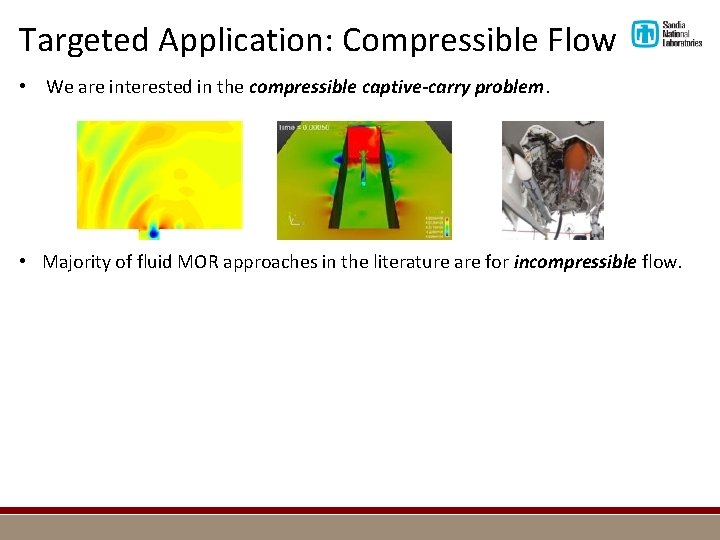
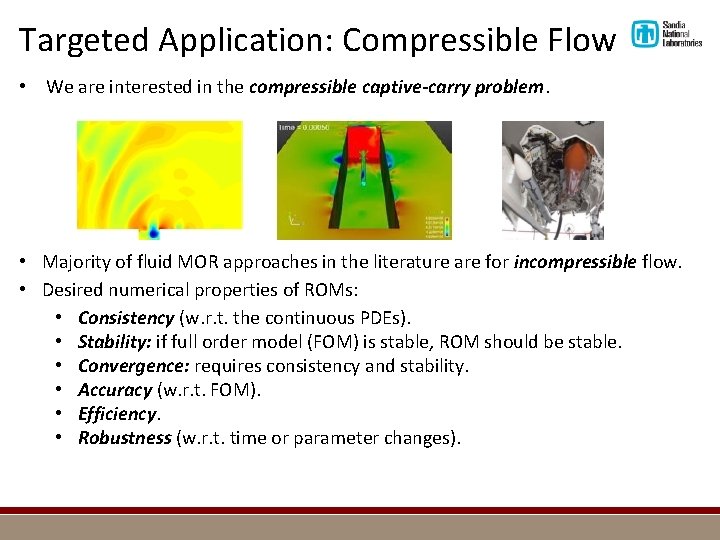
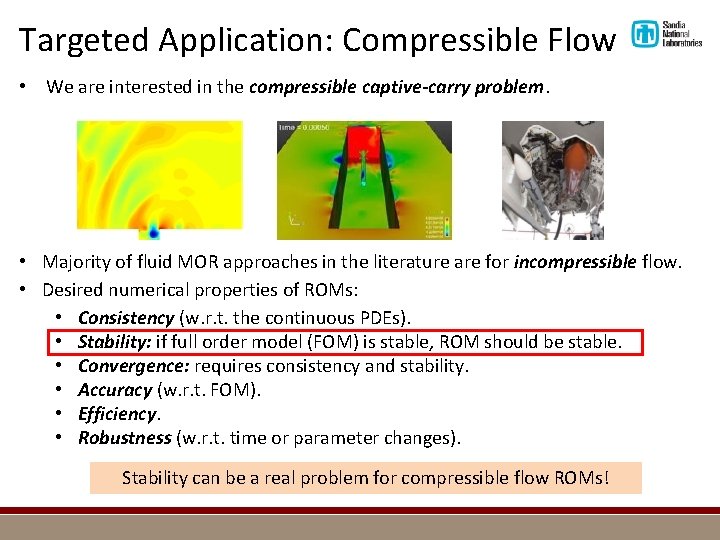
Targeted Application: Compressible Flow • We are interested in the compressible captive-carry problem.
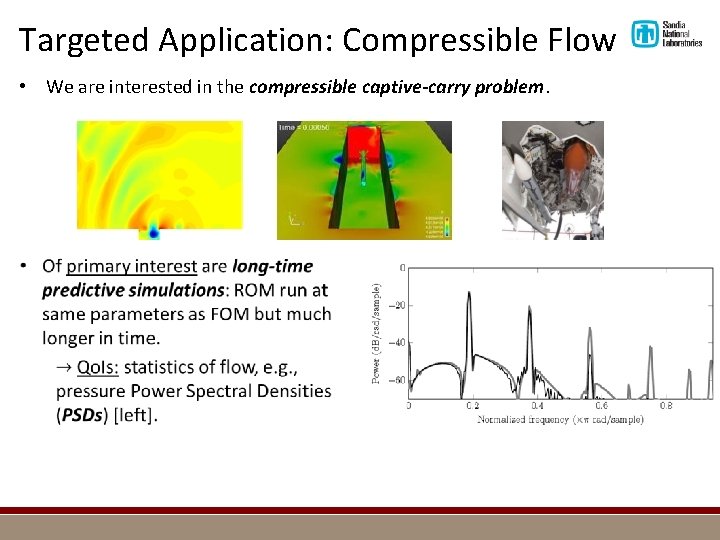
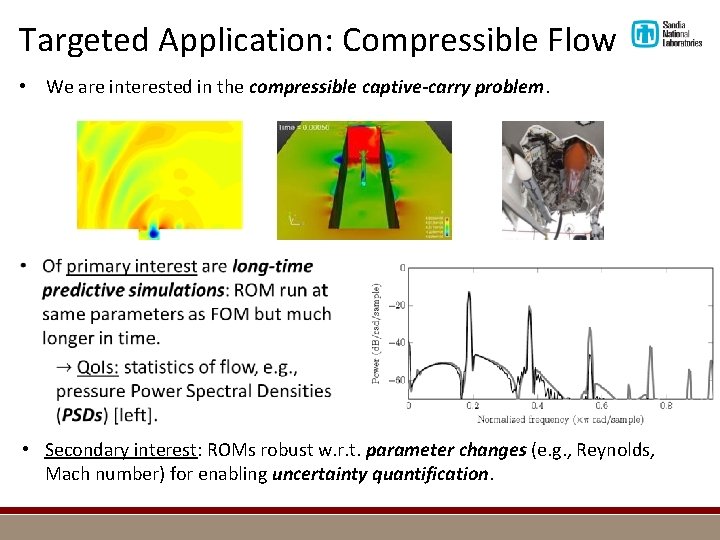
Targeted Application: Compressible Flow • We are interested in the compressible captive-carry problem. • Of primary interest are long-time predictive simulations: ROM run at same parameters as FOM but much longer in time.
Targeted Application: Compressible Flow • We are interested in the compressible captive-carry problem.
Targeted Application: Compressible Flow • We are interested in the compressible captive-carry problem. • Secondary interest: ROMs robust w. r. t. parameter changes (e. g. , Reynolds, Mach number) for enabling uncertainty quantification.
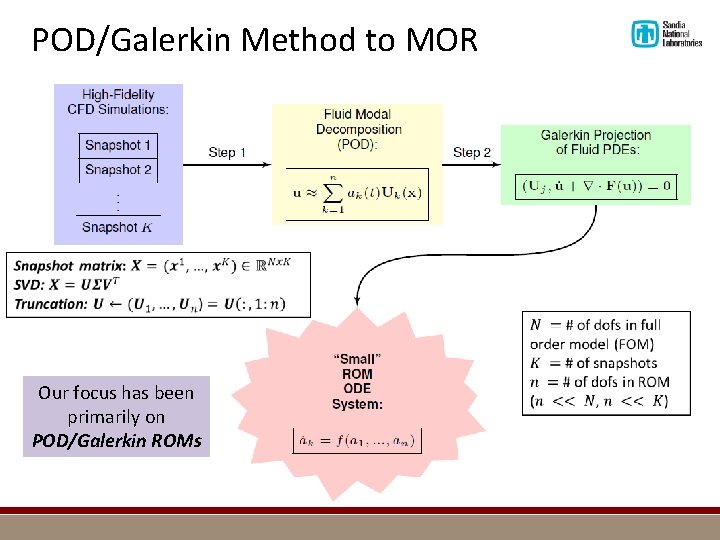
POD/Galerkin Method to MOR Our focus has been primarily on POD/Galerkin ROMs
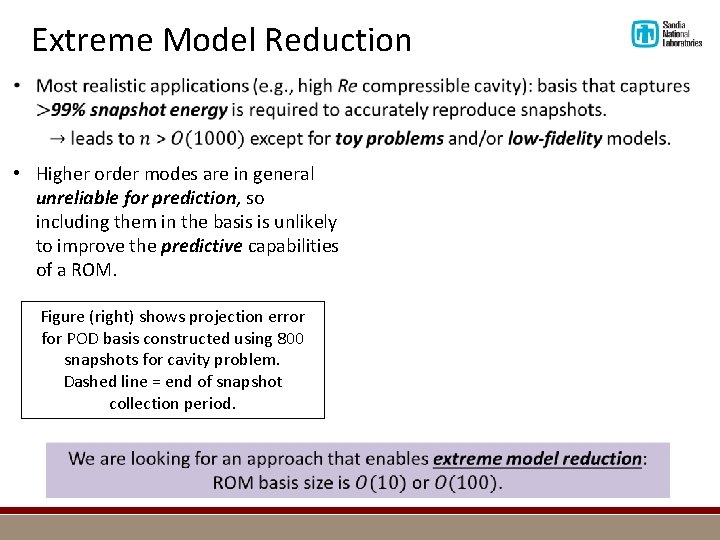
Extreme Model Reduction • Higher order modes are in general unreliable for prediction, so including them in the basis is unlikely to improve the predictive capabilities of a ROM. Figure (right) shows projection error for POD basis constructed using 800 snapshots for cavity problem. Dashed line = end of snapshot collection period.
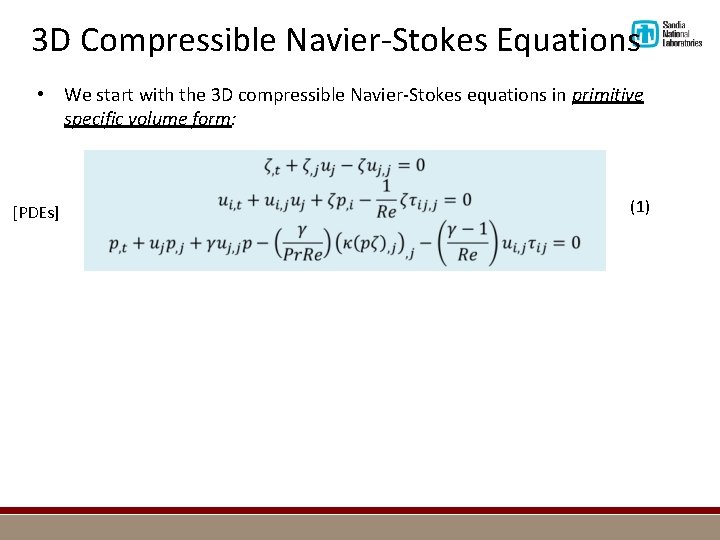
3 D Compressible Navier-Stokes Equations • We start with the 3 D compressible Navier-Stokes equations in primitive specific volume form: [PDEs] (1)
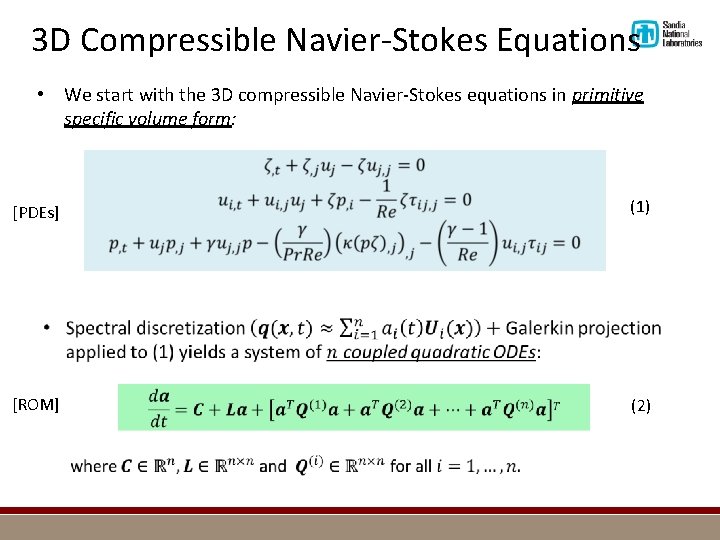
3 D Compressible Navier-Stokes Equations • We start with the 3 D compressible Navier-Stokes equations in primitive specific volume form: (1) [PDEs] [ROM] (2)
ROM Instability Problem Stability can be a real problem for compressible flow ROMs!
ROM Instability Problem Stability can be a real problem for compressible flow ROMs! • A compressible fluid POD/Galerkin ROM might be stable for a given number of modes, but unstable for other choices of basis size (Bui-Tanh et al. 2007).
ROM Instability Problem Stability can be a real problem for compressible flow ROMs! • A compressible fluid POD/Galerkin ROM might be stable for a given number of modes, but unstable for other choices of basis size (Bui-Tanh et al. 2007). • Instability can be due to:
ROM Instability Problem Stability can be a real problem for compressible flow ROMs! • A compressible fluid POD/Galerkin ROM might be stable for a given number of modes, but unstable for other choices of basis size (Bui-Tanh et al. 2007). • Instability can be due to: 1. Choice of inner product: Galerkin projection + L 2 inner product is unstable.
ROM Instability Problem Stability can be a real problem for compressible flow ROMs!
ROM Instability Problem Stability can be a real problem for compressible flow ROMs!
ROM Instability Problem Stability can be a real problem for compressible flow ROMs!
ROM Instability Problem Stability can be a real problem for compressible flow ROMs! This talk focuses on remedying “mode truncation instability” problem for projection-based (POD/Galerkin) compressible flow ROMs.
Mode Truncation Instability • Projection-based MOR necessitates truncation.
Mode Truncation Instability • Projection-based MOR necessitates truncation. • POD is, by definition and design, biased towards the large, energy producing scales of the flow (i. e. , modes with large POD eigenvalues).
Mode Truncation Instability • Projection-based MOR necessitates truncation. • POD is, by definition and design, biased towards the large, energy producing scales of the flow (i. e. , modes with large POD eigenvalues). • Truncated/unresolved modes are negligible from a data compression point of view (i. e. , small POD eigenvalues) but are crucial for the dynamical equations.
Mode Truncation Instability • Projection-based MOR necessitates truncation. • POD is, by definition and design, biased towards the large, energy producing scales of the flow (i. e. , modes with large POD eigenvalues). • Truncated/unresolved modes are negligible from a data compression point of view (i. e. , small POD eigenvalues) but are crucial for the dynamical equations. • For fluid flow applications, higher-order modes are associated with energy dissipation
Mode Truncation Instability • Projection-based MOR necessitates truncation. • POD is, by definition and design, biased towards the large, energy producing scales of the flow (i. e. , modes with large POD eigenvalues). • Truncated/unresolved modes are negligible from a data compression point of view (i. e. , small POD eigenvalues) but are crucial for the dynamical equations. • For fluid flow applications, higher-order modes are associated with energy dissipation
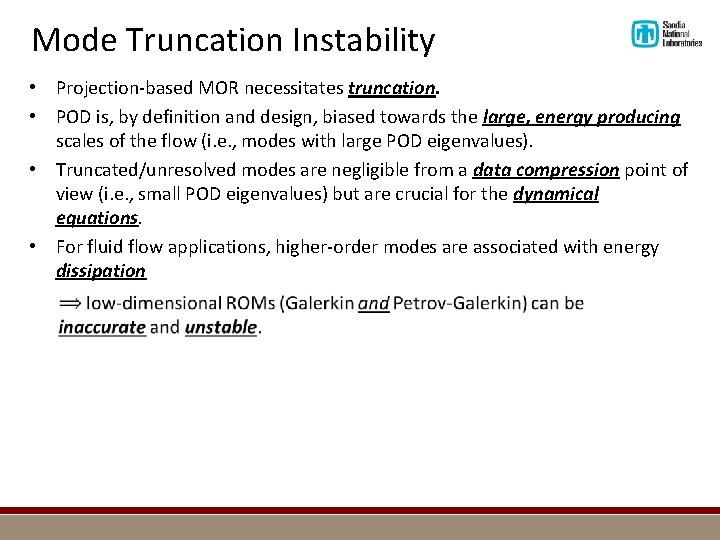
Mode Truncation Instability • Projection-based MOR necessitates truncation. • POD is, by definition and design, biased towards the large, energy producing scales of the flow (i. e. , modes with large POD eigenvalues). • Truncated/unresolved modes are negligible from a data compression point of view (i. e. , small POD eigenvalues) but are crucial for the dynamical equations. • For fluid flow applications, higher-order modes are associated with energy dissipation For a low-dimensional ROM to be stable and accurate, the truncated/unresolved subspace must be accounted for.
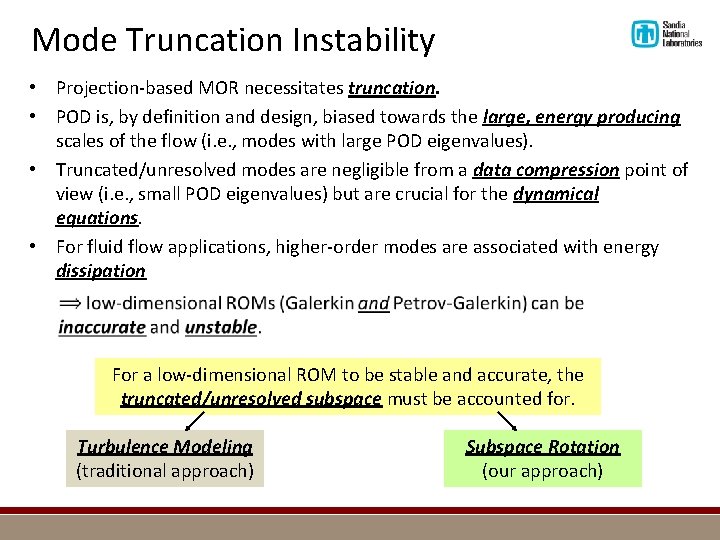
Mode Truncation Instability • Projection-based MOR necessitates truncation. • POD is, by definition and design, biased towards the large, energy producing scales of the flow (i. e. , modes with large POD eigenvalues). • Truncated/unresolved modes are negligible from a data compression point of view (i. e. , small POD eigenvalues) but are crucial for the dynamical equations. • For fluid flow applications, higher-order modes are associated with energy dissipation For a low-dimensional ROM to be stable and accurate, the truncated/unresolved subspace must be accounted for. Turbulence Modeling (traditional approach) Subspace Rotation (our approach)
Outline 1. Introduction • Targeted application • POD/Galerkin approach to MOR • Extreme model reduction • Mode truncation instability in MOR 2. Accounting for modal truncation • Traditional linear eddy-viscosity approach • New proposed approach via subspace rotation 3. Applications • Low Reynolds (Re) number channel driven cavity • Moderate Reynolds (Re) number channel driven cavity 4. Extension to Least-Squares Petrov-Galerkin (LSPG) ROMs 5. Summary & future work
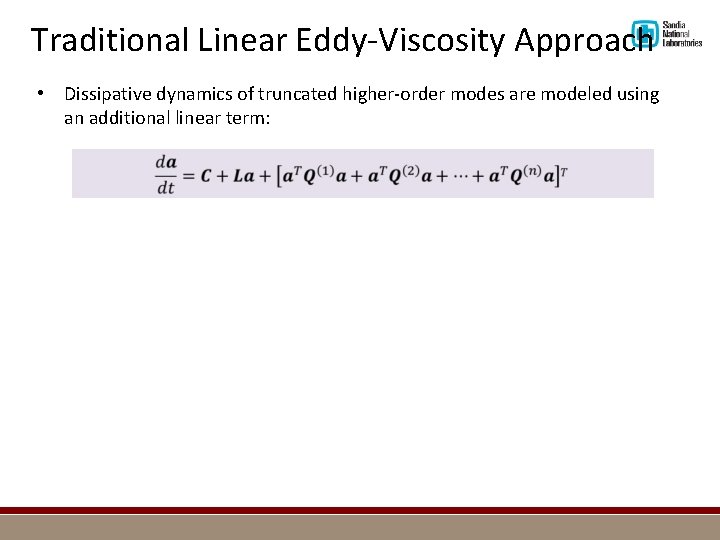
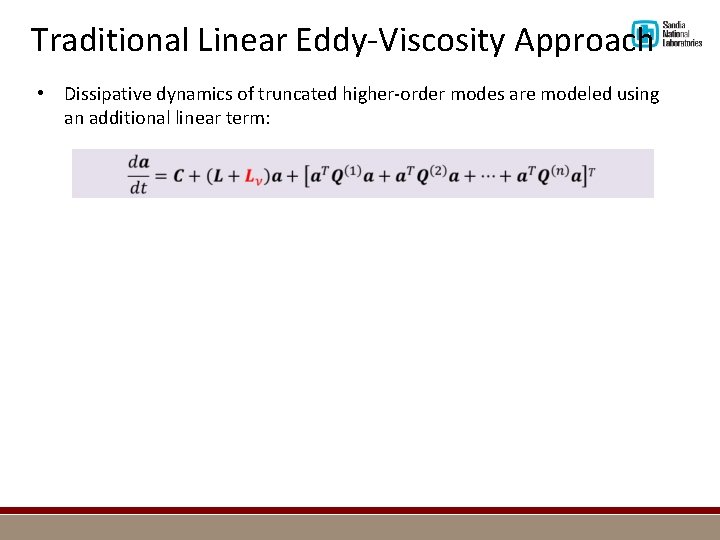
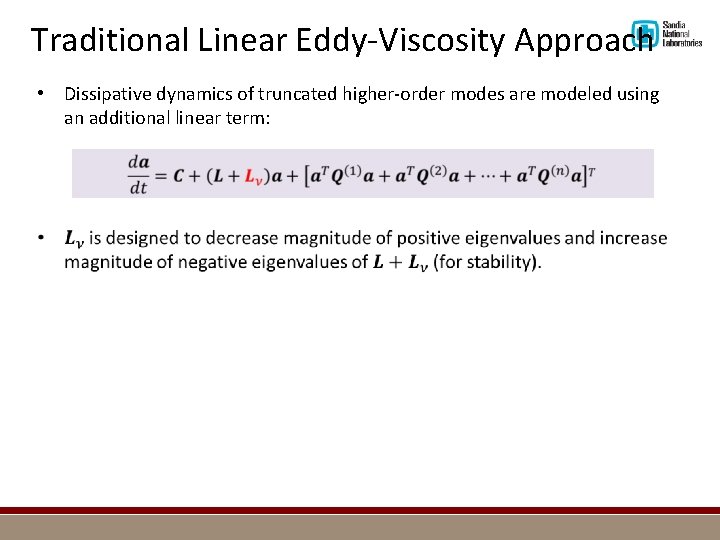
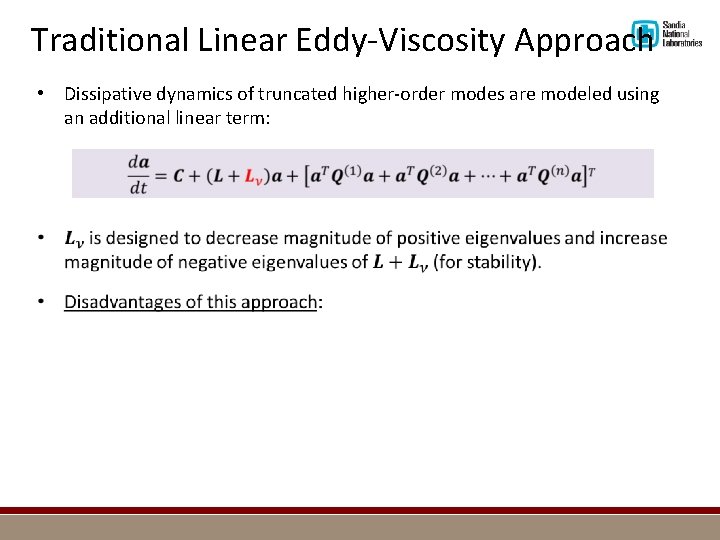
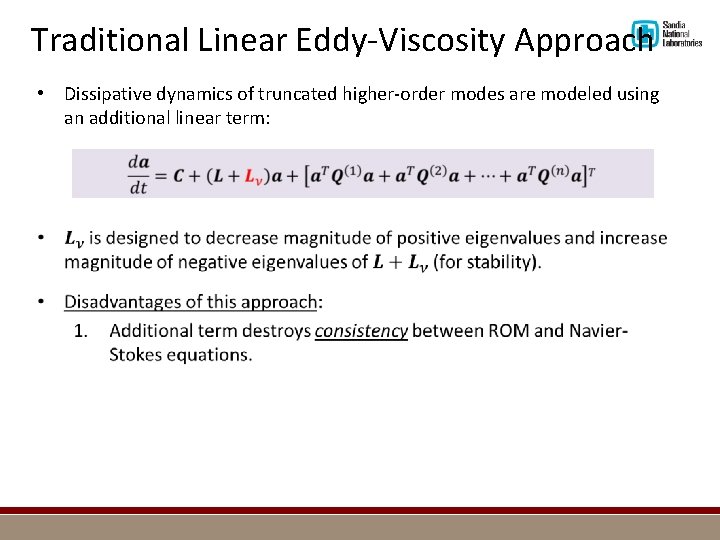
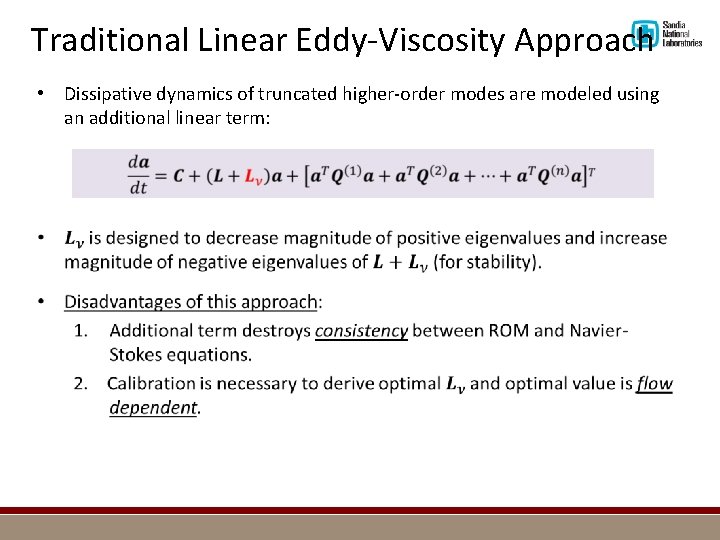
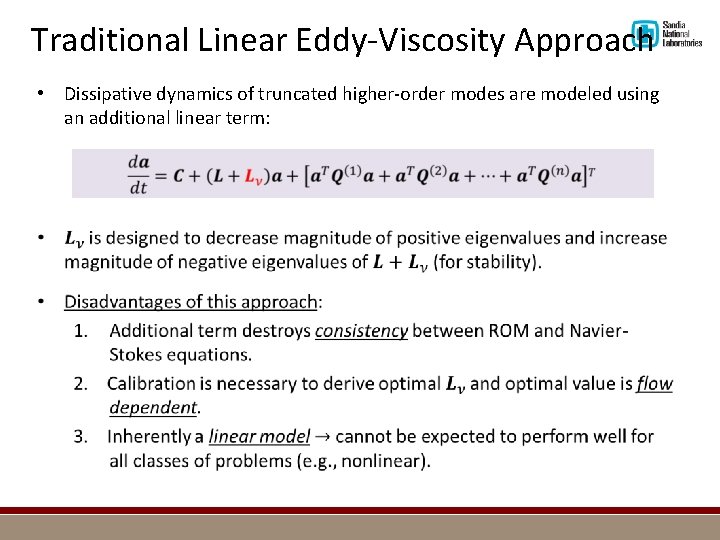
Traditional Linear Eddy-Viscosity Approach • Dissipative dynamics of truncated higher-order modes are modeled using an additional linear term:
Traditional Linear Eddy-Viscosity Approach • Dissipative dynamics of truncated higher-order modes are modeled using an additional linear term:
Traditional Linear Eddy-Viscosity Approach • Dissipative dynamics of truncated higher-order modes are modeled using an additional linear term:
Traditional Linear Eddy-Viscosity Approach • Dissipative dynamics of truncated higher-order modes are modeled using an additional linear term:
Traditional Linear Eddy-Viscosity Approach • Dissipative dynamics of truncated higher-order modes are modeled using an additional linear term:
Traditional Linear Eddy-Viscosity Approach • Dissipative dynamics of truncated higher-order modes are modeled using an additional linear term:
Traditional Linear Eddy-Viscosity Approach • Dissipative dynamics of truncated higher-order modes are modeled using an additional linear term:
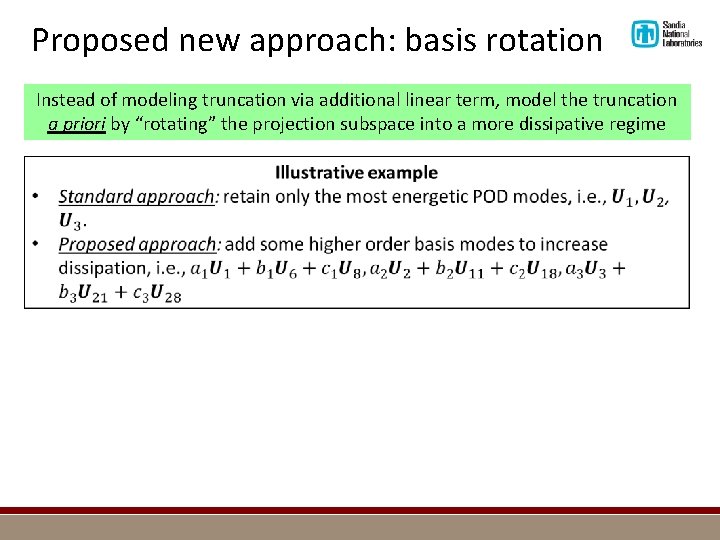
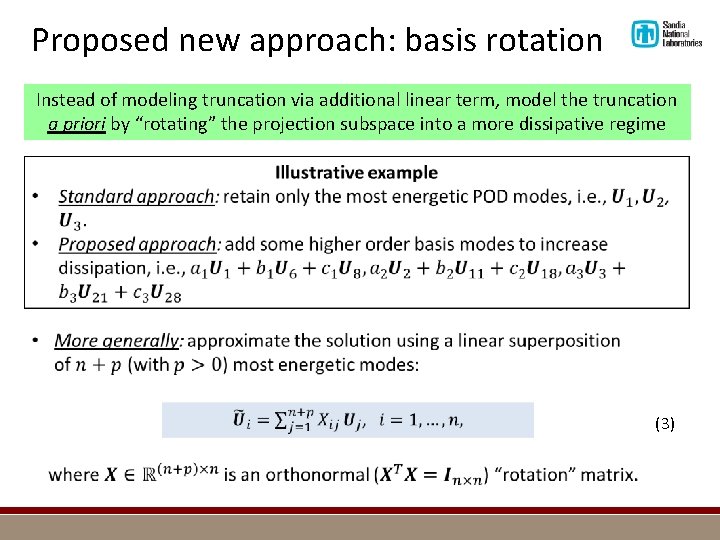
Proposed new approach: basis rotation Instead of modeling truncation via additional linear term, model the truncation a priori by “rotating” the projection subspace into a more dissipative regime
Proposed new approach: basis rotation Instead of modeling truncation via additional linear term, model the truncation a priori by “rotating” the projection subspace into a more dissipative regime
Proposed new approach: basis rotation Instead of modeling truncation via additional linear term, model the truncation a priori by “rotating” the projection subspace into a more dissipative regime (3)
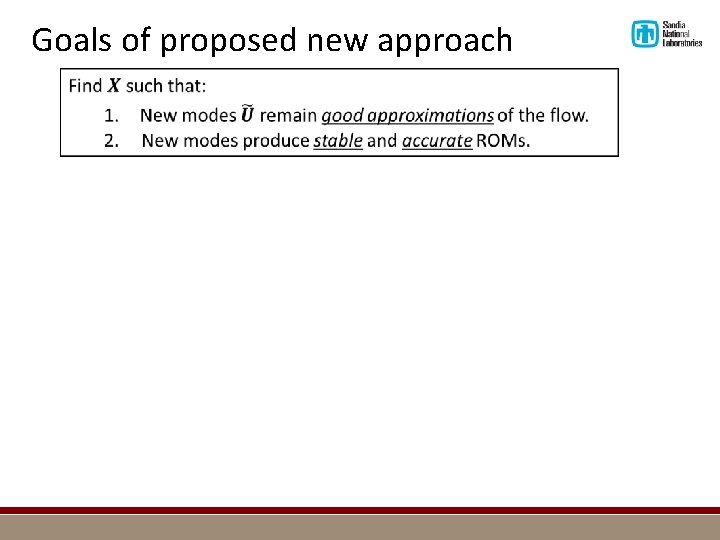
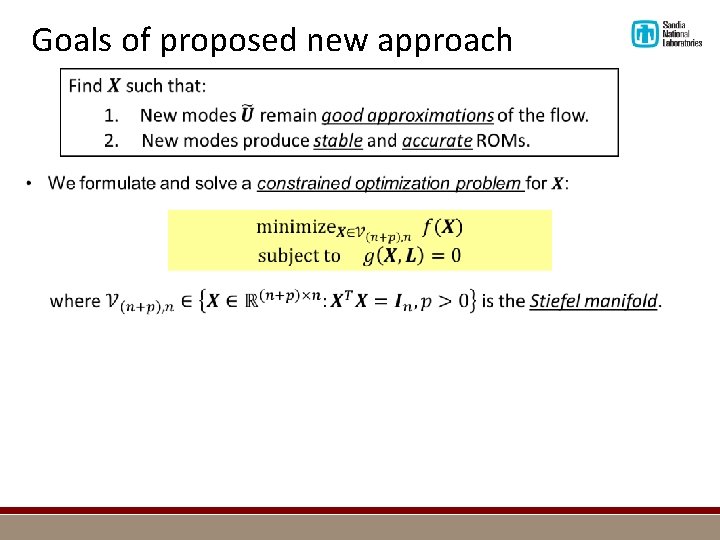
Goals of proposed new approach
Goals of proposed new approach
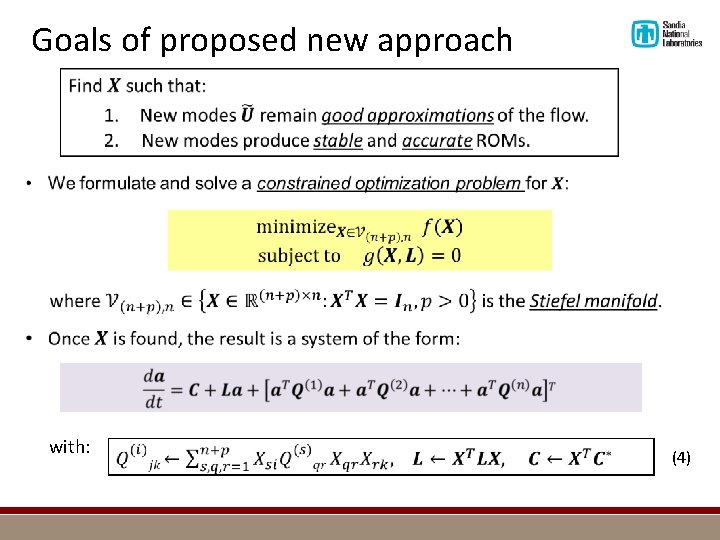
Goals of proposed new approach with: (4)
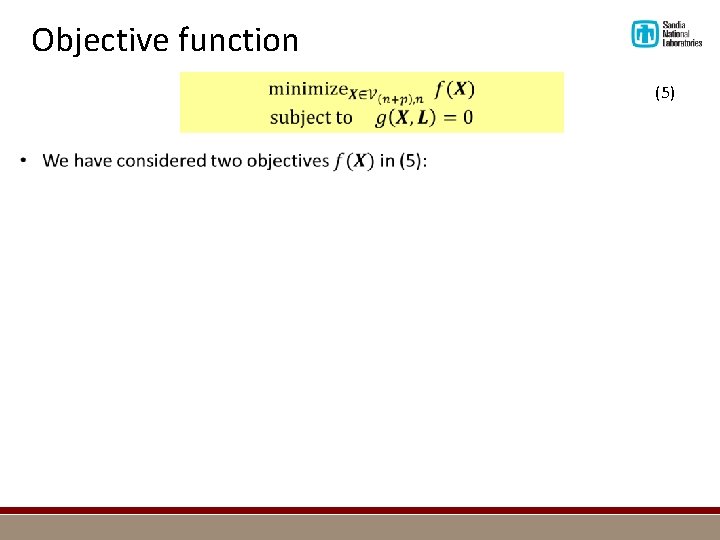
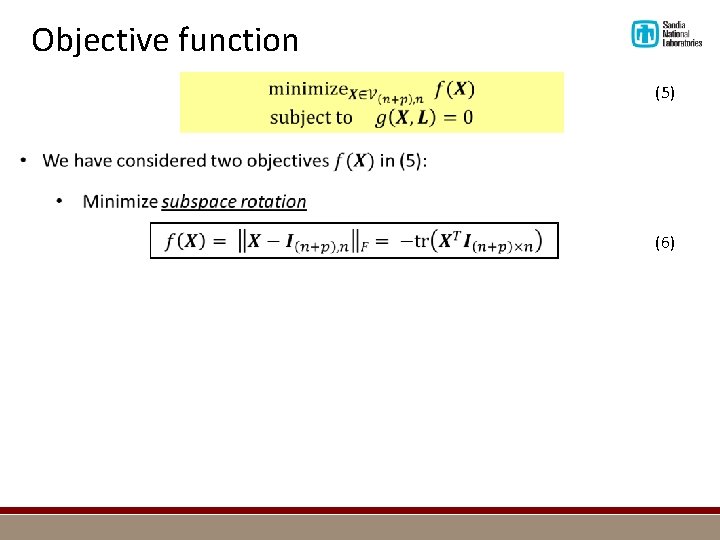
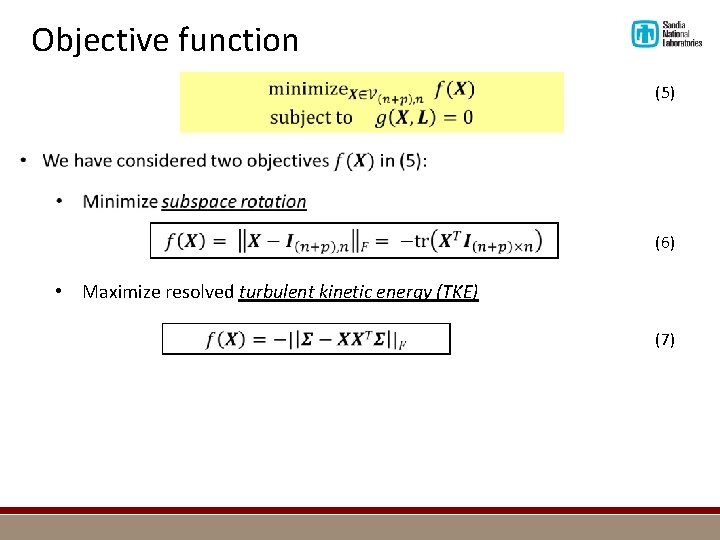
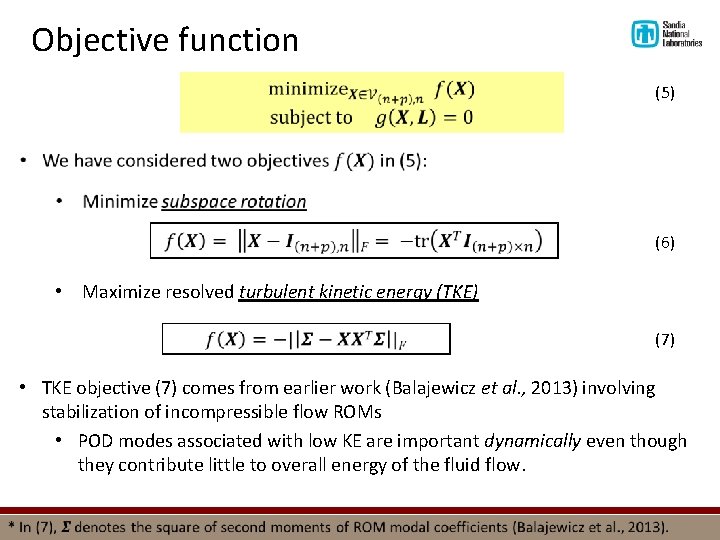
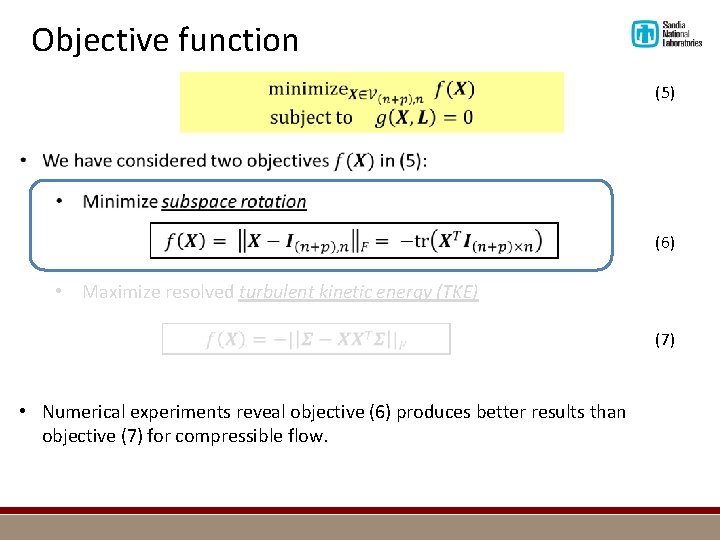
Objective function (5)
Objective function (5) (6)
Objective function (5) (6) • Maximize resolved turbulent kinetic energy (TKE) (7)
Objective function (5) (6) • Maximize resolved turbulent kinetic energy (TKE) (7) • TKE objective (7) comes from earlier work (Balajewicz et al. , 2013) involving stabilization of incompressible flow ROMs • POD modes associated with low KE are important dynamically even though they contribute little to overall energy of the fluid flow.
Objective function (5) (6) • Maximize resolved turbulent kinetic energy (TKE) • Numerical experiments reveal objective (6) produces better results than objective (7) for compressible flow. (7)
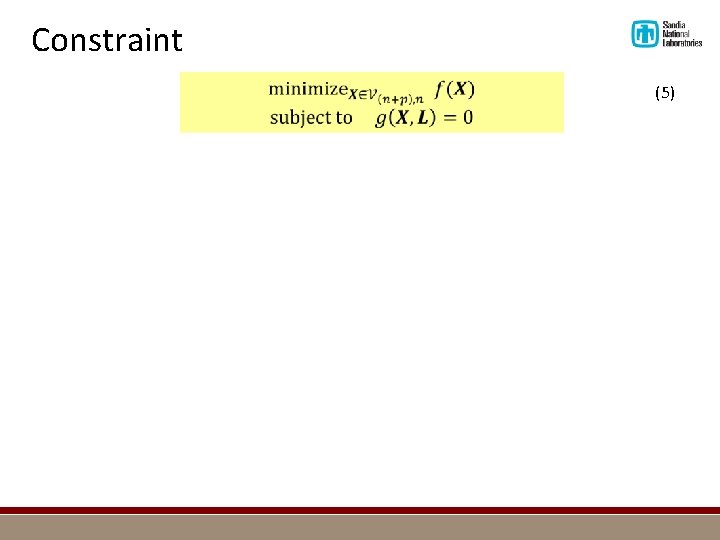
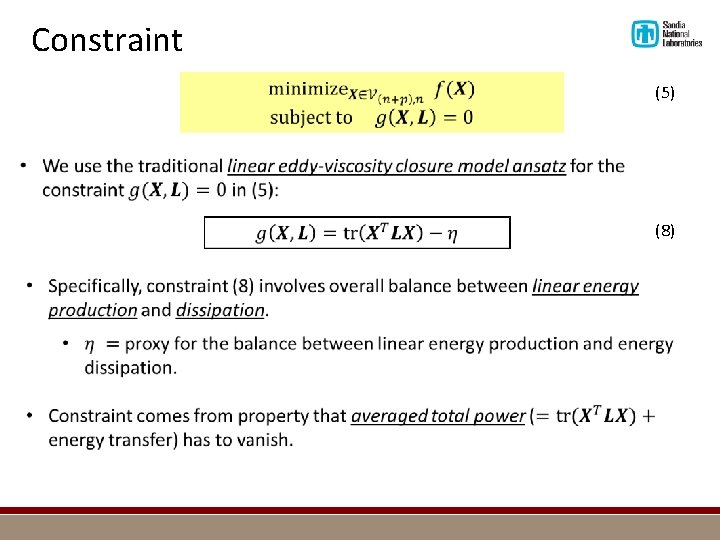
Constraint (5)
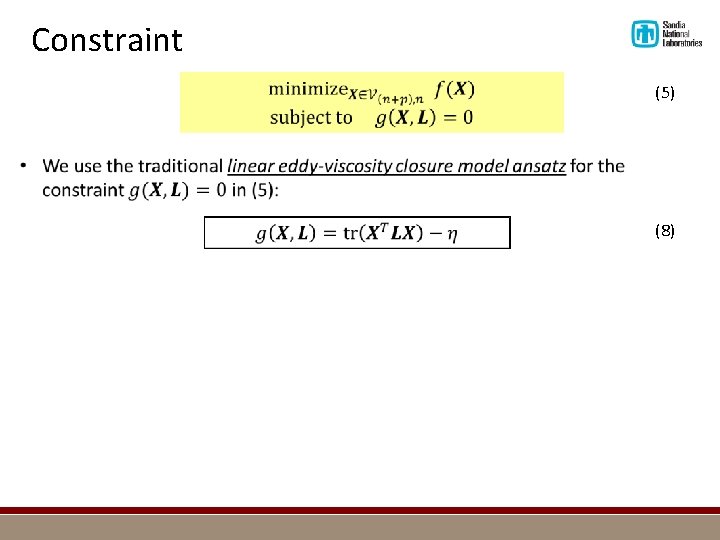
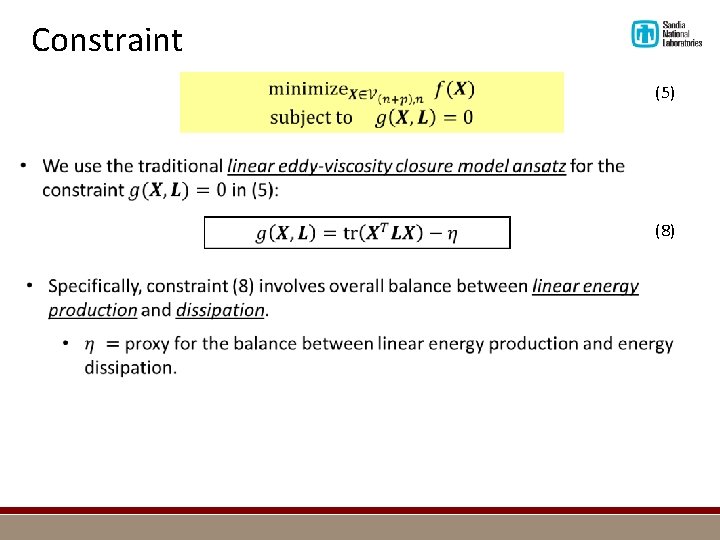
Constraint (5) (8)
Constraint (5) (8)
Constraint (5) (8)
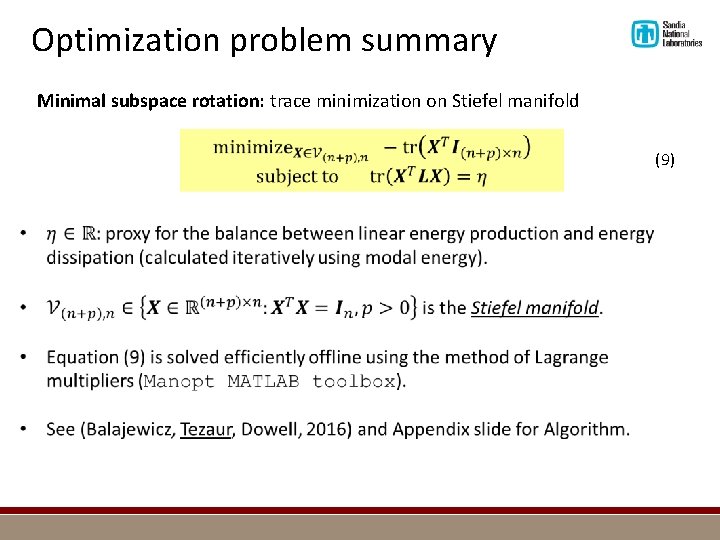
Optimization problem summary Minimal subspace rotation: trace minimization on Stiefel manifold (9)
Remarks on proposed approach Proposed approach may be interpreted as an a priori consistent formulation of the eddy-viscosity turbulence modeling approach.
Remarks on proposed approach Proposed approach may be interpreted as an a priori consistent formulation of the eddy-viscosity turbulence modeling approach. • Advantages of proposed approach:
Remarks on proposed approach Proposed approach may be interpreted as an a priori consistent formulation of the eddy-viscosity turbulence modeling approach.
Remarks on proposed approach Proposed approach may be interpreted as an a priori consistent formulation of the eddy-viscosity turbulence modeling approach.
Remarks on proposed approach Proposed approach may be interpreted as an a priori consistent formulation of the eddy-viscosity turbulence modeling approach.
Remarks on proposed approach Proposed approach may be interpreted as an a priori consistent formulation of the eddy-viscosity turbulence modeling approach.
Remarks on proposed approach Proposed approach may be interpreted as an a priori consistent formulation of the eddy-viscosity turbulence modeling approach.
Remarks on proposed approach Proposed approach may be interpreted as an a priori consistent formulation of the eddy-viscosity turbulence modeling approach.
Outline 1. Introduction • Targeted application • POD/Galerkin approach to MOR • Extreme model reduction • Mode truncation instability in MOR 2. Accounting for modal truncation • Traditional linear eddy-viscosity approach • New proposed approach via subspace rotation 3. Applications • Low Reynolds (Re) number channel driven cavity • Moderate Reynolds (Re) number channel driven cavity 4. Extension to Least-Squares Petrov-Galerkin (LSPG) ROMs 5. Summary & future work
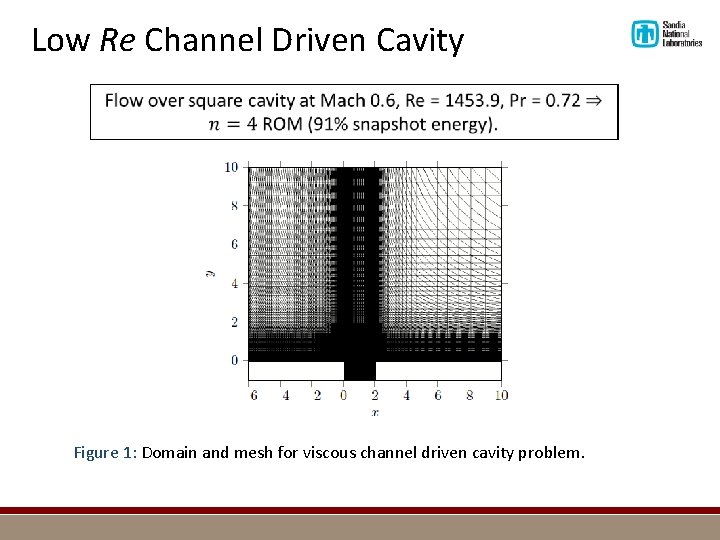
Low Re Channel Driven Cavity Figure 1: Domain and mesh for viscous channel driven cavity problem.
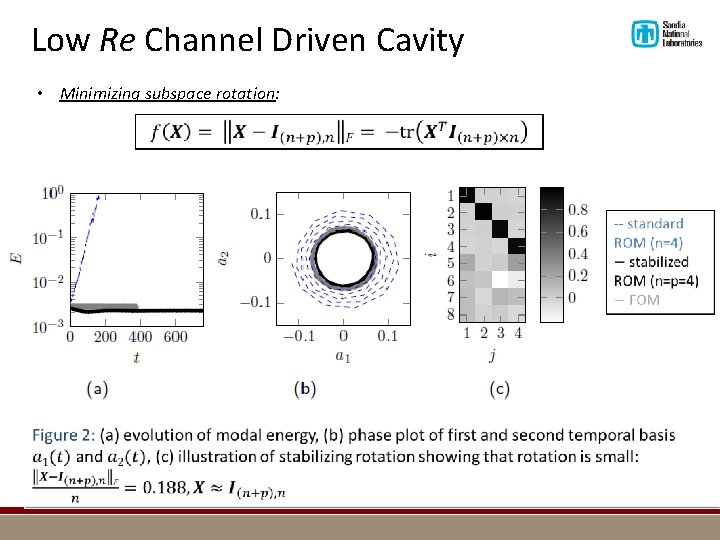
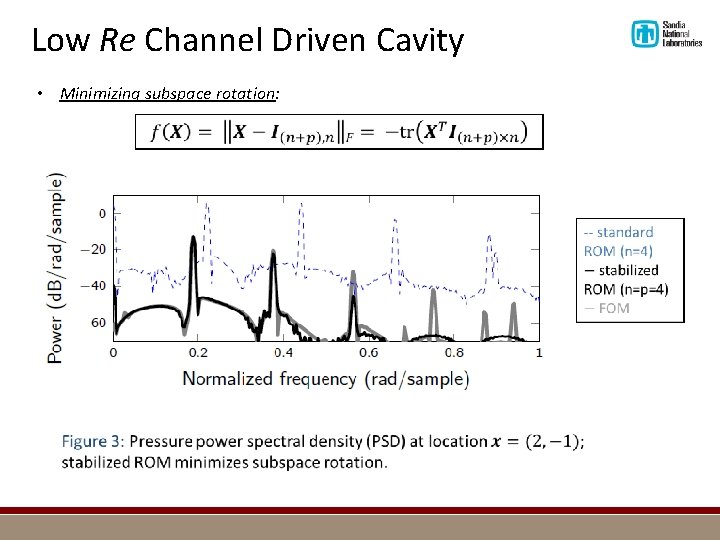
Low Re Channel Driven Cavity • Minimizing subspace rotation:
Low Re Channel Driven Cavity • Minimizing subspace rotation:
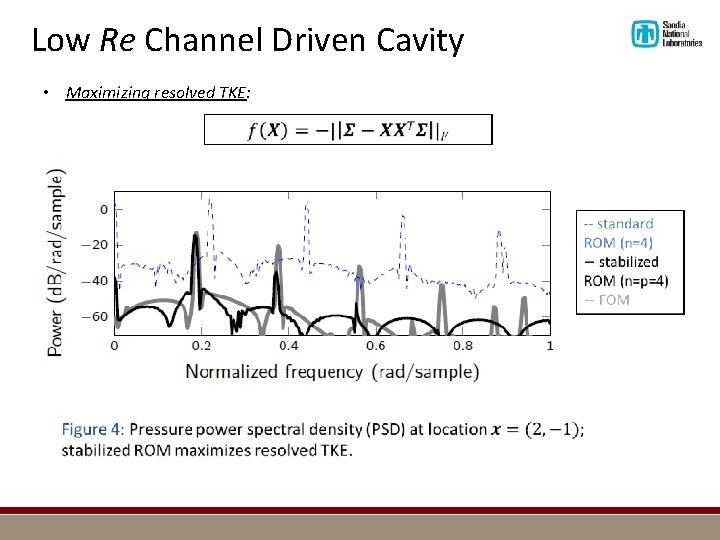
Low Re Channel Driven Cavity • Maximizing resolved TKE:
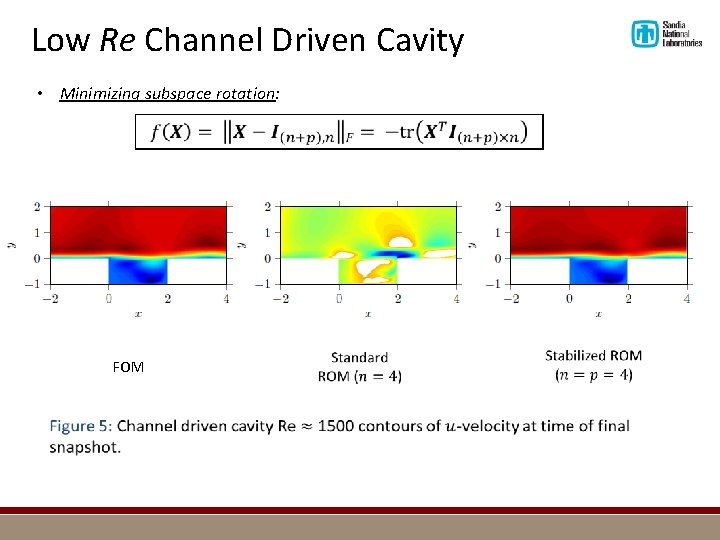
Low Re Channel Driven Cavity • Minimizing subspace rotation: FOM
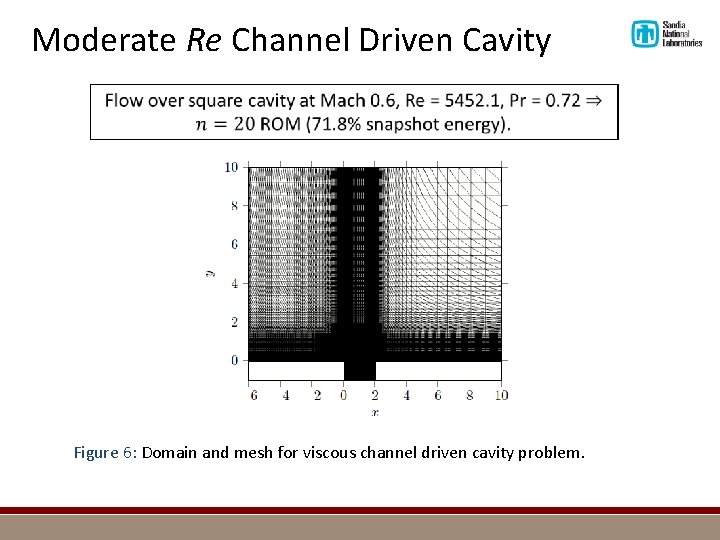
Moderate Re Channel Driven Cavity Figure 6: Domain and mesh for viscous channel driven cavity problem.
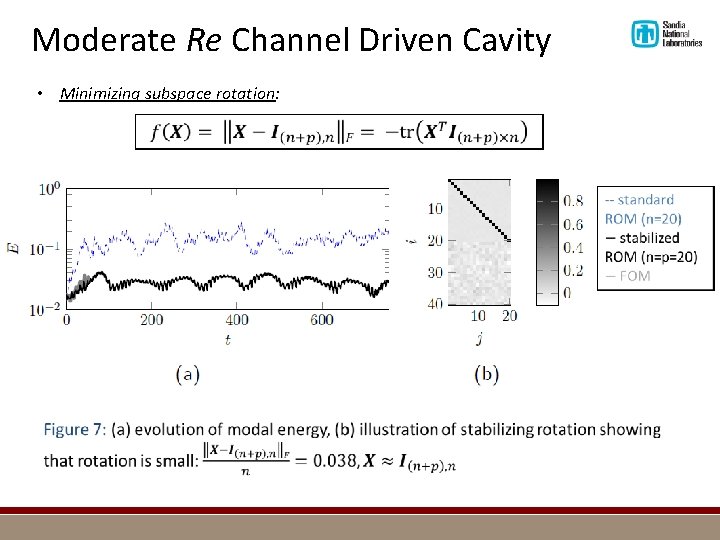
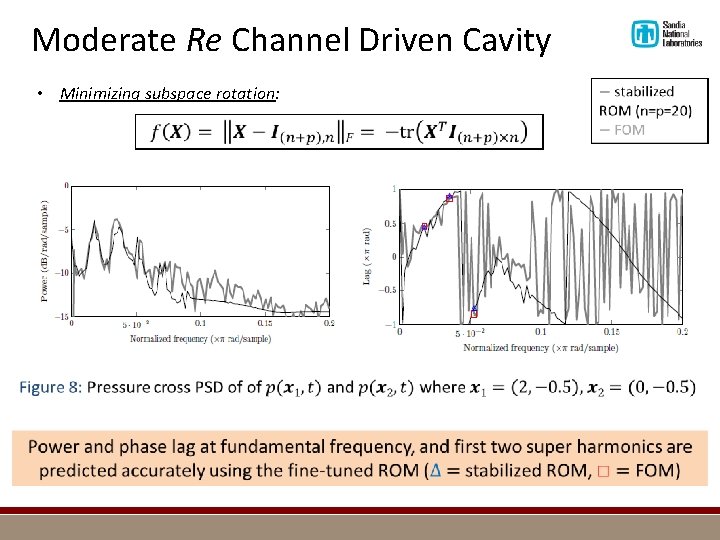
Moderate Re Channel Driven Cavity • Minimizing subspace rotation:
Moderate Re Channel Driven Cavity • Minimizing subspace rotation:
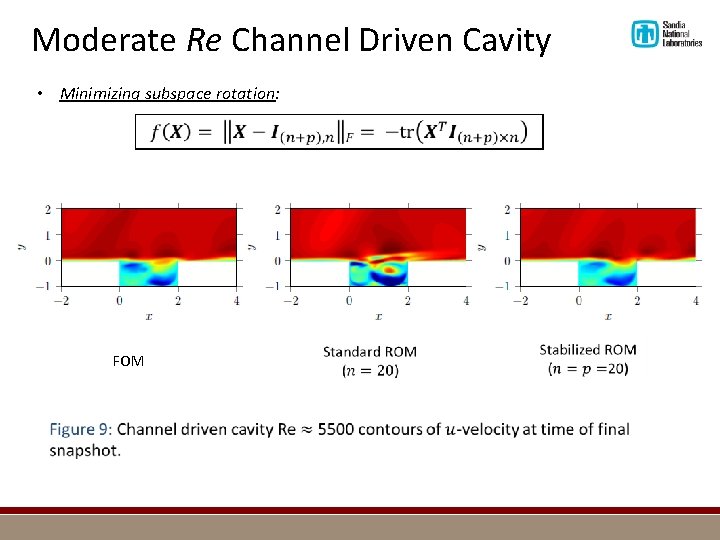
Moderate Re Channel Driven Cavity • Minimizing subspace rotation: FOM
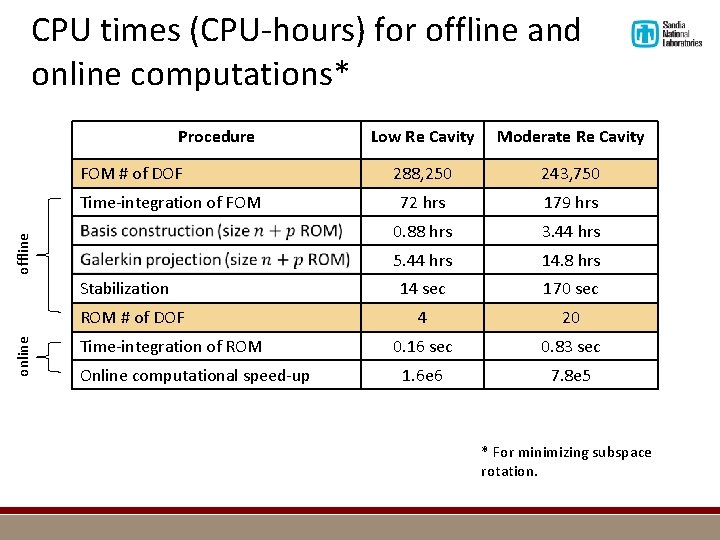
CPU times (CPU-hours) for offline and online computations* Procedure FOM # of DOF offline Time-integration of FOM Stabilization online ROM # of DOF Time-integration of ROM Online computational speed-up Low Re Cavity Moderate Re Cavity 288, 250 243, 750 72 hrs 179 hrs 0. 88 hrs 3. 44 hrs 5. 44 hrs 14. 8 hrs 14 sec 170 sec 4 20 0. 16 sec 0. 83 sec 1. 6 e 6 7. 8 e 5 * For minimizing subspace rotation.
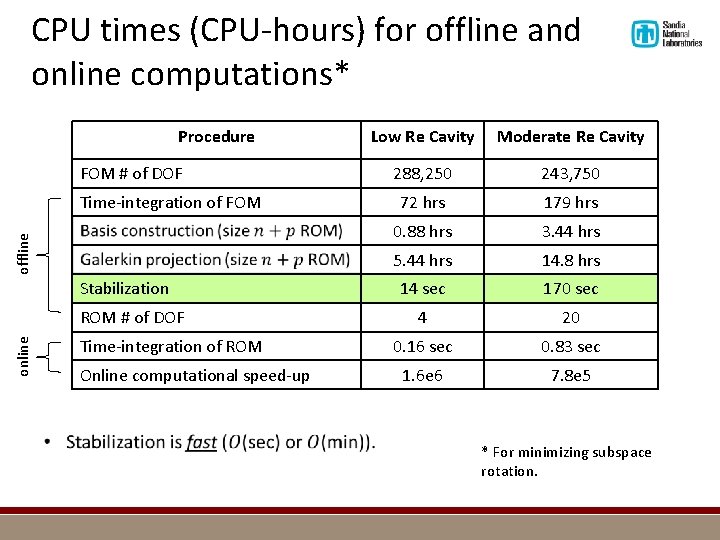
CPU times (CPU-hours) for offline and online computations* Procedure FOM # of DOF offline Time-integration of FOM Stabilization ROM # of DOF online Time-integration of ROM Online computational speed-up Low Re Cavity Moderate Re Cavity 288, 250 243, 750 72 hrs 179 hrs 0. 88 hrs 3. 44 hrs 5. 44 hrs 14. 8 hrs 14 sec 170 sec 4 20 0. 16 sec 0. 83 sec 1. 6 e 6 7. 8 e 5 * For minimizing subspace rotation.
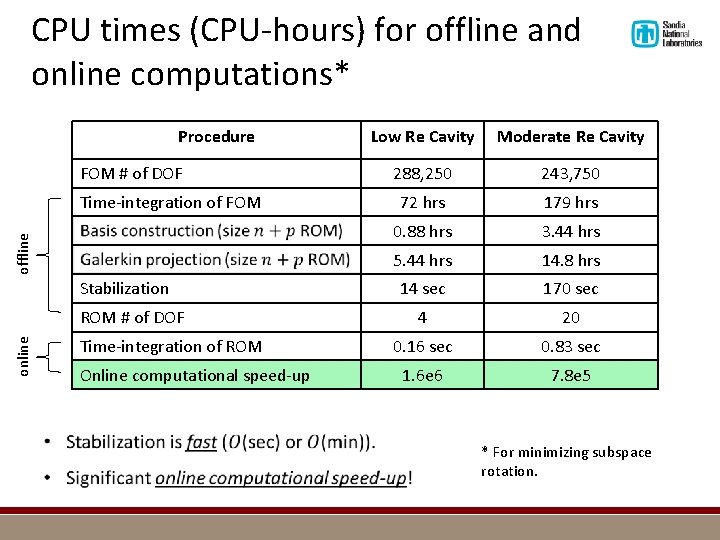
CPU times (CPU-hours) for offline and online computations* Procedure FOM # of DOF offline Time-integration of FOM Stabilization ROM # of DOF online Time-integration of ROM Online computational speed-up Low Re Cavity Moderate Re Cavity 288, 250 243, 750 72 hrs 179 hrs 0. 88 hrs 3. 44 hrs 5. 44 hrs 14. 8 hrs 14 sec 170 sec 4 20 0. 16 sec 0. 83 sec 1. 6 e 6 7. 8 e 5 * For minimizing subspace rotation.
Outline 1. Introduction • Targeted application • POD/Galerkin approach to MOR • Extreme model reduction • Mode truncation instability in MOR 2. Accounting for modal truncation • Traditional linear eddy-viscosity approach • New proposed approach via subspace rotation 3. Applications • Low Reynolds (Re) number channel driven cavity • Moderate Reynolds (Re) number channel driven cavity 4. Extension to Least-Squares Petrov-Galerkin (LSPG) ROMs 5. Summary & future work
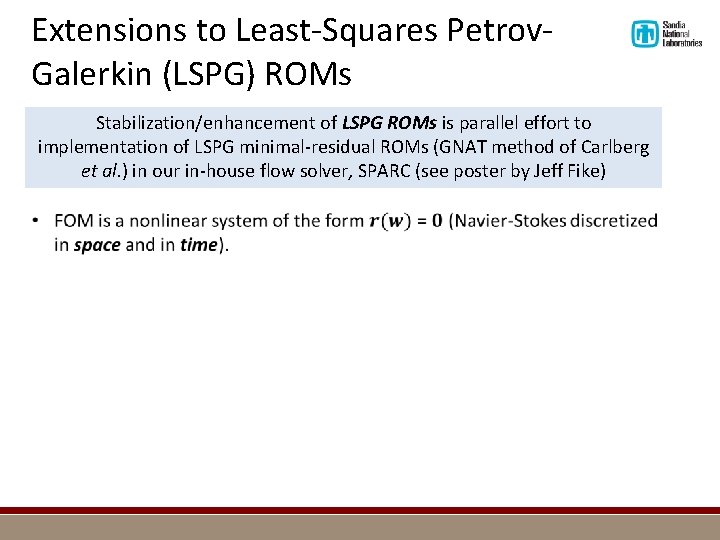
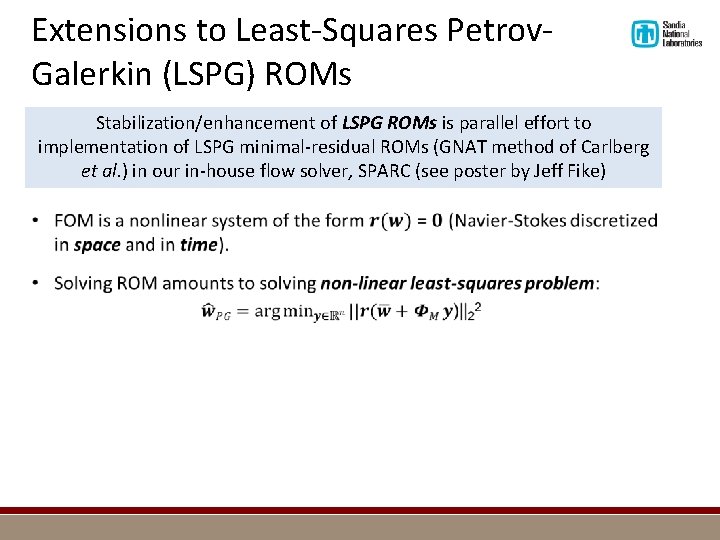
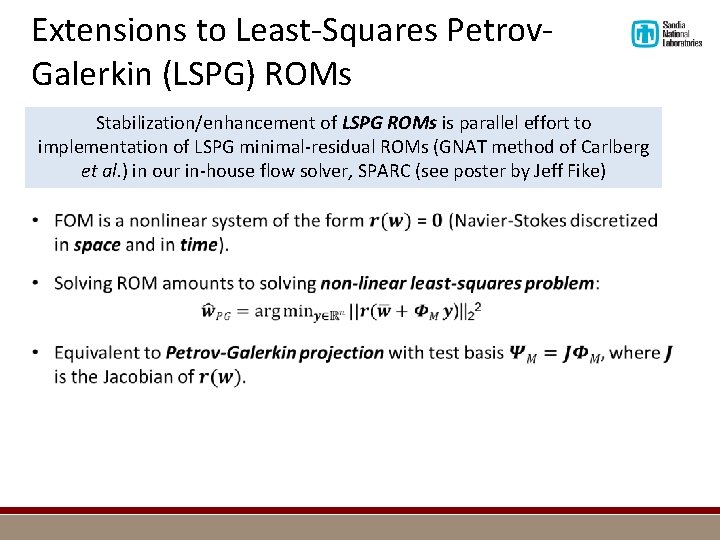
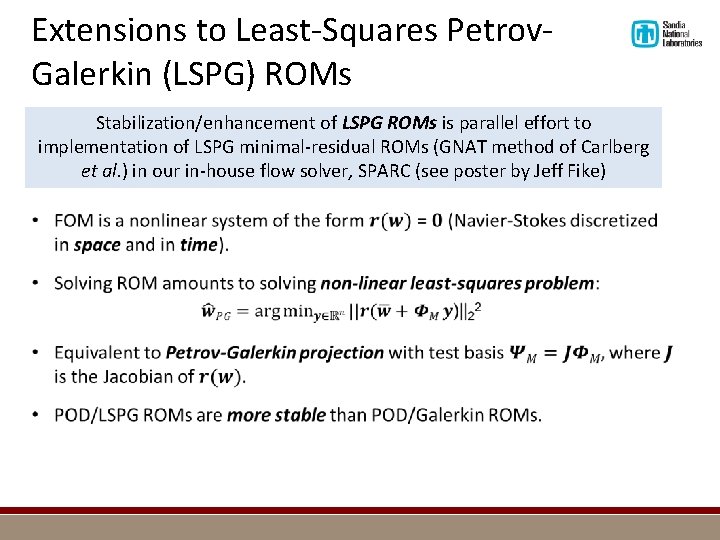
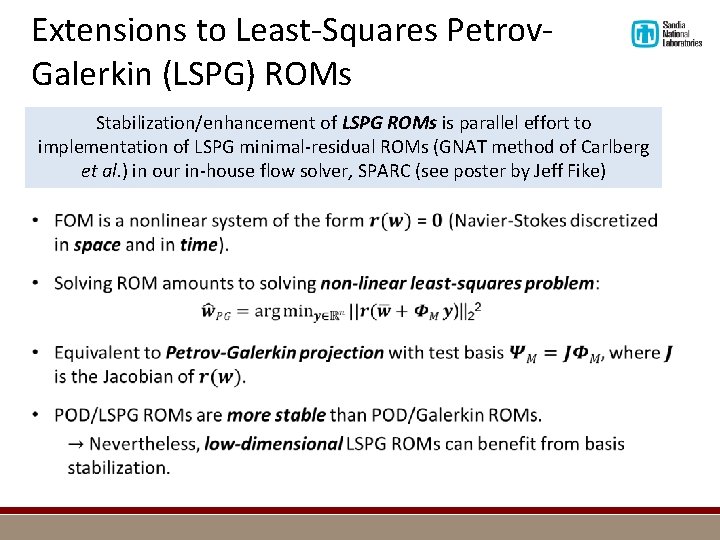
Extensions to Least-Squares Petrov. Galerkin (LSPG) ROMs Stabilization/enhancement of LSPG ROMs is parallel effort to implementation of LSPG minimal-residual ROMs (GNAT method of Carlberg et al. ) in our in-house flow solver, SPARC (see poster by Jeff Fike)
Extensions to Least-Squares Petrov. Galerkin (LSPG) ROMs Stabilization/enhancement of LSPG ROMs is parallel effort to implementation of LSPG minimal-residual ROMs (GNAT method of Carlberg et al. ) in our in-house flow solver, SPARC (see poster by Jeff Fike)
Extensions to Least-Squares Petrov. Galerkin (LSPG) ROMs Stabilization/enhancement of LSPG ROMs is parallel effort to implementation of LSPG minimal-residual ROMs (GNAT method of Carlberg et al. ) in our in-house flow solver, SPARC (see poster by Jeff Fike)
Extensions to Least-Squares Petrov. Galerkin (LSPG) ROMs Stabilization/enhancement of LSPG ROMs is parallel effort to implementation of LSPG minimal-residual ROMs (GNAT method of Carlberg et al. ) in our in-house flow solver, SPARC (see poster by Jeff Fike)
Extensions to Least-Squares Petrov. Galerkin (LSPG) ROMs Stabilization/enhancement of LSPG ROMs is parallel effort to implementation of LSPG minimal-residual ROMs (GNAT method of Carlberg et al. ) in our in-house flow solver, SPARC (see poster by Jeff Fike)
Extensions to Least-Squares Petrov. Galerkin (LSPG) ROMs Stabilization/enhancement of LSPG ROMs is parallel effort to implementation of LSPG minimal-residual ROMs (GNAT method of Carlberg et al. ) in our in-house flow solver, SPARC (see poster by Jeff Fike)
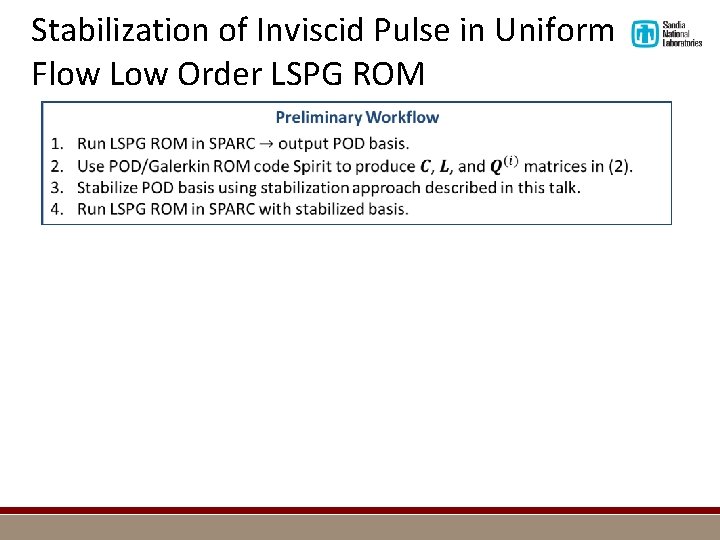
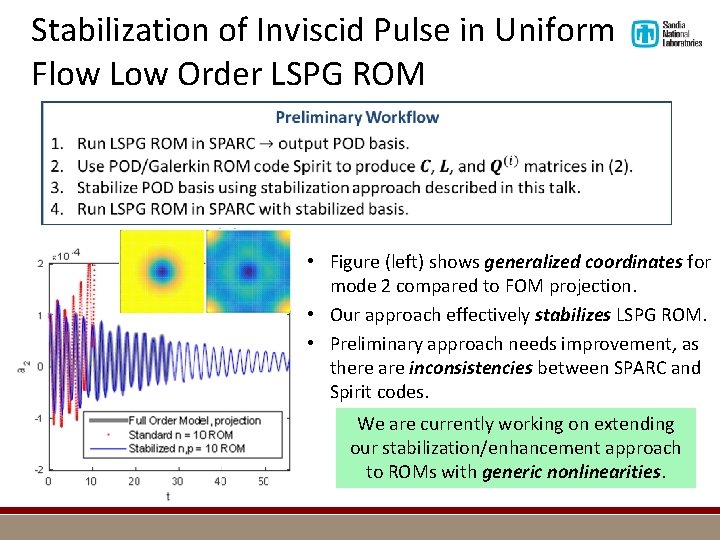
Stabilization of Inviscid Pulse in Uniform Flow Low Order LSPG ROM
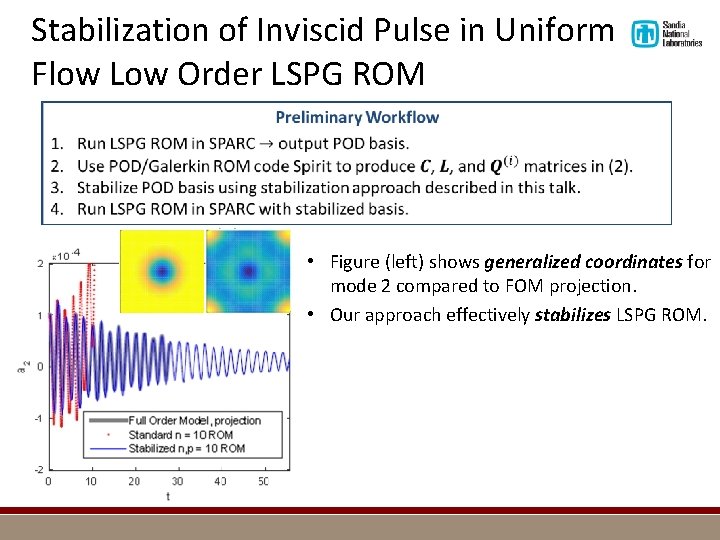
Stabilization of Inviscid Pulse in Uniform Flow Low Order LSPG ROM • Figure (left) shows generalized coordinates for mode 2 compared to FOM projection. • Our approach effectively stabilizes LSPG ROM.
Stabilization of Inviscid Pulse in Uniform Flow Low Order LSPG ROM • Figure (left) shows generalized coordinates for mode 2 compared to FOM projection. • Our approach effectively stabilizes LSPG ROM. • Preliminary approach needs improvement, as there are inconsistencies between SPARC and Spirit codes. We are currently working on extending our stabilization/enhancement approach to ROMs with generic nonlinearities.
Outline 1. Introduction • Targeted application • POD/Galerkin approach to MOR • Extreme model reduction • Mode truncation instability in MOR 2. Accounting for modal truncation • Traditional linear eddy-viscosity approach • New proposed approach via subspace rotation 3. Applications • Low Reynolds (Re) number channel driven cavity • Moderate Reynolds (Re) number channel driven cavity 4. Extension to Least-Squares Petrov-Galerkin (LSPG) ROMs 5. Summary & future work
Summary • We have developed a non-intrusive approach for stabilizing and finetuning projection-based ROMs for compressible flows. • The standard POD modes are “rotated” into a more dissipative regime to account for the dynamics in the higher order modes truncated by the standard POD method. • The new approach is consistent and does not require the addition of empirical turbulence model terms unlike traditional approaches. • Mathematically, the approach is formulated as a quadratic matrix program on the Stiefel manifold. • The constrained minimization problem is solved offline and small enough to be solved in MATLAB. • The method is demonstrated on several compressible flow problems and shown to deliver stable and accurate ROMs.
Future work
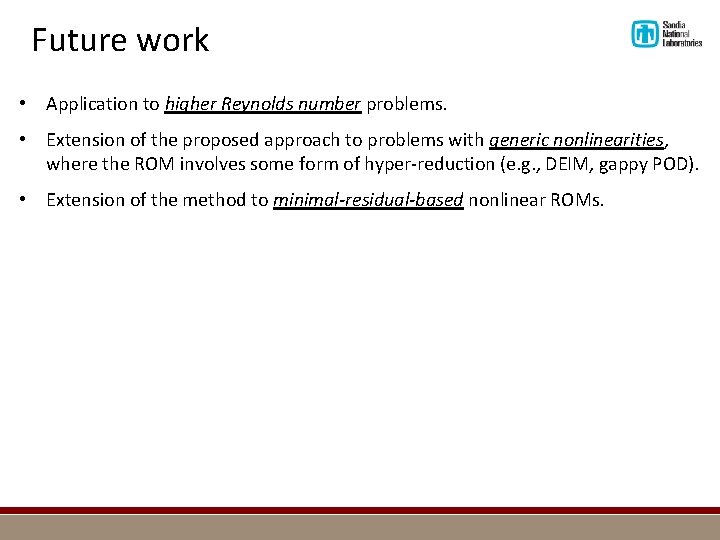
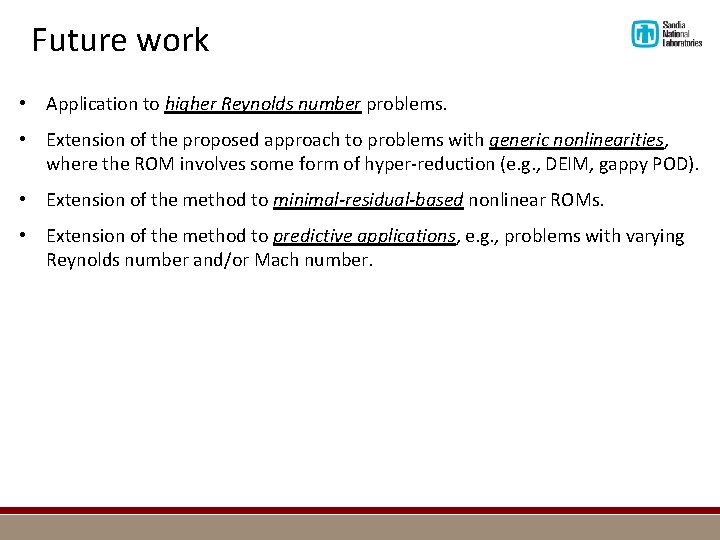
Future work • Application to higher Reynolds number problems.
Future work • Application to higher Reynolds number problems. • Extension of the proposed approach to problems with generic nonlinearities, where the ROM involves some form of hyper-reduction (e. g. , DEIM, gappy POD).
Future work • Application to higher Reynolds number problems. • Extension of the proposed approach to problems with generic nonlinearities, where the ROM involves some form of hyper-reduction (e. g. , DEIM, gappy POD). • Extension of the method to minimal-residual-based nonlinear ROMs.
Future work • Application to higher Reynolds number problems. • Extension of the proposed approach to problems with generic nonlinearities, where the ROM involves some form of hyper-reduction (e. g. , DEIM, gappy POD). • Extension of the method to minimal-residual-based nonlinear ROMs. • Extension of the method to predictive applications, e. g. , problems with varying Reynolds number and/or Mach number.
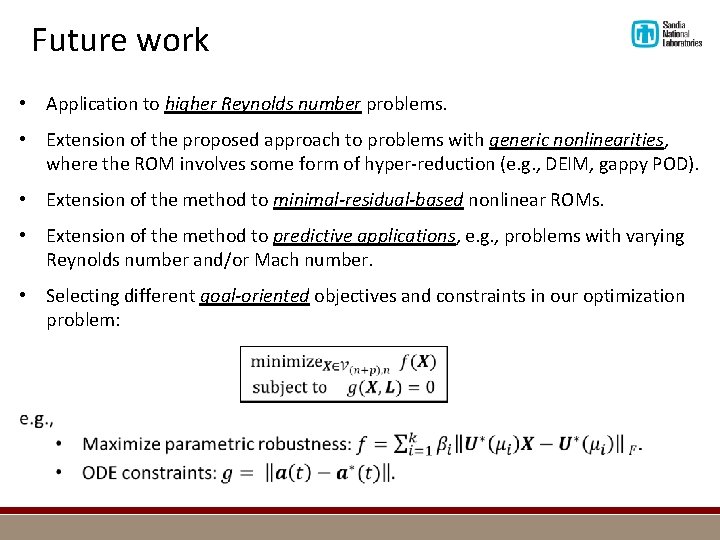
Future work • Application to higher Reynolds number problems. • Extension of the proposed approach to problems with generic nonlinearities, where the ROM involves some form of hyper-reduction (e. g. , DEIM, gappy POD). • Extension of the method to minimal-residual-based nonlinear ROMs. • Extension of the method to predictive applications, e. g. , problems with varying Reynolds number and/or Mach number. • Selecting different goal-oriented objectives and constraints in our optimization problem:
References [1] M. Balajewicz, E. Dowell. Stabilization of projection-based reduced order models of the Navier-Stokes equation. Nonlinear Dynamics 70(2), 1619 -1632, 2012. [2] M. Balajewicz, E. Dowell, B. Noack. Low-dimensional modelling of high-Reynolds-number shear flows incorporating constraints from the Navier-Stokes equation. Journal of Fluid Mechanics 729, 285 -308, 2013. [3] M. Balajewicz, I. Tezaur, E. Dowell. Minimal subspace rotation on the Stiefel manifold for stabilization and enhancement of projection-based reduced order models for the compressible Navier-Stokes equations. J. Comput. Phys. , 321, 224– 241, 2016. [4] M. Barone, I. Kalashnikova, D. Segalman, H. Thornquist. Stable Galerkin reduced order models for linearized compressible flow. J. Computat. Phys. 228(6), 1932 -1946, 2009. [5] K. Carlberg, C. Farhat, J. Cortial, D. Amsallem. The GNAT method for nonlinear model reduction: effective implementation and application to computational fluid dynamics and turbulent flows. J. Computat. Phys. 242, 623 -647, 2013. [6] I. Kalashnikova, S. Arunajatesan, M. Barone, B. van Bloemen Waanders, J. Fike. Reduced order modeling for prediction and control of large-scale systems. Sandia Tech. Report, 2014. [7] C. Rowley, T. Colonius, R. Murray. Model reduction for compressible flows using POD and Galerkin projection. Physica D: Nonlinear Phenomena. 189(1) 115 -129, 2004. [8] G. Serre, P. Lafon, X. Gloerfelt, C. Bailly. Reliable reduced-order models for timedependentlinearized euler equations. J. Computat. Phys. 231(15) 5176 -5194, 2012. [9] N. Aubry, P. Holmes, J. Lumley, E. Stone The dynamics of coherent structures in the wall region of a turbulent boundary layer. J. Fluid Mech. 192(115) 115 -173, 1988. [10] J. Osth, B. Noack, R. Krajnovic, D. Barros, J. Boree. On the need for a nonlinear subscale turbulence term in POD models as exemplified for a high Reynolds number flow over an Ahmed body. J. Fluid Mech. 747 518 -544, 2004. [11] T. Bui-Thanh, K. Willcox, O. Ghattas, and B. van Bloemen Waanders. Goal-oriented, model constrained optimization for reduction of large-scale systems. J. Comput. Phys. , 224, 880– 896, 2007.
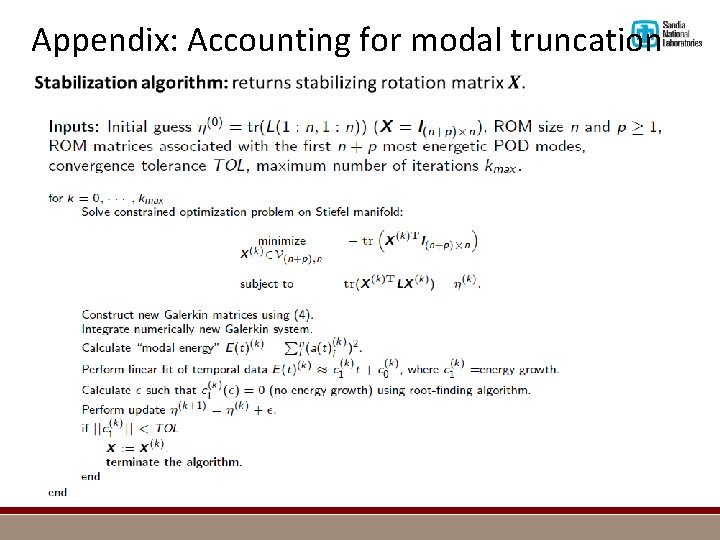
Appendix: Accounting for modal truncation
Targeted Application: Compressible Flow • We are interested in the compressible captive-carry problem. • Majority of fluid MOR approaches in the literature are for incompressible flow.
Targeted Application: Compressible Flow • We are interested in the compressible captive-carry problem. • Majority of fluid MOR approaches in the literature are for incompressible flow. • Desired numerical properties of ROMs: • Consistency (w. r. t. the continuous PDEs). • Stability: if full order model (FOM) is stable, ROM should be stable. • Convergence: requires consistency and stability. • Accuracy (w. r. t. FOM). • Efficiency. • Robustness (w. r. t. time or parameter changes).
Targeted Application: Compressible Flow • We are interested in the compressible captive-carry problem. • Majority of fluid MOR approaches in the literature are for incompressible flow. • Desired numerical properties of ROMs: • Consistency (w. r. t. the continuous PDEs). • Stability: if full order model (FOM) is stable, ROM should be stable. • Convergence: requires consistency and stability. • Accuracy (w. r. t. FOM). • Efficiency. • Robustness (w. r. t. time or parameter changes). Stability can be a real problem for compressible flow ROMs!