
Photorespiration Oxidative photosynthetic carbon cycle or C 2
Photorespiration Oxidative photosynthetic carbon cycle, or C 2 photosynthesis Or Glycolate Pathway
Photorespiration • Photorespiration (also known as the oxidative photosynthetic carbon cycle, or C 2 photosynthesis) • refers to a process in plant metabolism where the enzyme Ru. Bis. CO oxygenates Ru. BP, wasting some of the energy produced by photosynthesis.
• The desired reaction is the addition of carbon dioxide to Ru. BP (carboxylation), a key step in the Calvin–Benson cycle, • but approximately 25% of reactions by Ru. Bis. CO instead add oxygen to Ru. BP (oxygenation), creating a product that cannot be used within the Calvin–Benson cycle.
25% Reduction of Photosynthesis in C 3 Plants This process reduces the efficiency of photosynthesis, potentially reducing photosynthetic output by 25% in C 3 plants. • Photorespiration involves a complex network of enzyme reactions that exchange metabolites between chloroplasts, leaf peroxisomes and mitochondria. •

Photorespiration-As a wasteful Process • The oxygenation reaction of Ru. Bis. CO is a wasteful process because 3 phosphoglycerate (G 3 P) is created at a reduced rate and higher metabolic cost compared with Ru. BP carboxylase activity.
• While photorespiratory carbon cycling results in the formation of G 3 P eventually, around 25% of carbon fixed by photorespiration is rereleased as CO 2 and nitrogen, as ammonia. • Ammonia must then be detoxified at a substantial cost to the cell. • Photorespiration also incurs a direct cost of one ATP and one NAD(P)H.
Photorespiration • Conditions for Photorespiration: �Light �Temperature— 25 -35⁰C �Oxygen-High concentration �CO 2 -Low Concentration
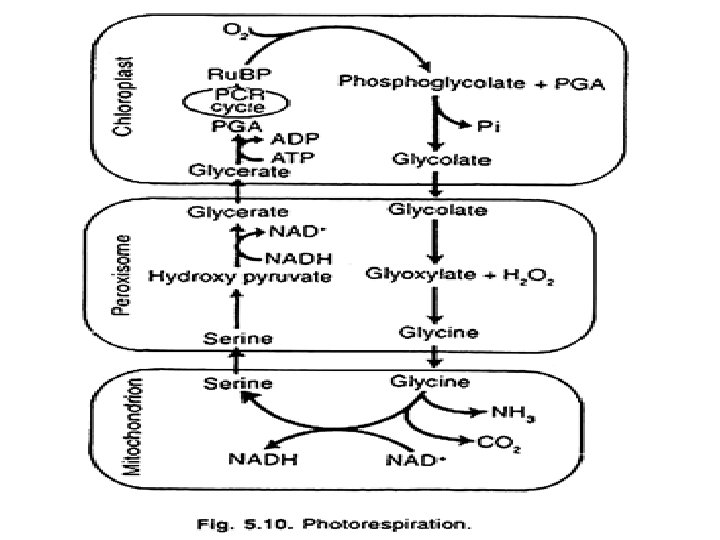
Photorespiration MECHANISM: • At mid-day, when temperature and CO 2 content are high, the affinity of Ru. BP carboxylase increases for O 2 but decreases for CO 2. Thus, it converts Ru. BP to 3 -carbon compound (PGA) and a 2 -carbon compound (phosphoglycolate) • In Chloroplast— Ru. BP+ O 2 (Ru. Bis. Co)→ 2 -Phosphoglycolic acid+ 3 -Phosphoglycerate •
Chloroplast • The oxygenation of Ru. BP (ribulose bisphosphate) in the presence of O 2 is first reaction of photorespiration that leads to the formation of one molecule of phosphoglycolate, a two-carbon compound and one molecule of PGA. • Where PGA is used in Calvin cycle, and phosphoglycolate is dephosphorylated to form glycolate in the chloroplast.
Peroxisome • From chloroplast, glycolate is diffused to peroxisome where it is oxidised to in glyoxylate. Here glyoxylate is used to form amino acid, glycine.
Mitochondria • Now, glycine enters mitochondria where two glycine molecules (4 carbons) give rise to one molecule of serine (3 carbons) and one molecule of CO 2 (one carbon).
Peroxisome • Now, serene is taken up by peroxisome, and through a series of reactions is being converted into glycerate. Chloroplast • This glycerate leaves the peroxisome and enters the chloroplast, where it is phosphorylated to form PGA.
C 2 oxidative photosynthetic cycle • Now PGA molecule enters the Calvin cycle to make carbohydrates, but one CO 2 molecule released in mitochondria during photorespiration has to be re-fixed. This means, 75 per cent of the carbon lost by the oxygenation of Ru. BP is recovered and 25 per cent is lost as release of one molecule of CO 2. • Photorespiration is also known as C 2 oxidative photosynthetic cycle
Conditions which affect photorespiration • Photorespiration rates are increased by: • Altered substrate availability: lowered CO 2 or increased O 2 • Factors which influence this include the atmospheric abundance of the two gases, the supply of the gases to the site of fixation • (i. e. in land plants: whether the stomata are open or closed), the length of the liquid phase (how far these gases have to diffuse through water in order to reach the reaction site).
• For example, when the stomata are closed to prevent water loss during drought: this limits the CO 2 supply, while O 2 production within the leaf will continue. • In algae (and plants which photosynthesize underwater); gases have to diffuse significant distances through water, which results in a decrease in the availability of CO 2 relative to O 2.
Increased Co 2 Increases Photorespiration • It has been predicted that the increase in ambient CO 2 concentrations predicted over the next 100 years may reduce the rate of photorespiration in most plants by around 50%. • However, at temperatures higher than the photosynthetic thermal optimum, the increases in turnover rate are not translated into increased CO 2 assimilation because of the decreased affinity of Rubisco for CO 2
Increased temperature • At higher temperatures Ru. Bis. CO is less able to discriminate between CO 2 and O 2. • Increasing temperatures also reduce the solubility of CO 2, thus reducing the concentration of CO 2 relative to O 2 in the chloroplast.
Biological adaptation to minimize photorespiration • 1. C 4 Plants and • CAM Plants
Possible purpose of photorespiration • Reducing photorespiration may not result in increased growth rates for plants. • Photorespiration may be necessary for the assimilation of nitrate from soil. • Thus, a reduction in photorespiration by genetic engineering or because of increasing atmospheric carbon dioxide (due to fossil fuel burning) may not benefit plants as has been proposed.
Photorespiration and Nitrogen assimilation • Several physiological processes may be responsible for linking photorespiration and nitrogen assimilation. • Photorespiration increases availability of NADH, which is required for the conversion of nitrate to nitrite. • Certain nitrite transporters also transport bicarbonate, and elevated CO 2 has been shown to suppress nitrite transport into chloroplasts.
Increased Crop Growth • However, in an agricultural setting, replacing the native photorespiration pathway with an engineered synthetic pathway to metabolize glycolate in the chloroplast resulted in a 40 percent increase in crop growth.
- Slides: 22