
Photoresistorul Description A photoresistor is a lightcontrolled variable

Photoresistorul
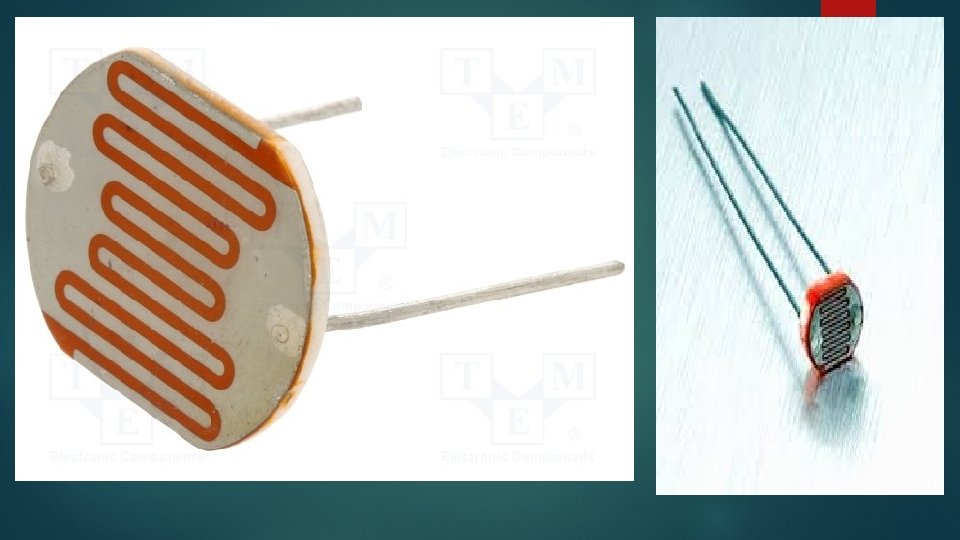
Description • A photoresistor is a light-controlled variable resistor. The resistance of a photoresistor decreases with light intensity; in other words, it exhibits photoconductivity. A photoresistor can be applied in light-sensitive detector circuits, and light- and dark-activated switching circuits. A photoresistor is made of a high resistance semiconductor. • If incident light on a photoresistor exceeds a certain frequency, photons absorbed by the semiconductor give bound electrons enough energy to jump into the conduction band.
Design considerations Photoresistors are less light-sensitive devices than photodiodes or phototransistors: the two latter components are true semiconductor devices, while a photoresistor is a passive component and does not have a PN-junction. The photoresistivity of any photoresistor may vary widely depending on ambient temperature, making them unsuitable for applications requiring precise measurement of or sensitivity to light photons.
Applications Photoresistors come in many types. Photoresistors can be placed in streetlights to control when the light is on. Ambient light falling on the photoresistor causes the streetlight to turn off. Thus energy is saved by ensuring the light is only on during hours of darkness.


This project was carried out by the student: Chiriac Florina Class A-x-A
- Slides: 7