
Photoreception Functional Anatomy of Photoreceptors process by which

Photoreception: Functional Anatomy of Photoreceptors • – process by which the eye detects light energy • Rods and cones contain _
Rods • Functional characteristics – Sensitive to ______________ and best suited for _ – Absorb _ – Perceived input is in _ – Sum of visual input from many rods feeds into a single ganglion cell – Results in _
Cones • Functional characteristics – Need __________________ for activation • have low _ – Have pigments that allow a _ – Each cone synapses with a _ – Vision is _
Excitation of Cones • There are three types of cones: • Intermediate colors are perceived by activation of _ • Method of excitation is similar to rods

Signal Transmission in the Retina

Adaptation • ___________________ (going from dark to light) involves: – Dramatic decreases in retinal sensitivity • – Switching from the rod to the cone system • • Adaptation to dark is the reverse – – Rhodopsin accumulates in the dark and retinal sensitivity is restored
Visual Pathways • Axons of retinal ganglion cells form the optic nerve • Medial fibers of the _ • Most fibers of the optic tracts continue to the _
Visual Pathways • Other optic tract fibers end in _ • Optic radiations travel from _
Visual Pathways • Some nerve fibers send tracts to the midbrain ending in the _ • A small subset of visual fibers contain melanopsin (circadian pigment) which: – Mediates papillary light reflexes – Sets daily _
Depth Perception • Achieved by both eyes viewing the same image from _ • Three-dimensional vision results from ___________________ of the slightly different images • If only one eye is used, ___________________a nd the observer must rely on learned clues to determine depth
Thalamic Processing • The ___________________ of the thalamus: – Relay information on _ – Segregate the retinal axons in preparation _ – Emphasize visual inputs from regions of high cone density – Sharpen the contrast information received by the retina
Cortical Processing • – Basic dark/bright and _ • Prestriate cortices (association areas) processes – Form, color, and movement • Visual information then proceeds anteriorly to the: – __________________ – processes identification of objects – __________________ and postcentral gyrus – processes spatial location
Chemical Senses • Chemical senses – – • Their chemoreceptors respond to chemicals in aqueous solution – Taste • to substances dissolved _ – Smell • to substances dissolved in _
Sense of Smell • The organ of smell is the ___________________, which covers the superior nasal concha • Olfactory receptor cells are ___________________ with radiating olfactory cilia • Basal cells lie at the base of the epithelium
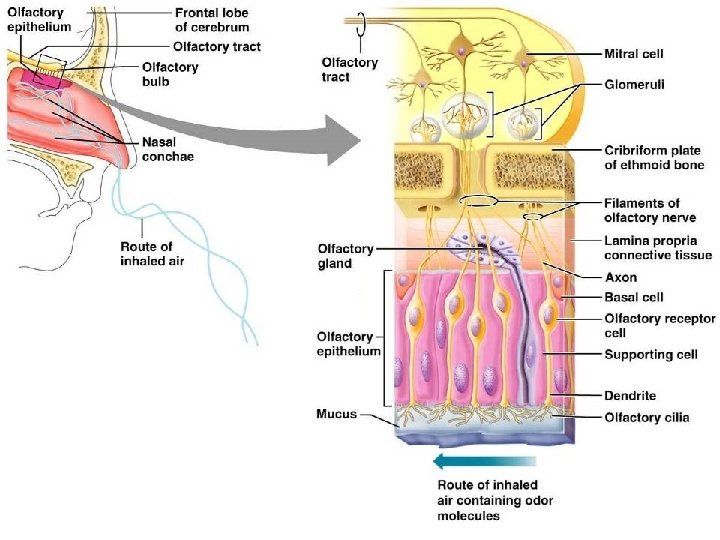
Olfactory Receptors
Physiology of Smell • Olfactory receptors respond to several different odor-causing chemicals • When bound to ligand these proteins _ • c. AMP (the second messenger) opens ion channels, – causing __________________ of the receptor membrane that then triggers an action potential
Olfactory Pathway • Olfactory receptor cells _ • Glomerular mitral cells _ • Mitral cells send impulses to: – The hypothalamus, amygdala, and _
Taste Buds • _________of the 10, 000 or so taste buds are found on the _ • Taste buds are found in papillae of the tongue mucosa • Papillae come in three types: – – – • Fungiform and circumvallate papillae _
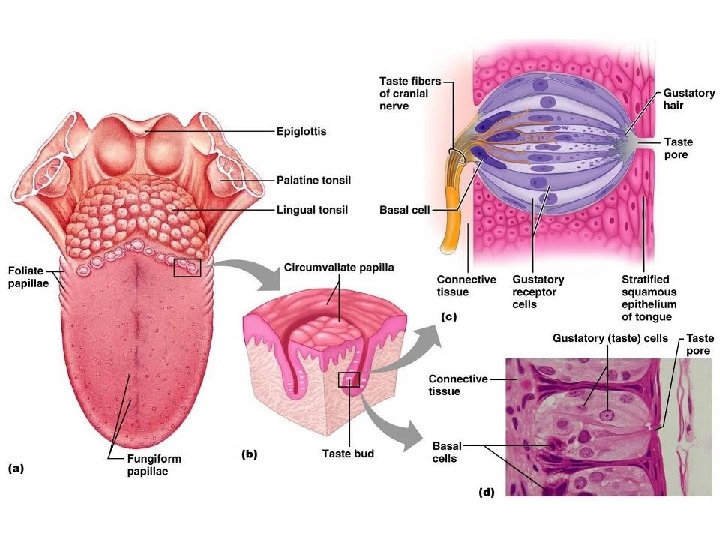
Structure of a Taste Bud • Each _________________ taste bud consists of three major cell types – • insulate the receptor – • dynamic stem cells – •
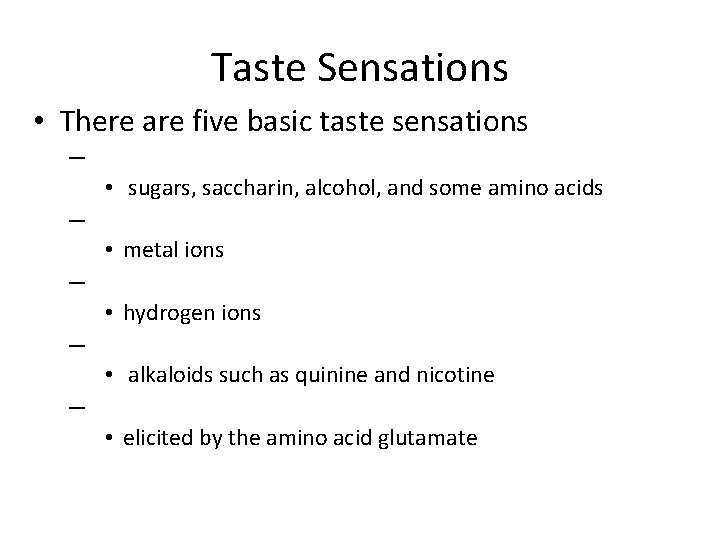
Taste Sensations • There are five basic taste sensations – • sugars, saccharin, alcohol, and some amino acids – • metal ions – • hydrogen ions – • alkaloids such as quinine and nicotine – • elicited by the amino acid glutamate
Physiology of Taste • In order to be tasted, a chemical: – Must be _ – Must contact _ • Binding of the food chemical: – Depolarizes the taste cell membrane, _ – Initiates a generator potential that elicits an _
Gustatory Pathway • Cranial Nerves _____________ carry impulses from _ • These impulses then travel to the ___________________, and from there fibers branch to the: – – Hypothalamus and limbic system (________________of taste)
Influence of Other Sensations on Taste • Taste _ • Thermoreceptors, mechanoreceptors, nociceptors also influence tastes • ____________________ _ enhance or detract from taste
The Ear: Hearing and Balance • The three parts of the ear are the _ • The outer and middle ear are involved with hearing • The inner ear functions – • Receptors for hearing and balance: – Respond to _ –
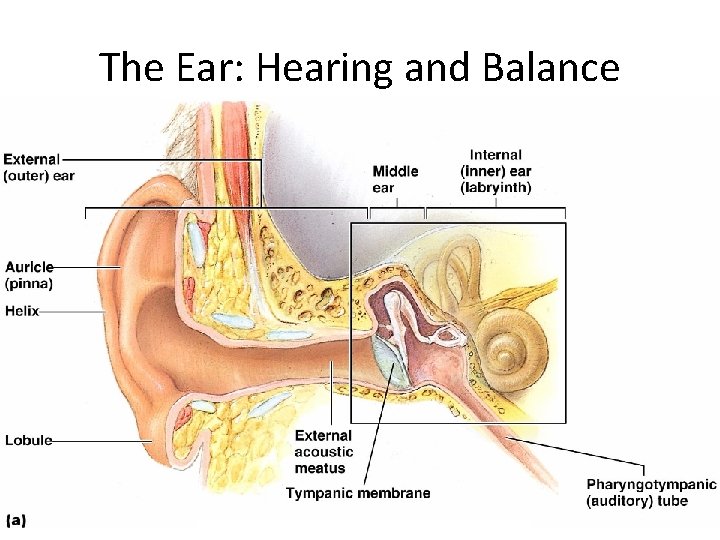
The Ear: Hearing and Balance
Outer Ear • The auricle (pinna) is composed of: – – The _ • External auditory canal – Short, curved tube filled with _
Outer Ear • Tympanic membrane _ – Thin connective tissue membrane that vibrates in response to sound – Transfers sound energy to the _ –
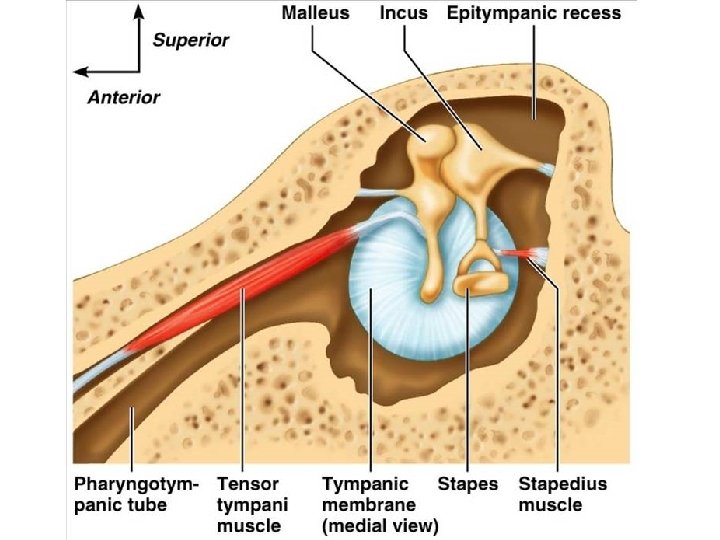
Middle Ear (Tympanic Cavity) • A small, ______________, mucosa-lined cavity – Flanked _ – Flanked medially by the _ • Epitympanic recess – superior portion of the middle ear • – connects the middle ear to the nasopharynx – ___________________ in the middle ear cavity with the external air pressure
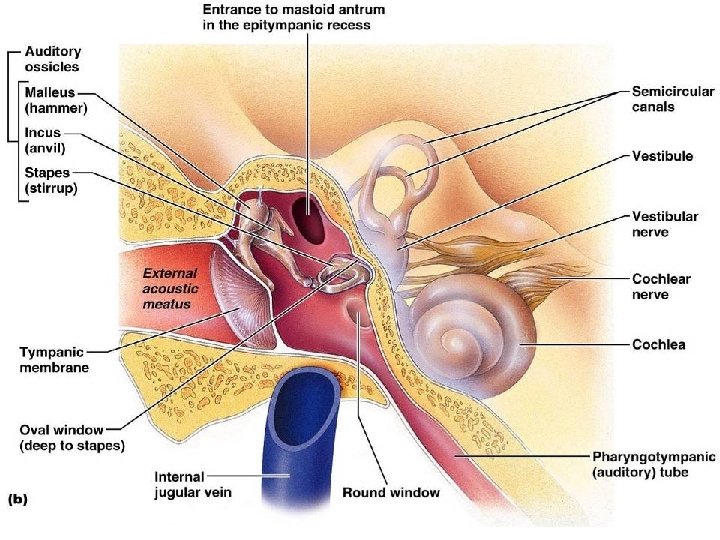
Middle and Internal Ear
Ear Ossicles • The tympanic cavity contains three small bones: • • • – Transmit _________________ of the eardrum to the _ – Dampened by the _
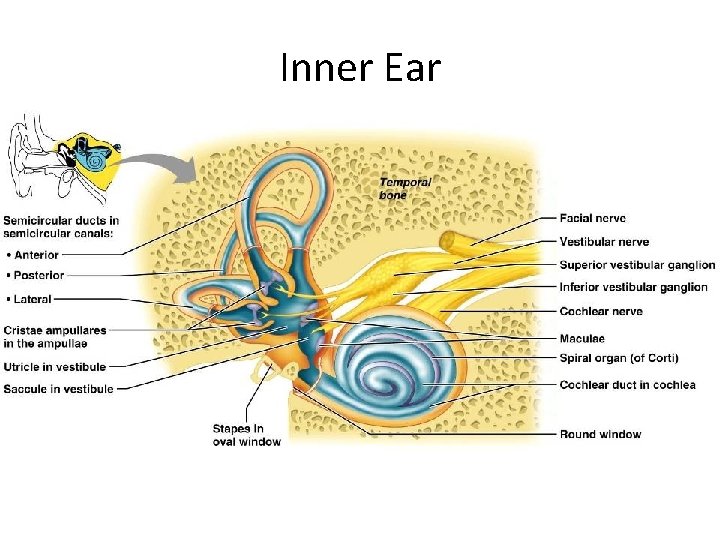
Inner Ear • – Tortuous channels worming their way through _ – Contains the _ – Filled with perilymph • Membranous labyrinth – Series of membranous sacs within the bony labyrinth – Filled with a _
Inner Ear
The Vestibule • The _________________ of the bony labyrinth • Suspended in its perilymph are two sacs: – – • The saccule extends _
- Slides: 35