
Photonic IP routing using optical codes 10 Gbits
Photonic IP routing using optical codes: 10 Gbit/s optical packet transfer experiment Presenter: Chen Wei Ren Date: 2005/06/10 1
Outline • • • Introduction Photonic IP routing Experimental set-up Result Conclusion 2
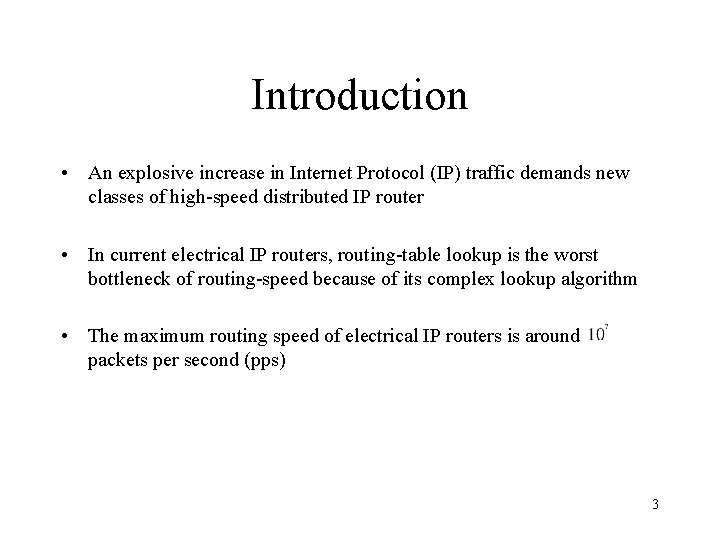
Introduction • An explosive increase in Internet Protocol (IP) traffic demands new classes of high-speed distributed IP router • In current electrical IP routers, routing-table lookup is the worst bottleneck of routing-speed because of its complex lookup algorithm • The maximum routing speed of electrical IP routers is around packets per second (pps) 3
![Introduction [contd] • Therefore, to remove the bottleneck of electrical table lookup, high performance](http://slidetodoc.com/presentation_image_h2/02b361023e7ce49d15cfb38ca42deae4/image-4.jpg "Introduction [contd] • Therefore, to remove the bottleneck of electrical table lookup, high performance")
Introduction [contd] • Therefore, to remove the bottleneck of electrical table lookup, high performance router having lookup speed close to the transmission rate is required • Only the photonic IP router will be able to satisfy this requirement • Its target speed is around pps 4
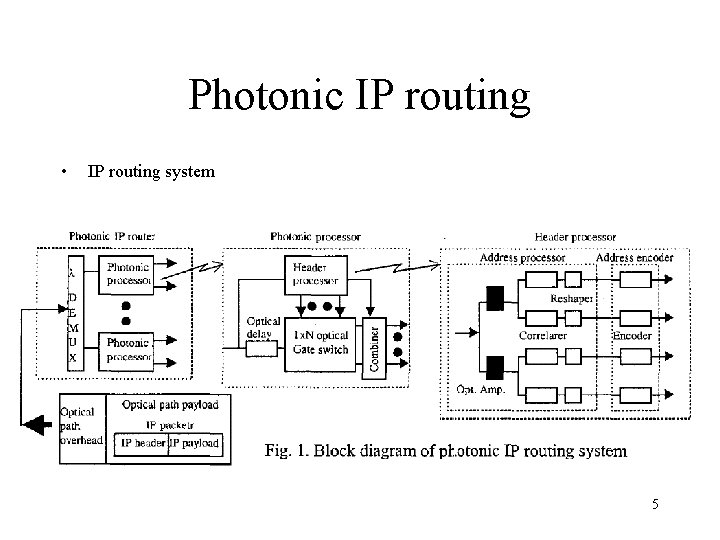
Photonic IP routing • IP routing system 5
![Photonic IP routing [contd] • The Optical frame ►optical path overhead: wavelength routing information](http://slidetodoc.com/presentation_image_h2/02b361023e7ce49d15cfb38ca42deae4/image-6.jpg "Photonic IP routing [contd] • The Optical frame ►optical path overhead: wavelength routing information")
Photonic IP routing [contd] • The Optical frame ►optical path overhead: wavelength routing information ►optical path payload: IP packet • The IP header is composed of the optical code Optical Frame 6
![Photonic IP routing [contd] • The photonic IP router ►wavelength demultiplexer ►photonic processor 7](http://slidetodoc.com/presentation_image_h2/02b361023e7ce49d15cfb38ca42deae4/image-7.jpg "Photonic IP routing [contd] • The photonic IP router ►wavelength demultiplexer ►photonic processor 7")
Photonic IP routing [contd] • The photonic IP router ►wavelength demultiplexer ►photonic processor 7
![Photonic IP routing [contd] • The photonic processor ►header processor ► 1×N optical switch](http://slidetodoc.com/presentation_image_h2/02b361023e7ce49d15cfb38ca42deae4/image-8.jpg "Photonic IP routing [contd] • The photonic processor ►header processor ► 1×N optical switch")
Photonic IP routing [contd] • The photonic processor ►header processor ► 1×N optical switch ►optical delay 8
![Photonic IP routing [contd] • The header processor ►address processor 1. optical amplifiers 2.](http://slidetodoc.com/presentation_image_h2/02b361023e7ce49d15cfb38ca42deae4/image-9.jpg "Photonic IP routing [contd] • The header processor ►address processor 1. optical amplifiers 2.")
Photonic IP routing [contd] • The header processor ►address processor 1. optical amplifiers 2. optical correlators 3. optical pulse reshapers ►address encoder 9
![Photonic IP routing [contd] • IP routing system 10](http://slidetodoc.com/presentation_image_h2/02b361023e7ce49d15cfb38ca42deae4/image-10.jpg "Photonic IP routing [contd] • IP routing system 10")
Photonic IP routing [contd] • IP routing system 10
Experimental set-up • Set-up ►Optical packet transmitter 1. 2 ps-10 GHz-MLLD 2. Li. Nb. O 3 intensity modulators (IM) 3. optical encoder 4. optical delay ►Photonic processor 1. address processor 2. 1× 2 optical gate switch 3. optical delay 11
![Experimental set-up [contd] 12](http://slidetodoc.com/presentation_image_h2/02b361023e7ce49d15cfb38ca42deae4/image-12.jpg "Experimental set-up [contd] 12")
Experimental set-up [contd] 12
![Experimental set-up [contd] • Address processor ►optical correlater ►photo detectors (PD) ►low-pass filters (LPF)](http://slidetodoc.com/presentation_image_h2/02b361023e7ce49d15cfb38ca42deae4/image-13.jpg "Experimental set-up [contd] • Address processor ►optical correlater ►photo detectors (PD) ►low-pass filters (LPF)")
Experimental set-up [contd] • Address processor ►optical correlater ►photo detectors (PD) ►low-pass filters (LPF) ►gain-clamped RF amplifier 13
![Experimental set-up [contd] • In the optical packet transmitter ►IM 1 and optical encoder](http://slidetodoc.com/presentation_image_h2/02b361023e7ce49d15cfb38ca42deae4/image-14.jpg "Experimental set-up [contd] • In the optical packet transmitter ►IM 1 and optical encoder")
Experimental set-up [contd] • In the optical packet transmitter ►IM 1 and optical encoder generate optical header which is 8 -chip BPSK optical cods with a time interval of 5 ps ►IM 2 generates 64 bit-long burst data signal at 10 Gbit/s • Generate optical code and payload data signal are combined to form a packet 14
![Experimental set-up [contd] • In the address processor ►if the input code matches with](http://slidetodoc.com/presentation_image_h2/02b361023e7ce49d15cfb38ca42deae4/image-15.jpg "Experimental set-up [contd] • In the address processor ►if the input code matches with")
Experimental set-up [contd] • In the address processor ►if the input code matches with the code of a correlater, the output (correlater signal) take a high value The correlation signal is converted to the electrical signal, and its waveform is elongated to gate and hold open the IM gate switch ►On the other hand, in unmatched case, the correlater signal takes lower value The bias is not changed, then the gate switch still close • The header processor can open an objective gate switch and reads the matched packet to the target port 15
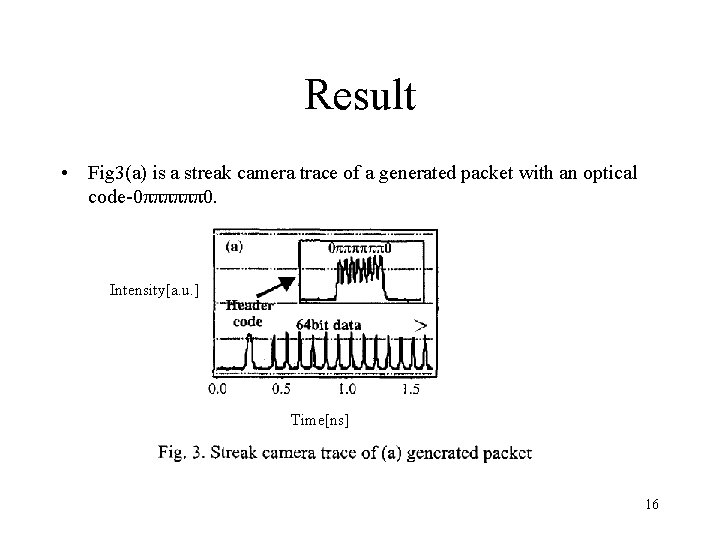
Result • Fig 3(a) is a streak camera trace of a generated packet with an optical code-0ππππππ0. Intensity[a. u. ] Time[ns] 16
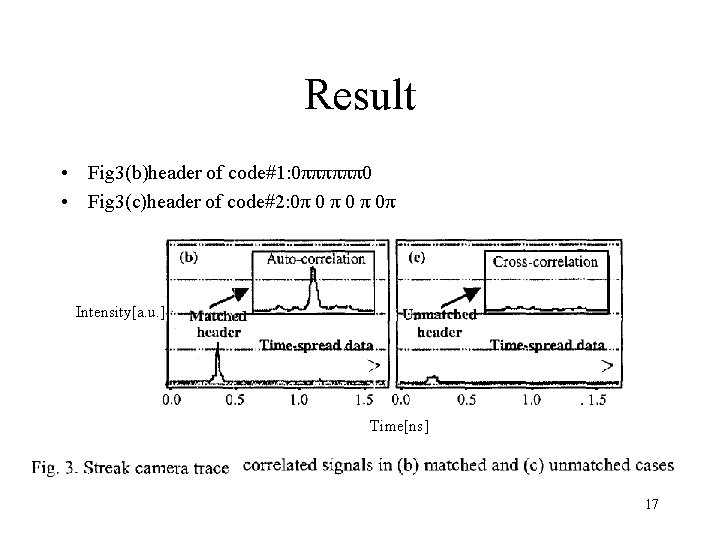
Result • Fig 3(b)header of code#1: 0ππππππ0 • Fig 3(c)header of code#2: 0π 0 π 0π Intensity[a. u. ] Time[ns] 17
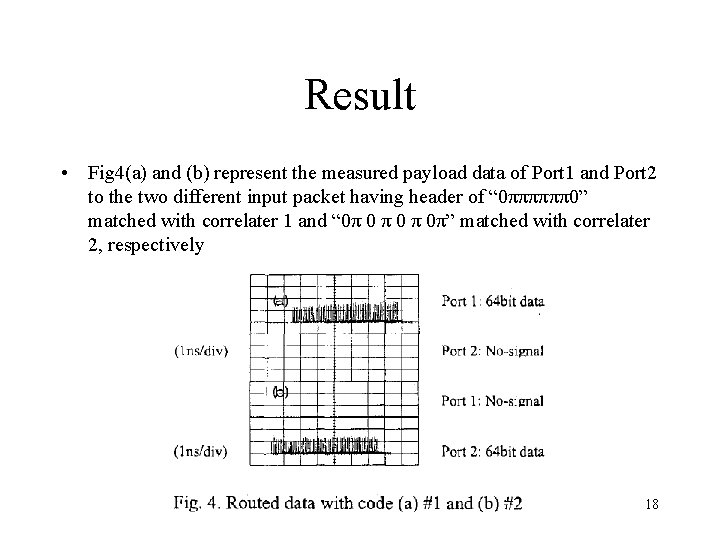
Result • Fig 4(a) and (b) represent the measured payload data of Port 1 and Port 2 to the two different input packet having header of “ 0ππππππ0” matched with correlater 1 and “ 0π 0 π 0π” matched with correlater 2, respectively 18
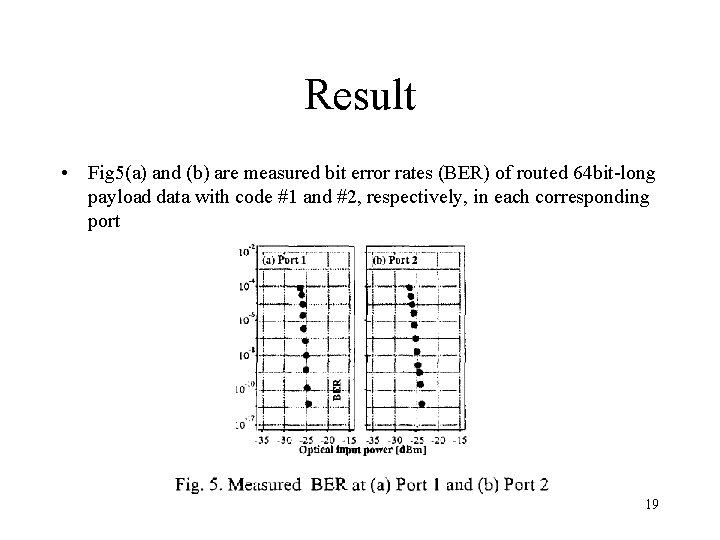
Result • Fig 5(a) and (b) are measured bit error rates (BER) of routed 64 bit-long payload data with code #1 and #2, respectively, in each corresponding port 19
Conclusion • Packets consisting of 8 -chip-long header and 64 bit-long burst payload data at 10 Gbit/s have been generated and routed optical domain, based upon photonic processings of the optically code address • All-optical control scheme for optical gate switch would be one of the subject to be studied 20
- Slides: 20