
Photonic Integrated Circuit FMCW Lidar On A Chip

- Slides: 20
Photonic Integrated Circuit FMCW Lidar On A Chip Paul J. M. Suni, James Colosimo, Lockheed Martin Coherent Technologies John Bowers, Larry Coldren, Jonathan Klamkin, University of California Santa Barbara S. J. Ben Yoo, University of California Davis This research was developed with funding from the Defense Advanced Research Projects Agency (DARPA). The views, opinions and/or findings expressed are those of the authors and should not be interpreted as representing the official views or policies of the Department of Defense or the U. S. Government. Distribution Statement "A" (Approved for Public Release, Distribution Unlimited) © Lockheed Martin Corporation. All rights reserved.
Outline • Photonic Integrated Circuits (PICs) introduction • DARPA Modular Optical Aperture Building Blocks (MOABB) Program – 5 year MTO program – Dr. Gordon Keeler PM – Lockheed Martin (LM) MOABB Team • LM Coherent Technologies • LM Advanced Technology Laboratory • UC Santa Barbara • UC Davis – Program goal is developing PIC based power/aperture scalable devices and architectures for lidar, communications, illuminators, designators etc. applications – Non-mechanical beam steering is critical part 2
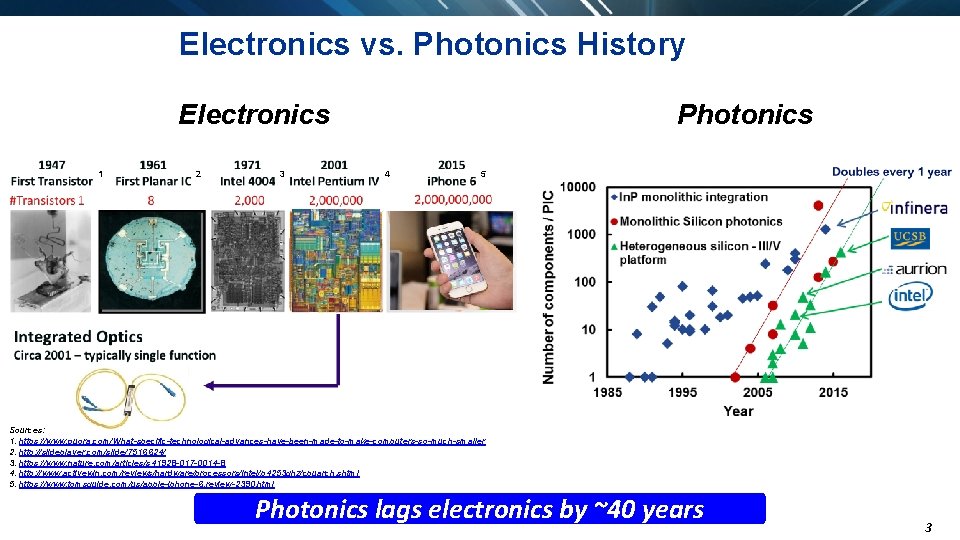
Electronics vs. Photonics History Electronics 1 2 3 Photonics 4 5 Sources: 1. https: //www. quora. com/What-specific-technological-advances-have-been-made-to-make-computers-so-much-smaller 2. http: //slideplayer. com/slide/7516624/ 3. https: //www. nature. com/articles/s 41928 -017 -0014 -8 4. http: //www. activewin. com/reviews/hardware/processors/intel/p 4253 ghz/cpuarch. shtml 5. https: //www. tomsguide. com/us/apple-iphone-6, review-2390. html Photonics lags electronics by ~40 years 3
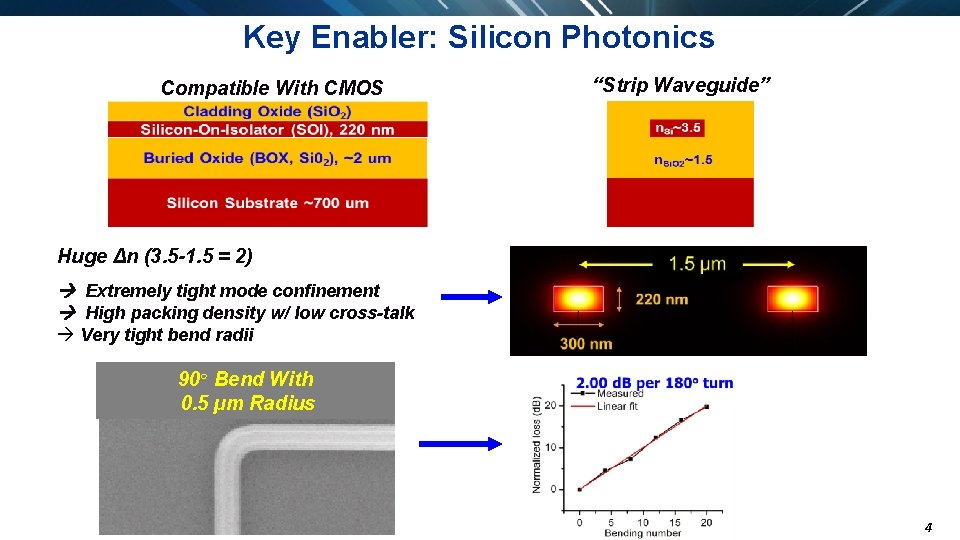
Key Enabler: Silicon Photonics Compatible With CMOS Fabrication “Strip Waveguide” Huge Δn (3. 5 -1. 5 = 2) Extremely tight mode confinement High packing density w/ low cross-talk à Very tight bend radii 90○ Bend With 0. 5 µm Radius 4
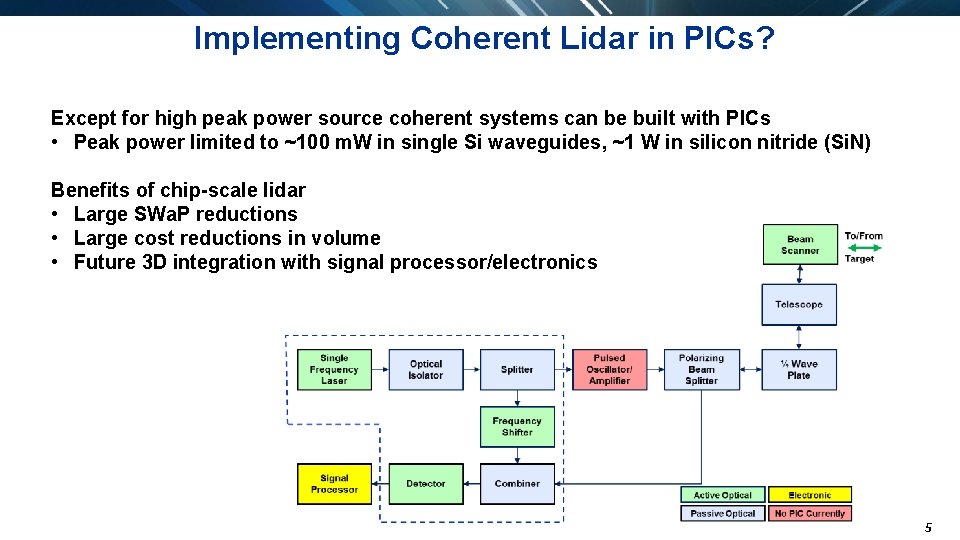
Implementing Coherent Lidar in PICs? Except for high peak power source coherent systems can be built with PICs • Peak power limited to ~100 m. W in single Si waveguides, ~1 W in silicon nitride (Si. N) Benefits of chip-scale lidar • Large SWa. P reductions • Large cost reductions in volume • Future 3 D integration with signal processor/electronics 5
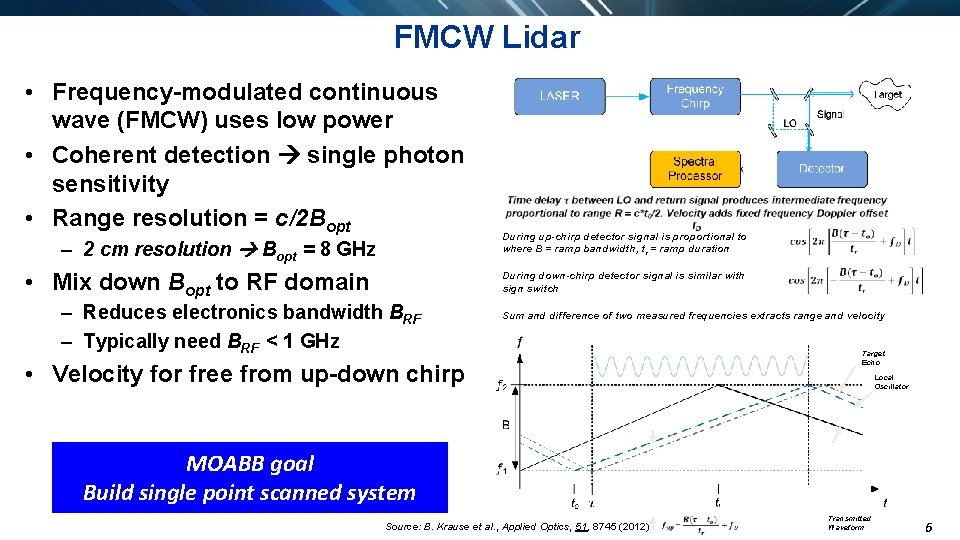
FMCW Lidar • Frequency-modulated continuous wave (FMCW) uses low power • Coherent detection single photon sensitivity • Range resolution = c/2 Bopt – 2 cm resolution Bopt = 8 GHz • Mix down Bopt to RF domain – Reduces electronics bandwidth BRF – Typically need BRF < 1 GHz During up-chirp detector signal is proportional to where B = ramp bandwidth, tr = ramp duration During down-chirp detector signal is similar with sign switch Sum and difference of two measured frequencies extracts range and velocity Target Echo • Velocity for free from up-down chirp Local Oscillator MOABB goal Build single point scanned system Source: B. Krause et al. , Applied Optics, 51, 8745 (2012) Transmitted Waveform 6
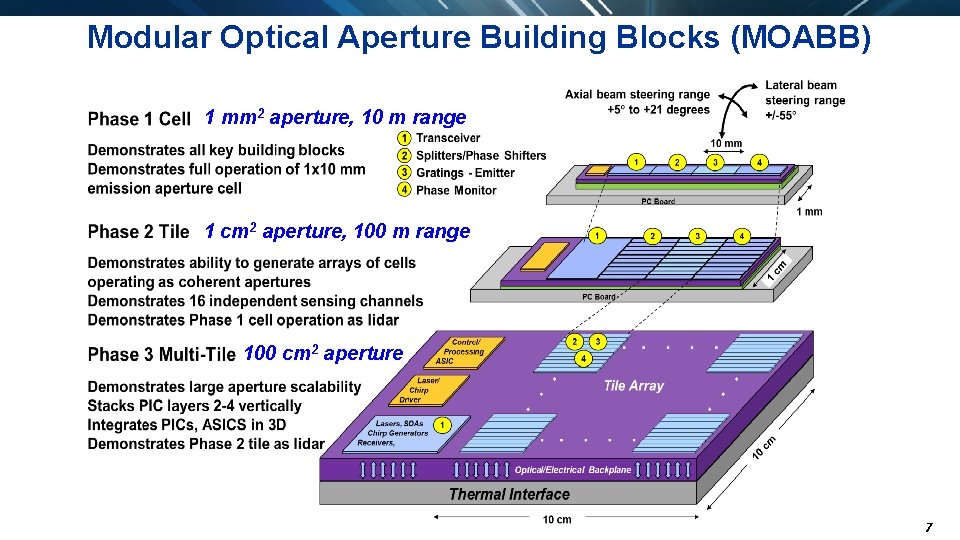
Modular Optical Aperture Building Blocks (MOABB) 1 mm 2 aperture, 10 m range 1 cm 2 aperture, 100 m range 100 cm 2 aperture 7
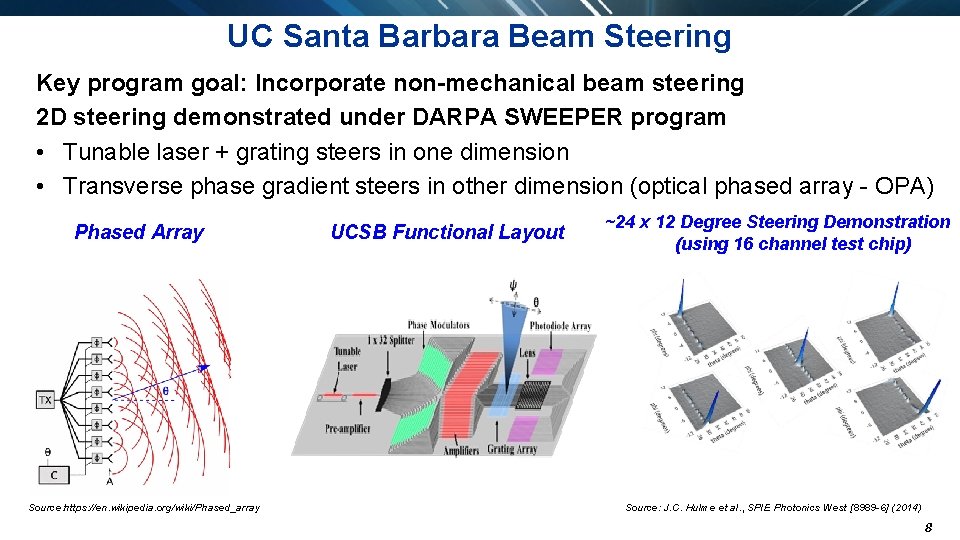
UC Santa Barbara Beam Steering Key program goal: Incorporate non-mechanical beam steering 2 D steering demonstrated under DARPA SWEEPER program • Tunable laser + grating steers in one dimension • Transverse phase gradient steers in other dimension (optical phased array - OPA) Phased Array Source: https: //en. wikipedia. org/wiki/Phased_array UCSB Functional Layout ~24 x 12 Degree Steering Demonstration (using 16 channel test chip) Source: J. C. Hulme et al. , SPIE Photonics West [8989 -6] (2014) 8
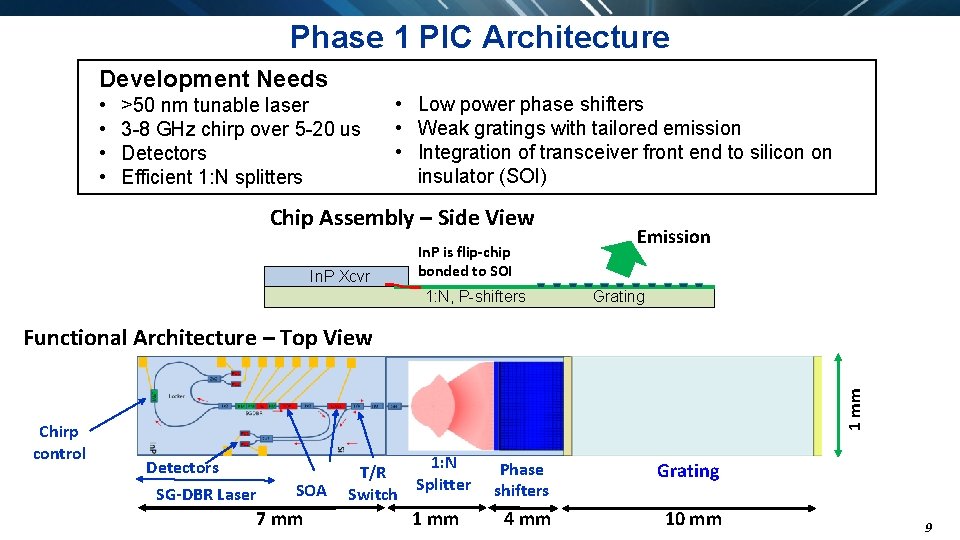
Phase 1 PIC Architecture Development Needs • • >50 nm tunable laser 3 -8 GHz chirp over 5 -20 us Detectors Efficient 1: N splitters • Low power phase shifters • Weak gratings with tailored emission • Integration of transceiver front end to silicon on insulator (SOI) Chip Assembly – Side View In. P Xcvr In. P is flip-chip bonded to SOI 1: N, P-shifters Emission Grating Chirp control 1 mm Functional Architecture – Top View Detectors SG-DBR Laser SOA 7 mm T/R Switch 1: N Splitter 1 mm Phase shifters Grating 4 mm 10 mm 9
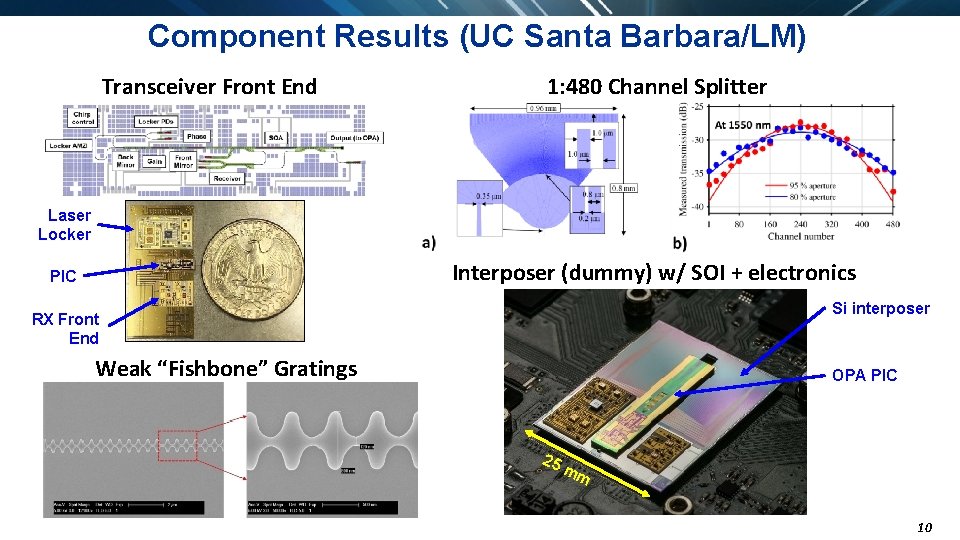
Component Results (UC Santa Barbara/LM) Transceiver Front End 1: 480 Channel Splitter Laser Locker Interposer (dummy) w/ SOI + electronics PIC Si interposer RX Front End Weak “Fishbone” Gratings OPA PIC 25 mm 10
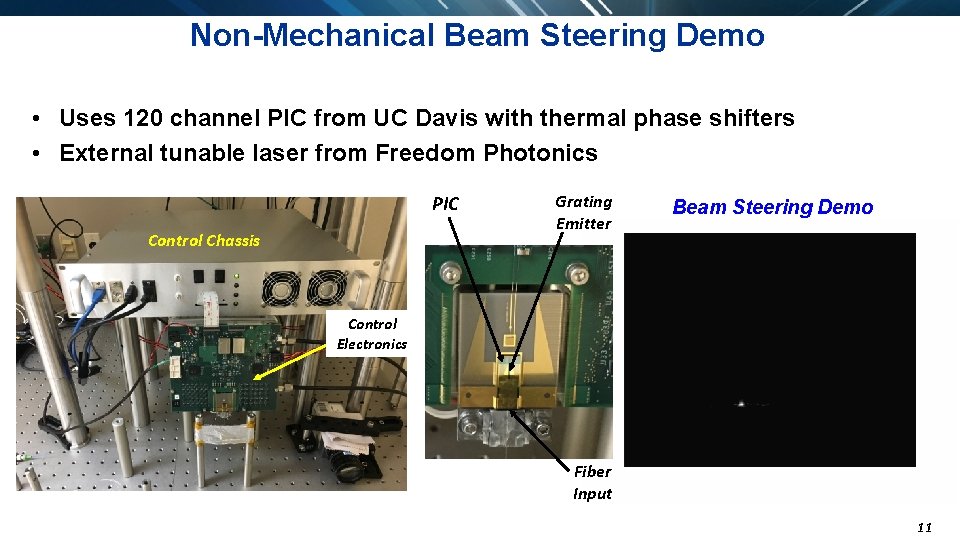
Non-Mechanical Beam Steering Demo • Uses 120 channel PIC from UC Davis with thermal phase shifters • External tunable laser from Freedom Photonics PIC Control Chassis Grating Emitter Beam Steering Demo Control Electronics Fiber Input 11
Aperture Scaling 12
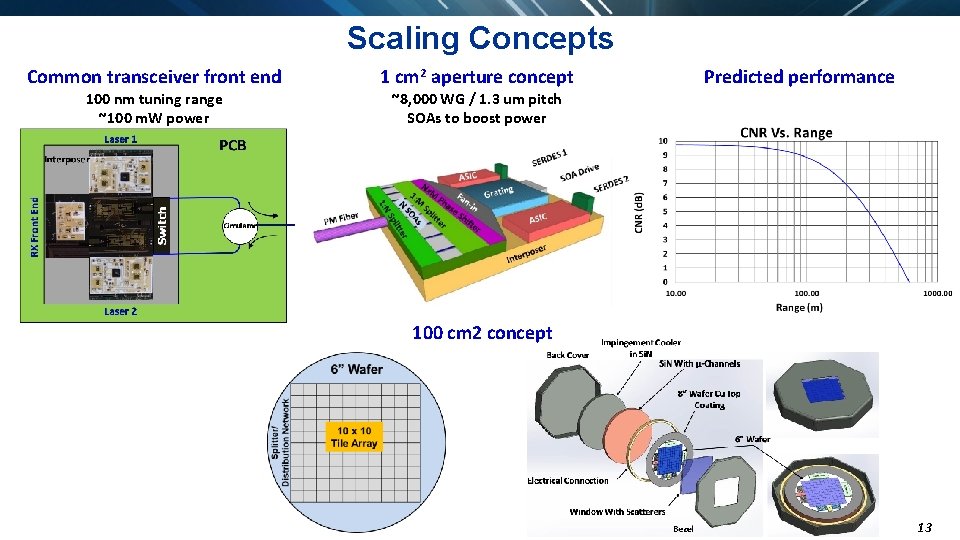
Scaling Concepts Common transceiver front end 100 nm tuning range ~100 m. W power 1 cm 2 aperture concept ~8, 000 WG / 1. 3 um pitch SOAs to boost power Predicted performance 100 cm 2 concept 13
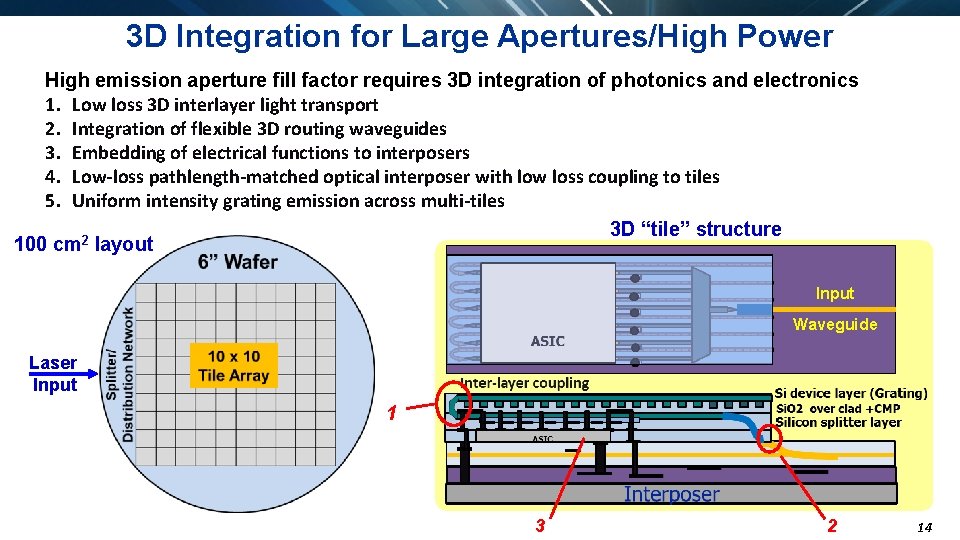
3 D Integration for Large Apertures/High Power High emission aperture fill factor requires 3 D integration of photonics and electronics 1. Low loss 3 D interlayer light transport 2. Integration of flexible 3 D routing waveguides 3. Embedding of electrical functions to interposers 4. Low-loss pathlength-matched optical interposer with low loss coupling to tiles 5. Uniform intensity grating emission across multi-tiles 3 D “tile” structure 2 100 cm layout Input Waveguide Laser Input 1 3 2 14
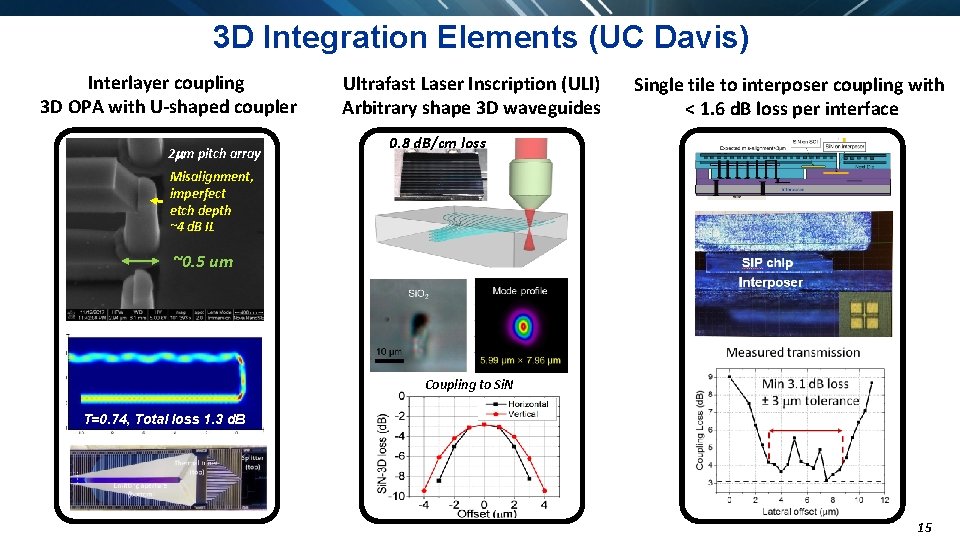
3 D Integration Elements (UC Davis) Interlayer coupling 3 D OPA with U-shaped coupler 2 mm pitch array Ultrafast Laser Inscription (ULI) Arbitrary shape 3 D waveguides Single tile to interposer coupling with < 1. 6 d. B loss per interface 0. 8 d. B/cm loss Misalignment, imperfect etch depth ~4 d. B IL ~0. 5 um Coupling to Si. N T=0. 74, Total loss 1. 3 d. B 15
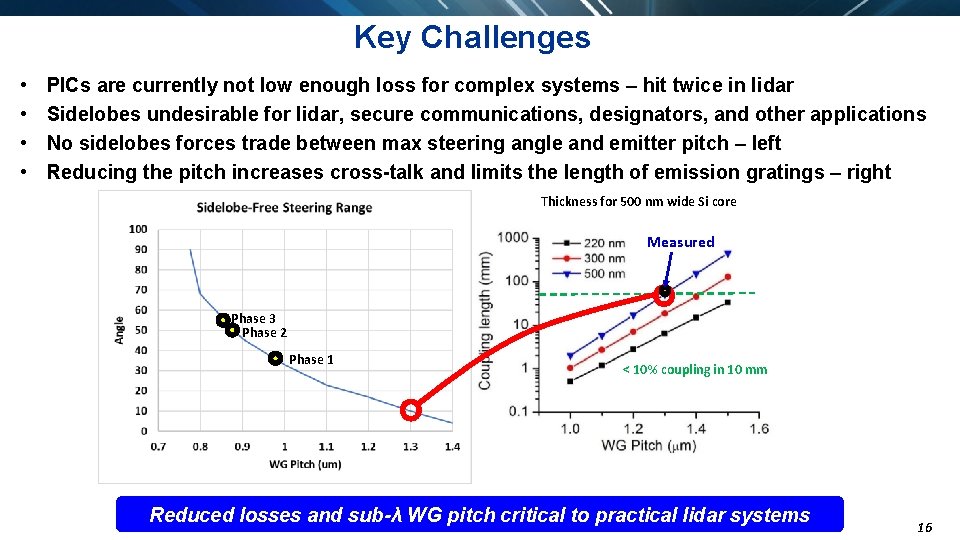
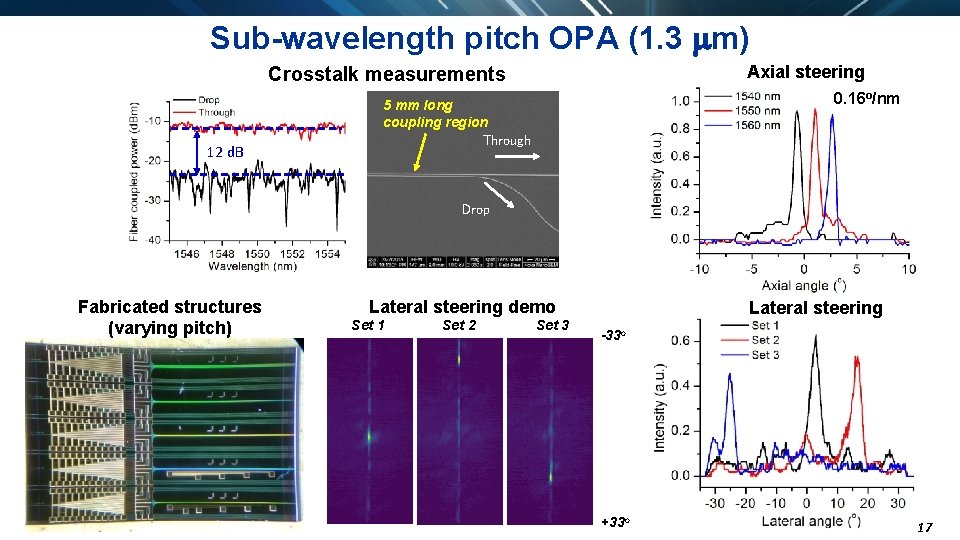
Key Challenges • • PICs are currently not low enough loss for complex systems – hit twice in lidar Sidelobes undesirable for lidar, secure communications, designators, and other applications No sidelobes forces trade between max steering angle and emitter pitch – left Reducing the pitch increases cross-talk and limits the length of emission gratings – right Thickness for 500 nm wide Si core Measured Phase 3 Phase 2 Phase 1 < 10% coupling in 10 mm Reduced losses and sub-λ WG pitch critical to practical lidar systems 16
Sub-wavelength pitch OPA (1. 3 mm) Axial steering Crosstalk measurements 12 d. B 0. 16 o/nm 5 mm long coupling region Through Drop Fabricated structures (varying pitch) Lateral steering demo Set 1 Set 2 Set 3 Lateral steering -33 o +33 o 17
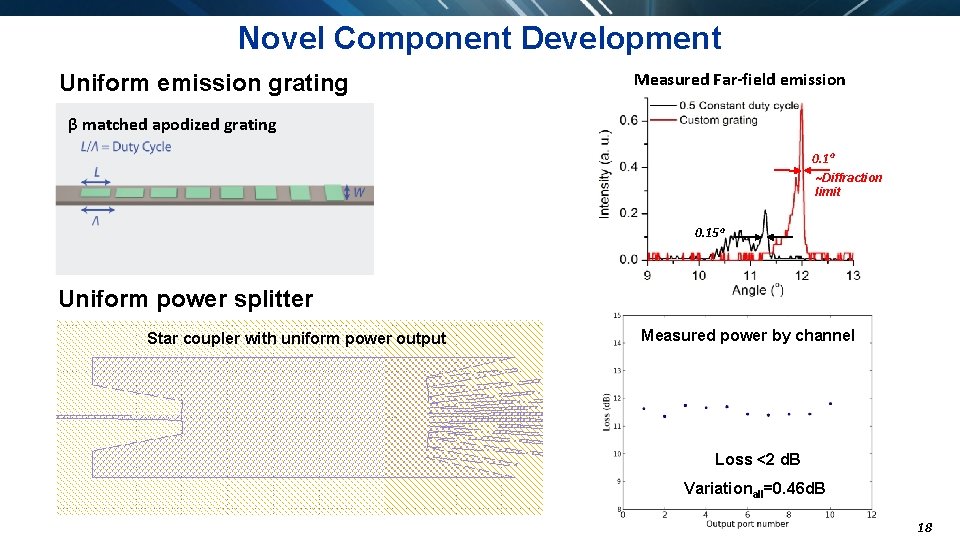
Novel Component Development Uniform emission grating Measured Far-field emission β matched apodized grating 0. 1 o ~Diffraction limit 0. 15 o Uniform power splitter Star coupler with uniform power output Measured power by channel Loss <2 d. B Variationall=0. 46 d. B 18
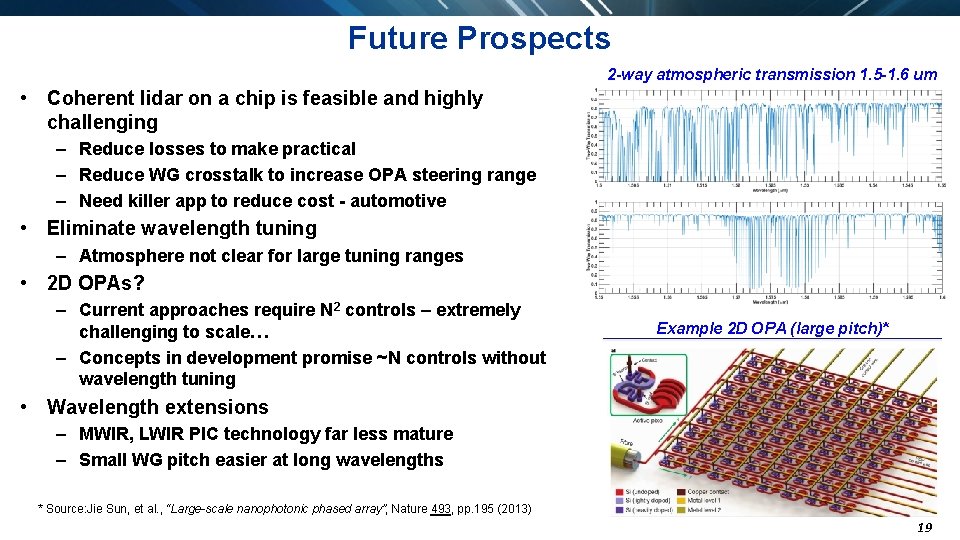
Future Prospects 2 -way atmospheric transmission 1. 5 -1. 6 um • Coherent lidar on a chip is feasible and highly challenging – Reduce losses to make practical – Reduce WG crosstalk to increase OPA steering range – Need killer app to reduce cost - automotive • Eliminate wavelength tuning – Atmosphere not clear for large tuning ranges • 2 D OPAs? – Current approaches require N 2 controls – extremely challenging to scale… – Concepts in development promise ~N controls without wavelength tuning Example 2 D OPA (large pitch)* • Wavelength extensions – MWIR, LWIR PIC technology far less mature – Small WG pitch easier at long wavelengths * Source: Jie Sun, et al. , “Large-scale nanophotonic phased array”, Nature 493, pp. 195 (2013) 19