
Photon neutron and proton induced reactions to produce

- Slides: 58
Photon, neutron and proton induced reactions to produce medical isotopes (CRP-Project No. 17443/R 0) BY H. Naik 1, G. N. Kim 2, S. V. Suryanarayana 3 & M. S. Murali 1 1. Radiochemistry Division, BARC 2. Kyungpook National Univ. , Korea 3. Nuclear Physics Division, BARC AND Dr. Roberto Capote Noy Division of Physical and Chemical Sciences, IAEA, VIENNA
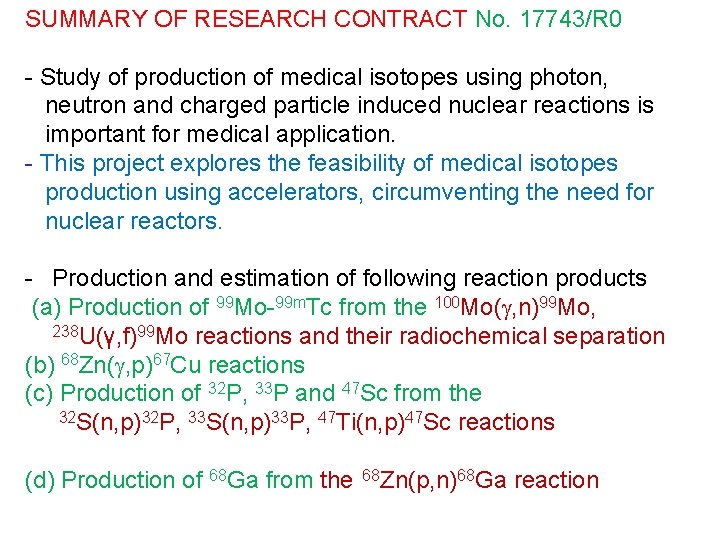
SUMMARY OF RESEARCH CONTRACT No. 17743/R 0 - Study of production of medical isotopes using photon, neutron and charged particle induced nuclear reactions is important for medical application. - This project explores the feasibility of medical isotopes production using accelerators, circumventing the need for nuclear reactors. - Production and estimation of following reaction products (a) Production of 99 Mo-99 m. Tc from the 100 Mo(g, n)99 Mo, 238 U(γ, f)99 Mo reactions and their radiochemical separation (b) 68 Zn(g, p)67 Cu reactions (c) Production of 32 P, 33 P and 47 Sc from the 32 S(n, p)32 P, 33 S(n, p)33 P, 47 Ti(n, p)47 Sc reactions (d) Production of 68 Ga from the 68 Zn(p, n)68 Ga reaction
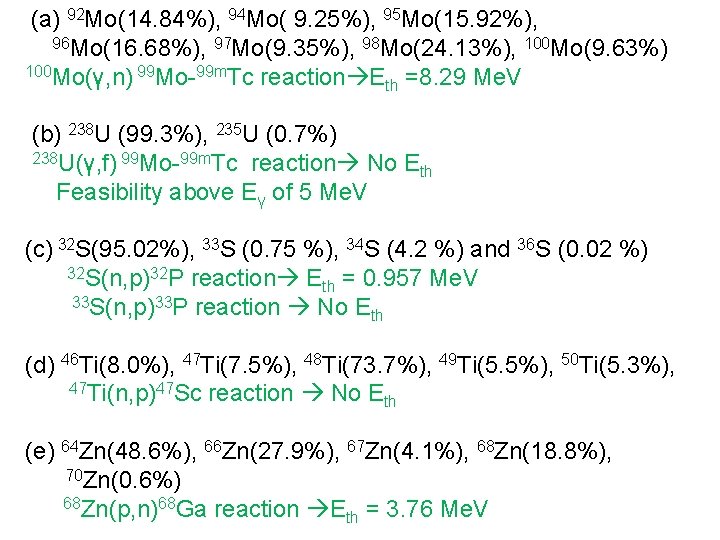
(a) 92 Mo(14. 84%), 94 Mo( 9. 25%), 95 Mo(15. 92%), 96 Mo(16. 68%), 97 Mo(9. 35%), 98 Mo(24. 13%), 100 Mo(9. 63%) 100 Mo(γ, n) 99 Mo-99 m. Tc reaction E =8. 29 Me. V th (b) 238 U (99. 3%), 235 U (0. 7%) 238 U(γ, f) 99 Mo-99 m. Tc reaction No E th Feasibility above Eγ of 5 Me. V (c) 32 S(95. 02%), 33 S (0. 75 %), 34 S (4. 2 %) and 36 S (0. 02 %) 32 S(n, p)32 P reaction E = 0. 957 Me. V th 33 S(n, p)33 P reaction No E th (d) 46 Ti(8. 0%), 47 Ti(7. 5%), 48 Ti(73. 7%), 49 Ti(5. 5%), 50 Ti(5. 3%), 47 Ti(n, p)47 Sc reaction No E th (e) 64 Zn(48. 6%), 66 Zn(27. 9%), 67 Zn(4. 1%), 68 Zn(18. 8%), 70 Zn(0. 6%) 68 Zn(p, n)68 Ga reaction E = 3. 76 Me. V th
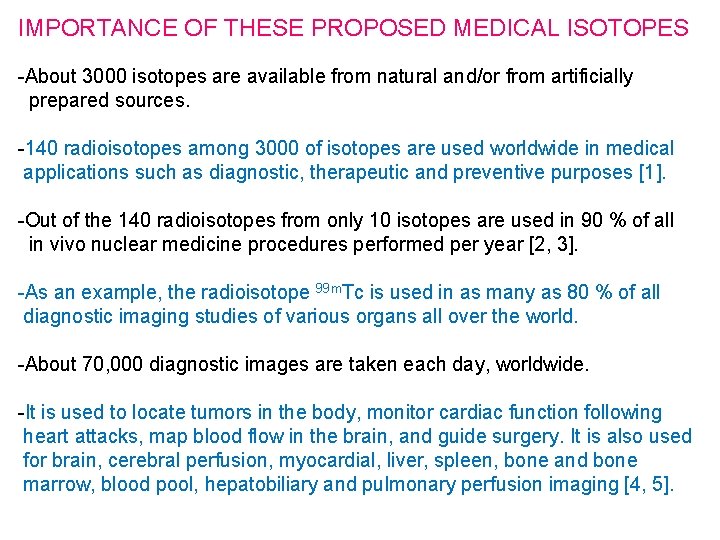
IMPORTANCE OF THESE PROPOSED MEDICAL ISOTOPES -About 3000 isotopes are available from natural and/or from artificially prepared sources. -140 radioisotopes among 3000 of isotopes are used worldwide in medical applications such as diagnostic, therapeutic and preventive purposes [1]. -Out of the 140 radioisotopes from only 10 isotopes are used in 90 % of all in vivo nuclear medicine procedures performed per year [2, 3]. -As an example, the radioisotope 99 m. Tc is used in as many as 80 % of all diagnostic imaging studies of various organs all over the world. -About 70, 000 diagnostic images are taken each day, worldwide. -It is used to locate tumors in the body, monitor cardiac function following heart attacks, map blood flow in the brain, and guide surgery. It is also used for brain, cerebral perfusion, myocardial, liver, spleen, bone and bone marrow, blood pool, hepatobiliary and pulmonary perfusion imaging [4, 5].
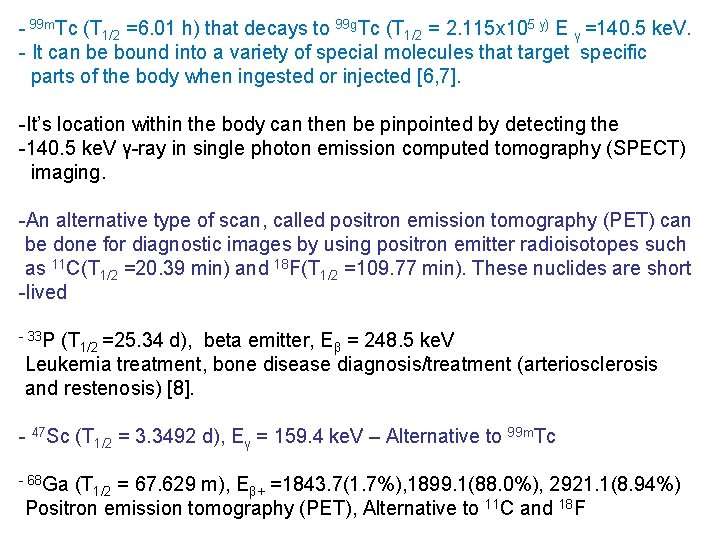
- 99 m. Tc (T 1/2 =6. 01 h) that decays to 99 g. Tc (T 1/2 = 2. 115 x 105 y) E γ =140. 5 ke. V. - It can be bound into a variety of special molecules that target specific parts of the body when ingested or injected [6, 7]. -It’s location within the body can then be pinpointed by detecting the -140. 5 ke. V γ-ray in single photon emission computed tomography (SPECT) imaging. -An alternative type of scan, called positron emission tomography (PET) can be done for diagnostic images by using positron emitter radioisotopes such as 11 C(T 1/2 =20. 39 min) and 18 F(T 1/2 =109. 77 min). These nuclides are short -lived - 33 P (T 1/2 =25. 34 d), beta emitter, Eβ = 248. 5 ke. V Leukemia treatment, bone disease diagnosis/treatment (arteriosclerosis and restenosis) [8]. - 47 Sc (T 1/2 = 3. 3492 d), Eγ = 159. 4 ke. V – Alternative to 99 m. Tc - 68 Ga (T 1/2 = 67. 629 m), Eβ+ =1843. 7(1. 7%), 1899. 1(88. 0%), 2921. 1(8. 94%) Positron emission tomography (PET), Alternative to 11 C and 18 F
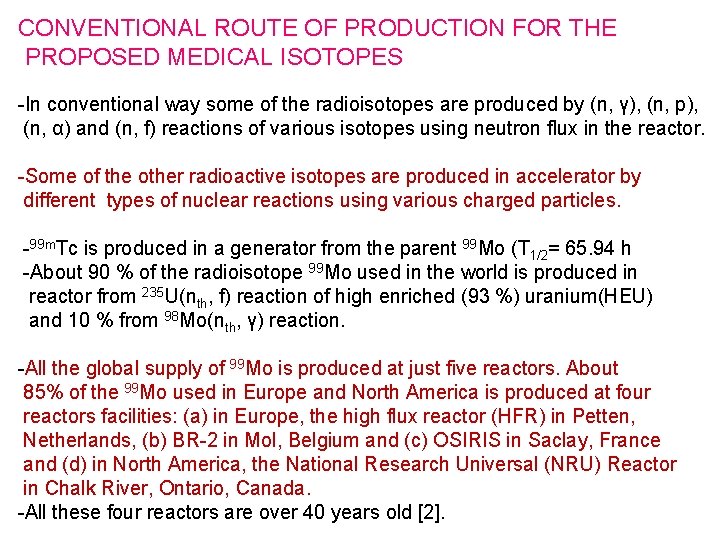
CONVENTIONAL ROUTE OF PRODUCTION FOR THE PROPOSED MEDICAL ISOTOPES -In conventional way some of the radioisotopes are produced by (n, γ), (n, p), (n, α) and (n, f) reactions of various isotopes using neutron flux in the reactor. -Some of the other radioactive isotopes are produced in accelerator by different types of nuclear reactions using various charged particles. -99 m. Tc is produced in a generator from the parent 99 Mo (T 1/2= 65. 94 h -About 90 % of the radioisotope 99 Mo used in the world is produced in reactor from 235 U(nth, f) reaction of high enriched (93 %) uranium(HEU) and 10 % from 98 Mo(nth, γ) reaction. -All the global supply of 99 Mo is produced at just five reactors. About 85% of the 99 Mo used in Europe and North America is produced at four reactors facilities: (a) in Europe, the high flux reactor (HFR) in Petten, Netherlands, (b) BR-2 in Mol, Belgium and (c) OSIRIS in Saclay, France and (d) in North America, the National Research Universal (NRU) Reactor in Chalk River, Ontario, Canada. -All these four reactors are over 40 years old [2].
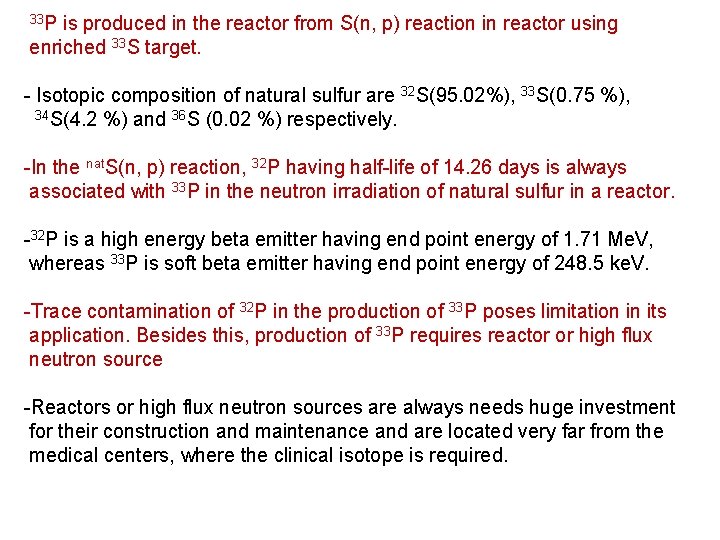
33 P is produced in the reactor from S(n, p) reaction in reactor using enriched 33 S target. - Isotopic composition of natural sulfur are 32 S(95. 02%), 33 S(0. 75 %), 34 S(4. 2 %) and 36 S (0. 02 %) respectively. -In the nat. S(n, p) reaction, 32 P having half-life of 14. 26 days is always associated with 33 P in the neutron irradiation of natural sulfur in a reactor. -32 P is a high energy beta emitter having end point energy of 1. 71 Me. V, whereas 33 P is soft beta emitter having end point energy of 248. 5 ke. V. -Trace contamination of 32 P in the production of 33 P poses limitation in its application. Besides this, production of 33 P requires reactor or high flux neutron source -Reactors or high flux neutron sources are always needs huge investment for their construction and maintenance and are located very far from the medical centers, where the clinical isotope is required.
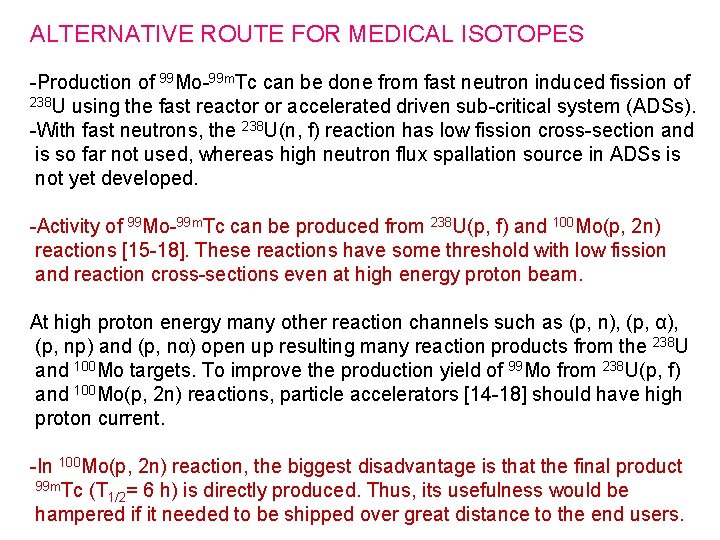
ALTERNATIVE ROUTE FOR MEDICAL ISOTOPES -Production of 99 Mo-99 m. Tc can be done from fast neutron induced fission of 238 U using the fast reactor or accelerated driven sub-critical system (ADSs). -With fast neutrons, the 238 U(n, f) reaction has low fission cross-section and is so far not used, whereas high neutron flux spallation source in ADSs is not yet developed. -Activity of 99 Mo-99 m. Tc can be produced from 238 U(p, f) and 100 Mo(p, 2 n) reactions [15 -18]. These reactions have some threshold with low fission and reaction cross-sections even at high energy proton beam. At high proton energy many other reaction channels such as (p, n), (p, α), (p, np) and (p, nα) open up resulting many reaction products from the 238 U and 100 Mo targets. To improve the production yield of 99 Mo from 238 U(p, f) and 100 Mo(p, 2 n) reactions, particle accelerators [14 -18] should have high proton current. -In 100 Mo(p, 2 n) reaction, the biggest disadvantage is that the final product 99 m. Tc (T = 6 h) is directly produced. Thus, its usefulness would be 1/2 hampered if it needed to be shipped over great distance to the end users.
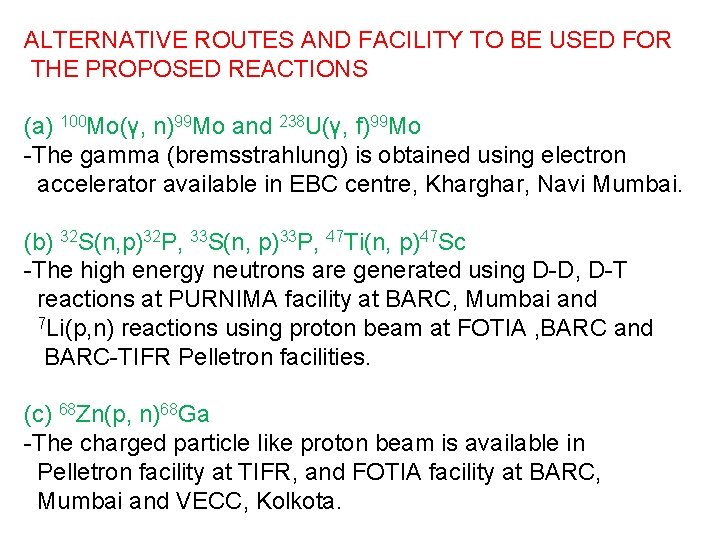
ALTERNATIVE ROUTES AND FACILITY TO BE USED FOR THE PROPOSED REACTIONS (a) 100 Mo(γ, n)99 Mo and 238 U(γ, f)99 Mo -The gamma (bremsstrahlung) is obtained using electron accelerator available in EBC centre, Kharghar, Navi Mumbai. (b) 32 S(n, p)32 P, 33 S(n, p)33 P, 47 Ti(n, p)47 Sc -The high energy neutrons are generated using D-D, D-T reactions at PURNIMA facility at BARC, Mumbai and 7 Li(p, n) reactions using proton beam at FOTIA , BARC and BARC-TIFR Pelletron facilities. (c) 68 Zn(p, n)68 Ga -The charged particle like proton beam is available in Pelletron facility at TIFR, and FOTIA facility at BARC, Mumbai and VECC, Kolkota.
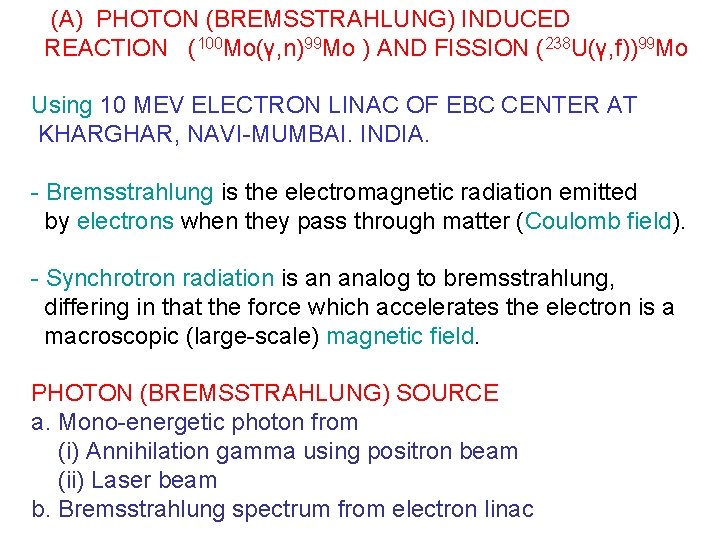
(A) PHOTON (BREMSSTRAHLUNG) INDUCED REACTION (100 Mo(γ, n)99 Mo ) AND FISSION (238 U(γ, f))99 Mo Using 10 MEV ELECTRON LINAC OF EBC CENTER AT KHARGHAR, NAVI-MUMBAI. INDIA. - Bremsstrahlung is the electromagnetic radiation emitted by electrons when they pass through matter (Coulomb field). - Synchrotron radiation is an analog to bremsstrahlung, differing in that the force which accelerates the electron is a macroscopic (large-scale) magnetic field. PHOTON (BREMSSTRAHLUNG) SOURCE a. Mono-energetic photon from (i) Annihilation gamma using positron beam (ii) Laser beam b. Bremsstrahlung spectrum from electron linac
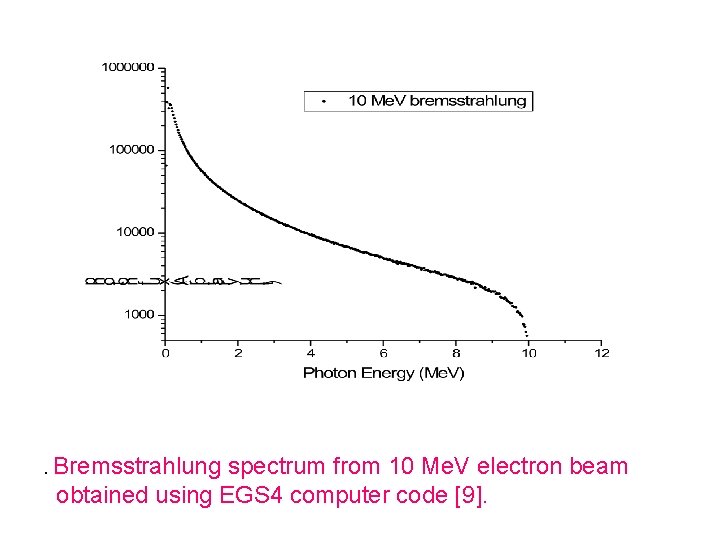
. Bremsstrahlung spectrum from 10 Me. V electron beam obtained using EGS 4 computer code [9].
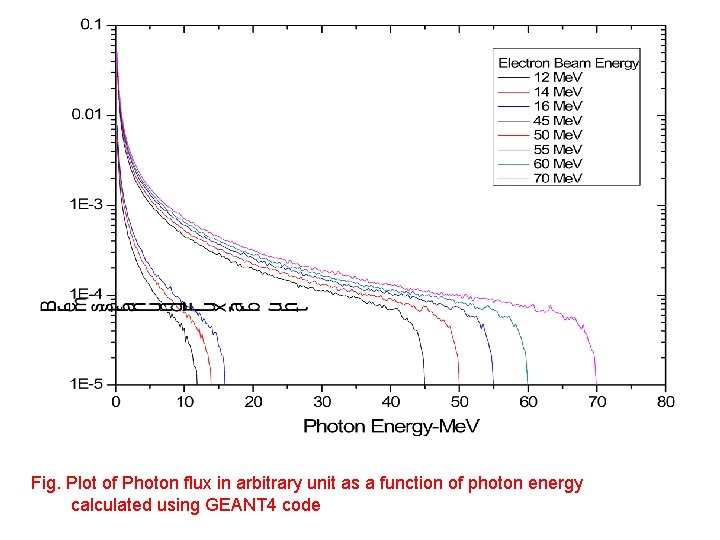
Fig. Plot of Photon flux in arbitrary unit as a function of photon energy calculated using GEANT 4 code
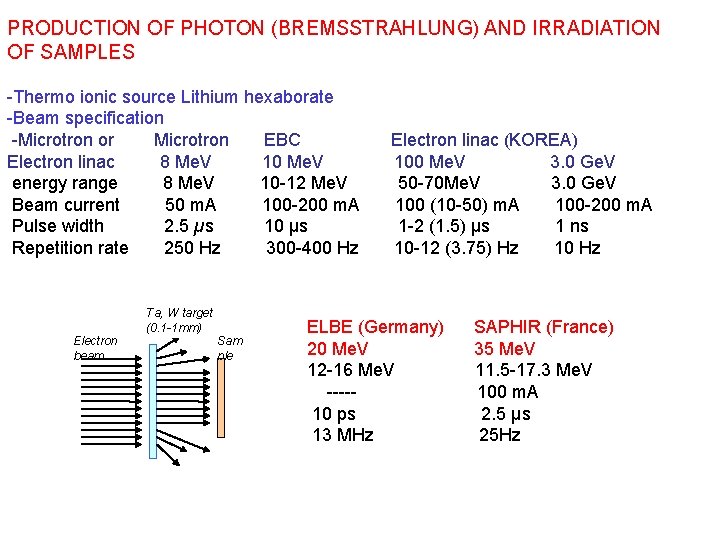
PRODUCTION OF PHOTON (BREMSSTRAHLUNG) AND IRRADIATION OF SAMPLES -Thermo ionic source Lithium hexaborate -Beam specification -Microtron or Microtron EBC Electron linac 8 Me. V 10 Me. V energy range 8 Me. V 10 -12 Me. V Beam current 50 m. A 100 -200 m. A Pulse width 2. 5 µs 10 μs Repetition rate 250 Hz 300 -400 Hz Ta, W target (0. 1 -1 mm) Electron beam Sam ple Electron linac (KOREA) 100 Me. V 3. 0 Ge. V 50 -70 Me. V 3. 0 Ge. V 100 (10 -50) m. A 100 -200 m. A 1 -2 (1. 5) μs 1 ns 10 -12 (3. 75) Hz 10 Hz ELBE (Germany) 20 Me. V 12 -16 Me. V ----10 ps 13 MHz SAPHIR (France) 35 Me. V 11. 5 -17. 3 Me. V 100 m. A 2. 5 μs 25 Hz
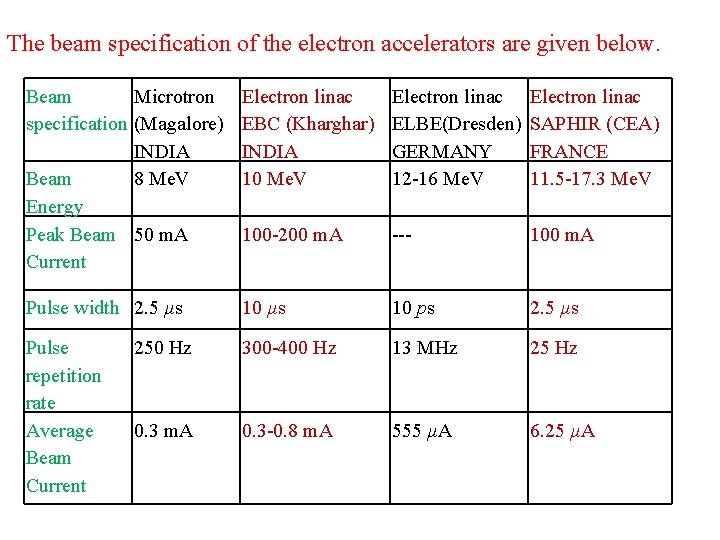
The beam specification of the electron accelerators are given below. Beam Microtron specification (Magalore) INDIA Beam 8 Me. V Energy Peak Beam 50 m. A Current Electron linac EBC (Kharghar) INDIA 10 Me. V Electron linac ELBE(Dresden) GERMANY 12 -16 Me. V Electron linac SAPHIR (CEA) FRANCE 11. 5 -17. 3 Me. V 100 -200 m. A --- 100 m. A Pulse width 2. 5 µs 10 ps 2. 5 µs Pulse repetition rate Average Beam Current 250 Hz 300 -400 Hz 13 MHz 25 Hz 0. 3 m. A 0. 3 -0. 8 m. A 555 µA 6. 25 µA
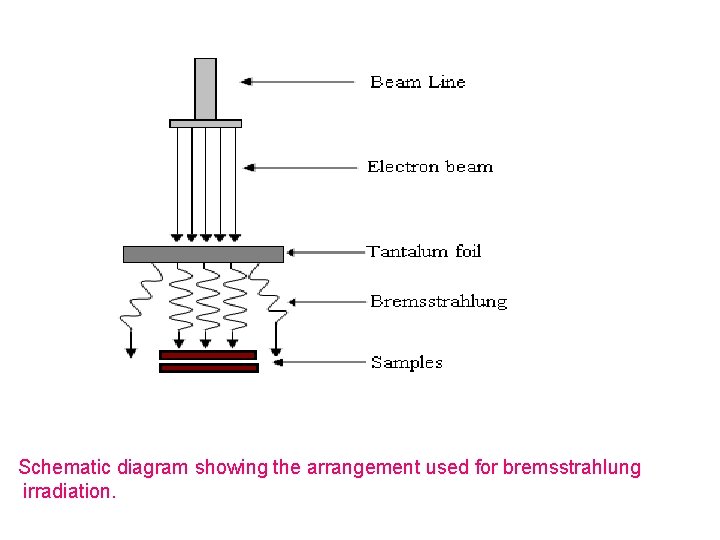
Schematic diagram showing the arrangement used for bremsstrahlung irradiation.
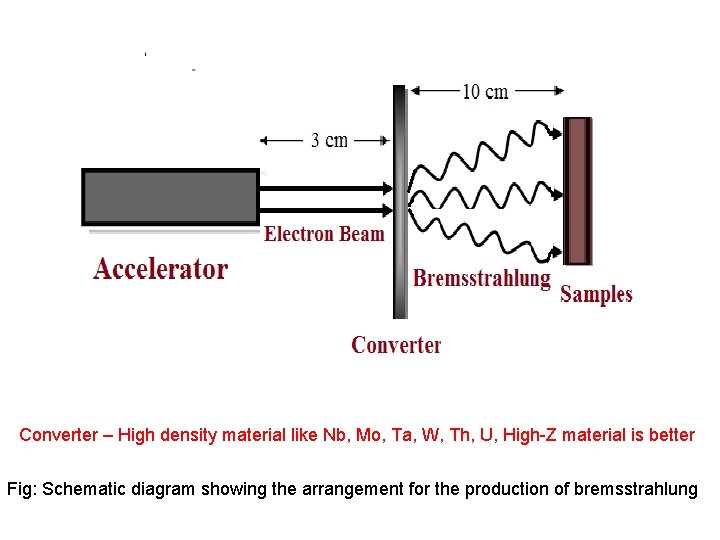
Converter – High density material like Nb, Mo, Ta, W, Th, U, High-Z material is better Fig: Schematic diagram showing the arrangement for the production of bremsstrahlung
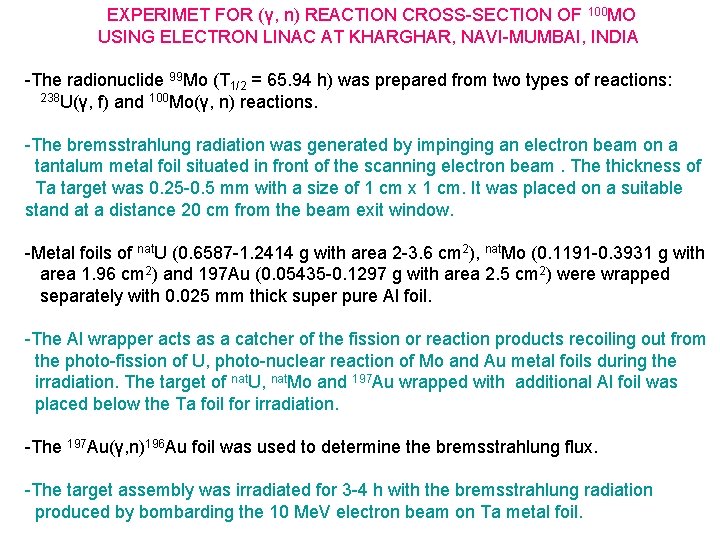
EXPERIMET FOR (γ, n) REACTION CROSS-SECTION OF 100 MO USING ELECTRON LINAC AT KHARGHAR, NAVI-MUMBAI, INDIA -The radionuclide 99 Mo (T 1/2 = 65. 94 h) was prepared from two types of reactions: 238 U(γ, f) and 100 Mo(γ, n) reactions. -The bremsstrahlung radiation was generated by impinging an electron beam on a tantalum metal foil situated in front of the scanning electron beam. The thickness of Ta target was 0. 25 -0. 5 mm with a size of 1 cm x 1 cm. It was placed on a suitable stand at a distance 20 cm from the beam exit window. -Metal foils of nat. U (0. 6587 -1. 2414 g with area 2 -3. 6 cm 2), nat. Mo (0. 1191 -0. 3931 g with area 1. 96 cm 2) and 197 Au (0. 05435 -0. 1297 g with area 2. 5 cm 2) were wrapped separately with 0. 025 mm thick super pure Al foil. -The Al wrapper acts as a catcher of the fission or reaction products recoiling out from the photo-fission of U, photo-nuclear reaction of Mo and Au metal foils during the irradiation. The target of nat. U, nat. Mo and 197 Au wrapped with additional Al foil was placed below the Ta foil for irradiation. -The 197 Au(γ, n)196 Au foil was used to determine the bremsstrahlung flux. -The target assembly was irradiated for 3 -4 h with the bremsstrahlung radiation produced by bombarding the 10 Me. V electron beam on Ta metal foil.
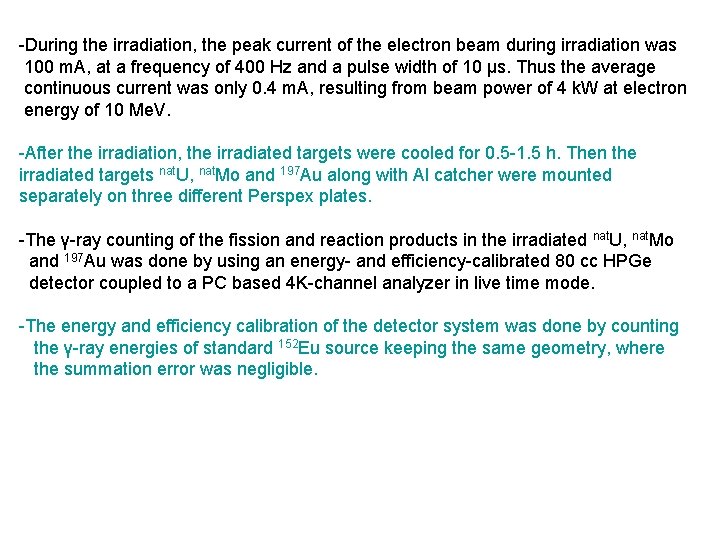
-During the irradiation, the peak current of the electron beam during irradiation was 100 m. A, at a frequency of 400 Hz and a pulse width of 10 μs. Thus the average continuous current was only 0. 4 m. A, resulting from beam power of 4 k. W at electron energy of 10 Me. V. -After the irradiation, the irradiated targets were cooled for 0. 5 -1. 5 h. Then the irradiated targets nat. U, nat. Mo and 197 Au along with Al catcher were mounted separately on three different Perspex plates. -The γ-ray counting of the fission and reaction products in the irradiated nat. U, nat. Mo and 197 Au was done by using an energy- and efficiency-calibrated 80 cc HPGe detector coupled to a PC based 4 K-channel analyzer in live time mode. -The energy and efficiency calibration of the detector system was done by counting the γ-ray energies of standard 152 Eu source keeping the same geometry, where the summation error was negligible.
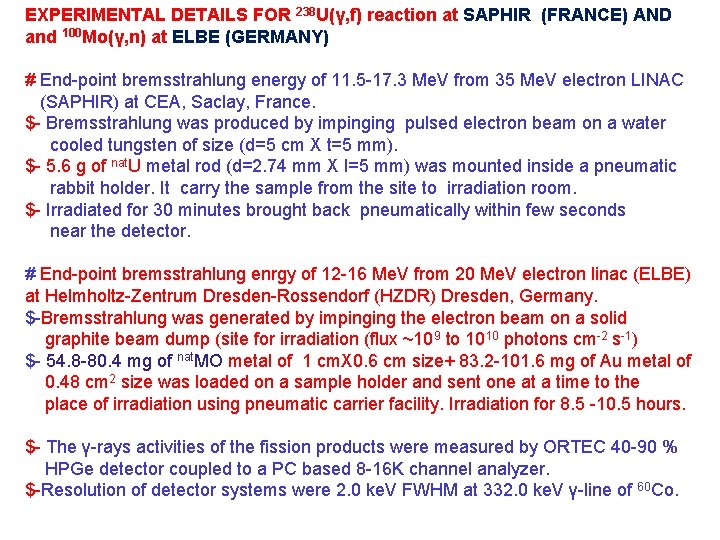
EXPERIMENTAL DETAILS FOR 238 U(γ, f) reaction at SAPHIR (FRANCE) AND and 100 Mo(γ, n) at ELBE (GERMANY) # End-point bremsstrahlung energy of 11. 5 -17. 3 Me. V from 35 Me. V electron LINAC (SAPHIR) at CEA, Saclay, France. $- Bremsstrahlung was produced by impinging pulsed electron beam on a water cooled tungsten of size (d=5 cm X t=5 mm). $- 5. 6 g of nat. U metal rod (d=2. 74 mm X l=5 mm) was mounted inside a pneumatic rabbit holder. It carry the sample from the site to irradiation room. $- Irradiated for 30 minutes brought back pneumatically within few seconds near the detector. # End-point bremsstrahlung enrgy of 12 -16 Me. V from 20 Me. V electron linac (ELBE) at Helmholtz-Zentrum Dresden-Rossendorf (HZDR) Dresden, Germany. $-Bremsstrahlung was generated by impinging the electron beam on a solid graphite beam dump (site for irradiation (flux ~109 to 1010 photons cm-2 s-1) $- 54. 8 -80. 4 mg of nat. MO metal of 1 cm. X 0. 6 cm size+ 83. 2 -101. 6 mg of Au metal of 0. 48 cm 2 size was loaded on a sample holder and sent one at a time to the place of irradiation using pneumatic carrier facility. Irradiation for 8. 5 -10. 5 hours. $- The γ-rays activities of the fission products were measured by ORTEC 40 -90 % HPGe detector coupled to a PC based 8 -16 K channel analyzer. $-Resolution of detector systems were 2. 0 ke. V FWHM at 332. 0 ke. V γ-line of 60 Co.
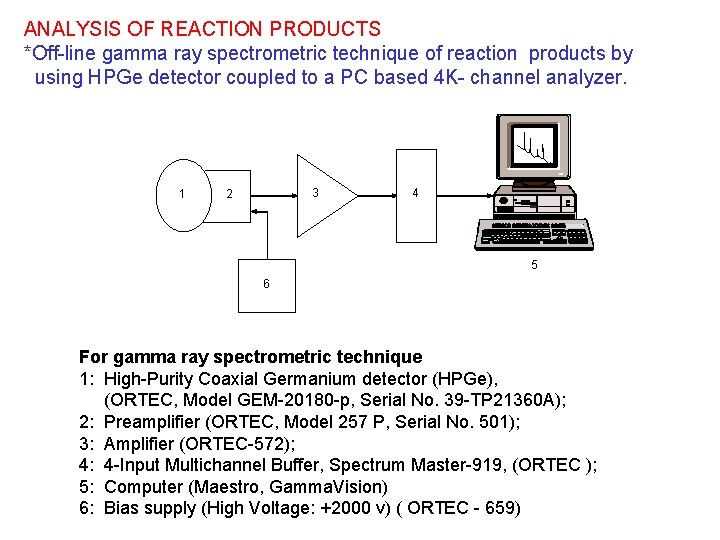
ANALYSIS OF REACTION PRODUCTS *Off-line gamma ray spectrometric technique of reaction products by using HPGe detector coupled to a PC based 4 K- channel analyzer. 1 3 2 4 5 6 For gamma ray spectrometric technique 1: High-Purity Coaxial Germanium detector (HPGe), (ORTEC, Model GEM-20180 -p, Serial No. 39 -TP 21360 A); 2: Preamplifier (ORTEC, Model 257 P, Serial No. 501); 3: Amplifier (ORTEC-572); 4: 4 -Input Multichannel Buffer, Spectrum Master-919, (ORTEC ); 5: Computer (Maestro, Gamma. Vision) 6: Bias supply (High Voltage: +2000 v) ( ORTEC - 659)
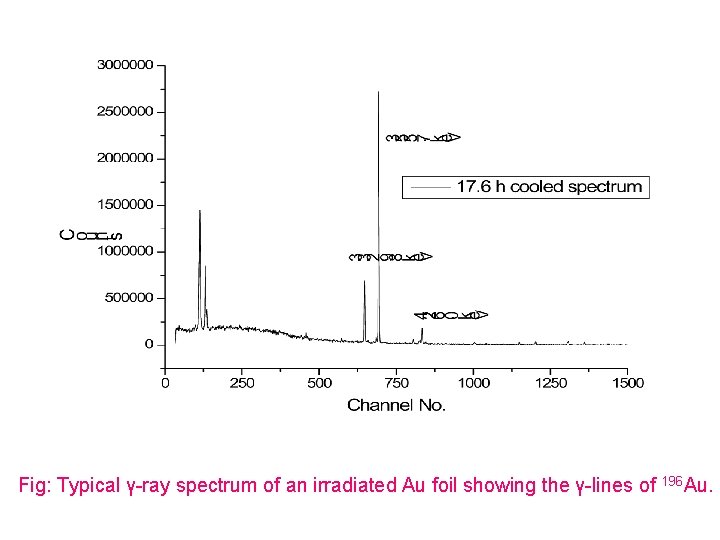
Fig: Typical γ-ray spectrum of an irradiated Au foil showing the γ-lines of 196 Au.
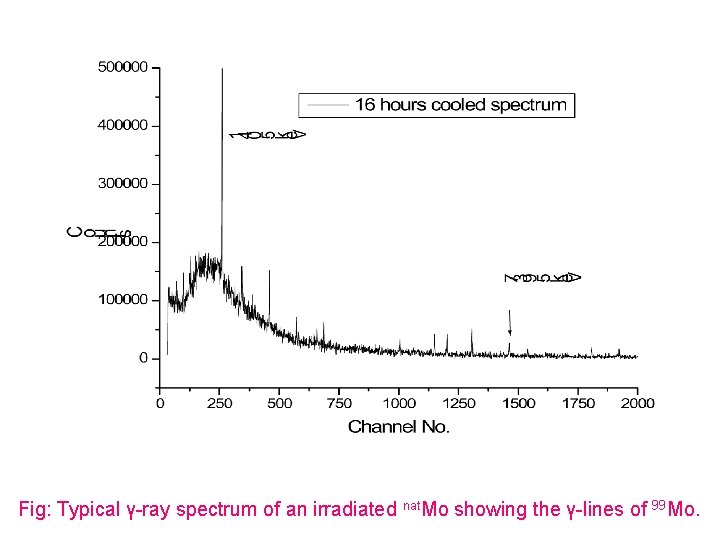
Fig: Typical γ-ray spectrum of an irradiated nat. Mo showing the γ-lines of 99 Mo.
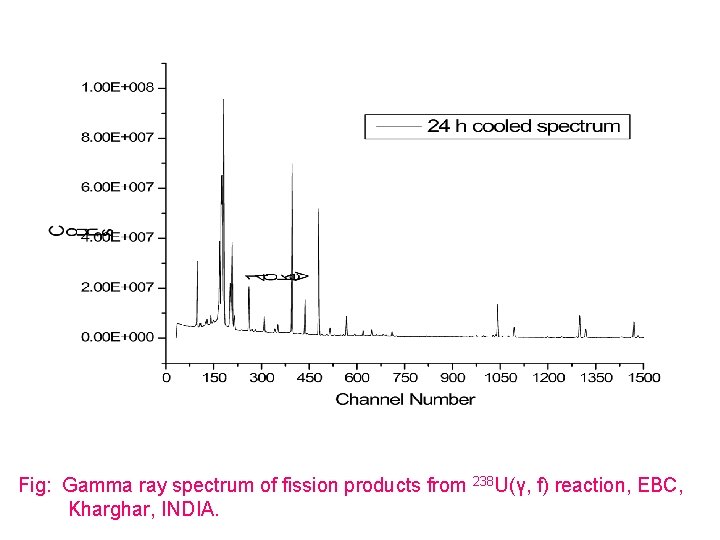
Fig: Gamma ray spectrum of fission products from 238 U(γ, f) reaction, EBC, Kharghar, INDIA.
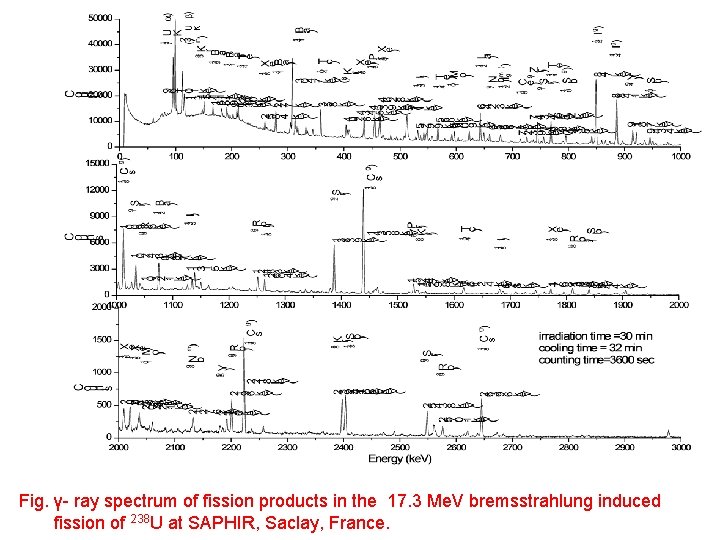
Fig. γ- ray spectrum of fission products in the 17. 3 Me. V bremsstrahlung induced fission of 238 U at SAPHIR, Saclay, France.
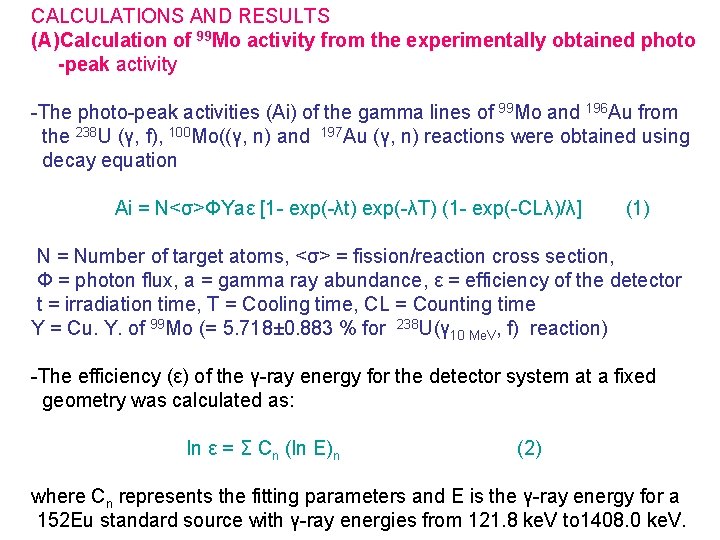
CALCULATIONS AND RESULTS (A)Calculation of 99 Mo activity from the experimentally obtained photo -peak activity -The photo-peak activities (Ai) of the gamma lines of 99 Mo and 196 Au from the 238 U (γ, f), 100 Mo((γ, n) and 197 Au (γ, n) reactions were obtained using decay equation Ai = N<σ>ΦYaε [1 - exp(-λt) exp(-λT) (1 - exp(-CLλ)/λ] (1) N = Number of target atoms, <σ> = fission/reaction cross section, Φ = photon flux, a = gamma ray abundance, ε = efficiency of the detector t = irradiation time, T = Cooling time, CL = Counting time Y = Cu. Y. of 99 Mo (= 5. 718± 0. 883 % for 238 U(γ 10 Me. V, f) reaction) -The efficiency (ε) of the γ-ray energy for the detector system at a fixed geometry was calculated as: ln ε = Σ Cn (ln E)n (2) where Cn represents the fitting parameters and E is the γ-ray energy for a 152 Eu standard source with γ-ray energies from 121. 8 ke. V to 1408. 0 ke. V.
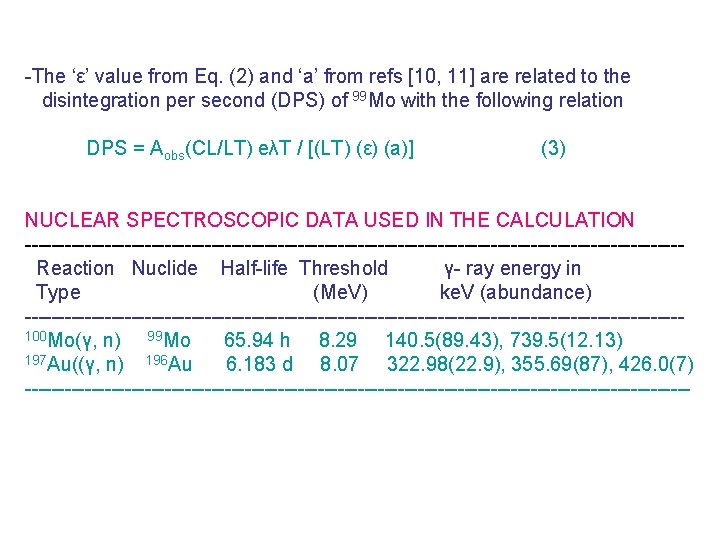
-The ‘ε’ value from Eq. (2) and ‘a’ from refs [10, 11] are related to the disintegration per second (DPS) of 99 Mo with the following relation DPS = Aobs(CL/LT) eλT / [(LT) (ε) (a)] (3) NUCLEAR SPECTROSCOPIC DATA USED IN THE CALCULATION -------------------------------------------------Reaction Nuclide Half-life Threshold γ- ray energy in Type (Me. V) ke. V (abundance) -------------------------------------------------100 Mo(γ, n) 99 Mo 65. 94 h 8. 29 140. 5(89. 43), 739. 5(12. 13) 197 Au((γ, n) 196 Au 6. 183 d 8. 07 322. 98(22. 9), 355. 69(87), 426. 0(7) --------------------------------------------------
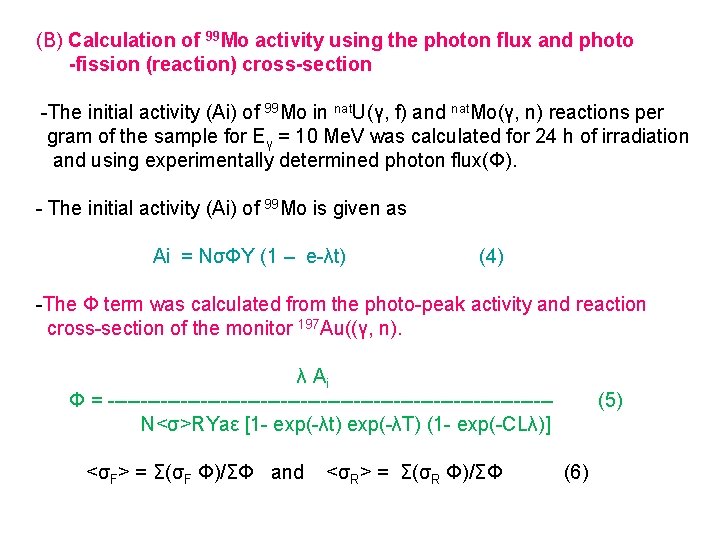
(B) Calculation of 99 Mo activity using the photon flux and photo -fission (reaction) cross-section -The initial activity (Ai) of 99 Mo in nat. U(γ, f) and nat. Mo(γ, n) reactions per gram of the sample for Eγ = 10 Me. V was calculated for 24 h of irradiation and using experimentally determined photon flux(Φ). - The initial activity (Ai) of 99 Mo is given as Ai = NσΦY (1 – e-λt) (4) -The Φ term was calculated from the photo-peak activity and reaction cross-section of the monitor 197 Au((γ, n). λ Ai Φ = ---------------------------------N<σ>RYaε [1 - exp(-λt) exp(-λT) (1 - exp(-CLλ)] <σF> = Σ(σF Φ)/ΣΦ and <σR> = Σ(σR Φ)/ΣΦ (5) (6)
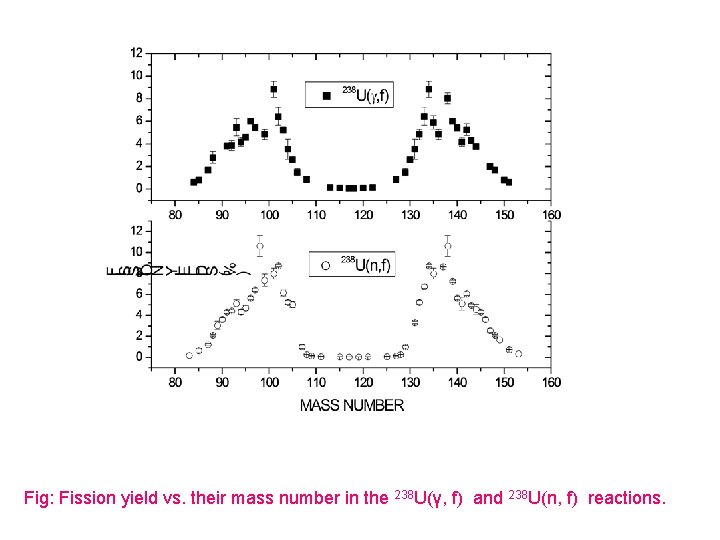
Fig: Fission yield vs. their mass number in the 238 U(γ, f) and 238 U(n, f) reactions.
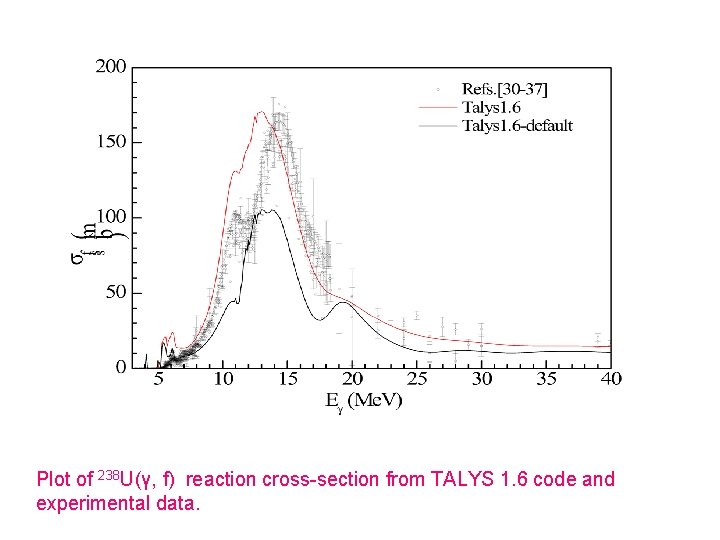
Plot of 238 U(γ, f) reaction cross-section from TALYS 1. 6 code and experimental data.
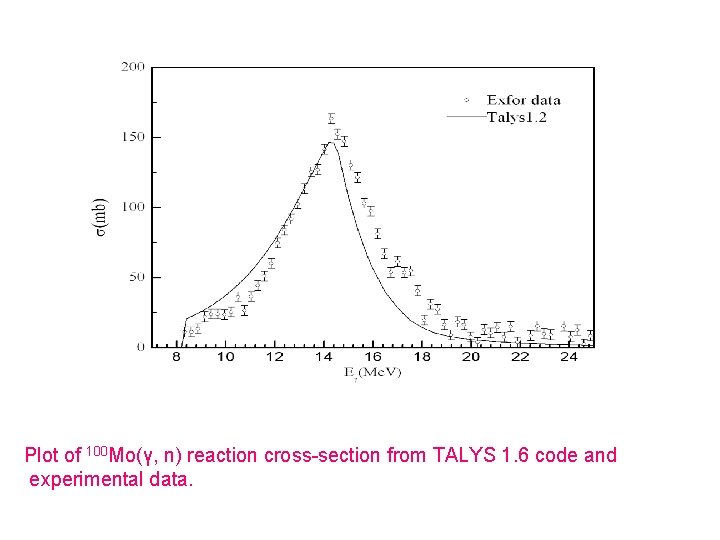
Plot of 100 Mo(γ, n) reaction cross-section from TALYS 1. 6 code and experimental data.
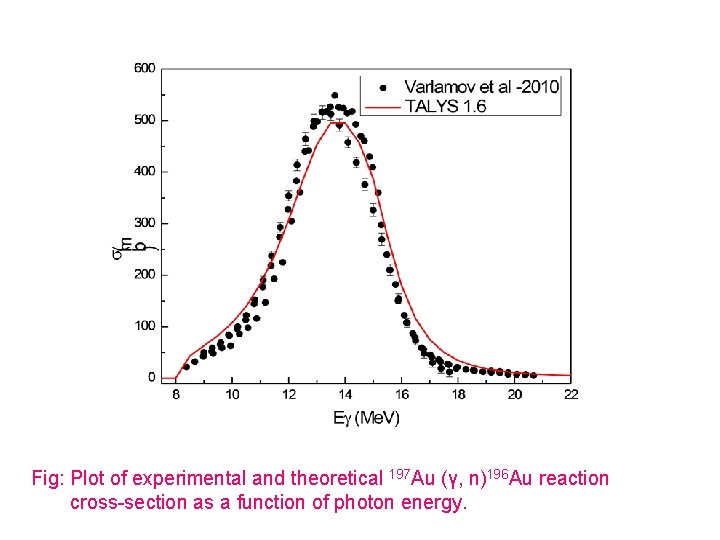
Fig: Plot of experimental and theoretical 197 Au (γ, n)196 Au reaction cross-section as a function of photon energy.
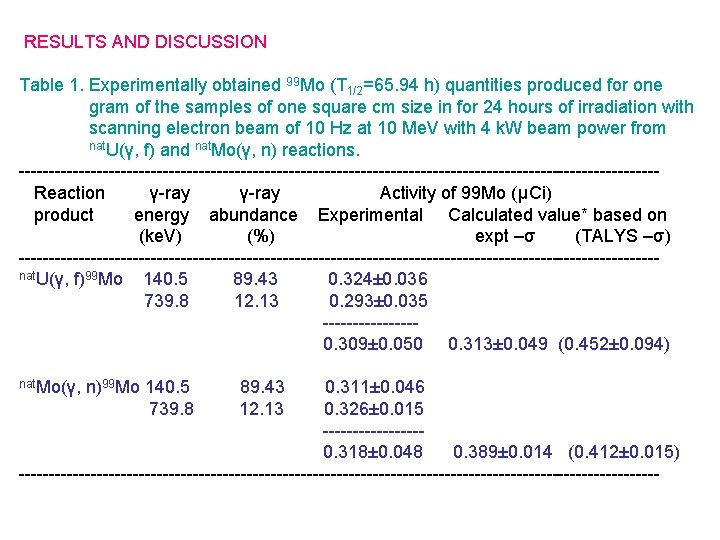
RESULTS AND DISCUSSION Table 1. Experimentally obtained 99 Mo (T 1/2=65. 94 h) quantities produced for one gram of the samples of one square cm size in for 24 hours of irradiation with scanning electron beam of 10 Hz at 10 Me. V with 4 k. W beam power from nat. U(γ, f) and nat. Mo(γ, n) reactions. -----------------------------------------------------Reaction γ-ray Activity of 99 Mo (μCi) product energy abundance Experimental Calculated value* based on (ke. V) (%) expt –σ (TALYS –σ) -----------------------------------------------------nat. U(γ, f)99 Mo 140. 5 89. 43 0. 324± 0. 036 739. 8 12. 13 0. 293± 0. 035 --------0. 309± 0. 050 0. 313± 0. 049 (0. 452± 0. 094) nat. Mo(γ, n)99 Mo 140. 5 739. 8 89. 43 12. 13 0. 311± 0. 046 0. 326± 0. 015 --------0. 318± 0. 048 0. 389± 0. 014 (0. 412± 0. 015) ------------------------------------------------------
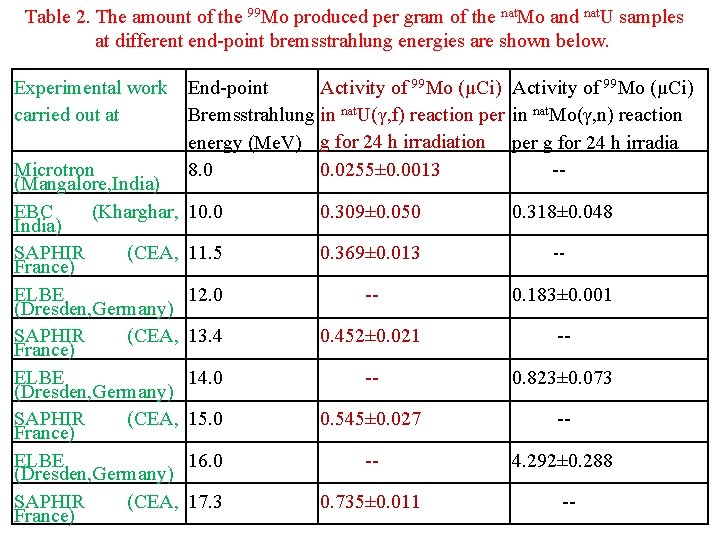
Table 2. The amount of the 99 Mo produced per gram of the nat. Mo and nat. U samples at different end-point bremsstrahlung energies are shown below. Experimental work carried out at Microtron (Mangalore, India) EBC (Kharghar, India) SAPHIR (CEA, France) ELBE (Dresden, Germany) SAPHIR (CEA, France) End-point Activity of 99 Mo (μCi) Bremsstrahlung in nat. U(γ, f) reaction per in nat. Mo(γ, n) reaction energy (Me. V) g for 24 h irradiation per g for 24 h irradia 8. 0 0. 0255± 0. 0013 -10. 0 0. 309± 0. 050 0. 318± 0. 048 11. 5 0. 369± 0. 013 -- 12. 0 -- 0. 183± 0. 001 13. 4 0. 452± 0. 021 -- 14. 0 -- 0. 823± 0. 073 15. 0 0. 545± 0. 027 -- 16. 0 -- 4. 292± 0. 288 17. 3 0. 735± 0. 011 --
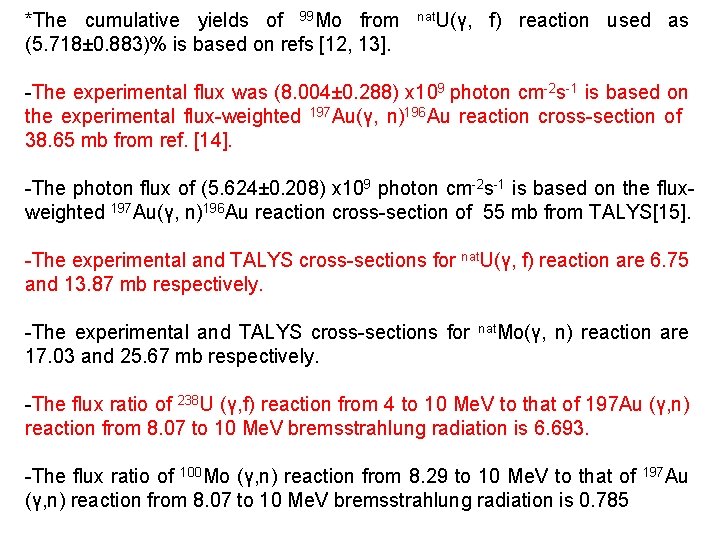
*The cumulative yields of 99 Mo from (5. 718± 0. 883)% is based on refs [12, 13]. nat. U(γ, f) reaction used as -The experimental flux was (8. 004± 0. 288) x 109 photon cm-2 s-1 is based on the experimental flux-weighted 197 Au(γ, n)196 Au reaction cross-section of 38. 65 mb from ref. [14]. -The photon flux of (5. 624± 0. 208) x 109 photon cm-2 s-1 is based on the fluxweighted 197 Au(γ, n)196 Au reaction cross-section of 55 mb from TALYS[15]. -The experimental and TALYS cross-sections for nat. U(γ, f) reaction are 6. 75 and 13. 87 mb respectively. -The experimental and TALYS cross-sections for 17. 03 and 25. 67 mb respectively. nat. Mo(γ, n) reaction are -The flux ratio of 238 U (γ, f) reaction from 4 to 10 Me. V to that of 197 Au (γ, n) reaction from 8. 07 to 10 Me. V bremsstrahlung radiation is 6. 693. -The flux ratio of 100 Mo (γ, n) reaction from 8. 29 to 10 Me. V to that of (γ, n) reaction from 8. 07 to 10 Me. V bremsstrahlung radiation is 0. 785 197 Au
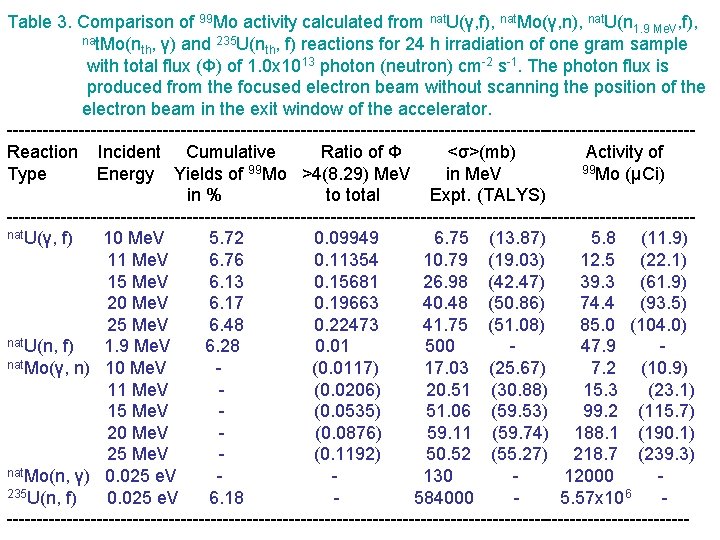
Table 3. Comparison of 99 Mo activity calculated from nat. U(γ, f), nat. Mo(γ, n), nat. U(n 1. 9 Me. V, f), nat. Mo(n , γ) and 235 U(n , f) reactions for 24 h irradiation of one gram sample th th with total flux (Φ) of 1. 0 x 1013 photon (neutron) cm-2 s-1. The photon flux is produced from the focused electron beam without scanning the position of the electron beam in the exit window of the accelerator. ---------------------------------------------------------Reaction Incident Cumulative Ratio of Φ <σ>(mb) Activity of 99 Mo (μCi) Type Energy Yields of 99 Mo >4(8. 29) Me. V in % to total Expt. (TALYS) ---------------------------------------------------------nat. U(γ, f) 10 Me. V 5. 72 0. 09949 6. 75 (13. 87) 5. 8 (11. 9) 11 Me. V 6. 76 0. 11354 10. 79 (19. 03) 12. 5 (22. 1) 15 Me. V 6. 13 0. 15681 26. 98 (42. 47) 39. 3 (61. 9) 20 Me. V 6. 17 0. 19663 40. 48 (50. 86) 74. 4 (93. 5) 25 Me. V 6. 48 0. 22473 41. 75 (51. 08) 85. 0 (104. 0) nat. U(n, f) 1. 9 Me. V 6. 28 0. 01 500 47. 9 nat. Mo(γ, n) 10 Me. V (0. 0117) 17. 03 (25. 67) 7. 2 (10. 9) 11 Me. V (0. 0206) 20. 51 (30. 88) 15. 3 (23. 1) 15 Me. V (0. 0535) 51. 06 (59. 53) 99. 2 (115. 7) 20 Me. V (0. 0876) 59. 11 (59. 74) 188. 1 (190. 1) 25 Me. V (0. 1192) 50. 52 (55. 27) 218. 7 (239. 3) nat. Mo(n, γ) 0. 025 e. V 130 12000 235 U(n, f) 0. 025 e. V 6. 18 584000 5. 57 x 10 6 ---------------------------------------------------------
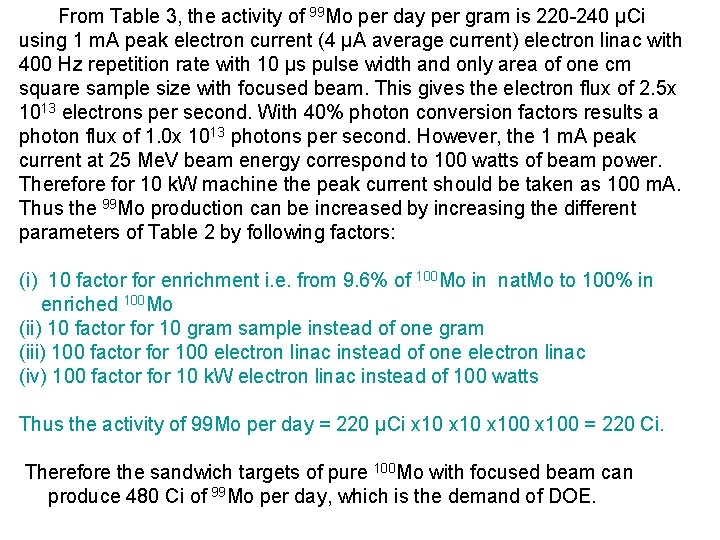
From Table 3, the activity of 99 Mo per day per gram is 220 -240 μCi using 1 m. A peak electron current (4 μA average current) electron linac with 400 Hz repetition rate with 10 μs pulse width and only area of one cm square sample size with focused beam. This gives the electron flux of 2. 5 x 10¹³ electrons per second. With 40% photon conversion factors results a photon flux of 1. 0 x 1013 photons per second. However, the 1 m. A peak current at 25 Me. V beam energy correspond to 100 watts of beam power. Therefore for 10 k. W machine the peak current should be taken as 100 m. A. Thus the 99 Mo production can be increased by increasing the different parameters of Table 2 by following factors: (i) 10 factor for enrichment i. e. from 9. 6% of 100 Mo in nat. Mo to 100% in enriched 100 Mo (ii) 10 factor for 10 gram sample instead of one gram (iii) 100 factor for 100 electron linac instead of one electron linac (iv) 100 factor for 10 k. W electron linac instead of 100 watts Thus the activity of 99 Mo per day = 220 μCi x 100 = 220 Ci. Therefore the sandwich targets of pure 100 Mo with focused beam can produce 480 Ci of 99 Mo per day, which is the demand of DOE.
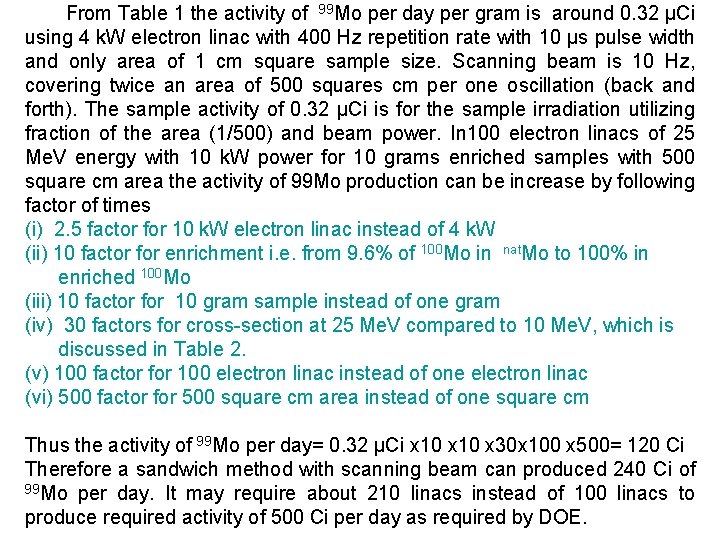
From Table 1 the activity of 99 Mo per day per gram is around 0. 32 μCi using 4 k. W electron linac with 400 Hz repetition rate with 10 μs pulse width and only area of 1 cm square sample size. Scanning beam is 10 Hz, covering twice an area of 500 squares cm per one oscillation (back and forth). The sample activity of 0. 32 μCi is for the sample irradiation utilizing fraction of the area (1/500) and beam power. In 100 electron linacs of 25 Me. V energy with 10 k. W power for 10 grams enriched samples with 500 square cm area the activity of 99 Mo production can be increase by following factor of times (i) 2. 5 factor for 10 k. W electron linac instead of 4 k. W (ii) 10 factor for enrichment i. e. from 9. 6% of 100 Mo in nat. Mo to 100% in enriched 100 Mo (iii) 10 factor for 10 gram sample instead of one gram (iv) 30 factors for cross-section at 25 Me. V compared to 10 Me. V, which is discussed in Table 2. (v) 100 factor for 100 electron linac instead of one electron linac (vi) 500 factor for 500 square cm area instead of one square cm Thus the activity of 99 Mo per day= 0. 32 μCi x 10 x 30 x 100 x 500= 120 Ci Therefore a sandwich method with scanning beam can produced 240 Ci of 99 Mo per day. It may require about 210 linacs instead of 100 linacs to produce required activity of 500 Ci per day as required by DOE.
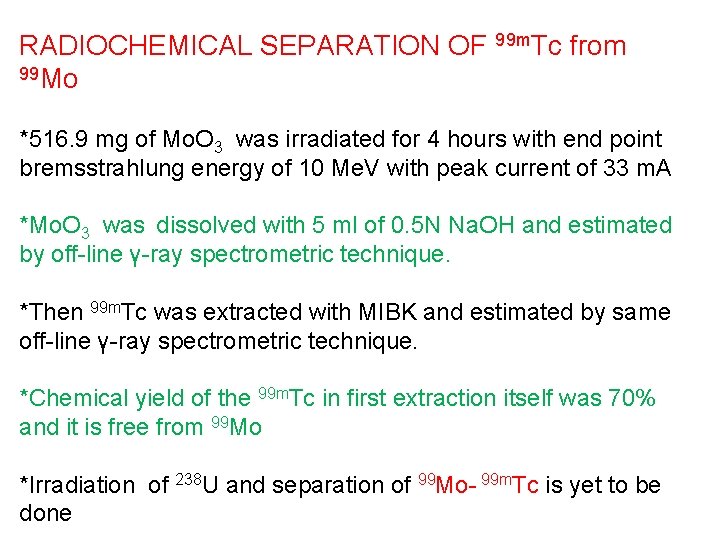
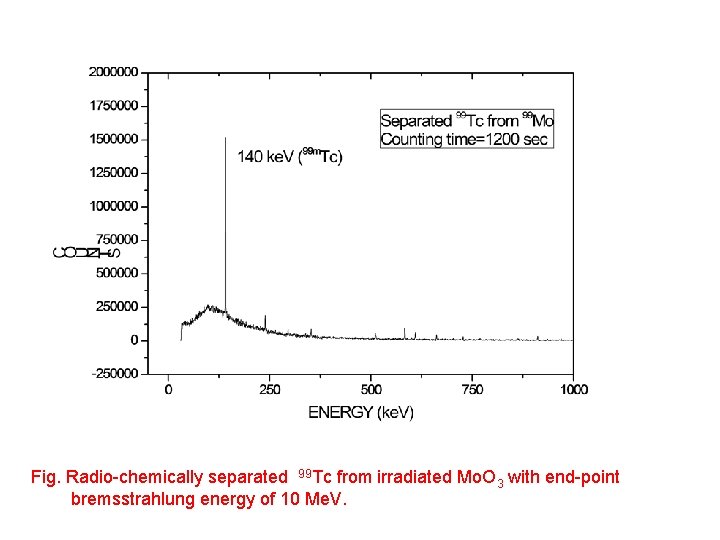
RADIOCHEMICAL SEPARATION OF 99 m. Tc from 99 Mo *516. 9 mg of Mo. O 3 was irradiated for 4 hours with end point bremsstrahlung energy of 10 Me. V with peak current of 33 m. A *Mo. O 3 was dissolved with 5 ml of 0. 5 N Na. OH and estimated by off-line γ-ray spectrometric technique. *Then 99 m. Tc was extracted with MIBK and estimated by same off-line γ-ray spectrometric technique. *Chemical yield of the 99 m. Tc in first extraction itself was 70% and it is free from 99 Mo *Irradiation of 238 U and separation of 99 Mo- 99 m. Tc is yet to be done
Fig. Radio-chemically separated 99 Tc from irradiated Mo. O 3 with end-point bremsstrahlung energy of 10 Me. V.
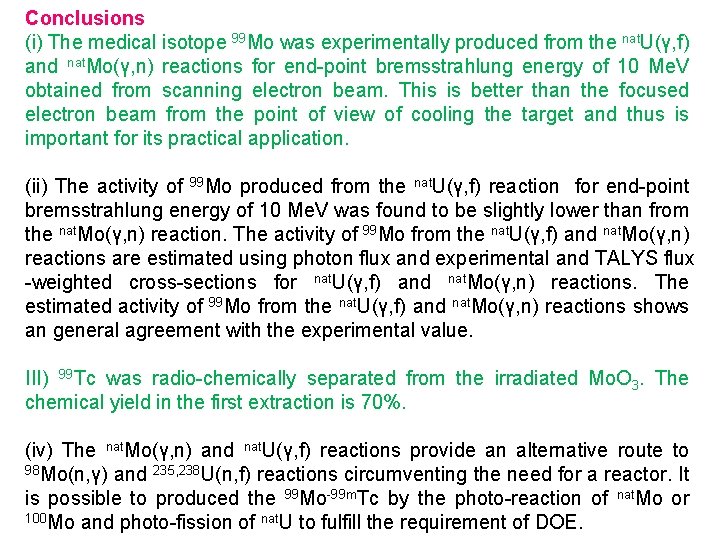
Conclusions (i) The medical isotope 99 Mo was experimentally produced from the nat. U(γ, f) and nat. Mo(γ, n) reactions for end-point bremsstrahlung energy of 10 Me. V obtained from scanning electron beam. This is better than the focused electron beam from the point of view of cooling the target and thus is important for its practical application. (ii) The activity of 99 Mo produced from the nat. U(γ, f) reaction for end-point bremsstrahlung energy of 10 Me. V was found to be slightly lower than from the nat. Mo(γ, n) reaction. The activity of 99 Mo from the nat. U(γ, f) and nat. Mo(γ, n) reactions are estimated using photon flux and experimental and TALYS flux -weighted cross-sections for nat. U(γ, f) and nat. Mo(γ, n) reactions. The estimated activity of 99 Mo from the nat. U(γ, f) and nat. Mo(γ, n) reactions shows an general agreement with the experimental value. III) 99 Tc was radio-chemically separated from the irradiated Mo. O 3. The chemical yield in the first extraction is 70%. (iv) The nat. Mo(γ, n) and nat. U(γ, f) reactions provide an alternative route to 98 Mo(n, γ) and 235, 238 U(n, f) reactions circumventing the need for a reactor. It is possible to produced the 99 Mo-99 m. Tc by the photo-reaction of nat. Mo or 100 Mo and photo-fission of nat. U to fulfill the requirement of DOE.
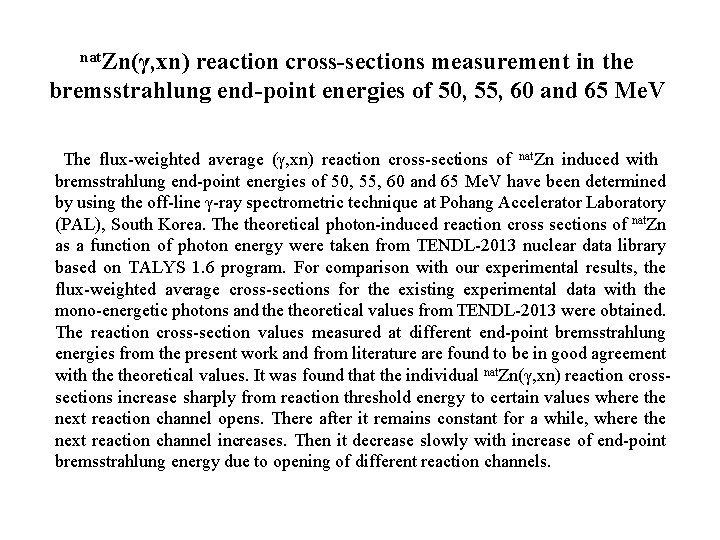
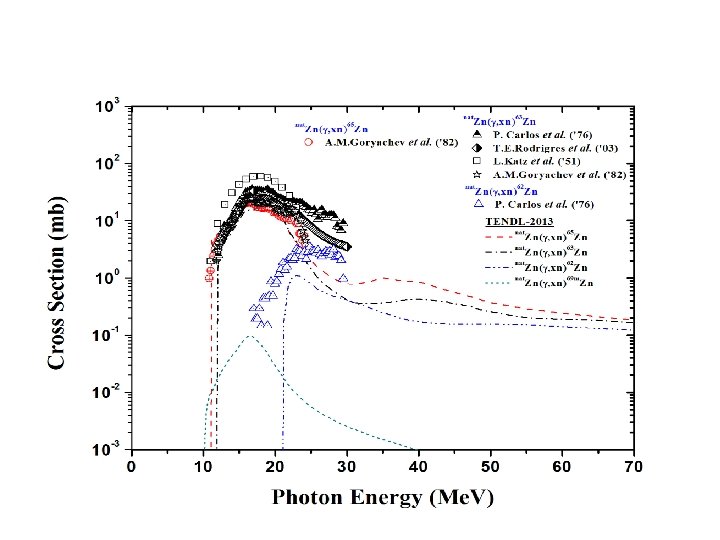
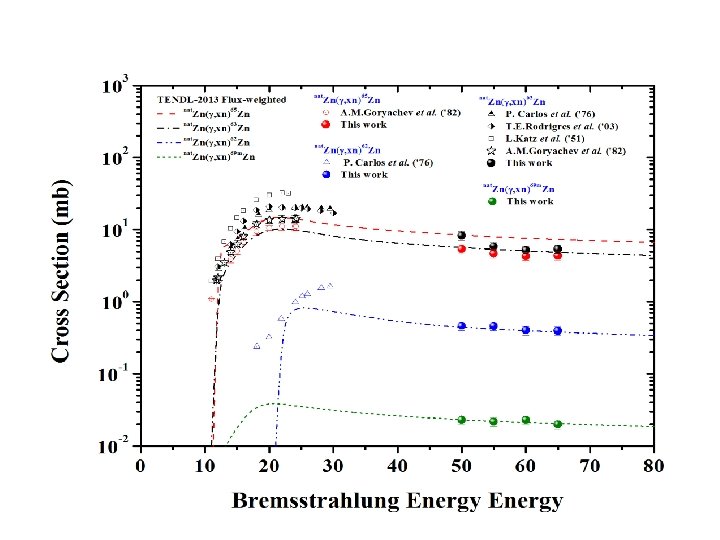
nat. Zn(γ, xn) reaction cross-sections measurement in the bremsstrahlung end-point energies of 50, 55, 60 and 65 Me. V The flux-weighted average (γ, xn) reaction cross-sections of nat. Zn induced with bremsstrahlung end-point energies of 50, 55, 60 and 65 Me. V have been determined by using the off-line γ-ray spectrometric technique at Pohang Accelerator Laboratory (PAL), South Korea. The theoretical photon-induced reaction cross sections of nat. Zn as a function of photon energy were taken from TENDL-2013 nuclear data library based on TALYS 1. 6 program. For comparison with our experimental results, the flux-weighted average cross-sections for the existing experimental data with the mono-energetic photons and theoretical values from TENDL-2013 were obtained. The reaction cross-section values measured at different end-point bremsstrahlung energies from the present work and from literature are found to be in good agreement with theoretical values. It was found that the individual nat. Zn(γ, xn) reaction crosssections increase sharply from reaction threshold energy to certain values where the next reaction channel opens. There after it remains constant for a while, where the next reaction channel increases. Then it decrease slowly with increase of end-point bremsstrahlung energy due to opening of different reaction channels.
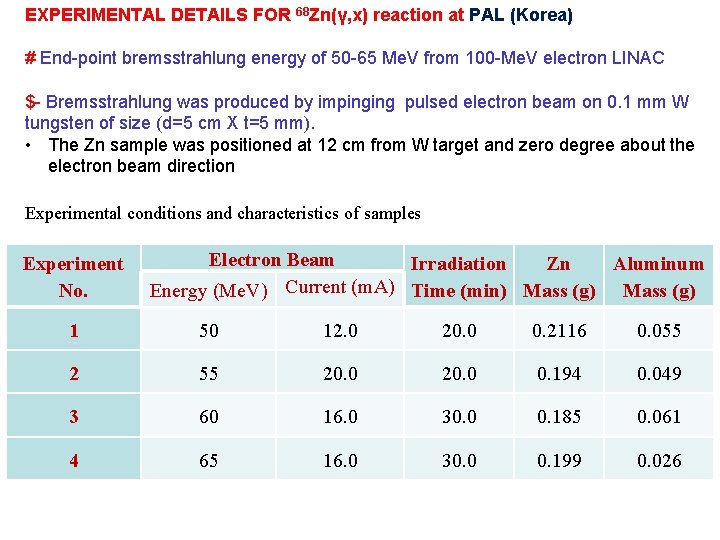
EXPERIMENTAL DETAILS FOR 68 Zn(γ, x) reaction at PAL (Korea) # End-point bremsstrahlung energy of 50 -65 Me. V from 100 -Me. V electron LINAC $- Bremsstrahlung was produced by impinging pulsed electron beam on 0. 1 mm W tungsten of size (d=5 cm X t=5 mm). • The Zn sample was positioned at 12 cm from W target and zero degree about the electron beam direction Experimental conditions and characteristics of samples Experiment No. Electron Beam Irradiation Zn Aluminum Energy (Me. V) Current (m. A) Time (min) Mass (g) 1 50 12. 0 20. 0 0. 2116 0. 055 20. 0 0. 194 0. 049 3 60 16. 0 30. 0 0. 185 0. 061 4 65 16. 0 30. 0 0. 199 0. 026
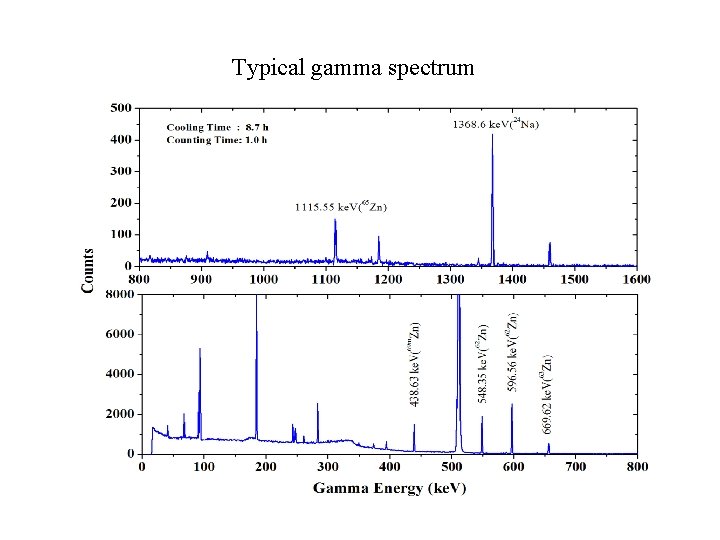
Typical gamma spectrum
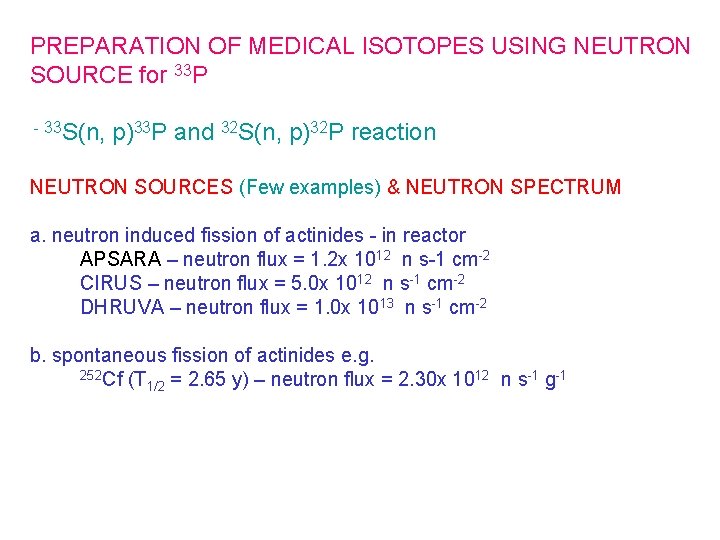
PREPARATION OF MEDICAL ISOTOPES USING NEUTRON SOURCE for 33 P - 33 S(n, p)33 P and 32 S(n, p)32 P reaction NEUTRON SOURCES (Few examples) & NEUTRON SPECTRUM a. neutron induced fission of actinides - in reactor APSARA – neutron flux = 1. 2 x 10¹² n s-1 cm-2 CIRUS – neutron flux = 5. 0 x 1012 n s-1 cm-2 DHRUVA – neutron flux = 1. 0 x 1013 n s-1 cm-2 b. spontaneous fission of actinides e. g. 252 Cf (T 12 n s-1 g-1 1/2 = 2. 65 y) – neutron flux = 2. 30 x 10
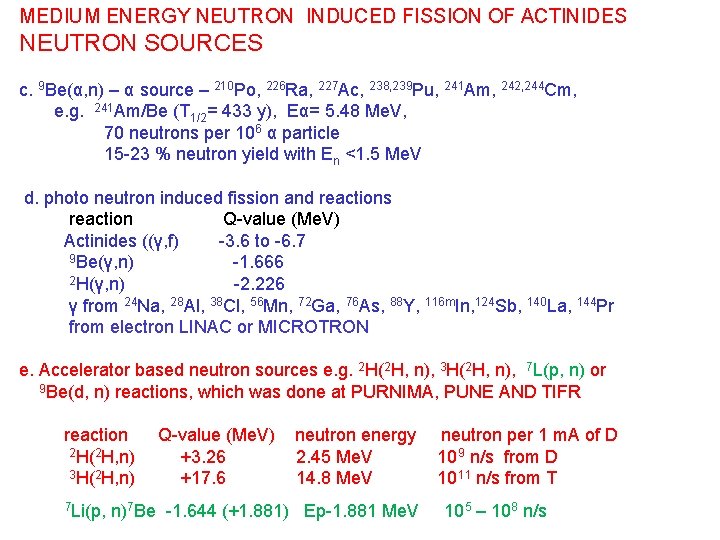
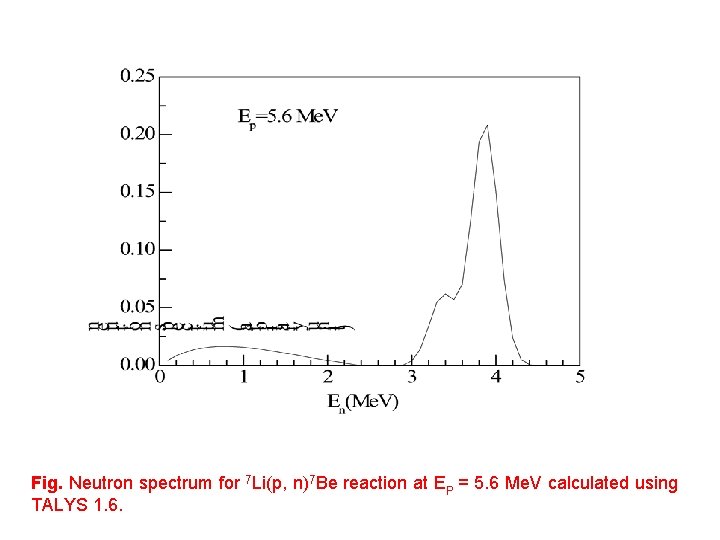
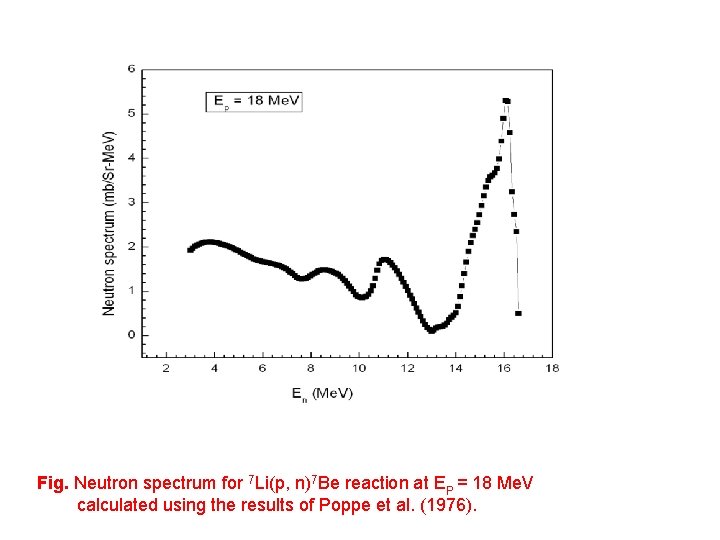
MEDIUM ENERGY NEUTRON INDUCED FISSION OF ACTINIDES NEUTRON SOURCES c. 9 Be(α, n) – α source – 210 Po, 226 Ra, 227 Ac, 238, 239 Pu, 241 Am, 242, 244 Cm, e. g. 241 Am/Be (T 1/2= 433 y), Eα= 5. 48 Me. V, 70 neutrons per 106 α particle 15 -23 % neutron yield with En <1. 5 Me. V d. photo neutron induced fission and reactions reaction Q-value (Me. V) Actinides ((γ, f) -3. 6 to -6. 7 9 Be(γ, n) -1. 666 2 H(γ, n) -2. 226 γ from 24 Na, 28 Al, 38 Cl, 56 Mn, 72 Ga, 76 As, 88 Y, 116 m. In, 124 Sb, 140 La, 144 Pr from electron LINAC or MICROTRON e. Accelerator based neutron sources e. g. 2 H(2 H, n), 3 H(2 H, n), 7 L(p, n) or 9 Be(d, n) reactions, which was done at PURNIMA, PUNE AND TIFR reaction 2 H(2 H, n) 3 H(2 H, n) 7 Li(p, Q-value (Me. V) +3. 26 +17. 6 neutron energy 2. 45 Me. V 14. 8 Me. V n)7 Be -1. 644 (+1. 881) Ep-1. 881 Me. V neutron per 1 m. A of D 10 9 n/s from D 10 11 n/s from T 105 – 108 n/s
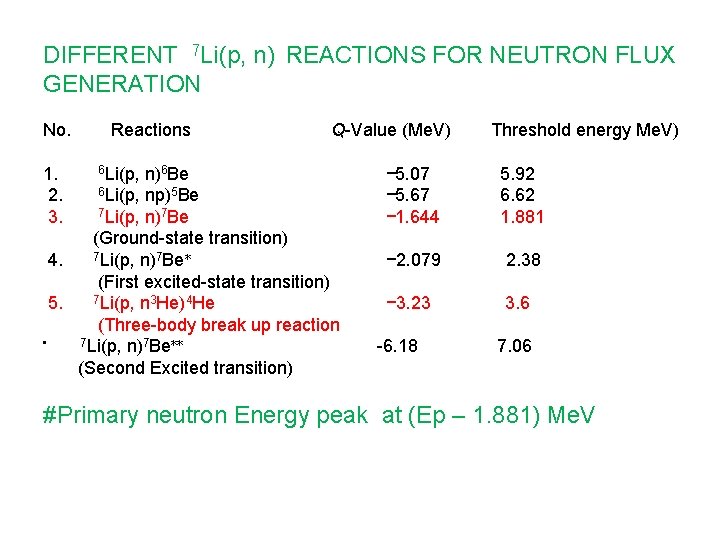
DIFFERENT 7 Li(p, n) REACTIONS FOR NEUTRON FLUX GENERATION No. 1. 2. 3. Reactions 6 Li(p, Q-Value (Me. V) n)6 Be 6 Li(p, np)5 Be 7 Li(p, n)7 Be (Ground-state transition) 7 Li(p, n)7 Be∗ 4. (First excited-state transition) 7 Li(p, n 3 He)4 He 5. (Three-body break up reaction • 7 Li(p, n)7 Be∗∗ (Second Excited transition) Threshold energy Me. V) − 5. 07 − 5. 67 − 1. 644 5. 92 6. 62 1. 881 − 2. 079 2. 38 − 3. 23 3. 6 -6. 18 7. 06 #Primary neutron Energy peak at (Ep – 1. 881) Me. V
Fig. Neutron spectrum for 7 Li(p, n)7 Be reaction at EP = 5. 6 Me. V calculated using TALYS 1. 6.
Fig. Neutron spectrum for 7 Li(p, n)7 Be reaction at EP = 18 Me. V calculated using the results of Poppe et al. (1976).
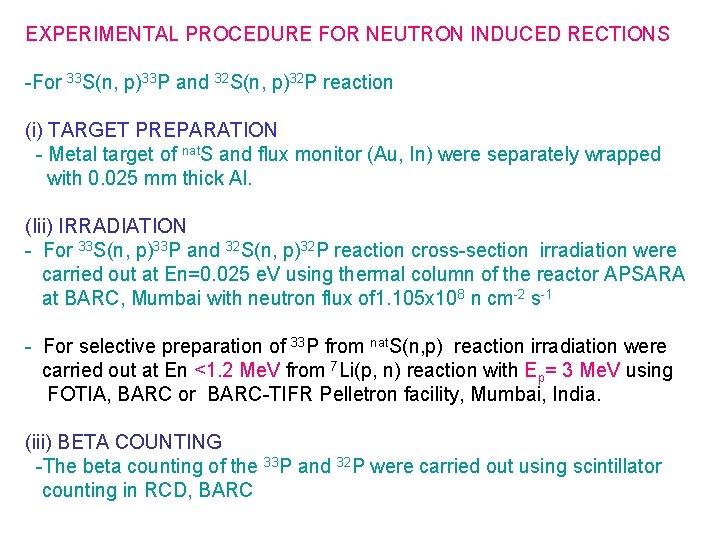
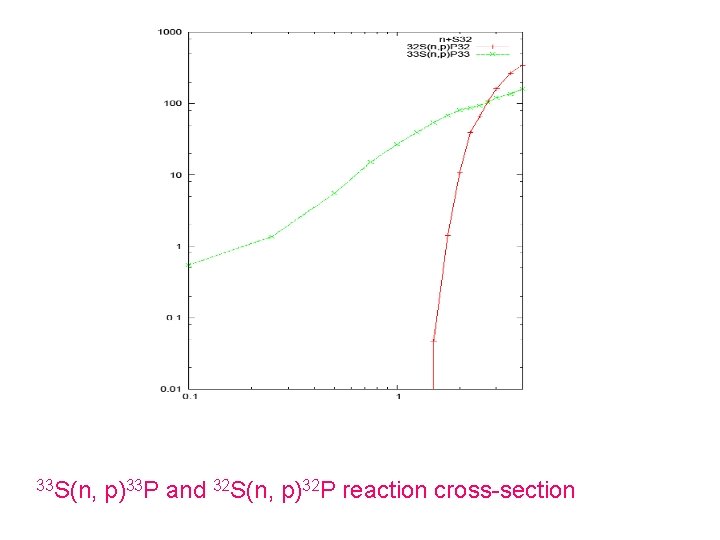
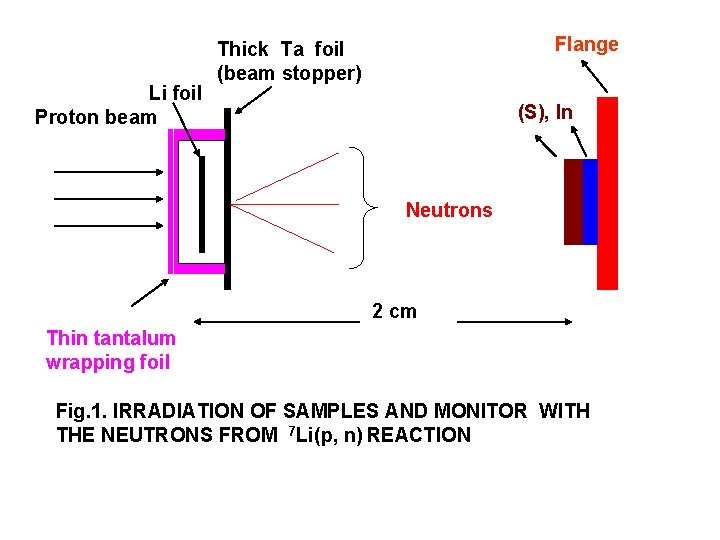
EXPERIMENTAL PROCEDURE FOR NEUTRON INDUCED RECTIONS -For 33 S(n, p)33 P and 32 S(n, p)32 P reaction (i) TARGET PREPARATION - Metal target of nat. S and flux monitor (Au, In) were separately wrapped with 0. 025 mm thick Al. (Iii) IRRADIATION - For 33 S(n, p)33 P and 32 S(n, p)32 P reaction cross-section irradiation were carried out at En=0. 025 e. V using thermal column of the reactor APSARA at BARC, Mumbai with neutron flux of 1. 105 x 108 n cm-2 s-1 - For selective preparation of 33 P from nat. S(n, p) reaction irradiation were carried out at En <1. 2 Me. V from 7 Li(p, n) reaction with Ep= 3 Me. V using FOTIA, BARC or BARC-TIFR Pelletron facility, Mumbai, India. (iii) BETA COUNTING -The beta counting of the 33 P and 32 P were carried out using scintillator counting in RCD, BARC
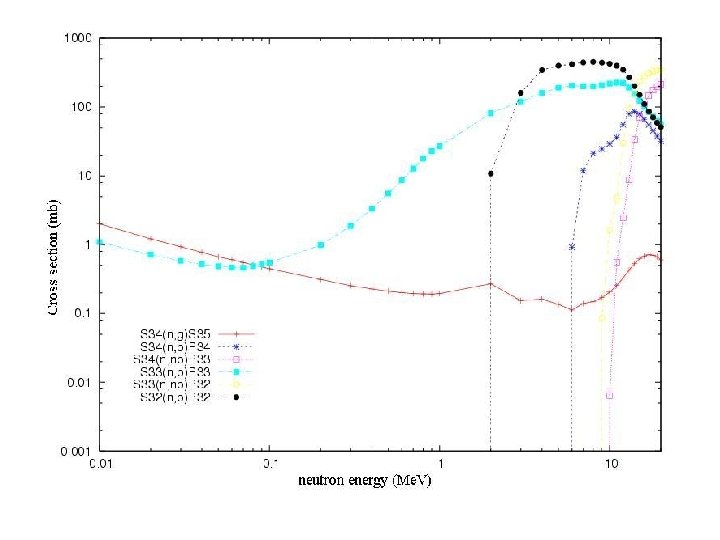
33 S(n, p)33 P and 32 S(n, p)32 P reaction cross-section
Li foil Proton beam Flange Thick Ta foil (beam stopper) (S), In Neutrons 2 cm Thin tantalum wrapping foil Fig. 1. IRRADIATION OF SAMPLES AND MONITOR WITH THE NEUTRONS FROM 7 Li(p, n) REACTION
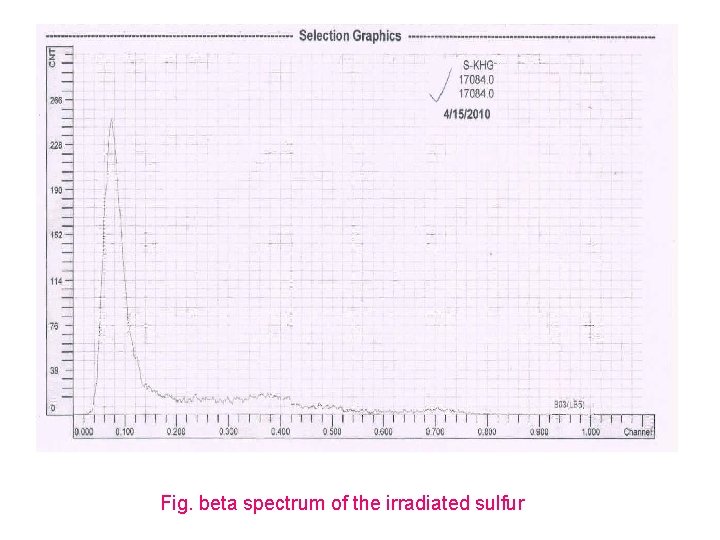
Fig. beta spectrum of the irradiated sulfur
[1] Groth S (2000) Nuclear application in health care-lasting benefits. IAEA Bulletin, 42/1/2000, Vienna 2000. [2] Ruth T (2009), Accelerating production of medical isotopes, Nature, 457, January 2009, p. 29. [3] INTERNATIONAL ATOMIC ENERGY AGENCY. Nuclear technology review, Annex VIII: Production and supply of Molybdenum-99: IAEA/NTR/2010, Vienna (2010) P 150 -167. [4] Charged particle cross-section database for medical radioisotope production: diagnostic radioisotopes and monitor reactions IAEA-TECDOC-1211. [5] Gambini PJ, Cabral P, Alonso O, Savio E, Figueroa SD, Zhang X, Ma L, Deutscher SL, Quinn TP (2011) Evaluation of 99 m. Tc-glucarate as a breast cancer Imaging agent in a xenograft animal model, Nuclear Medicine and Biology 38: 255. [6] Gambini PJ, Cabral P, Alonso O, Savio E, Figueroa SD, Zhang X, Ma L, Deutscher SL, Quinn TP (2011) Evaluation of 99 m. Tc-glucarate as a breast cancer Imaging agent in a xenograft animal model, Nuclear Medicine and Biology 38: 255. [7] Terán MA, Martínez E, Reyes AL, Paolino A, Vital M, Esperón P, Pacheco JP, Savio E (2011) Biological studies in animal models using [99 m. Tc](CO)3 recombinant annexin V as diagnostic agent of apoptotic processes, Nuclear Medicine and Biology 38: 279. [8]. G. Prabhakar et al. IAEA- TECDOC 1228, p. 125; M. Zubillage et al. ibid, p. 275. [9] Nelson WR, Hirayama H and Rogers DWO (1985) MAC report 265
[10] Naik H, Nimje VT, Raj D, Suryanarayana SV, Goswami A, Sarbjit Singh, Acharya SN, Mittal KC, Ganesan S, Chandrachoodan P, Manchanda VK, Venugopal V and Banarjee S (2011) Mass distribution in the bremsstrahlunginduced fission of 232 Th, 238 U and 240 Pu, Nucl. Phys. A 853: 1. [11] Scmitt RA and Sugarman N (1954) Phys. Rev. 95: 1260. [12] Browne E and Firestone RB, Table of Radioactive Isotopes, ed. Shirley VS (1986); Firestone RB, Ekstrom LP (2004) Table of Radioactive Isotopes. [13] Blachot J and Fiche Ch (1981) Table of Radioactive Isotopes and their main decay characteristics, Ann. de Phys. 6: 3 -218. [14] Varlamov VV, Ishkhanov BS, Orlin VN, Yu TS, Izv. Rossiiskoi Akademii (2010) Nauk, Ser. Fiz. 74: 884. [15] Koning AJ, Hilaire S and Duijvestijn MC (2004) Proceedings of the International Conference on Nuclear Data for Science and Technology-ND 2004, AIP Vol. 769, Sept. 26 -Oct. 1, 2004, Edited by Haight R. C. , Chadwick M. B. , Kawano T. and Talou P. (Santa Fe, USA (2005)) P. 1154.
THANK YOU ALL FOR YOUR CONCENTRATION