
Photon collider ILC configuration and IR issues how
- Slides: 35
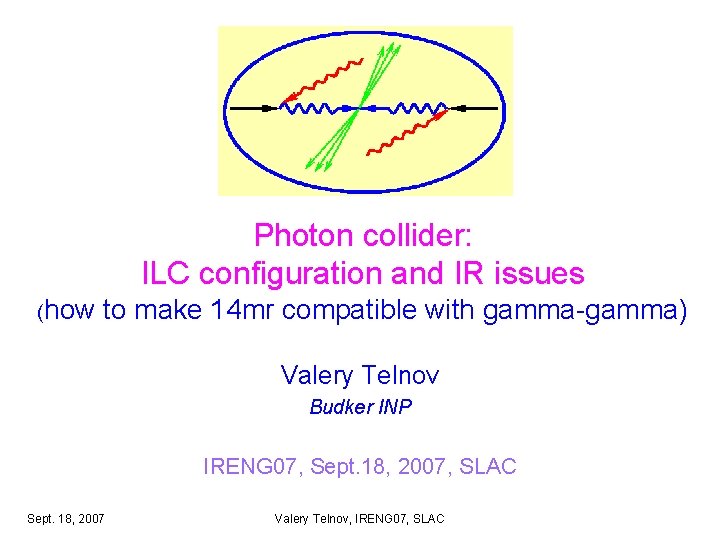
Photon collider: ILC configuration and IR issues (how to make 14 mr compatible with gamma-gamma) Valery Telnov Budker INP IRENG 07, Sept. 18, 2007, SLAC Sept. 18, 2007 Valery Telnov, IRENG 07, SLAC
Contents • • • Introduction Crossing angle Beam dump Laser optics, detector Conclusion Sept. 18, 2007 Valery Telnov, IRENG 07, SLAC 2
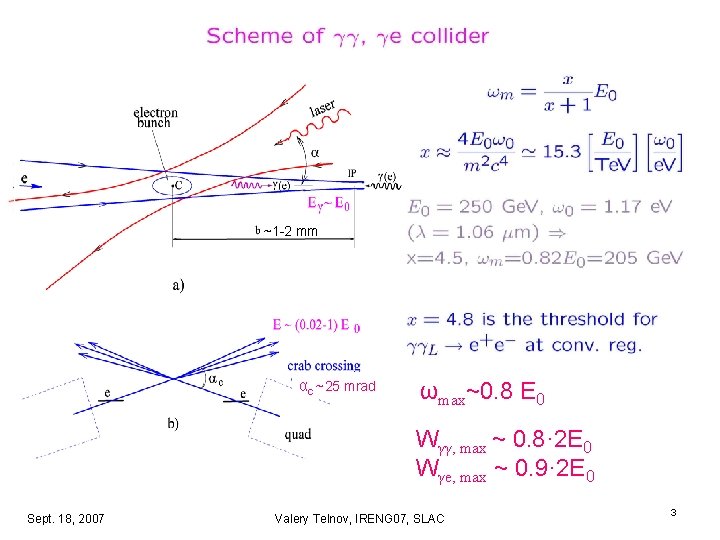
~1 -2 mm αc ~25 mrad ωmax~0. 8 E 0 Wγγ, max ~ 0. 8· 2 E 0 Wγe, max ~ 0. 9· 2 E 0 Sept. 18, 2007 Valery Telnov, IRENG 07, SLAC 3
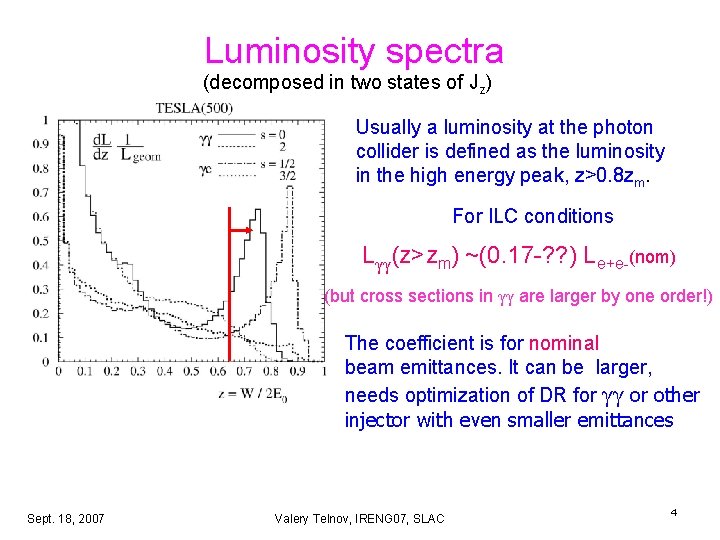
Luminosity spectra (decomposed in two states of Jz) Usually a luminosity at the photon collider is defined as the luminosity in the high energy peak, z>0. 8 zm. For ILC conditions Lγγ(z>zm) ~(0. 17 -? ? ) Le+e-(nom) (but cross sections in γγ are larger by one order!) The coefficient is for nominal beam emittances. It can be larger, needs optimization of DR for γγ or other injector with even smaller emittances Sept. 18, 2007 Valery Telnov, IRENG 07, SLAC 4
Physics motivation: summary In , e collisions compared to e+e 1. the energy is smaller only by 10 -20% 2. the number of events is similar or even higher 3. access to higher particle masses (H, A in γγ, charged and light neutral SUSY in γe) 4. higher precision for some phenomena 5. different type of reactions (different dependence on theoretical parameters) One example: 2 E 0=500 Ge. V For e+e- MH, A(max)~250 Ge. V (H, A are produced in pairs) For γγ ~400 Ge. V (single resonance) Sept. 18, 2007 Valery Telnov, IRENG 07, SLAC 5
So, linear colliders provide a unique opportunity to study , e interaction at high energies and luminosities. About 20 -25% of all publications on LC physics are related to the photon collider. The opinion of the physics community is expressed in the LC consensus and IFCA scope document: the ILC design should include γγ, γe. The ILC baseline and reference designs did not account the photon collider (in order to reduce the baseline cost), now the GDE has intent to consider it in the EDR. Sept. 18, 2007 Valery Telnov, IRENG 07, SLAC 6
What is important now. It is important to make design decisions on the baseline ILC project not prohibitive or unnecessarily difficult for the photon collider, which allow to reach its ultimate performance and rather easy transition between e+e- and γγ, γe modes. The PLC needs: • the IP with the crossing angle ~ 25 mrad ; • places for the special beam dump and the laser system; • detector design (s) compatible with gamma-gamma; • R&D on the laser system, IR issues, e. t. c… Sept. 18, 2007 Valery Telnov, IRENG 07, SLAC 7
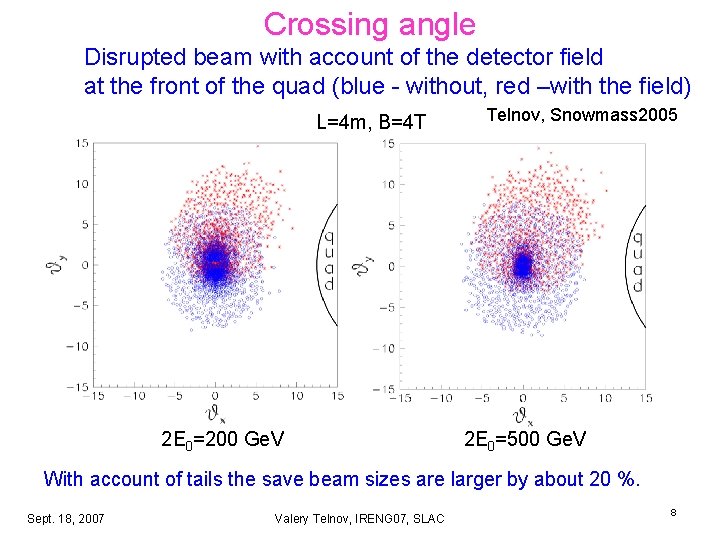
Crossing angle Disrupted beam with account of the detector field at the front of the quad (blue - without, red –with the field) L=4 m, B=4 T 2 E 0=200 Ge. V Telnov, Snowmass 2005 2 E 0=500 Ge. V With account of tails the save beam sizes are larger by about 20 %. Sept. 18, 2007 Valery Telnov, IRENG 07, SLAC 8
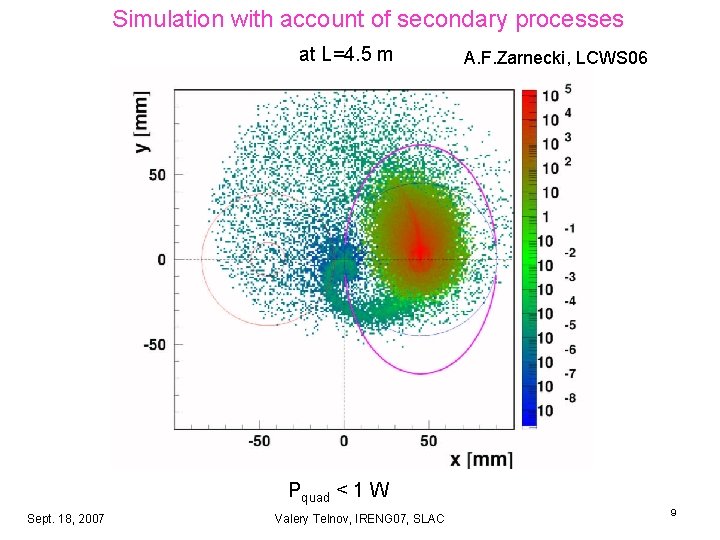
Simulation with account of secondary processes at L=4. 5 m A. F. Zarnecki, LCWS 06 Pquad < 1 W Sept. 18, 2007 Valery Telnov, IRENG 07, SLAC 9
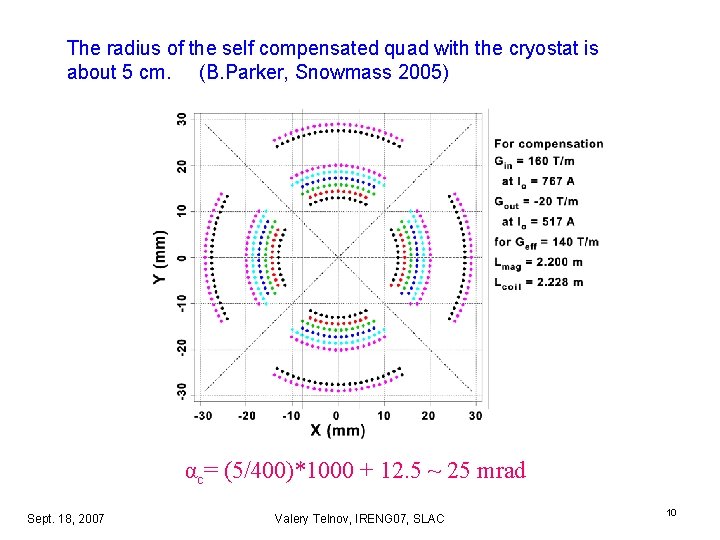
The radius of the self compensated quad with the cryostat is about 5 cm. (B. Parker, Snowmass 2005) αc= (5/400)*1000 + 12. 5 ~ 25 mrad Sept. 18, 2007 Valery Telnov, IRENG 07, SLAC 10
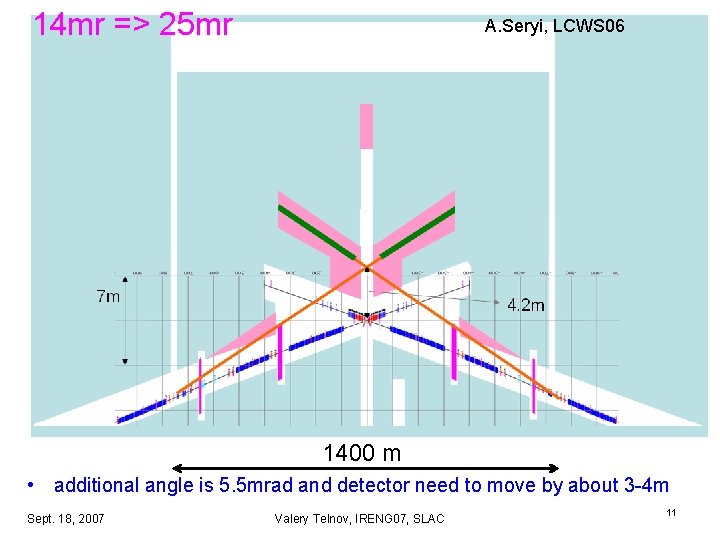
14 mr => 25 mr A. Seryi, LCWS 06 1400 m • additional angle is 5. 5 mrad and detector need to move by about 3 -4 m Sept. 18, 2007 Valery Telnov, IRENG 07, SLAC 11
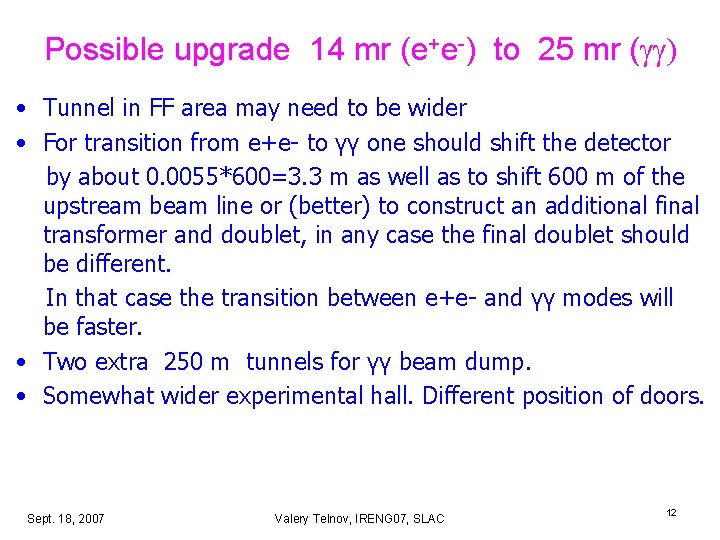
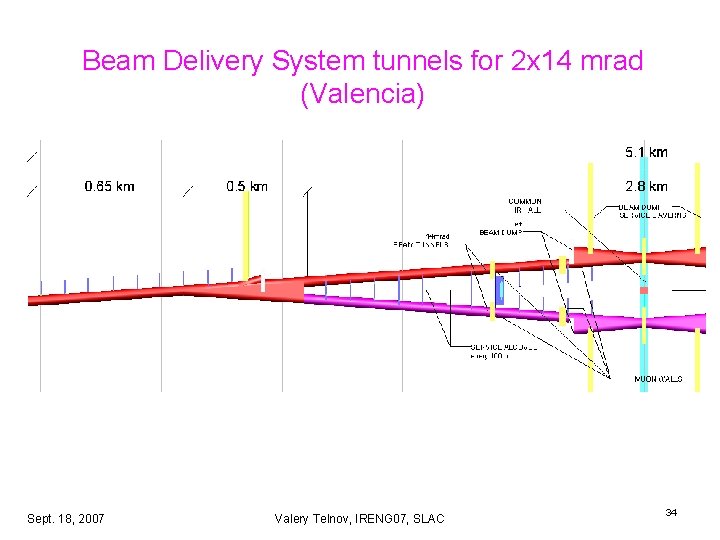
Possible upgrade 14 mr (e+e-) to 25 mr ( ) • Tunnel in FF area may need to be wider • For transition from e+e- to γγ one should shift the detector by about 0. 0055*600=3. 3 m as well as to shift 600 m of the upstream beam line or (better) to construct an additional final transformer and doublet, in any case the final doublet should be different. In that case the transition between e+e- and γγ modes will be faster. • Two extra 250 m tunnels for γγ beam dump. • Somewhat wider experimental hall. Different position of doors. Sept. 18, 2007 Valery Telnov, IRENG 07, SLAC 12
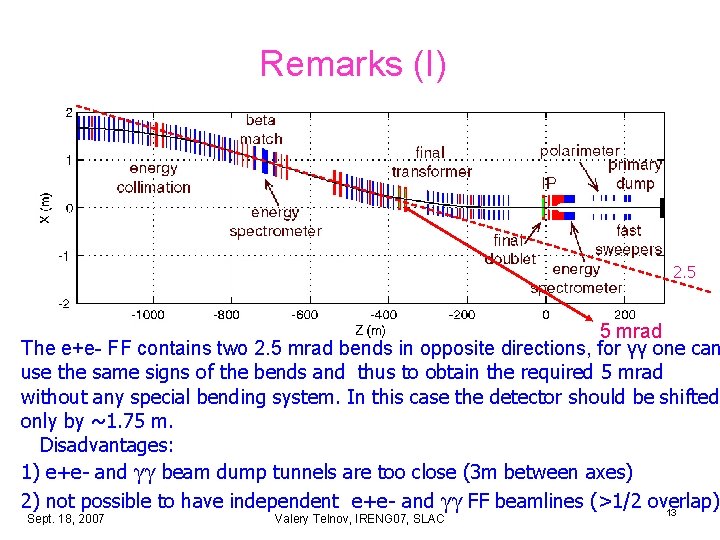
Remarks (I) 2. 5 5 mrad The e+e- FF contains two 2. 5 mrad bends in opposite directions, for γγ one can use the same signs of the bends and thus to obtain the required 5 mrad without any special bending system. In this case the detector should be shifted only by ~1. 75 m. Disadvantages: 1) e+e- and γγ beam dump tunnels are too close (3 m between axes) 2) not possible to have independent e+e- and γγ FF beamlines (>1/2 overlap) 13 Sept. 18, 2007 Valery Telnov, IRENG 07, SLAC
It would be nice by the end of the workshop to produce a preliminary picture of required tunnel modification for 25 mrad crossing angle. Sept. 18, 2007 Valery Telnov, IRENG 07, SLAC 14
Remarks (II) In principle, one can use the same crossing angle ~25 mrad for e+e- and γγ, but e+e- people want a special extraction line with beam diagnostic (energy, spectrum, polarization), while γγ needs clear way to the beam dump (which is very special). Replacements of beam dumps will be difficult due to the induced radioactivity. So, different crossing angles are even more preferable. However, it is not clear whether e+e- needs such very instrumented extraction line. There a lot of diagnostics upstream the IP(energy and polarization) and in the detector (acollinearity angles, e+e- pair), which may be sufficient for reconstruction of beam properties. In addition, one can measure easily beam profiles downstream the IP. Such effects as depolarization during the collision can be accounted by simulation. This needs further study. Also we will not consider at this meeting the two IR designs case. Sept. 18, 2007 Valery Telnov, IRENG 07, SLAC 15
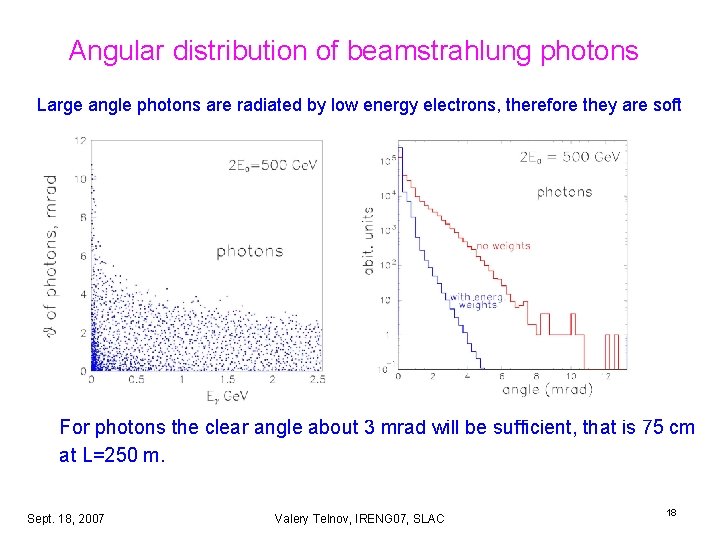
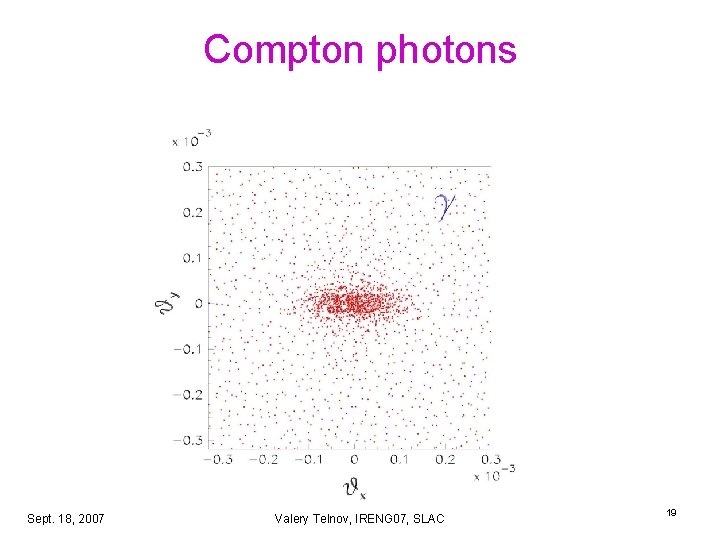
Beam dump V. Telnov, physics/0512048, Snowmass 2005 The disrupted beam at the photon collider has 3 components, two are wide and one narrow: 1. e+, e- with the angular spread ~10 -12 mrad (need some focusing); 2. beamstrahlung photons with angles up to 3 -4 mrad; R~1 m at L=250 m from the IP. 3. Compton photons with angles σθx~4· 10 -5 rad, σθy~1. 5· 10 -5 rad, that is 1 x 0. 35 cm 2 at the distance 250 m. Sept. 18, 2007 Valery Telnov, IRENG 07, SLAC 16
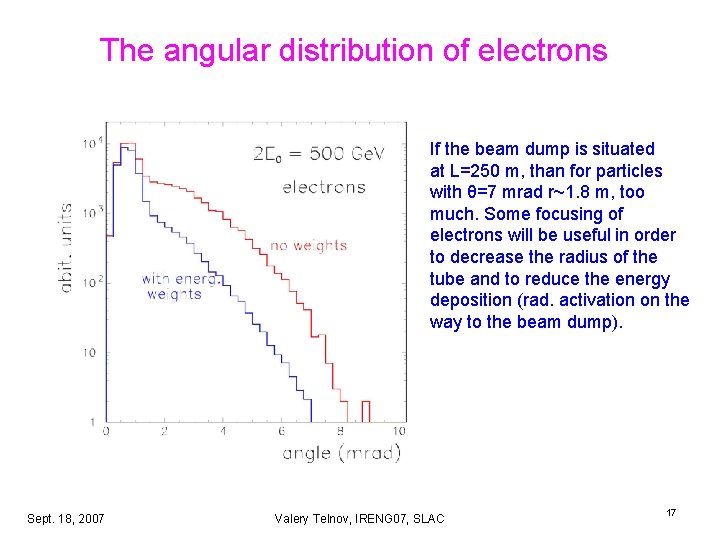
The angular distribution of electrons If the beam dump is situated at L=250 m, than for particles with θ=7 mrad r~1. 8 m, too much. Some focusing of electrons will be useful in order to decrease the radius of the tube and to reduce the energy deposition (rad. activation on the way to the beam dump). Sept. 18, 2007 Valery Telnov, IRENG 07, SLAC 17
Angular distribution of beamstrahlung photons Large angle photons are radiated by low energy electrons, therefore they are soft For photons the clear angle about 3 mrad will be sufficient, that is 75 cm at L=250 m. Sept. 18, 2007 Valery Telnov, IRENG 07, SLAC 18
Compton photons Sept. 18, 2007 Valery Telnov, IRENG 07, SLAC 19
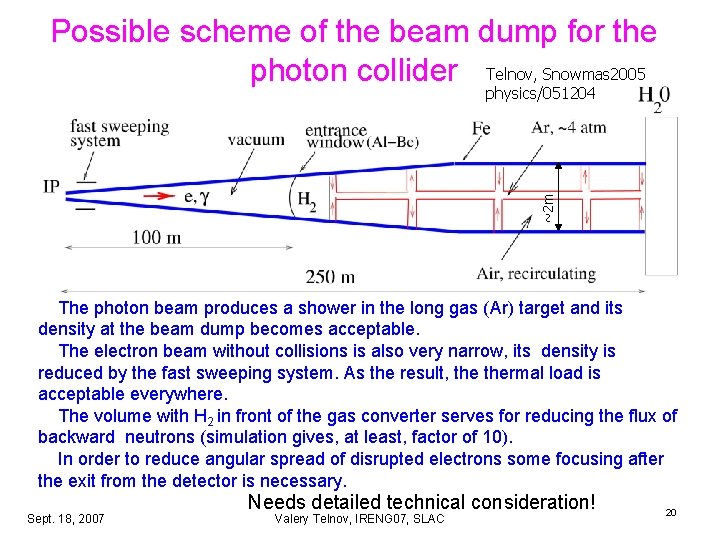
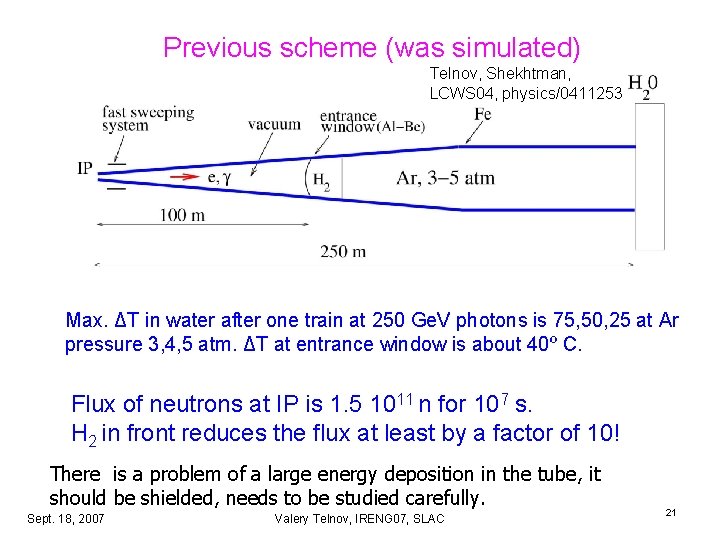
Possible scheme of the beam dump for the photon collider Telnov, Snowmas 2005 ~2 m physics/051204 The photon beam produces a shower in the long gas (Ar) target and its density at the beam dump becomes acceptable. The electron beam without collisions is also very narrow, its density is reduced by the fast sweeping system. As the result, thermal load is acceptable everywhere. The volume with H 2 in front of the gas converter serves for reducing the flux of backward neutrons (simulation gives, at least, factor of 10). In order to reduce angular spread of disrupted electrons some focusing after the exit from the detector is necessary. Sept. 18, 2007 Needs detailed technical consideration! Valery Telnov, IRENG 07, SLAC 20
Previous scheme (was simulated) Telnov, Shekhtman, LCWS 04, physics/0411253 Max. ΔT in water after one train at 250 Ge. V photons is 75, 50, 25 at Ar pressure 3, 4, 5 atm. ΔT at entrance window is about 40º C. Flux of neutrons at IP is 1. 5 1011 n for 107 s. H 2 in front reduces the flux at least by a factor of 10! There is a problem of a large energy deposition in the tube, it should be shielded, needs to be studied carefully. Sept. 18, 2007 Valery Telnov, IRENG 07, SLAC 21
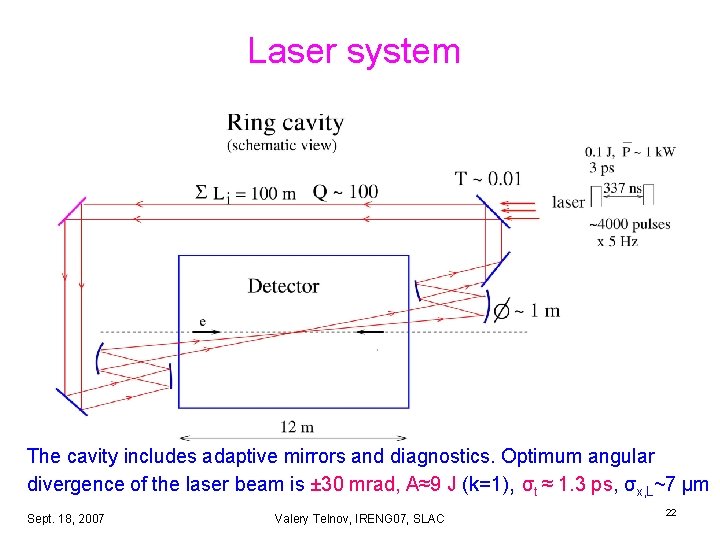
Laser system The cavity includes adaptive mirrors and diagnostics. Optimum angular divergence of the laser beam is ± 30 mrad, A≈9 J (k=1), σt ≈ 1. 3 ps, σx, L~7 μm Sept. 18, 2007 Valery Telnov, IRENG 07, SLAC 22
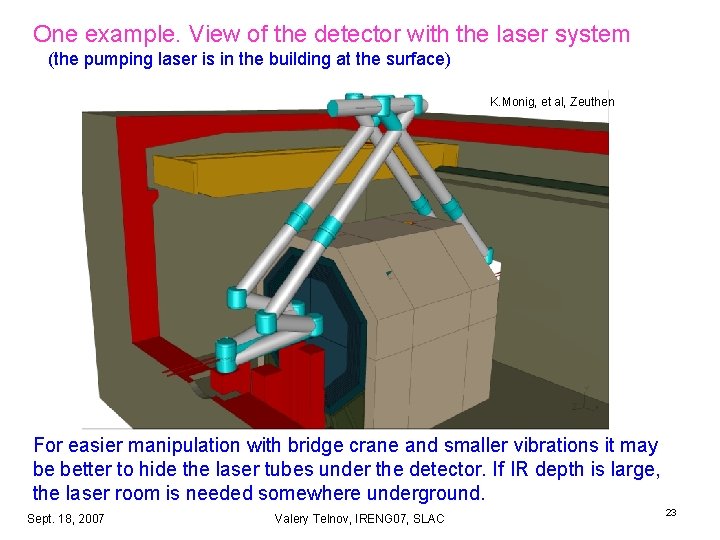
One example. View of the detector with the laser system (the pumping laser is in the building at the surface) K. Monig, et al, Zeuthen For easier manipulation with bridge crane and smaller vibrations it may be better to hide the laser tubes under the detector. If IR depth is large, the laser room is needed somewhere underground. Sept. 18, 2007 Valery Telnov, IRENG 07, SLAC 23
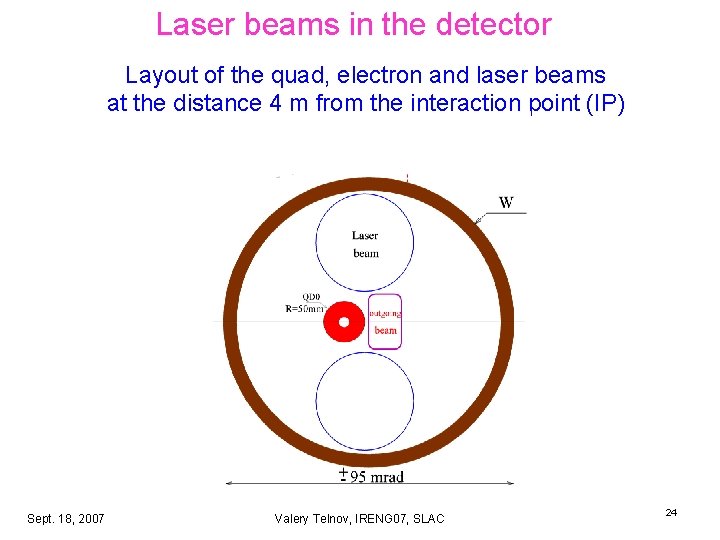
Laser beams in the detector Layout of the quad, electron and laser beams at the distance 4 m from the interaction point (IP) Sept. 18, 2007 Valery Telnov, IRENG 07, SLAC 24
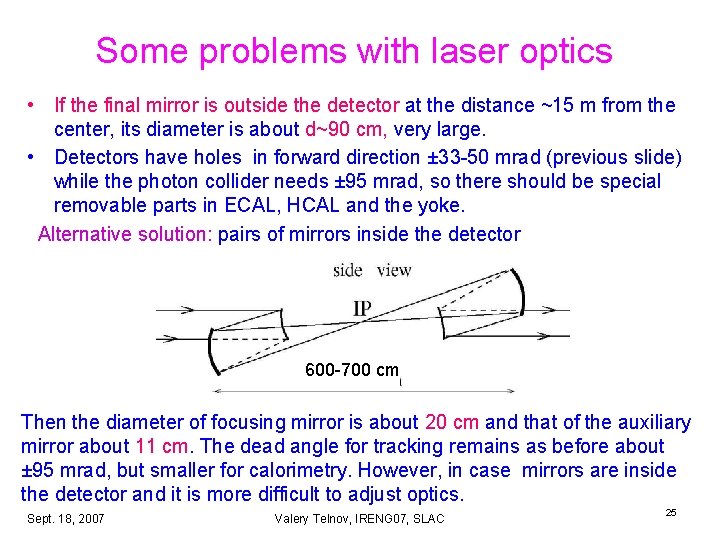
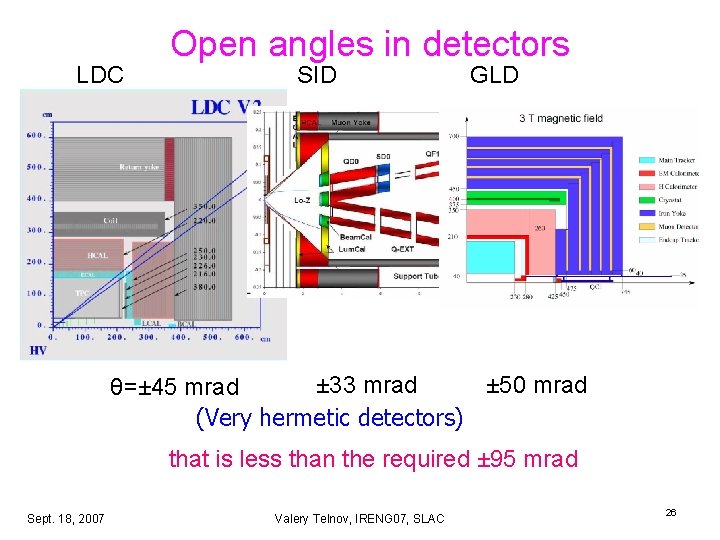
Some problems with laser optics • If the final mirror is outside the detector at the distance ~15 m from the center, its diameter is about d~90 cm, very large. • Detectors have holes in forward direction ± 33 -50 mrad (previous slide) while the photon collider needs ± 95 mrad, so there should be special removable parts in ECAL, HCAL and the yoke. Alternative solution: pairs of mirrors inside the detector 600 -700 cm Then the diameter of focusing mirror is about 20 cm and that of the auxiliary mirror about 11 cm. The dead angle for tracking remains as before about ± 95 mrad, but smaller for calorimetry. However, in case mirrors are inside the detector and it is more difficult to adjust optics. Sept. 18, 2007 Valery Telnov, IRENG 07, SLAC 25
LDC Open angles in detectors SID GLD ± 33 mrad ± 50 mrad θ=± 45 mrad (Very hermetic detectors) that is less than the required ± 95 mrad Sept. 18, 2007 Valery Telnov, IRENG 07, SLAC 26
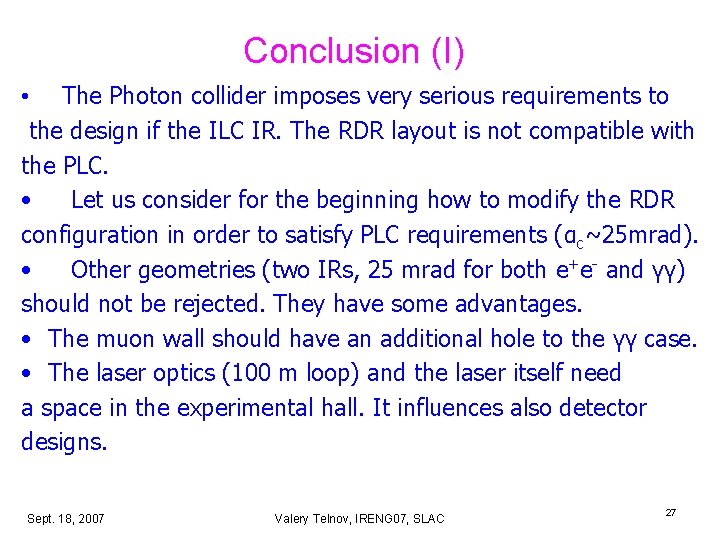
Conclusion (I) • The Photon collider imposes very serious requirements to the design if the ILC IR. The RDR layout is not compatible with the PLC. • Let us consider for the beginning how to modify the RDR configuration in order to satisfy PLC requirements (αc~25 mrad). • Other geometries (two IRs, 25 mrad for both e+e- and γγ) should not be rejected. They have some advantages. • The muon wall should have an additional hole to the γγ case. • The laser optics (100 m loop) and the laser itself need a space in the experimental hall. It influences also detector designs. Sept. 18, 2007 Valery Telnov, IRENG 07, SLAC 27
Conclusion (II) The beginning of the LC construction continuously delays and the cost grows: 7 B$ according to RDR and 15 -28 B$ (total) according to the Chicago Tribune. Such expensive project can be approved only if it ambitious enough and has rich experimental program! It is obvious that beside e+e- it should include e-e-, γγ, γe, fixed target etc. The End Sept. 18, 2007 Valery Telnov, IRENG 07, SLAC 28
Some additional slides (not shown) Sept. 18, 2007 Valery Telnov, IRENG 07, SLAC 29
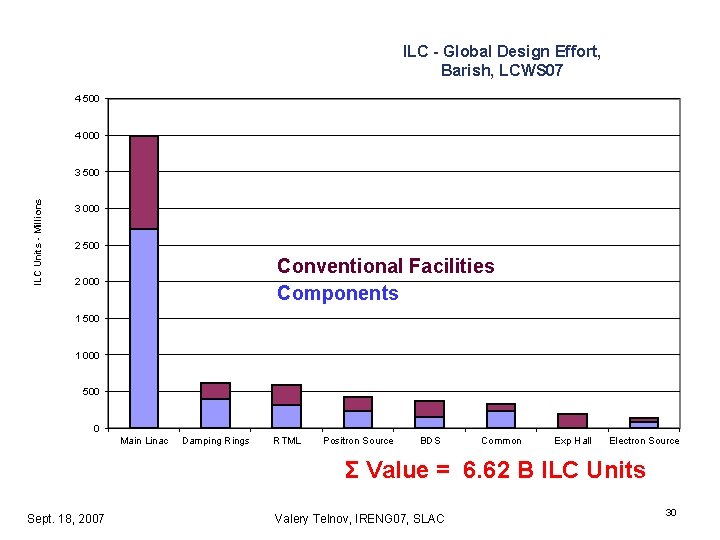
ILC - Global Design Effort, Barish, LCWS 07 4 500 4 000 ILC Units - Millions 3 500 3 000 2 500 Conventional Facilities Components 2 000 1 500 1 000 500 0 Main Linac Damping Rings RTML Positron Source BDS Common Exp Hall Electron Source Σ Value = 6. 62 B ILC Units Sept. 18, 2007 Valery Telnov, IRENG 07, SLAC 30
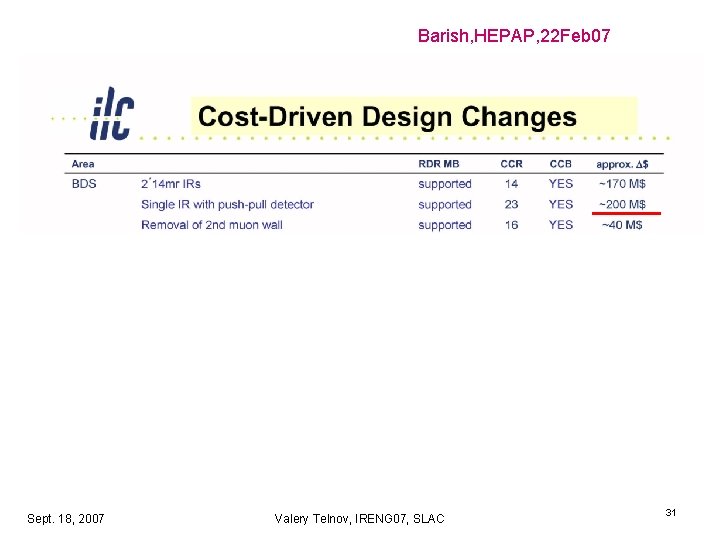
Barish, HEPAP, 22 Feb 07 Sept. 18, 2007 Valery Telnov, IRENG 07, SLAC 31
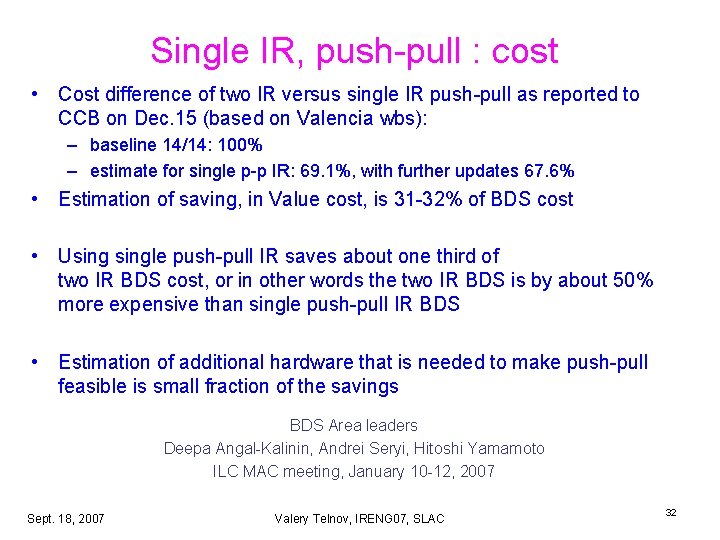
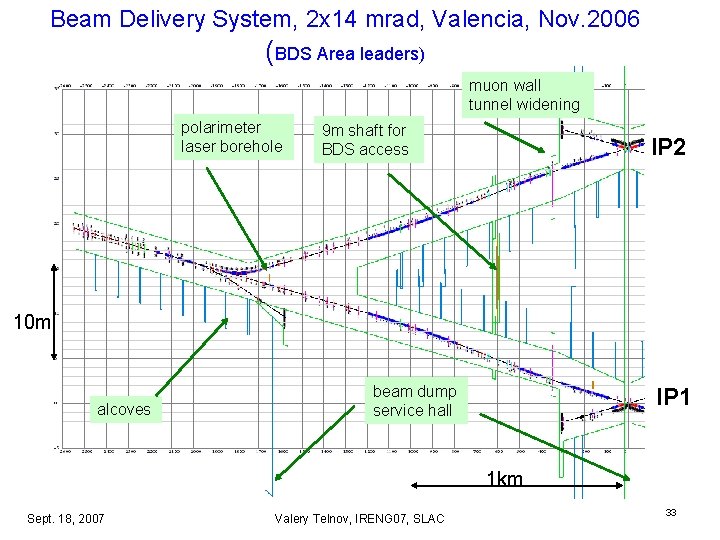
Single IR, push-pull : cost • Cost difference of two IR versus single IR push-pull as reported to CCB on Dec. 15 (based on Valencia wbs): – baseline 14/14: 100% – estimate for single p-p IR: 69. 1%, with further updates 67. 6% • Estimation of saving, in Value cost, is 31 -32% of BDS cost • Usingle push-pull IR saves about one third of two IR BDS cost, or in other words the two IR BDS is by about 50% more expensive than single push-pull IR BDS • Estimation of additional hardware that is needed to make push-pull feasible is small fraction of the savings BDS Area leaders Deepa Angal-Kalinin, Andrei Seryi, Hitoshi Yamamoto ILC MAC meeting, January 10 -12, 2007 Sept. 18, 2007 Valery Telnov, IRENG 07, SLAC 32
Beam Delivery System, 2 x 14 mrad, Valencia, Nov. 2006 (BDS Area leaders) muon wall tunnel widening polarimeter laser borehole 9 m shaft for BDS access IP 2 10 m alcoves beam dump service hall IP 1 1 km Sept. 18, 2007 Valery Telnov, IRENG 07, SLAC 33
Beam Delivery System tunnels for 2 x 14 mrad (Valencia) Sept. 18, 2007 Valery Telnov, IRENG 07, SLAC 34
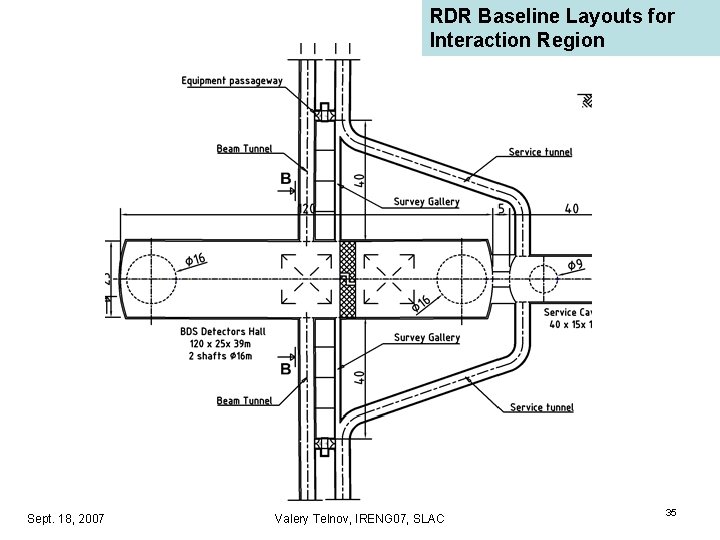
RDR Baseline Layouts for Interaction Region Sept. 18, 2007 Valery Telnov, IRENG 07, SLAC 35