
Photomultiplier Lecture 12 Photo detectors Purpose Convert light

- Slides: 13
Photomultiplier Lecture 12
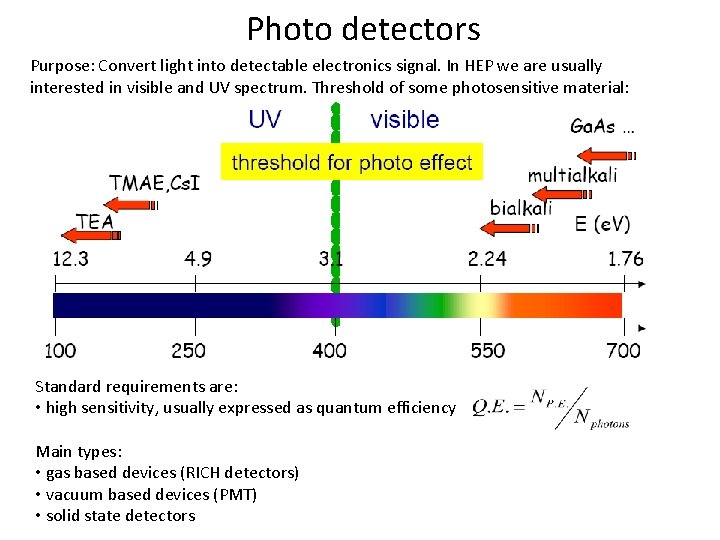
Photo detectors Purpose: Convert light into detectable electronics signal. In HEP we are usually interested in visible and UV spectrum. Threshold of some photosensitive material: Standard requirements are: • high sensitivity, usually expressed as quantum efficiency Main types: • gas based devices (RICH detectors) • vacuum based devices (PMT) • solid state detectors
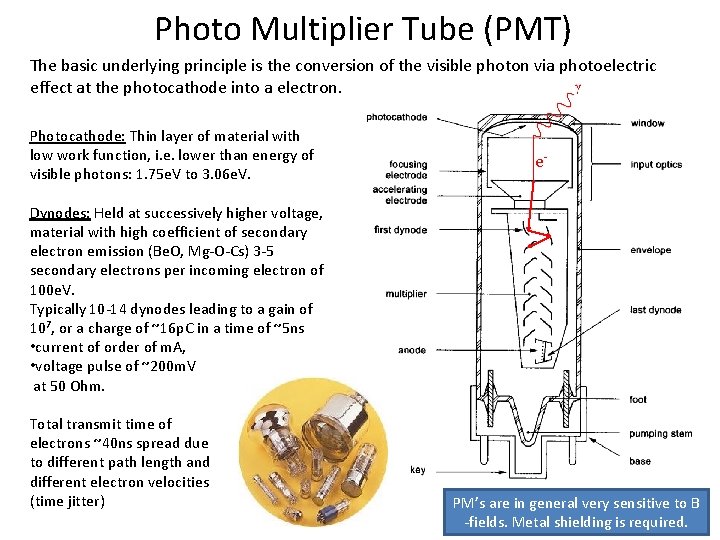
Photo Multiplier Tube (PMT) The basic underlying principle is the conversion of the visible photon via photoelectric effect at the photocathode into a electron. Photocathode: Thin layer of material with low work function, i. e. lower than energy of visible photons: 1. 75 e. V to 3. 06 e. V. e- Dynodes: Held at successively higher voltage, material with high coefficient of secondary electron emission (Be. O, Mg-O-Cs) 3 -5 secondary electrons per incoming electron of 100 e. V. Typically 10 -14 dynodes leading to a gain of 107, or a charge of ~16 p. C in a time of ~5 ns • current of order of m. A, • voltage pulse of ~200 m. V at 50 Ohm. Total transmit time of electrons ~40 ns spread due to different path length and different electron velocities (time jitter) PM’s are in general very sensitive to B -fields. Metal shielding is required.
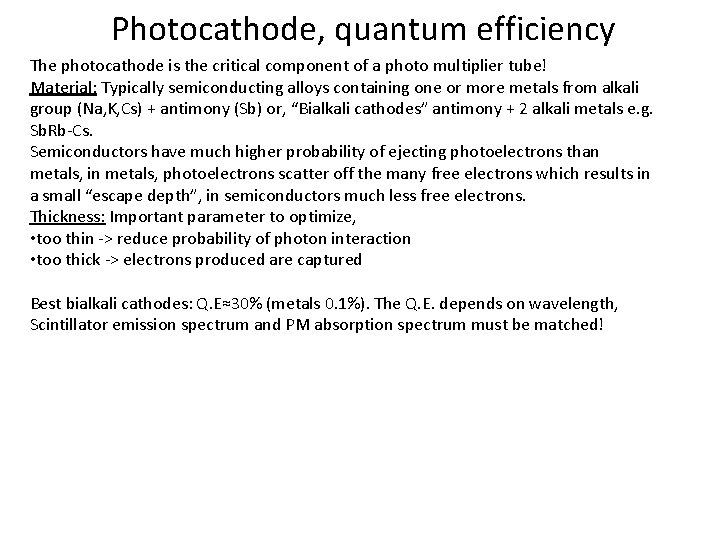
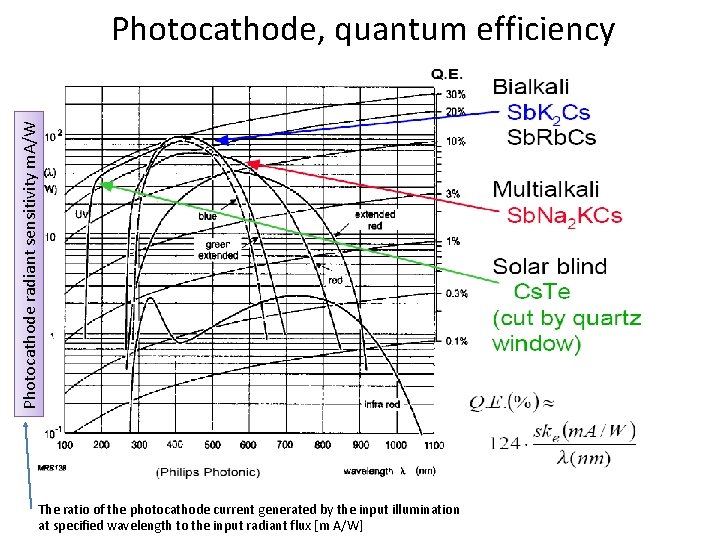
Photocathode, quantum efficiency The photocathode is the critical component of a photo multiplier tube! Material: Typically semiconducting alloys containing one or more metals from alkali group (Na, K, Cs) + antimony (Sb) or, “Bialkali cathodes” antimony + 2 alkali metals e. g. Sb. Rb-Cs. Semiconductors have much higher probability of ejecting photoelectrons than metals, in metals, photoelectrons scatter off the many free electrons which results in a small “escape depth”, in semiconductors much less free electrons. Thickness: Important parameter to optimize, • too thin -> reduce probability of photon interaction • too thick -> electrons produced are captured Best bialkali cathodes: Q. E≈30% (metals 0. 1%). The Q. E. depends on wavelength, Scintillator emission spectrum and PM absorption spectrum must be matched!
Photocathode radiant sensitivity m. A/W Photocathode, quantum efficiency The ratio of the photocathode current generated by the input illumination at specified wavelength to the input radiant flux [m A/W]
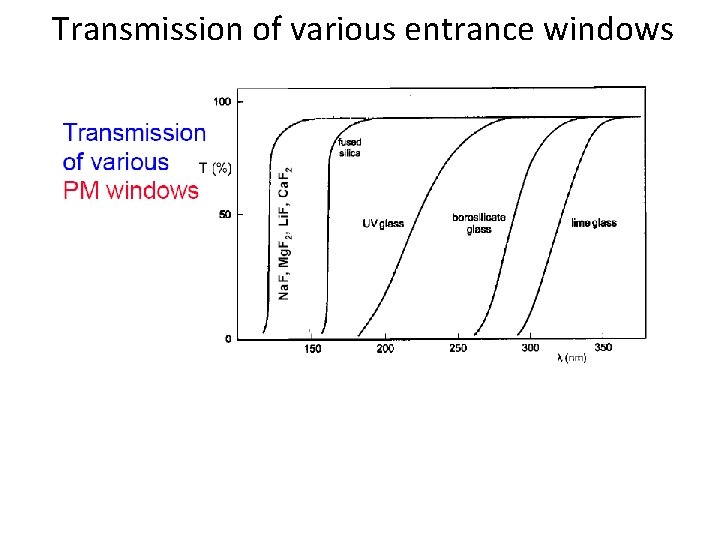
Transmission of various entrance windows
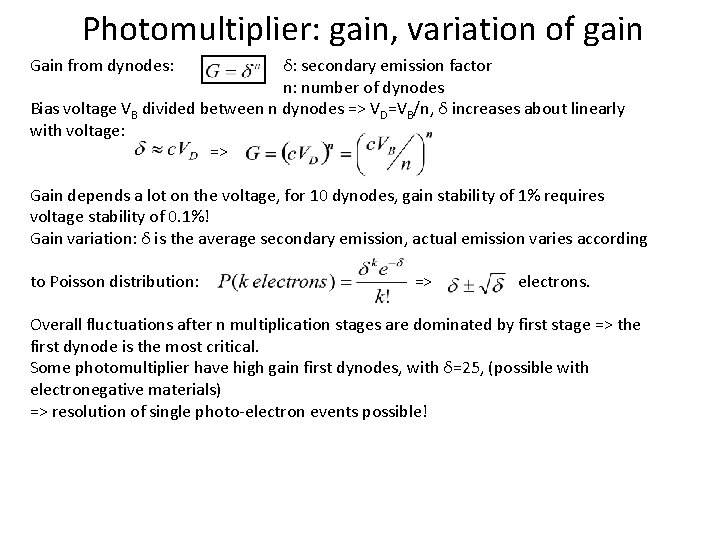
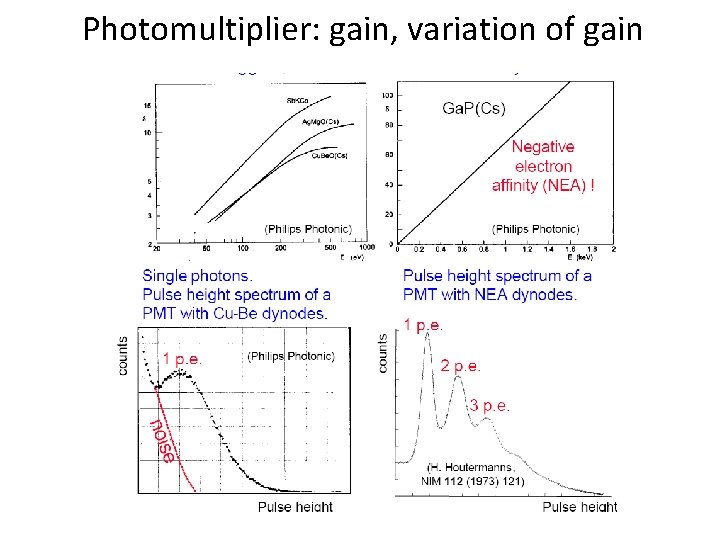
Photomultiplier: gain, variation of gain Gain from dynodes: δ: secondary emission factor n: number of dynodes Bias voltage VB divided between n dynodes => VD=VB/n, δ increases about linearly with voltage: => Gain depends a lot on the voltage, for 10 dynodes, gain stability of 1% requires voltage stability of 0. 1%! Gain variation: δ is the average secondary emission, actual emission varies according to Poisson distribution: => electrons. Overall fluctuations after n multiplication stages are dominated by first stage => the first dynode is the most critical. Some photomultiplier have high gain first dynodes, with δ=25, (possible with electronegative materials) => resolution of single photo-electron events possible!
Photomultiplier: gain, variation of gain
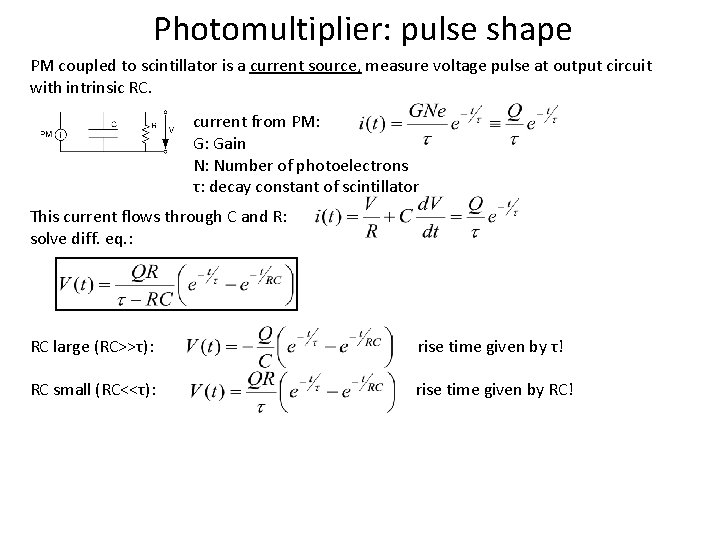
Photomultiplier: pulse shape PM coupled to scintillator is a current source, measure voltage pulse at output circuit with intrinsic RC. current from PM: G: Gain N: Number of photoelectrons τ: decay constant of scintillator This current flows through C and R: solve diff. eq. : RC large (RC>>τ): rise time given by τ! RC small (RC<<τ): rise time given by RC!
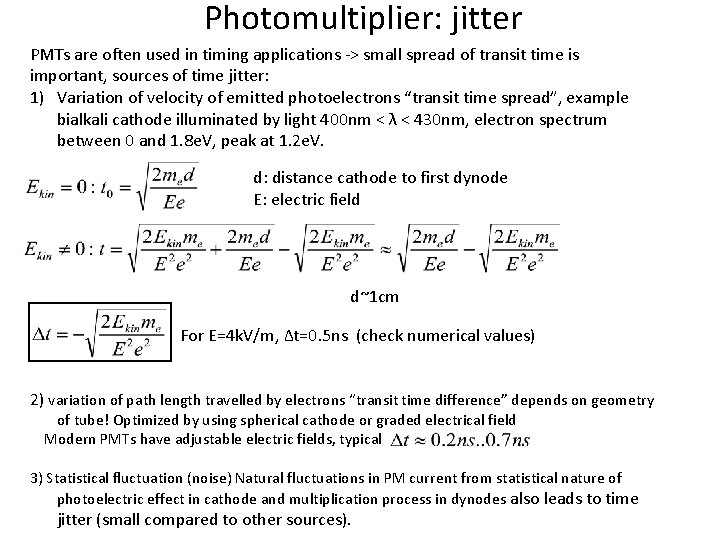
Photomultiplier: jitter PMTs are often used in timing applications -> small spread of transit time is important, sources of time jitter: 1) Variation of velocity of emitted photoelectrons “transit time spread”, example bialkali cathode illuminated by light 400 nm < λ < 430 nm, electron spectrum between 0 and 1. 8 e. V, peak at 1. 2 e. V. d: distance cathode to first dynode E: electric field d~1 cm For E=4 k. V/m, Δt=0. 5 ns (check numerical values) 2) variation of path length travelled by electrons “transit time difference” depends on geometry of tube! Optimized by using spherical cathode or graded electrical field Modern PMTs have adjustable electric fields, typical 3) Statistical fluctuation (noise) Natural fluctuations in PM current from statistical nature of photoelectric effect in cathode and multiplication process in dynodes also leads to time jitter (small compared to other sources).
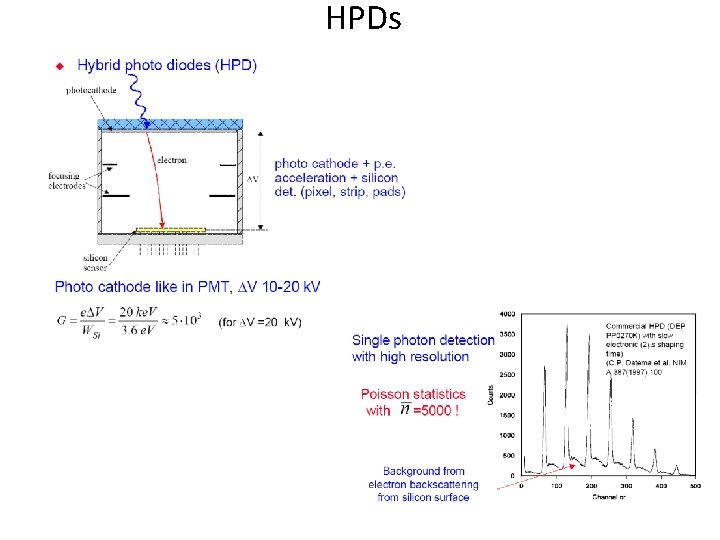
HPDs
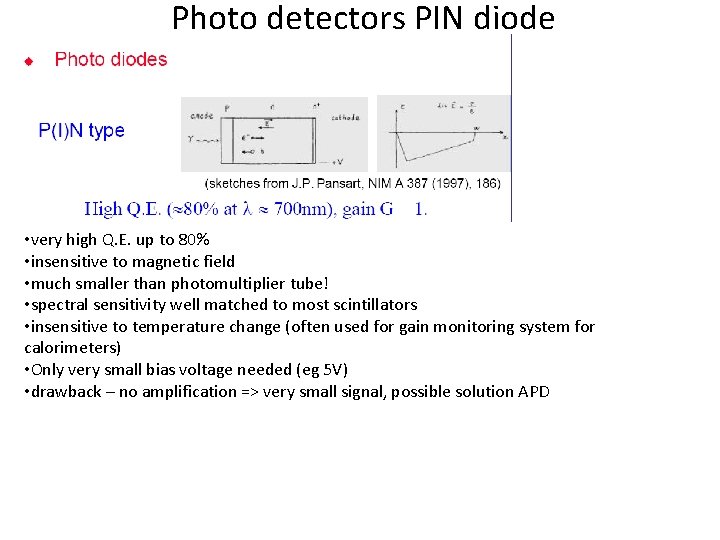
Photo detectors PIN diode • very high Q. E. up to 80% • insensitive to magnetic field • much smaller than photomultiplier tube! • spectral sensitivity well matched to most scintillators • insensitive to temperature change (often used for gain monitoring system for calorimeters) • Only very small bias voltage needed (eg 5 V) • drawback – no amplification => very small signal, possible solution APD
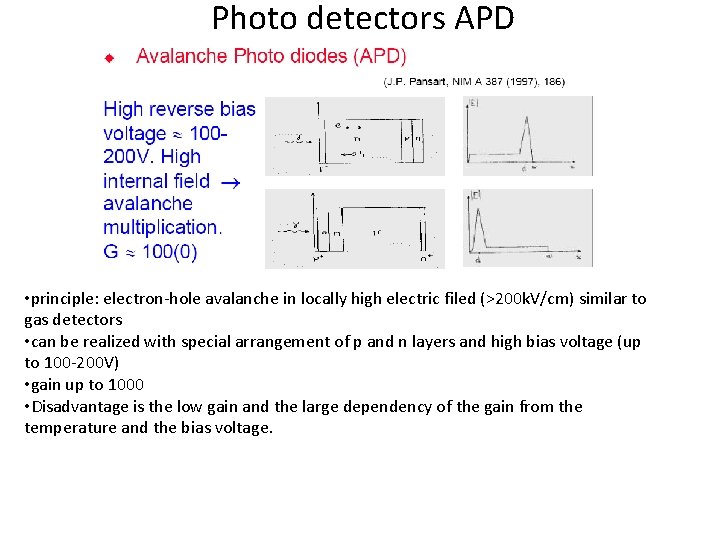
Photo detectors APD • principle: electron-hole avalanche in locally high electric filed (>200 k. V/cm) similar to gas detectors • can be realized with special arrangement of p and n layers and high bias voltage (up to 100 -200 V) • gain up to 1000 • Disadvantage is the low gain and the large dependency of the gain from the temperature and the bias voltage.