
Photography of Bill Maris Employing iterative processing in
Photography of Bill Maris Employing iterative processing in a pilot study of Access to Memory Diana Rosenthal, Ryan Alons, Laura Childs, Zinia Rahman, and Jaclyn Cafarella
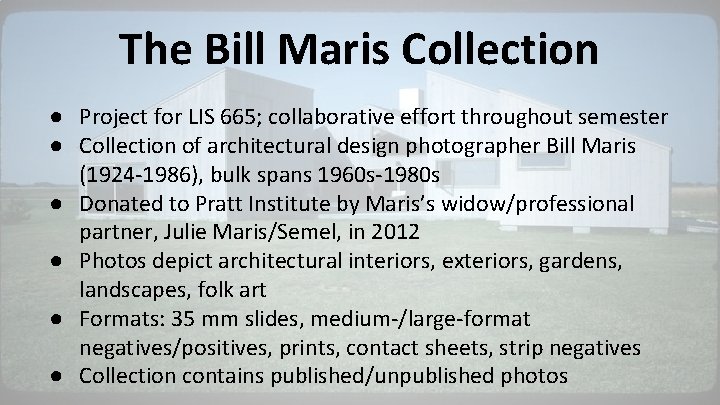
The Bill Maris Collection ● Project for LIS 665; collaborative effort throughout semester ● Collection of architectural design photographer Bill Maris (1924 -1986), bulk spans 1960 s-1980 s ● Donated to Pratt Institute by Maris’s widow/professional partner, Julie Maris/Semel, in 2012 ● Photos depict architectural interiors, exteriors, gardens, landscapes, folk art ● Formats: 35 mm slides, medium-/large-format negatives/positives, prints, contact sheets, strip negatives ● Collection contains published/unpublished photos
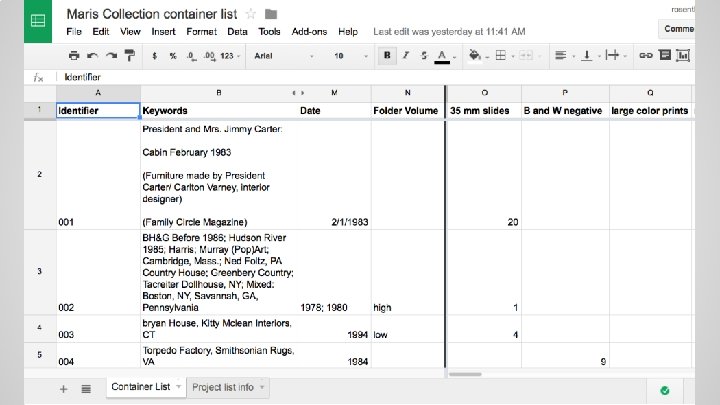
Vision for the Maris Project ● Intellectually organize collection ● Choose a metadata schema ● Conduct extensive research of Maris and other involved parties (publications, architecture firms) ● Use Access to Memory (Ato. M) (Canadian archival description software) to create web presence and online finding aid ● Digitize materials and use Ato. M as digital repository ● But first! Inventory and assess the physical collection. . .

Other Challenges of Overall Project ● Applying DACS metadata schema to the Maris Collection ● No experience working with Ato. M (uses PHP and Symfony) ● Limited experience working with diverse photographic mediums ● No background knowledge of architecture ● Working with outdated technology equipment; lacking necessary digitization technology ● Lack of time; need for iterative processing (Santamaria, 2015) and “More Product, Less Process” (Greene & Meissner, 2005)
Curation and Research Laura Childs and Kathleen Arthur were responsible for presenting the collection in a meaningful way and researching Bill Maris and associated architects, designers, publications, and other clients. Our work included: ● Writing biographical note on Bill Maris and Julie Maris/Semel ● Compiling information on clients for Ato. M authority records ● Reconciling errors and discrepancies within donor list and in relation to collection ● Establishing foundation for digitization plan
Curation Challenges and Accomplishments ● Primary challenges o Lack of prior processing of physical collection o Inaccuracies in donor list o Digitization planning hindered ● Solutions o Assess collection and create new inventory that eliminates errors and uncovers problems -- missing projects, mystery containers o Create preliminary digitization plan ● Accomplishments o Future classes will have a reconciled inventory and can immediately begin digitizing photographs
Research Challenges and Accomplishments ● Research on Bill Maris o Primary challenges: Lack of biographical information and trouble contacting donor o Solution: Devise bio questions based on DACS o Accomplishment: Biographical Sketch on Bill and Julie Maris/Semel ● Research for Authority Records o Primary challenges: Umbrella terms, incorrect names on donor list o Solution: Verify entities in authority records and compile background info o Accomplishment: All names normalized and entities described in authority records
Technology and Design Ryan Alons and Zinia Rahman were tasked with defining the current/future technology and design needs of a digital archive and developing the structure of a robust, web-based finding aid an online host for the digitized items in the Maris repository. ● Ato. M uses PHP language and Symfony programming components ● Follows international archival standards ● Has option to import/export metadata from different encoding standards -- EAD 2002 XML, DC 1. 1 XML, CSV ● Responded to needs of metadata and curation groups, worked out technological issues ● Continued previous semester’s digitization efforts (35 mm slides)
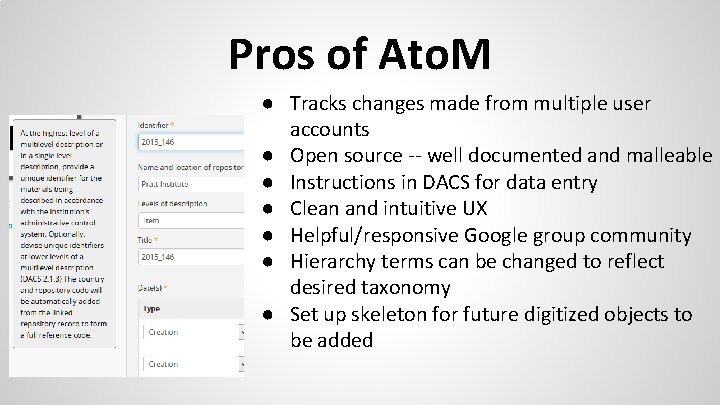
Pros of Ato. M ● Tracks changes made from multiple user accounts ● Open source -- well documented and malleable ● Instructions in DACS for data entry ● Clean and intuitive UX ● Helpful/responsive Google group community ● Hierarchy terms can be changed to reflect desired taxonomy ● Set up skeleton for future digitized objects to be added
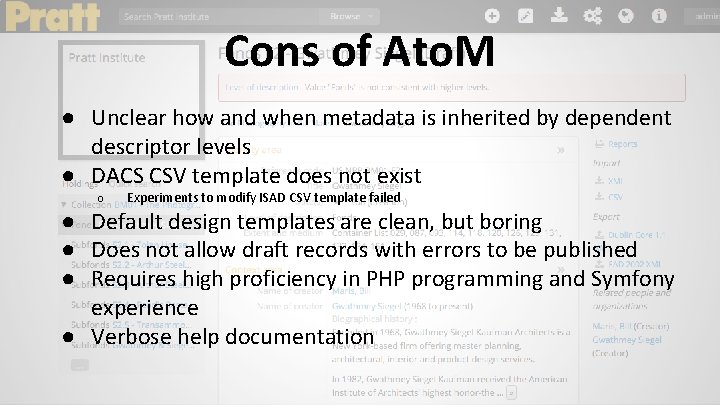
Cons of Ato. M ● Unclear how and when metadata is inherited by dependent descriptor levels ● DACS CSV template does not exist o Experiments to modify ISAD CSV template failed ● Default design templates are clean, but boring ● Does not allow draft records with errors to be published ● Requires high proficiency in PHP programming and Symfony experience ● Verbose help documentation
Metadata and Intellectual Organization Diana Rosenthal and Jaclyn Cafarella were responsible for deciding upon and implementing all facets of metadata and intellectual organization, including but not limited to: ● Application of DACS and implementation of minimum requirements ● Hierarchical structure and intellectual organization of the collection (following original order on donor list) ● Authority records, access points, and standardized vocabulary and format ● Creation of identifiers
Metadata Challenges and Accomplishments ● Primary challenges o Describing the collection: choosing essential metadata elements for various hierarchy levels o Data entry in Ato. M complicated by initial single-user setup; hierarchy problems due to back-end parent/child level assignments o Issues saving changes and creating duplicate records o Getty and LOC vocabularies too specialized o Unlabeled folders and items/projects in donor list that cannot be reconciled ● Solutions o Implemented DACS minimum requirements (2013 manual) o Tech group created multiple users to eliminate problems saving records and creating duplicates; reassigned hierarchy levels to publish records o Elected to focus on people/entities/places access points instead of subject access points and headings o Use of “notes” field to indicate existence of missing items
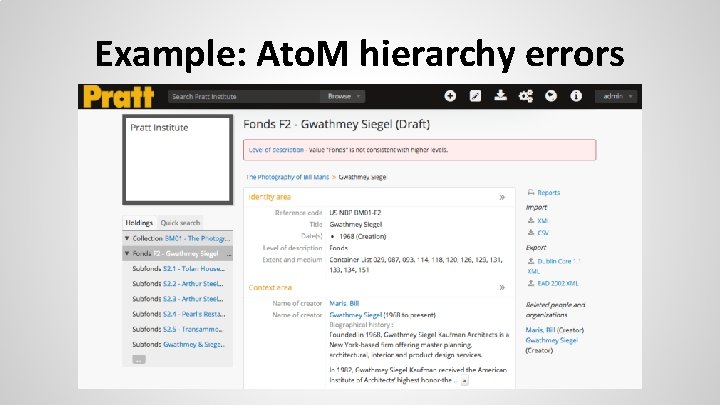
Example: Ato. M hierarchy errors
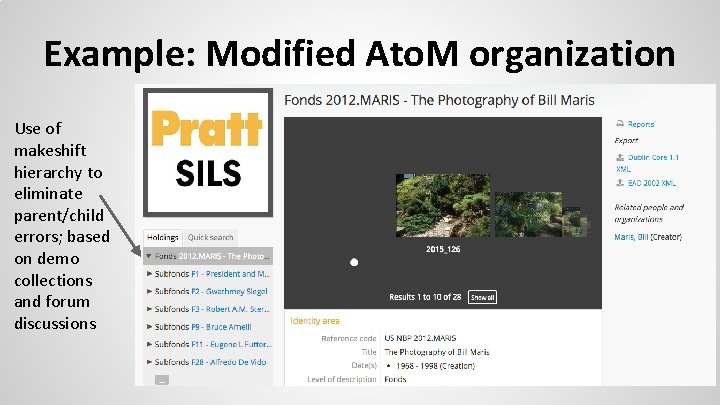
Example: Modified Ato. M organization Use of makeshift hierarchy to eliminate parent/child errors; based on demo collections and forum discussions
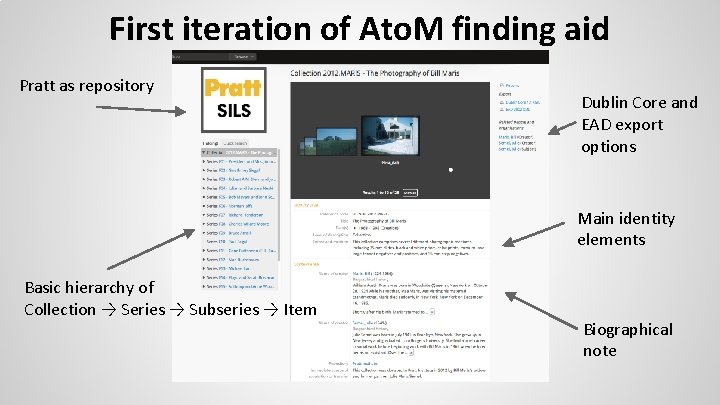
First iteration of Ato. M finding aid Pratt as repository Dublin Core and EAD export options Main identity elements Basic hierarchy of Collection → Series → Subseries → Item Biographical note
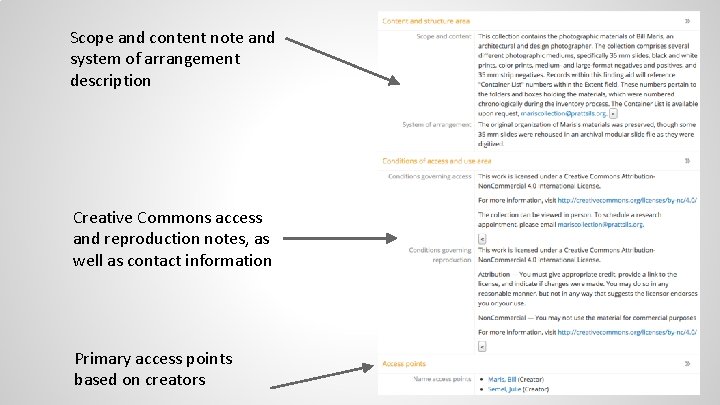
Scope and content note and system of arrangement description Creative Commons access and reproduction notes, as well as contact information Primary access points based on creators
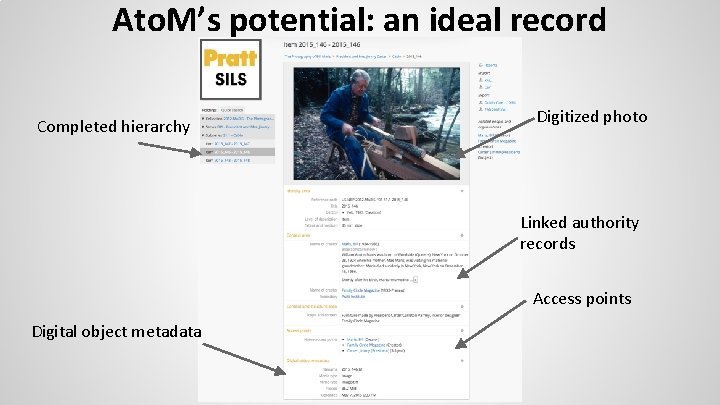
Ato. M’s potential: an ideal record Completed hierarchy Digitized photo Linked authority records Access points Digital object metadata
Conclusions ● Used MPLP/iterative processing ● Placed metadata/archival description at forefront of workflow and worked collaboratively ● Shifted priorities toward inventorying physical collection, creating website featuring finding aid, researching authority records and background information ● Used Ato. M platform to make Maris’s work available to researchers ● One step closer to a fully realized digital repository atom. prattsils. org
- Slides: 19