
Photography Mrs Berkun Significance of Photography in a
Photography Mrs. Berkun
Significance of Photography in a visual Society Different Ways to Use Photos 1. Newspaper-info. 2. Police-document 3. Museums-exhibit 4. Publishers-$ 5. Families-memories
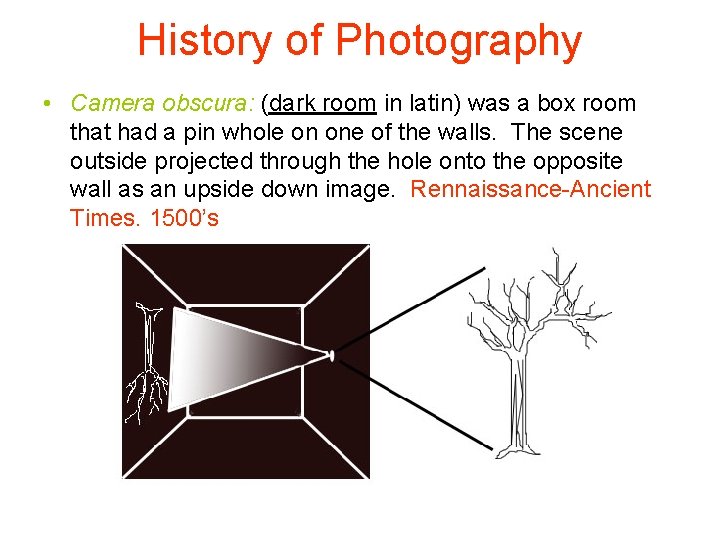
History of Photography • Camera obscura: (dark room in latin) was a box room that had a pin whole on one of the walls. The scene outside projected through the hole onto the opposite wall as an upside down image. Rennaissance-Ancient Times. 1500’s
Camera Lucida Invented in the early 1800’s in England by William Hyde Wollaston, did away with the camera obscura box. The device consisted of a prism mounted on a stand, was placed above a sheet of drawing paper. When the artist looked downward through the prism, he or she would see the scene in front of the camera projected onto the paper.
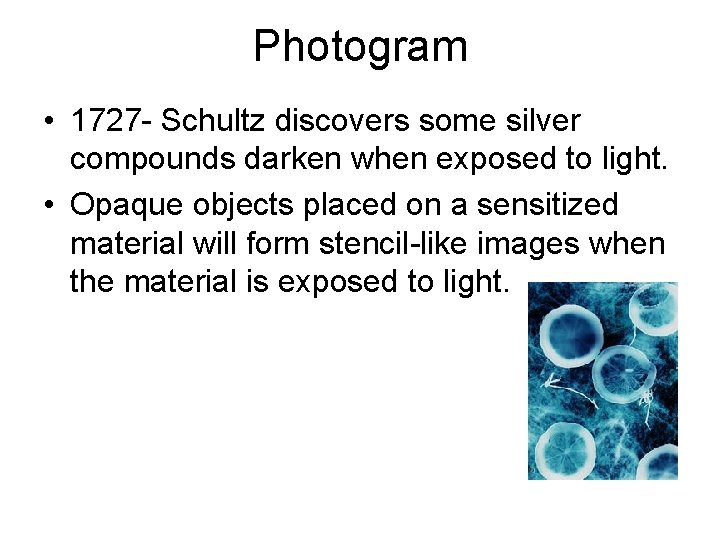
Photogram • 1727 - Schultz discovers some silver compounds darken when exposed to light. • Opaque objects placed on a sensitized material will form stencil-like images when the material is exposed to light.
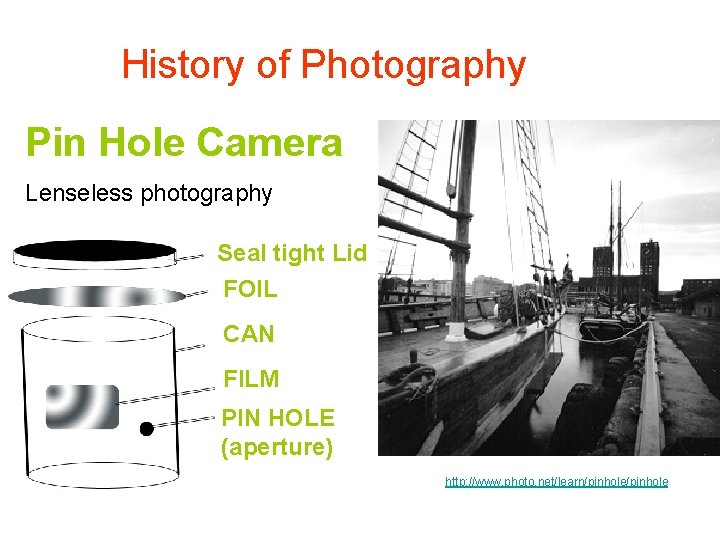
History of Photography Pin Hole Camera Lenseless photography Seal tight Lid FOIL CAN FILM PIN HOLE (aperture) http: //www. photo. net/learn/pinhole
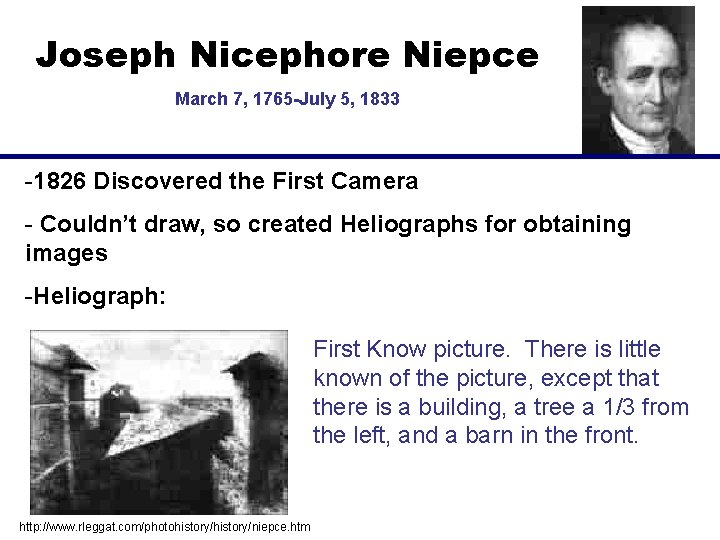
Joseph Nicephore Niepce March 7, 1765 -July 5, 1833 -1826 Discovered the First Camera - Couldn’t draw, so created Heliographs for obtaining images -Heliograph: First Know picture. There is little known of the picture, except that there is a building, a tree a 1/3 from the left, and a barn in the front. http: //www. rleggat. com/photohistory/niepce. htm
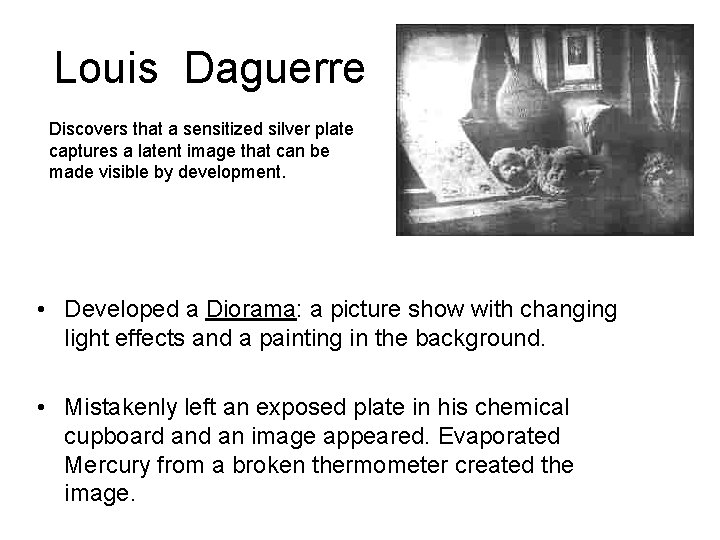
Louis Daguerre Discovers that a sensitized silver plate captures a latent image that can be made visible by development. • Developed a Diorama: a picture show with changing light effects and a painting in the background. • Mistakenly left an exposed plate in his chemical cupboard an image appeared. Evaporated Mercury from a broken thermometer created the image.
NEGATIVE • In the early 1830’s, William Henry Fox Talbot, captures a photographic image on paper with a silver chloride solution.
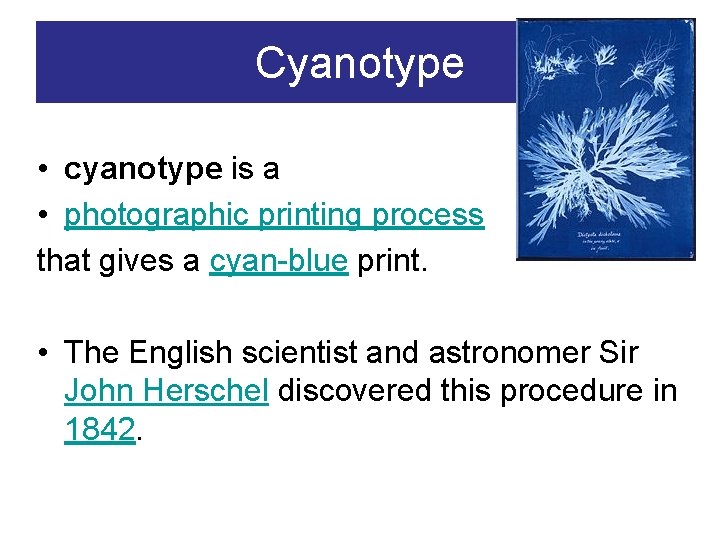
Cyanotype • cyanotype is a • photographic printing process that gives a cyan-blue print. • The English scientist and astronomer Sir John Herschel discovered this procedure in 1842.
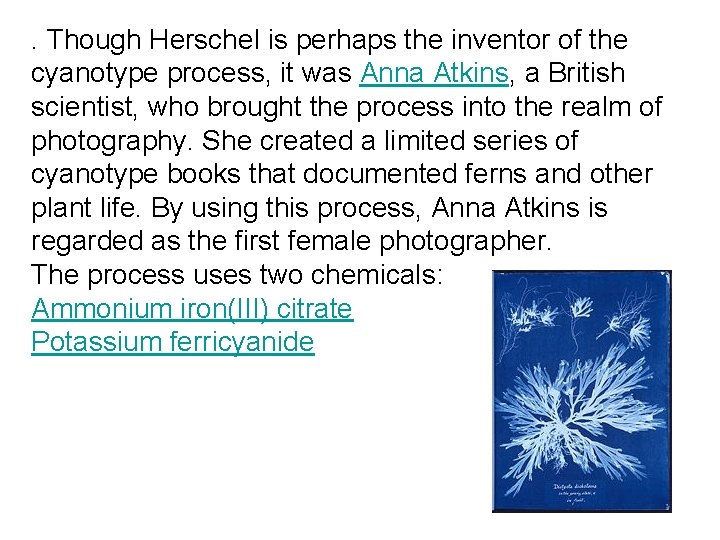
. Though Herschel is perhaps the inventor of the cyanotype process, it was Anna Atkins, a British scientist, who brought the process into the realm of photography. She created a limited series of cyanotype books that documented ferns and other plant life. By using this process, Anna Atkins is regarded as the first female photographer. The process uses two chemicals: Ammonium iron(III) citrate Potassium ferricyanide
History and Legends of Photography • Ancient times camera obscura • 1826 -camera was discovered by Joseph Niepce-image on pewter • 1839 -1 st of two primary photographers started Louis Daguerre-silver on copper • 1839 - William Talbot-Silver on paper • Alfred Steiglitz-Father of American photo, Husband to Georgio O’Keefe • Mathew Brady-Photos of Battle scenes of Civil War • Tim O’Sullivan-shot great American Landscapes • Lewis Hire-shot conditions of Children(immigrants coming to the U. S. ) • Ansel Adams
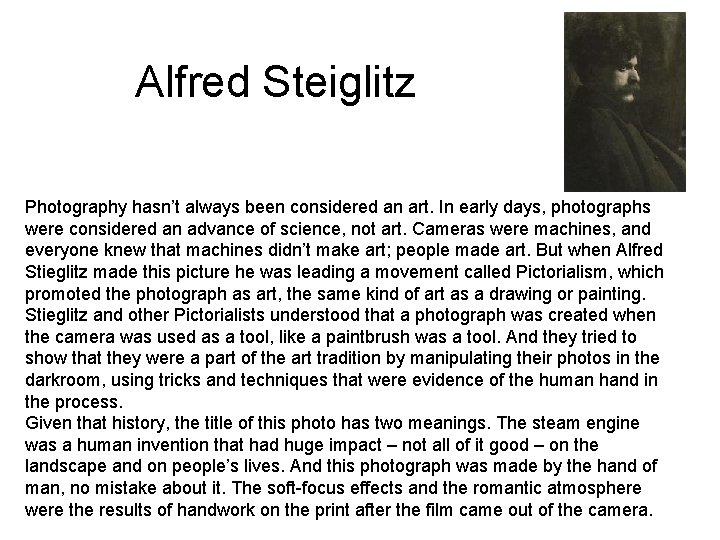
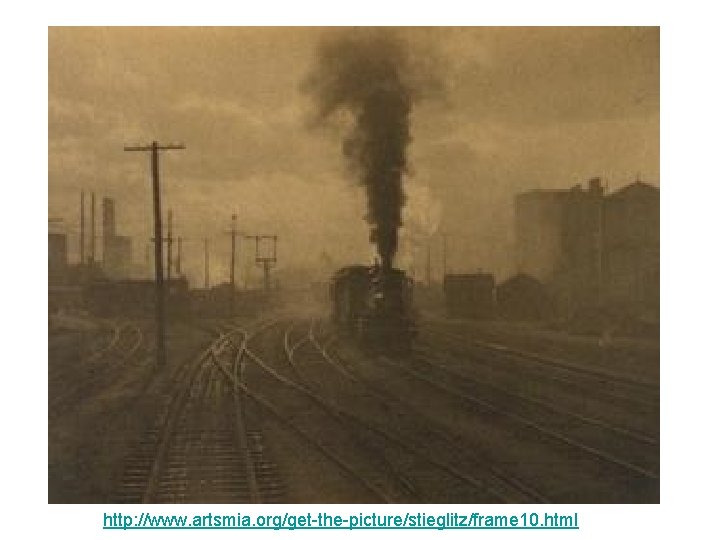
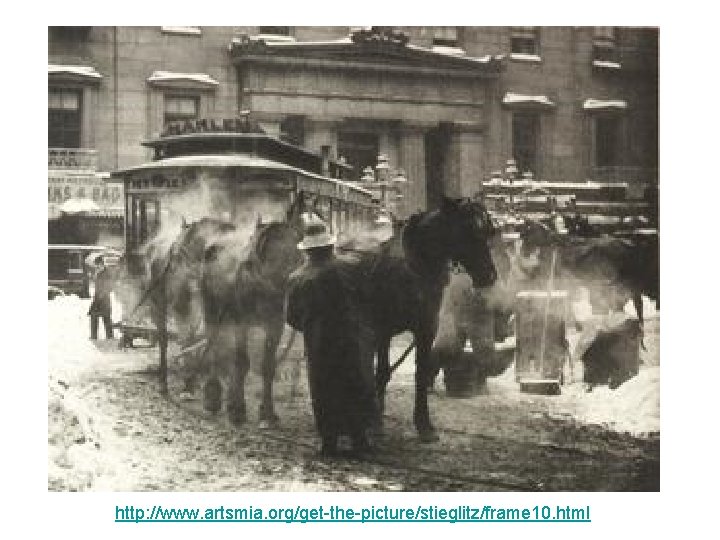
Alfred Steiglitz Photography hasn’t always been considered an art. In early days, photographs were considered an advance of science, not art. Cameras were machines, and everyone knew that machines didn’t make art; people made art. But when Alfred Stieglitz made this picture he was leading a movement called Pictorialism, which promoted the photograph as art, the same kind of art as a drawing or painting. Stieglitz and other Pictorialists understood that a photograph was created when the camera was used as a tool, like a paintbrush was a tool. And they tried to show that they were a part of the art tradition by manipulating their photos in the darkroom, using tricks and techniques that were evidence of the human hand in the process. Given that history, the title of this photo has two meanings. The steam engine was a human invention that had huge impact – not all of it good – on the landscape and on people’s lives. And this photograph was made by the hand of man, no mistake about it. The soft-focus effects and the romantic atmosphere were the results of handwork on the print after the film came out of the camera.
http: //www. artsmia. org/get-the-picture/stieglitz/frame 10. html
http: //www. artsmia. org/get-the-picture/stieglitz/frame 10. html
F/16 Rule On a bright sunny day (front lighting and no clouds), set the aperture to f/16. Find the ISO of the film and place it under the number 1. This fraction is the amount of exposure time for the film. For example if the ISO is 100 is 1/100 of a second
Notes • Bright sunny day-cloudless • Front light – light on the subject (behind the photographer) • ISO (International Standardization Organization) : measures a materials sensitivity to light • Aperture:
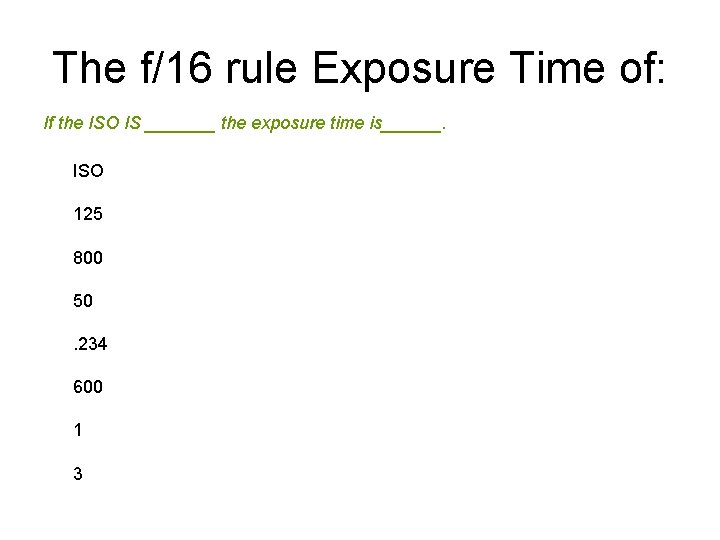
The f/16 rule Exposure Time of: If the ISO IS _______ the exposure time is______. ISO 125 800 50. 234 600 1 3
Problem: The Film (printing paper) speed we are using is ISO 16 What is your exposure time? What F/stop in the chart matches the exposure time Can anyone calculate this correctly when taking a picture? Try
I can’t What would happen if you exceeded the optimum time? So, what can we do? We can’t change the film speed because we we only have ISO 16 speed print paper.
How can we modify our experiment to increase the time?
We want to increase the time which will allow more light to come in. What setting on the camera will solve this problem?
Aperture • Look at the aperture chart and the exposure times • Which exposure times are countable? • What should we do to the aperture to be able to count?

Rayleigh’s Formula • Refer to your packet
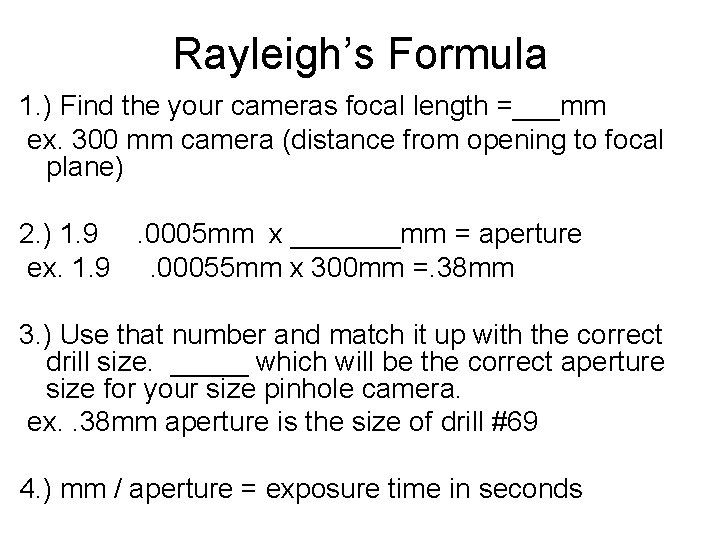
Rayleigh’s Formula 1. ) Find the your cameras focal length =___mm ex. 300 mm camera (distance from opening to focal plane) 2. ) 1. 9. 0005 mm x _______mm = aperture ex. 1. 9. 00055 mm x 300 mm =. 38 mm 3. ) Use that number and match it up with the correct drill size. _____ which will be the correct aperture size for your size pinhole camera. ex. . 38 mm aperture is the size of drill #69 4. ) mm / aperture = exposure time in seconds
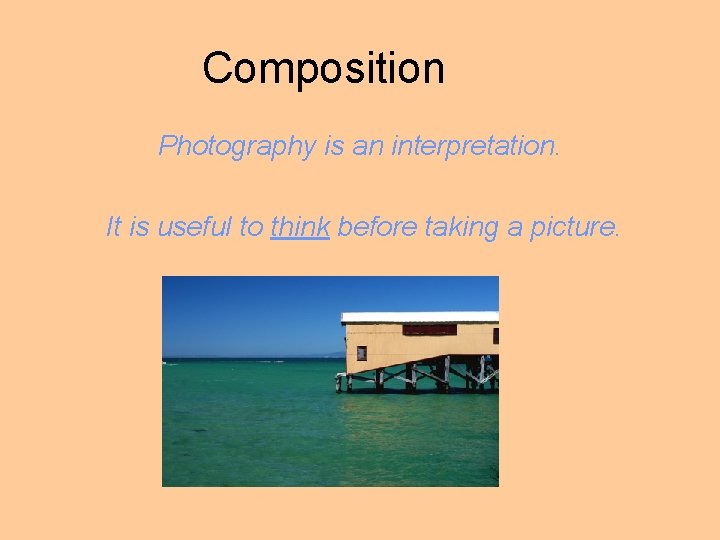
Composition Photography is an interpretation. It is useful to think before taking a picture.
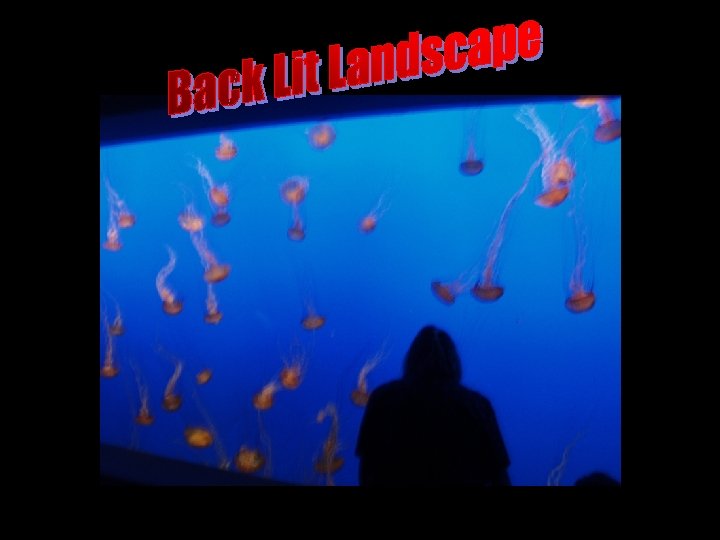
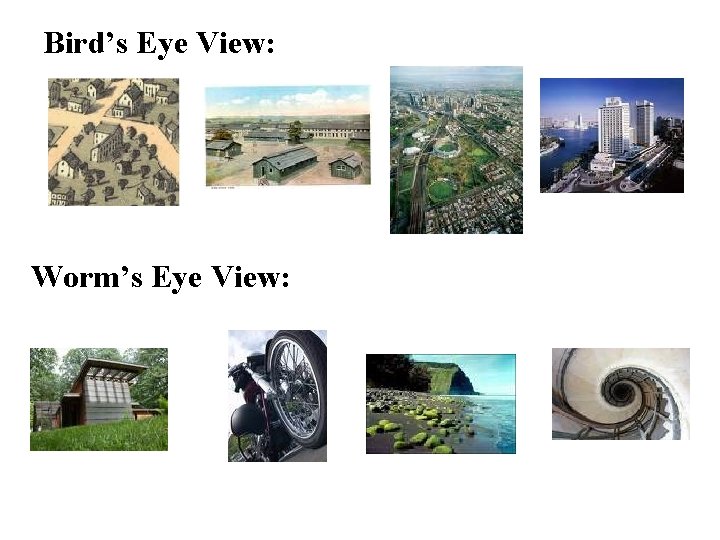
Bird’s Eye View: Worm’s Eye View:
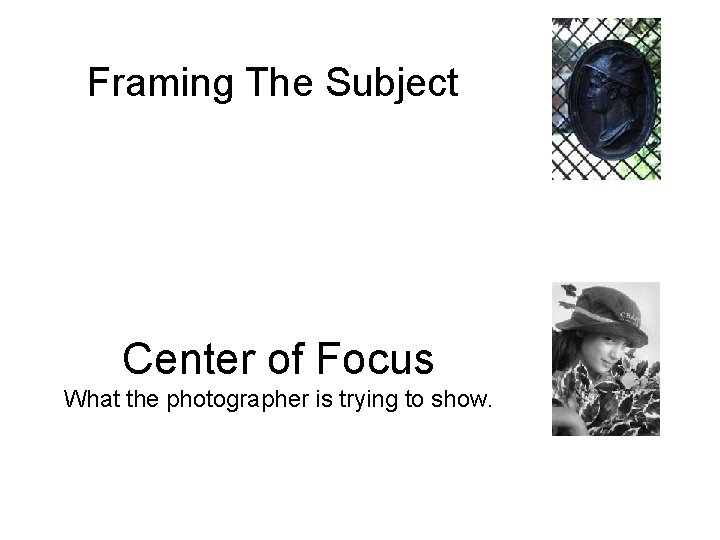
Framing The Subject Center of Focus What the photographer is trying to show.

Center of Focus
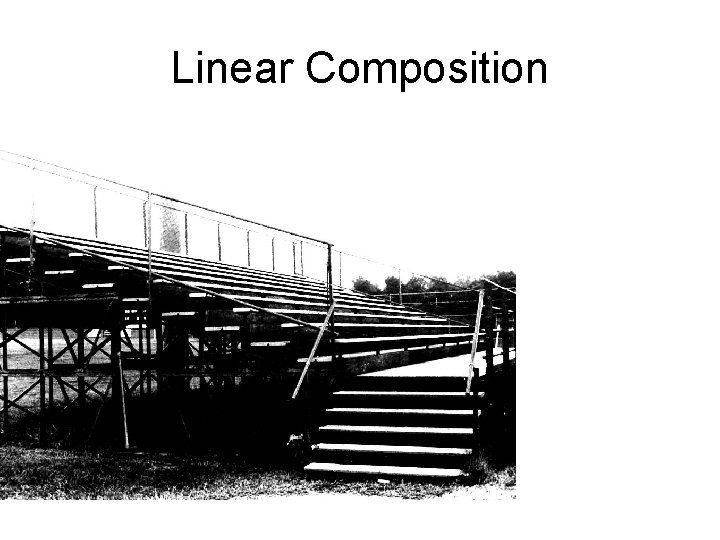
Linear Composition
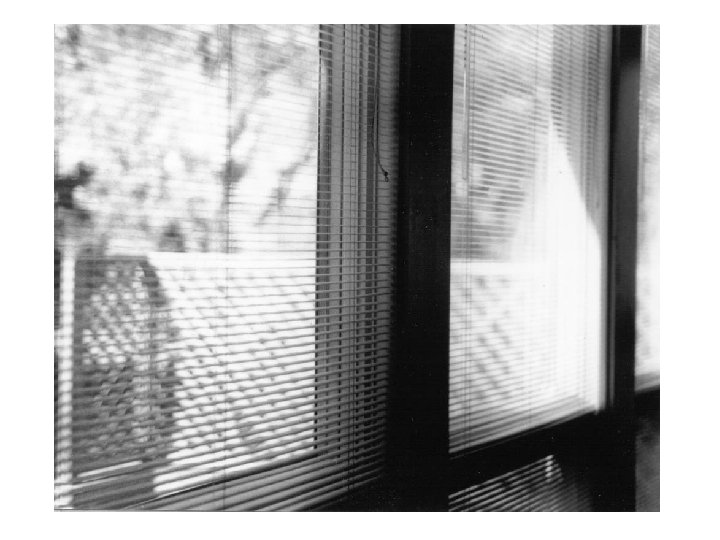
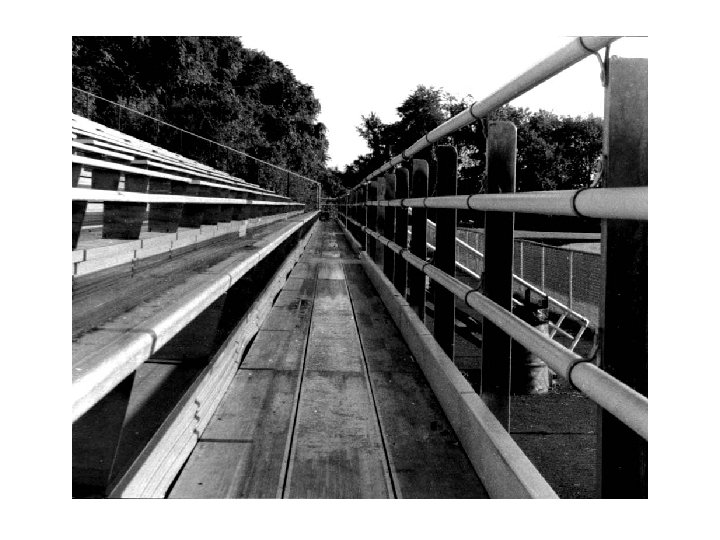
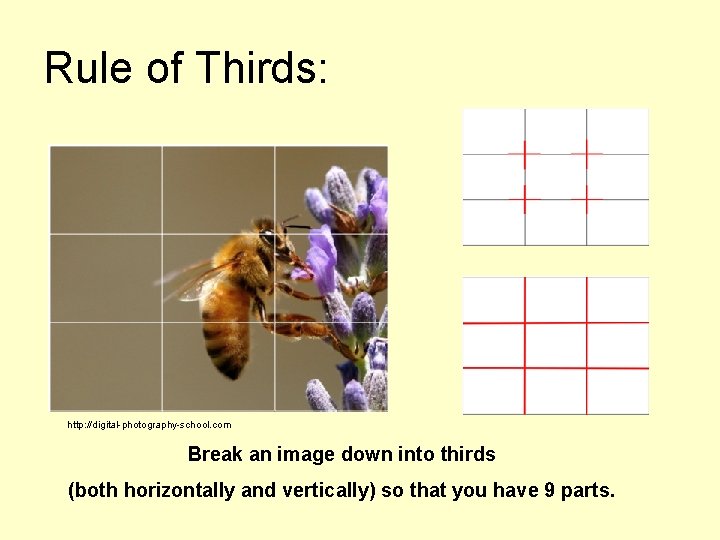
Rule of Thirds: http: //digital-photography-school. com Break an image down into thirds (both horizontally and vertically) so that you have 9 parts.
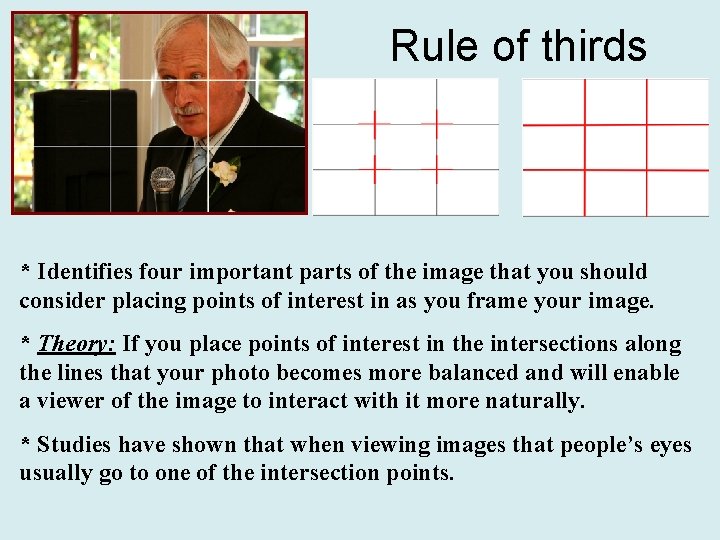
Rule of thirds * Identifies four important parts of the image that you should consider placing points of interest in as you frame your image. * Theory: If you place points of interest in the intersections along the lines that your photo becomes more balanced and will enable a viewer of the image to interact with it more naturally. * Studies have shown that when viewing images that people’s eyes usually go to one of the intersection points.
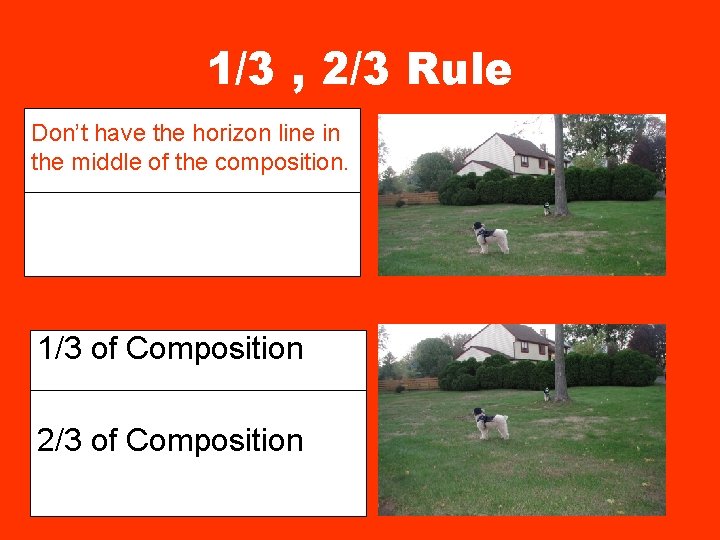
1/3 , 2/3 Rule Don’t have the horizon line in the middle of the composition. 1/3 of Composition 2/3 of Composition
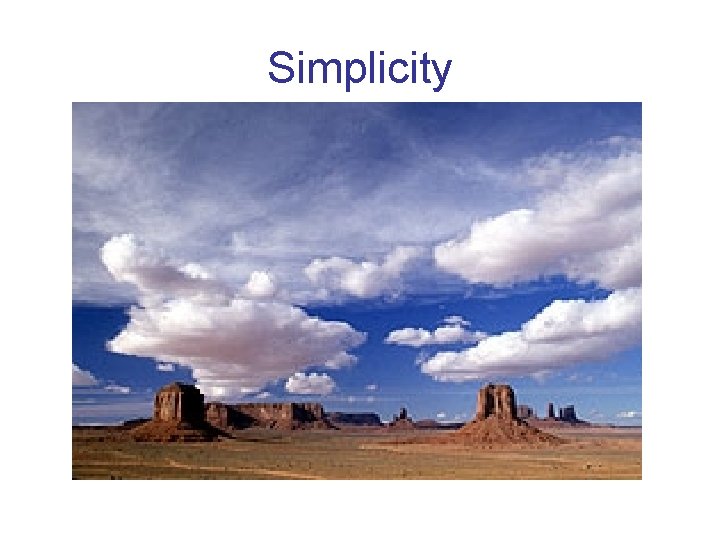
Simplicity
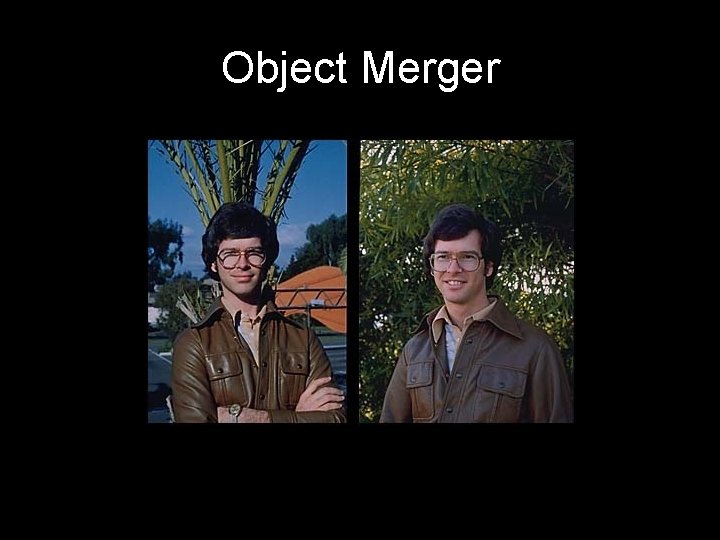
Object Merger
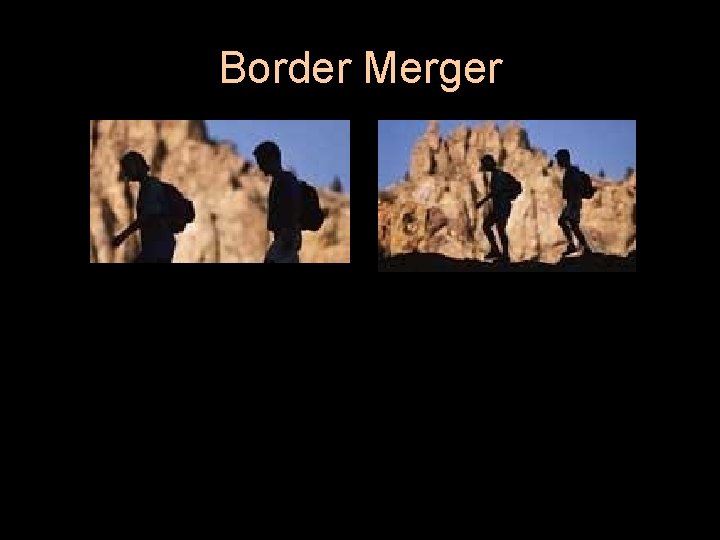
Border Merger
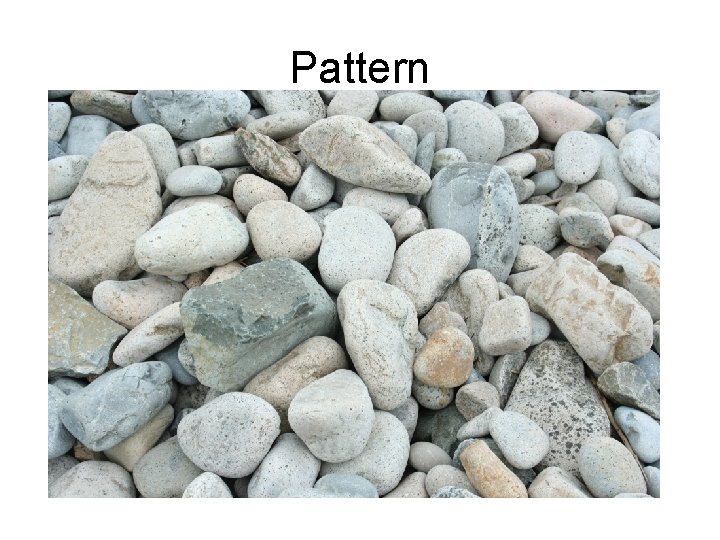
Pattern
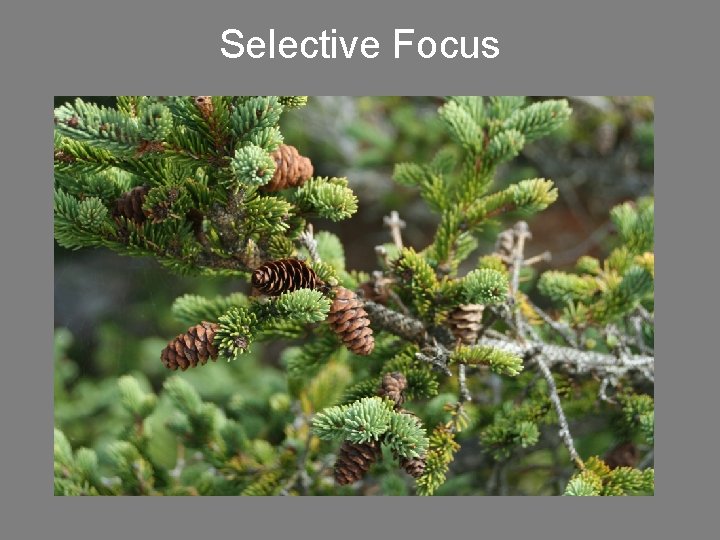
Selective Focus
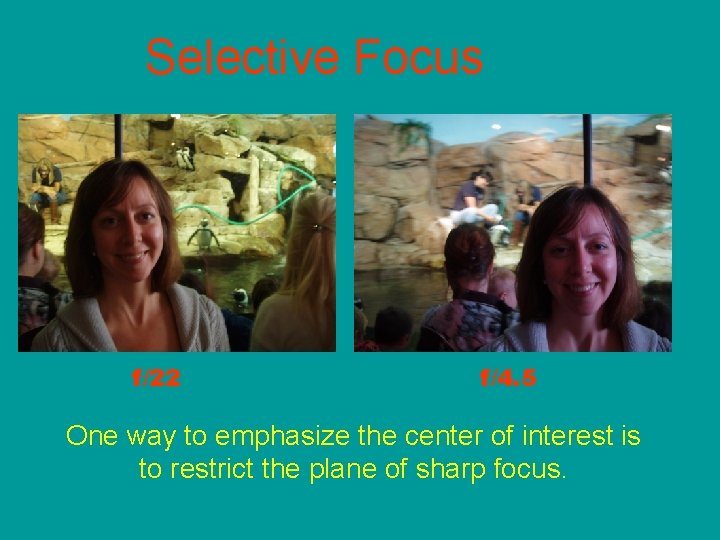
Selective Focus f/22 f/4. 5 One way to emphasize the center of interest is to restrict the plane of sharp focus.
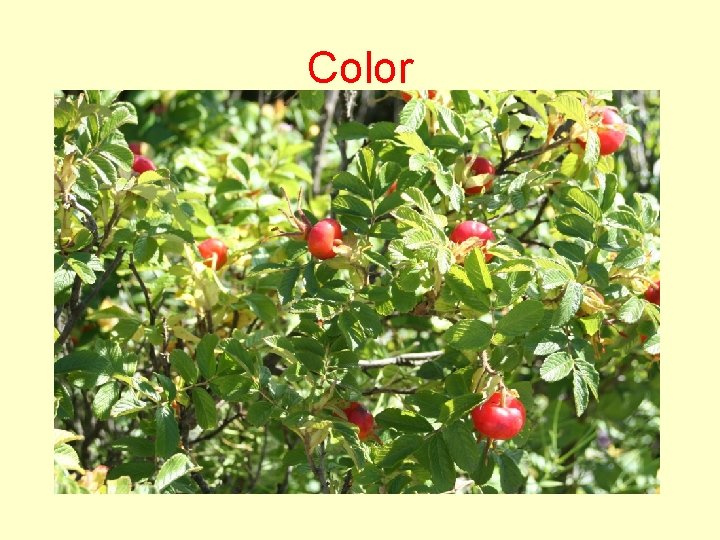
Color
Texture
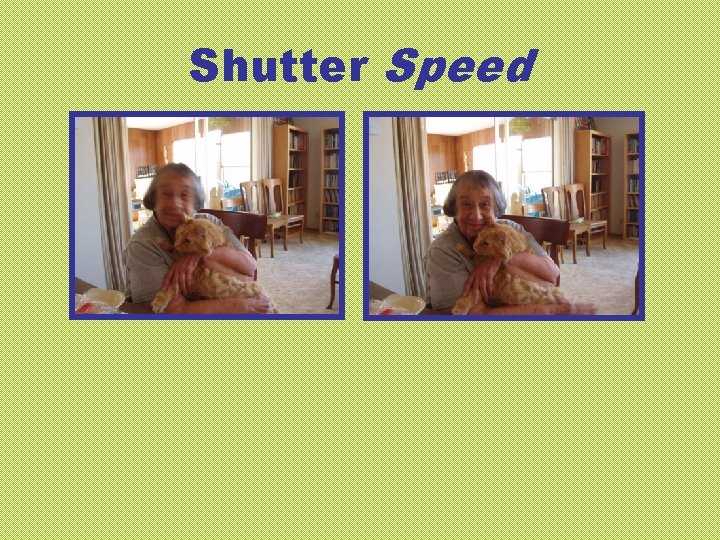
Shutter Speed
Depth of Field
- Slides: 48