
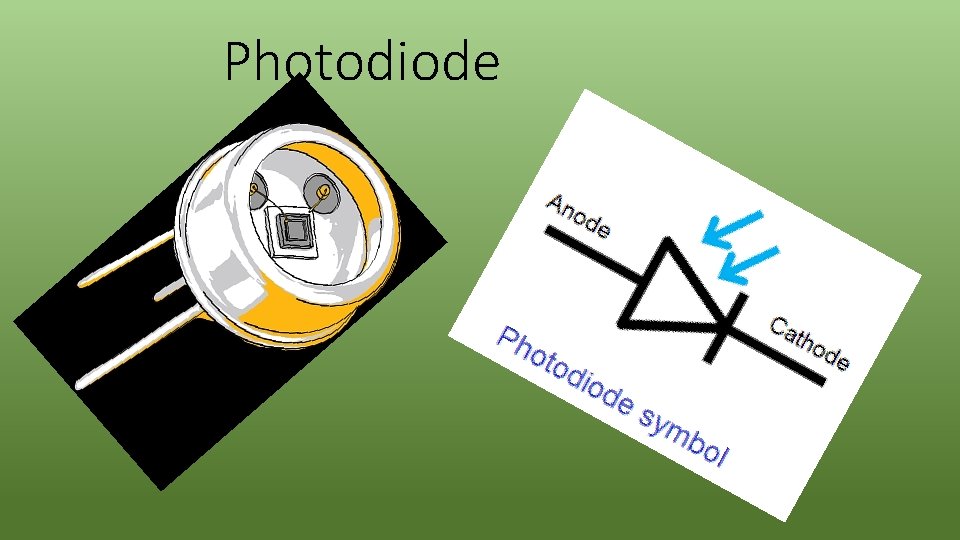
Photodiode A photodiode is a semiconductor device that


- Slides: 11
Photodiode
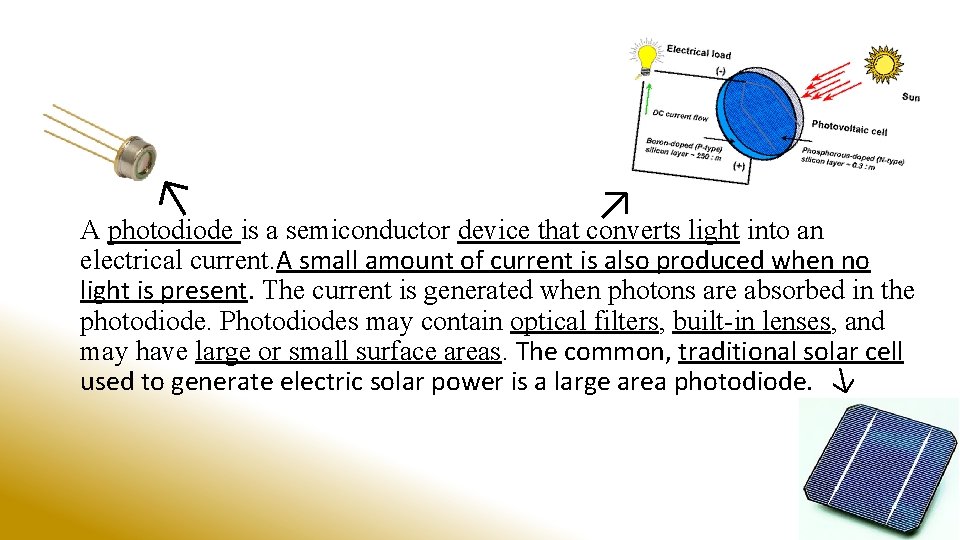
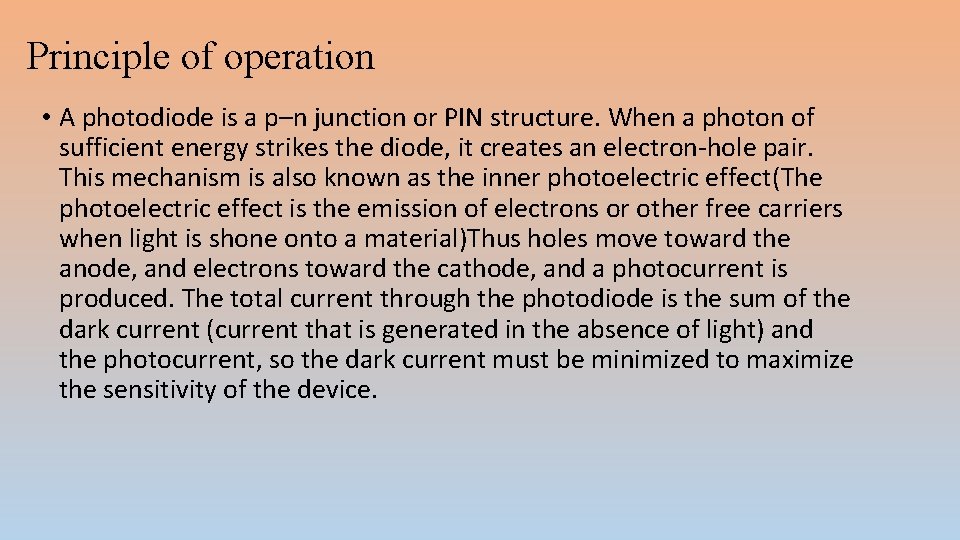
↑ ↑ A photodiode is a semiconductor device that converts light into an electrical current. A small amount of current is also produced when no light is present. The current is generated when photons are absorbed in the photodiode. Photodiodes may contain optical filters, built-in lenses, and may have large or small surface areas. The common, traditional solar cell used to generate electric solar power is a large area photodiode. ↓
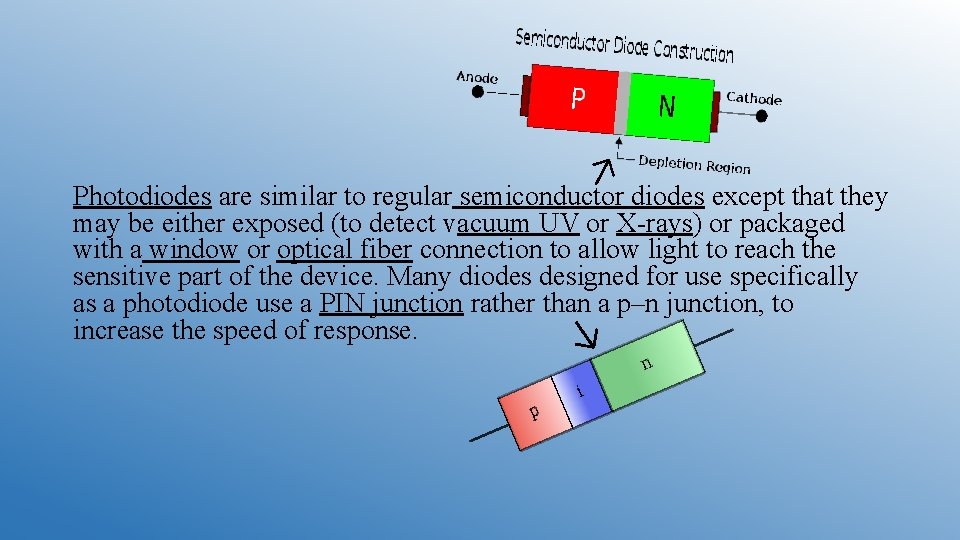
↑ Photodiodes are similar to regular semiconductor diodes except that they may be either exposed (to detect vacuum UV or X-rays) or packaged with a window or optical fiber connection to allow light to reach the sensitive part of the device. Many diodes designed for use specifically as a photodiode use a PIN junction rather than a p–n junction, to increase the speed of response. ↓
Principle of operation • A photodiode is a p–n junction or PIN structure. When a photon of sufficient energy strikes the diode, it creates an electron-hole pair. This mechanism is also known as the inner photoelectric effect(The photoelectric effect is the emission of electrons or other free carriers when light is shone onto a material)Thus holes move toward the anode, and electrons toward the cathode, and a photocurrent is produced. The total current through the photodiode is the sum of the dark current (current that is generated in the absence of light) and the photocurrent, so the dark current must be minimized to maximize the sensitivity of the device.
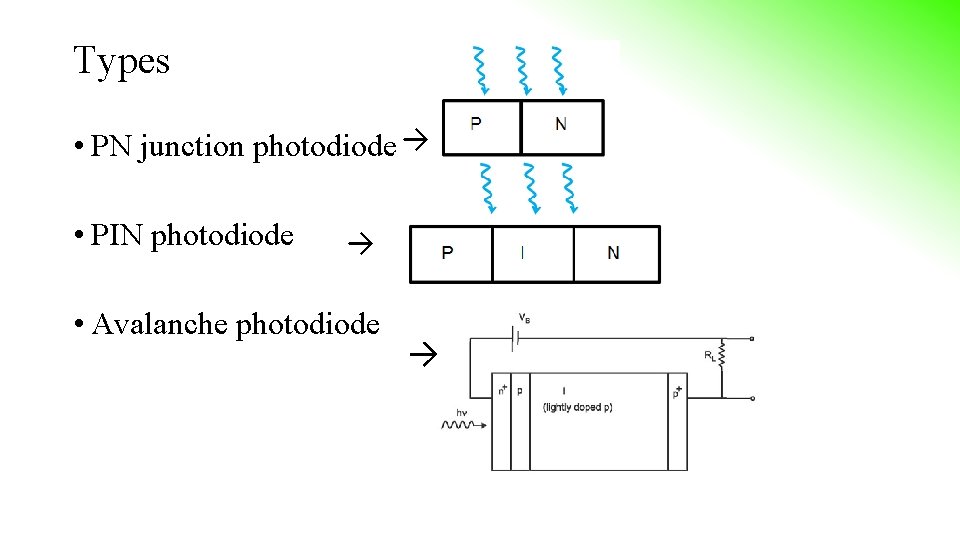
Types • PN junction photodiode → • PIN photodiode → • Avalanche photodiode →
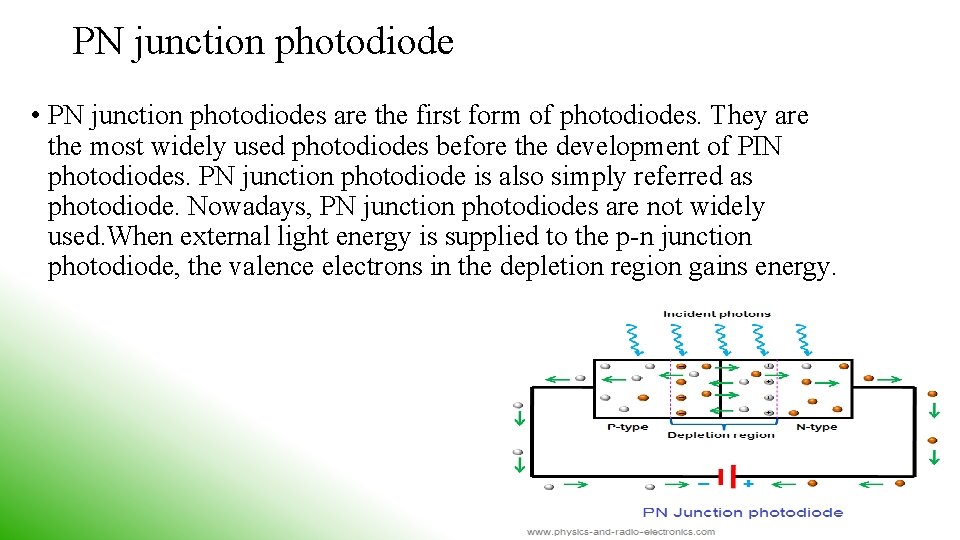
PN junction photodiode • PN junction photodiodes are the first form of photodiodes. They are the most widely used photodiodes before the development of PIN photodiodes. PN junction photodiode is also simply referred as photodiode. Nowadays, PN junction photodiodes are not widely used. When external light energy is supplied to the p-n junction photodiode, the valence electrons in the depletion region gains energy.
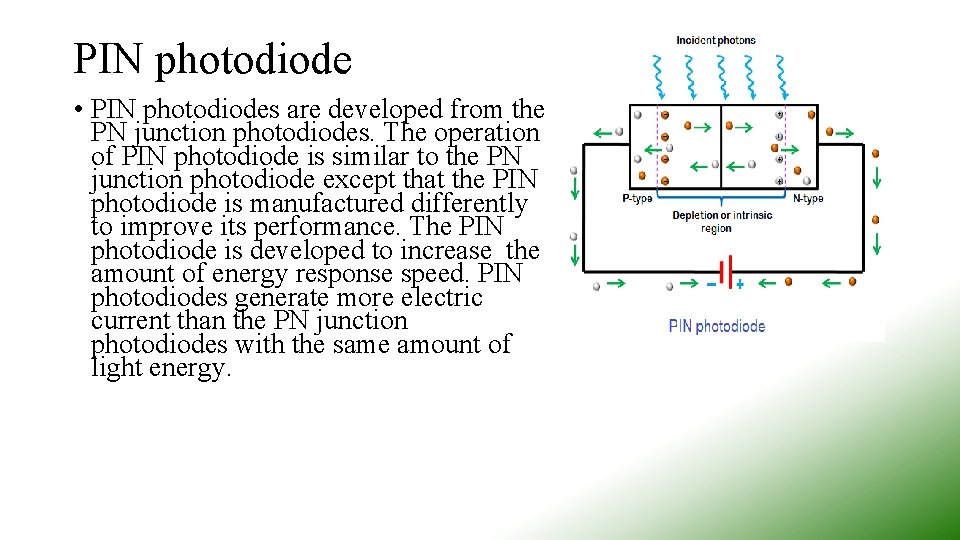
PIN photodiode • PIN photodiodes are developed from the PN junction photodiodes. The operation of PIN photodiode is similar to the PN junction photodiode except that the PIN photodiode is manufactured differently to improve its performance. The PIN photodiode is developed to increase the amount of energy response speed. PIN photodiodes generate more electric current than the PN junction photodiodes with the same amount of light energy.
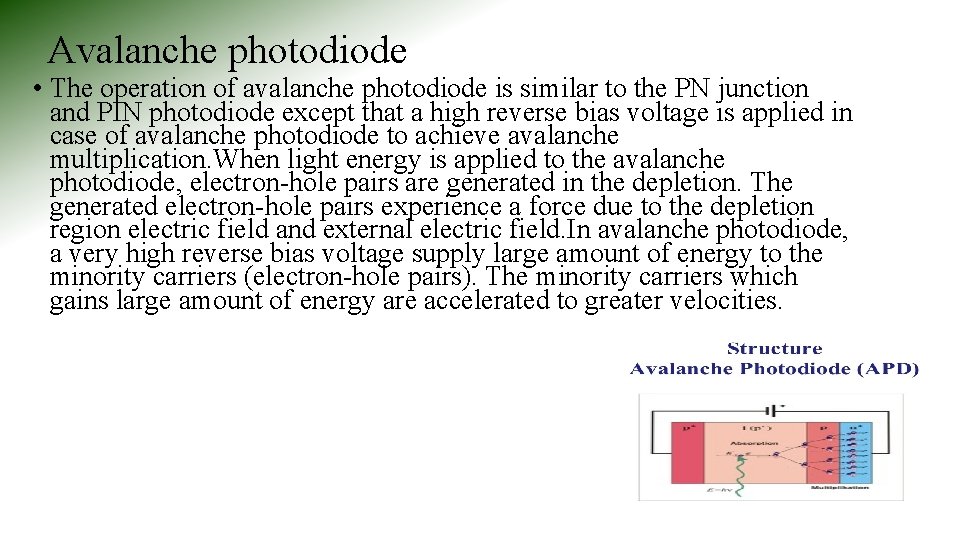
Avalanche photodiode • The operation of avalanche photodiode is similar to the PN junction and PIN photodiode except that a high reverse bias voltage is applied in case of avalanche photodiode to achieve avalanche multiplication. When light energy is applied to the avalanche photodiode, electron-hole pairs are generated in the depletion. The generated electron-hole pairs experience a force due to the depletion region electric field and external electric field. In avalanche photodiode, a very high reverse bias voltage supply large amount of energy to the minority carriers (electron-hole pairs). The minority carriers which gains large amount of energy are accelerated to greater velocities.
Photodiode applications The various applications of photodiodes are: Compact disc players Smoke detectors Space applications Photodiodes are used in medical applications such as computed tomography, instruments to analyze samples, and pulse oximeters. 5. Photodiodes are used for optical communications. 6. Photodiodes are used to measure extremely low light intensities. v 1. 2. 3. 4.
Thanks !!!!! I know that this wasn't the greatest presentation ever , But I hope that you have learn some new cool stuff , and thanks a lot for the time you've given to me.