
Photochromic particles Smart Materials Smart materials react to
- Slides: 1
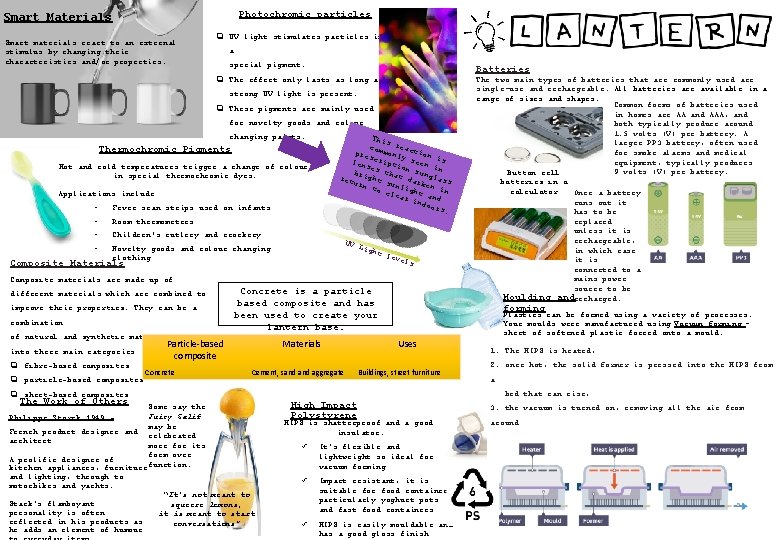
Photochromic particles Smart Materials Smart materials react to an external stimulus by changing their characteristics and/or properties. q UV light stimulates particles in a special pigment. Batteries q The effect only lasts as long as strong UV light is present. q These pigments are mainly used for novelty goods and colour changing paints. Thi s r ea co pre mmonl ction scr y s is i e len ses ption en in sun tha bri gla t gh ret urn t sun darken ss lig to in ht cle a ar ind nd oor s. Thermochromic Pigments Hot and cold temperatures trigger a change of colour in special thermochromic dyes. Applications include: • Fever scan strips used on infants • Room thermometers • Children's cutlery and crockery • Novelty goods and colour changing clothing UV Lig ht Composite Materials lev els Composite materials are made up of different materials which are combined to improve their properties. They can be a combination of natural and synthetic materials but fall into three main categories: q fibre-based composites q particle-based composites Concrete is a particle based composite and has been used to create your lantern base. Particle-based composite Concrete Materials Cement, sand aggregate forming Plastics can be formed using a variety of processes. Your moulds were manufactured using Vacuum forming sheet of softened plastic forced onto a mould. Uses Buildings, street furniture q sheet-based composites The Work of Others Some say the Juicy Salif may be French product designer and celebrated architect: more for its form over A prolific designer of kitchen appliances, furniture function. and lighting, through to motorbikes and yachts. “It’s not meant to Stark’s flamboyant squeeze lemons, personality is often it is meant to start reflected in his products as conversations” he adds an element of humour Philippe Starck 1949 - The two main types of batteries that are commonly used are single-use and rechargeable. All batteries are available in a range of sizes and shapes. Common forms of batteries used in homes are AA and AAA, and both typically produce around 1. 5 volts (V) per battery. A larger PP 3 battery, often used for smoke alarms and medical equipment, typically produces 9 volts (V) per battery. Button cell batteries in a calculator Once a battery runs out it has to be replaced unless it is rechargeable, in which case it is connected to a mains power source to be Moulding andrecharged. 1. The HIPS is heated, 2. once hot, the solid former is pressed into the HIPS from a bed that can rise, High Impact Polystyrene HIPS is shatterproof and a good insulator. ü It’s flexible and lightweight so ideal for vacuum forming ü Impact resistant, it is suitable for food containers particularly yoghurt pots and fast food containers ü HIPS is easily mouldable and has a good gloss finish 3. the vacuum is turned on, removing all the air from around the former, 4. the HIPS takes the form of the solid former.