
Photocathode Physics for Photoinjectors P 3 2016 Jefferson

- Slides: 17
Photocathode Physics for Photoinjectors (P 3) 2016 Jefferson Laboratory, October 17 -19, 2016 Pb. Te(111): DFT analysis and experimental results W. Andreas Schroeder Physics Department University of Illinois at Chicago Tuo Li Benjamin Rickman National Science Foundation PHYS-1535279 UIC
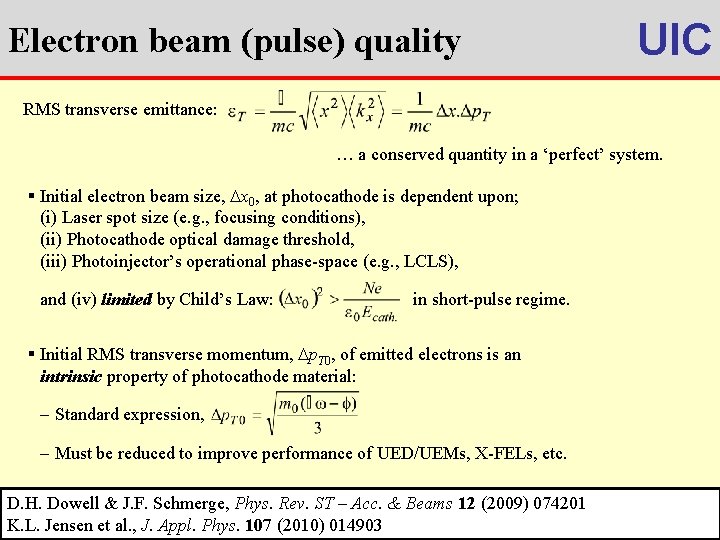
Electron beam (pulse) quality UIC RMS transverse emittance: … a conserved quantity in a ‘perfect’ system. § Initial electron beam size, x 0, at photocathode is dependent upon; (i) Laser spot size (e. g. , focusing conditions), (ii) Photocathode optical damage threshold, (iii) Photoinjector’s operational phase-space (e. g. , LCLS), and (iv) limited by Child’s Law: in short-pulse regime. § Initial RMS transverse momentum, p. T 0, of emitted electrons is an intrinsic property of photocathode material: Standard expression, Must be reduced to improve performance of UED/UEMs, X-FELs, etc. D. H. Dowell & J. F. Schmerge, Phys. Rev. ST – Acc. & Beams 12 (2009) 074201 K. L. Jensen et al. , J. Appl. Phys. 107 (2010) 014903
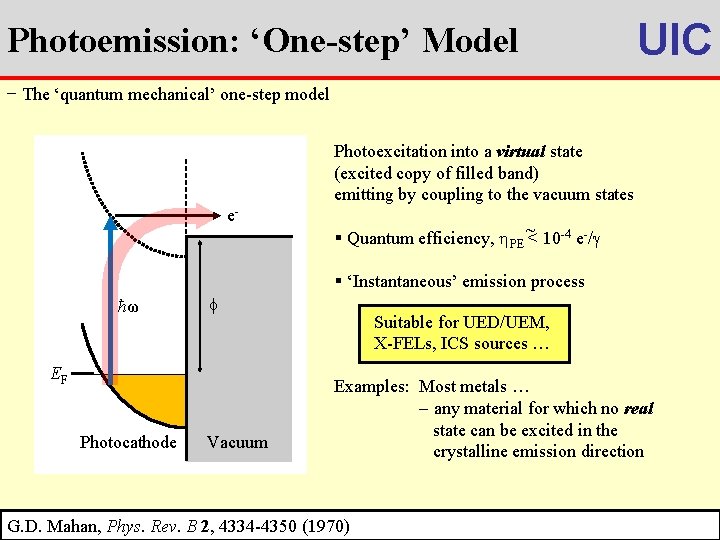
Photoemission: ‘One-step’ Model UIC − The ‘quantum mechanical’ one-step model e- Photoexcitation into a virtual state (excited copy of filled band) emitting by coupling to the vacuum states § Quantum efficiency, PE ~< 10 -4 e-/ § ‘Instantaneous’ emission process ħω EF Photocathode Vacuum Suitable for UED/UEM, X-FELs, ICS sources … Examples: Most metals … any material for which no real state can be excited in the crystalline emission direction G. D. Mahan, Phys. Rev. B 2, 4334 -4350 (1970)
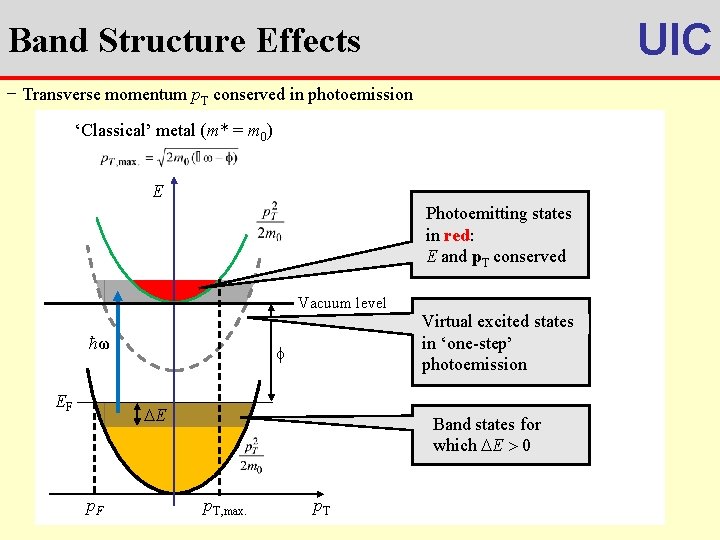
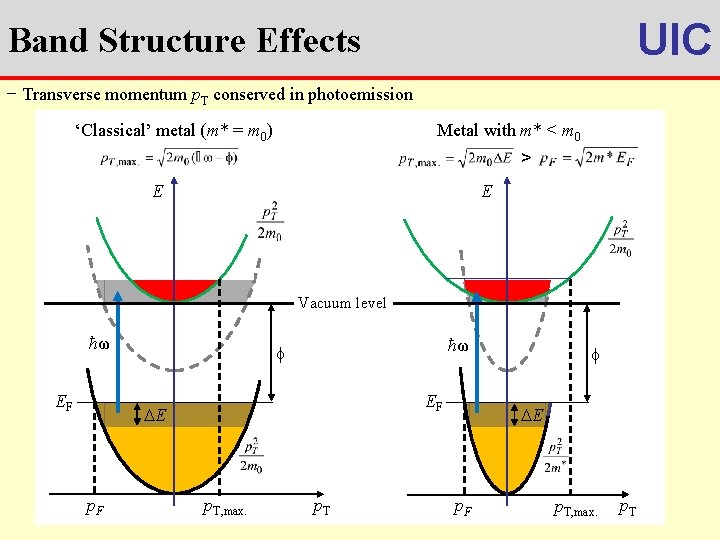
UIC Band Structure Effects − Transverse momentum p. T conserved in photoemission Metal with m* < m 0 ‘Classical’ metal (m* = m 0) > E E Photoemitting states in red: E and p. T conserved Vacuum level ħω EF EF E Band states for which E 0 E p. F Virtual excited states in ‘one-step’ ħω photoemission p. T, max. p. T p. F p. T, max. p. T
UIC Band Structure Effects − Transverse momentum p. T conserved in photoemission Metal with m* < m 0 ‘Classical’ metal (m* = m 0) > E E Vacuum level ħω EF ħω EF E p. F p. T, max. p. T
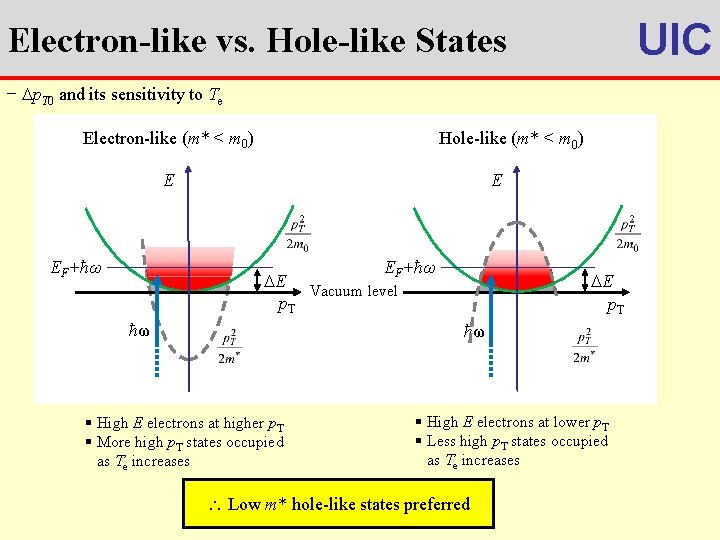
UIC Electron-like vs. Hole-like States − p. T 0 and its sensitivity to Te Electron-like (m* < m 0) Hole-like (m* < m 0) E EF+ħω E Vacuum level p. T ħω E p. T ħω § High E electrons at higher p. T § More high p. T states occupied as Te increases § High E electrons at lower p. T § Less high p. T states occupied as Te increases Low m* hole-like states preferred
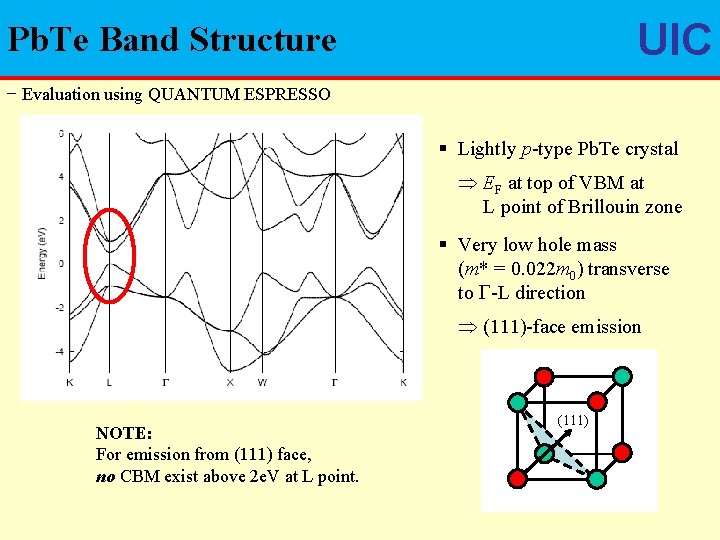
UIC Pb. Te Band Structure − Evaluation using QUANTUM ESPRESSO § Lightly p-type Pb. Te crystal EF at top of VBM at L point of Brillouin zone § Very low hole mass (m* = 0. 022 m 0) transverse to -L direction (111)-face emission NOTE: For emission from (111) face, no CBM exist above 2 e. V at L point. (111)
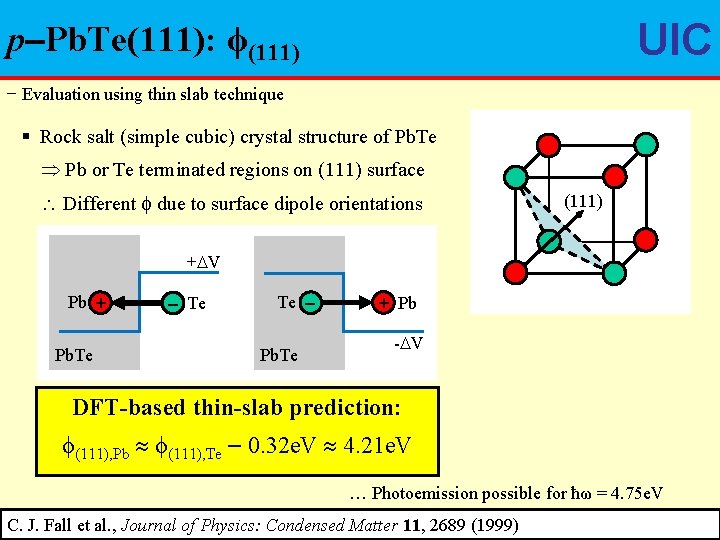
UIC p Pb. Te(111): ϕ(111) − Evaluation using thin slab technique § Rock salt (simple cubic) crystal structure of Pb. Te Pb or Te terminated regions on (111) surface Different due to surface dipole orientations (111) + V Pb + Pb. Te _ Te Te _ Pb. Te + Pb - V DFT-based thin-slab prediction: ϕ(111), Pb ϕ(111), Te 0. 32 e. V 4. 21 e. V … Photoemission possible for ħω = 4. 75 e. V C. J. Fall et al. , Journal of Physics: Condensed Matter 11, 2689 (1999)
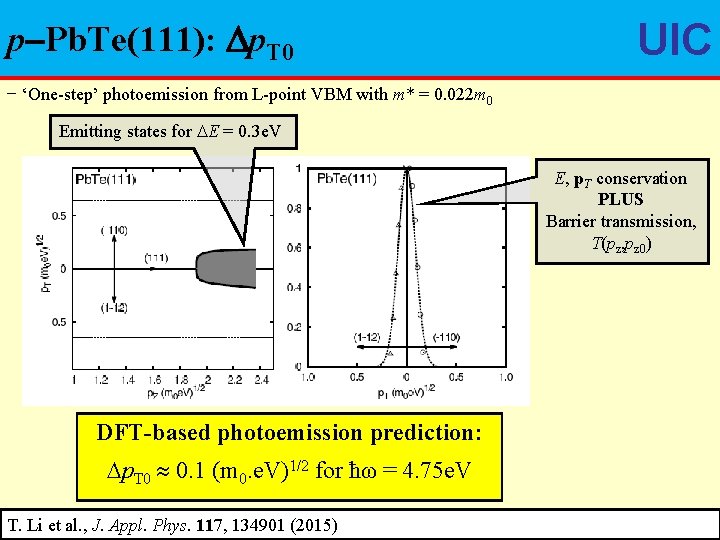
p Pb. Te(111): p. T 0 UIC − ‘One-step’ photoemission from L-point VBM with m* = 0. 022 m 0 Emitting states for E = 0. 3 e. V E, p. T conservation PLUS Barrier transmission, T(pz, pz 0) DFT-based photoemission prediction: p. T 0 0. 1 (m 0. e. V)1/2 for ħω = 4. 75 e. V T. Li et al. , J. Appl. Phys. 117, 134901 (2015)
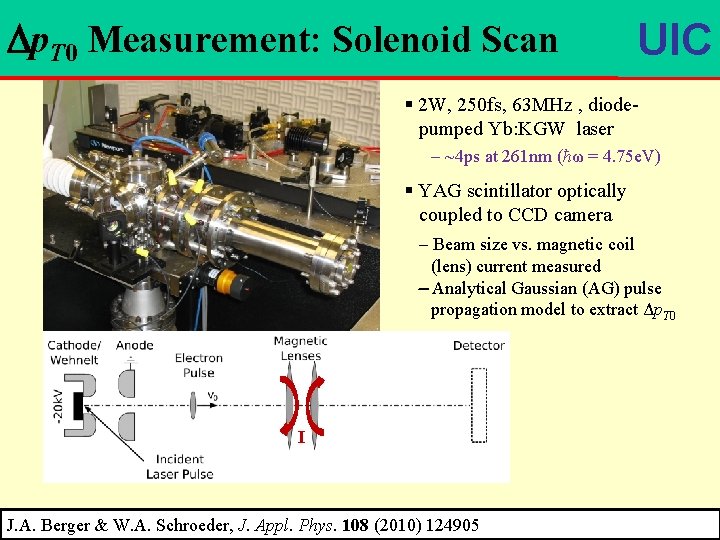
p. T 0 Measurement: Solenoid Scan UIC § 2 W, 250 fs, 63 MHz , diodepumped Yb: KGW laser ~4 ps at 261 nm (ħω = 4. 75 e. V) § YAG scintillator optically coupled to CCD camera Beam size vs. magnetic coil (lens) current measured Analytical Gaussian (AG) pulse propagation model to extract Δp. T 0 I J. A. Berger & W. A. Schroeder, J. Appl. Phys. 108 (2010) 124905
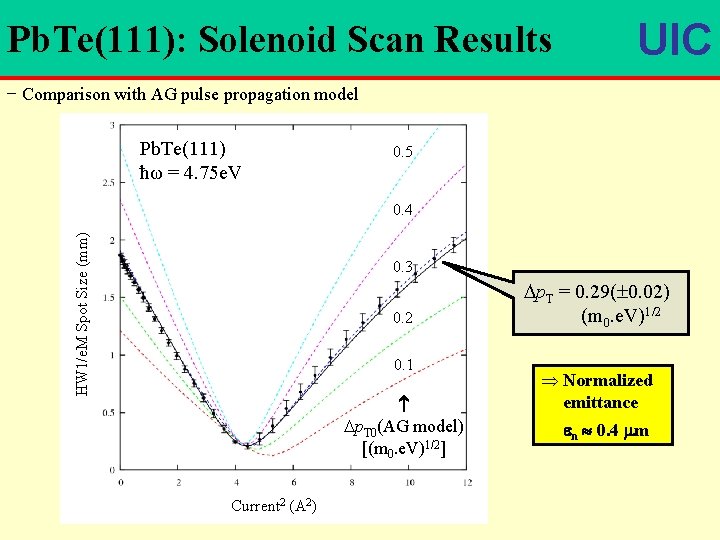
Pb. Te(111): Solenoid Scan Results UIC − Comparison with AG pulse propagation model Pb. Te(111) ħω = 4. 75 e. V 0. 5 HW 1/e. M Spot Size (mm) 0. 4 0. 3 0. 2 0. 1 p. T 0(AG model) [(m 0. e. V)1/2] Current 2 (A 2) p. T = 0. 29( 0. 02) (m 0. e. V)1/2 Normalized emittance n 0. 4 m
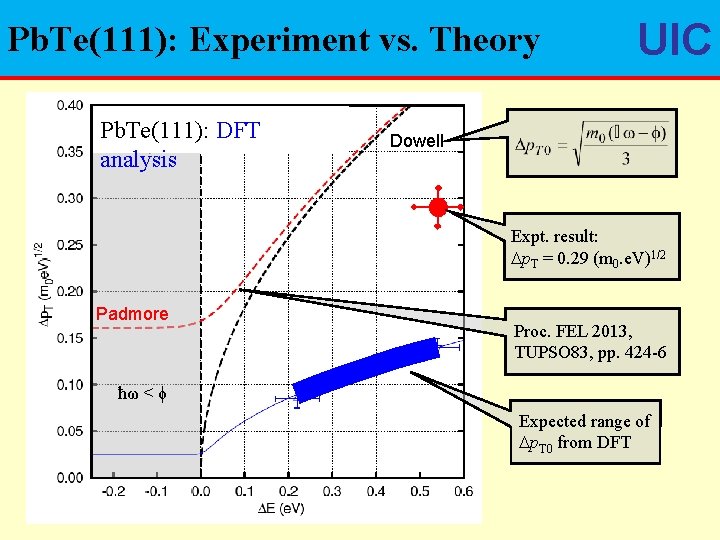
Pb. Te(111): Experiment vs. Theory Pb. Te(111): DFT analysis UIC Dowell Expt. result: p. T = 0. 29 (m 0. e. V)1/2 Padmore Proc. FEL 2013, TUPSO 83, pp. 424 -6 ħω < ϕ Expected range of p. T 0 from DFT
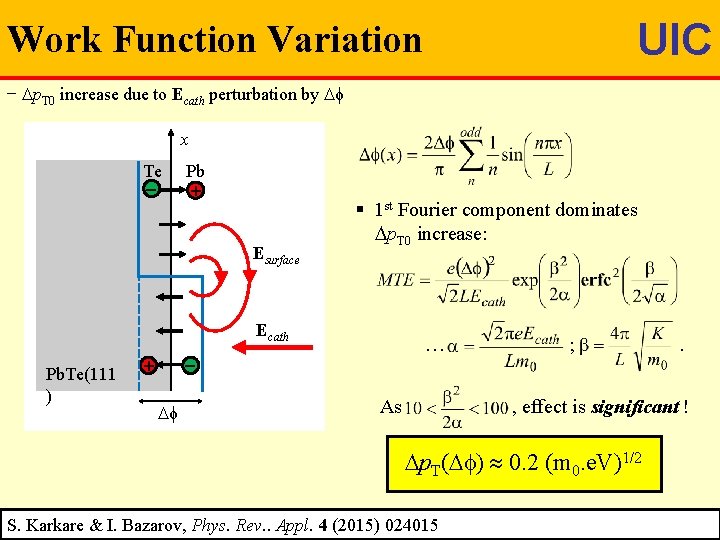
UIC Work Function Variation − p. T 0 increase due to Ecath perturbation by ϕ x Te _ Pb + Esurface § 1 st Fourier component dominates p. T 0 increase: Ecath Pb. Te(111 ) … _ + ϕ As ; . , effect is significant ! p. T( ) 0. 2 (m 0. e. V)1/2 S. Karkare & I. Bazarov, Phys. Rev. . Appl. 4 (2015) 024015
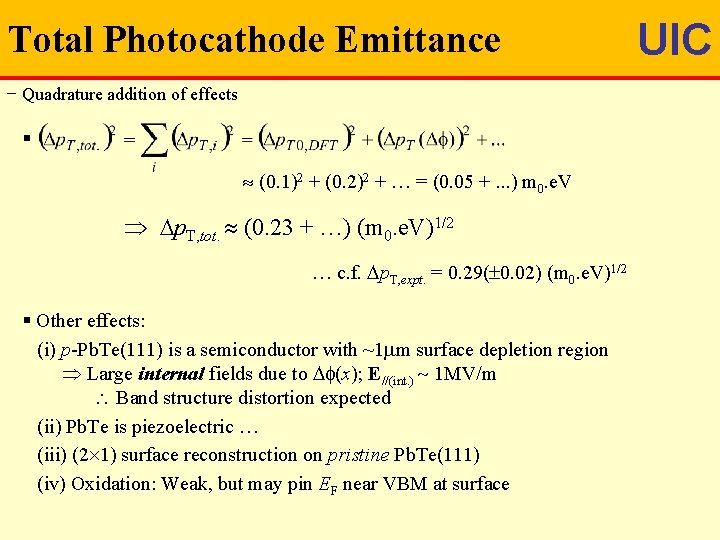
Total Photocathode Emittance − Quadrature addition of effects § (0. 1)2 + (0. 2)2 + … = (0. 05 +. . . ) m 0. e. V p. T, tot. (0. 23 + …) (m 0. e. V)1/2 … c. f. p. T, expt. = 0. 29( 0. 02) (m 0. e. V)1/2 § Other effects: (i) p-Pb. Te(111) is a semiconductor with ~1 m surface depletion region Large internal fields due to (x); E//(int. ) 1 MV/m Band structure distortion expected (ii) Pb. Te is piezoelectric … (iii) (2 1) surface reconstruction on pristine Pb. Te(111) (iv) Oxidation: Weak, but may pin EF near VBM at surface UIC
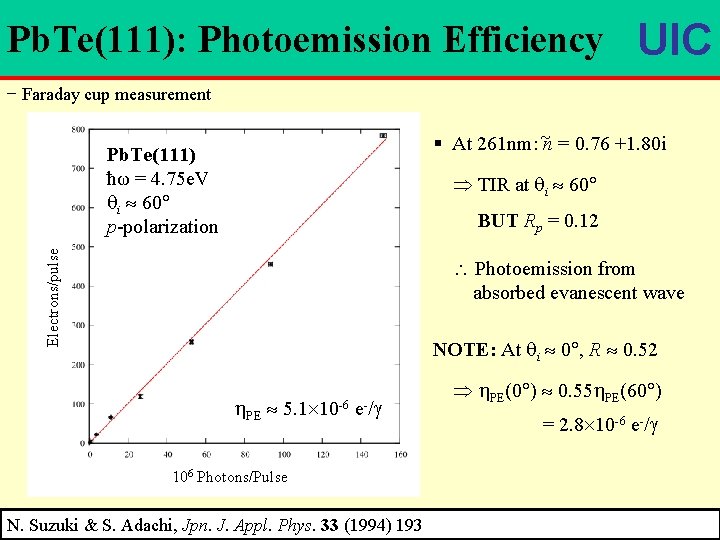
Pb. Te(111): Photoemission Efficiency UIC − Faraday cup measurement § At 261 nm: n = 0. 76 +1. 80 i Pb. Te(111) ħω = 4. 75 e. V i 60 p-polarization TIR at i 60 Electrons/pulse BUT Rp = 0. 12 Photoemission from absorbed evanescent wave NOTE: At i 0 , R 0. 52 PE 5. 1 10 -6 e-/ 106 Photons/Pulse N. Suzuki & S. Adachi, Jpn. J. Appl. Phys. 33 (1994) 193 PE(0 ) 0. 55 PE(60 ) = 2. 8 10 -6 e-/
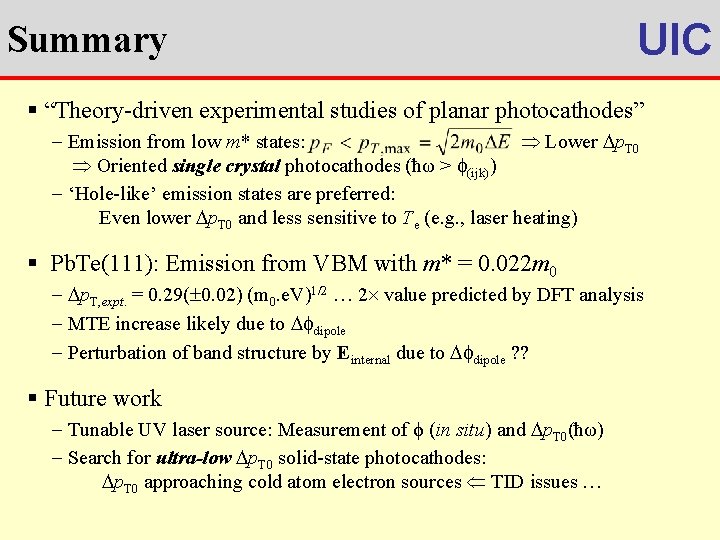
Summary UIC § “Theory-driven experimental studies of planar photocathodes” Emission from low m* states: Lower p. T 0 Oriented single crystal photocathodes (ħω > (ijk)) ‘Hole-like’ emission states are preferred: Even lower p. T 0 and less sensitive to Te (e. g. , laser heating) § Pb. Te(111): Emission from VBM with m* = 0. 022 m 0 p. T, expt. = 0. 29( 0. 02) (m 0. e. V)1/2 … 2 value predicted by DFT analysis MTE increase likely due to dipole Perturbation of band structure by Einternal due to dipole ? ? § Future work Tunable UV laser source: Measurement of ϕ (in situ) and p. T 0(ħω) Search for ultra-low p. T 0 solid-state photocathodes: p. T 0 approaching cold atom electron sources TID issues …
UIC Thank You!