
Photocatalytic Water Splitting Outline l Introduction l The

- Slides: 17
Photocatalytic Water Splitting ——表面物理第一小组
Outline l. Introduction l. The basic mechanism l. Photolysis in Ti. O 2 l. Optimization for photocatalytic activity l. Conclusion 2
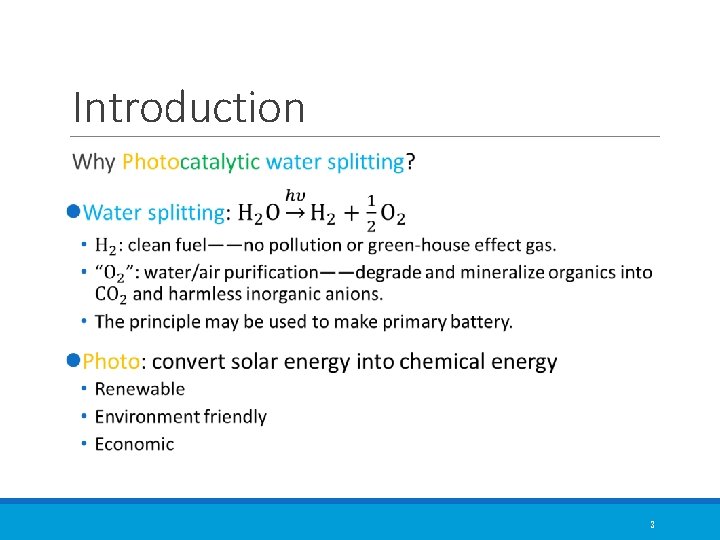
Introduction 3
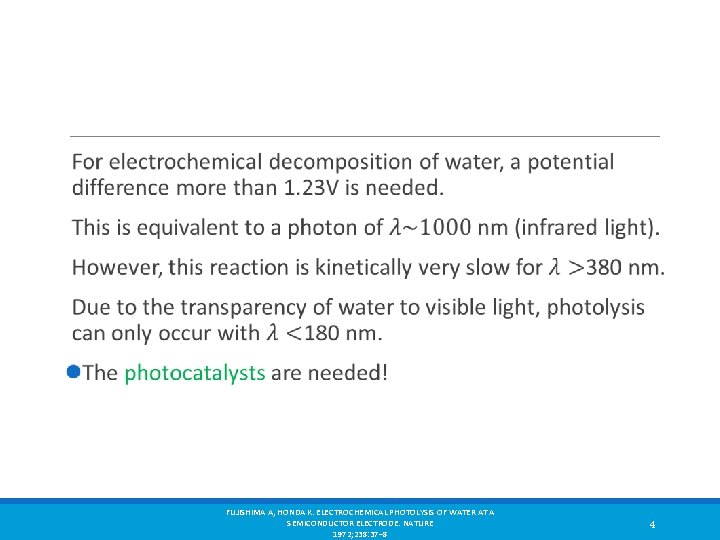
FUJISHIMA A, HONDA K. ELECTROCHEMICAL PHOTOLYSIS OF WATER AT A SEMICONDUCTOR ELECTRODE. NATURE 1972; 238: 37– 8 4
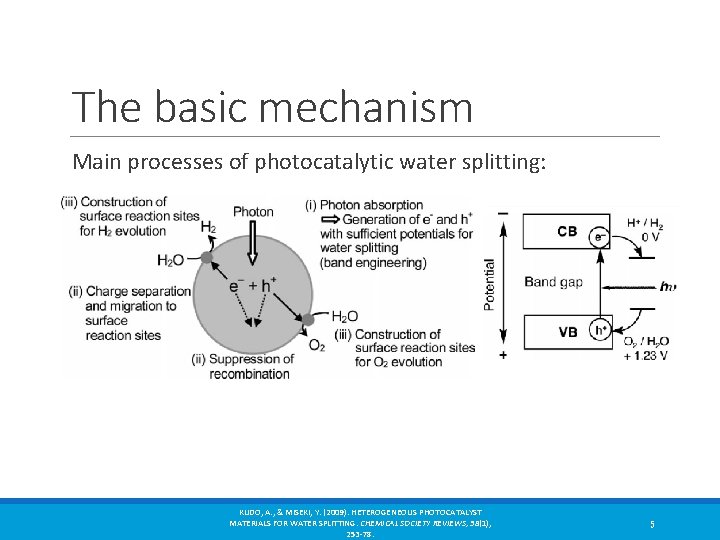
The basic mechanism Main processes of photocatalytic water splitting: KUDO, A. , & MISEKI, Y. (2009). HETEROGENEOUS PHOTOCATALYST MATERIALS FOR WATER SPLITTING. CHEMICAL SOCIETY REVIEWS, 38(1), 253 -78. 5
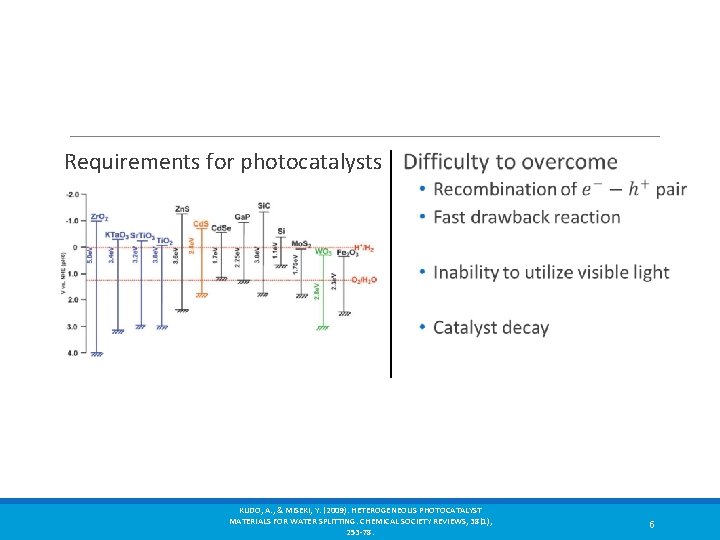
Requirements for photocatalysts KUDO, A. , & MISEKI, Y. (2009). HETEROGENEOUS PHOTOCATALYST MATERIALS FOR WATER SPLITTING. CHEMICAL SOCIETY REVIEWS, 38(1), 253 -78. 6
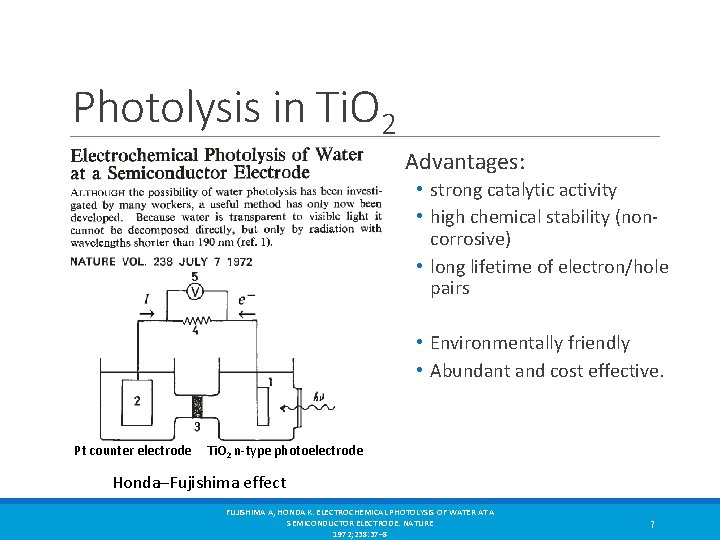
Photolysis in Ti. O 2 Advantages: • strong catalytic activity • high chemical stability (noncorrosive) • long lifetime of electron/hole pairs • Environmentally friendly • Abundant and cost effective. Pt counter electrode Ti. O 2 n-type photoelectrode Honda–Fujishima effect FUJISHIMA A, HONDA K. ELECTROCHEMICAL PHOTOLYSIS OF WATER AT A SEMICONDUCTOR ELECTRODE. NATURE 1972; 238: 37– 8 7
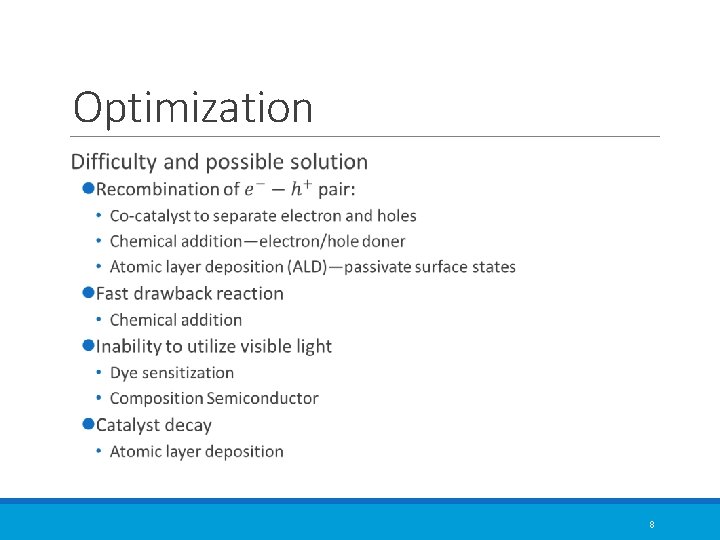
Optimization 8
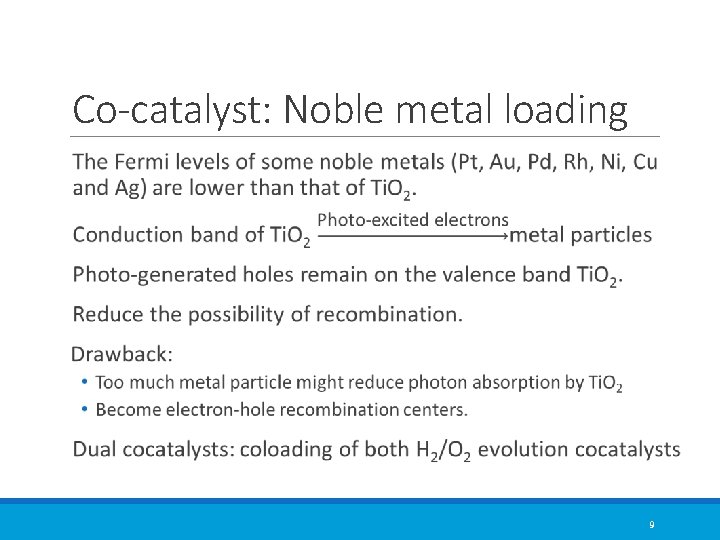
Co-catalyst: Noble metal loading 9
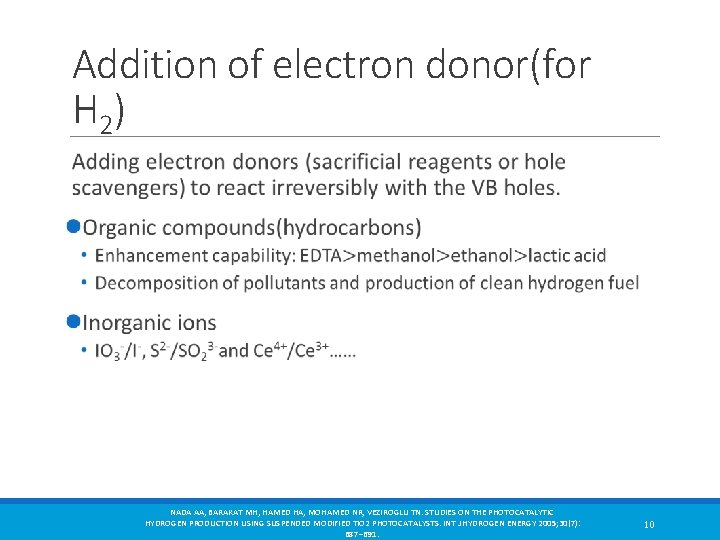
Addition of electron donor(for H 2) NADA AA, BARAKAT MH, HAMED HA, MOHAMED NR, VEZIROGLU TN. STUDIES ON THE PHOTOCATALYTIC HYDROGEN PRODUCTION USING SUSPENDED MODIFIED TIO 2 PHOTOCATALYSTS. INT J HYDROGEN ENERGY 2005; 30(7): 687– 691. 10
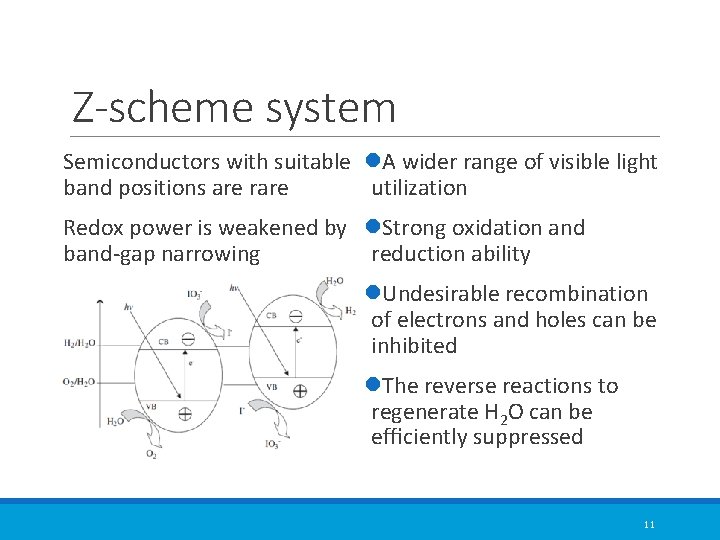
Z-scheme system Semiconductors with suitable l. A wider range of visible light band positions are rare utilization Redox power is weakened by l. Strong oxidation and band-gap narrowing reduction ability l. Undesirable recombination of electrons and holes can be inhibited l. The reverse reactions to regenerate H 2 O can be efficiently suppressed 11
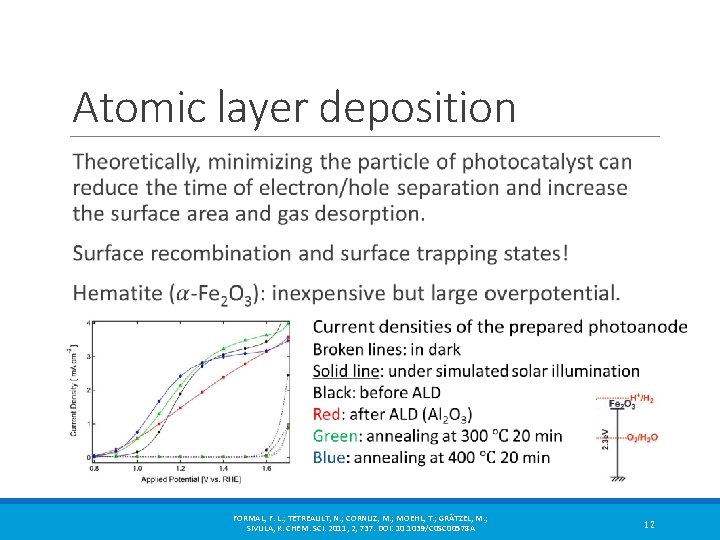
Atomic layer deposition FORMAL, F. L. ; TÉTREAULT, N. ; CORNUZ, M. ; MOEHL, T. ; GRÄTZEL, M. ; SIVULA, K. CHEM. SCI. 2011, 2, 737. DOI: 10. 1039/C 0 SC 00578 A 12
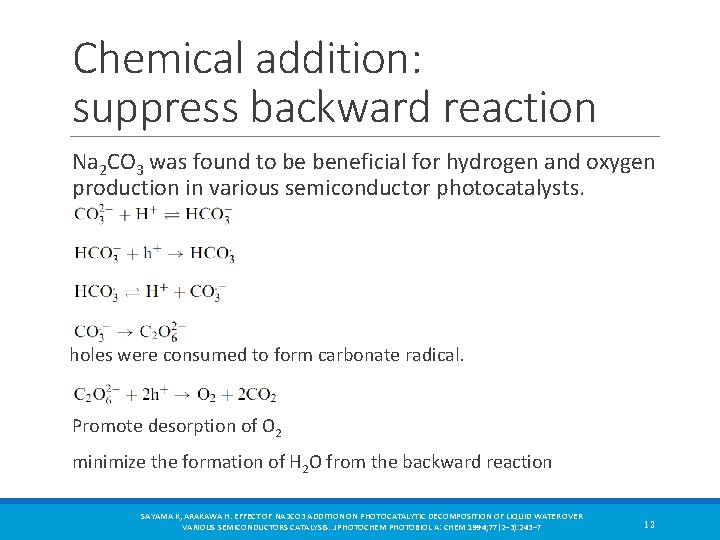
Chemical addition: suppress backward reaction Na 2 CO 3 was found to be beneficial for hydrogen and oxygen production in various semiconductor photocatalysts. holes were consumed to form carbonate radical. Promote desorption of O 2 minimize the formation of H 2 O from the backward reaction SAYAMA K, ARAKAWA H. EFFECT OF NA 2 CO 3 ADDITION ON PHOTOCATALYTIC DECOMPOSITION OF LIQUID WATER OVER VARIOUS SEMICONDUCTORS CATALYSIS. J PHOTOCHEM PHOTOBIOL A: CHEM 1994; 77(2– 3): 243– 7 13
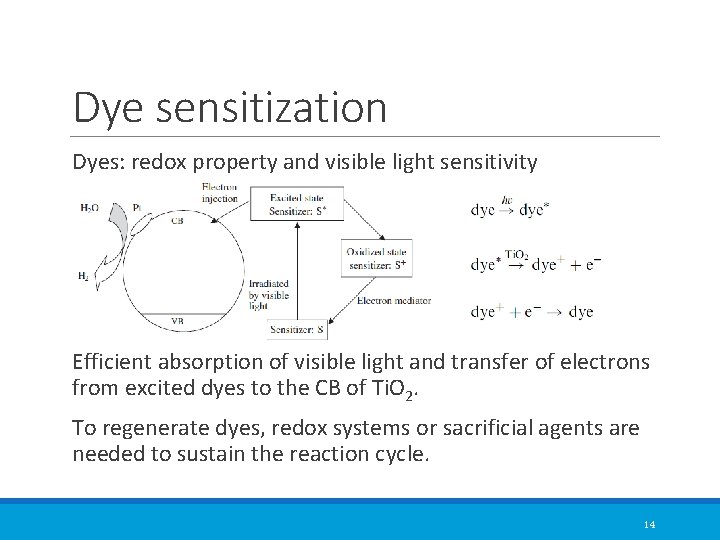
Dye sensitization Dyes: redox property and visible light sensitivity Efficient absorption of visible light and transfer of electrons from excited dyes to the CB of Ti. O 2. To regenerate dyes, redox systems or sacrificial agents are needed to sustain the reaction cycle. 14
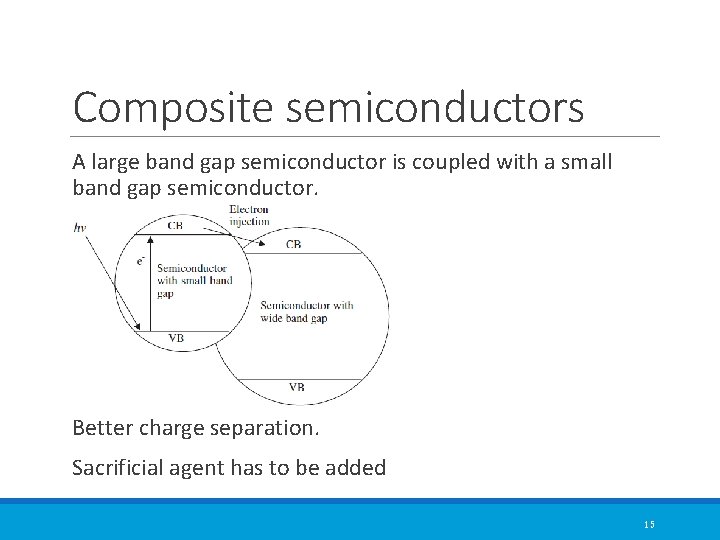
Composite semiconductors A large band gap semiconductor is coupled with a small band gap semiconductor. Better charge separation. Sacrificial agent has to be added 15
Conclusion l. The mechanism of photo-catalysis. l. Strategies to improve photocatalytic activity: • Enhancing visible light harvesting • Boosting the separation and migration of photogenerated charge carriers • Loading efficient cocatalysts for H 2 and/or O 2 evolution l. Synergistic investigation of above strategies are needed. l. Deeper understanding of the kinetics and dynamics of a photocatalytic reaction should is necessary to establish rational strategies. 16
Thank you! 17