
Photo double ionization of fixed in Space Hydrogen
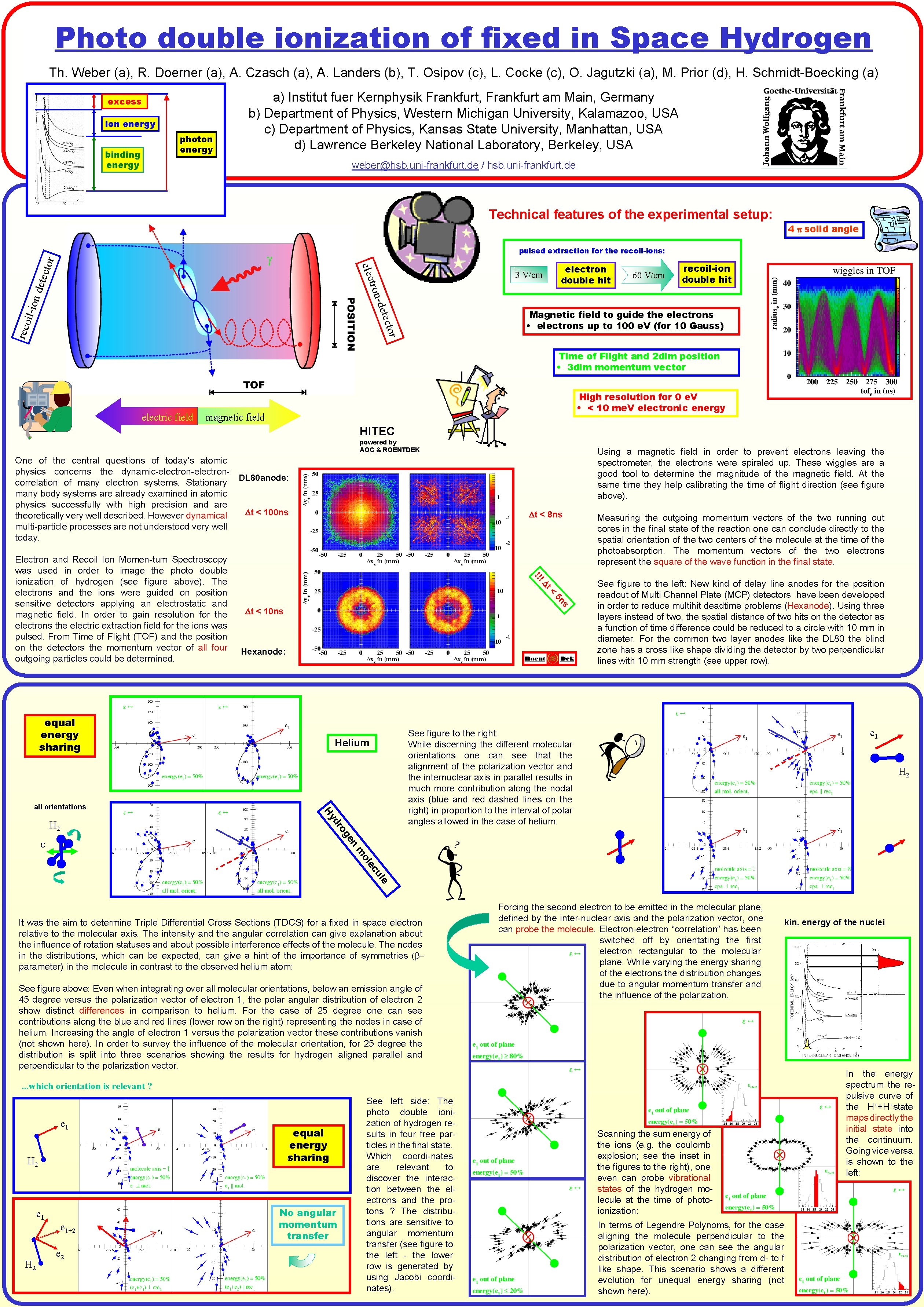
Photo double ionization of fixed in Space Hydrogen Th. Weber (a), R. Doerner (a), A. Czasch (a), A. Landers (b), T. Osipov (c), L. Cocke (c), O. Jagutzki (a), M. Prior (d), H. Schmidt-Boecking (a) excess ion energy photon energy binding energy a) Institut fuer Kernphysik Frankfurt, Frankfurt am Main, Germany b) Department of Physics, Western Michigan University, Kalamazoo, USA c) Department of Physics, Kansas State University, Manhattan, USA d) Lawrence Berkeley National Laboratory, Berkeley, USA weber@hsb. uni-frankfurt. de / hsb. uni-frankfurt. de Technical features of the experimental setup: 4 p solid angle il-io 60 V/cm recoil-ion double hit Magnetic field to guide the electrons • electrons up to 100 e. V (for 10 Gauss) ecto r reco electron double hit 3 V/cm -det n de tron elec tecto r pulsed extraction for the recoil-ions: Time of Flight and 2 dim position • 3 dim momentum vector electric field High resolution for 0 e. V • < 10 me. V electronic energy magnetic field HITEC powered by AOC & ROENTDEK Using a magnetic field in order to prevent electrons leaving the spectrometer, the electrons were spiraled up. These wiggles are a good tool to determine the magnitude of the magnetic field. At the same time they help calibrating the time of flight direction (see figure above). One of the central questions of today's atomic physics concerns the dynamic-electron. DL 80 anode: correlation of many electron systems. Stationary many body systems are already examined in atomic physics successfully with high precision and are Dt < 100 ns theoretically very well described. However dynamical multi-particle processes are not understood very well today. !!! Dt < s 5 n Electron and Recoil Ion Momen-tum Spectroscopy was used in order to image the photo double ionization of hydrogen (see figure above). The electrons and the ions were guided on position sensitive detectors applying an electrostatic and magnetic field. In order to gain resolution for the electrons the electric extraction field for the ions was pulsed. From Time of Flight (TOF) and the position on the detectors the momentum vector of all four outgoing particles could be determined. Dt < 8 ns Dt < 10 ns Hexanode: , equal energy sharing Helium og dr H 2 e 1 H 2 en e See figure to the left: New kind of delay line anodes for the position readout of Multi Channel Plate (MCP) detectors have been developed in order to reduce multihit deadtime problems (Hexanode). Using three layers instead of two, the spatial distance of two hits on the detector as a function of time difference could be reduced to a circle with 10 mm in diameter. For the common two layer anodes like the DL 80 the blind zone has a cross like shape dividing the detector by two perpendicular lines with 10 mm strength (see upper row). See figure to the right: While discerning the different molecular orientations one can see that the alignment of the polarization vector and the internuclear axis in parallel results in much more contribution along the nodal axis (blue and red dashed lines on the right) in proportion to the interval of polar angles allowed in the case of helium. Hy all orientations Measuring the outgoing momentum vectors of the two running out cores in the final state of the reaction one can conclude directly to the spatial orientation of the two centers of the molecule at the time of the photoabsorption. The momentum vectors of the two electrons represent the square of the wave function in the final state. e ul ec ol m It was the aim to determine Triple Differential Cross Sections (TDCS) for a fixed in space electron relative to the molecular axis. The intensity and the angular correlation can give explanation about the influence of rotation statuses and about possible interference effects of the molecule. The nodes in the distributions, which can be expected, can give a hint of the importance of symmetries (bparameter) in the molecule in contrast to the observed helium atom: See figure above: Even when integrating over all molecular orientations, below an emission angle of 45 degree versus the polarization vector of electron 1, the polar angular distribution of electron 2 show distinct differences in comparison to helium. For the case of 25 degree one can see contributions along the blue and red lines (lower row on the right) representing the nodes in case of helium. Increasing the angle of electron 1 versus the polarization vector these contributions vanish (not shown here). In order to survey the influence of the molecular orientation, for 25 degree the distribution is split into three scenarios showing the results for hydrogen aligned parallel and perpendicular to the polarization vector. Forcing the second electron to be emitted in the molecular plane, defined by the inter-nuclear axis and the polarization vector, one can probe the molecule. Electron-electron “correlation” has been switched off by orientating the first electron rectangular to the molecular plane. While varying the energy sharing of the electrons the distribution changes due to angular momentum transfer and the influence of the polarization. . which orientation is relevant ? e 1 H 2 e 1+2 H 2 equal energy sharing No angular momentum transfer See left side: The photo double ionization of hydrogen results in four free particles in the final state. Which coordi-nates are relevant to discover the interaction between the electrons and the protons ? The distributions are sensitive to angular momentum transfer (see figure to the left - the lower row is generated by using Jacobi coordinates). Scanning the sum energy of the ions (e. g. the coulomb explosion; see the inset in the figures to the right), one even can probe vibrational states of the hydrogen molecule at the time of photoionization: In terms of Legendre Polynoms, for the case aligning the molecule perpendicular to the polarization vector, one can see the angular distribution of electron 2 changing from d- to f like shape. This scenario shows a different evolution for unequal energy sharing (not shown here). kin. energy of the nuclei In the energy spectrum the repulsive curve of the H++H+state maps directly the initial state into the continuum. Going vice versa is shown to the left:
- Slides: 1