
Photo Darlene Redmond Vietnam Curriculum Development 5 Steps
- Slides: 54
Photo: Darlene Redmond, Vietnam
Curriculum Development 5 Steps to a Competency- Based Curriculum By Darlene Redmond
Darlene Redmond, B. Tech, M. Ed(IT) Curriculum Development Advisor Vietnam Association of Community Colleges Vietnam Faculty Member Information Technology Systems Management Nova Scotia Community College Canada Uniterra/WUSC Volunteer 3
Workshop Objectives By the end of this workshop, participants will be able to: • Define competency-based curriculum development • � Describe the five-step approach to curriculum development • � Develop a program or course curriculum using the five-step approach 4
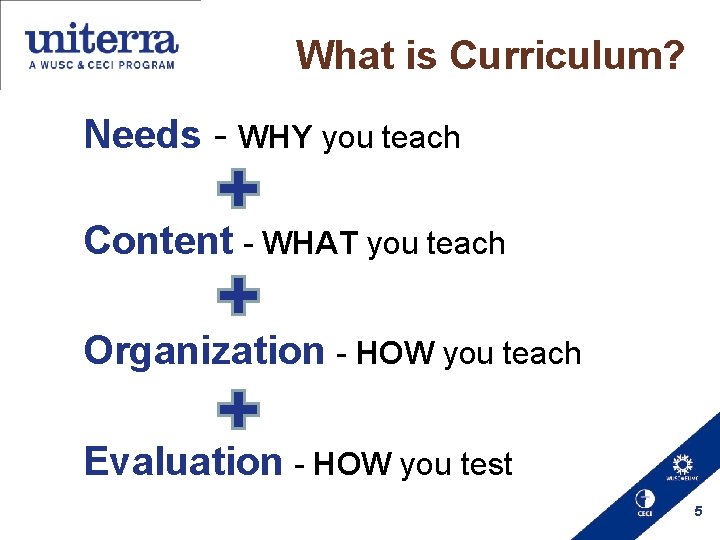
What is Curriculum? Needs - WHY you teach Content - WHAT you teach Organization - HOW you teach Evaluation - HOW you test 5
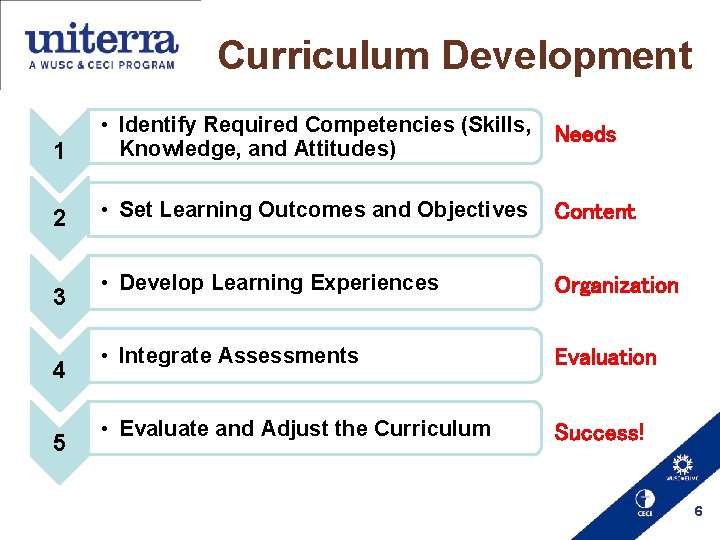
Curriculum Development 1 • Identify Required Competencies (Skills, Needs Knowledge, and Attitudes) 2 • Set Learning Outcomes and Objectives Content • Develop Learning Experiences Organization • Integrate Assessments Evaluation • Evaluate and Adjust the Curriculum Success! 3 4 5 6
Topic 1 NEEDS: IDENTIFY REQUIRED COMPETENCIES 7
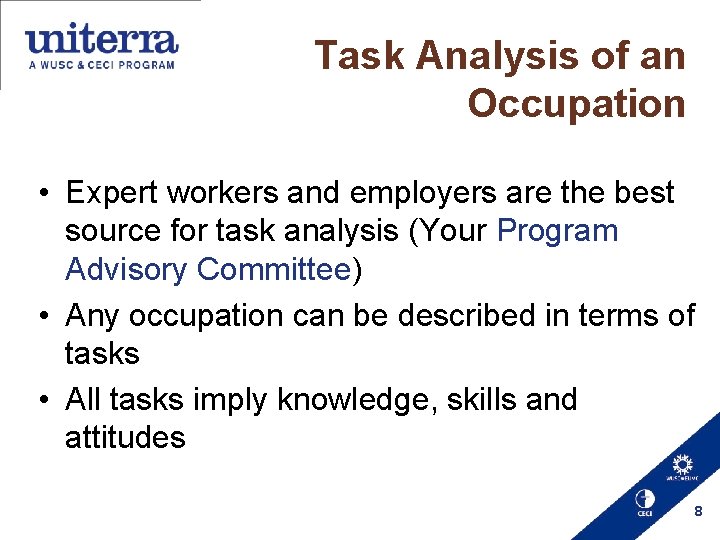
Task Analysis of an Occupation • Expert workers and employers are the best source for task analysis (Your Program Advisory Committee) • Any occupation can be described in terms of tasks • All tasks imply knowledge, skills and attitudes 8
Example: Safety and Health Coordinator “The Safety and Health Coordinator recognizes, evaluates, and controls workplace hazards through employee education and engineering practices to ensure a safe and healthy work environment. ” What tasks are involved? What does the graduate need to know? What does the graduate need to be able to do to complete occupational tasks? 9
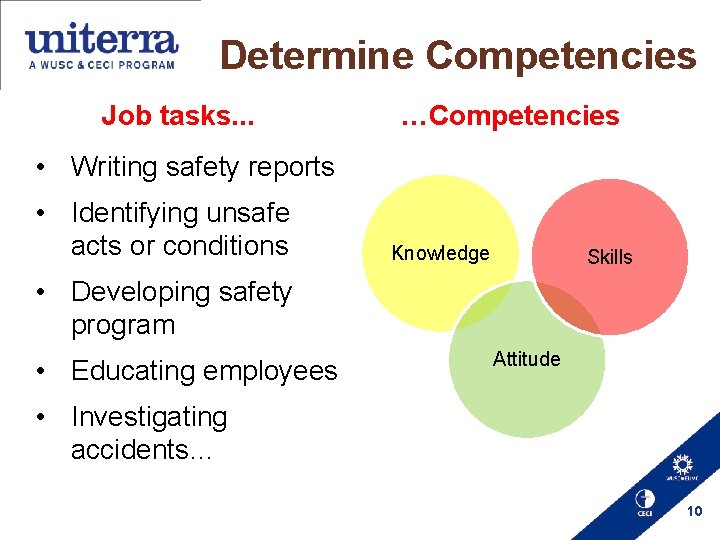
Determine Competencies Job tasks. . . …Competencies • Writing safety reports • Identifying unsafe acts or conditions Knowledge Skills • Developing safety program • Educating employees Attitude • Investigating accidents… 10
Determine Competencies Knowledge Health and Safety standards: Investigation techniques: Training tools: Word-processing, presentations 11
Determine Competencies Skills Analysis: Find and compare information from various sources and identify issues and relationships. Planning and organising: Develop plans of action to reach a particular goal. Written communication: Able to express ideas in writing appropriately and accurately. Questioning: Asks questions effectively and appropriately to obtain information. 12
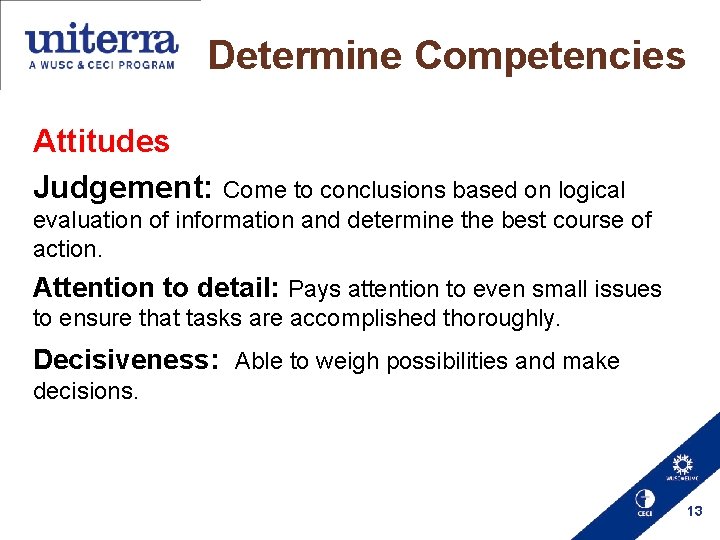
Determine Competencies Attitudes Judgement: Come to conclusions based on logical evaluation of information and determine the best course of action. Attention to detail: Pays attention to even small issues to ensure that tasks are accomplished thoroughly. Decisiveness: Able to weigh possibilities and make decisions. 13
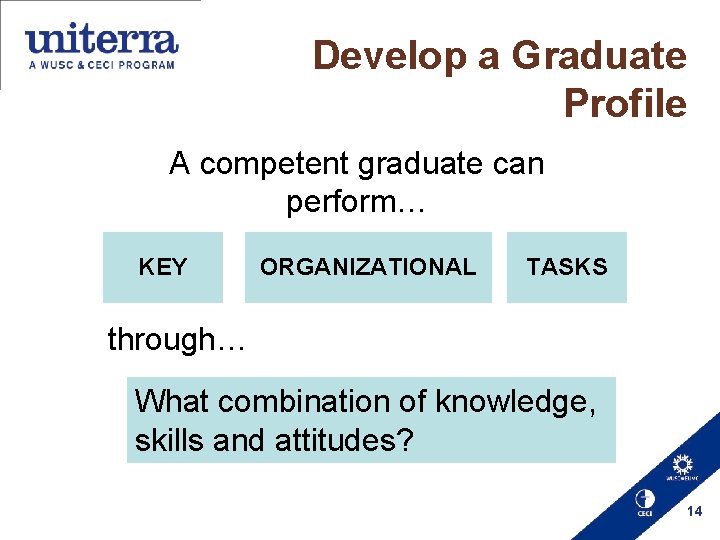
Develop a Graduate Profile A competent graduate can perform… KEY ORGANIZATIONAL TASKS through… What combination of knowledge, skills and attitudes? 14
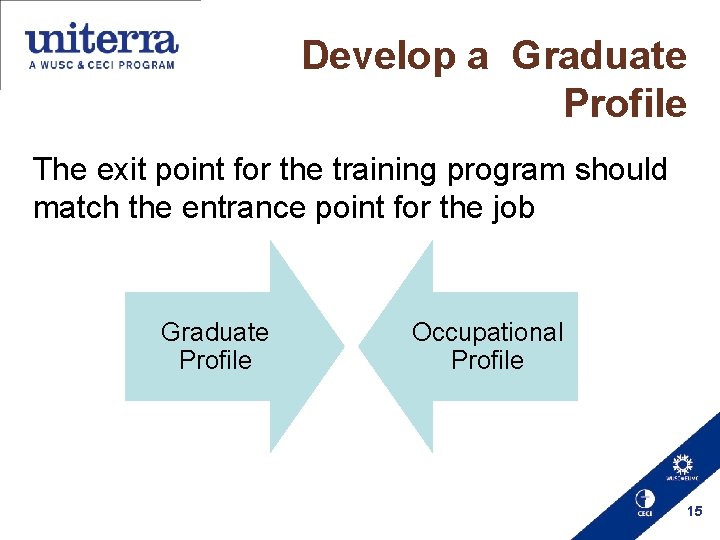
Develop a Graduate Profile The exit point for the training program should match the entrance point for the job Graduate Profile Occupational Profile 15
Your Turn Exercise #1 • Identify Required Competencies (Skills, 1 Knowledge, and Attitudes) 16
Topic 2 CONTENT: SET LEARNING OUTCOMES AND OBJECTIVES 17
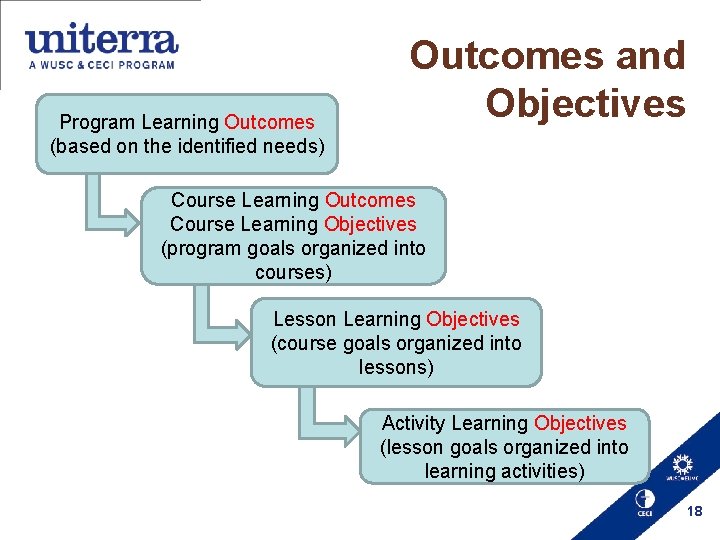
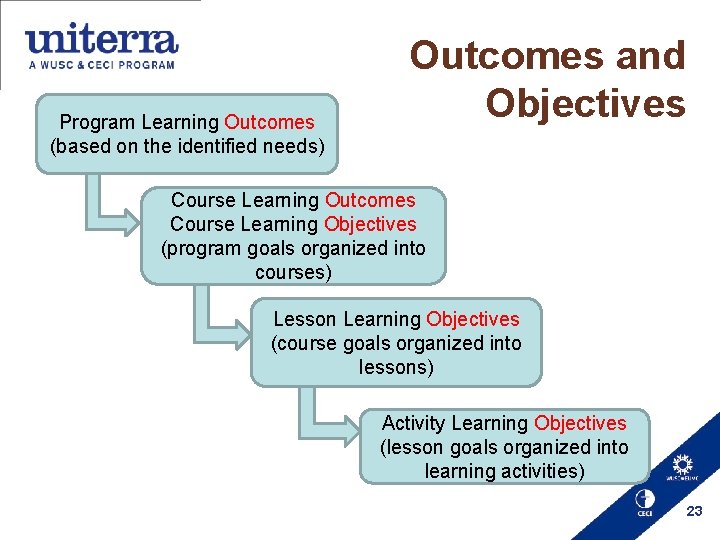
Program Learning Outcomes (based on the identified needs) Outcomes and Objectives Course Learning Outcomes Course Learning Objectives (program goals organized into courses) Lesson Learning Objectives (course goals organized into lessons) Activity Learning Objectives (lesson goals organized into learning activities) 18
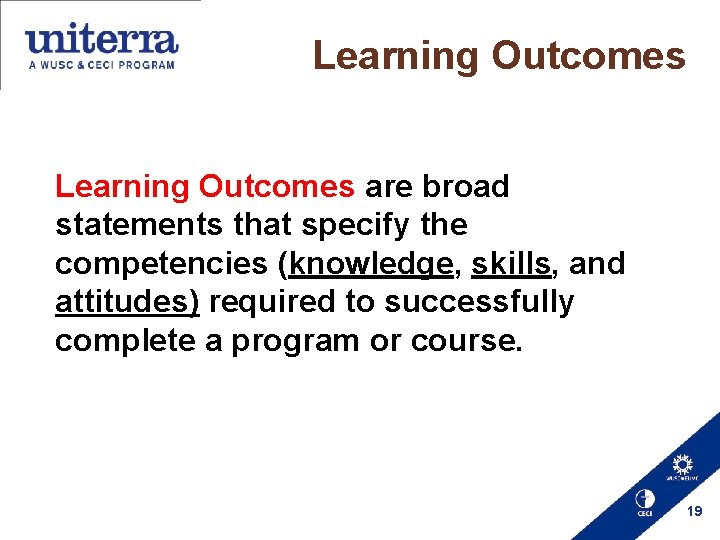
Learning Outcomes are broad statements that specify the competencies (knowledge, skills, and attitudes) required to successfully complete a program or course. 19
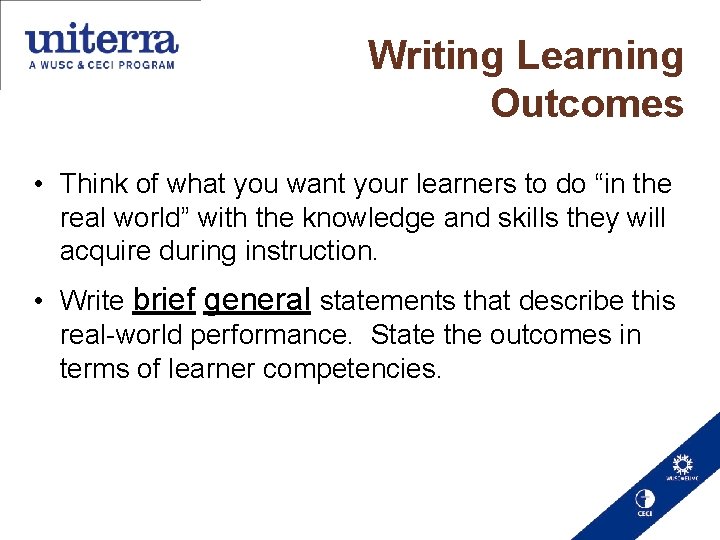
Writing Learning Outcomes • Think of what you want your learners to do “in the real world” with the knowledge and skills they will acquire during instruction. • Write brief general statements that describe this real-world performance. State the outcomes in terms of learner competencies.
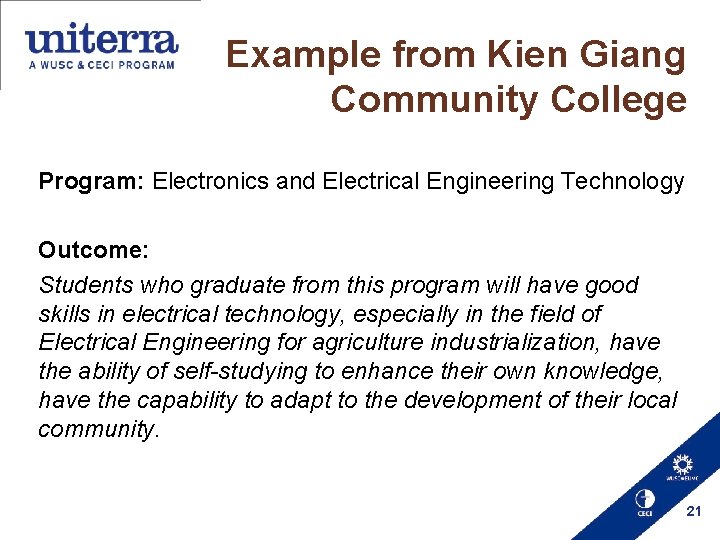
Example from Kien Giang Community College Program: Electronics and Electrical Engineering Technology Outcome: Students who graduate from this program will have good skills in electrical technology, especially in the field of Electrical Engineering for agriculture industrialization, have the ability of self-studying to enhance their own knowledge, have the capability to adapt to the development of their local community. 21
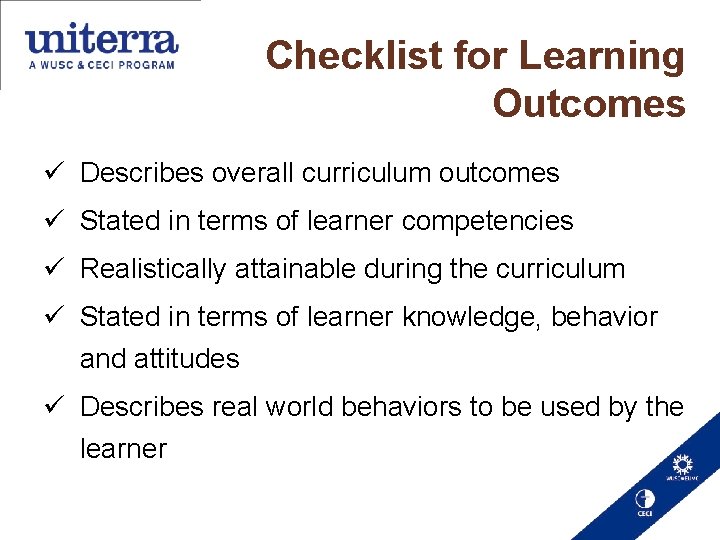
Checklist for Learning Outcomes Describes overall curriculum outcomes Stated in terms of learner competencies Realistically attainable during the curriculum Stated in terms of learner knowledge, behavior and attitudes Describes real world behaviors to be used by the learner
Program Learning Outcomes (based on the identified needs) Outcomes and Objectives Course Learning Outcomes Course Learning Objectives (program goals organized into courses) Lesson Learning Objectives (course goals organized into lessons) Activity Learning Objectives (lesson goals organized into learning activities) 23
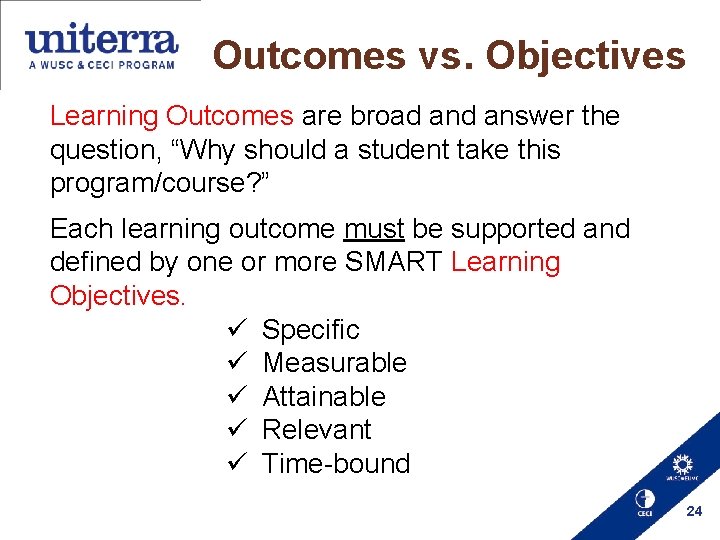
Outcomes vs. Objectives Learning Outcomes are broad answer the question, “Why should a student take this program/course? ” Each learning outcome must be supported and defined by one or more SMART Learning Objectives. Specific Measurable Attainable Relevant Time-bound 24
Outcomes vs. Objectives "The outcome is where we want to be. The objectives are the steps needed to get there. " 25
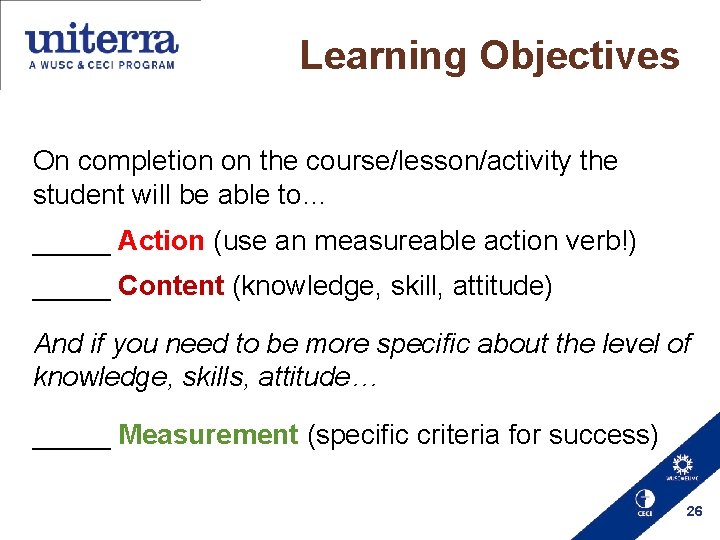
Learning Objectives On completion on the course/lesson/activity the student will be able to… _____ Action (use an measureable action verb!) _____ Content (knowledge, skill, attitude) And if you need to be more specific about the level of knowledge, skills, attitude… _____ Measurement (specific criteria for success) 26
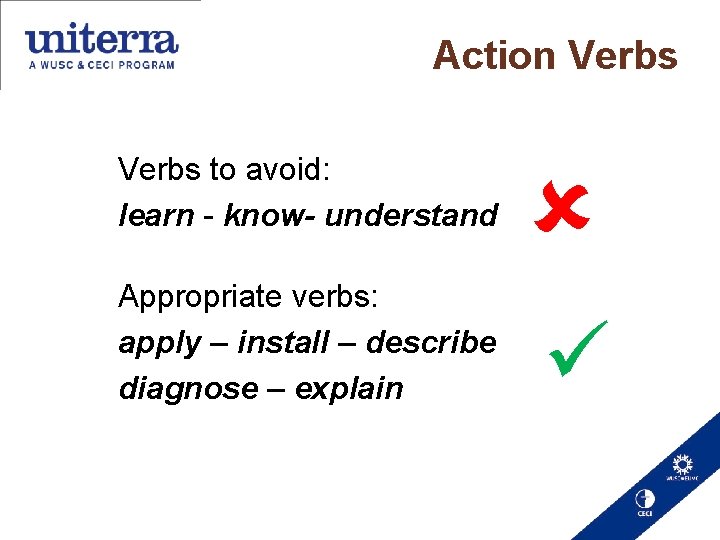
Action Verbs to avoid: learn - know- understand Appropriate verbs: apply – install – describe diagnose – explain
Workshop Learning Objectives • Explain competency-based curriculum development • � Describe the five-step approach to curriculum development • � Develop a program or course curriculum using the five-step approach 28
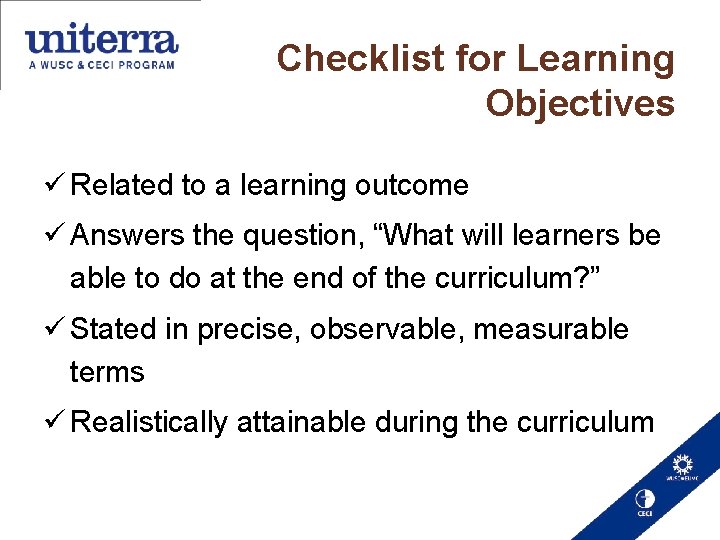
Checklist for Learning Objectives Related to a learning outcome Answers the question, “What will learners be able to do at the end of the curriculum? ” Stated in precise, observable, measurable terms Realistically attainable during the curriculum
Your Turn Exercise #2 2 • Write Learning Objectives 30
Topic 3 ORGANIZATION: DESIGN LEARNING EXPERIENCES 31
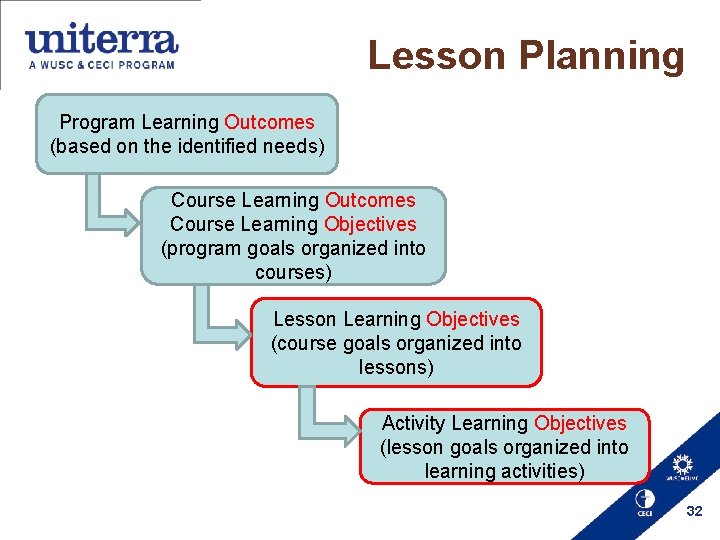
Lesson Planning Program Learning Outcomes (based on the identified needs) Course Learning Outcomes Course Learning Objectives (program goals organized into courses) Lesson Learning Objectives (course goals organized into lessons) Activity Learning Objectives (lesson goals organized into learning activities) 32
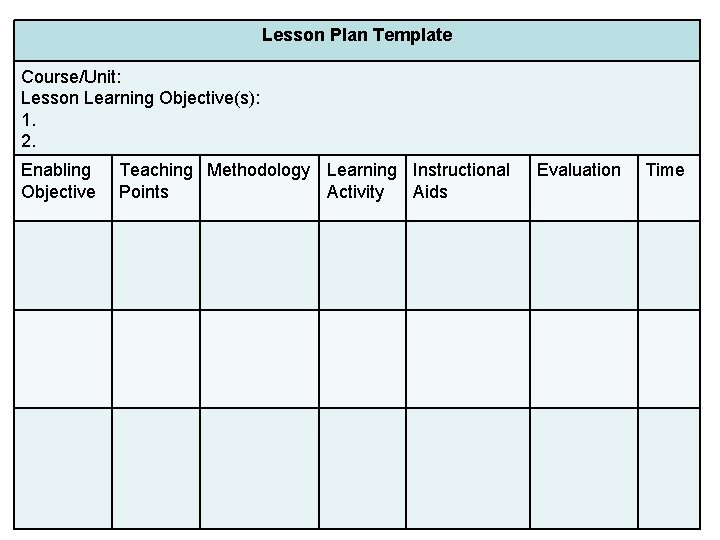
Lesson Plan Template Course/Unit: Lesson Learning Objective(s): 1. 2. Enabling Objective Organization Teaching Methodology Learning Instructional Points Activity Aids Evaluation Time
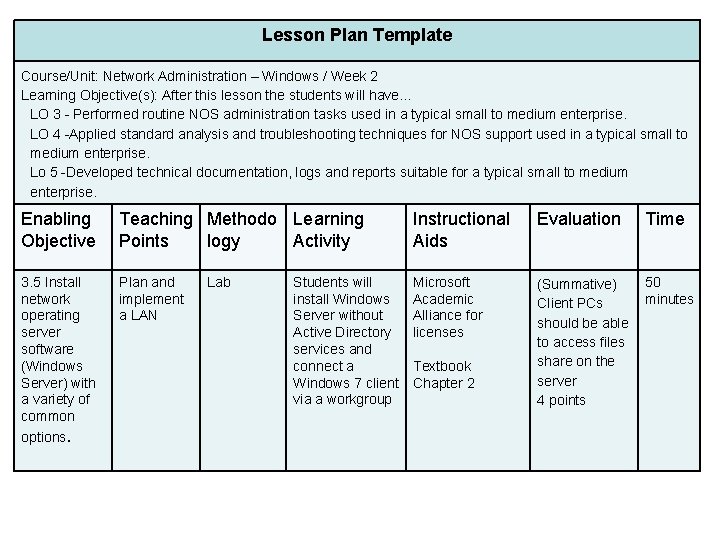
Lesson Plan Template Organization Course/Unit: Network Administration – Windows / Week 2 Learning Objective(s): After this lesson the students will have… LO 3 - Performed routine NOS administration tasks used in a typical small to medium enterprise. LO 4 -Applied standard analysis and troubleshooting techniques for NOS support used in a typical small to medium enterprise. Lo 5 -Developed technical documentation, logs and reports suitable for a typical small to medium enterprise. Enabling Objective Teaching Methodo Learning Points logy Activity Instructional Aids Evaluation 3. 5 Install network operating server software (Windows Server) with a variety of common options. Plan and implement a LAN Microsoft Academic Alliance for licenses 50 (Summative) minutes Client PCs should be able to access files share on the server 4 points Lab Students will install Windows Server without Active Directory services and connect a Windows 7 client via a workgroup Textbook Chapter 2 Time
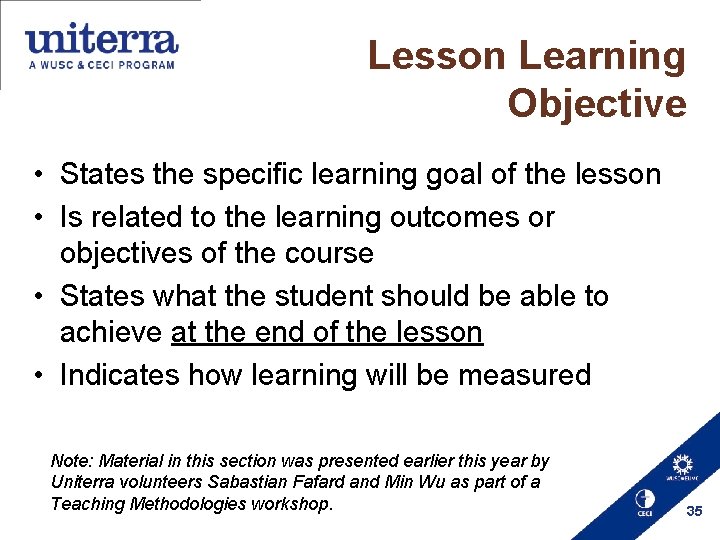
Lesson Learning Objective • States the specific learning goal of the lesson • Is related to the learning outcomes or objectives of the course • States what the student should be able to achieve at the end of the lesson • Indicates how learning will be measured Note: Material in this section was presented earlier this year by Uniterra volunteers Sabastian Fafard and Min Wu as part of a Teaching Methodologies workshop. 35
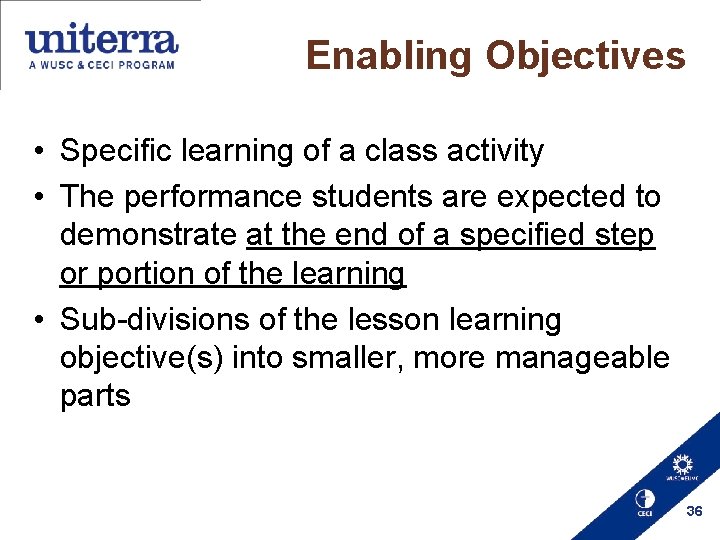
Enabling Objectives • Specific learning of a class activity • The performance students are expected to demonstrate at the end of a specified step or portion of the learning • Sub-divisions of the lesson learning objective(s) into smaller, more manageable parts 36
Teaching Points • The competencies (knowledge, skill, or attitudes) that are the focus of a lesson • What participants need to learn to reach the objective 37
Methodology How will the content be taught? • Lecture/Discussion • Demonstration/Performance • Case Studies • Role Play/Simulation • E-Learning 38
Learning Activities If you tell me I will forget If you show me I might remember But if you involve me, I will learn. -Chinese Proverb 39
Learning Activities • The average adult can sit and listen for about 10 minutes • Build active learning techniques to improve and retain attention • Vary your activities • Use different modalities to meet the learning style needs of students (visual, audible, kinesthetic) 40
Your Turn Exercise #3 3 • Develop Lesson Plan 41
Topic 4 EVALUATION: INTEGRATE ASSESSMENTS 42
Formative Assessment • Takes place on an ongoing basis as instruction is proceeding • Rates the student in terms of functional ability to communicate, using criteria that the student has helped to identify • Helps students recognize ways of improving their learning 43
Summative Assessment • Takes place at the end of a predetermined period of instruction (for example, mid-term, final) • Rates the student in relation to an external standard of correctness (how many right answers are given) 44
Examples of Formative Assessments • • Polls/Surveys Discussion/Questions Think/Pair/Share 5 minute paper Muddiest point Peer/Self Assessment Wrappers 45
Examples of Summative Assessments • • • Exams Papers Projects Presentations Portfolios 46
Your Turn Exercise #4 4 • The Wrapper 47
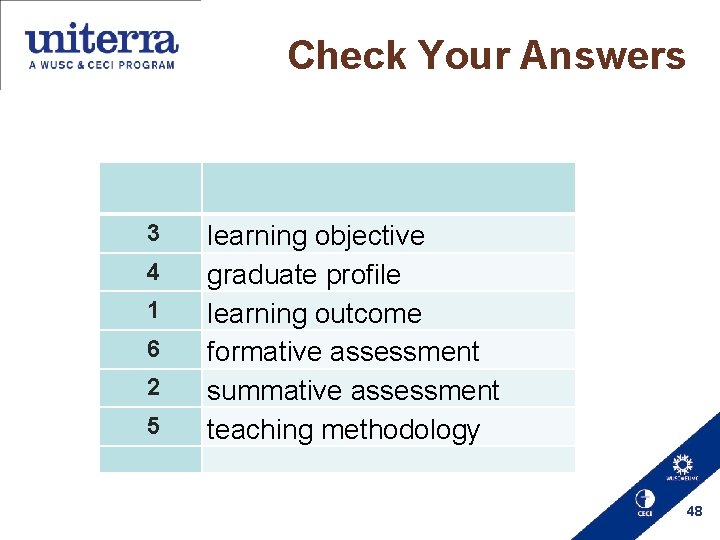
Check Your Answers 3 4 1 6 2 5 learning objective graduate profile learning outcome formative assessment summative assessment teaching methodology 48
Topic 5 EVALUATE AND ADJUST THE CURRICULUM 49
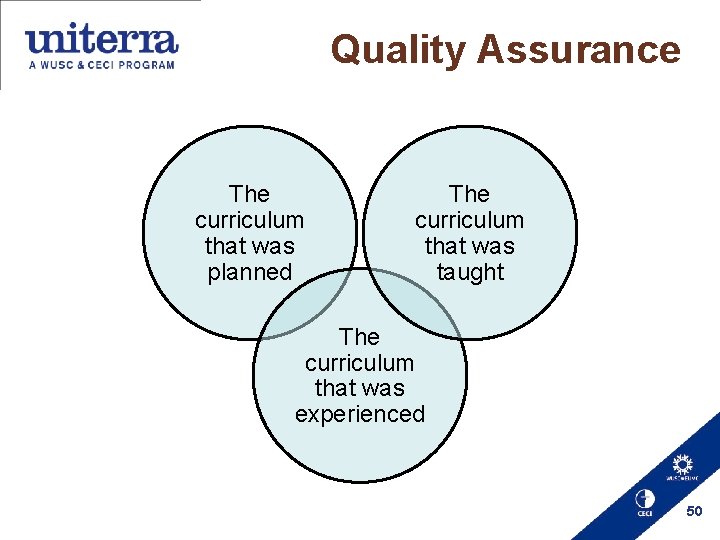
Quality Assurance The curriculum that was planned The curriculum that was taught The curriculum that was experienced 50
Evaluating the Curriculum • Does the curriculum meet the intended learning outcomes? • Does the curriculum integrate employability and life skills? • Does the content incorporate appropriately validated skills, tasks, and/or competencies? 51
Evaluating the Curriculum • Is the content sequenced from basic to more complex concepts in coherent clusters? • Is the content presented in an interesting and appealing manner geared towards the diversity of learners? 52
Thank you! Email: darlene. redmond@nscc. ca Blog: darleneredmond. wordpress. com 53
References Ravalli County Curriculum Consortium, Bloom’s Taxonomy http: //ravallicurriculum. pbworks. com/w/file/66914389/Blooms%20 Taxonomy%20 A ction%20 Verbs. pdf University of Chicago, Curriculum Terms and Concepts uip. uchicago. edu/wit/2000/curriculum/homeroommodules/curriculum. Terms/extra. h tm#develop Theory Into Practice Wiki, Classroom Assessment http: //classroom-assessment-theory-into-practice. wikispaces. com/ University of Toronto, Examples of Learning Outcomes http: //www. teaching. utoronto. ca/topics/coursedesign/learningoutcomes/examples. htm 54