
Photo by Markus Spiske on Unsplash Mori Data
Photo by Markus Spiske on Unsplash Māori Data Sovereignty Richard Arnold DATA 301 2020
Key Concepts • • • Whakapapa Mauri Wairua Manaakitanga Whanaungatanga Tupuna/Tipuna Kaitiaki Mātauranga Kaupapa Tikanga • • • Taonga Āwhina Tangata whenua Mana whenua Tino Rangatiratanga Kawanatanga Whānau Iwi Hapū Kotahitanga Pono
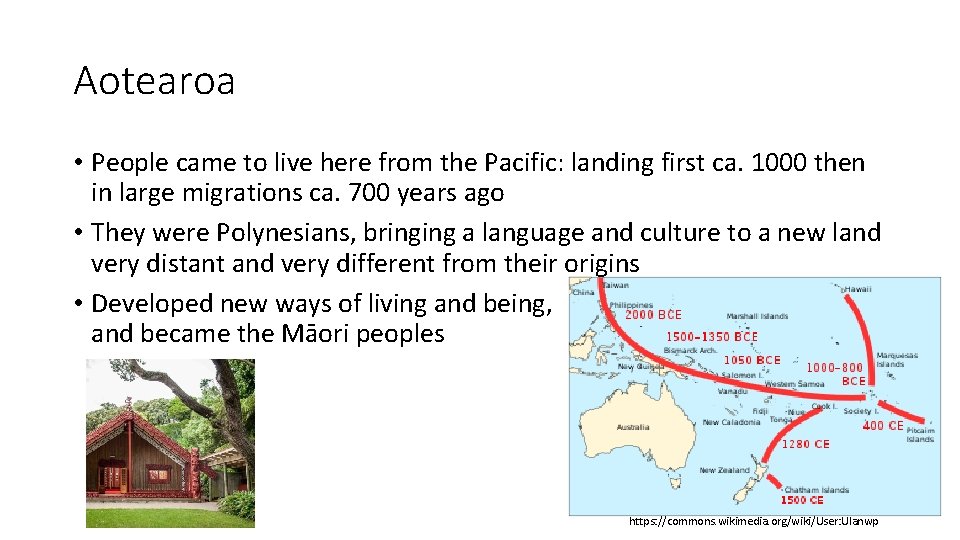
Aotearoa • People came to live here from the Pacific: landing first ca. 1000 then in large migrations ca. 700 years ago • They were Polynesians, bringing a language and culture to a new land very distant and very different from their origins • Developed new ways of living and being, and became the Māori peoples https: //commons. wikimedia. org/wiki/User: Ulanwp
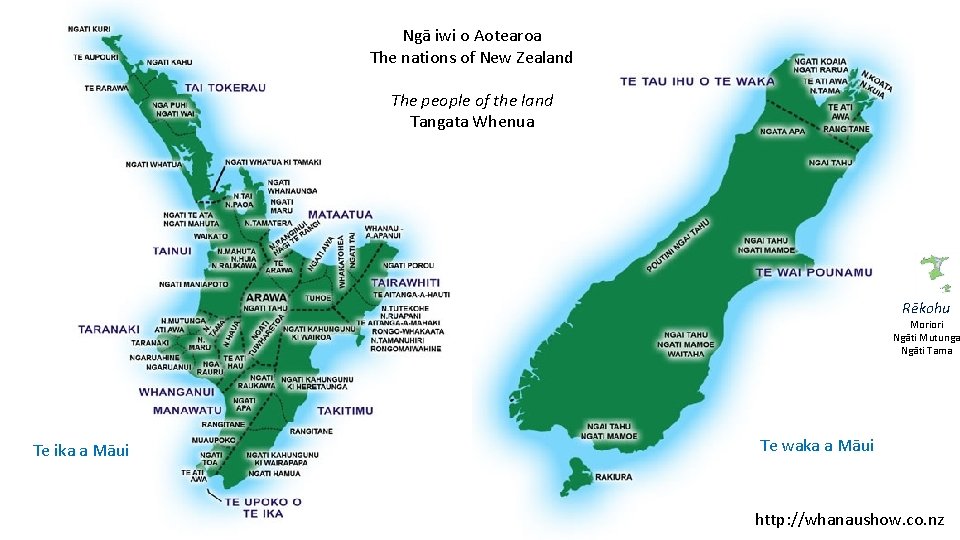
Ngā iwi o Aotearoa The nations of New Zealand The people of the land Tangata Whenua Rēkohu Moriori Ngāti Mutunga Ngāti Tama Te ika a Māui Te waka a Māui http: //whanaushow. co. nz
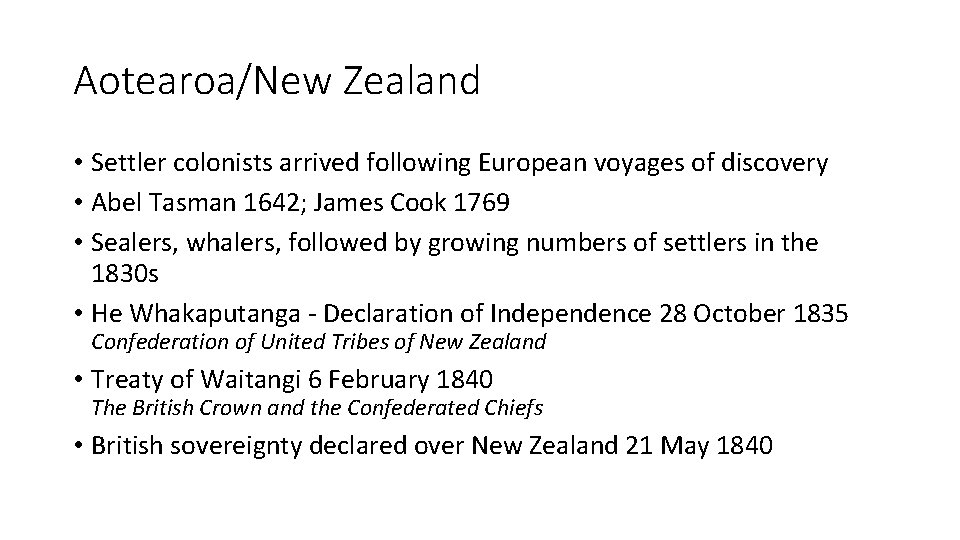
Aotearoa/New Zealand • Settler colonists arrived following European voyages of discovery • Abel Tasman 1642; James Cook 1769 • Sealers, whalers, followed by growing numbers of settlers in the 1830 s • He Whakaputanga - Declaration of Independence 28 October 1835 Confederation of United Tribes of New Zealand • Treaty of Waitangi 6 February 1840 The British Crown and the Confederated Chiefs • British sovereignty declared over New Zealand 21 May 1840
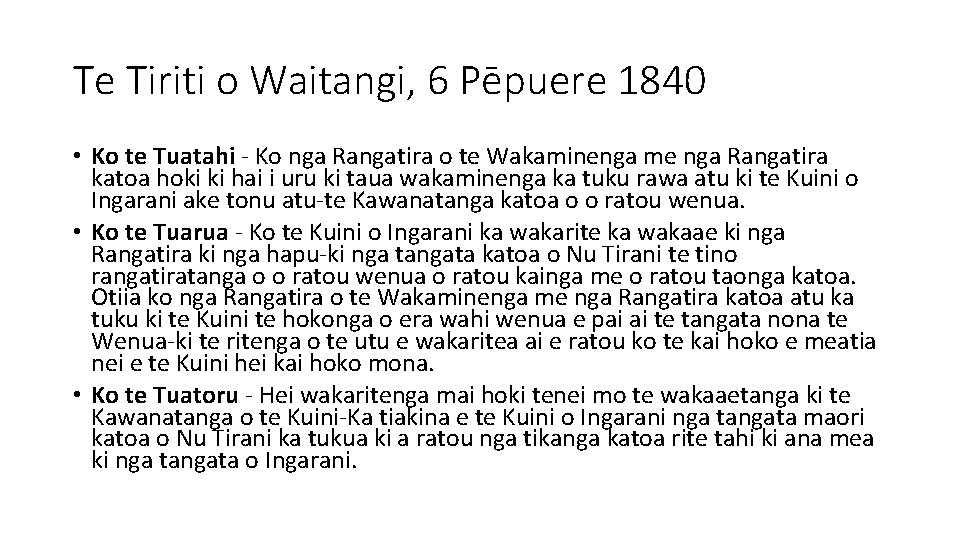
Te Tiriti o Waitangi, 6 Pēpuere 1840 • Ko te Tuatahi - Ko nga Rangatira o te Wakaminenga me nga Rangatira katoa hoki ki hai i uru ki taua wakaminenga ka tuku rawa atu ki te Kuini o Ingarani ake tonu atu-te Kawanatanga katoa o o ratou wenua. • Ko te Tuarua - Ko te Kuini o Ingarani ka wakarite ka wakaae ki nga Rangatira ki nga hapu-ki nga tangata katoa o Nu Tirani te tino rangatiratanga o o ratou wenua o ratou kainga me o ratou taonga katoa. Otiia ko nga Rangatira o te Wakaminenga me nga Rangatira katoa atu ka tuku ki te Kuini te hokonga o era wahi wenua e pai ai te tangata nona te Wenua-ki te ritenga o te utu e wakaritea ai e ratou ko te kai hoko e meatia nei e te Kuini hei kai hoko mona. • Ko te Tuatoru - Hei wakaritenga mai hoki tenei mo te wakaaetanga ki te Kawanatanga o te Kuini-Ka tiakina e te Kuini o Ingarani nga tangata maori katoa o Nu Tirani ka tukua ki a ratou nga tikanga katoa rite tahi ki ana mea ki nga tangata o Ingarani.
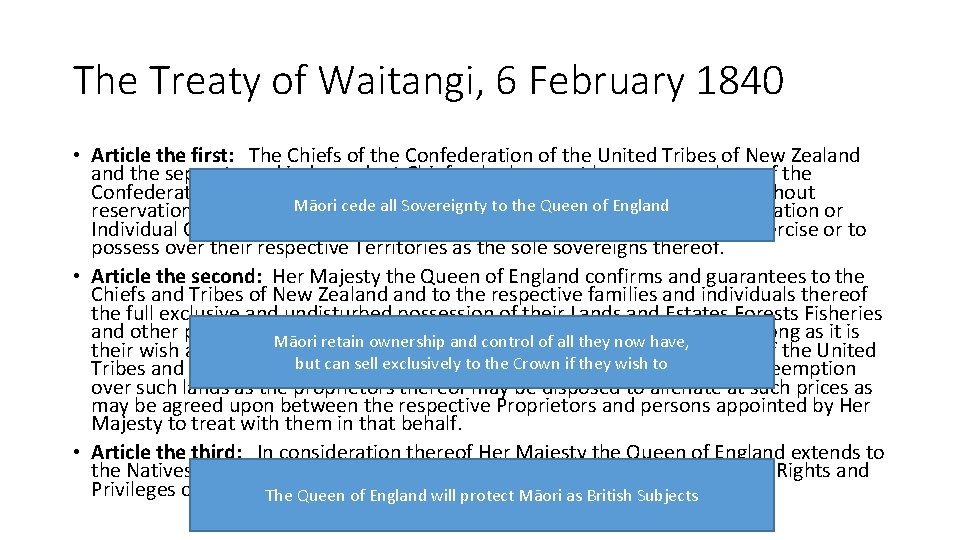
The Treaty of Waitangi, 6 February 1840 • Article the first: The Chiefs of the Confederation of the United Tribes of New Zealand the separate and independent Chiefs who have not become members of the Confederation cede to Her Majesty the Queen of England absolutely and without Māori cede all Sovereignty to the Queen of England reservation all the rights and powers of Sovereignty which the said Confederation or Individual Chiefs respectively exercise or possess, or may be supposed to exercise or to possess over their respective Territories as the sole sovereigns thereof. • Article the second: Her Majesty the Queen of England confirms and guarantees to the Chiefs and Tribes of New Zealand to the respective families and individuals thereof the full exclusive and undisturbed possession of their Lands and Estates Forests Fisheries and other properties which they may collectively or individually possess so long as it is Māori retain ownership and control of all they now have, their wish and desire to retain the same in their possession; but the Chiefs of the United but can sell exclusively to the Crown if they wish to Tribes and the individual Chiefs yield to Her Majesty the exclusive right of Preemption over such lands as the proprietors thereof may be disposed to alienate at such prices as may be agreed upon between the respective Proprietors and persons appointed by Her Majesty to treat with them in that behalf. • Article third: In consideration thereof Her Majesty the Queen of England extends to the Natives of New Zealand Her royal protection and imparts to them all the Rights and Privileges of British Subjects. The Queen of England will protect Māori as British Subjects
The Treaty of Waitangi, 6 February 1840 • Article the first: The Chiefs of the Confederation of the United Tribes of New Zealand the separate and independent Chiefs who have not become members of the Confederation cede to Her Majesty the Queen of England absolutely and without reservation all the rights and powers of Sovereignty which the said Confederation or Individual Chiefs respectively exercise or possess, or may be supposed to exercise or to possess over their respective Territories as the sole sovereigns thereof. • Article the second: Her Majesty the Queen of England confirms and guarantees to the Chiefs and Tribes of New Zealand to the respective families and individuals thereof the full exclusive and undisturbed possession of their Lands and Estates Forests Fisheries and other properties which they may collectively or individually possess so long as it is their wish and desire to retain the same in their possession; but the Chiefs of the United Tribes and the individual Chiefs yield to Her Majesty the exclusive right of Preemption over such lands as the proprietors thereof may be disposed to alienate at such prices as may be agreed upon between the respective Proprietors and persons appointed by Her Majesty to treat with them in that behalf. • Article third: In consideration thereof Her Majesty the Queen of England extends to the Natives of New Zealand Her royal protection and imparts to them all the Rights and Privileges of British Subjects.
The Treaty of Waitangi, 6 February 1840 • Article the first: The Chiefs of the Confederation of the United Tribes of New Zealand the separate and independent Chiefs who have not become members of the Confederation cede to Her Majesty the Queen of England absolutely and without reservation all the rights and powers of Sovereignty which the said Confederation or Individual Chiefs respectively exercise or possess, or may be supposed to exercise or to possess over their respective Territories as the sole sovereigns thereof. • Article the second: Her Majesty the Queen of England confirms and guarantees to the Chiefs and Tribes of New Zealand to the respective families and individuals thereof the full exclusive and undisturbed possession of their Lands and Estates Forests Fisheries and other properties which they may collectively or individually possess so long as it is their wish and desire to retain the same in their possession; but the Chiefs of the United Tribes and the individual Chiefs yield to Her Majesty the exclusive right of Preemption over such lands as the proprietors thereof may be disposed to alienate at such prices as may be agreed upon between the respective Proprietors and persons appointed by Her Majesty to treat with them in that behalf. • Article third: In consideration thereof Her Majesty the Queen of England extends to the Natives of New Zealand Her royal protection and imparts to them all the Rights and Privileges of British Subjects.
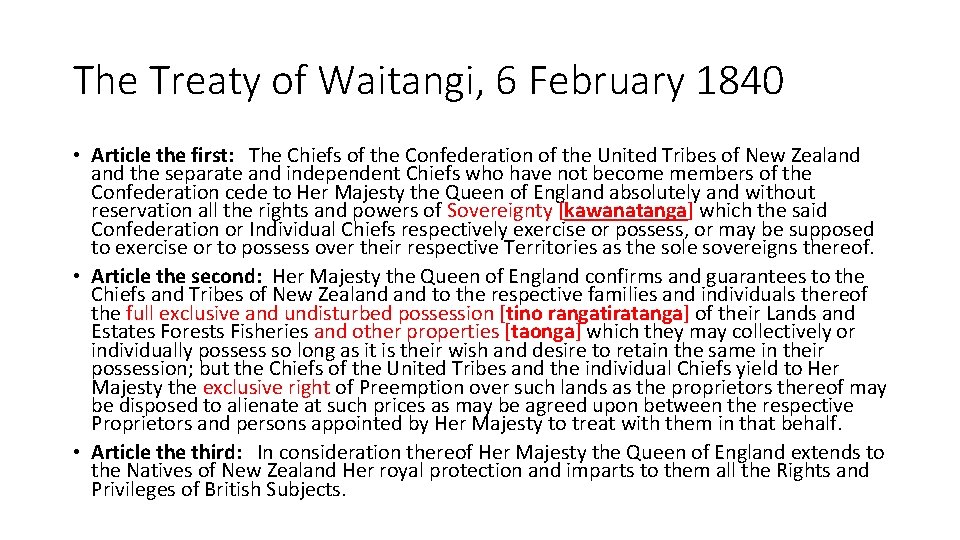
The Treaty of Waitangi, 6 February 1840 • Article the first: The Chiefs of the Confederation of the United Tribes of New Zealand the separate and independent Chiefs who have not become members of the Confederation cede to Her Majesty the Queen of England absolutely and without reservation all the rights and powers of Sovereignty [kawanatanga] which the said Confederation or Individual Chiefs respectively exercise or possess, or may be supposed to exercise or to possess over their respective Territories as the sole sovereigns thereof. • Article the second: Her Majesty the Queen of England confirms and guarantees to the Chiefs and Tribes of New Zealand to the respective families and individuals thereof the full exclusive and undisturbed possession [tino rangatiratanga] of their Lands and Estates Forests Fisheries and other properties [taonga] which they may collectively or individually possess so long as it is their wish and desire to retain the same in their possession; but the Chiefs of the United Tribes and the individual Chiefs yield to Her Majesty the exclusive right of Preemption over such lands as the proprietors thereof may be disposed to alienate at such prices as may be agreed upon between the respective Proprietors and persons appointed by Her Majesty to treat with them in that behalf. • Article third: In consideration thereof Her Majesty the Queen of England extends to the Natives of New Zealand Her royal protection and imparts to them all the Rights and Privileges of British Subjects.
Context • Population growth of settlers, decline of Māori population size • Suppression of the Māori language, culture • Alienation of land resources • Armed conflict 1845 -1872 – The New Zealand Wars • Resettlement and rural deprivation • Drift to the cities, urban deprivation, cultural alienation
1960 s and 1970 s • Resurgence of Māori claims over land, cultural identity, expression self determination and sovereignty • 1975 Waitangi Tribunal – a government Commission of Inquiry • Ongoing reparations through treaty claims • Claims are made by iwi, hapū and whanau and Māori as a whole • Revival of the language Te Reo Māori
The situation today • Inequalities and injustices persist • The process of claims continues, a variety of policies and approaches (with a varying levels of success) to address inequalities and injustices • Commitment at Government level to adhere to “Treaty Principles” • Te Puni Kōkiri / Ministry of Māori Development: Principal policy advisor to the Government on Māori outcomes

Te Ao Māori Understanding the Māori World View
Te Ao Māori • World view structured by whakapapa – the origins and connections between people and the land • Knowledge and understanding of the land sea, of plants and animals is crucial to survival and health of the people • The world is gifted to the living by the wisdom and care of the ancestors Te Reo, Tikanga and Mātauranga Māori • Is cared for today by the living are the pillars • And kept healthy for the descendants who will come after
The modern world of data fits right into this • Data are a taonga • They have a whakapapa – an origin, and a relationship to us now • They have mauri, wairua – significance and meaning And therefore • Data must be curated with care • Used responsibly • Kept safe for the future
Data Sovereignty There are both opportunities and risks for Māori in the new world of Data Science
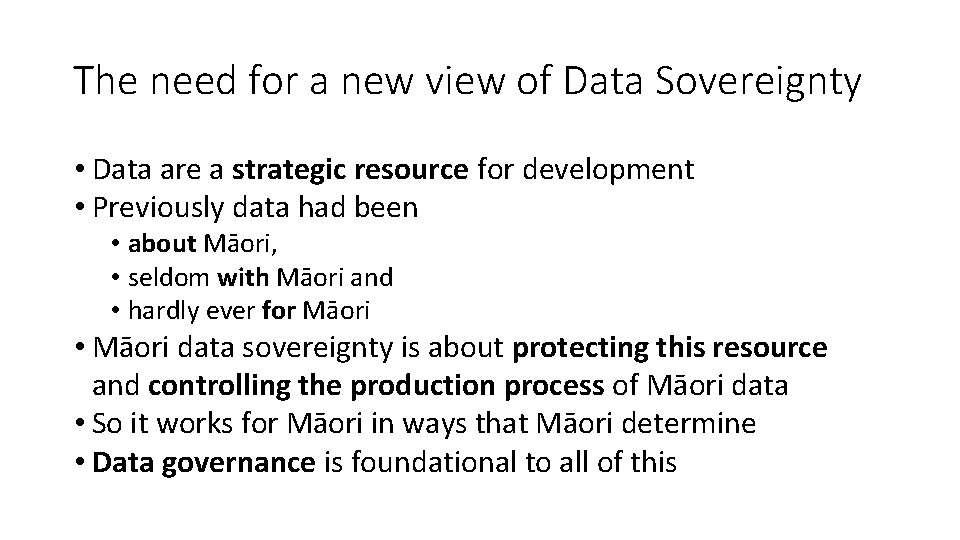
The need for a new view of Data Sovereignty • Data are a strategic resource for development • Previously data had been • about Māori, • seldom with Māori and • hardly ever for Māori • Māori data sovereignty is about protecting this resource and controlling the production process of Māori data • So it works for Māori in ways that Māori determine • Data governance is foundational to all of this
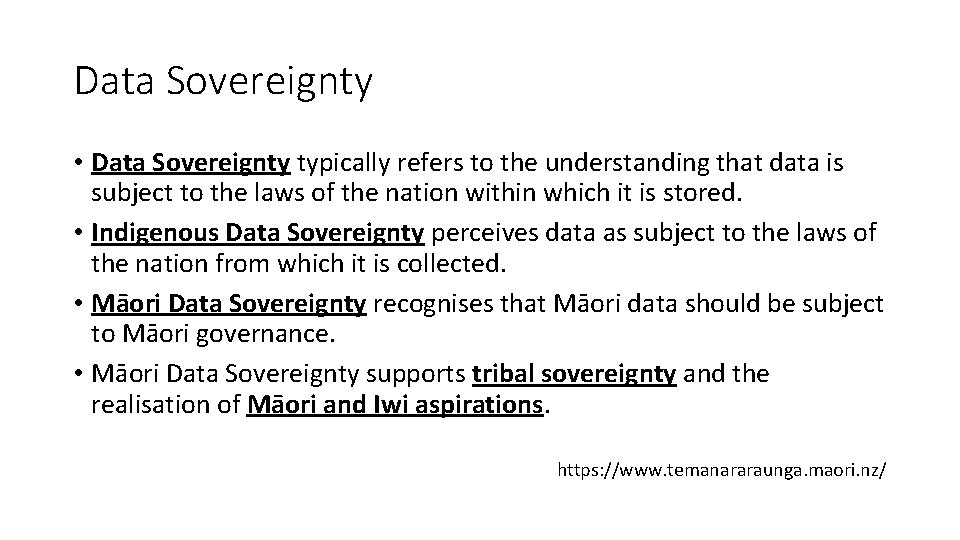
Data Sovereignty • Data Sovereignty typically refers to the understanding that data is subject to the laws of the nation within which it is stored. • Indigenous Data Sovereignty perceives data as subject to the laws of the nation from which it is collected. • Māori Data Sovereignty recognises that Māori data should be subject to Māori governance. • Māori Data Sovereignty supports tribal sovereignty and the realisation of Māori and Iwi aspirations. https: //www. temanararaunga. maori. nz/
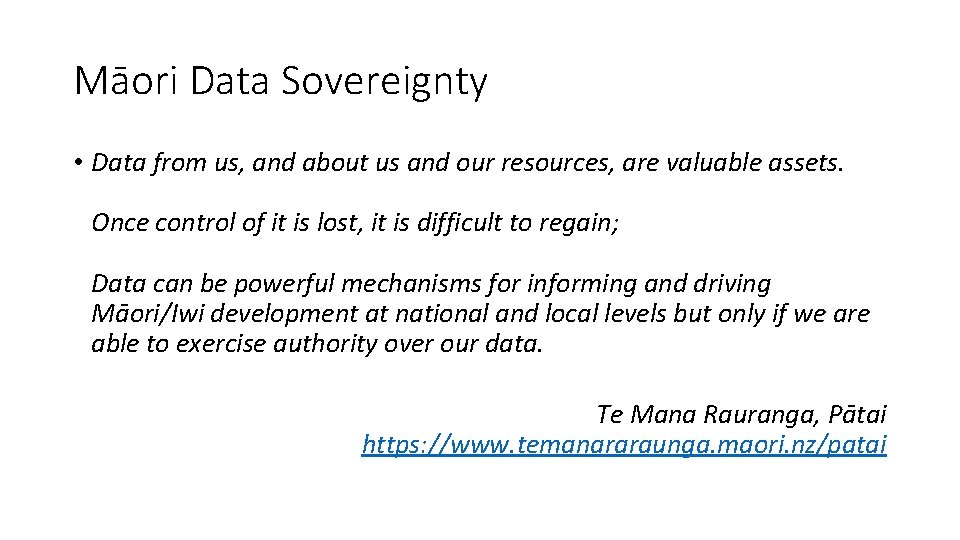
Māori Data Sovereignty • Data from us, and about us and our resources, are valuable assets. Once control of it is lost, it is difficult to regain; Data can be powerful mechanisms for informing and driving Māori/Iwi development at national and local levels but only if we are able to exercise authority over our data. Te Mana Rauranga, Pātai https: //www. temanararaunga. maori. nz/patai
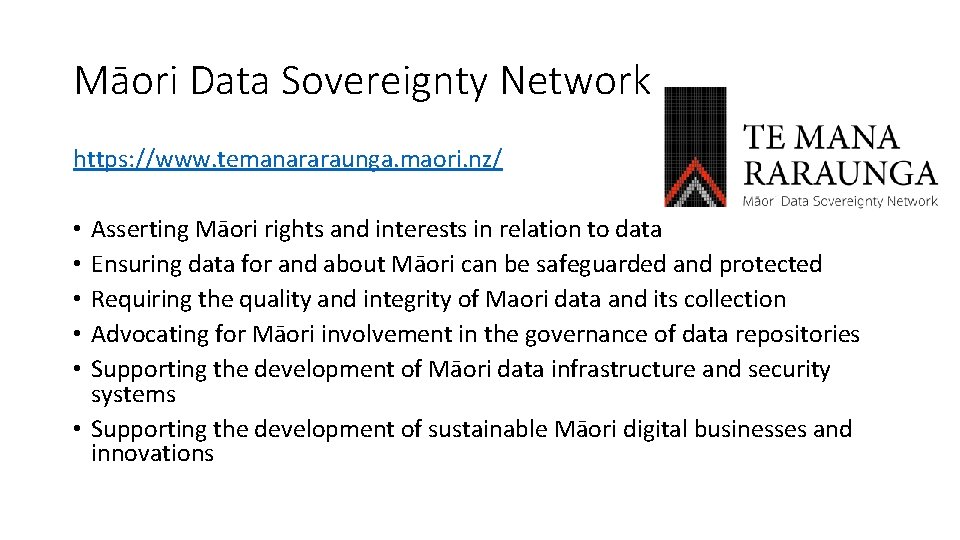
Māori Data Sovereignty Network https: //www. temanararaunga. maori. nz/ Asserting Māori rights and interests in relation to data Ensuring data for and about Māori can be safeguarded and protected Requiring the quality and integrity of Maori data and its collection Advocating for Māori involvement in the governance of data repositories Supporting the development of Māori data infrastructure and security systems • Supporting the development of sustainable Māori digital businesses and innovations • • •
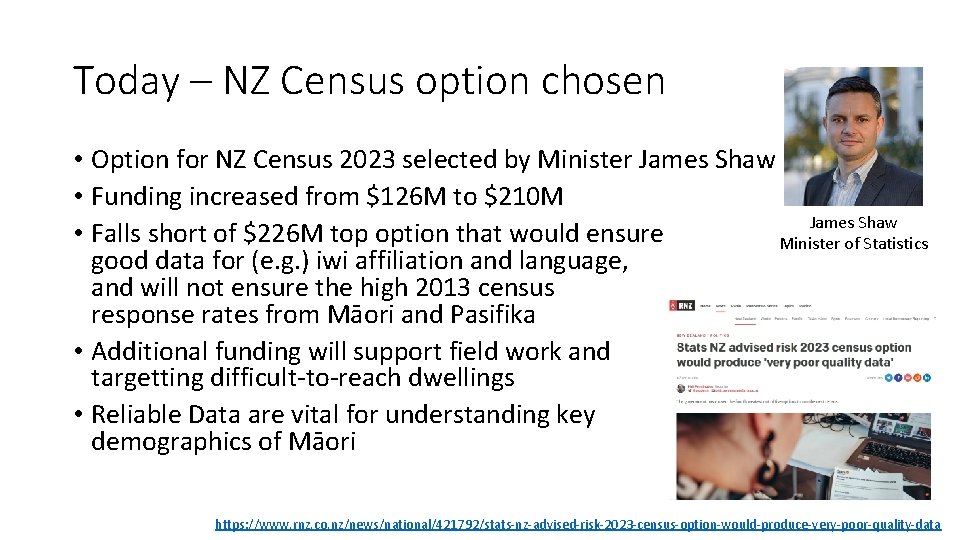
Today – NZ Census option chosen • Option for NZ Census 2023 selected by Minister James Shaw • Funding increased from $126 M to $210 M James Shaw • Falls short of $226 M top option that would ensure Minister of Statistics good data for (e. g. ) iwi affiliation and language, and will not ensure the high 2013 census response rates from Māori and Pasifika • Additional funding will support field work and targetting difficult-to-reach dwellings • Reliable Data are vital for understanding key demographics of Māori https: //www. rnz. co. nz/news/national/421792/stats-nz-advised-risk-2023 -census-option-would-produce-very-poor-quality-data
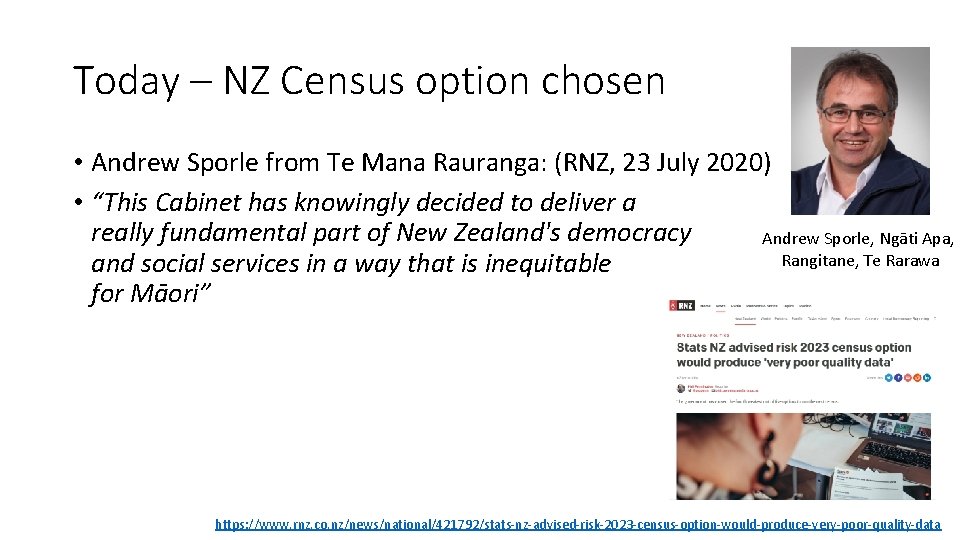
Today – NZ Census option chosen • Andrew Sporle from Te Mana Rauranga: (RNZ, 23 July 2020) • “This Cabinet has knowingly decided to deliver a really fundamental part of New Zealand's democracy Andrew Sporle, Ngāti Apa, Rangitane, Te Rarawa and social services in a way that is inequitable for Māori” https: //www. rnz. co. nz/news/national/421792/stats-nz-advised-risk-2023 -census-option-would-produce-very-poor-quality-data
Māori Data Sovereignty Māori data are data that are produced by Māori, and data that are about Māori and the environments we have relationships with. Data are a living tāonga and are of strategic value to Māori data include but are not limited to: • Data from government agencies, organisations and/or businesses • Data about Māori that are used to describe or compare Māori collectives • Data about Te Ao Māori that emerges from research
Definitions • Māori data refers to digital or digitisable information or knowledge that is about or from Māori people, our language, culture, resources or environments. • Māori Data Sovereignty refers to the inherent rights and interests that Māori have in relation to the collection, ownership, and application of Māori data. • Māori Data Governance refers to the principles, structures, accountability mechanisms, legal instruments and policies through which Māori exercise control over Māori data.
Principles 1. Rangatiratanga – Authority – the right of Māori to control and to make decisions about the creation, storage and use of Māori data; 2. Whakapapa – Relationships – the genealogy of the data and its connection to the people should be known, and respected; 3. Whanaungatanga – Obligations – a balance in the rights of individuals and communities must be sought; 4. Kotahitanga – Collective Benefit – Data should be created, stored and used in ways that benefit Maori, including the capability of Maori to work with their own data, and to make connections with others; 5. Manaakitanga – Reciprocity – Consent is central, and respect for the dignity of individuals and communities should be upheld; 6. Kaitiakitanga – Guardianship – Data will be stored and curated, and access granted ensuring respect and care for the data and the future
Mana Ōrite • An agreement (30 Oct 2019) between • Statistics NZ and • the Data Iwi Leaders Group [Subgroup of the Iwi Chairs Forum https: //iwichairs. maori. nz/, who are elected as representatives of their respective iwi] • Aims to realise the potential of data to make a sustainable positive difference to outcomes for iwi, hapū and whānau
Practical principles and steps How should we approach working with Māori data?
Trust is central • Relationship building (whanaungatanga) and respect (manaaki) are the foundations of all successful work with Māori data and people • Access to data is derived from whakapapa • For others, access to data is not a given – access is a privilege that is earned through trust and integrity (pono) • For all, maintaining access means maintaining integrity
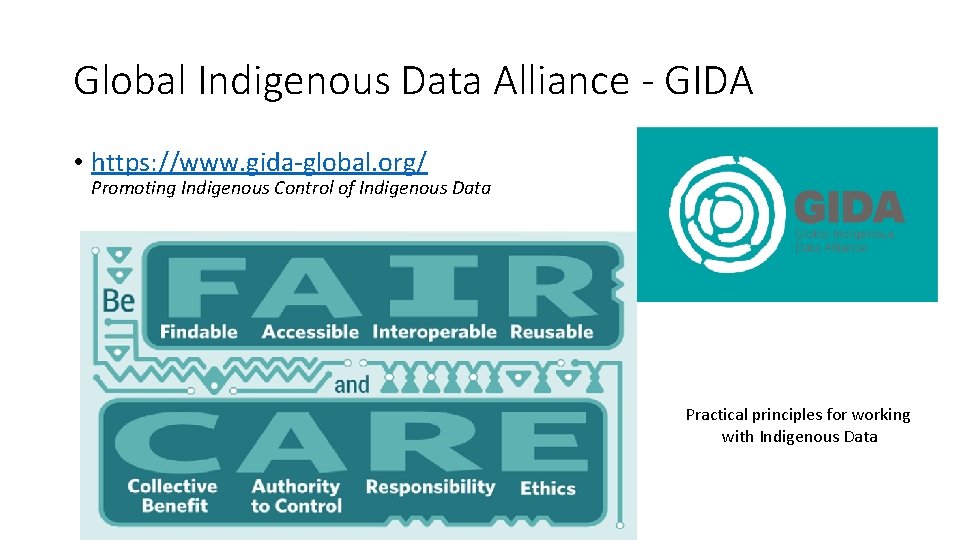
Global Indigenous Data Alliance - GIDA • https: //www. gida-global. org/ Promoting Indigenous Control of Indigenous Data Practical principles for working with Indigenous Data
CAREful Design Researcher obligations • Collective Benefit - Data ecosystems shall be designed and function in ways that enable Indigenous Peoples to derive benefit from the data; • Authority to Control - Indigenous Peoples’ rights and interests in Indigenous data must be recognised and their authority to control such data be empowered; • Responsibility - Data are used to support Indigenous Peoples’ selfdetermination and collective benefit. Accountability requires meaningful and openly available evidence of this; • Ethics - Indigenous Peoples’ rights and wellbeing should be the primary concern at all stages of the data life cycle and across the data ecosystem.
FAIR Design User perspective • Findable - Metadata and data should be easy to find for both humans and computers. Machine-readable metadata are essential for automatic discovery of datasets and services; • Accessible - Once the user finds the required data, she/he needs to know how can they be accessed, possibly including authentication and authorisation; • Interoperable - The data usually need to be integrated with other data and to interoperate with applications or workflows for analysis, storage, and processing; • Reusable - Metadata and data should be well-described so that they can be replicated and/or combined in different settings
In Practice - Questions to consider • How are the data relevant to Māori? (From, for, by, about, for the benefit of …) • How will Māori be engaged? • Who will own the data? • Who will govern access? • Who will store and manage the data? (Stewardship) • Where will the data for this project be stored? • Will there be an agreement about data reuse? How, by whom? • What will happen to the data at the end of the project? • How will results be communicated back? • How will results be used?

Examples
How are the principles enacted? • Protocols for the collection, curation, governance and use of Maori data • Appropriate labelling of data and resources as Traditional Knowledge (TK) • Extension to biological data, genomics Enrich - https: //www. enrich-hub. org/ Biocultural labels “a critical tool for addressing issues of ownership, access and control over Indigenous digital collections and data”
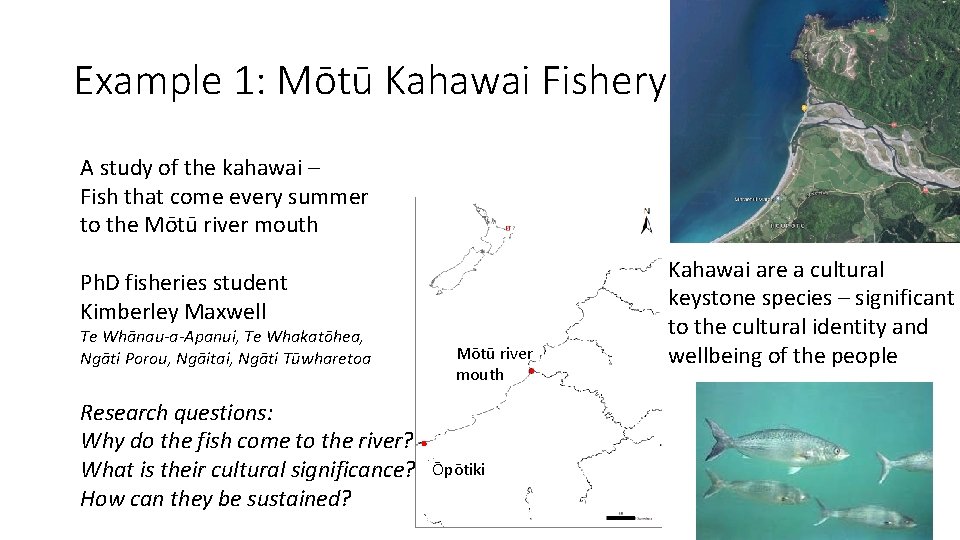
Example 1: Mōtū Kahawai Fishery A study of the kahawai – Fish that come every summer to the Mōtū river mouth Ph. D fisheries student Kimberley Maxwell Te Whānau-a-Apanui, Te Whakatōhea, Ngāti Porou, Ngāitai, Ngāti Tūwharetoa Mōtū river mouth Research questions: Why do the fish come to the river? What is their cultural significance? Ōpōtiki How can they be sustained? . Kahawai are a cultural keystone species – significant to the cultural identity and wellbeing of the people
Trans-disciplinary Research Methods • Discussion, consultation, support and agreement from the hapū – the research aims to aid the hapū to better understand, protect and sustain the kahawai • Reporting back to the hapū, discussion and interpretation of results during the research and at the end ( … possible photo exhibition) • Data collection and collation: • • Interviews with hapū members Collection of written records, newspaper reports Government policy and management, interviewed Minister of Fisheries Collection and analysis of fish from the river and the ocean
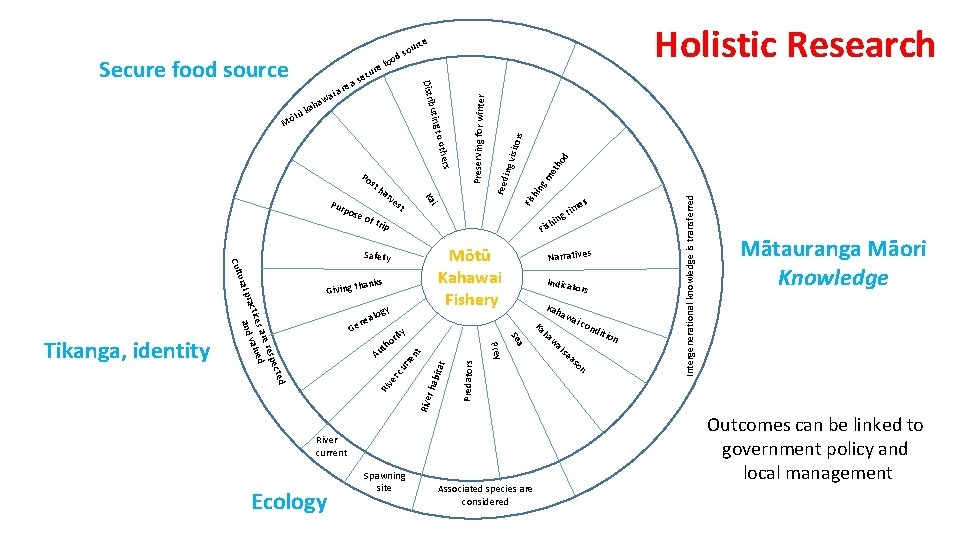
Holistic Research e urc d ho Fi Mōtū Kahawai Fishery hanks gy alo e n e G Predators Rive r ha bita t nt ur re r c ve d Ri Indicat ors Kah River current Ecology aw Ka h a ho ut Narratives Se y rit Prey te pec res are ued ices l ract and va ral p Giving t A es im t ng i h s Spawning site Associated species are considered aw ai s ai c ea ond so n itio n Intergenerational knowledge is transferred trip Safety u Cult Tikanga, identity e of es t Fis pos i Ka Pur ha rv et ers st g m to oth Po rs Mō hin w ha ka tū Feed ing v isito c se a re ai a uting Distrib Secure food source o fo ure Preserving for winter o d s Mātauranga Māori Knowledge Outcomes can be linked to government policy and local management
Outcomes • Supporting mātauranga Māori with science to transform policy • Biocultural planning objectives • Demonstrate mātauranga as best information available in lieu of expensive time consuming ecological studies on the same subject • Recognising the right to transfer Māori data through a Māori knowledge system, for example, through pūrākau or narratives, is a key part of Māori data sovereignty
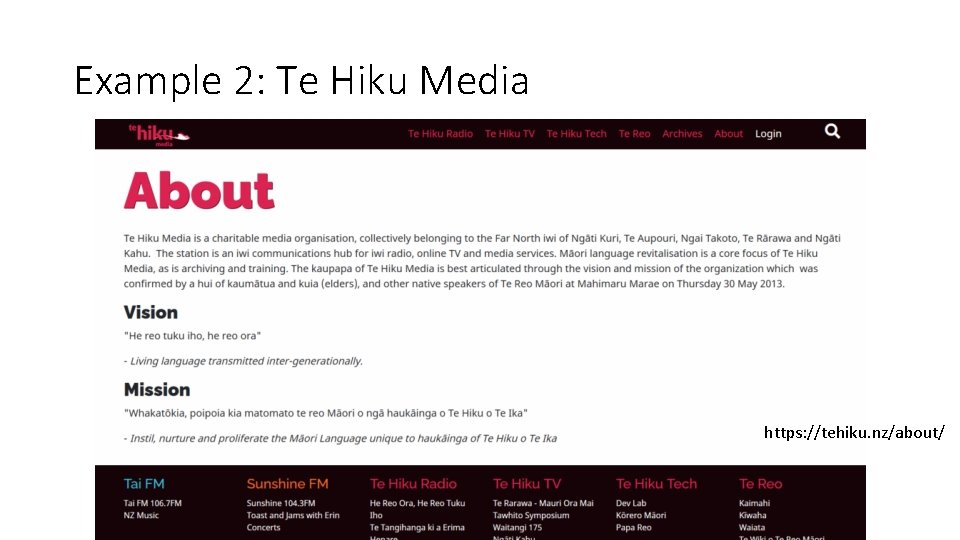
Example 2: Te Hiku Media https: //tehiku. nz/about/
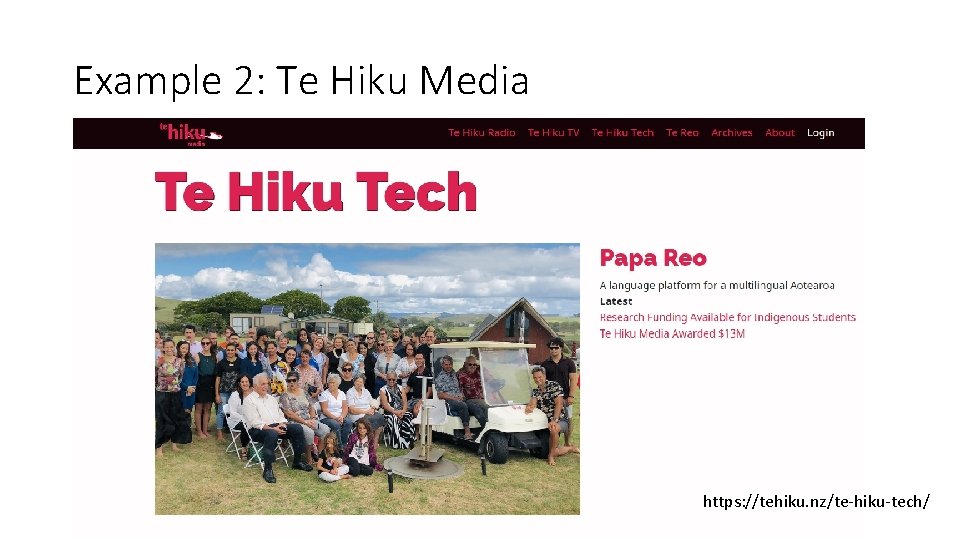
Example 2: Te Hiku Media https: //tehiku. nz/te-hiku-tech/
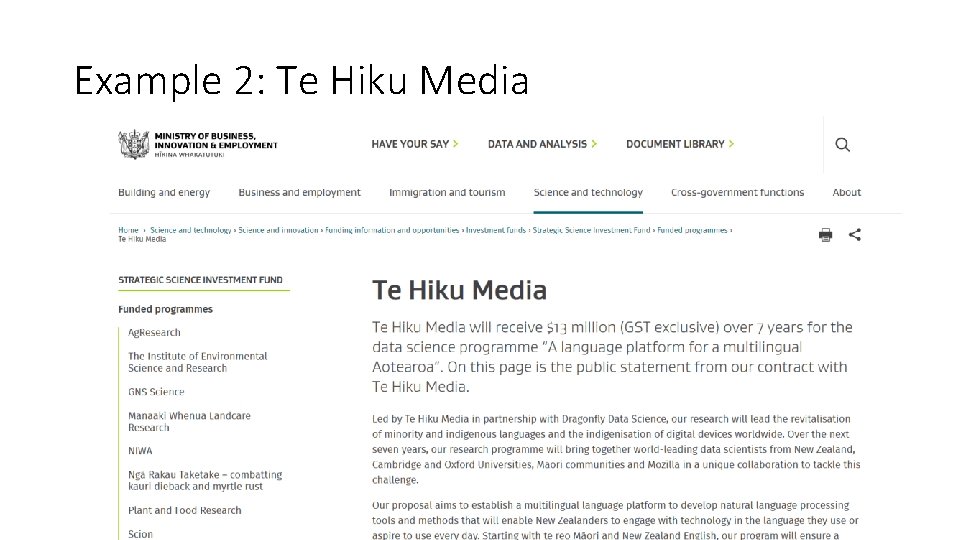
Example 2: Te Hiku Media MBIE has announced a $13 million investment in Te Hiku Media for Papa Reo, a multilingual language platform that will develop cutting edge natural language processing tools, starting with te reo Māori. The tools will enable applications to be built that will ensure all New Zealanders can use te reo Māori when engaging with their digital devices. New Zealand English and Pacific languages will also be included to further support the growth of a multilingual Aotearoa. https: //tehiku. nz/te-hiku-tech/papa-reo/11261/te-hiku-media-awarded-13 m
Example 2: Te Hiku Media
https: //github. com/Te. Hiku. Media/Kaitiakitanga-License Te Hiku Kaitiakitanga License Kaitiaki is a Māori word without specific English translation, but its meaning is similar to the words guardian, protector, and custodian. In this context we protect the code in this repository and will provide access to the code as we deem fit through our tikanga (Māori customs and protocols). While we recognize the importance of open source technology, we're mindful that the majority of tangata whenua and other indigenous peoples may not have access to the resources that enable them to benefit from open source technologies. As tangata whenua, our ability to grow, develop, and innovate has been stymied through colonization. We must protect our ability to grow as tangata whenua. By simply open sourcing our data and knowledge, we further allow ourselves to be colonised digitally in the modern world. The Kaitiakitanga License is a work in progress. It's a living license. It will evolve as we see fit. We hope to develop a license that is an international example for indigenous people's retention of mana over data and other intellectual property in a Western construct.
https: //github. com/Te. Hiku. Media/Kaitiakitanga-License Te Hiku Kaitiakitanga License Terms 1. You must contact us and seek permission to access, use, contribute towards, or modify code in this repository; 2. You may not use code in this repository or any derivations for commercial purposes unless we explicitly grant you the right to do so; 3. All works derived from code in this repository are bound by the Kaitiakitanga License; 4. All works that make use of any code in this repository are bound by the Kaitiakitanga License
Kia Ora / Thank you to • Kim Maxwell, Andrew Sporle, Jo Kidman, Linley Jesson, Kevin Shedlock … for their help in putting this lecture together
Additional references • Glossary of Māori terms https: //www. landcareresearch. co. nz/__data/assets/pdf_file/0007/13 4953/8 -1 -Glossary-of-Maori-Terms. pdf
- Slides: 47