
Phosphate fertilizer effect of thermally processed sewage sludge
- Slides: 18
Phosphate fertilizer effect of thermally processed sewage sludge ash compared to triple superphosphate SPS 2014 (Sustainable Phosphorus Summit) - Montpellier Maximilian Severin, Joachim Breuer, Martin Rex, Jan Steman, Christian Adam, Herman Van den Weghe and Martin Kücke 15. 09. 2021 Maximilian Severin – Phosphate fertilizer effect of thermally processed sewage sludge ash compared to triple superphosphate 1
Structure 1. 2. 3. 4. 5. State of knowledge Research aims Experimental set up and results Conclusions Outlook 15. 09. 2021 Maximilian Severin – Phosphate fertilizer effect of thermally processed sewage sludge ash compared to triple superphosphate 2
State of knowledge – Reasons for P-recycling of sewage sludge • A substitution of phosphates by other resources is not possible, • The easily degradable geogenic phosphate reserves will be exhausted in 320 years, • Contamination with heavy metals (especially cadmium and uranium) increases, • Europe is entirely dependent on the imports of mineral phosphates, • Phosphate deposits are located in regions with political instability, • Legislation applies the P-recycling (Recycling Law). (SCHNEE 2014 and BERGS 2014) 15. 09. 2021 Maximilian Severin – Phosphate fertilizer effect of thermally processed sewage sludge ash compared to triple superphosphate 3
Research aims and questions 1. Have thermochemical treated sewage sludge ashes a higher P availability and a higher effect on plant growth compared to untreated sewage sludge ashes? 2. Show heat treated sewage sludge ashes at similar levels of application a comparable effect to triple superphosphate with regard to P plant availability and plant growth promotion after fertilization? 15. 09. 2021 Maximilian Severin – Phosphate fertilizer effect of thermally processed sewage sludge ash compared to triple superphosphate 4
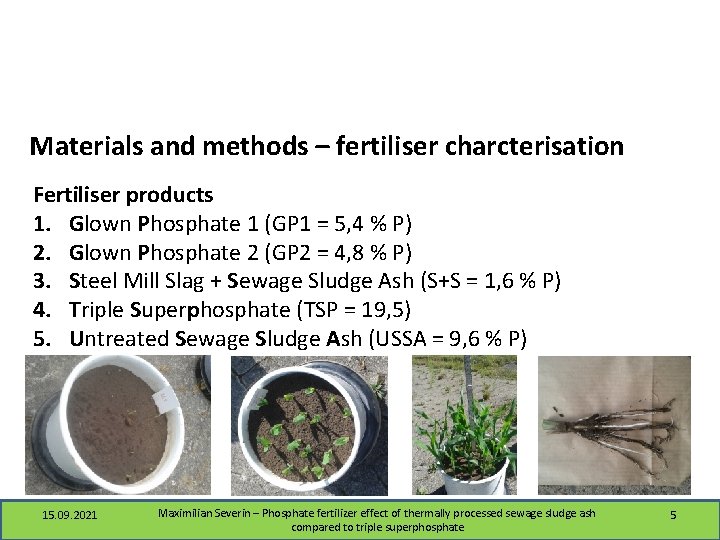
Materials and methods – fertiliser charcterisation Fertiliser products 1. Glown Phosphate 1 (GP 1 = 5, 4 % P) 2. Glown Phosphate 2 (GP 2 = 4, 8 % P) 3. Steel Mill Slag + Sewage Sludge Ash (S+S = 1, 6 % P) 4. Triple Superphosphate (TSP = 19, 5) 5. Untreated Sewage Sludge Ash (USSA = 9, 6 % P) 15. 09. 2021 Maximilian Severin – Phosphate fertilizer effect of thermally processed sewage sludge ash compared to triple superphosphate 5
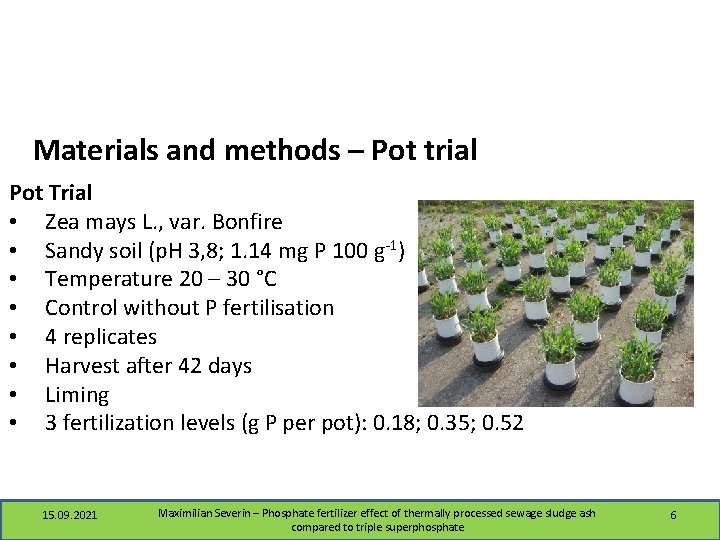
Materials and methods – Pot trial Pot Trial • Zea mays L. , var. Bonfire • Sandy soil (p. H 3, 8; 1. 14 mg P 100 g-1) • Temperature 20 – 30 °C • Control without P fertilisation • 4 replicates • Harvest after 42 days • Liming • 3 fertilization levels (g P per pot): 0. 18; 0. 35; 0. 52 15. 09. 2021 Maximilian Severin – Phosphate fertilizer effect of thermally processed sewage sludge ash compared to triple superphosphate 6
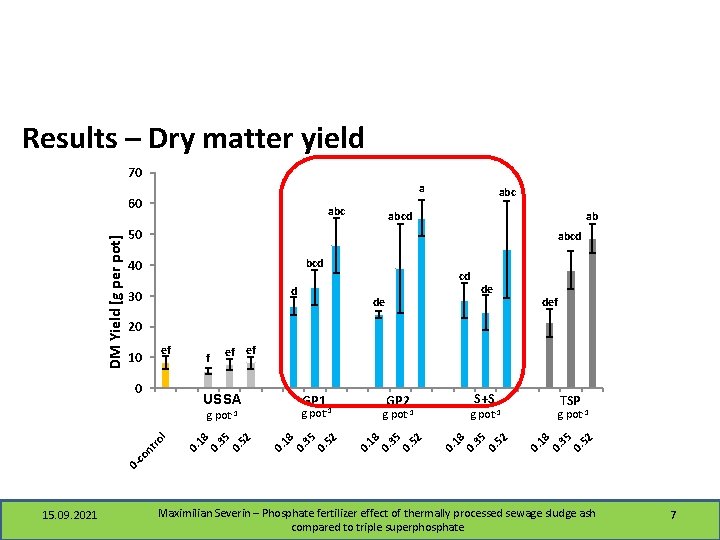
Results – Dry matter yield 70 a abc ab abcd 50 abcd 40 cd d 30 de de def 20 ef ef TSP 52 0. 35 0. 18 g pot-1 0. 18 0. 35 0. 52 g pot-1 0. 52 35 pot-1 0. 18 g 0. 18 0. 52 35 18 0. g S+S GP 2 pot-1 0 - co nt ro l g GP 1 pot-1 0. USSA 52 0 0. f 35 ef 10 0. DM Yield [g per pot] 60 abc 15. 09. 2021 Maximilian Severin – Phosphate fertilizer effect of thermally processed sewage sludge ash compared to triple superphosphate 7
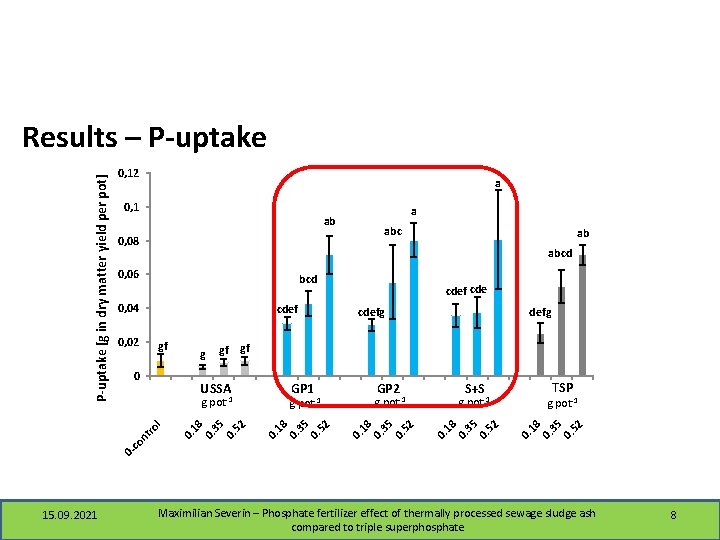
0, 12 a 0, 1 a ab abc 0, 08 ab abcd 0, 06 bcd 0, 04 cdef 5 S+S 6 0. TSP g pot-1 18 0. 35 0. 52 pot-1 0. 18 g 0. 52 0. 18 pot-1 35 g 0. g GP 2 pot-1 35 0. 52 GP 12 52 1 35 52 0. 35 pot-1 0. ro defg 0 - co nt 18 g cdefg 0. USSA 0. 0 cdef cde gf gf g 18 gf 0. 0, 02 l P-uptake [g in dry matter yield per pot] Results – P-uptake 15. 09. 2021 Maximilian Severin – Phosphate fertilizer effect of thermally processed sewage sludge ash compared to triple superphosphate 8
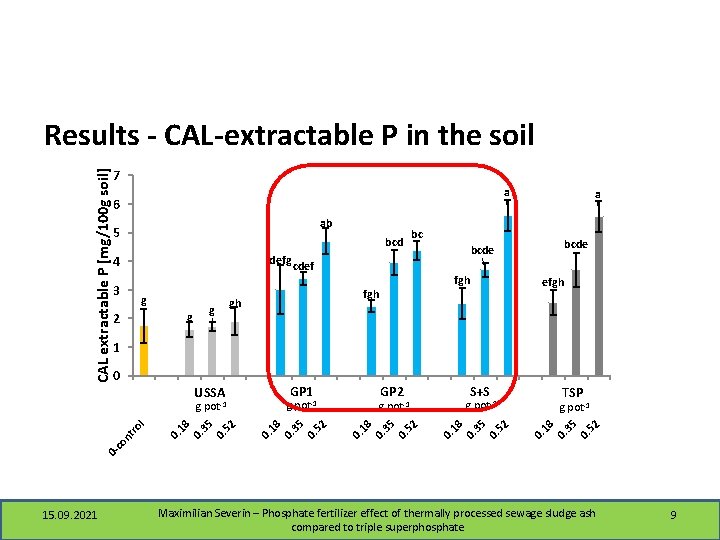
7 a 6 ab 5 bcd defg 4 3 g g 2 bcde fgh gh g a bc cdef efgh 1 TSP 52 0. 35 0. 18 g pot-1 0. 52 0. 18 0. 52 0. 35 0. 18 0. l ro S+S g pot-1 0 - co nt GP 2 g pot-1 35 GP 1 USSA 0. 0 35 CAL extractable P [mg/100 g soil] Results - CAL-extractable P in the soil 15. 09. 2021 Maximilian Severin – Phosphate fertilizer effect of thermally processed sewage sludge ash compared to triple superphosphate 9
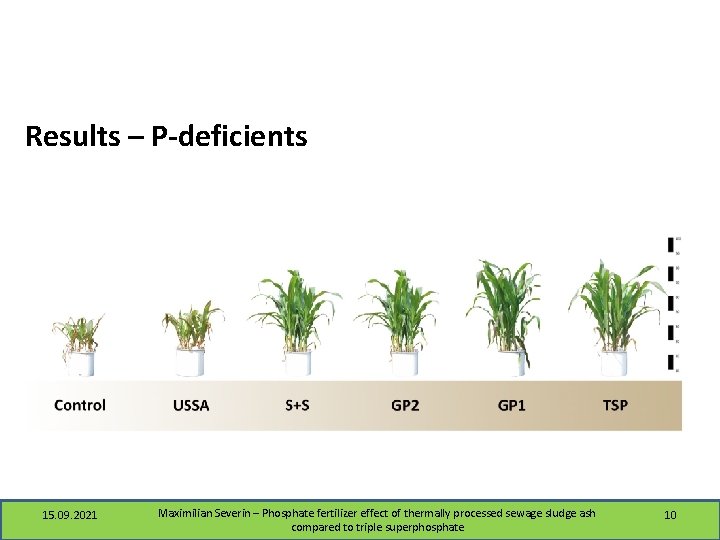
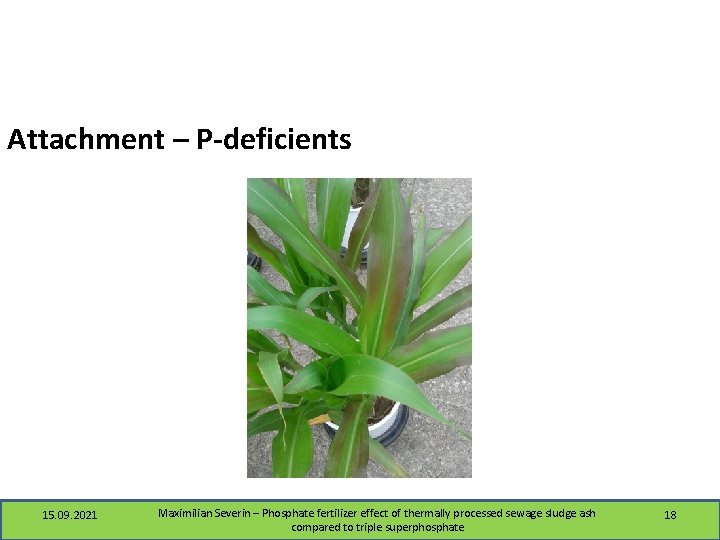
Results – P-deficients 15. 09. 2021 Maximilian Severin – Phosphate fertilizer effect of thermally processed sewage sludge ash compared to triple superphosphate 10
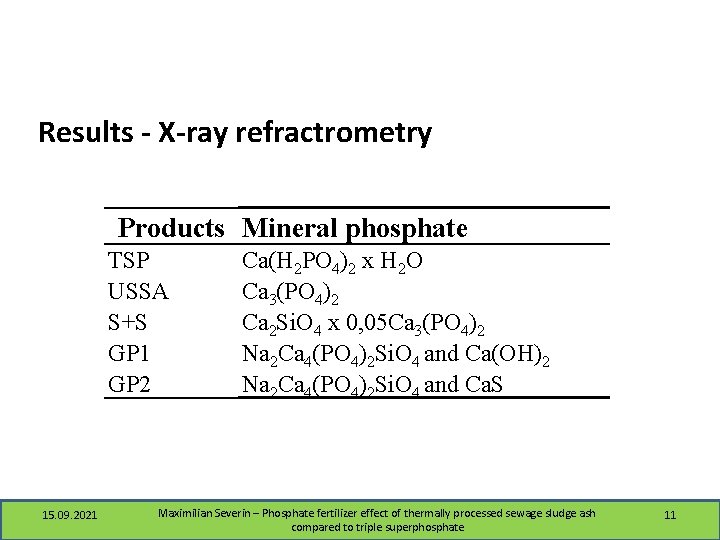
Results - X-ray refractrometry Products Mineral phosphate TSP USSA S+S GP 1 GP 2 15. 09. 2021 Ca(H 2 PO 4)2 x H 2 O Ca 3(PO 4)2 Ca 2 Si. O 4 x 0, 05 Ca 3(PO 4)2 Na 2 Ca 4(PO 4)2 Si. O 4 and Ca(OH)2 Na 2 Ca 4(PO 4)2 Si. O 4 and Ca. S Maximilian Severin – Phosphate fertilizer effect of thermally processed sewage sludge ash compared to triple superphosphate 11
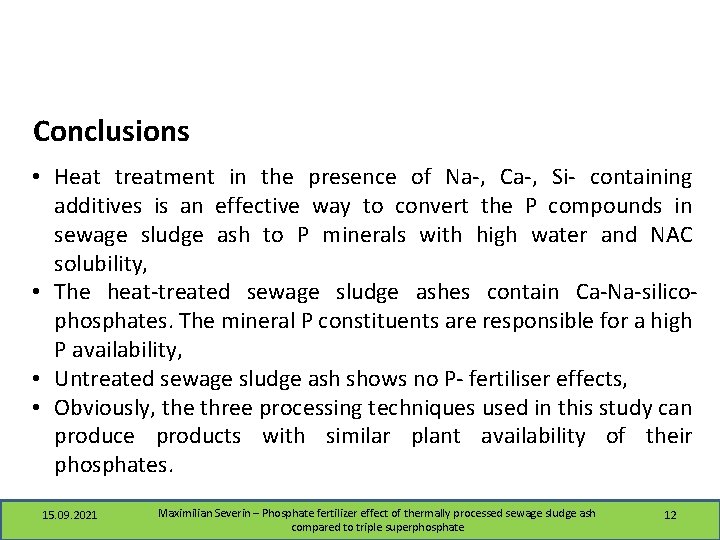
Conclusions • Heat treatment in the presence of Na-, Ca-, Si- containing additives is an effective way to convert the P compounds in sewage sludge ash to P minerals with high water and NAC solubility, • The heat-treated sewage sludge ashes contain Ca-Na-silicophosphates. The mineral P constituents are responsible for a high P availability, • Untreated sewage sludge ash shows no P- fertiliser effects, • Obviously, the three processing techniques used in this study can produce products with similar plant availability of their phosphates. 15. 09. 2021 Maximilian Severin – Phosphate fertilizer effect of thermally processed sewage sludge ash compared to triple superphosphate 12
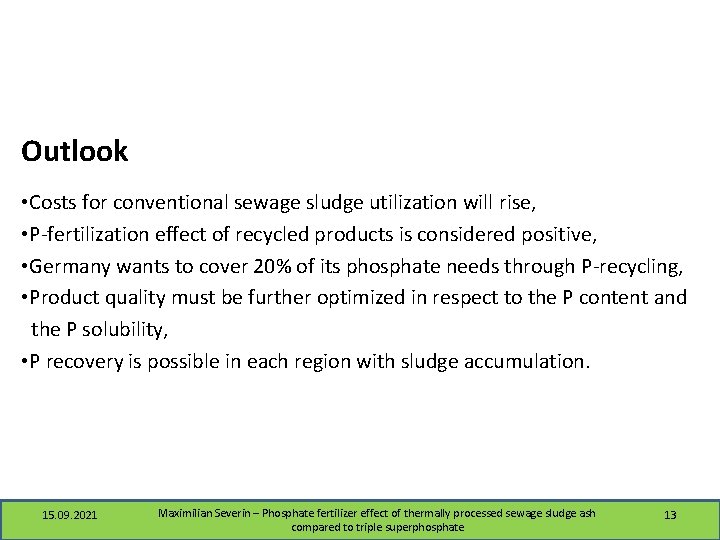
Outlook • Costs for conventional sewage sludge utilization will rise, • P-fertilization effect of recycled products is considered positive, • Germany wants to cover 20% of its phosphate needs through P-recycling, • Product quality must be further optimized in respect to the P content and the P solubility, • P recovery is possible in each region with sludge accumulation. 15. 09. 2021 Maximilian Severin – Phosphate fertilizer effect of thermally processed sewage sludge ash compared to triple superphosphate 13
Thank You for Your attention 15. 09. 2021 Maximilian Severin – Phosphate fertilizer effect of thermally processed sewage sludge ash compared to triple superphosphate 14
References • Adam, C. und F-G. Simon (2010): Phosphorrückgewinnung im Bereich der kommunalen Abwasserreinigung, Vortrag, http: //processnet. org/processnet_media/Neumann/FA_Au. W/Vortrag+Adam. pdf, abgerufen am 13. 07. 2012 • Bergs, C. (2014): Phosphorrückgewinnungsverordnung und Betrachtung zum Abfallende, Vortrag im Rahmen des Workshops „Abwasser – Phosphor – Dünger“, 28. /29. Januar 2014 BAM, Berlin • Faostat (2012): Worldwide P-Fertilizer Consumption 2002 -2009, http: //faostat. fao. org/site/575/Desktop. Default. aspx? Page. ID=575#ancor, abgerufen am 17. 07. 2012 • JUNG, R. , E. HALSCH, T. ANZER UND M. FAULSTICH (2003): Potential der Phosphorrückgewinnung aus Kläranlagen, Gewässerschutz - Wasser – Abwasser, Band 190 RWTH Aachen 70/1 -70/17, außerdem veröffentlicht in Dockhorn (Jahr unbekannt): Ökonomische Aspekte des Phosphorrecyclings, Vortrag • Pinnekamp, J. , KH. Weinfurtner, C. Sartorius und S. Gäth (2011): Phosphorrecycling – ökologische und wirtschaftliche Bewertung verschiedener Verfahren und Entwicklung eines strategischen Verwertungskonzeptes für Deutschland (Pho. Be), Abschlussbericht • SARTORIUS, C. (2011): Technologievorausschau und Zukunftschancen durch die Entwicklung von Phosphorrecyclingstechnologien in Deutschland, Vortrag: Kreislauswirtschaft für Pflanzennährstoffe insbesondere Phosphor, http: //www. susana. org/docs_ccbk/susana_download/2 -1305 -12 phobesartorius. pdf, abgerufen am 23. 06. 2012 • Schnee, R. (2014): Extraktion von Phosphaten mit Kohlendioxid, Vortrag im Rahmen des Workshops „Abwasser – Phosphor – Dünger“, 28. /29. Januar 2014 BAM, Berlin 15. 09. 2021 Maximilian Severin – Phosphate fertilizer effect of thermally processed sewage sludge ash compared to triple superphosphate 15
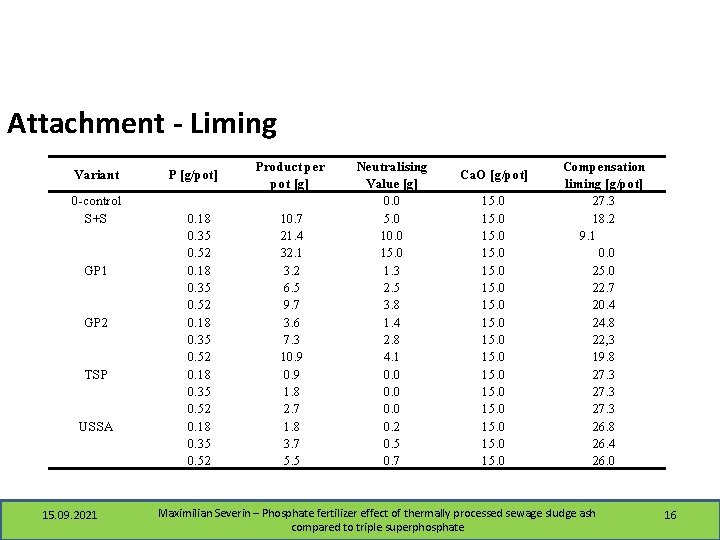
Attachment - Liming Variant 0 -control S+S GP 1 GP 2 TSP USSA 15. 09. 2021 P [g/pot] 0. 18 0. 35 0. 52 Product per pot [g] 10. 7 21. 4 32. 1 3. 2 6. 5 9. 7 3. 6 7. 3 10. 9 1. 8 2. 7 1. 8 3. 7 5. 5 Neutralising Value [g] 0. 0 5. 0 10. 0 15. 0 1. 3 2. 5 3. 8 1. 4 2. 8 4. 1 0. 0 0. 2 0. 5 0. 7 Ca. O [g/pot] 15. 0 15. 0 Compensation liming [g/pot] 27. 3 18. 2 9. 1 0. 0 25. 0 22. 7 20. 4 24. 8 22, 3 19. 8 27. 3 26. 8 26. 4 26. 0 Maximilian Severin – Phosphate fertilizer effect of thermally processed sewage sludge ash compared to triple superphosphate 16
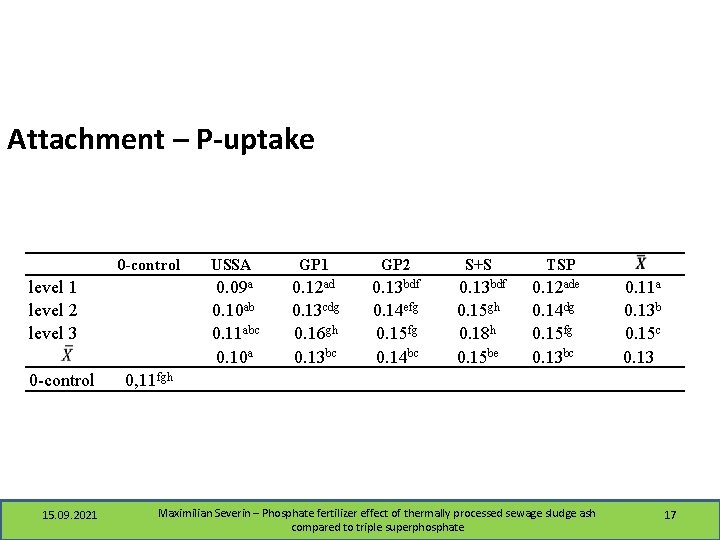
Attachment – P-uptake 0 -control level 1 level 2 level 3 0 -control 15. 09. 2021 USSA GP 1 GP 2 S+S TSP 0. 09 a 0. 10 ab 0. 11 abc 0. 10 a 0. 12 ad 0. 13 cdg 0. 16 gh 0. 13 bc 0. 13 bdf 0. 14 efg 0. 15 fg 0. 14 bc 0. 13 bdf 0. 15 gh 0. 18 h 0. 15 be 0. 12 ade 0. 14 dg 0. 15 fg 0. 13 bc 0. 11 a 0. 13 b 0. 15 c 0. 13 0, 11 fgh Maximilian Severin – Phosphate fertilizer effect of thermally processed sewage sludge ash compared to triple superphosphate 17
Attachment – P-deficients 15. 09. 2021 Maximilian Severin – Phosphate fertilizer effect of thermally processed sewage sludge ash compared to triple superphosphate 18