
Phonology Morphology Review Syntax Pronunciation Practice 22 March
![4. If an ELL consistently pronounces [z] as [s], how can a teacher help](https://slidetodoc.com/presentation_image_h/25383fded538ed547707467b1ba1fa31/image-7.jpg "4. If an ELL consistently pronounces [z] as [s], how can a teacher help")
- Slides: 30
Phonology & Morphology Review Syntax Pronunciation Practice 22 March 2014 Mariana De. Luca, Gilmara Johnson, Carolyn Singleton, Stacy Feldstein
Phonology Review
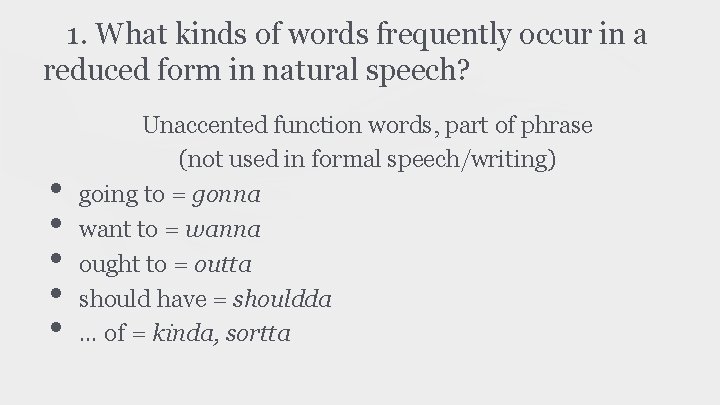
1. What kinds of words frequently occur in a reduced form in natural speech? • • • Unaccented function words, part of phrase (not used in formal speech/writing) going to = gonna want to = wanna ought to = outta should have = shouldda … of = kinda, sortta
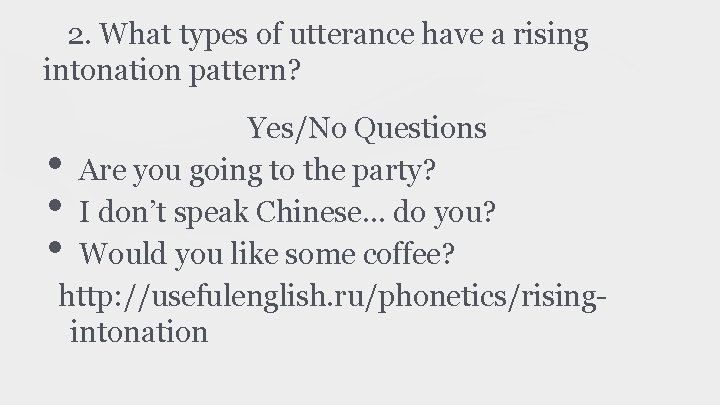
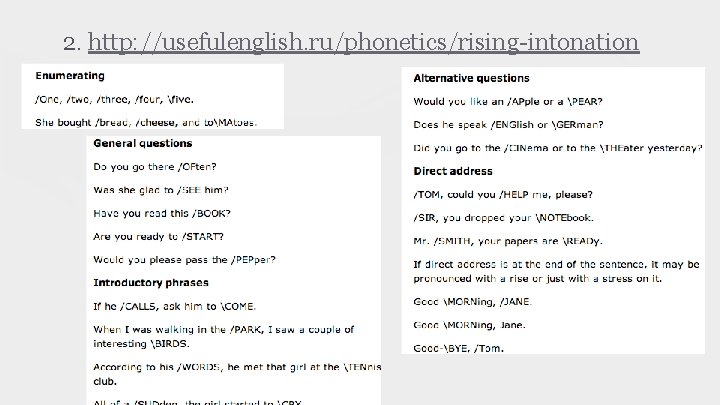
2. What types of utterance have a rising intonation pattern? Yes/No Questions Are you going to the party? I don’t speak Chinese. . . do you? Would you like some coffee? http: //usefulenglish. ru/phonetics/risingintonation • • •
2. http: //usefulenglish. ru/phonetics/rising-intonation
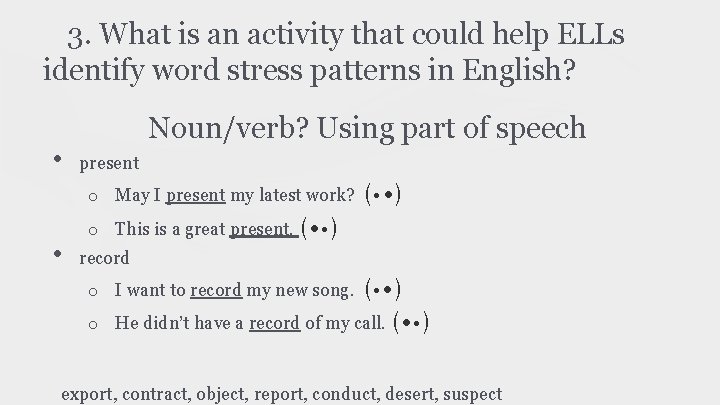
3. What is an activity that could help ELLs identify word stress patterns in English? • Noun/verb? Using part of speech present o May I present my latest work? ( • • ) • o This is a great present. ( • • ) record o I want to record my new song. ( • • ) o He didn’t have a record of my call. ( • • ) export, contract, object, report, conduct, desert, suspect
4. If an ELL consistently pronounces [z] as [s], how can a teacher help the student learn to correct the error? http: //www. grammar. cl/engli pronunciation-final-s. htm
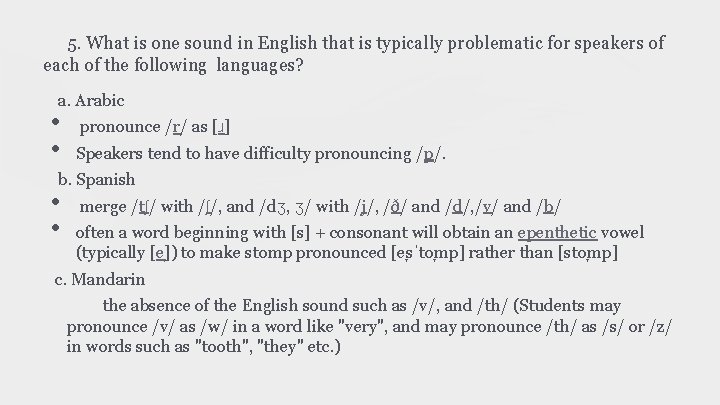
5. What is one sound in English that is typically problematic for speakers of each of the following languages? a. Arabic • • pronounce /r/ as [ɹ] Speakers tend to have difficulty pronouncing /p/. b. Spanish • • merge /tʃ/ with /ʃ/, and /dʒ, ʒ/ with /j/, /ð/ and /d/, /v/ and /b/ often a word beginning with [s] + consonant will obtain an epenthetic vowel (typically [e ]) to make stomp pronounced [e sˈto mp] rather than [sto mp] c. Mandarin the absence of the English sound such as /v/, and /th/ (Students may pronounce /v/ as /w/ in a word like "very", and may pronounce /th/ as /s/ or /z/ in words such as "tooth", "they" etc. )
Syntax
SYNTAX AND SEMANTICS: SENTENCE PATTERNS OF LANGUAGE AND HOW WE “MEAN WHAT WE SAY” Stacy Feldstein, M. A. T.
Semantics � study of: � Meaning � Idioms
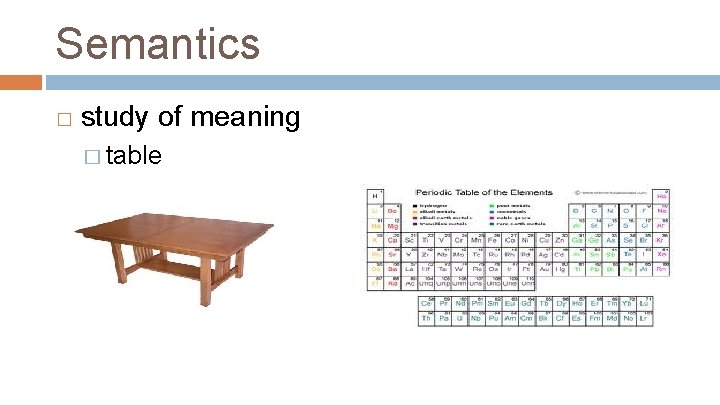
Semantics � study of meaning � table
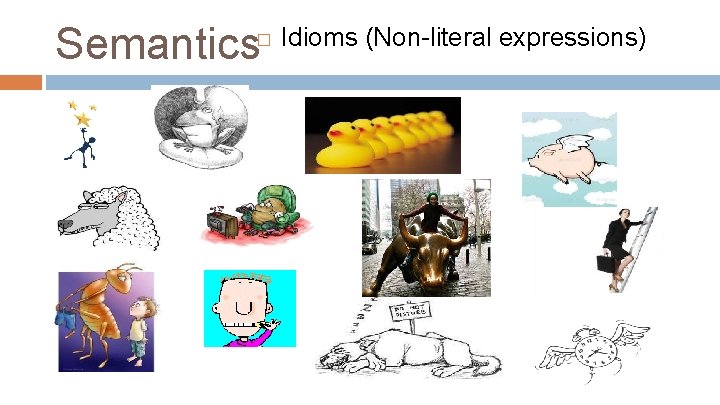
Semantics � Idioms (Non-literal expressions)
Semantics � Figurative Language � I’ve told you a million times to clean your room! � Her head was spinning from all the new information. � Think outside the box!
What is syntax? " The part of grammar that represents a speaker's knowledge of sentences and their structures. . . " (p. 77)
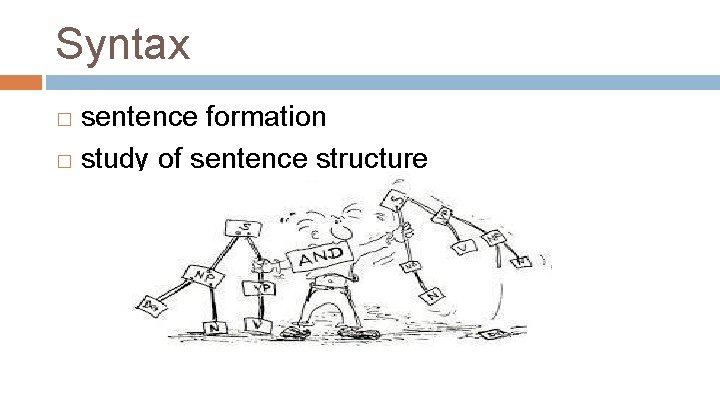
Syntax sentence formation � study of sentence structure �
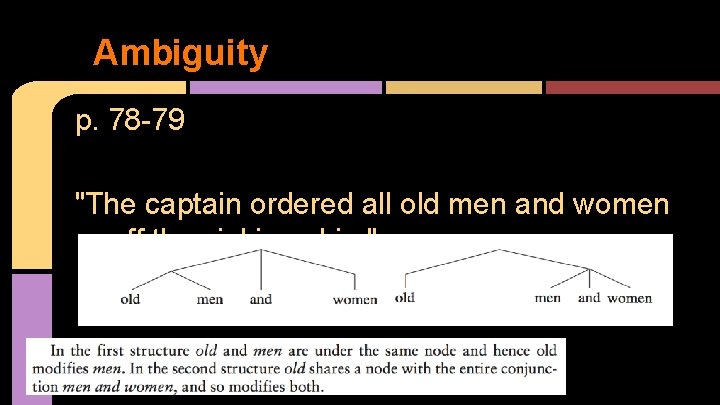
Ambiguity p. 78 -79 "The captain ordered all old men and women off the sinking ship. "
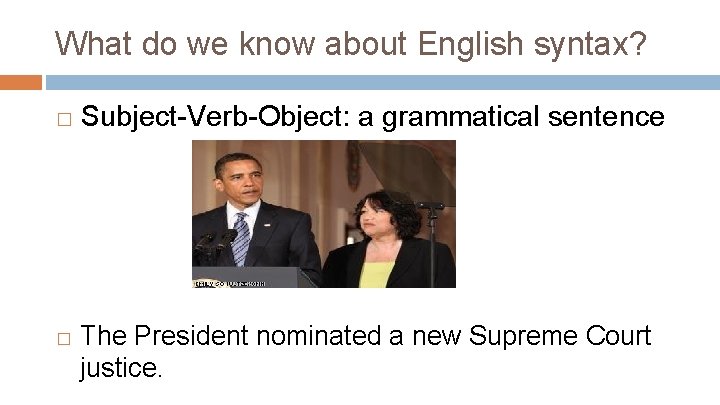
What do we know about English syntax? � � Subject-Verb-Object: a grammatical sentence The President nominated a new Supreme Court justice.
What do we know about English syntax? � An ungrammatical sentence: � *President the new Supreme justice Court a nominated. Rules of syntax are imbedded in our minds and guide us subconsciously to group words into meaningful phrases and sentences!
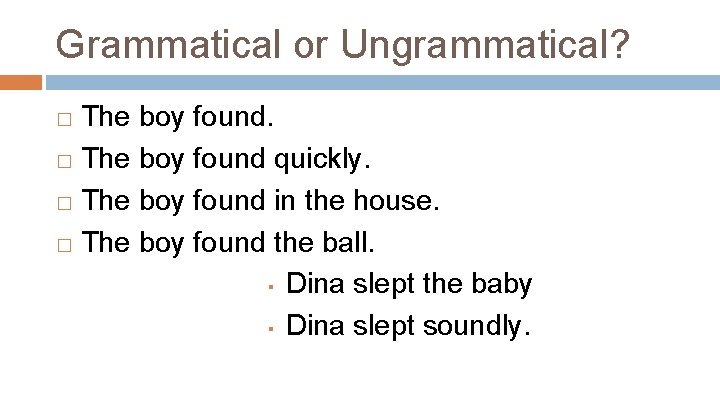
Grammatical or Ungrammatical? The boy found. � The boy found quickly. � The boy found in the house. � The boy found the ball. ▪ Dina slept the baby ▪ Dina slept soundly. �
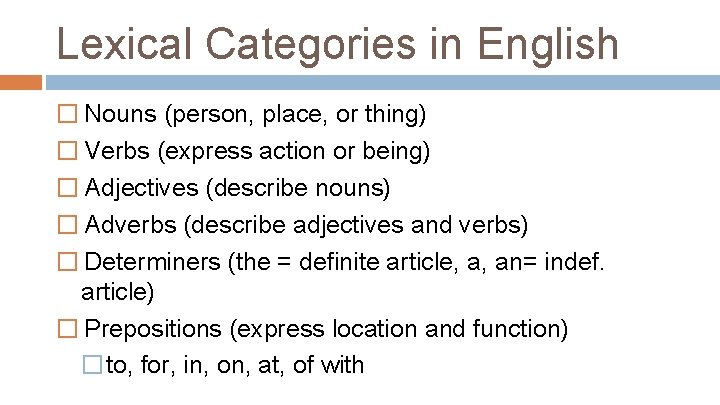
Lexical Categories in English � Nouns (person, place, or thing) � Verbs (express action or being) � Adjectives (describe nouns) � Adverbs (describe adjectives and verbs) � Determiners (the = definite article, a, an= indef. article) � Prepositions (express location and function) �to, for, in, on, at, of with
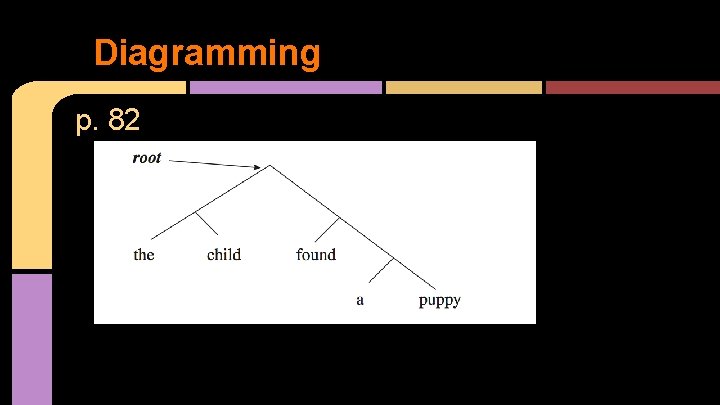
Diagramming p. 82
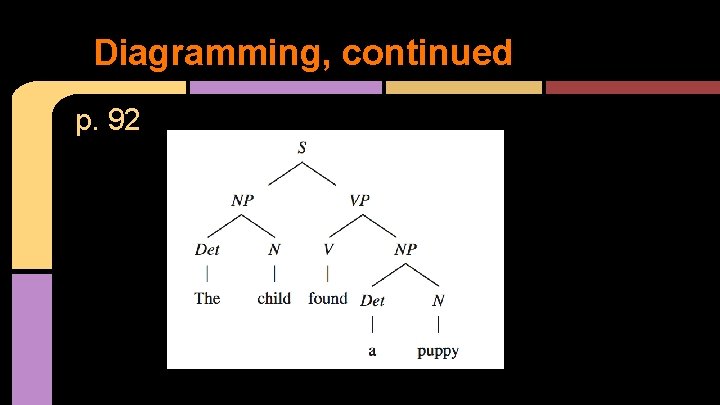
Diagramming, continued p. 92
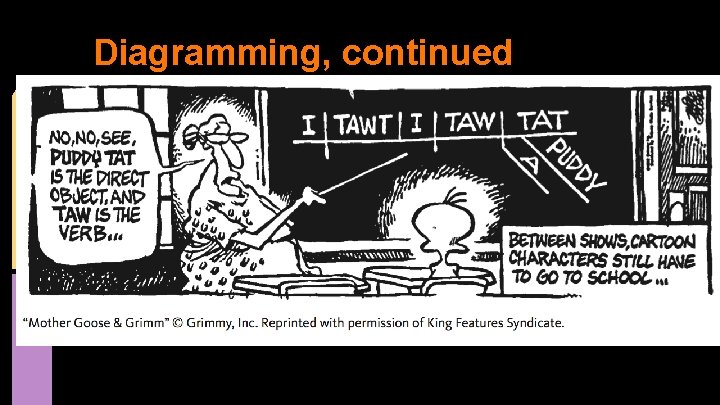
Diagramming, continued
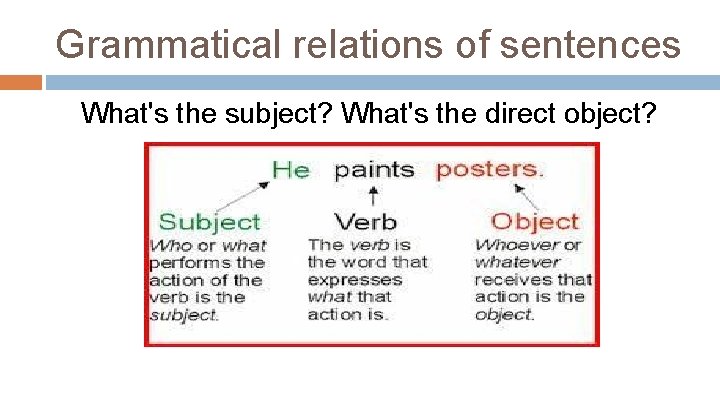
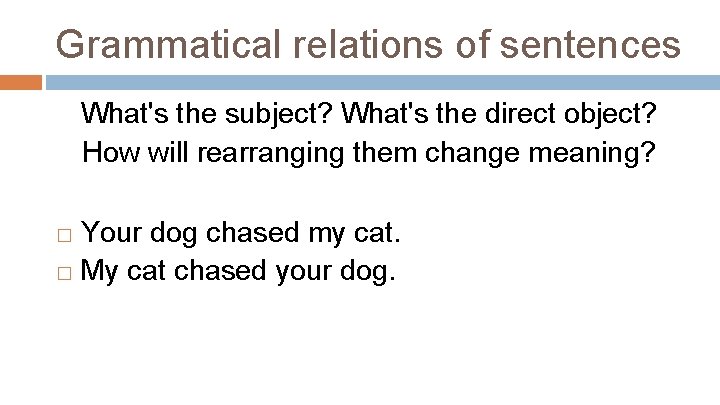
Grammatical relations of sentences What's the subject? What's the direct object?
Grammatical relations of sentences What's the subject? What's the direct object? How will rearranging them change meaning? Your dog chased my cat. � My cat chased your dog. �
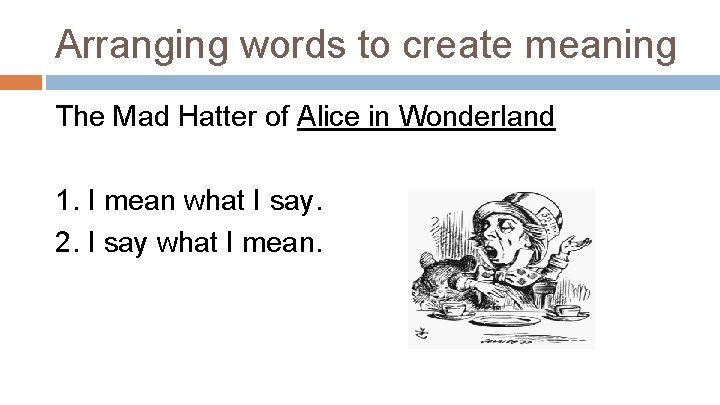
Arranging words to create meaning The Mad Hatter of Alice in Wonderland 1. I mean what I say. 2. I say what I mean.
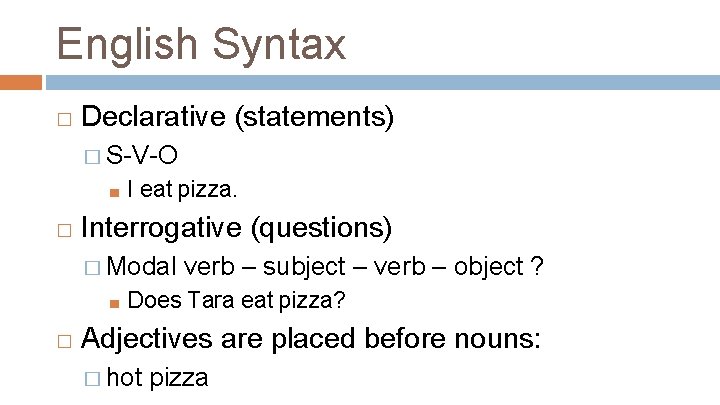
English Syntax � Declarative (statements) � S-V-O ■ � I eat pizza. Interrogative (questions) � Modal ■ � verb – subject – verb – object ? Does Tara eat pizza? Adjectives are placed before nouns: � hot pizza
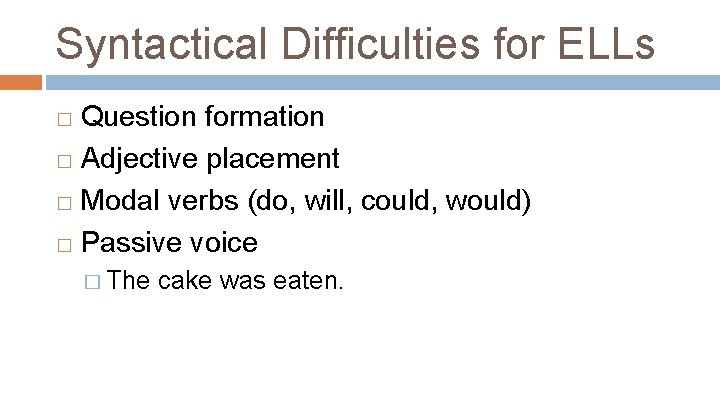
Syntactical Difficulties for ELLs Question formation � Adjective placement � Modal verbs (do, will, could, would) � Passive voice � � The cake was eaten.
Test questions on syntax (1, 4, 6, 7, 8, 9, 10, 94, 106)