
PHONOLOGY Level of Linguistics Analysis Phonology The study
- Slides: 34
PHONOLOGY
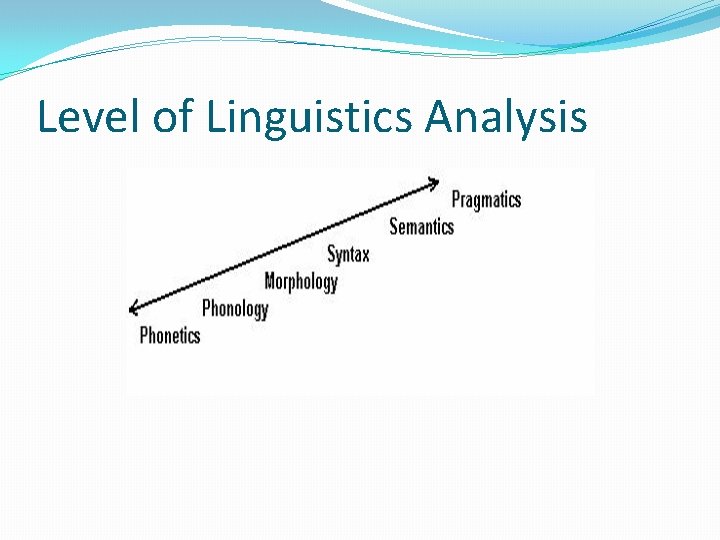
Level of Linguistics Analysis
Phonology �The study of the sound system of languages and the mental representation of sounds (Darrell Larsen) �The study of the organization of speech sounds in a language. 1. How they function 2. How they are distributed
Phonetics �PHONETICS, the study of the inventory of all SPEECH SOUNDS which humans are capable of producing. �Phonetics: concerned with actual pronunciation; concerned with speech organ.
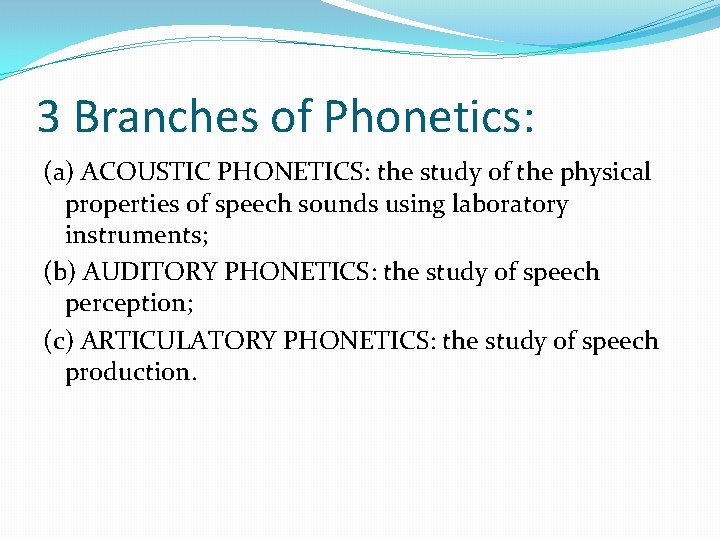
3 Branches of Phonetics: (a) ACOUSTIC PHONETICS: the study of the physical properties of speech sounds using laboratory instruments; (b) AUDITORY PHONETICS: the study of speech perception; (c) ARTICULATORY PHONETICS: the study of speech production.
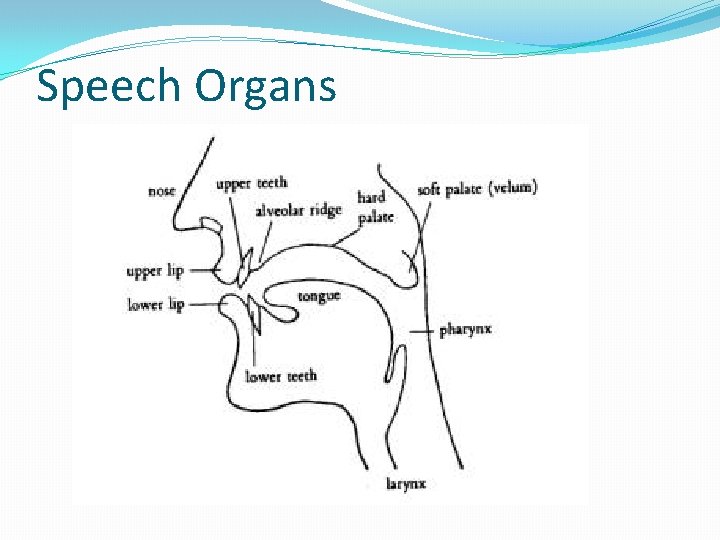
Speech Organs
Segmentals Sound �Consonants �Vowels �Diphthongs
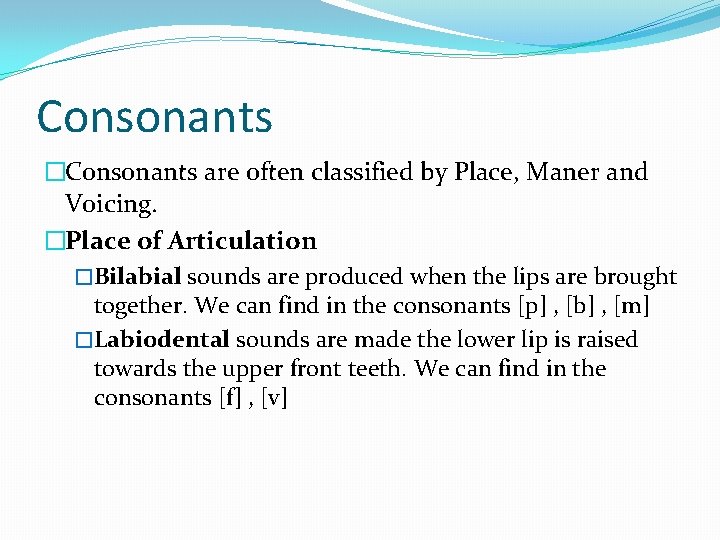
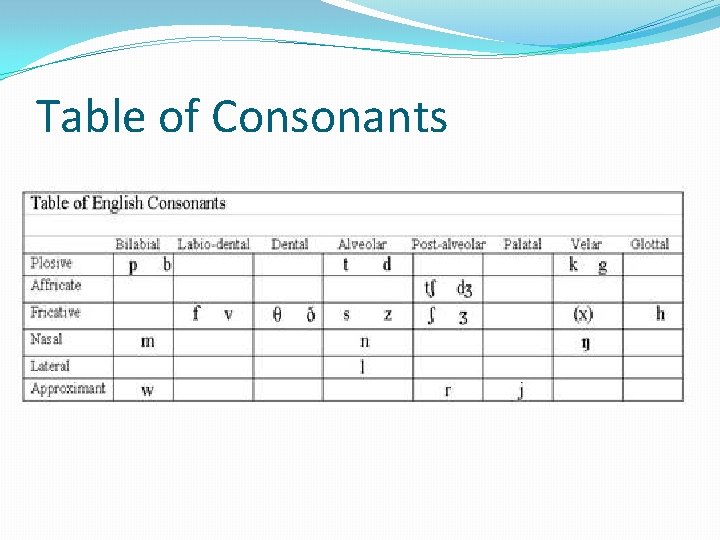
Consonants �Consonants are often classified by Place, Maner and Voicing. �Place of Articulation �Bilabial sounds are produced when the lips are brought together. We can find in the consonants [p] , [b] , [m] �Labiodental sounds are made the lower lip is raised towards the upper front teeth. We can find in the consonants [f] , [v]
�Dental sounds are produced by touching the upper front teeth with the tip of the tongue. The consonants are [ ] , [ ] �Alveolar sounds are made by raising the tip of the tongue towards the ridge that is right behind the upper teeth, called alveolar ridge. The consonants are [t] , [d] , [s] , [z] , [n] , [ l ] �Palatal veolar sounds are made by raising the blade of the tongue towards the part of the palate just behind the alveolar ridge. The consonants are [∫] , [t∫] , [d ]
�Palatal sounds are very similar to palatal veolar, they are just produced further back towards the velum. The consonant is [j] �Velar sounds are made by raising the back of the tongue towards soft palate, called the velum. The consonants are [g] , [ŋ] , [w] �Glottal sounds are produced when the air passes through the glottis as it is narrowed. The consonant is [h]
�Manner of Articulation �Plosives are sounds in which there is a complete closure in the mouth, so that the air is blocked for a fraction of a second and then released with a small burst of sound. �Fricatives have a closure which is not quite complete. This means that the air is not blocked at any point, and therefore there is no plosion. On the other hand the obstruction is big enough for the air to make a noise when it passes through it, because of the friction.
�Affricates are a combination of a plosive and fricative. They begin like a plosive, with a complete closure, but instead of a plosion, they have a very slow release, moving backwards to a place where a friction can be heard. �Nasals resemble plosives, except that there is a complete closure in the mouth, but as the velum is lowered the air can escape through the nasal cavity.
�Laterals are sounds where the air escapes around the sides of the tongue. There is only one lateral in English, [l], a voiced alveolar lateral. �Approximants are sounds where the tongue only approaches the roof of the mouth, so that there is not enough obstruction to create any friction. English has three approximants, which are all voiced.
�Voicing �Sounds are voiceless when the vocal cords are apart so that air flows freely through the glottis into the oral cavity. �But if the vocal cords are together, the airstream forces its way through and causes them to vibrate. Such sounds are called voiced.
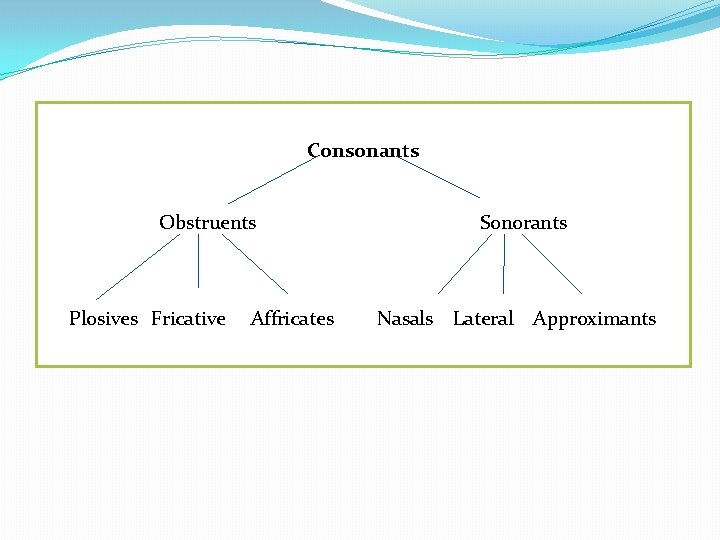
�The manners of articulation can be put into two major groups, obstruents and sonorants. �The obstruents are plosives, fricatives and affricates, all sounds with a high degree of obstruction. �Obstruents usually come in pairs, one voiceless, one voiced, e. g [p] , [b] �Sonorants have much less obstruction and are all voiced and therefore more sonorous. �They include nasals, lateral, approximants.
Consonants Obstruents Plosives Fricative Affricates Sonorants Nasals Lateral Approximants
Table of Consonants
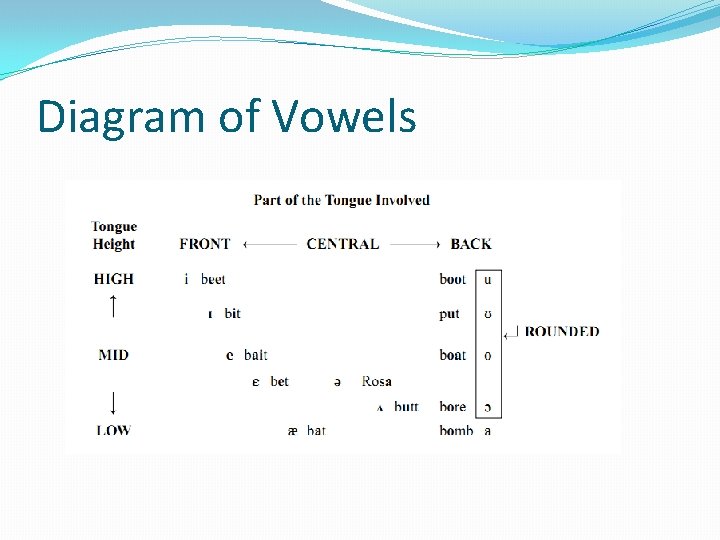
Vowels �We analyze vowels phonetically according to: �How high or low in the mouth is the tongue? �How forward or backward in the mouth is the tongue? �Are the lips rounded (pursed) or spread?
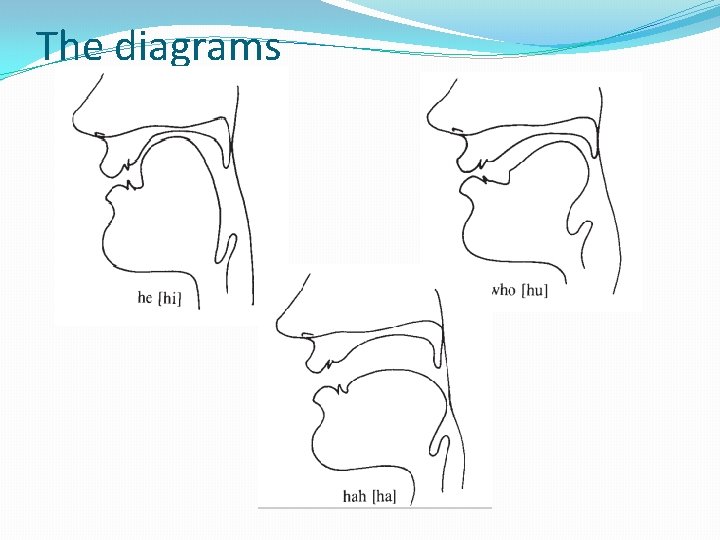
The diagrams
�Tongue Position �The upper two diagrams show that the tongue is high in the mouth in the production of the vowels [i] and [u] in the words he [hi] and who [hu]. �In he the front part (but not the tip) of the tongue is raised; in who it is the back of the tongue. (Prolong the vowels of these words and try to feel the raised part of your tongue. ) �These are both high vowels, and the [i] is a high front vowel while the [u] is a high back vowel. �To produce the vowel sound [a] of hah [ha], the back of the tongue is low in the mouth.
Diagram of Vowels
Suprasegmentals �The term suprasegmental was invented to refer to aspects of sound such as intonation that did not seem to be properties of individual segments �There has never been full agreement about how many suprasegmental features are to be found in speech, but pitch, loudness, tempo, rhythm, intonation and stress are the most commonly mentioned ones.
Phoneme vs Allophone �Phoneme: �A minimal unit of sound that serves to distinguish meaning between words �May be composed of as et of sounds (allophones) that are considered by native speakers to the ‘same’ sound �Allophone: �The different phonetic realizations of a phoneme
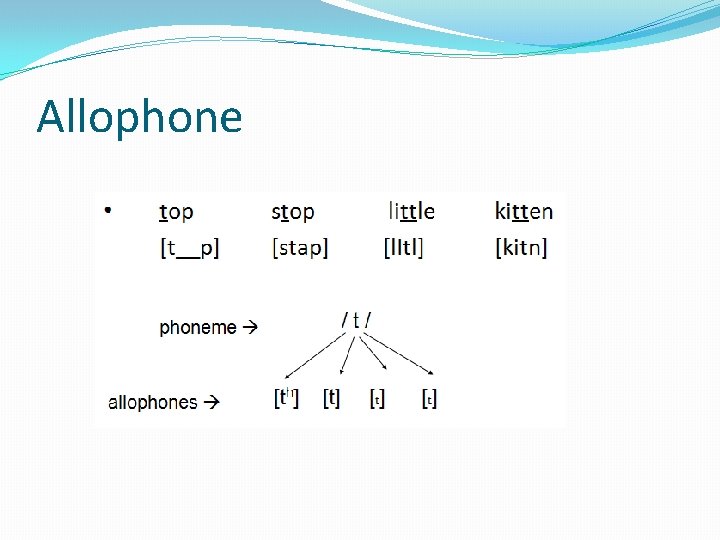
Allophone
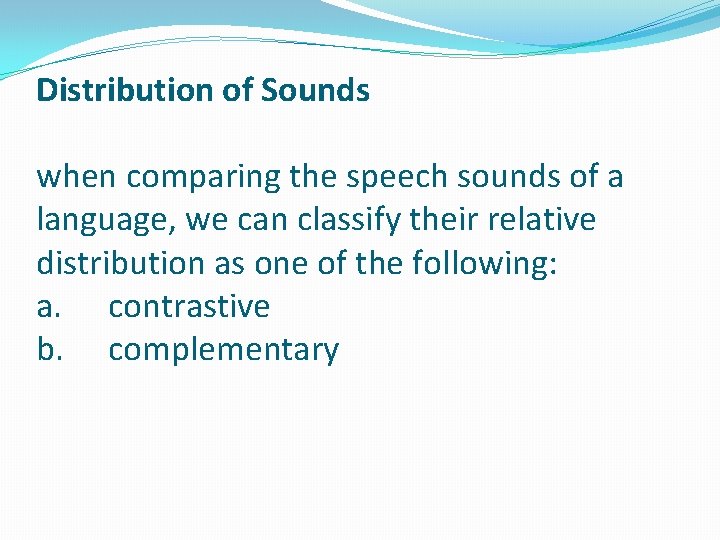
Distribution of Sounds when comparing the speech sounds of a language, we can classify their relative distribution as one of the following: a. contrastive b. complementary
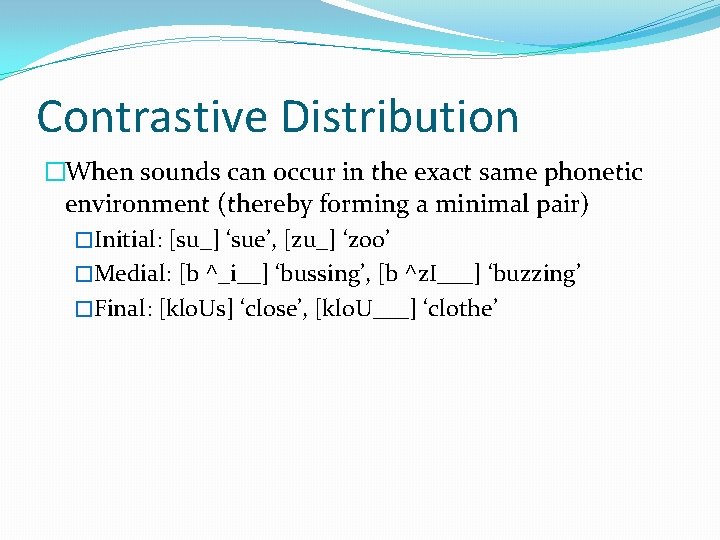
Contrastive Distribution �When sounds can occur in the exact same phonetic environment (thereby forming a minimal pair) �Initial: [su_] ‘sue’, [zu_] ‘zoo’ �Medial: [b ^_i__] ‘bussing’, [b ^z. I___] ‘buzzing’ �Final: [klo. Us] ‘close’, [klo. U___] ‘clothe’
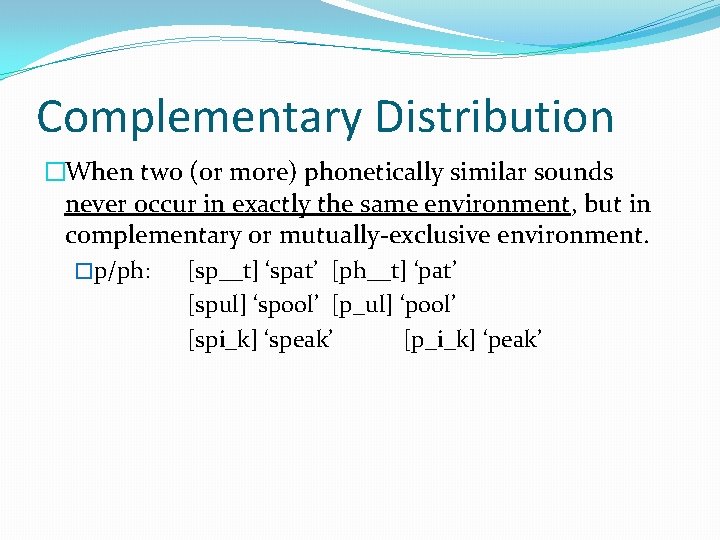
Complementary Distribution �When two (or more) phonetically similar sounds never occur in exactly the same environment, but in complementary or mutually-exclusive environment. �p/ph: [sp__t] ‘spat’ [ph__t] ‘pat’ [spul] ‘spool’ [p_ul] ‘pool’ [spi_k] ‘speak’ [p_i_k] ‘peak’
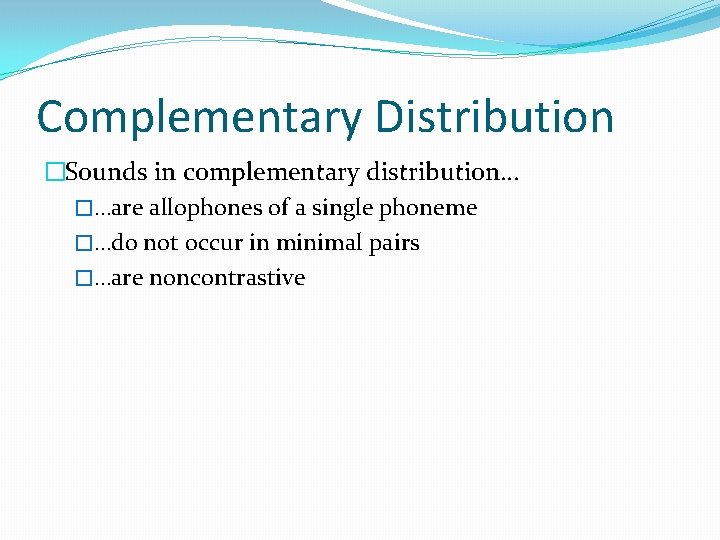
Complementary Distribution �Sounds in complementary distribution… �…are allophones of a single phoneme �…do not occur in minimal pairs �…are noncontrastive
Phonological Processes �Assimilation �Dissimilation �Epenthesis �Deletion �Metathesis �Vowel reduction
Assimilation is the modification of a sound in order to make it more similar to some other sound in its neighborhood. The advantage of having assimilation is that it results in smoother, more effortless, more economical transitions from one sound to another. It facilitates the task of speaking.
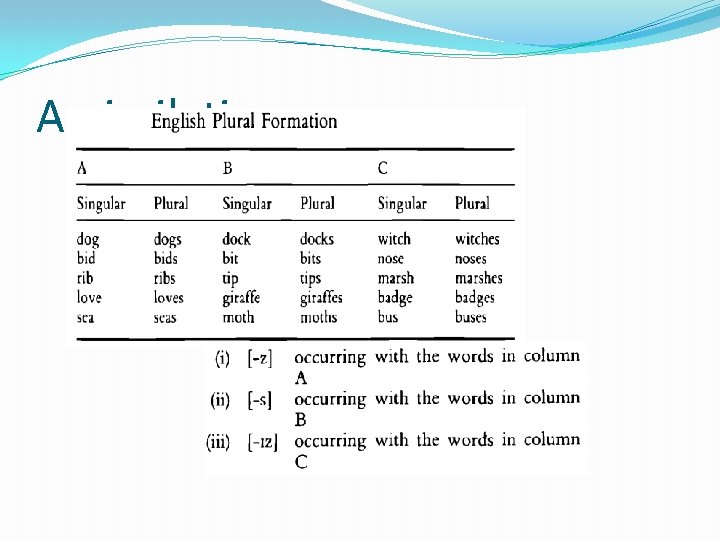
Assimilation �Usually, the alternation in the phonological realizations of a MORPHEME (i. e. minimal meaningful or distributional unit in a language, which may be a simple word like dog, or a suffix like the -s plural marker in dogs, or the negative prefix un- in un -do) can be accounted for in terms of assimilation. �Consider the regular plural ending in English. It is written as s, but it may, in fact, be pronounced as [-s] as in [pet-s] pets, or as [-z] as in [bel-z] bells or even as [-iz] as in [rauz-iz] roses.
Assimilation �The principle that determines the shape of the suffix is VOICE ASSIMILATION: this suffix must always agree in voicing with the preceding sound.
Assimilation
Dissimilation �Phonological process which ensure that differences between sounds are enhanced so that sounds become more auditorily distinct. �Effect of dissimilation is to make sounds more distinct from other sounds in their environment.