
PHONOLOGICAL TYPOLOGY AND NATURALNESS Feature Theory The Foundation
![Answer: e --> a / [ɨ, u, a, o] C 0 ___ More](https://slidetodoc.com/presentation_image_h2/7a8d07f0346fe88f8876c7ef919ac6fd/image-6.jpg "Answer: e --> a / [ɨ, u, a, o] C 0 ___ More")
![Phonological Typology: 1. Inventory of Speech Sounds Marked vs unmarked Example: [p, t, k]](https://slidetodoc.com/presentation_image_h2/7a8d07f0346fe88f8876c7ef919ac6fd/image-12.jpg "Phonological Typology: 1. Inventory of Speech Sounds Marked vs unmarked Example: [p, t, k]")
![Consonants Place of articulation: Most common [p, t, k], then alveopalatal. Less common: uvular,](https://slidetodoc.com/presentation_image_h2/7a8d07f0346fe88f8876c7ef919ac6fd/image-13.jpg "Consonants Place of articulation: Most common [p, t, k], then alveopalatal. Less common: uvular,")

![Example of vowel epenthesis: Fula The vowel [i] is inserted to reduce consonant clusters](https://slidetodoc.com/presentation_image_h2/7a8d07f0346fe88f8876c7ef919ac6fd/image-30.jpg "Example of vowel epenthesis: Fula The vowel [i] is inserted to reduce consonant clusters")
- Slides: 35
PHONOLOGICAL TYPOLOGY AND NATURALNESS
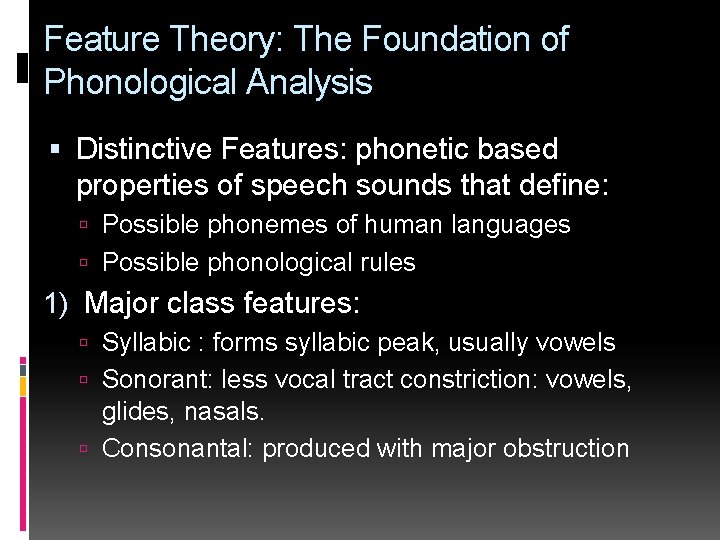
Feature Theory: The Foundation of Phonological Analysis Distinctive Features: phonetic based properties of speech sounds that define: Possible phonemes of human languages Possible phonological rules 1) Major class features: Syllabic : forms syllabic peak, usually vowels Sonorant: less vocal tract constriction: vowels, glides, nasals. Consonantal: produced with major obstruction
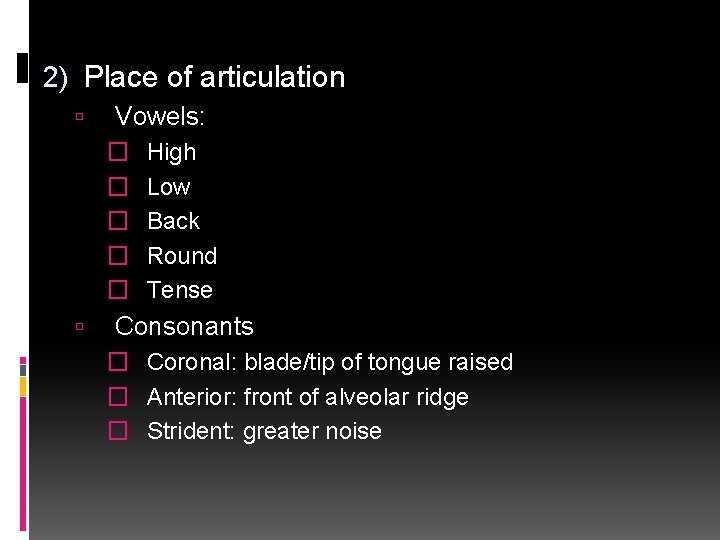
2) Place of articulation Vowels: � � � High Low Back Round Tense Consonants � Coronal: blade/tip of tongue raised � Anterior: front of alveolar ridge � Strident: greater noise
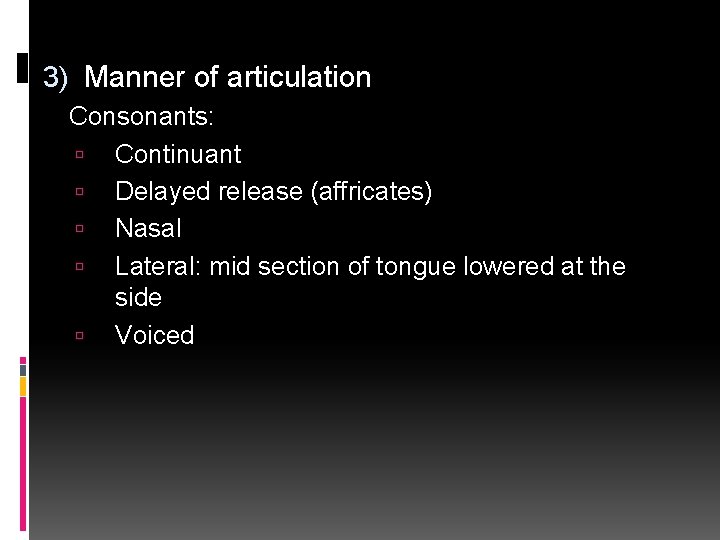
3) Manner of articulation Consonants: Continuant Delayed release (affricates) Nasal Lateral: mid section of tongue lowered at the side Voiced
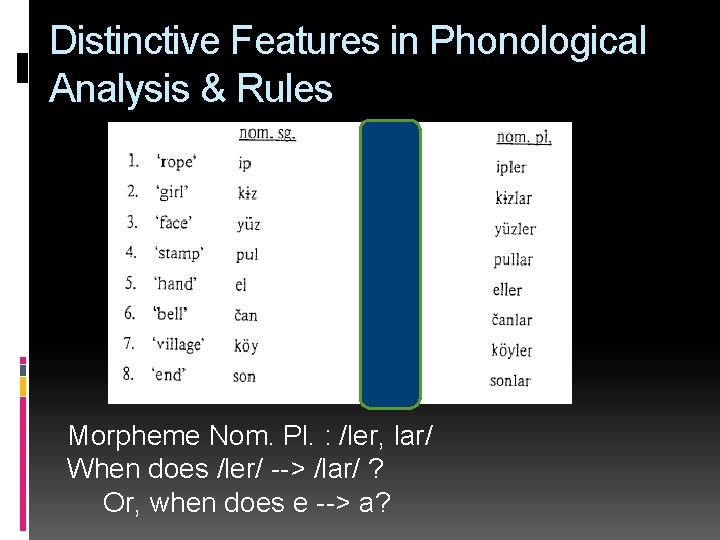
Distinctive Features in Phonological Analysis & Rules Morpheme Nom. Pl. : /ler, lar/ When does /ler/ --> /lar/ ? Or, when does e --> a?
Answer: e --> a / [ɨ, u, a, o] C 0 ___ More clear if written out in distinctive features: V [-bk] --> V [+bk] / V [+bk] C 0 ______ We can then also see a phonological process: vowel harmony.
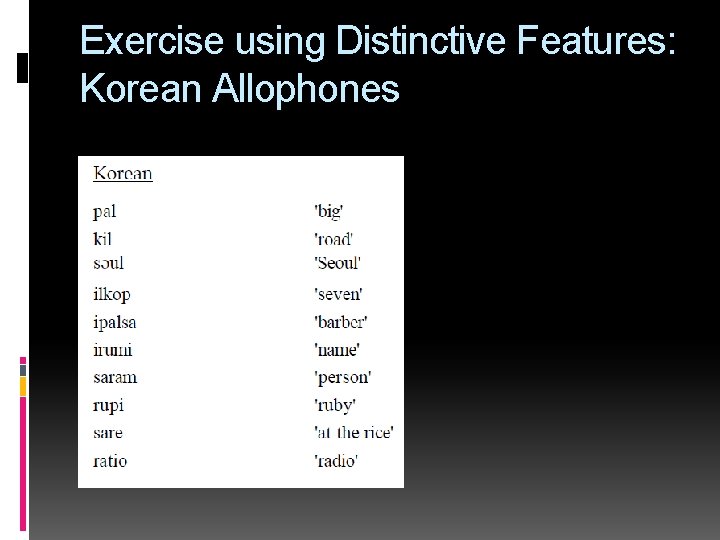
Exercise using Distinctive Features: Korean Allophones
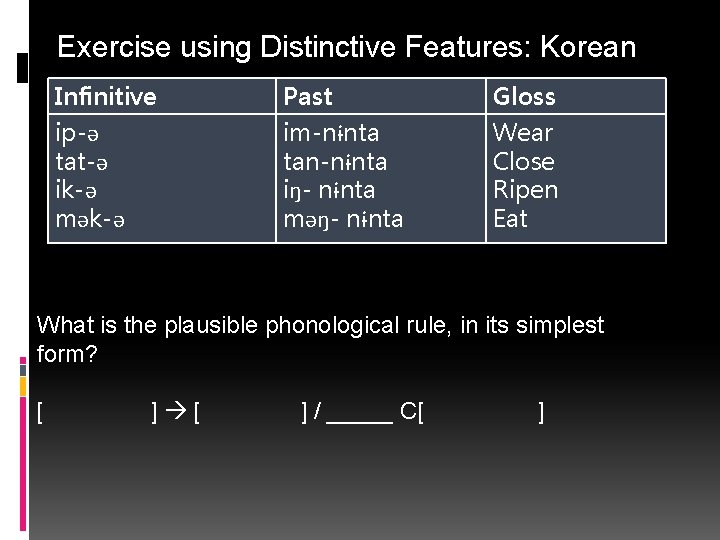
Exercise using Distinctive Features: Korean Infinitive ip-ə tat-ə ik-ə mək-ə Past im-nɨnta tan-nɨnta iŋ- nɨnta məŋ- nɨnta Gloss Wear Close Ripen Eat What is the plausible phonological rule, in its simplest form? [ ] / _____ C[ ]
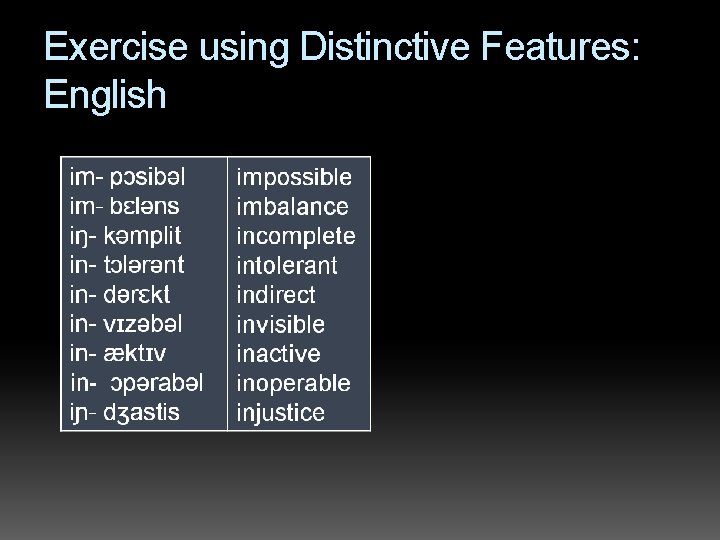
Exercise using Distinctive Features: English
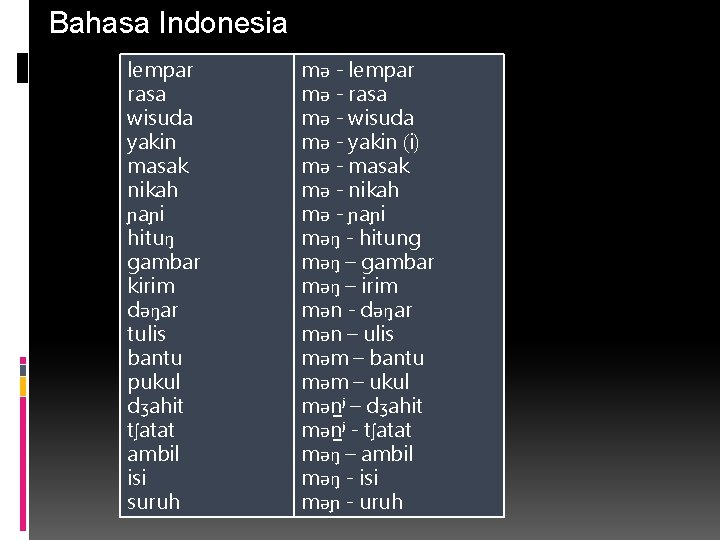
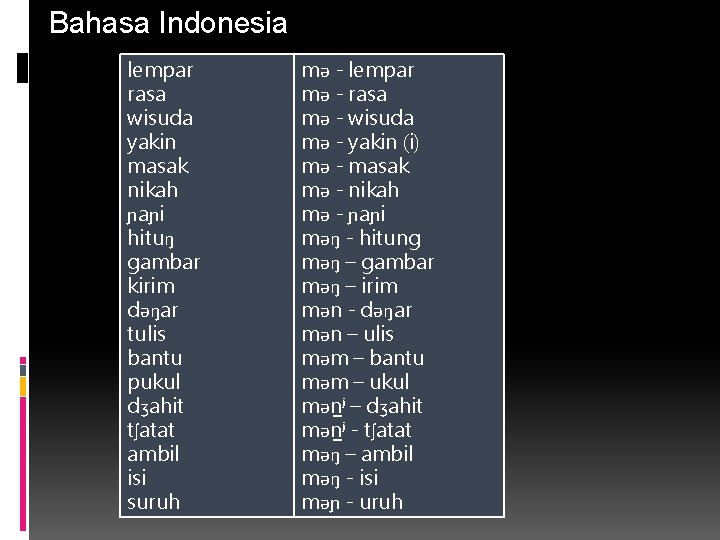
Bahasa Indonesia lempar rasa wisuda yakin masak nikah ɲaɲi hituŋ gambar kirim dəŋar tulis bantu pukul dʒahit tʃatat ambil isi suruh mə - lempar mə - rasa mə - wisuda mə - yakin (i) mə - masak mə - nikah mə - ɲaɲi məŋ - hitung məŋ – gambar məŋ – irim mən - dəŋar mən – ulis məm – bantu məm – ukul mən ʲ – dʒahit mən ʲ - tʃatat məŋ – ambil məŋ - isi məɲ - uruh
Objectives of Phonological Typology Decide which analysis/phonological rules are more ‘natural’ or common in all languages. Phonological typology: What processes are commonly found in all languages.
Phonological Typology: 1. Inventory of Speech Sounds Marked vs unmarked Example: [p, t, k] is unmarked/common; whereas uvular [q] is marked/uncommon. Implicational relations: Example: Nasal vowels implies the existence of oral vowels. In other words: if there are nasal vowels ->then there are oral vowels in the language.
Consonants Place of articulation: Most common [p, t, k], then alveopalatal. Less common: uvular, dental, retroflex Least common: pharyngeal Manner of articulation: Most common: stops, then fricatives, especially [s] All languages have voiced & voiceless consonants Rare: ejectives, implosives, breathy-voiced
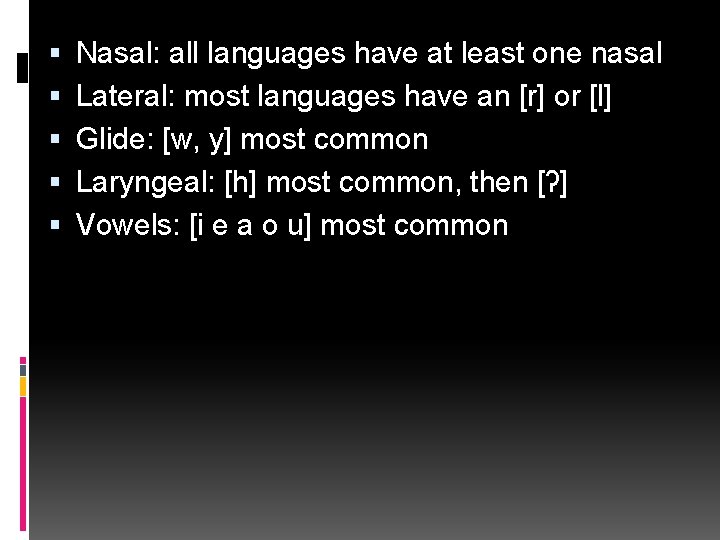
Nasal: all languages have at least one nasal Lateral: most languages have an [r] or [l] Glide: [w, y] most common Laryngeal: [h] most common, then [ʔ] Vowels: [i e a o u] most common
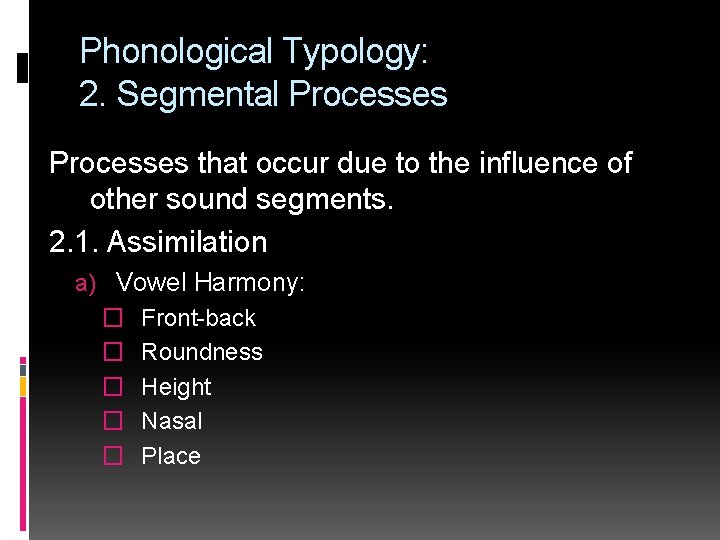
Phonological Typology: 2. Segmental Processes that occur due to the influence of other sound segments. 2. 1. Assimilation a) Vowel Harmony: � Front-back � Roundness � Height � Nasal � Place
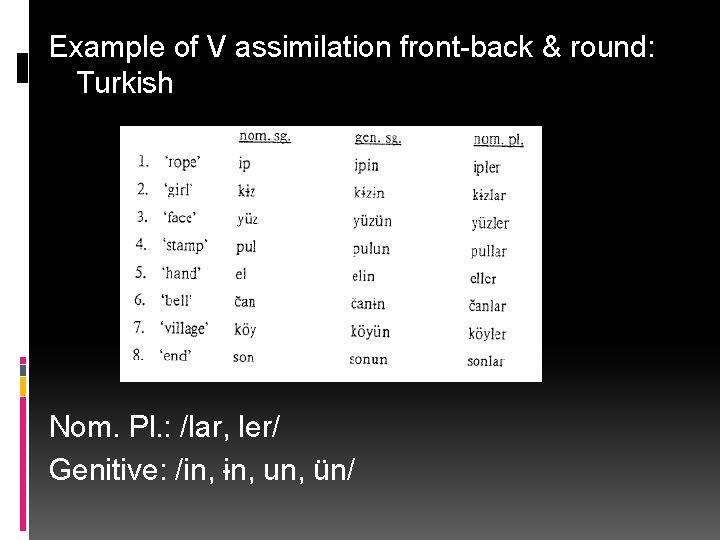
Example of V assimilation front-back & round: Turkish Nom. Pl. : /lar, ler/ Genitive: /in, ɨn, un, ün/
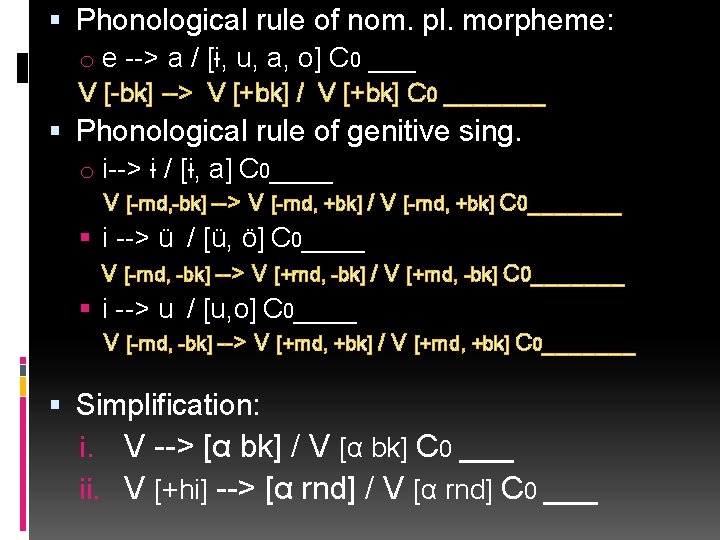
Phonological rule of nom. pl. morpheme: o e --> a / [ɨ, u, a, o] C 0 ___ V [-bk] --> V [+bk] / V [+bk] C 0 _______ Phonological rule of genitive sing. o i--> ɨ / [ɨ, a] C 0____ V [-rnd, -bk] --> V [-rnd, +bk] / V [-rnd, +bk] C 0_______ i --> ü / [ü, ö] C 0____ V [-rnd, -bk] --> V [+rnd, -bk] / V [+rnd, -bk] C 0_______ i --> u / [u, o] C 0____ V [-rnd, -bk] --> V [+rnd, +bk] / V [+rnd, +bk] C 0_______ Simplification: i. V --> [α bk] / V [α bk] C 0 ___ ii. V [+hi] --> [α rnd] / V [α rnd] C 0 ___
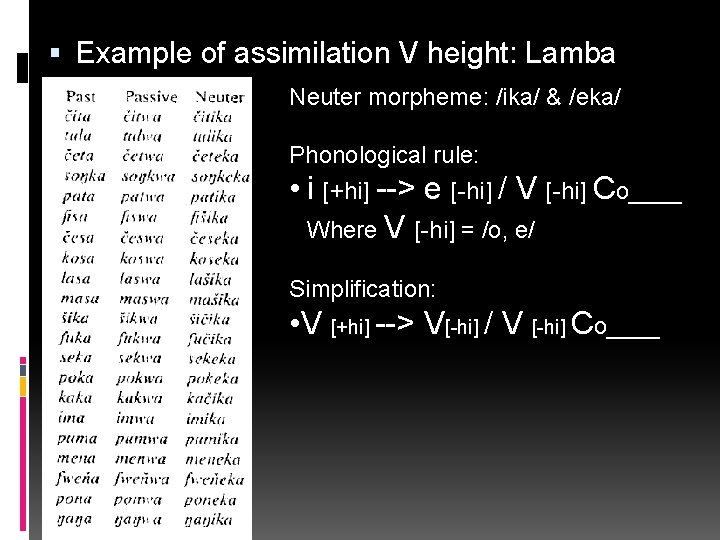
Example of assimilation V height: Lamba Neuter morpheme: /ika/ & /eka/ Phonological rule: • i [+hi] --> e [-hi] / V [-hi] Co____ Where V [-hi] = /o, e/ Simplification: • V [+hi] --> V[-hi] / V [-hi] Co____
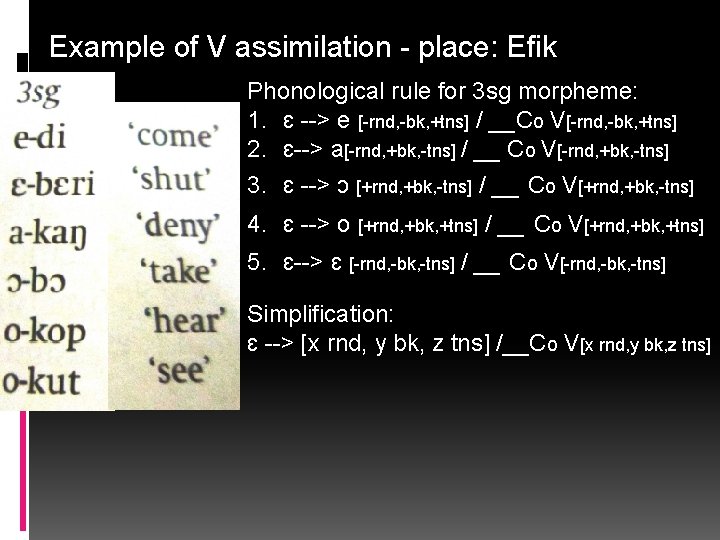
Example of V assimilation - place: Efik Phonological rule for 3 sg morpheme: 1. ɛ --> e [-rnd, -bk, +tns] / __Co V[-rnd, -bk, +tns] 2. ɛ--> a[-rnd, +bk, -tns] / __ Co V[-rnd, +bk, -tns] 3. ɛ --> ɔ [+rnd, +bk, -tns] / __ Co V[+rnd, +bk, -tns] 4. ɛ --> o [+rnd, +bk, +tns] / __ Co V[+rnd, +bk, +tns] 5. ɛ--> ɛ [-rnd, -bk, -tns] / __ Co V[-rnd, -bk, -tns] Simplification: ɛ --> [x rnd, y bk, z tns] /__Co V[x rnd, y bk, z tns]
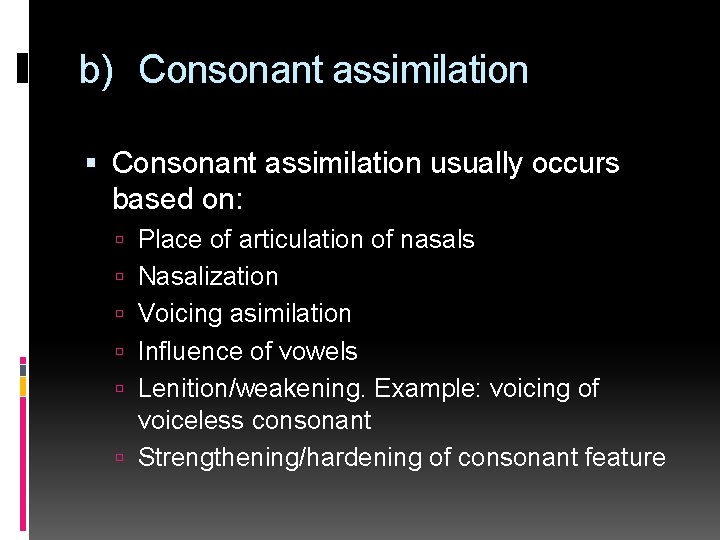
b) Consonant assimilation usually occurs based on: Place of articulation of nasals Nasalization Voicing asimilation Influence of vowels Lenition/weakening. Example: voicing of voiceless consonant Strengthening/hardening of consonant feature
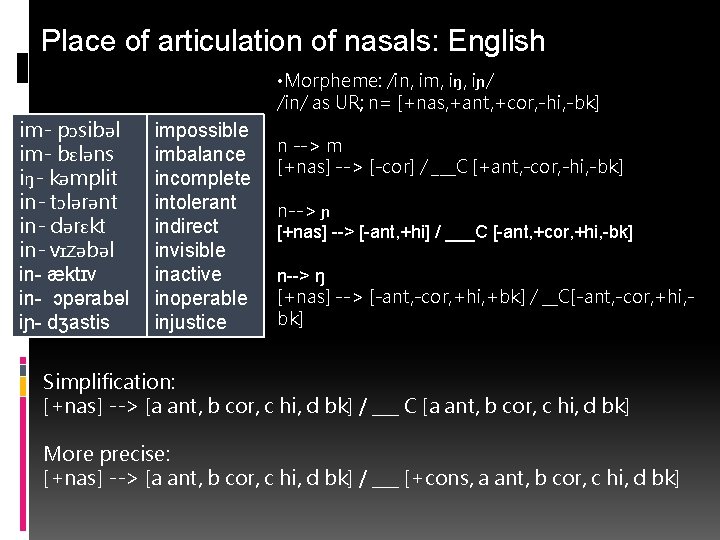
Place of articulation of nasals: English • Morpheme: /in, im, iŋ, iɲ/ /in/ as UR; n= [+nas, +ant, +cor, -hi, -bk] im- pɔsibəl im- bɛləns iŋ- kəmplit in- tɔlərənt in- dərɛkt in- vɪzəbəl in- æktɪv in- ɔpərabəl iɲ- dʒastis impossible imbalance incomplete intolerant indirect invisible inactive inoperable injustice n --> m [+nas] --> [-cor] / ___C [+ant, -cor, -hi, -bk] n--> ɲ [+nas] --> [-ant, +hi] / ___C [-ant, +cor, +hi, -bk] n--> ŋ [+nas] --> [-ant, -cor, +hi, +bk] / __C[-ant, -cor, +hi, bk] Simplification: [+nas] --> [a ant, b cor, c hi, d bk] / ___ C [a ant, b cor, c hi, d bk] More precise: [+nas] --> [a ant, b cor, c hi, d bk] / ___ [+cons, a ant, b cor, c hi, d bk]
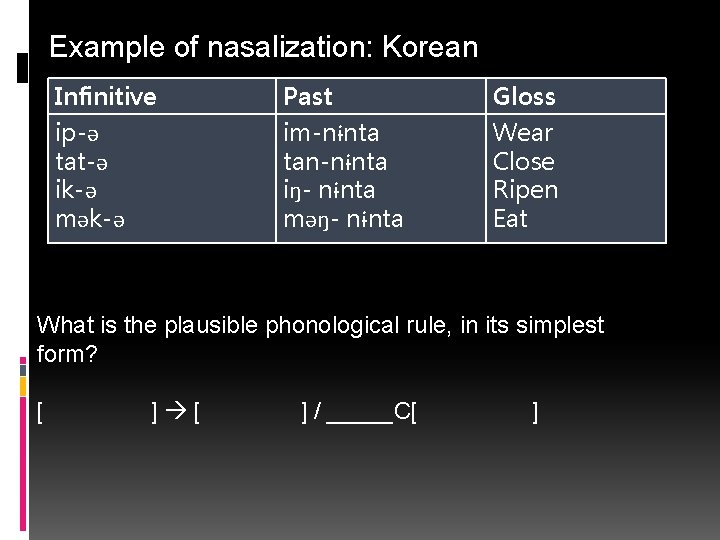
Example of nasalization: Korean Infinitive ip-ə tat-ə ik-ə mək-ə Past im-nɨnta tan-nɨnta iŋ- nɨnta məŋ- nɨnta Gloss Wear Close Ripen Eat What is the plausible phonological rule, in its simplest form? [ ] / _____C[ ]
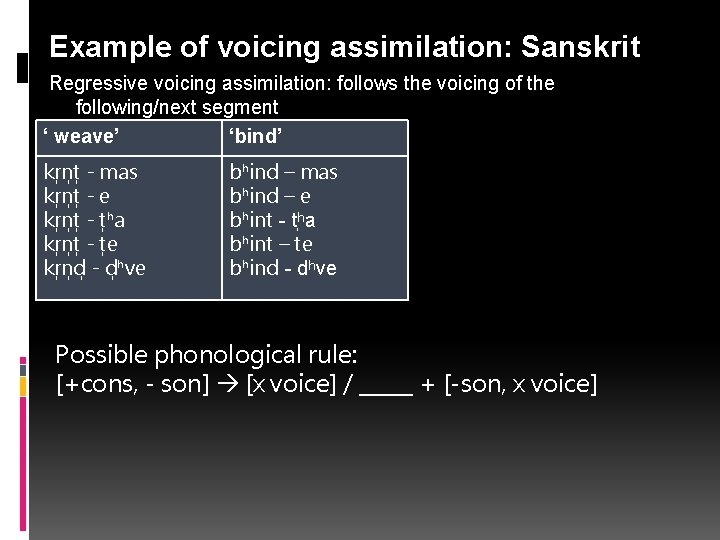
Example of voicing assimilation: Sanskrit Regressive voicing assimilation: follows the voicing of the following/next segment ‘ weave’ ‘bind’ kr n t - mas kr n t - e kr n t - t ʰa kr n t - t e kr n d - d ʰve bʰind – mas bʰind – e bʰint - t ʰa bʰint – te bʰind - dʰve Possible phonological rule: [+cons, - son] [x voice] / _____ + [-son, x voice]
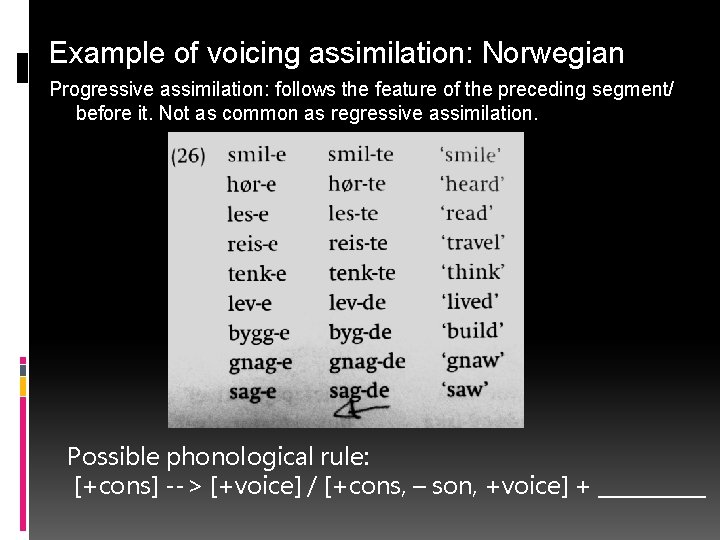
Example of voicing assimilation: Norwegian Progressive assimilation: follows the feature of the preceding segment/ before it. Not as common as regressive assimilation. Possible phonological rule: [+cons] --> [+voice] / [+cons, – son, +voice] + _____
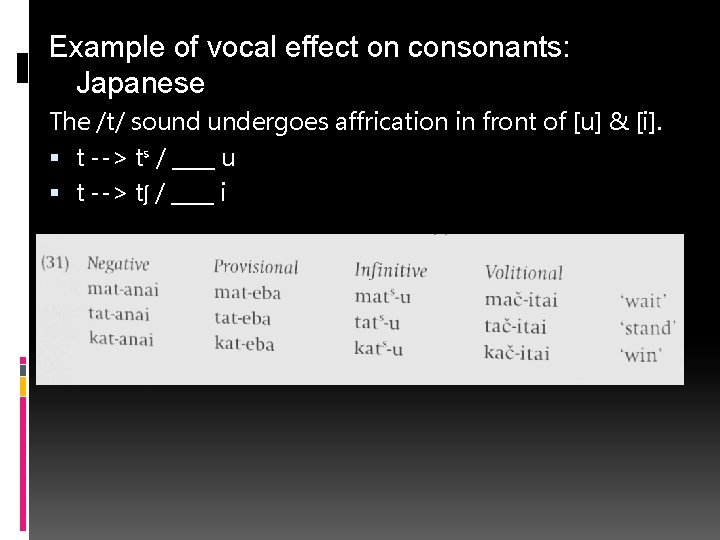
Example of vocal effect on consonants: Japanese The /t/ sound undergoes affrication in front of [u] & [i]. t --> tˢ / ____ u t --> tʃ / ____ i
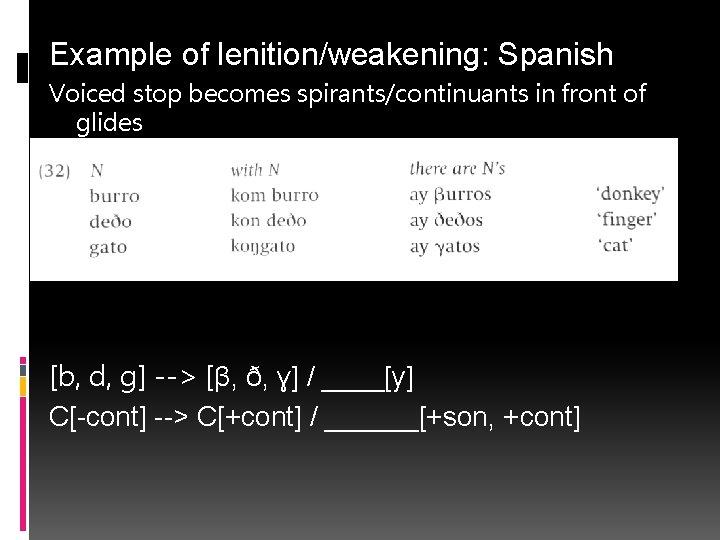
Example of lenition/weakening: Spanish Voiced stop becomes spirants/continuants in front of glides [b, d, g] --> [β, ð, ɣ] / ____[y] C[-cont] --> C[+cont] / ______[+son, +cont]
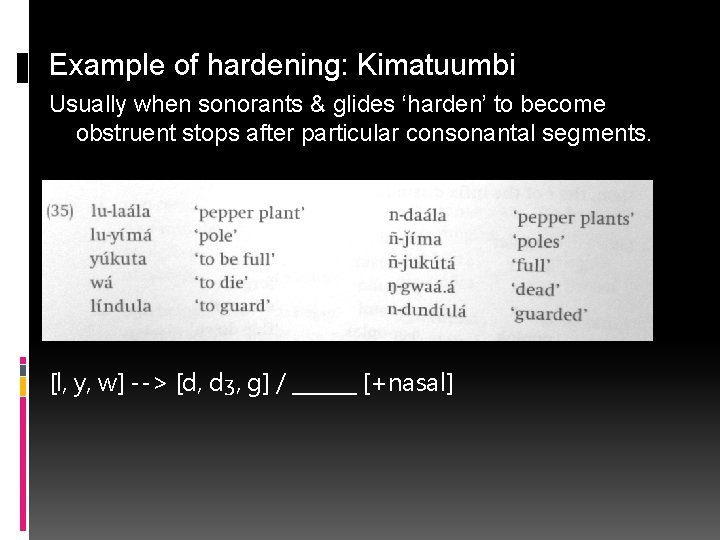
Example of hardening: Kimatuumbi Usually when sonorants & glides ‘harden’ to become obstruent stops after particular consonantal segments. [l, y, w] --> [d, dʒ, g] / ______ [+nasal]
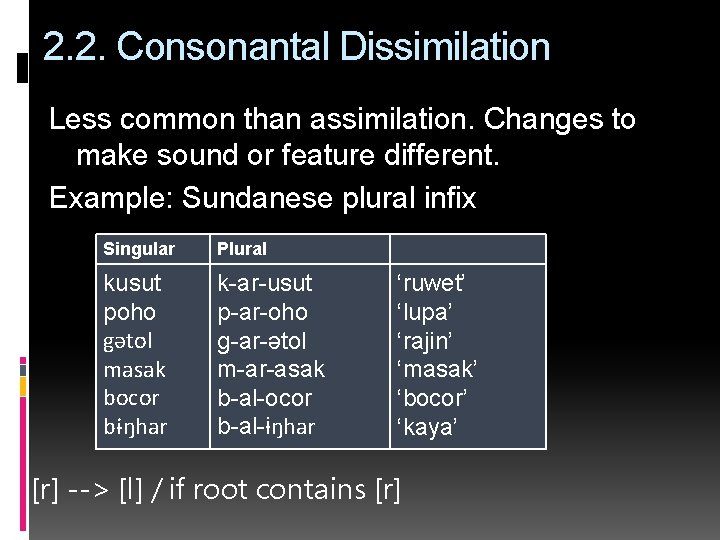
2. 2. Consonantal Dissimilation Less common than assimilation. Changes to make sound or feature different. Example: Sundanese plural infix Singular Plural kusut poho gətol masak bocor bɨŋhar k-ar-usut p-ar-oho g-ar-ətol m-ar-asak b-al-ocor b-al-ɨŋhar ‘ruwet’ ‘lupa’ ‘rajin’ ‘masak’ ‘bocor’ ‘kaya’ [r] --> [l] / if root contains [r]
3. Prosodically based processes Effects the level of syllables or higher, usually in the form of insertion or deletion of vowels/consonants. Commonly found processes: Vowel deletion Vowel epenthesis / insertion Consonant cluster reduction Lengthening of vowels
Example of vowel epenthesis: Fula The vowel [i] is inserted to reduce consonant clusters as a result of the /-na/ suffix.
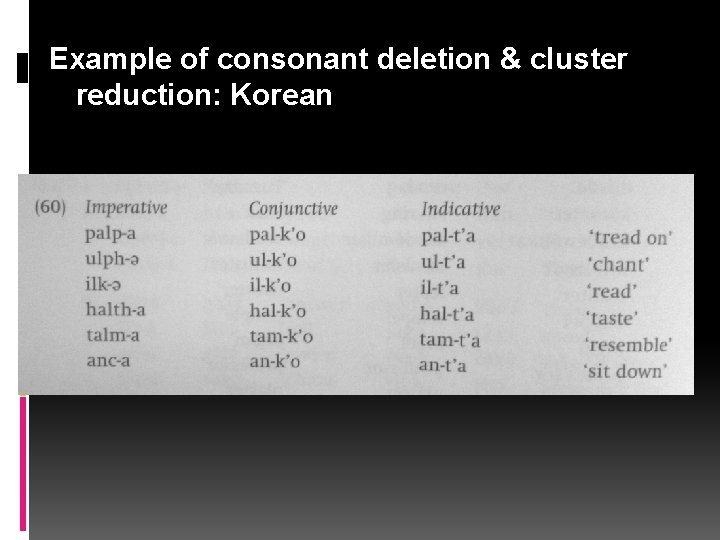
Example of consonant deletion & cluster reduction: Korean
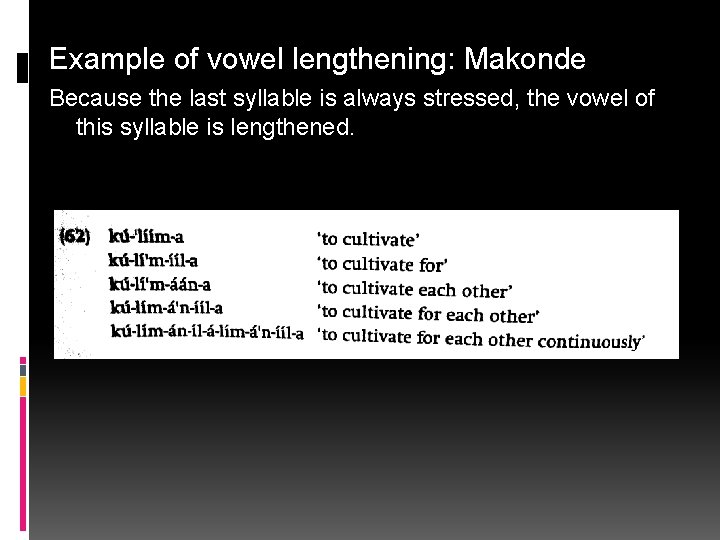
Example of vowel lengthening: Makonde Because the last syllable is always stressed, the vowel of this syllable is lengthened.
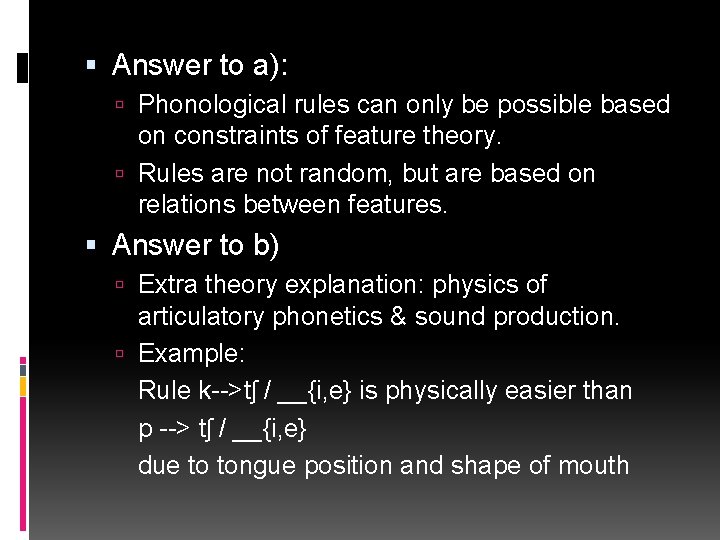
4. Why do phonological rules/processes happen? Basic questions: a) Can any rule/process exist? b) If so, why does a certain rule exist? Are some rules more natural than others?
Answer to a): Phonological rules can only be possible based on constraints of feature theory. Rules are not random, but are based on relations between features. Answer to b) Extra theory explanation: physics of articulatory phonetics & sound production. Example: Rule k-->tʃ / __{i, e} is physically easier than p --> tʃ / __{i, e} due to tongue position and shape of mouth
Bahasa Indonesia lempar rasa wisuda yakin masak nikah ɲaɲi hituŋ gambar kirim dəŋar tulis bantu pukul dʒahit tʃatat ambil isi suruh mə - lempar mə - rasa mə - wisuda mə - yakin (i) mə - masak mə - nikah mə - ɲaɲi məŋ - hitung məŋ – gambar məŋ – irim mən - dəŋar mən – ulis məm – bantu məm – ukul mən ʲ – dʒahit mən ʲ - tʃatat məŋ – ambil məŋ - isi məɲ - uruh