
Phonological Awareness Phonemic Awareness Alphabetic Principle Research Finding
Phonological Awareness, Phonemic Awareness, Alphabetic Principle
Research Finding s (National Academy of Science, Committee for the Prevention of Reading Difficulties, 1998) “Research has shown the effectiveness of clearly articulated, well-implemented, school-wide efforts that build on coherent classroom reading instruction. ” (Snow, Burns, & Griffin, 1998, p. 326) “…in order to prevent reading difficulties, formal instruction in reading needs to focus on the development of phonemic awareness, word recognition, fluency, and comprehension. ” (National Reading Panel, 2000; Snow, Burns, & Griffin, 1998)
Pre-test: A FAST Phonics and Phonemic Awareness Knowledge Quiz Take the Phonics and Phonemic Awareness quiz If you know the answer right away, write it down If you don’t know the answer, skip it and go on to the next question The purpose is to establish what you already know and what you need to learn to successfully complete the quiz
Phonological Awareness ability to hear and manipulate sounds in spoken words includes all sizes of sound units (words, syllables, phonemes)
Phonological Awareness versus Phonemic Awareness What’s the difference? Phonological Awareness: broader category- larger parts & smaller parts of spoken language Phonemic Awareness: Ability to hear and manipulate individual sounds
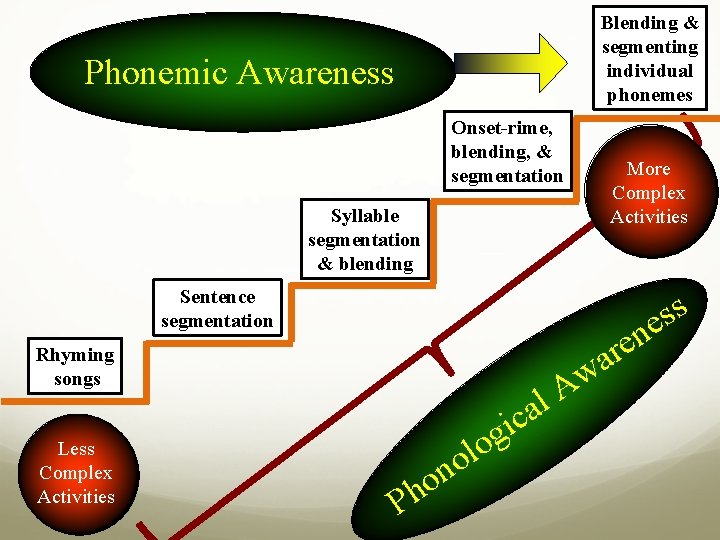
Blending & segmenting individual phonemes Phonemic Awareness Onset-rime, blending, & segmentation Syllable segmentation & blending Sentence segmentation s s e Rhyming songs Less Complex Activities More Complex Activities Ph o n o l a c i g o l w A n e ar
Phonological Awareness versus Phonics/Alphabetic Principle/Alphabetic Understanding What’s the difference? Phonological & Phonemic Awareness: Auditory skill only- can do in the dark Phonics/Alphabetic Principle/Alphabetic Understanding: Understanding that letters represent sounds Understanding that those sounds can be blended together to make meaningful words

Key Terminology Phoneme Smallest unit of sound - / m / t / a / sh / Diacritical marks & virgules Grapheme Printed representation of sound(s) or “letters” Morpheme Smallest linguistic unit that has meaning Whole words (work) Affixes - re, un, dis, ful, est, able (unworkable)
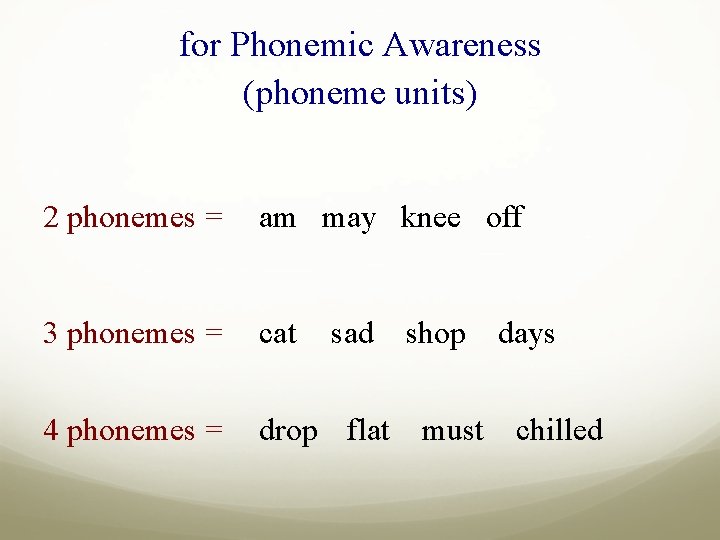
for Phonemic Awareness (phoneme units) 2 phonemes = am may knee off 3 phonemes = cat 4 phonemes = drop flat sad shop must days chilled
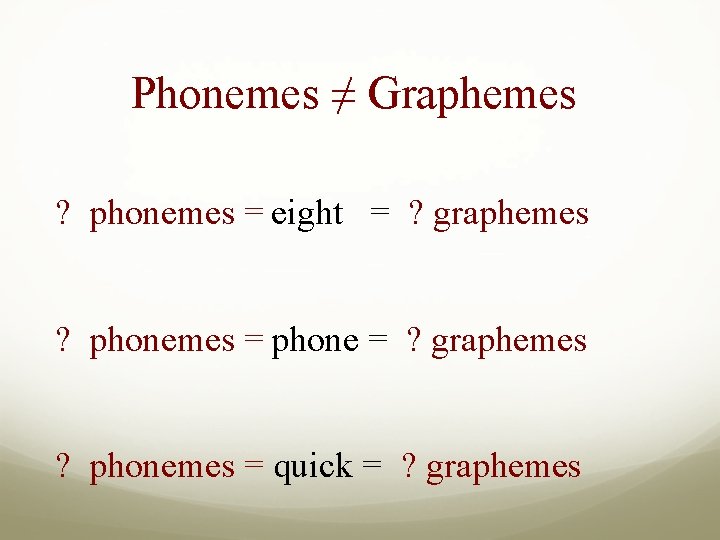
Phonemes ≠ Graphemes ? phonemes = eight = ? graphemes ? phonemes = phone = ? graphemes ? phonemes = quick = ? graphemes
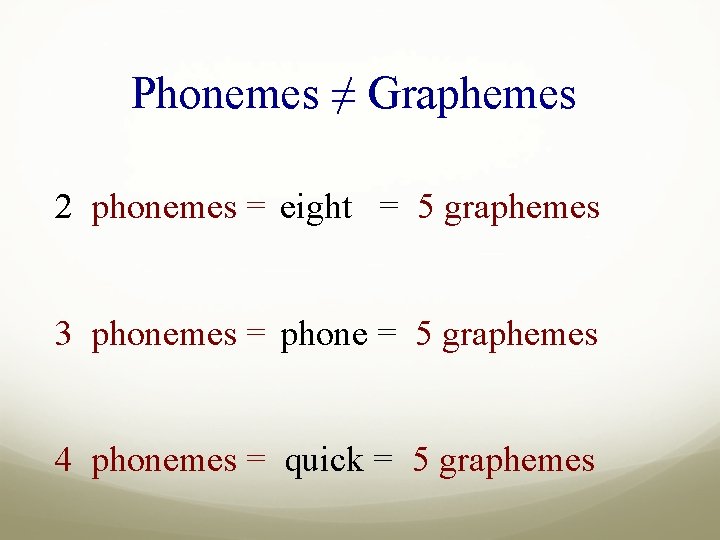
Phonemes ≠ Graphemes 2 phonemes = eight = 5 graphemes 3 phonemes = phone = 5 graphemes 4 phonemes = quick = 5 graphemes
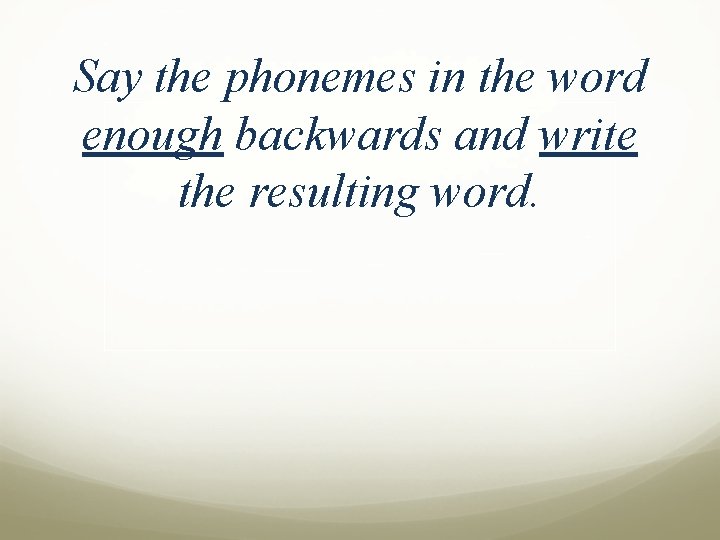
Say the phonemes in the word enough backwards and write the resulting word.
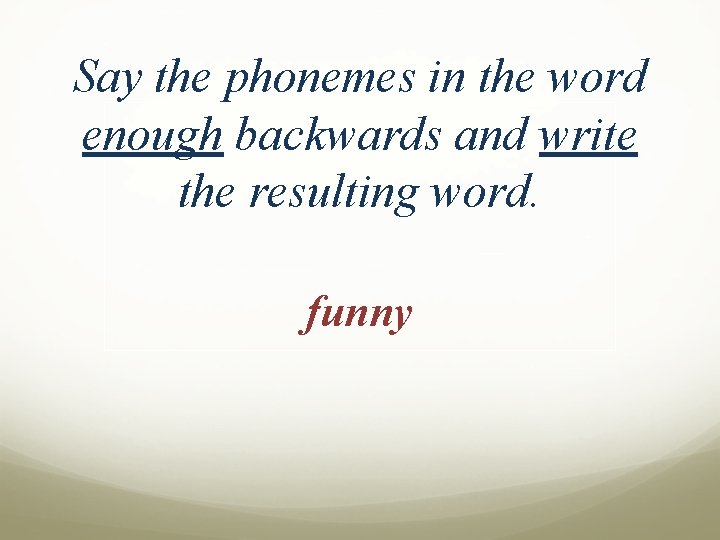
Say the phonemes in the word enough backwards and write the resulting word. funny
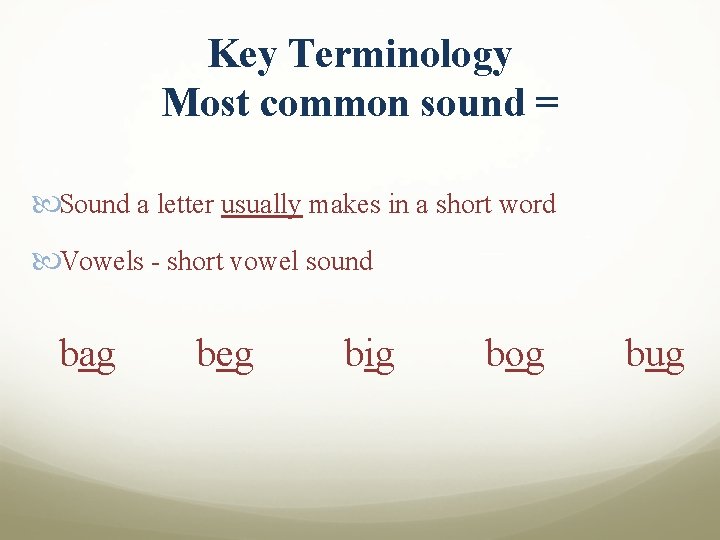
Key Terminology Most common sound = Sound a letter usually makes in a short word Vowels - short vowel sound bag beg big bog bug
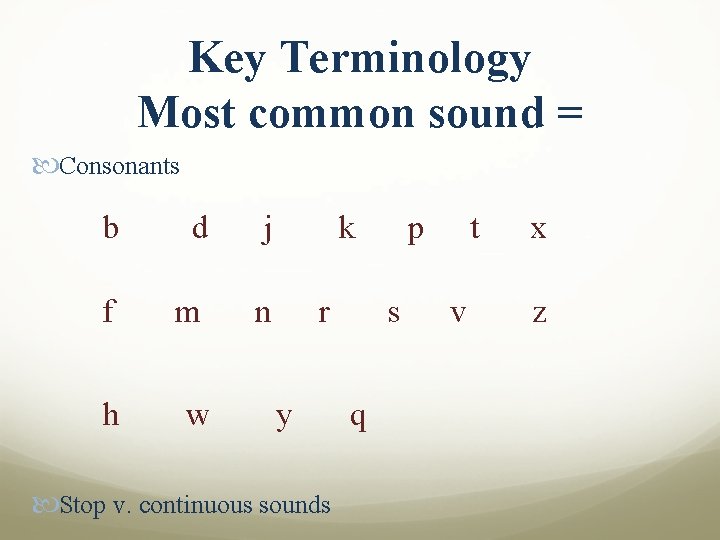
Key Terminology Most common sound = Consonants b d j f m n h w k r y Stop v. continuous sounds p s q t v x z
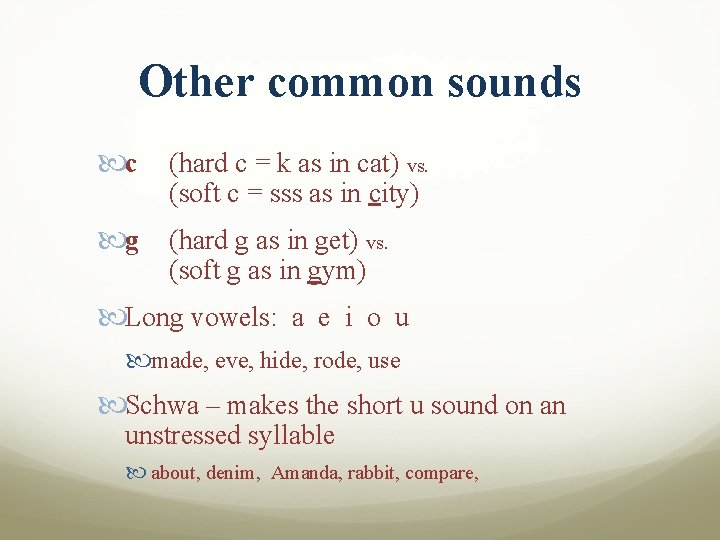
Other common sounds c (hard c = k as in cat) vs. (soft c = sss as in city) g (hard g as in get) vs. (soft g as in gym) Long vowels: a e i o u made, eve, hide, rode, use Schwa – makes the short u sound on an unstressed syllable about, denim, Amanda, rabbit, compare,
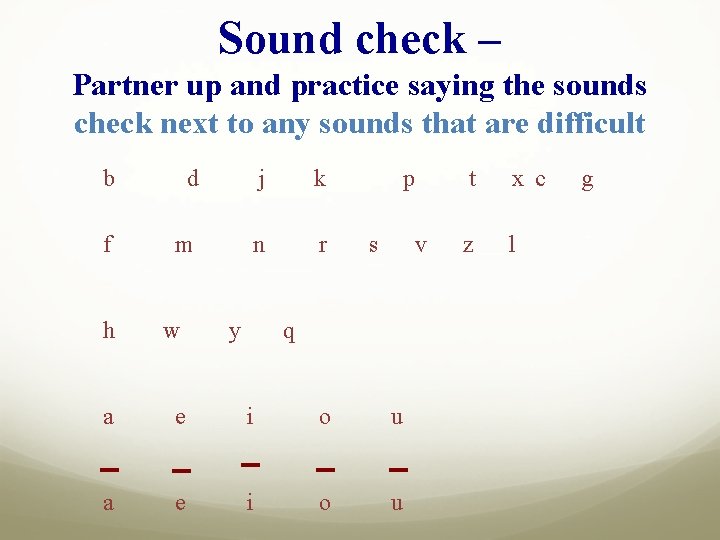
Sound check – Partner up and practice saying the sounds check next to any sounds that are difficult b d j k f m n r y p s v h w q a e i o u t x c z l g
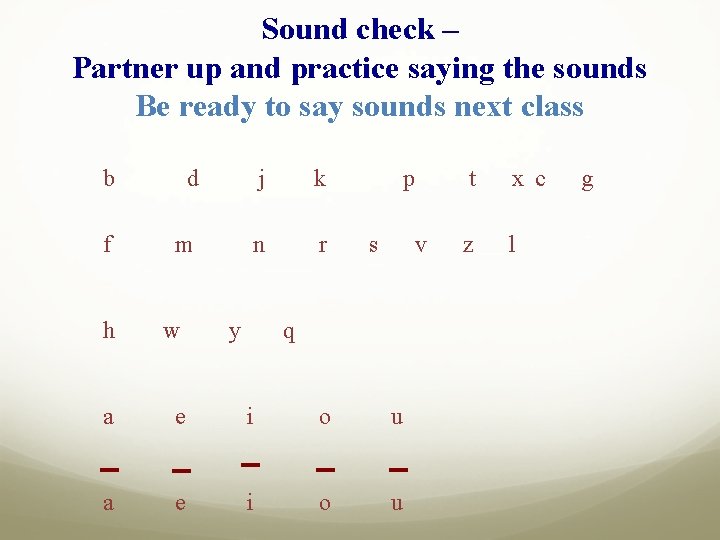
Sound check – Partner up and practice saying the sounds Be ready to say sounds next class b d j k f m n r y p s v h w q a e i o u t x c z l g
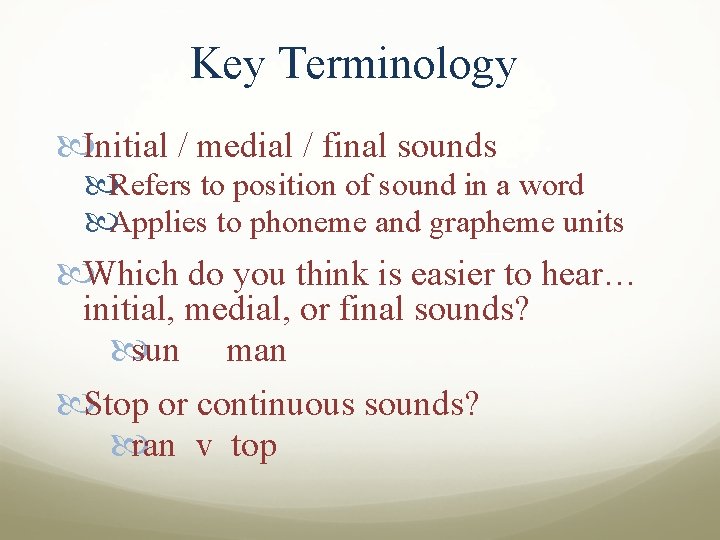
Key Terminology Initial / medial / final sounds Refers to position of sound in a word Applies to phoneme and grapheme units Which do you think is easier to hear… initial, medial, or final sounds? sun man Stop or continuous sounds? ran v top
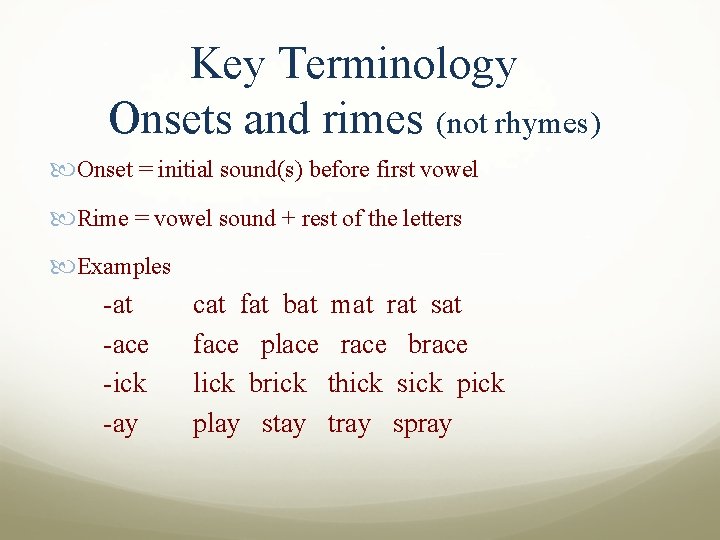
Key Terminology Onsets and rimes (not rhymes) Onset = initial sound(s) before first vowel Rime = vowel sound + rest of the letters Examples -at -ace -ick -ay cat fat bat mat rat sat face place race brace lick brick thick sick play stay tray spray
Word Types for Grapheme Units c = consonant v = vowel applies only to single syllable words and words made up of most common sounds used in sequencing word difficulty for beginning readers
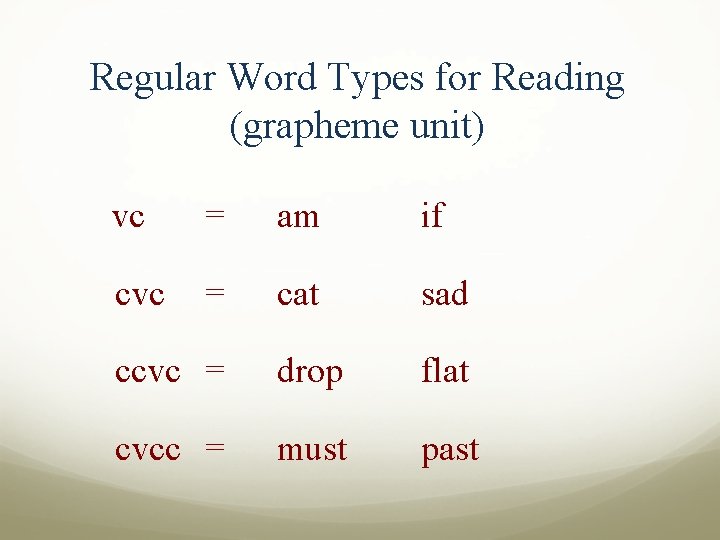
Regular Word Types for Reading (grapheme unit) vc = am if cvc = cat sad ccvc = drop flat cvcc = must past
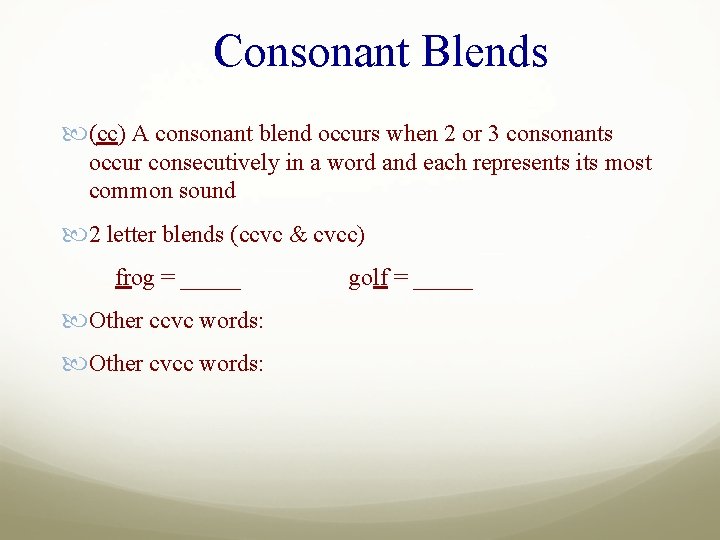
Consonant Blends (cc) A consonant blend occurs when 2 or 3 consonants occur consecutively in a word and each represents its most common sound 2 letter blends (ccvc & cvcc) frog = _____ Other ccvc words: Other cvcc words: golf = _____
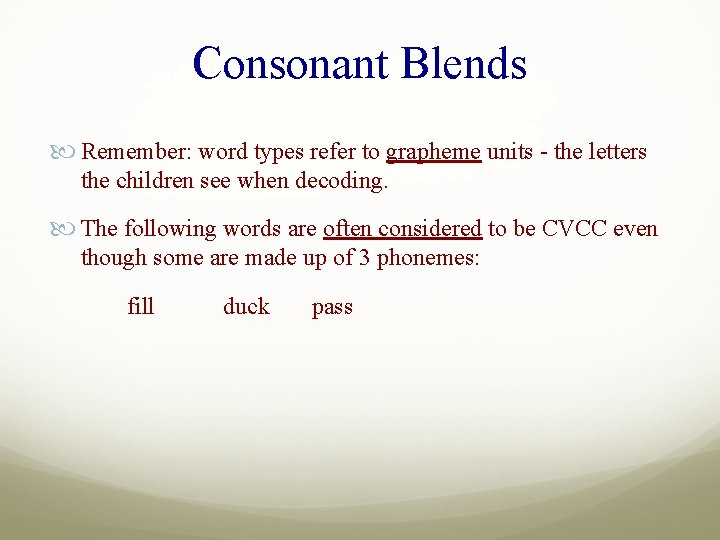
Consonant Blends Remember: word types refer to grapheme units - the letters the children see when decoding. The following words are often considered to be CVCC even though some are made up of 3 phonemes: fill duck pass
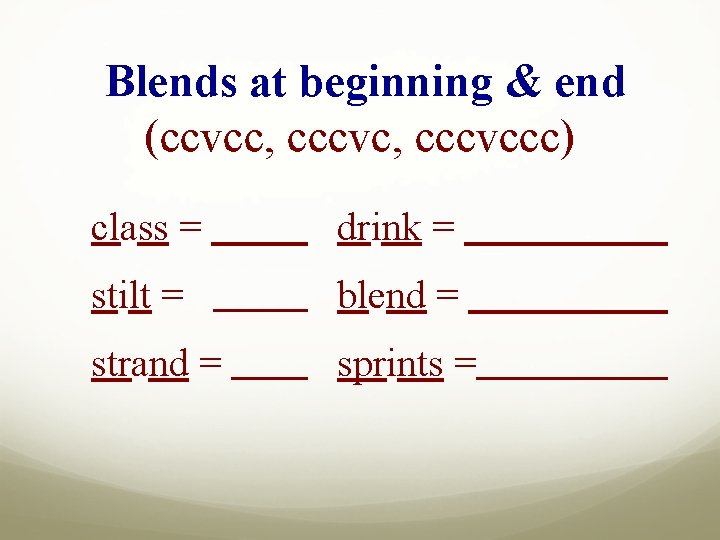
Blends at beginning & end (ccvcc, cccvccc) class = drink = stilt = blend = strand = sprints =
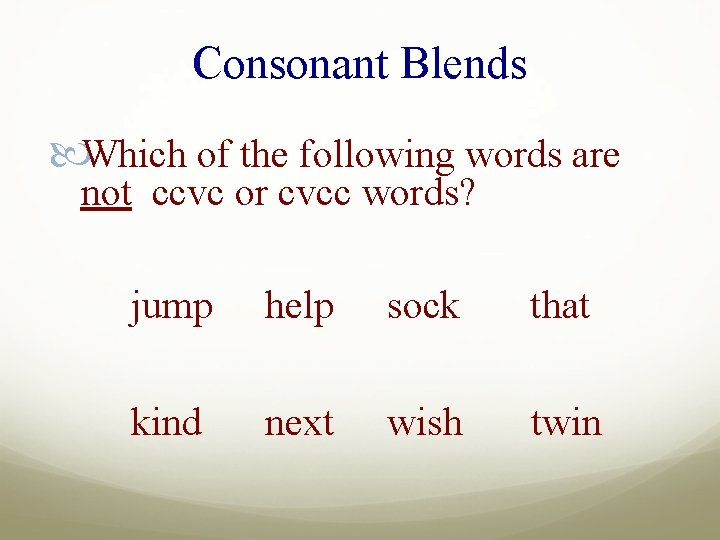
Consonant Blends Which of the following words are not ccvc or cvcc words? jump help sock that kind next wish twin
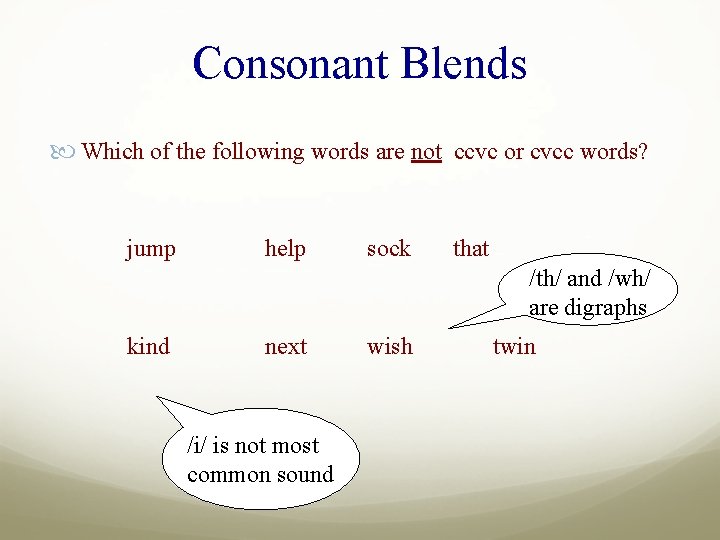
Consonant Blends Which of the following words are not ccvc or cvcc words? jump help sock that /th/ and /wh/ are digraphs kind next /i/ is not most common sound wish twin
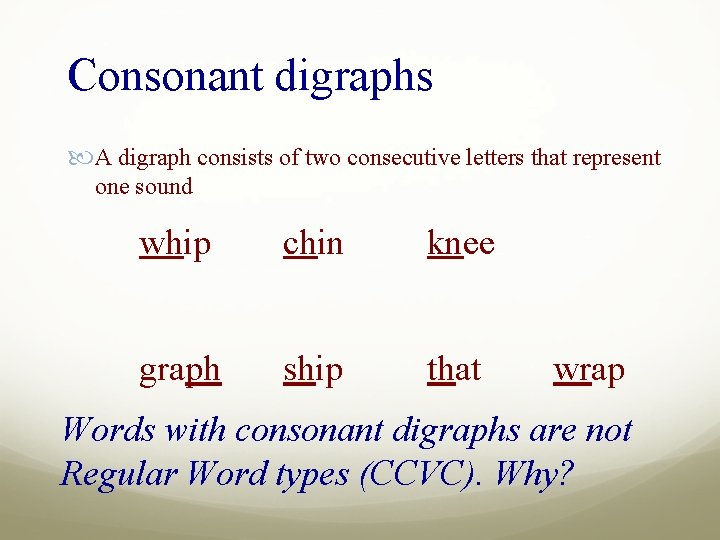
Consonant digraphs A digraph consists of two consecutive letters that represent one sound whip chin knee graph ship that wrap Words with consonant digraphs are not Regular Word types (CCVC). Why?
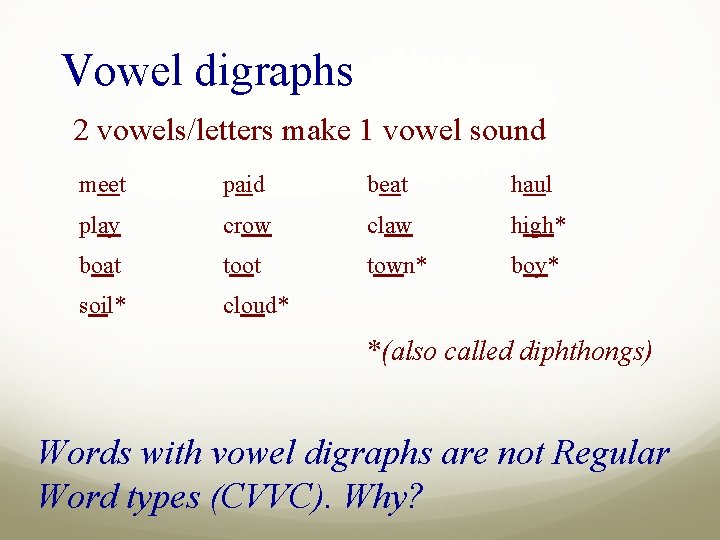
Vowel digraphs 2 vowels/letters make 1 vowel sound meet paid beat haul play crow claw high* boat toot town* boy* soil* cloud* *(also called diphthongs) Words with vowel digraphs are not Regular Word types (CVVC). Why?
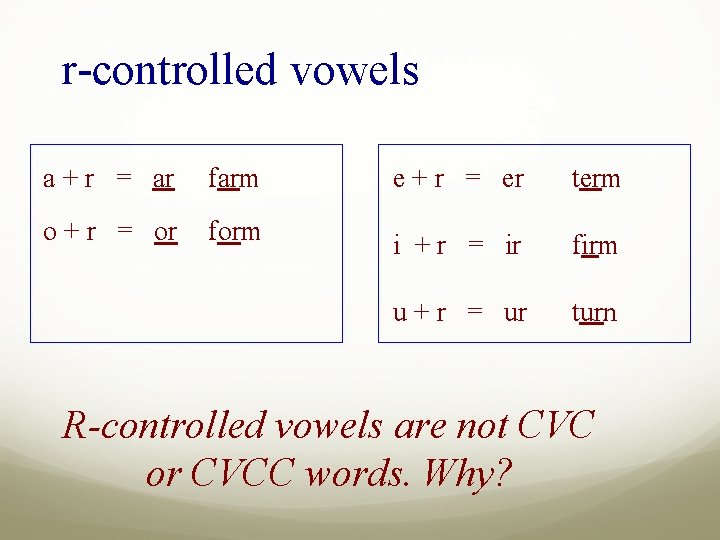
r-controlled vowels a + r = ar farm e + r = er term o + r = or form i + r = ir firm u + r = ur turn R-controlled vowels are not CVC or CVCC words. Why?
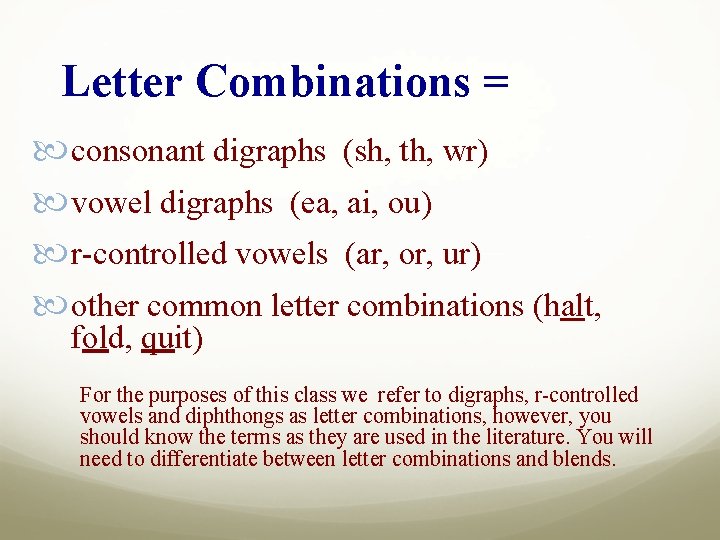
Letter Combinations = consonant digraphs (sh, th, wr) vowel digraphs (ea, ai, ou) r-controlled vowels (ar, or, ur) other common letter combinations (halt, fold, quit) For the purposes of this class we refer to digraphs, r-controlled vowels and diphthongs as letter combinations, however, you should know the terms as they are used in the literature. You will need to differentiate between letter combinations and blends.

Regular or Irregular? Regular Words for beginning readers = words in which each letter represents its most common sound Irregular Words for beginning readers = words in which letters do not make their most common sound
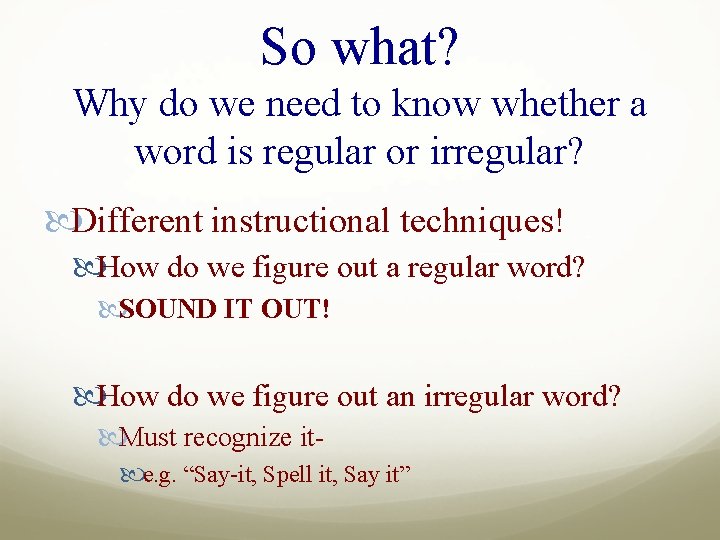
So what? Why do we need to know whether a word is regular or irregular? Different instructional techniques! How do we figure out a regular word? SOUND IT OUT! How do we figure out an irregular word? Must recognize it e. g. “Say-it, Spell it, Say it”
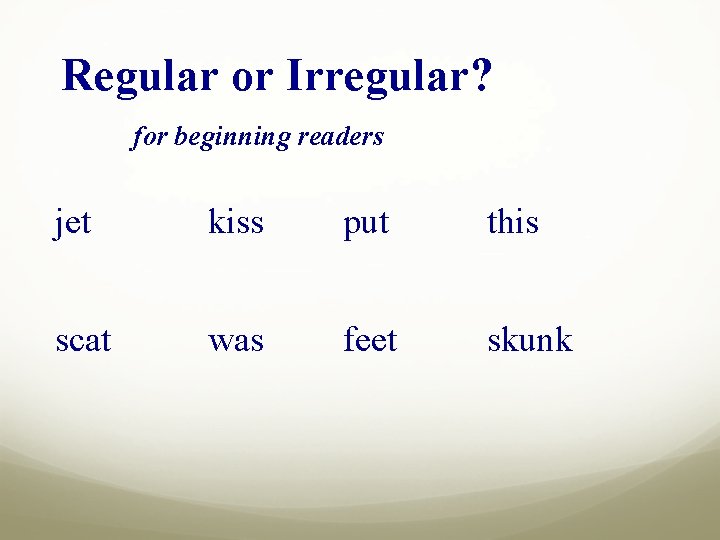
Regular or Irregular? for beginning readers jet kiss put this scat was feet skunk
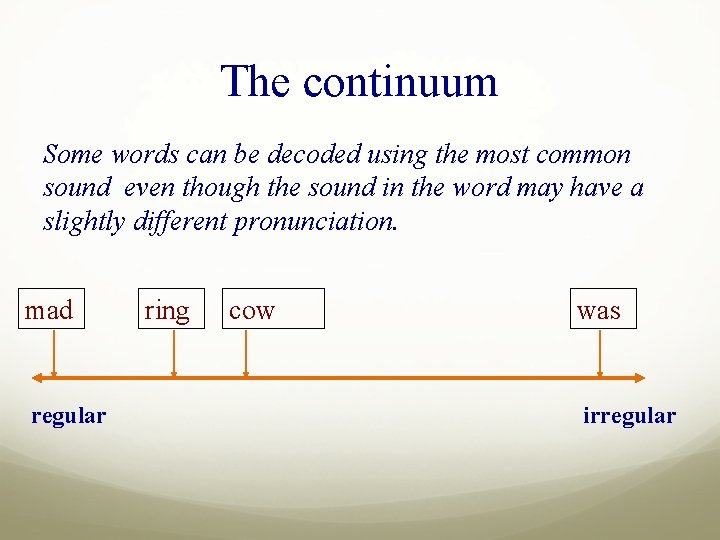
The continuum Some words can be decoded using the most common sound even though the sound in the word may have a slightly different pronunciation. mad regular ring cow was irregular
Phonics Quiz: Check for Understanding Complete the Phonics Quiz based on the knowledge learned in class about phonics and phonemic awareness
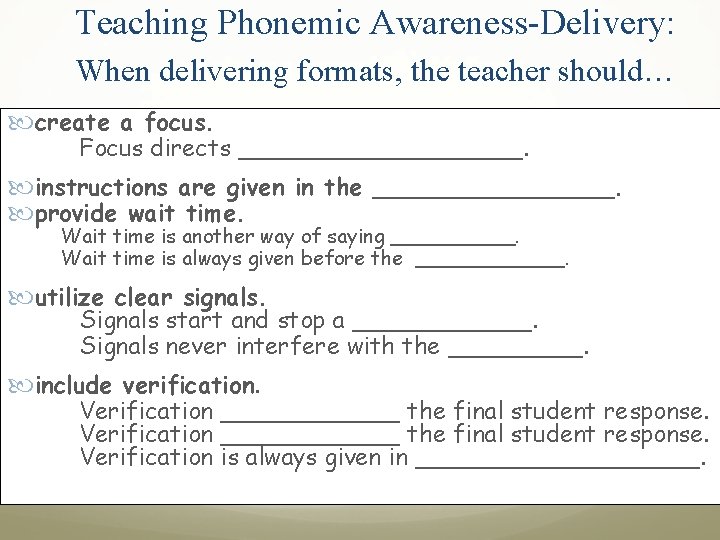
Teaching Phonemic Awareness-Delivery: When delivering formats, the teacher should… create a focus. Focus directs __________. instructions are given in the ________. provide wait time. Wait time is another way of saying _____. Wait time is always given before the ______. utilize clear signals. Signals start and stop a ______. Signals never interfere with the _____. include verification. Verification ____________ the final student response. Verification is always given in __________.
Signaling: Hand Drop Signal Use when asking for response to oral questions Visual, audible, predictable Finger snap Clap Table top tap Voice (only for experts) Goal: students answer together Practice hand drop only
Practice with these questions. . . What day is it today? How many months are in a year? Who is the President of the United States? What is 6 x 8? What season is it? What is the opposite of north? Where did Dorothy go to meet the Wizard? What state do you live in?
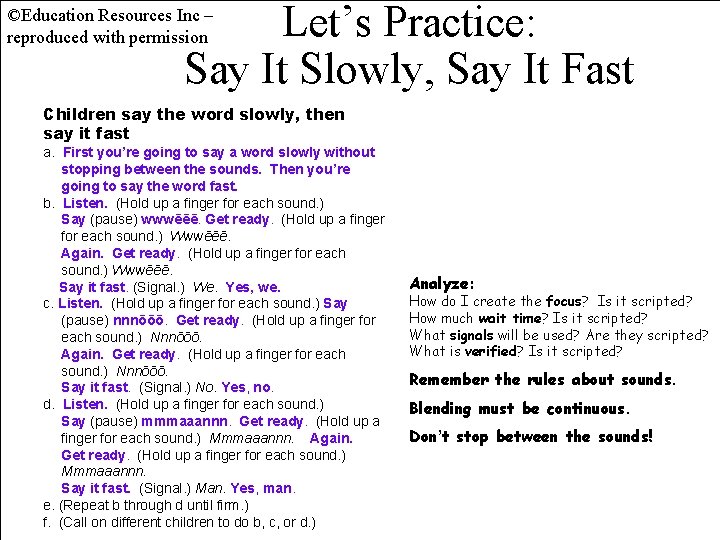
Let’s Practice: Say It Slowly, Say It Fast ©Education Resources Inc – reproduced with permission Children say the word slowly, then say it fast a. First you’re going to say a word slowly without stopping between the sounds. Then you’re going to say the word fast. b. Listen. (Hold up a finger for each sound. ) Say (pause) wwwēēē. Get ready. (Hold up a finger for each sound. ) Wwwēēē. Again. Get ready. (Hold up a finger for each sound. ) Wwwēēē. Say it fast. (Signal. ) We. Yes, we. c. Listen. (Hold up a finger for each sound. ) Say (pause) nnnōōō. Get ready. (Hold up a finger for each sound. ) Nnnōōō. Again. Get ready. (Hold up a finger for each sound. ) Nnnōōō. Say it fast. (Signal. ) No. Yes, no. d. Listen. (Hold up a finger for each sound. ) Say (pause) mmmaaannn. Get ready. (Hold up a finger for each sound. ) Mmmaaannn. Again. Get ready. (Hold up a finger for each sound. ) Mmmaaannn. Say it fast. (Signal. ) Man. Yes, man. e. (Repeat b through d until firm. ) f. (Call on different children to do b, c, or d. ) Analyze: How do I create the focus? Is it scripted? How much wait time? Is it scripted? What signals will be used? Are they scripted? What is verified? Is it scripted? Remember the rules about sounds. Blending must be continuous. Don’t stop between the sounds!
Direct Instruction Design Delivery
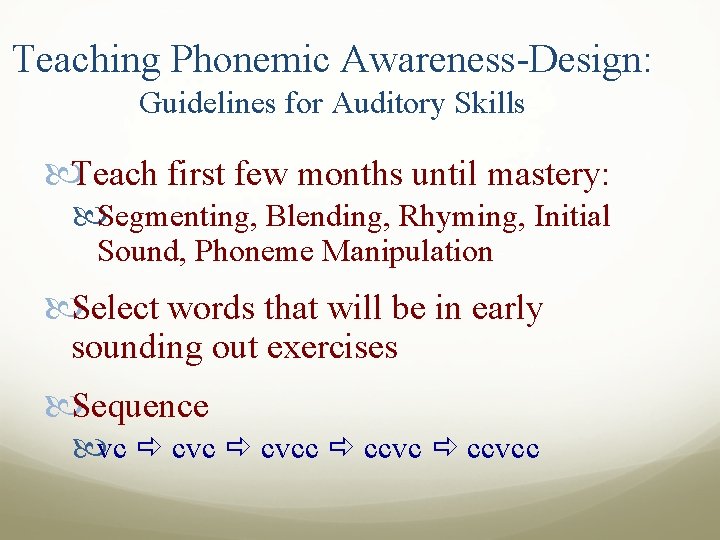
Teaching Phonemic Awareness-Design: Guidelines for Auditory Skills Teach first few months until mastery: Segmenting, Blending, Rhyming, Initial Sound, Phoneme Manipulation Select words that will be in early sounding out exercises Sequence vc cvcc ccvcc
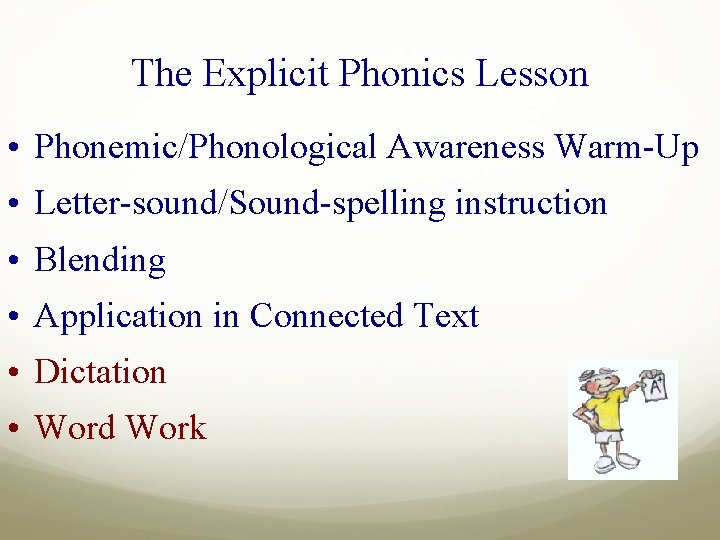
The Explicit Phonics Lesson • Phonemic/Phonological Awareness Warm-Up • Letter-sound/Sound-spelling instruction • Blending • Application in Connected Text • Dictation • Word Work
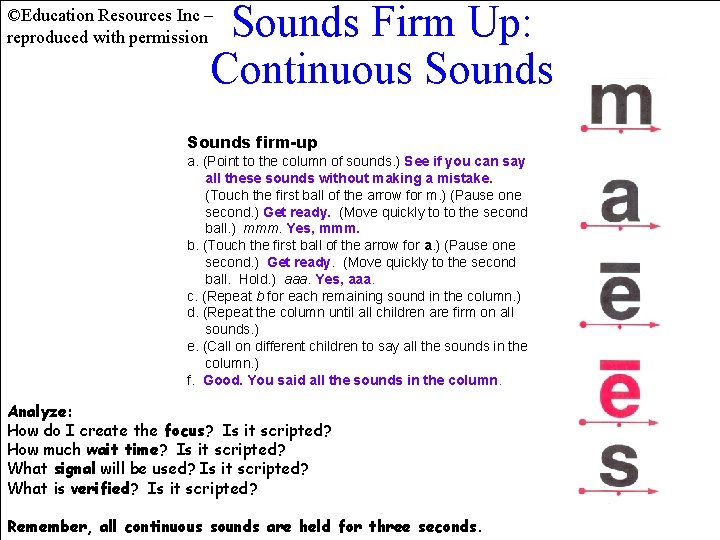
Sounds Firm Up: Continuous Sounds ©Education Resources Inc – reproduced with permission Sounds firm-up a. (Point to the column of sounds. ) See if you can say all these sounds without making a mistake. (Touch the first ball of the arrow for m. ) (Pause one second. ) Get ready. (Move quickly to to the second ball. ) mmm. Yes, mmm. b. (Touch the first ball of the arrow for a. ) (Pause one second. ) Get ready. (Move quickly to the second ball. Hold. ) aaa. Yes, aaa. c. (Repeat b for each remaining sound in the column. ) d. (Repeat the column until all children are firm on all sounds. ) e. (Call on different children to say all the sounds in the column. ) f. Good. You said all the sounds in the column. Analyze: How do I create the focus? Is it scripted? How much wait time? Is it scripted? What signal will be used? Is it scripted? What is verified? Is it scripted? Remember, all continuous sounds are held for three seconds.
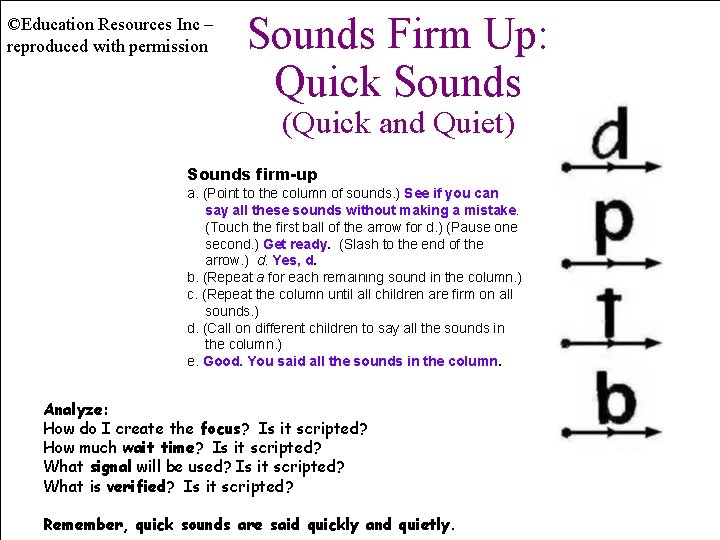
©Education Resources Inc – reproduced with permission Sounds Firm Up: Quick Sounds (Quick and Quiet) Sounds firm-up a. (Point to the column of sounds. ) See if you can say all these sounds without making a mistake. (Touch the first ball of the arrow for d. ) (Pause one second. ) Get ready. (Slash to the end of the arrow. ) d. Yes, d. b. (Repeat a for each remaining sound in the column. ) c. (Repeat the column until all children are firm on all sounds. ) d. (Call on different children to say all the sounds in the column. ) e. Good. You said all the sounds in the column. Analyze: How do I create the focus? Is it scripted? How much wait time? Is it scripted? What signal will be used? Is it scripted? What is verified? Is it scripted? Remember, quick sounds are said quickly and quietly.
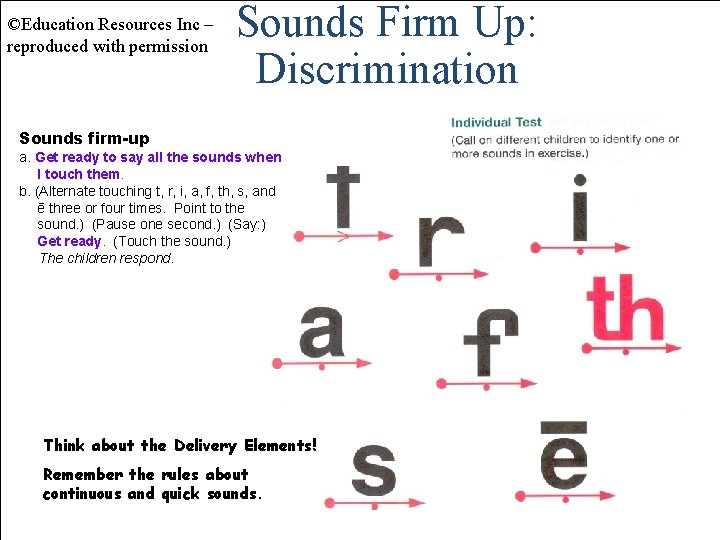
©Education Resources Inc – reproduced with permission Sounds Firm Up: Discrimination Sounds firm-up a. Get ready to say all the sounds when I touch them. b. (Alternate touching t, r, i, a, f, th, s, and ē three or four times. Point to the sound. ) (Pause one second. ) (Say: ) Get ready. (Touch the sound. ) The children respond. Think about the Delivery Elements! Remember the rules about continuous and quick sounds.
Observe and Provide Feedback on Direct Instruction Elements: How did I: Create the focus Provide wait time (how much? ) Signal Verify the response
Corrective Feedback Immediate, neutral, modeled That sounds is /d/. What sound? Repeated positive practice Use alternating pattern or Part firm (go back to the beginning or several tasks prior).
OR Standards for Phonemic Awareness in K & 1 st Grade http: //www. ode. state. or. us/teachlearn/real/docume nts/05 -06 elak-3 optional. pdf

Curriculum maps sequence the skills http: //reading. uoregon. edu/appendices/maps. php
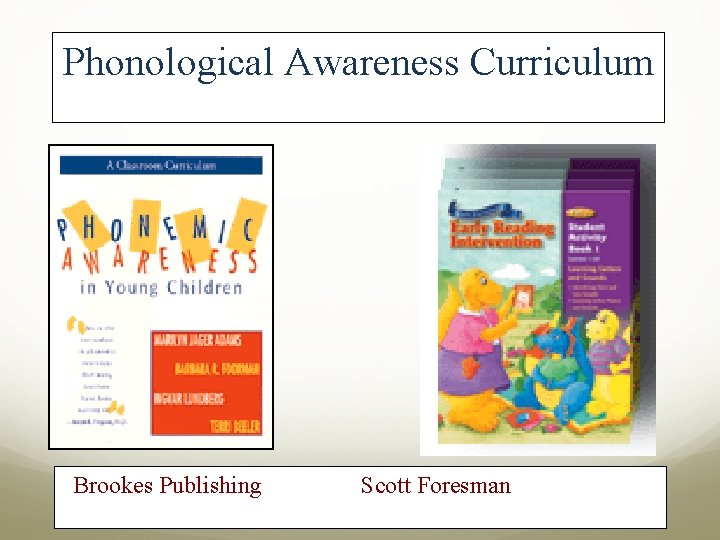
Phonological Awareness Curriculum Brookes Publishing Scott Foresman
- Slides: 51