
PHONICS VS WHOLE LANGUAGE The Great Debate Presented
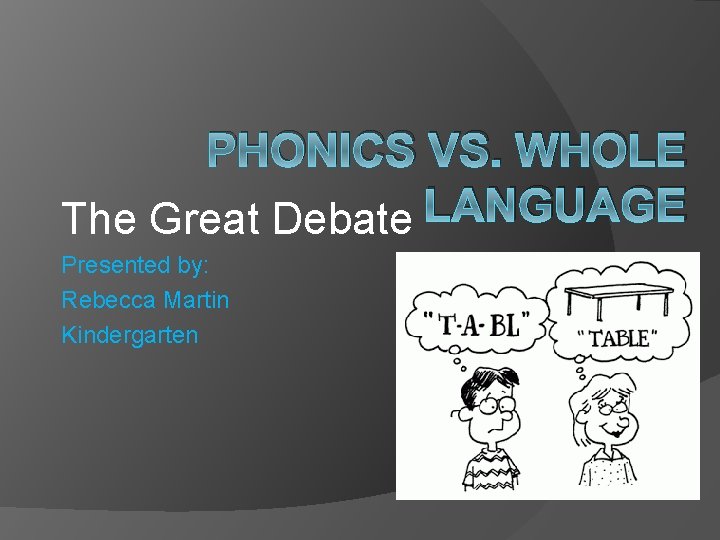
PHONICS VS. WHOLE LANGUAGE The Great Debate Presented by: Rebecca Martin Kindergarten
What we will be doing… �Today we will be exploring the benefits of both phonics and whole language. This exploration will further expand the knowledge needed to successfully use a balanced literacy approach in K-2 Classrooms.
Learning Objectives By the end of this professional development, you will be able to: � Describe the differences between phonics and whole language and how each of these benefit students individually. � Identify teaching strategies that allow educators to incorporate more phonics time into their every day routines resulting in a more balanced literacy approach. � Plan lessons that involve the use of both phonics and whole language to create a balanced literacy approach.
Survey Results Twelve K-2 Teachers responded. The following overall perspectives were observed: � Many kindergarten teachers stated a need for increased phonics. � First Grade teachers expressed that students coming into first grade were struggling due to a decrease in phonics. � Second grade teachers expressed the importance of whole language when students get to higher grades more than in Kindergarten and First.
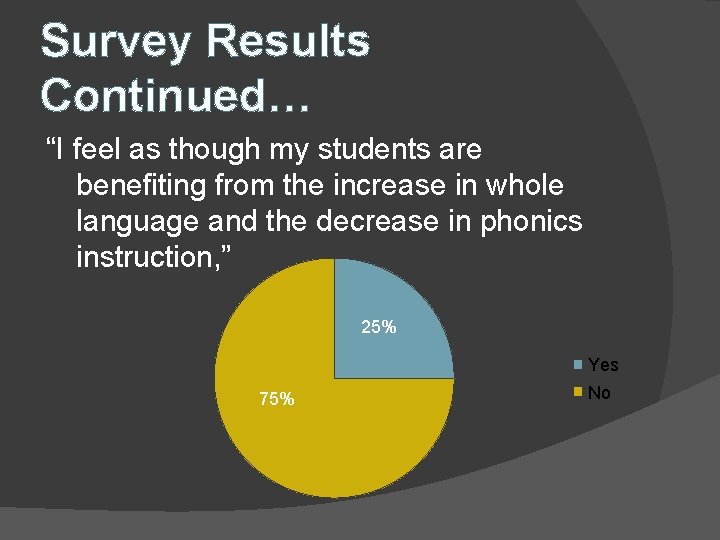
Survey Results Continued… “I feel as though my students are benefiting from the increase in whole language and the decrease in phonics instruction, ” 25% Yes 75% No
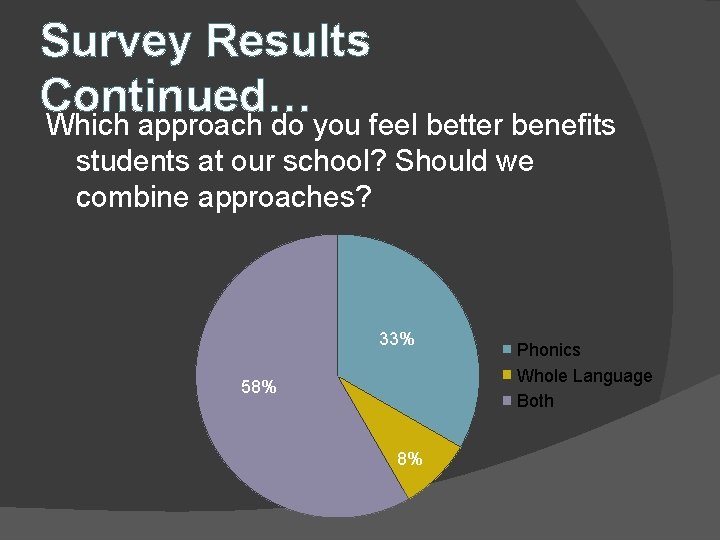
Survey Results Continued… Which approach do you feel better benefits students at our school? Should we combine approaches? 33% 58% 8% Phonics Whole Language Both
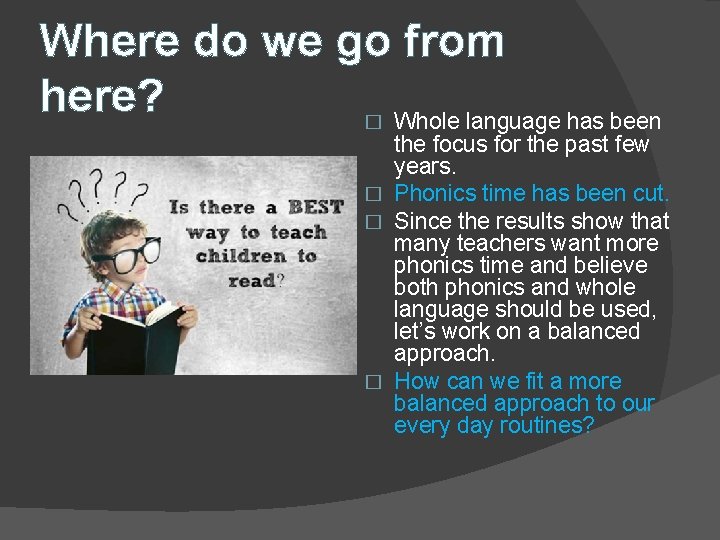
Where do we go from here? � Whole language has been the focus for the past few years. � Phonics time has been cut. � Since the results show that many teachers want more phonics time and believe both phonics and whole language should be used, let’s work on a balanced approach. � How can we fit a more balanced approach to our every day routines?
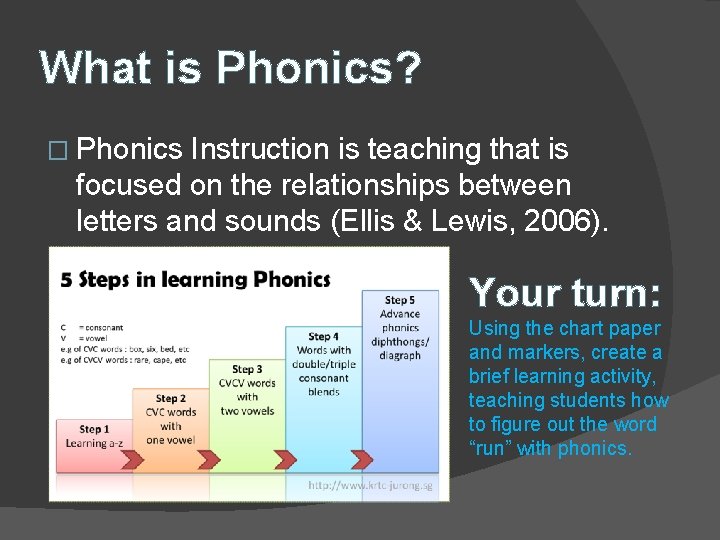
What is Phonics? � Phonics Instruction is teaching that is focused on the relationships between letters and sounds (Ellis & Lewis, 2006). Your turn: Using the chart paper and markers, create a brief learning activity, teaching students how to figure out the word “run” with phonics.
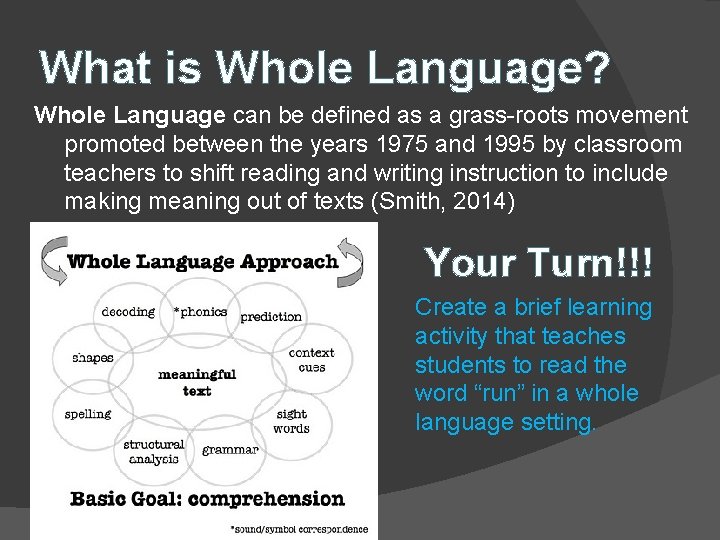
What is Whole Language? Whole Language can be defined as a grass-roots movement promoted between the years 1975 and 1995 by classroom teachers to shift reading and writing instruction to include making meaning out of texts (Smith, 2014) Your Turn!!! Create a brief learning activity that teaches students to read the word “run” in a whole language setting.
Put your thinking caps on! With the people around you, create a Venn Diagram describing the similarities and differences between whole language and phonics!
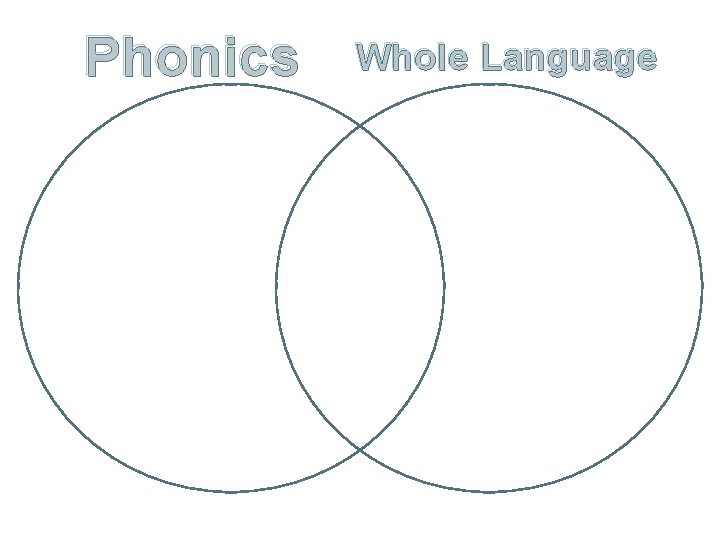
Phonics Whole Language
Comparisons � What did you notice about the two different methods? � What are some benefits of both? � What are some negatives? � How can we work to combine the two methods in order to help more students grow?
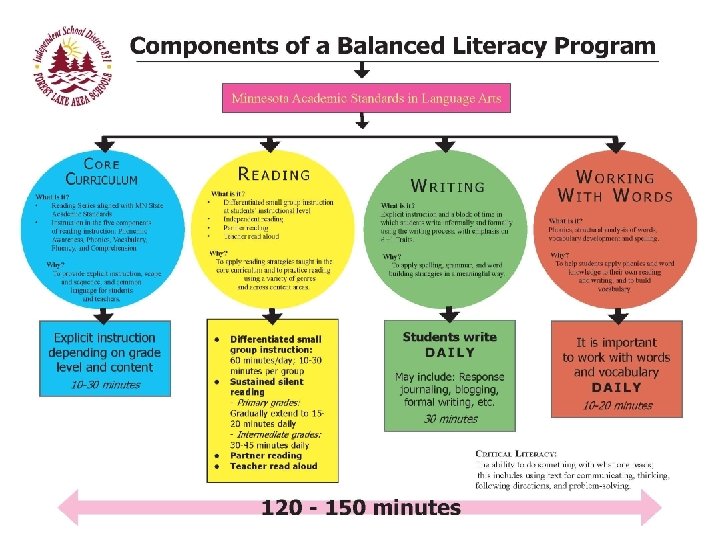
Balanced Literacy Approach What is a balanced Literacy Approach? Turn and talk to discuss. Make a list of the different things you would see in a balanced literacy approach.
Balanced Literacy in the Classroom Video: Balanced Literacy How can we do this in our current curriculum? What are some things we currently do? How is this helpful to students?
Article Read article, “Whole Language and Phonics, Can they Work Together? ” http: //www. educationworld. com/a_curr/curr 029. shtm l Discussion: What did you get from the article? Is it realistic? How would this help our students?
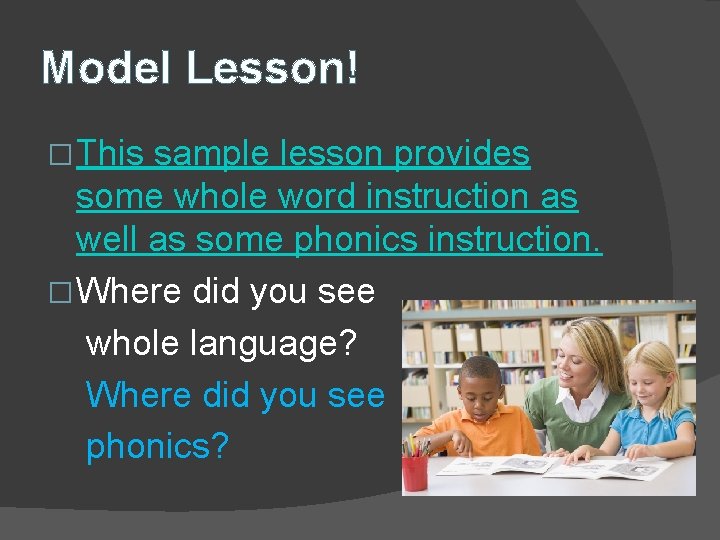
Model Lesson! � This sample lesson provides some whole word instruction as well as some phonics instruction. � Where did you see whole language? Where did you see phonics?
Time to Try on your own! � Create your own!! � With your grade level, create a half hour to an hour lesson that involves both phonics and whole language! � Share!
Where are we in terms of using a balanced literacy approach at our school? Are we leaning more toward one method of instruction? How can we balance out our approach in order to establish a more balanced literacy approach?
How can we incorporate more phonics?
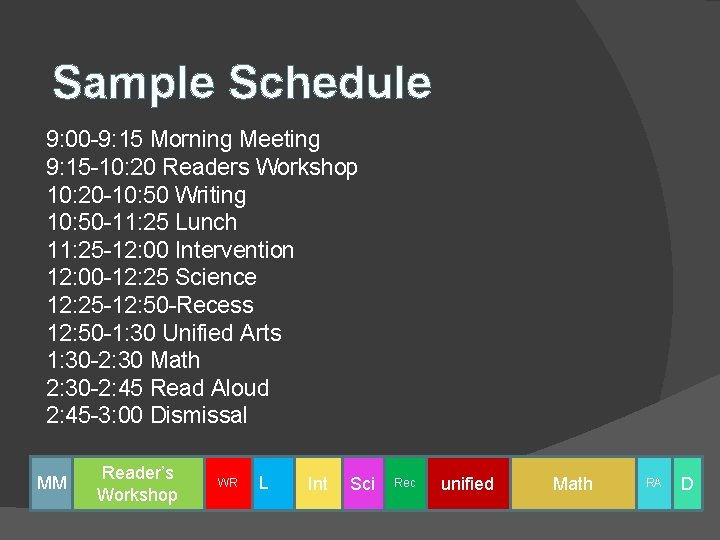
Sample Schedule 9: 00 -9: 15 Morning Meeting 9: 15 -10: 20 Readers Workshop 10: 20 -10: 50 Writing 10: 50 -11: 25 Lunch 11: 25 -12: 00 Intervention 12: 00 -12: 25 Science 12: 25 -12: 50 -Recess 12: 50 -1: 30 Unified Arts 1: 30 -2: 30 Math 2: 30 -2: 45 Read Aloud 2: 45 -3: 00 Dismissal MM Reader’s Workshop WR L Int Sci Rec unified Math RA D
Balanced Literacy? Where in the model schedule can we fit in more phonics time to create a more balanced literacy approach? Turn and Talk. Share.
Our New Learning Today we have: � Described the differences between phonics and whole language and how each of these benefit students individually. � Identified teaching strategies that allow educators to incorporate more phonics time into their every day routines resulting in a more balanced literacy approach. � Planned lessons that involve the use of both phonics and whole language to create a balanced literacy approach.
Reflections On the exit slip, write down at least 2 things you will take from this professional development today.
References � � � Education World. (1997). Whole language and phonics: Can they work together? - see more at. Education World, Retrieved from http: //www. educationworld. com/a_curr/curr 029. shtml Ellis, S. , & Lewis , M. (2006). Phonics: Practice, research, and policy. London, England: Paul Chapman. Layfield, L. (Producer). (2014, March 6). How to Teach Phonics to Kindergarten Children [Web Video]. Retrieved from https: //www. youtube. com/watch? v=td. I-_c. O_z. GQ Sandymcdgp. (Producer). (2010, September 22). The Components of Balanced Literacy [Web Video]. Retrieved from https: //www. youtube. com/watch? v=8 nh. Z 7 g 0955 Q Smith, T. (2014). Whole language. Retrieved from http: //eds. b. ebscohost. com/eds/pdfviewer? sid=73 c 4 ecd 58246 -4 b 78 -960 c-19 b 94 b 518838@sessionmgr 110&vid=6&hid=116 The Balanced Literacy Diet. (Producer). (2012, April 22). Build Your Own Poem!: Making Rhymes Based on Spelling Patterns (Virtual Tour) [Web Video]. Retrieved from https: //www. youtube. com/watch? v=Dbfjlf. EJy. XQ
Clip Art References Baby Reading. Retrieved on July 27, 2014, from: http: //i. ytimg. com/vi/3 IJo 3 Wa 9 Kk. M/maxresdefault. jpg Balance. Retrieved on July 27, 2014, from: http: //blog. ganpatrimoine. fr/wpcontent/uploads/2012/08/62508_art_5_Livre_blanc_Patrimoine_et_crise. jpg Children Reading. Retrieved on August 6, 2014, from: http: //community. starbucks. com/servlet/Jive. Servlet/show. Image/96891546 -5123 -1701/children_reading 1. jpg Comparing Apples to Oranges. Retrieved on July 27, 2014, from: http: //sale. images. woot. com/Comparing_Apples_to_Orangesx 56 Thumbnail. png Components of a Balanced Literacy Program. Retrieved on July 27, 2014, from: http: //media-cacheak 0. pinimg. com/236 x/da/d 0/bb/dad 0 bb 66 fb 8 bd 6889390353725 bb 58 a 8. jpg Gearhead. Retrieved on July 27, 2014, from: http: //fluency 21. com/blog/wp-content/uploads/2012/08/gearhead. jpg Is There a Best Way to Teach Children to Read. Retrieved on July 27, 2014, from: https: //lh 3. ggpht. com/Bued. Pt. O 1 gnv. Qkvj. Ixmz. DU 8 Qt. BZNtx 2 oqlfqr. JMcy 2 CAY 8_kcow. Gz 07 b. Cb 4 VWL 6 Tv. EB 6 pe. A= s 126 Learning Phonics. Retrieved on July 27, 2014, from: https: //lh 3. ggpht. com/Fq. Nq 0 m. YBlu 7 z. Ddm. Yf 3 R 9 wc. VJb. YFPzd. In. Qs. WI 6 gn 3 d. TTEr. Uk. SQAl. Neh. Mw. Yu. Kq 6 p_CH 0 o 3 Kg=s 133 Make It Fit. Retrieved on July 27, 2014, from: http: //iwritewrite. com/wpcontent/uploads/2014/06/shutterstock_98786507. jpg Phonics. Retrieved on July 27, 2014, from: http: //kidskouch. files. wordpress. com/2010/04/phonics. gif Read Aloud. Retrieved on July 27, 2014, from: http: //1. bp. blogspot. com/uy. Ng. D 7 F 0 Xfo/Ux. KQbpj. We 4 I/AAAAAOI/dfd. YXb 1 H 10 k/s 1600/history+3. jpg Refection. Retrieved on July 27, 2014, from: http: //ua. convdocs. org/pars_docs/refs/35/34146_html_m 997 a 7 c 5. gif Survey Results. Retrieved on July 27, 2014, from: http: //beritaprotes. com/wp-content/uploads/2014/07/Survey. jpg Teacher Reading. Retrieved on July 27, 2014, from: http: //www. sensupport. nl/typo 3 temp/pics/SEN_Specialist_02_697 e 90 e 537. png Teamwork. Retrieved on July 27, 2014, from: http: //1. bp. blogspot. com/zh. Ir 7 q. RWLPU/UZw 4 by. Dbl_I/AAAATEo/332 Bf. Cs 46 hc/s 1200/20121011105647_untitled. png Thinkers. Retrieved on July 27, 2014, from: http: //cfile 24. uf. tistory. com/R 750 x 0/2415043 B 52517 E 28348 E 02 Thinking Cap. Retrieved on July 27, 2014, from: http: //jotter 2. files. cache. s 3. amazonaws. com/sampled/717/SAMPLED_245717_930____ Whole Language Approach. Retrieved on July 27, 2014, from: https: //lh 5. ggpht. com/p. SCVx. WS_b. Q 7 Vas 0 b 8 Vkm. Fcgbpn 9 -Mf. Igti. D 49 DXdv. Mu. PA 85 Ik_6 VVj-q. DDu. Pvc. JOWe. K=s 93
- Slides: 26