
Phonics Meeting for Parents Why teach phonics Phonics
- Slides: 20
Phonics Meeting for Parents
Why teach phonics? • Phonics helps children to develop good reading and spelling skills. • The ability to read and write is a vital skill for all children, paving the way for an enjoyable and successful school experience. • We use a synthetic phonics approach called ‘Letters and Sounds’.
What is synthetic phonics? • Synthetic Phonics is a way of teaching reading. • Children are taught to read letters or groups of letters by saying the sound(s) they represent – so, they are taught that the letter s sounds like s when we say it. • Children can then start to read words by blending the sounds together to make a word.
Why synthetic phonics? “Synthetic phonics offers the vast majority of young children the best and most direct route to becoming skilled readers and writers” Sir Jim Rose, Rose Review of Reading 2006
Some Definitions A Phoneme This is the smallest unit of sound in a word. How many phonemes can you hear in cat?
Some Definitions A Grapheme This is a letter or group of letter that represents a sound How many graphemes can you see in cat?
• A phoneme you hear • A grapheme you see A word doesn’t always have the same number of phonemes and graphemes!
Phase 1 • Environmental sounds (sirens, cars, birds etc. ) • Instrumental sounds (musical instruments) • Body percussion (clapping, tapping, stamping ) • Rhythm and Rhyme (reading rhyming books, singing nursery rhymes) • Alliteration (bouncy ball, licking lollies ) • Voice sounds (wheeee, boing) • Oral blending and segmenting
Phase 2 • Revisit phase 1 including ‘soundtalk’. • Phonemes (sounds) and graphemes (letters). They may be using pictures or hand movements to help them remember these. • VC and CVC words
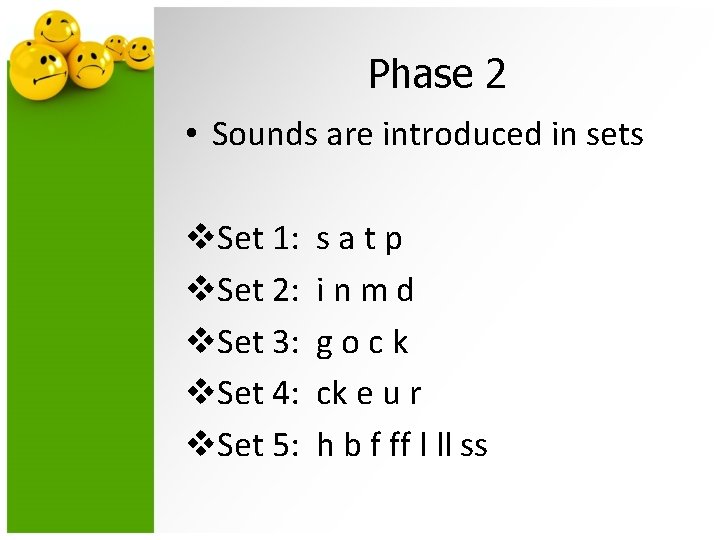
Phase 2 • Sounds are introduced in sets v. Set 1: s a t p v. Set 2: i n m d v. Set 3: g o c k v. Set 4: ck e u r v. Set 5: h b f ff l ll ss
How to say the sounds • Saying the sounds correctly with your child is extremely important. • The way we say the sound may well be different from when you were at school. • We say the shortest form of the sounds.
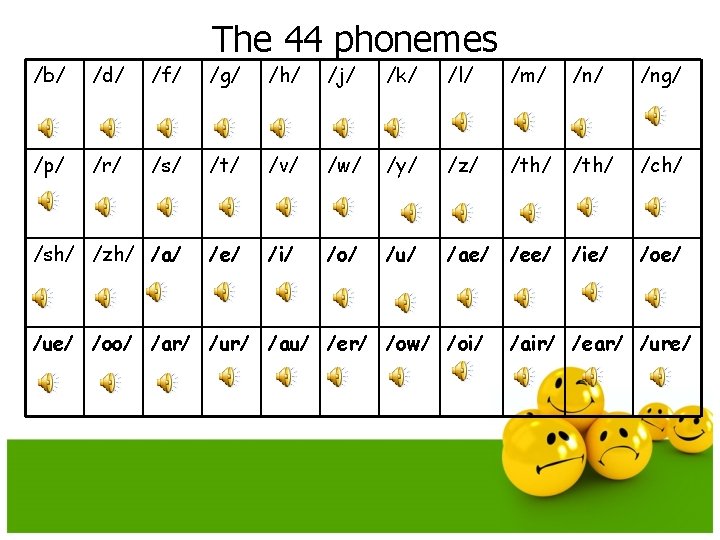
The 44 phonemes /b/ /d/ /f/ /g/ /h/ /j/ /k/ /l/ /m/ /ng/ /p/ /r/ /s/ /t/ /v/ /w/ /y/ /z/ /th/ /ch/ /sh/ /zh/ /a/ /e/ /i/ /o/ /u/ /ae/ /ee/ /ie/ /oe/ /ue/ /oo/ /ar/ /ur/ /au/ /er/ /ow/ /oi/ /air/ /ear/ /ure/
Sounding out • Recognising the letter sounds in a written word, for example: c-u-p
Blending • Merging or ‘blending’ the sounds in the order in which they are written to pronounce the word cup Speedy recognition of the sound for each letter is really important, so your child can blend them to read words easily.
Segmenting Activity • Using ‘sound buttons’ can you say how many phonemes are in each word. • cat • sun • dog • back Challenge: How many graphemes?
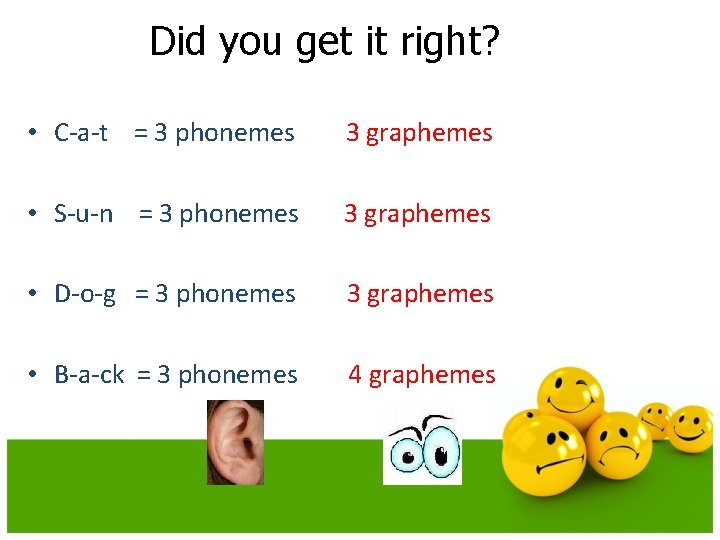
Did you get it right? • C-a-t = 3 phonemes 3 graphemes • S-u-n = 3 phonemes 3 graphemes • D-o-g = 3 phonemes 3 graphemes • B-a-ck = 3 phonemes 4 graphemes
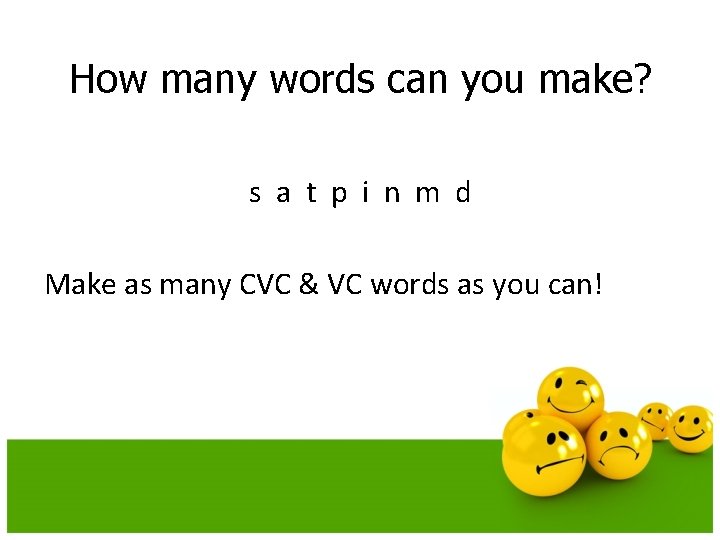
How many words can you make? s a t p i n m d Make as many CVC & VC words as you can!
Tricky Words • Some everyday words in English have tricky spellings and can’t be read by blending. • These are sometimes called high frequency tricky words. • These words just have to be learned by sight and flashcard-type games are a good way to practise these.
How can I help at home? • • • By reading lots of books with your child. Praise your child for trying. Sing an alphabet song together. Play ‘I spy’…This will help them to hear the initial sound in words. Continue to read rhyming books and sing nursery rhymes. • Play phonics games on www. letters-and-sounds. com • Play rhyming games. • Watch Jolly Phonics phase 2 on You Tube: http: //www. youtube. com/jollyphonics • Watch Letterland (megamix) on You Tube: • https: //www. youtube. com/letterland
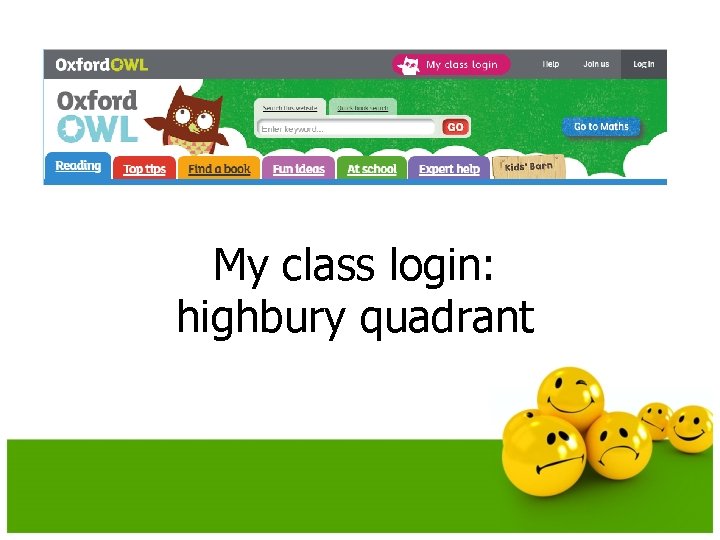
My class login: highbury quadrant