
Phonics How You Can Help At Home Learning





- Slides: 18
Phonics: How You Can Help At Home
Learning to Read and Spell at St Nicholas School Synthetic Phonics A recognised method for teaching children to read and write by saying the sound(s) each letter represents. Phonics Scheme Ø Letters and Sounds Ø Jolly Phonics – actions and songs. Baseline Phonics Ø Assessment Ø Sharing Nursery information.
Early Writing Ø From Nursery our children are given opportunities to develop their fine and gross motor skills ready to write. Ø Children experience a variety of activities to develop precursive patterns. Ø This naturally leads on to the introduction of real letters. Watching and copying the shapes of letters and the various joining techniques will enable pupils to learn to write simple words in a cursive style at this early stage.
Cursive Writing Ø At St. Nicholas we teach children to form letters first (i. e. write them separately, without joins) and then move onto cursive. Ø Every letter starts on the line with an entry stroke and leads out with an exit stroke. Ø An example of this can be found in your handout. Please have a go on your whiteboard.
Daily Phonics Ø Every day the children have a 20 minute sessions of phonics. Ø Fast paced approach Ø Lessons encompass a range of games, songs and rhymes. Each lesson follows a recap, teach, practice and apply approach. Ø We show children the cursive grapheme and the non-cursive grapheme.
Phase 1 Phonics Ø Listening and Attention skills - Environmental sounds - Rhyming - Alliteration - Develop children’s language through play - Listening games Being a “good listener” is vital to be able to distinguish between sounds when learning phonics. Games we might play.
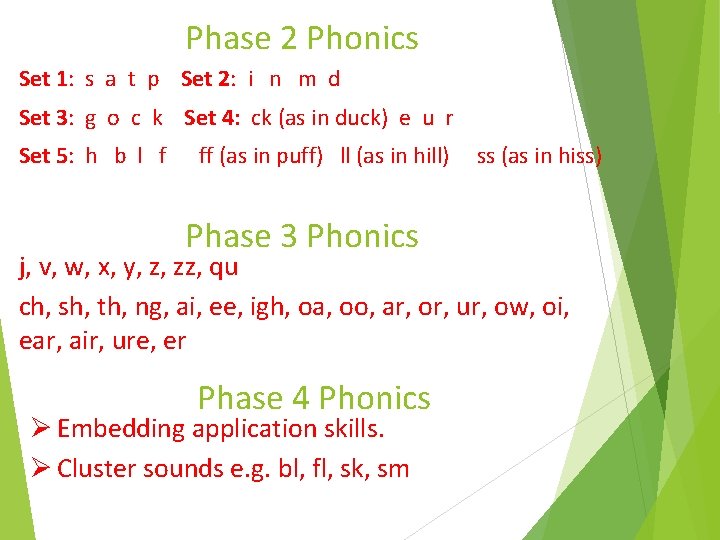
Phase 2 Phonics Set 1: s a t p Set 2: i n m d Set 3: g o c k Set 4: ck (as in duck) e u r Set 5: h b l f ff (as in puff) ll (as in hill) Phase 3 Phonics ss (as in hiss) j, v, w, x, y, z, zz, qu ch, sh, th, ng, ai, ee, igh, oa, oo, ar, or, ur, ow, oi, ear, air, ure, er Phase 4 Phonics Ø Embedding application skills. Ø Cluster sounds e. g. bl, fl, sk, sm
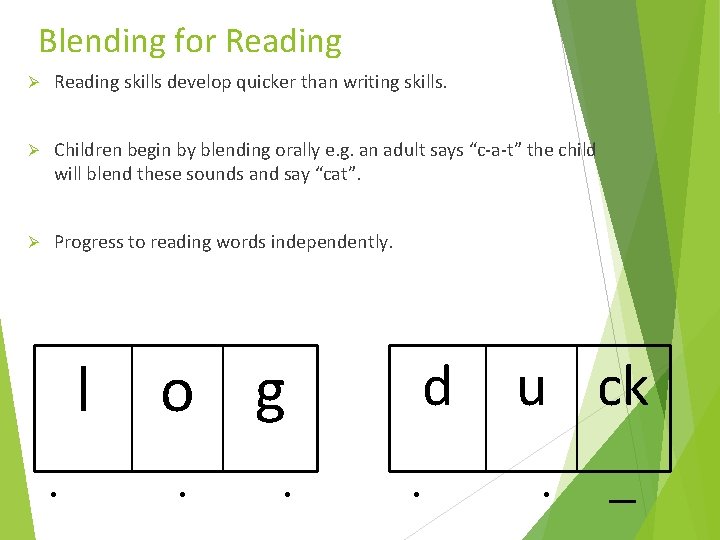
Blending for Reading Ø Reading skills develop quicker than writing skills. Ø Children begin by blending orally e. g. an adult says “c-a-t” the child will blend these sounds and say “cat”. Ø Progress to reading words independently. l. o g. . d. u ck. _
Blending Nonsense Words… Ødrep Øblom Øgris Confidently reading nonsense or ‘alien’ words is essential for the Year 1 Phonics Screen,
Segmenting for Spelling Ø ‘Chopping Up’ the word to spell it out At school we use ‘Robot Arms’ Let’s have a go…
Ø Say it Ø Chop it Ø Write it t a p
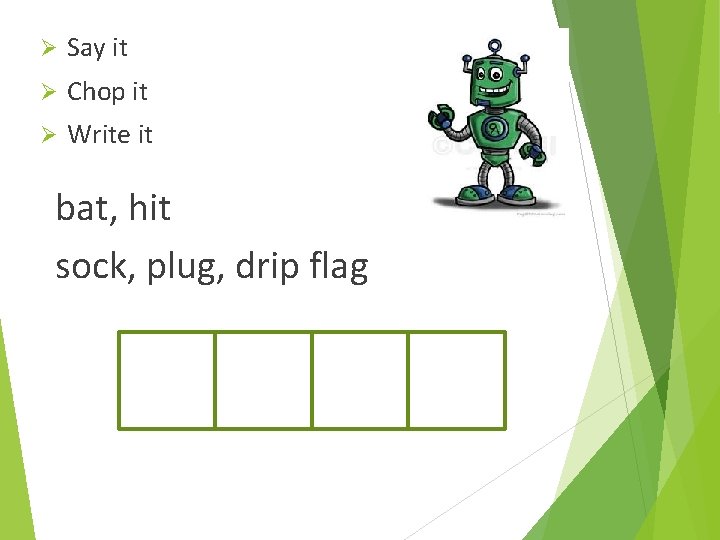
Ø Say it Ø Chop it Ø Write it bat, hit sock, plug, drip flag
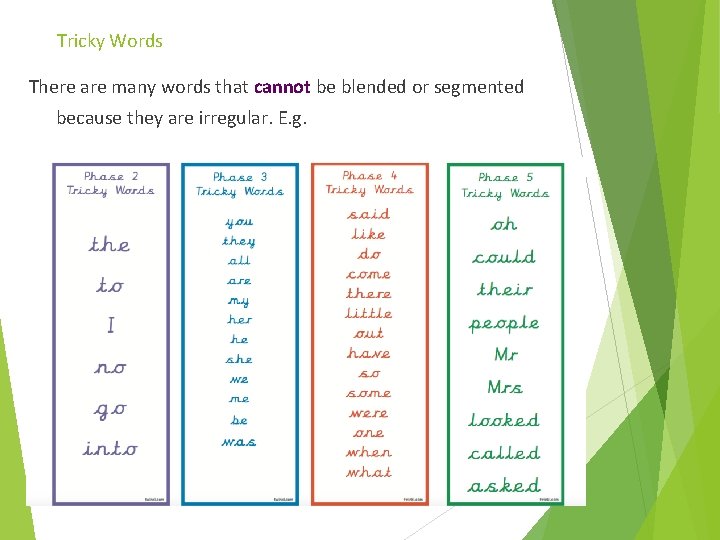
Tricky Words There are many words that cannot be blended or segmented because they are irregular. E. g.
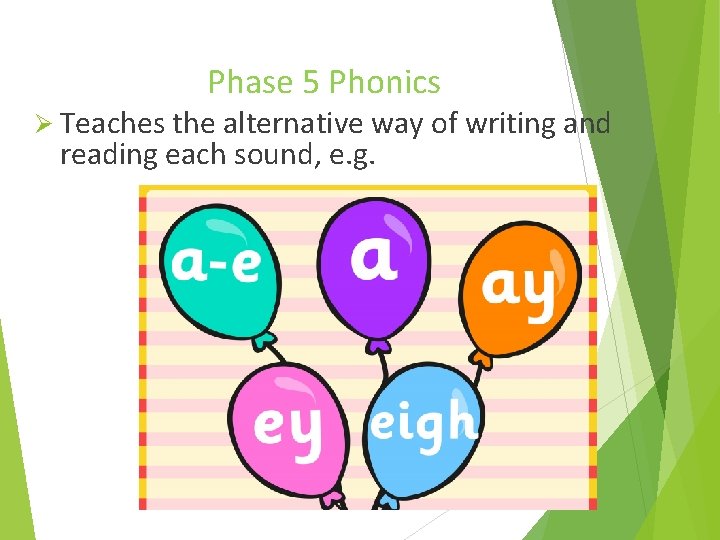
Phase 5 Phonics Ø Teaches the alternative way of writing and reading each sound, e. g.
What is the phonic screen? Ø A list of 40 words, including nonsense (alien) words. Ø Will happen in Year 1 or be retaken in Year 2. Ø It will assess phonics skills and knowledge learnt through reception and year 1. Ø Current pass rate is 32 out of 40. At St Nicholas our pass rate in Summer 2019 was 88. 3% 89 percent which is well above that achieved nationally.
Don’t forget… Learning to read and write should be fun for both children and parents.
Useful Websites Ø www. parentsintouch. co. uk Ø www. bbc. co. uk/schools/parents Ø www. jollylearning. co. uk Ø www. phonicsplay. co. uk/ Ø www. focusonphonics. co. uk Ø www. syntheticphonics. com