
Phonics and early reading Grove Vale Primary School
- Slides: 38
Phonics and early reading Grove Vale Primary School M Bunch
The EYFS Framework The EYFS framework places a greater emphasis on speaking, listening and understanding spoken word. This will ensure that children have the basic skills in order to access the rest of the curriculum. Model expected language, use a growing vocabulary and move away from ‘baby talk’. Develop competent listening skills. If children cannot listen, they will find it difficult to learn. If children cannot talk in sentences, they will find it difficult to write in sentences. If their spoken language is limited, their written language will be limited.
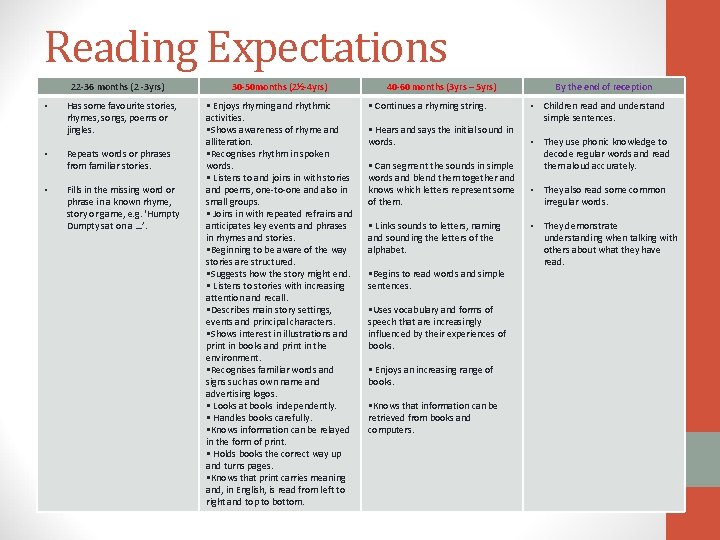
Reading Expectations 22 -36 months (2 -3 yrs) • • • Has some favourite stories, rhymes, songs, poems or jingles. Repeats words or phrases from familiar stories. Fills in the missing word or phrase in a known rhyme, story or game, e. g. ‘Humpty Dumpty sat on a …’. 30 -50 months (2½-4 yrs) • Enjoys rhyming and rhythmic activities. • Shows awareness of rhyme and alliteration. • Recognises rhythm in spoken words. • Listens to and joins in with stories and poems, one-to-one and also in small groups. • Joins in with repeated refrains and anticipates key events and phrases in rhymes and stories. • Beginning to be aware of the way stories are structured. • Suggests how the story might end. • Listens to stories with increasing attention and recall. • Describes main story settings, events and principal characters. • Shows interest in illustrations and print in books and print in the environment. • Recognises familiar words and signs such as own name and advertising logos. • Looks at books independently. • Handles books carefully. • Knows information can be relayed in the form of print. • Holds books the correct way up and turns pages. • Knows that print carries meaning and, in English, is read from left to right and top to bottom. 40 -60 months (3 yrs – 5 yrs) • Continues a rhyming string. • Hears and says the initial sound in words. • Can segment the sounds in simple words and blend them together and knows which letters represent some of them. • Links sounds to letters, naming and sounding the letters of the alphabet. • Begins to read words and simple sentences. • Uses vocabulary and forms of speech that are increasingly influenced by their experiences of books. • Enjoys an increasing range of books. • Knows that information can be retrieved from books and computers. By the end of reception • Children read and understand simple sentences. • They use phonic knowledge to decode regular words and read them aloud accurately. • They also read some common irregular words. • They demonstrate understanding when talking with others about what they have read.
Enjoying books We all know reading to our children is a good thing—but there are specific advantages your child can receive by being exposed to the merits of reading. Below are some benefits that highlight the importance of reading to your child between the ages of two and five. A stronger relationship with you. Academic excellence. Basic speech skills. The basics of how to read a book. Better communication skills. Mastery of language. More logical thinking skills. • Acclimation to new experiences. • Enhanced concentration and discipline. • The knowledge that reading is fun! • • •
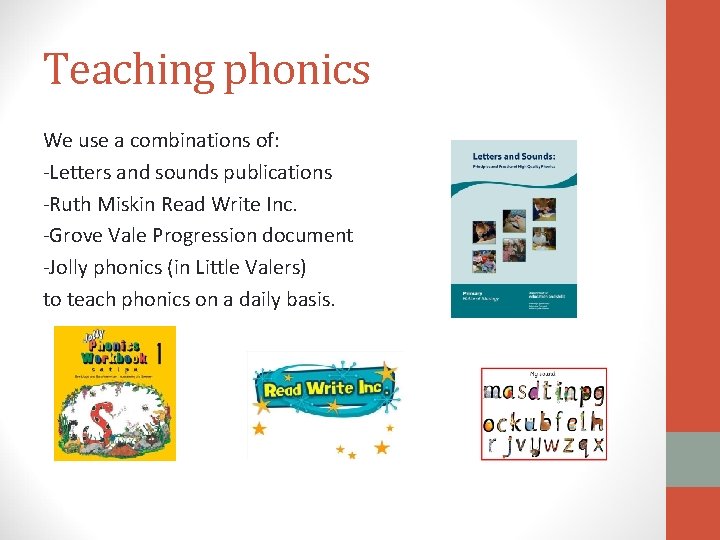
Teaching phonics We use a combinations of: -Letters and sounds publications -Ruth Miskin Read Write Inc. -Grove Vale Progression document -Jolly phonics (in Little Valers) to teach phonics on a daily basis.
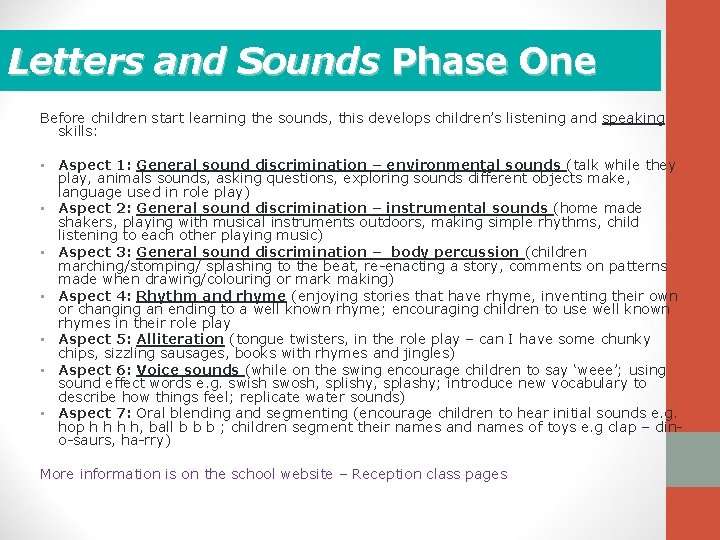
Letters and Sounds Phase One Before children start learning the sounds, this develops children’s listening and speaking skills: • Aspect 1: General sound discrimination – environmental sounds (talk while they play, animals sounds, asking questions, exploring sounds different objects make, language used in role play) • Aspect 2: General sound discrimination – instrumental sounds (home made shakers, playing with musical instruments outdoors, making simple rhythms, child listening to each other playing music) • Aspect 3: General sound discrimination – body percussion (children marching/stomping/ splashing to the beat, re-enacting a story, comments on patterns made when drawing/colouring or mark making) • Aspect 4: Rhythm and rhyme (enjoying stories that have rhyme, inventing their own or changing an ending to a well known rhyme; encouraging children to use well known rhymes in their role play • Aspect 5: Alliteration (tongue twisters, in the role play – can I have some chunky chips, sizzling sausages, books with rhymes and jingles) • Aspect 6: Voice sounds (while on the swing encourage children to say ‘weee’; using sound effect words e. g. swish swosh, splishy, splashy; introduce new vocabulary to describe how things feel; replicate water sounds) • Aspect 7: Oral blending and segmenting (encourage children to hear initial sounds e. g. hop h h, ball b b b ; children segment their names and names of toys e. g clap – dino-saurs, ha-rry) More information is on the school website – Reception class pages
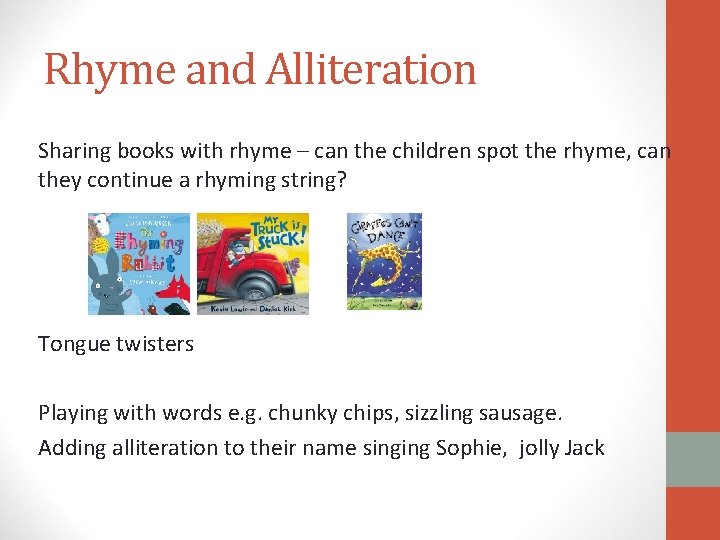
Rhyme and Alliteration Sharing books with rhyme – can the children spot the rhyme, can they continue a rhyming string? Tongue twisters Playing with words e. g. chunky chips, sizzling sausage. Adding alliteration to their name singing Sophie, jolly Jack
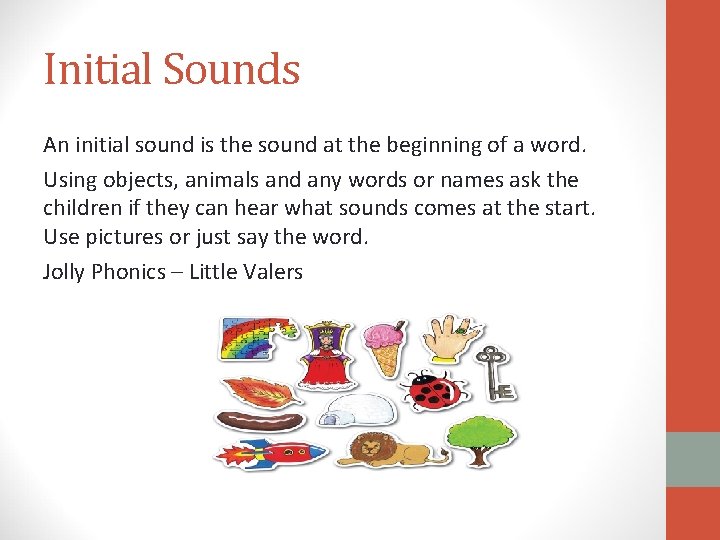
Initial Sounds An initial sound is the sound at the beginning of a word. Using objects, animals and any words or names ask the children if they can hear what sounds comes at the start. Use pictures or just say the word. Jolly Phonics – Little Valers
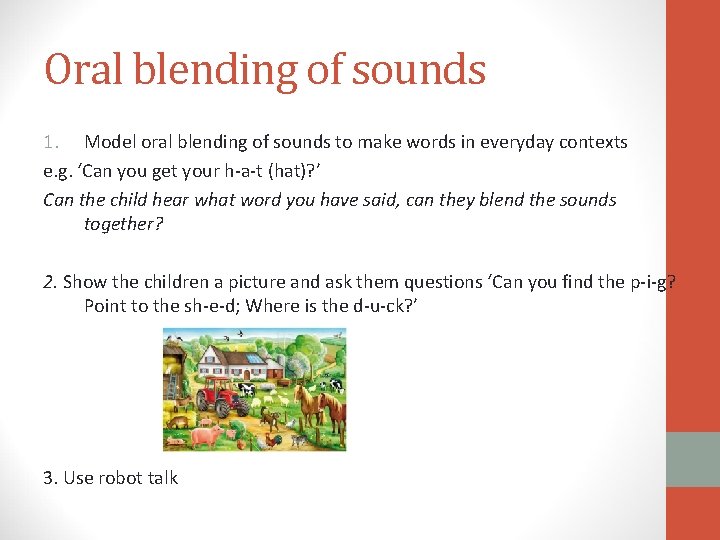
Oral blending of sounds 1. Model oral blending of sounds to make words in everyday contexts e. g. ‘Can you get your h-a-t (hat)? ’ Can the child hear what word you have said, can they blend the sounds together? 2. Show the children a picture and ask them questions ‘Can you find the p-i-g? Point to the sh-e-d; Where is the d-u-ck? ’ 3. Use robot talk
Learning the sounds • Since 2009 schools have been teaching children phonics following the publication of the document Letters and Sounds following the Rose Review. • This is a method of teaching reading which first teaches the pure letter sounds (synthetic phonics)and then builds up to blending these sounds together to achieve full pronunciation of whole words. • Children will have daily phonics sessions
Phonics - Letters & Sounds What is phonics? Phonics is the link between letters and the sounds they make. There are over 42 sounds. Phoneme is the sound they make Grapheme - how it is written
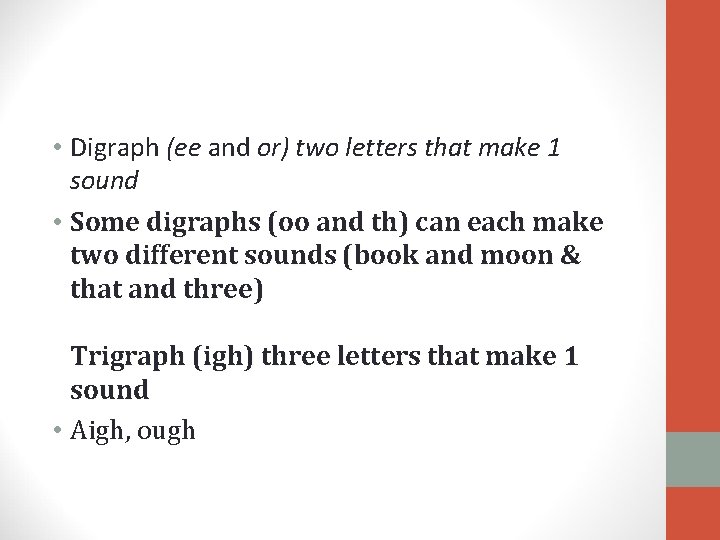
• Digraph (ee and or) two letters that make 1 sound • Some digraphs (oo and th) can each make two different sounds (book and moon & that and three) Trigraph (igh) three letters that make 1 sound • Aigh, ough
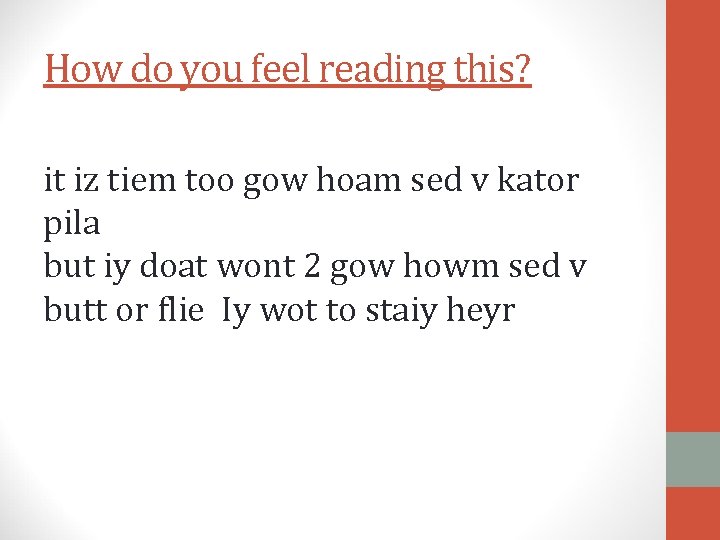
How do you feel reading this? it iz tiem too gow hoam sed v kator pila but iy doat wont 2 gow howm sed v butt or flie Iy wot to staiy heyr
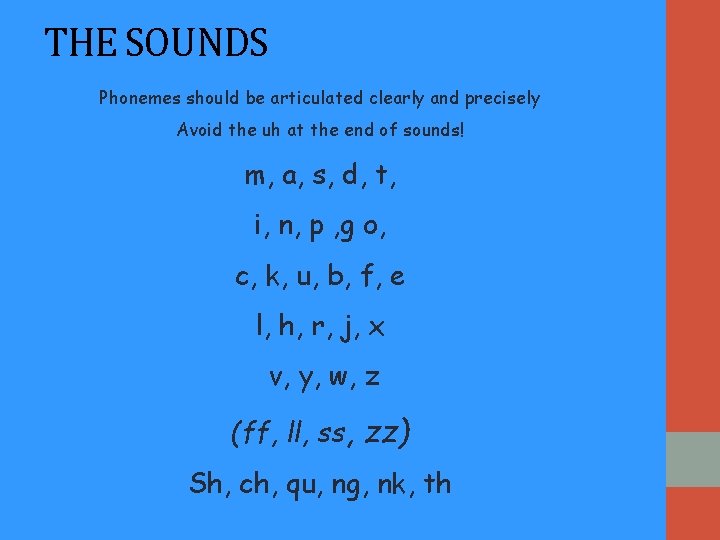
THE SOUNDS Phonemes should be articulated clearly and precisely Avoid the uh at the end of sounds! m, a, s, d, t, i, n, p , g o, c, k, u, b, f, e l, h, r, j, x v, y, w, z (ff, ll, ss, zz) Sh, ch, qu, ng, nk, th
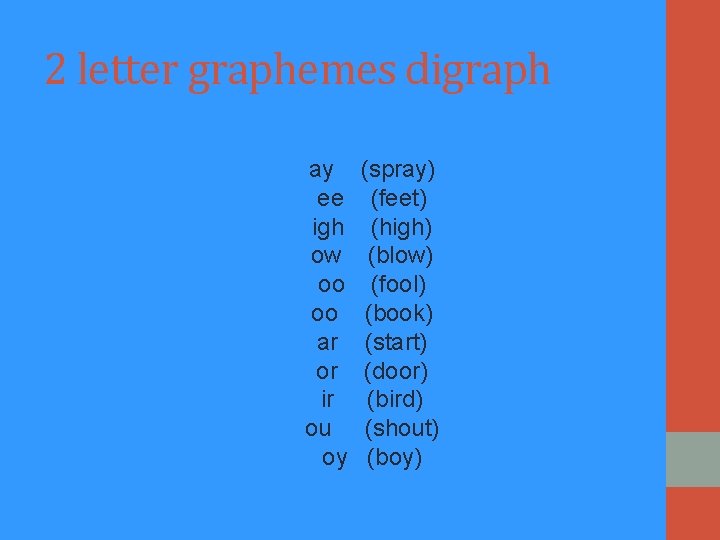
2 letter graphemes digraph ay ee igh ow oo oo ar or ir ou oy (spray) (feet) (high) (blow) (fool) (book) (start) (door) (bird) (shout) (boy)
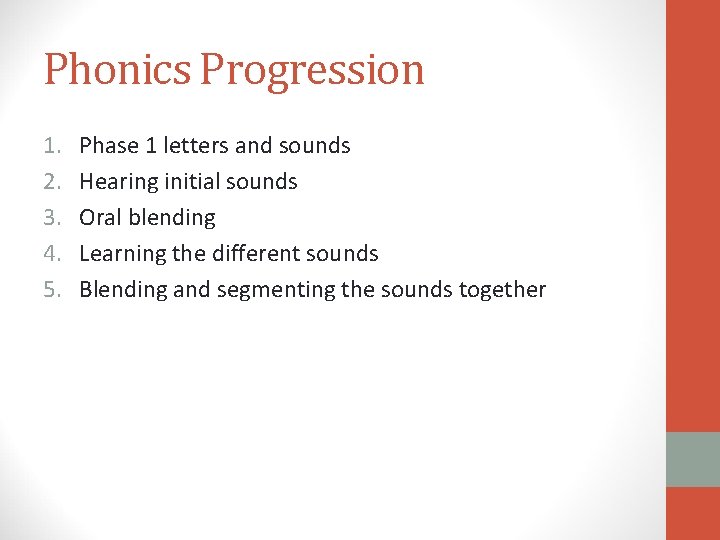
Phonics Progression 1. 2. 3. 4. 5. Phase 1 letters and sounds Hearing initial sounds Oral blending Learning the different sounds Blending and segmenting the sounds together
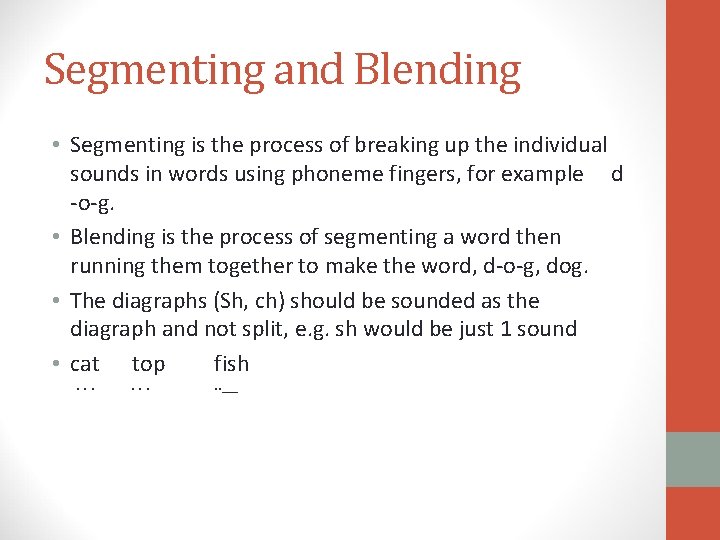
Segmenting and Blending • Segmenting is the process of breaking up the individual sounds in words using phoneme fingers, for example d -o-g. • Blending is the process of segmenting a word then running them together to make the word, d-o-g, dog. • The diagraphs (Sh, ch) should be sounded as the diagraph and not split, e. g. sh would be just 1 sound • cat top fish . . . __
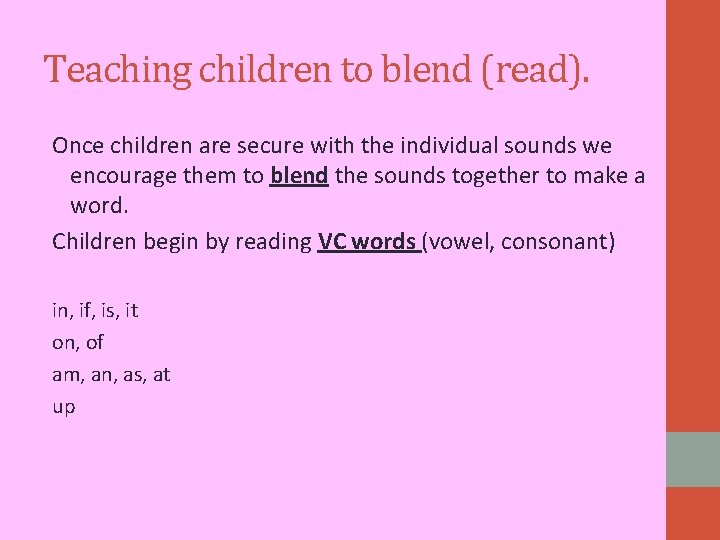
Teaching children to blend (read). Once children are secure with the individual sounds we encourage them to blend the sounds together to make a word. Children begin by reading VC words (vowel, consonant) in, if, is, it on, of am, an, as, at up
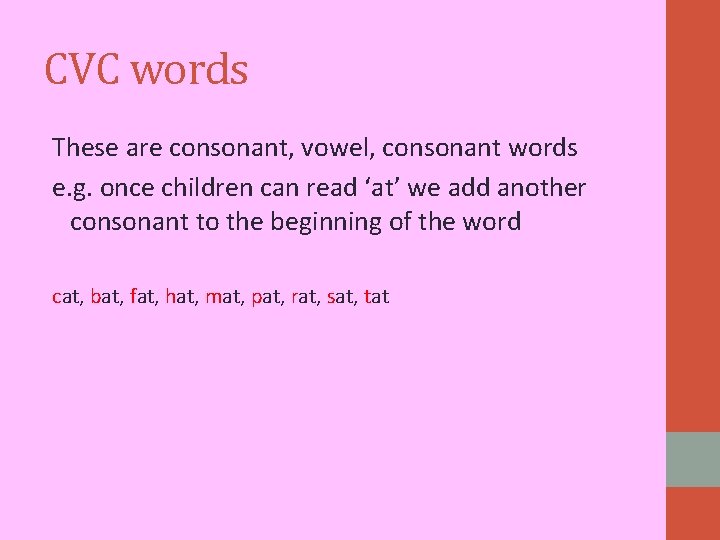
CVC words These are consonant, vowel, consonant words e. g. once children can read ‘at’ we add another consonant to the beginning of the word cat, bat, fat, hat, mat, pat, rat, sat, tat
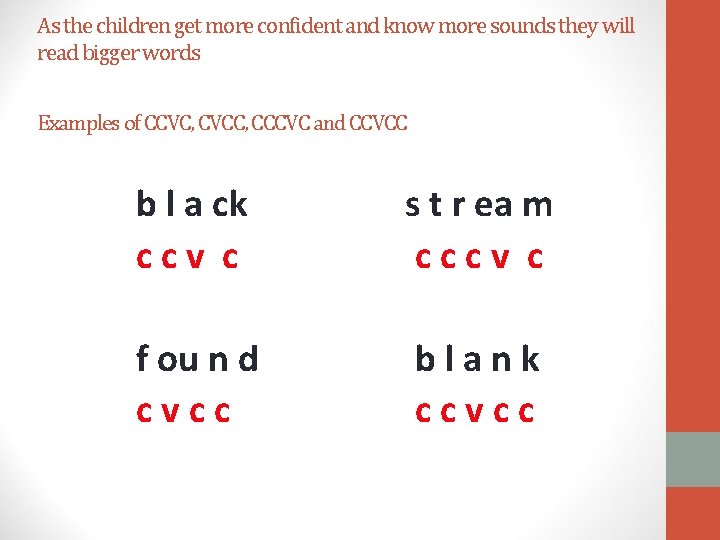
As the children get more confident and know more sounds they will read bigger words Examples of CCVC, CVCC, CCCVC and CCVCC b l a ck ccv c s t r ea m cccv c f ou n d cvcc blank ccvcc
Alien words • Children have to read made-up nonsense words, this tests their pure decoding ability e. g. thop, quin, tid
High Frequency words • High-frequency words are the words that appear most often in printed materials. • High-frequency words are hard for students to remember because they tend to be abstract. E. g. children can't use a picture clue to figure out the word with. • Learning to recognise high-frequency words by sight is critical to developing fluency in reading • We expect children to know the first 100 HFW by the end of year 1.
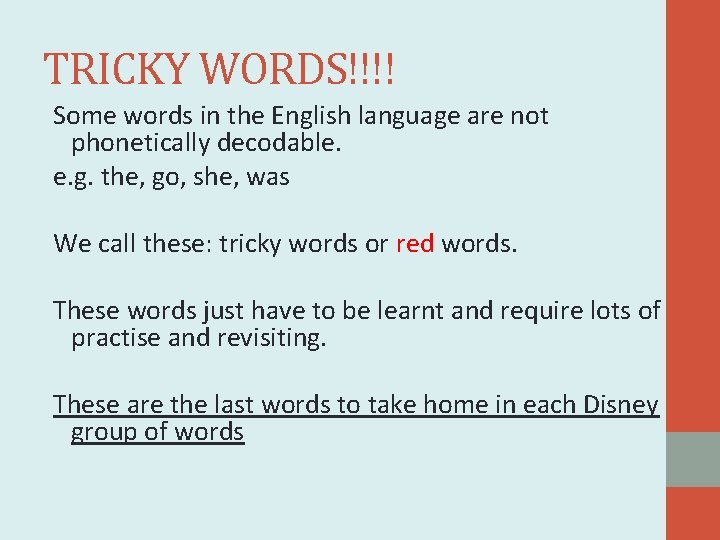
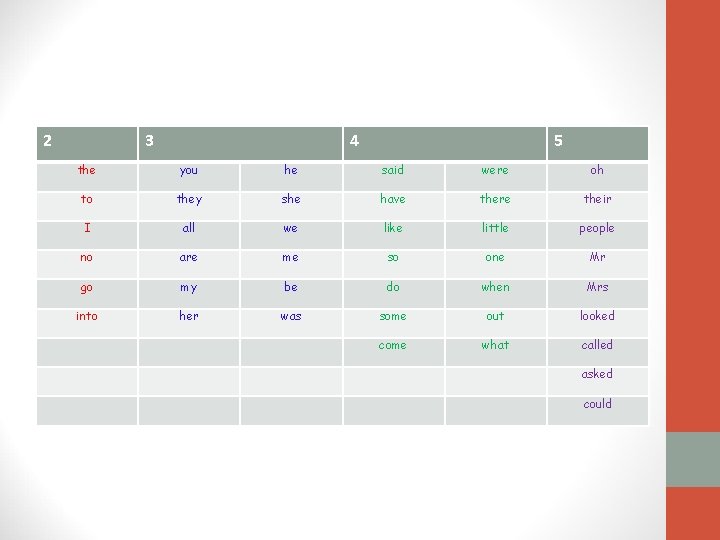
TRICKY WORDS!!!! Some words in the English language are not phonetically decodable. e. g. the, go, she, was We call these: tricky words or red words. These words just have to be learnt and require lots of practise and revisiting. These are the last words to take home in each Disney group of words
2 3 4 5 the you he said were oh to they she have there their I all we like little people no are me so one Mr go my be do when Mrs into her was some out looked come what called asked could
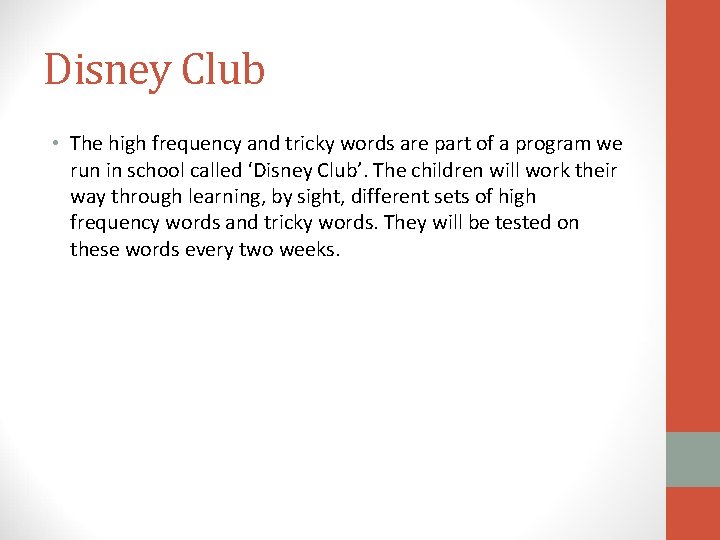
Disney Club • The high frequency and tricky words are part of a program we run in school called ‘Disney Club’. The children will work their way through learning, by sight, different sets of high frequency words and tricky words. They will be tested on these words every two weeks.
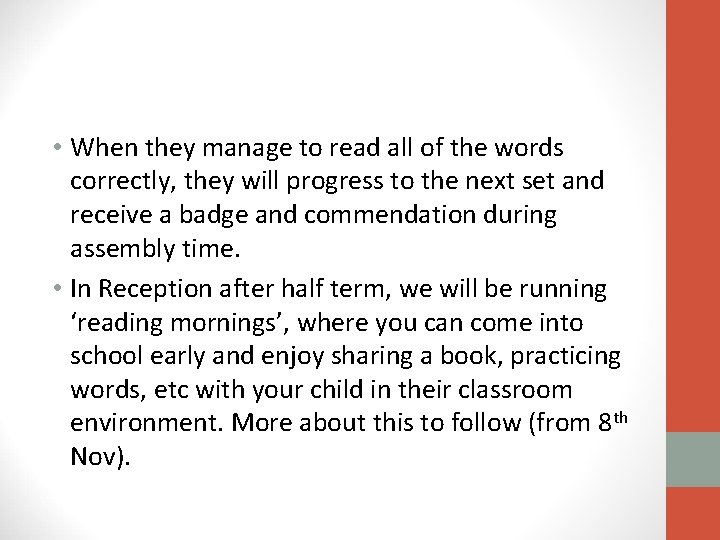
• When they manage to read all of the words correctly, they will progress to the next set and receive a badge and commendation during assembly time. • In Reception after half term, we will be running ‘reading mornings’, where you can come into school early and enjoy sharing a book, practicing words, etc with your child in their classroom environment. More about this to follow (from 8 th Nov).
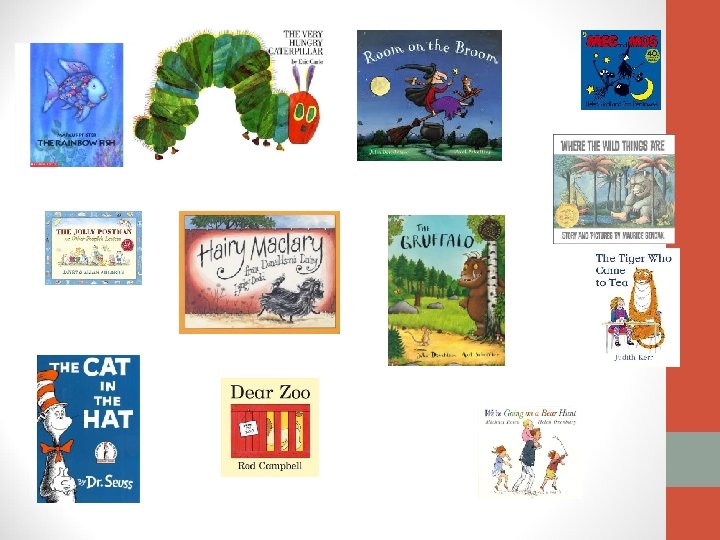
Picture Books in Reception • Picture books are a valuable way to develop skills of comprehension, inference and story telling. This is a whole school focus this year. • Picture books come home with questions for you to ask about the story, instructions of things to find a checklist to refer to.
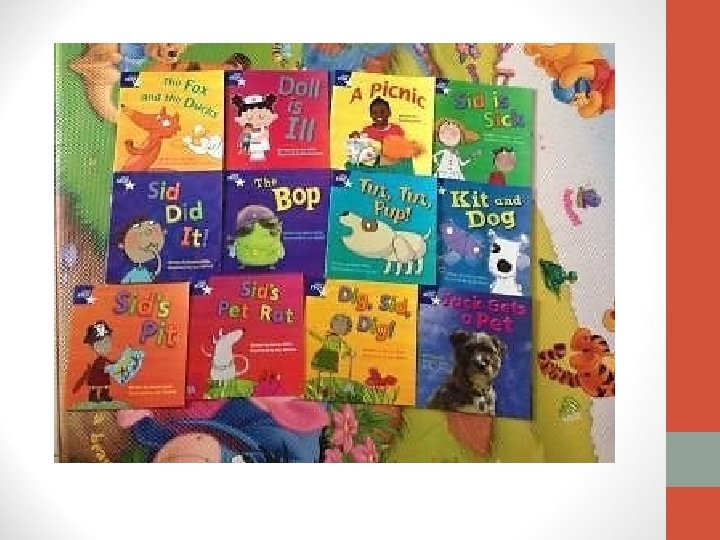
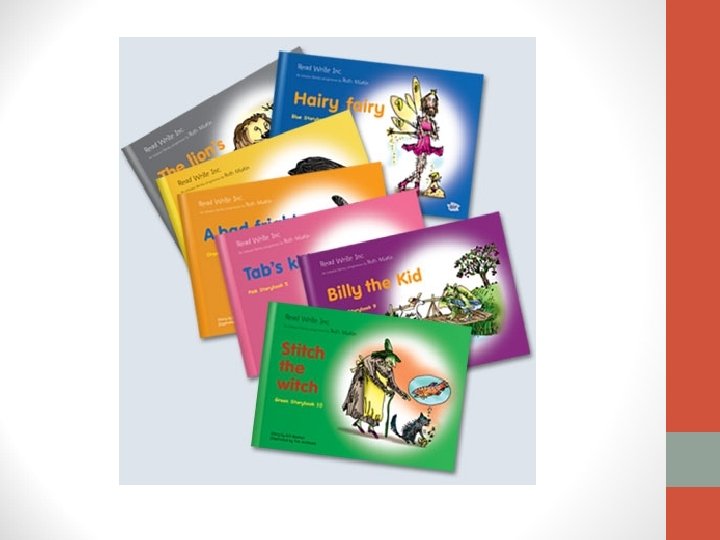
Reading books with words • When your child is confident and competent at blending sounds in words they will progress to a book with words. • We use the Rigby Star Phonic readers and RML, read write inc books which will match the phonic sounds they have been learning. • Please ensure you ask them comprehension and inference questions as they read these books as well – it is not always about reading the words but understanding what they have read.
Expectations at home and school for reading • Each child will read with the teacher every week and children will also complete reading related activities in small groups, over the course of the week. Reading books will be changed every week, but not necessarily on the same day, so please ensure that your child’s reading book is in their school bag every day. You will also receive a reading record to fill in whenever you read with your child. Please make sure you keep a record so that we can see how you have got on at home.
Comprehension When your child has been given a reading book: 1. discuss the sounds found in the book 2. share the tricky words 3. Blend the sounds to say the words and talk about what happens on every page. 4. discuss questions at the back of the book A child’s understanding of what they have read is just as important as their ability to decode and read the words on the page.
Ways to help your child • Flashcards – with sounds and tricky words • Magnetic letters • Looking for letters around the environment, when sharing books. • Listening for initial sounds in words e. g. you are eating an apple, what sound does that start with? • Segmenting a word, can the children squash the sounds together and hear the word? (Can you get me a b-o-x? ) • Share books with children at bedtime and as often as you can. • Hear them read their reading book and ask them questions. • Spotting words that rhyme and continuing a rhyming string (mat, cat, bat…)
Year 1 Phonics Check In the summer term of Year 1 children have to complete a phonics check. They have to read 40 words using their phonetical knowledge to decode the words. This test is reported to the local authority and to parents. 2016: 87% of our children passed the check
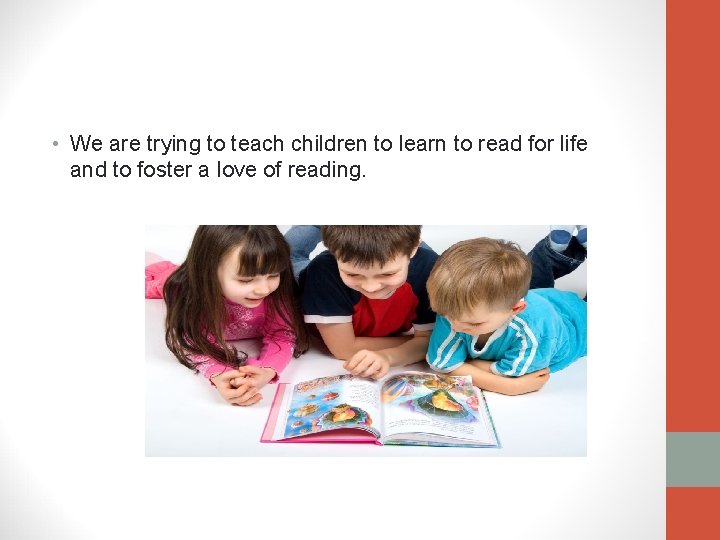
• We are trying to teach children to learn to read for life and to foster a love of reading.
Websites: http: //www. letters-and-sounds. com/ http: //www. phonicsplay. co. uk/free. Index. htm http: //www. familylearning. org. uk/phonics_games. html http: //www. primarytopics. co. uk/english/phonics. htm